And The Walls Came Down

When I was a kid, I lived for the Scholastic Book Fairs. There were always more books I wanted than I can afford (still a problem for me with books to this very day), and it was through them that I discovered my love for mysteries as well as deepened my love of history. I bought anything that was history or mystery; very rarely did a book combine both.

This is part of the reason I was so appalled and disgusted by Scholastic’s cowardly abandonment of its commitment to education and diversity by giving book fairs the options to opt out of carrying books–you know, the ones that teach kids empathy for people who are different from them or show kids that they aren’t alone or books they can see themselves in–because they might upset some bigoted parents in Brotherfuck, Arkansas or Sisterfuck, Tennessee.

When I think about what a difference a book like Annie on My Mind by Nancy Garden or Trying Hard to Hear You by Sandra Scoppetone or Rainbow Boys by Alex Sanchez would have made for young Gregalicious, this Scholastic decision makes me shake with rage. (I have pointed out any number of times that Scholastic also publishes the Bitch-Queen of TERFs, so their cowardice is really no surprise. Can’t piss off their massive cash cow, now can they?)

I was thinking about this as I read Angel Luis Colón’s book, Infested, because it would probably be one of the books shoved into that Diverse Books To Not Be Included box Scholastic uses to warn schools about “subversive” and “dangerous” books. The book, by the way, is not only is superb but something any kid who enjoys horror would love.

However, it centers a main character who is a teenager of Puerto Rican descent, and while it never disparages white people…it doesn’t center them, so I can easily some Daughter of the Confederacy getting her panties into a nasty twist over her precious child reading something that doesn’t uphold White Supremacy. How dare young Hispanic readers have an option to read about a Hispanic teenager’s hero’s journey?

The NERVE of MTV Fear to publish such a book!

I can’t remember a time I hated my mother and my stepfather more than the summer before my senior year.

And it wasn’t the normal kind of Oh man, these people don’t understand me bad Disney movie kind of throwback hate. This was mortal-enemy-level hate. It was deep and pitch-black and enough to make me nearly consider getting into death metal.

While I knew I’d change my mind as the emotions scarred over, the laundry list of offenses was too much to bear.

Let me start by saying how much I really enjoyed this book. The main character, Manny, is very realistic and both relatable and likable. The pacing is excellent, and it builds beautifully to its thrilling climax and resolution. The stakes are high but grounded in reality, and the authorial voice is so strong and memorable that I was sorry to finish and bid Manny and his friends and family farewell.

I was also a little amused because the original opening line of Bury Me in Shadows–back when it was called Ruins still–was My mother ruined my life the summer before my senior year.

Obviously, that changed–a lot changed as Ruins morphed into Bury Me in Shadows–but great minds, right? I’ve admired Angel’s work for a very long time–I really need to go back and finish his backlist–and so was excited to see what he could do with a young adult horror thriller.

Great things, it turns out.

The story focuses on the first person perspective of Manny, a seventeen-year-old with a baby half-sister whose stepfather has taken a job in the Bronx managing an apartment building that’s about to open. Manny doesn’t want to leave San Antonio, but it’s more resentment that he wasn’t consulted (no one wants to change schools before their senior year; I can relate because I changed high schools after my sophomore year) rather than anything else. He doesn’t really have a lot of friends back there, but it was home and familiar to him. He also struggles with identity issues; he’s Puerto Rican, but a blanquito–someone who is Hispanic but white (which could lead into all kinds of sidebar conversation which would be inappropriate for now)–and he doesn’t really speak much Spanish anymore; he did when younger but is losing it as he gets older, which is also concerning to him. He’s angry about the move–they didn’t discuss anything with him, just told him it was happening, and he really didn’t want to leave San Antonio–but once he’s in the Bronx, he begins to see that it’s really not a bad thing to have moved there. There’s a variety of Hispanic/Latinx cultures there he can learn about, and he likes that. There’s also other issues touched on here–gentrification being a major one, and as there are no easy answers to that question in real life, one isn’t provided here but both sides of the issue are addressed and Manny sees the good and bad in both.

But the building has a roach problem–and it’s not just your usual roach problem, either. Something very strange is going on in that building, and Manny isn’t entirely sure if these things are really happening, or if he is losing his mind. If you’re like me and hate insects of all shapes, sizes and varieties, your skin will crawl repeatedly throughout this book. It’s up to Manny and his new friend Sasha to figure out the truth about what is really going on in the building, and as I said, it’s terrific and fast-paced and very hard to stop reading once the story starts going great guns.

Highly recommended–unless you’re truly squeamish and triggered by insects. Colón made my skin crawl–no small feat!
Here Comes That Rainy Day Feeling Again

I didn’t start reading young adult fiction until I was an actual adult.

I didn’t read it when I was an actual young adult,, which I’ve tried to remedy in the years since I discovered that there is young adult fiction that is not “ABC Afterschool Special” style drama–these abounded to an extreme when I was a teen; everything was a cautionary tale. You want to have sex? Here, read Mr. and Mrs. Bo Jo Jones or My Darling My Hamburger. Drugs? You should read Go Ask Alice. And on and on it went…the 1970s were a very weird time to go through puberty and your teens, especially if you were beginning to realize your sexuality was all wrong and you needed to hide almost everything true and honest about yourself from everyone you know. There were actually good books for teens being written and published during that time, of course; I just never found them (some have been recommended to me by friends who are the same age and read them at the time; Trying Hard Not to Hear You by Sandra Scoppetone could have made a significant difference in my life had I read it back then).

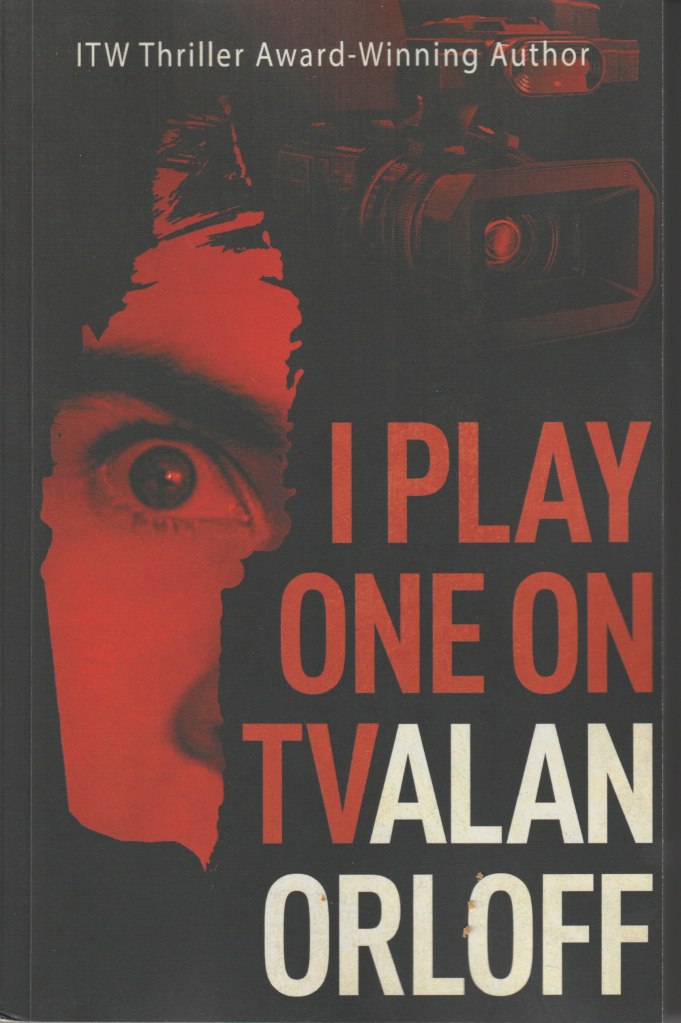
But in the early 1990’s, I started reading horror/mystery novels by teens by Christopher Pike, which led me to R. L. Stine’s Fear Street books and my favorite mystery writer for teens–the forgotten and vastly under-appreciated Jay Bennett. Those books got me to start writing my own y/a horror/mystery/suspense novels for teens–which eventually became my novels Sara, Sleeping Angel, and Sorceress–and I continue to write them from time to time; my last two releases were actually young adult fiction (or marketed as such). I try to keep my hand in the field by reading horror/mystery/suspense novels for young adults that are more current; it’s hard to keep up with everything I want to read as it is, but I was really happy one of the books I took with me on my trip was Alan Orloff’s Agatha Award winning (and Anthony Award finalist) I Play One on TV.

He watched as a teen in a dark hoodie emerged from a storage closet and crept into the high school locker room. In the dum light, the shadowy figure advanced, slowly, methodically. In his left hand, a knife blade glinted.

The man’s insides constricted as he observed. He could almost smell the stale sweat left behind by the athletes after football practice, soon to be replaced by the stench of fear and the coppery odor of fresh blood.

The feelings he experienced now–rage, fear, excitement–mirrored those he had felt then, five years ago. When he had been the teen in the hoodie in that locker room. When he had been wielding the knife.

When he had been stalking his unsuspecting victim.

The premise of I Play One on TV is very original and clever: the main character is a teenager with ambitions of becoming an actor–he has an agent, goes out on auditions for commercials and local theatre productions, and works with his high school’s summer theater camp–and thus far his biggest break was starring as a teenaged killer in a true crime reenactment series. The killer he is playing, Homer Lee Varney, was a bullied outsider who murdered a jock, and has recently been released from prison due to a legal technicality. Dalton’s two best friends are also aspiring actors, and shortly after his episode of the show airs, someone starts stalking him–and he fears he is being stalked by the actual killer.

But was Homer guilty, or was he railroaded? Dalton has found some discrepancies in the police reports which indicate that the investigation might not have been as thorough or efficient as one might think…so maybe Homer isn’t a killer after all?

Dalton, despite his faults (and it’s to Orloff’s credit as a writer that he doesn’t make Dalton perfect–especially since this is a first person narrative), is easy to connect with, identify with, and root for to succeed–not just as an amateur private eye but as an actor and as a person. He’s a bit selfish and self-absorbed (as creative artists have a tendency to be), and he also has some serious professional jealousy for a schoolmate who often winds up going up for the same parts–but gets them instead of Dalton (which is a stage name). Dalton’s relationships with his parents and with his sister are also realistic and well drawn, and the story/mystery progresses at an excellent pace, and comes to a very satisfying, enjoyable conclusion.

I Play One on TV recently won the Agatha Award for Best Childrens/Young Adult Novel, and also received an Anthony nomination in the same category.

Definitely recommended!

The Long Run

Not only do I write two private eye series, erotica, and the occasional stand alone,  I also, sometimes, write what’s classified as young adult fiction. I have not published anything that could remotely be considered y/a in quite a while, and therein lies a tale (I think the last book I published that could be considered “young adult” was Dark Tide; I could be wrong. I no longer remember when and in what order my non-series books came out).

To be clear, the fact that I even call those books “y/a” even though I don’t really think of them as young adult fiction is a marketing thing, really; in my mind, they’re simply novels I wrote about teenagers. I started writing about teenagers when I actually was one; the stories I wrote in high school weren’t bad, for a teenager, and were the first indication–from my fellow classmates, and my English teacher–that I could seriously become a published writer if I chose to try to do so; the utter lack of seriousness my writing aspirations received from my family was kind of soul-crushing. But I always wanted to write about teenagers, from the very beginnings; I wanted to do my own Nancy Drew/Hardy Boys style series, and then progressed to other stories.

I progressed as a reader pretty quickly when I was growing up; I went from the series books, like the Hardy Boys and Nancy Drew, and the Scholastic Book Club mysteries, to Agatha Christie, Charlotte Armstrong, and Ellery Queen when I was around eleven or twelve, if not younger; I know I read both Gone with the Wind and Antonia Fraser’s Mary Queen of Scots when I was ten. The few books I read that were considered “children’s books” (there was no such thing as young adult fiction then) were books like The Outsiders and The Cat Ate My Gymsuit and I did enjoy them; I just didn’t think of them as either being particularly authentic or realistic. Nor did they have any bearing on my life, or the lives of my friends–I viewed them like youth-oriented television shows like The Brady Bunch, existing in some bizarre alternate universe that has no basis in actual reality or what those of us who were that age were actually experiencing. I always thought there was something missing–complicated and authentic books about the lives of real teenagers and the real issues they faced everyday, without getting into the insanity of the preachy-teachy “issue” books that usually wound up as ABC After-school Specials, which I loathed. 

Not all “issue books” were bad, in all fairness; some, like Lisa Bright and Dark, about a girl struggling with mental illness whose parents refused to face their daughter’s reality, so her friends tried to help her by serving as amateur psychologists, and  I Never Promised You a Rose Garden, about a teenaged girl in a mental hospital dealing with her illness were actually quite good. But I loved books like The Cheerleader, about a poor girl in a small New England town with ambitions and dreams that far exceeded those of most of her friends…dealing with issues of popularity, sex, and first love.  David Marlow’s Yearbook was also a favorite, and while not marketed to kids, was about high school, but had some themes and plot-lines considered far too heavy for teens to digest in the 1970’s. You can also see it in the pap that was considered movies for teenagers; G-rated bubble-gum like The Computer Wore Tennis Shoes, and inevitably came from Disney and starred Kurt Russell. (These movies are an interesting time capsule; I did try to watch one of them recently on Disney Plus and didn’t last three minutes in that squeaky clean, sex-free college environment.)

(Also, I would like to point out at this time there were terrific books being published in the 1970’s for teens that dealt with major issues and were groundbreaking; Sandra Scoppetone was writing about queer teens back then, and there were some others doing terrific work at the time–I just wasn’t aware of those books until much later.)

My first three young adult novels–Sorceress, Sleeping Angel, Sara–were written as first drafts in the early 1990’s, put in a drawer, and forgotten about for nearly twenty years. Sorceress  had no queer content in it at all; it was my version of the truly popular trope of romantic/domestic suspense where an orphaned girl goes to live in a spooky mansion far away from her old life (Jane Eyre, Rebecca, almost everything written by Victoria Holt), and slowly becomes aware that everything in the house isn’t as it seems. It was a lot of fun to write–I loved those books and I loved putting a modern spin on them. Sleeping Angel’s first draft was never completed, and the published version is vastly different than what the original first draft contained; there are still some vestiges of the original plot there in the book that are never truly explained, and by the time I realized, after many drafts, that I hadn’t removed those vestiges from the book it was too late to do anything about it other than hope no one noticed. The book did well, won an award or two, and is still a favorite of my readers, according to what I see on social media. One of the things I added to the story was a queer subplot about bullying, which is what I think readers truly responded to, and I also feel like adding that to the story in addition to the other changes I made to it made it a stronger book. Sara was always intended to have gay characters and a gay plot; I originally started writing it as a novel for adults and realized, over the course of writing it, that actually the teenage story was the most interesting part and I could deal with some issues there if I switched the focus of the book to the teenagers. One thing that changed from the 1991 first draft to the draft that was published is that the character I originally had being bullied for being gay, even though he wasn’t (another character, one of the biggest bullies, actually was), was actually not only gay but had come out, and so the book also talked about the reverberations of a popular football coming out, and what impact that had on the school social structure and hierarchy.

Sara, incidentally, is one of my lowest selling titles–which also kind of breaks my heart a little bit.

Since those three, there have been others I’ve written–Lake Thirteen, Dark Tide–and I’ve also dabbled in what is called “new adult fiction”–books about college-age or just out of college-age characters–this is where The Orion Mask and Timothy and the current one I’m working on, Bury Me in Shadows, fall on the marketing spectrum.

One of the questions I had to deal with in writing young adult novels with queer content was the question of sex. I had already been through being banned in Virginia because I had written gay erotica (a really long story that I revisited recently with Brad Shreve on his podcast; I really do need to write in depth about the entire experience); what would happen if ‘notorious gay porn writer’ Greg Herren began writing fiction specifically aimed at teenagers? But the truly interesting thing about being used as a political pawn by the right-wing fanatics in the power games they play is that once they’ve made use of you, they forget about you and move on. My young adult fiction was released without a single complaint, protest, or any of the sturm und drang that my speaking at a high school to a group of queer and queer-supportive youth created scant years earlier.

Interesting, isn’t it?

And yet…there is no sex in any of those books. None. I don’t  remember my gay teens even getting a chaste kiss, let alone a sex life, or fantasies, or a boyfriend.

And what about desire?

A couple of years ago someone tagged me on Facebook on an article about just that very subject; that was when I started writing this post (three yeara ago, looks like) but I never finished writing this until this morning.

Go ahead and read it. I’ll wait.

Okay, welcome back. Some interesting points, no?

Now, check out this one. 

I know, it’s a lot of information to process, but it’s something we should all be thinking about, particularly as the calls for diversity in publishing and popular culture continue. Sex is, quite obviously, a touchy subject when it comes to young adult fiction, but when it comes to questions of sexuality and being a sexual minority, what is too much and what is not enough? Even depictions of straight sexuality is frowned on and controversial when it comes to young adult fiction. (For the record, that is also considered the case for crime fiction–no explicit sex scenes–or at least so I was told when I was first getting started; doubly ironic that my mystery series were what the right-wing Virginian fanatics considered porn–I really do need to write about that.)

I also have noticed the elitism evident in hashtags like #ownvoices and #weneeddiversevoices that have come and gone and return periodically on Twitter; those actively involved in promoting those tags, when it comes to queer books, make it abundantly clear they only care about those published by the Big Five in New York–which is a good target, I agree, and they do need to be doing better when it comes to diversity and “own voices” work–but this focus also ignores the small presses, particularly the queer ones, who have been doing this work all along and making sure queer books were still being published for all ages and getting out there and made available to those who want and need them. I am absolutely delighted to see queer books by queers being published by the Big 5, and young adult work in particular…and yet…there are some serious issues still with the Big 5–and with what is called ” young adult Twitter”.

I do find it interesting to see who they decide are the “cool kids” and who they banish to the outer tables with the freaks and geeks.

It’s part of the reason I don’t engage with young adult twitter, to be honest. I really have no desire to return to the high school cafeteria at this point in my life.

And I’ll write about teenagers whenever there’s a story I want to tell involving teenagers–which currently is the Kansas book; I turned my protagonist in Bury Me in Shadows into a college student because it actually works better.

And on that note, tis back to the spice mines with me. (And huzzah for finally finishing this post!)