So, when Ellen Byron was preparing to interview me for our live stream event from Murder by the Book, she sent me some questions to prepare myself with. They were good questions, actually, and I thought that taking time to answer them when I can think about the responses would be an excellent BLATANT SELF-PROMOTION post.
So, without further ado, here we go!
What inspired your book? Series premise and the specific story?
That’s an interesting story, actually. I had been toying with the idea of writing a cozy for a long time–I’ve always liked them–but never was sure I could do it; there were rules, after all, and I’m terrible about following rules, always have been. Several friends have been encouraging me for years to do it, but I always hesitated. It was (I thought) outside of my comfort zone, and while I would toy with ideas here and there, none ever came to anything. My partner’s office is near a costume shop, and he’d had to go in there one day for some reason or another, and as is his wont, he struck up a conversation with an employee about the costume business, how they made money, how they stayed open all year, etc etc etc. He’s very curious. Anyway, that night I mentioned to him that someone had yet again suggested I write a cozy, and he wasn’t sure what one was, so I gave him a thumbnail overview, and he said, “Oh, you should do a costume shop” and proceeded to tell me about his conversation with the shop employee. I agreed it was an interesting idea, and stowed it away in the back of my head for future reference, and would think about it now and then, come up with characters and a community for the main character to be a part of, and so on. But at the same time I kept thinking New Orleans wasn’t the right place for a cozy series–basically looking for ways to fail instead of reasons to succeed, which is the underlying theme of my life, really–and so it went. An editor I’ve worked with before was interested in the idea of my writing a cozy series, so I wrote up a proposal and sent it off. They liked it, but couldn’t sign it, and recommended I take it somewhere else, so I did. It evolved from a costume shop to an antique shop during the process of me signing a contract with Crooked Lane; they liked everything about my idea except for the shop itself, so I had to change that. I went down to Magazine Street and walked for a block, writing down every kind of shop I saw, and sent the list in–and we all came to an agreement about the series being structured around an antiques business. As for the story, well, I wanted to talk about and explore the gentrification of New Orleans that has been ongoing almost this entire century, and how real estate has just exploded around here. (It still staggers me that our rent was $450 when we first moved here; the lowest rent I’ve seen advertised in our neighborhood is around $1500 for less than thousand square feet. Our original apartment now rents for $2500 per month now, which is insane.) What happens to Valerie–the fear of a new tax assessment pricing her out of her house–actually happened to a friend of mine; and the prices just seem to keep going up all the time. You can’t even buy a condo in my neighborhood for less than $350, 000 now–the asking prices for houses in the neighborhood are completely insane. Every time I see a new listing in the neighborhood for half a million dollars or more I think, we really should have bought when we moved here–but home-ownership is New Orleans isn’t something Paul or I have ever been terribly interested in. Termites, tornados, hurricanes, floods, black mold–no thanks! But man, what a return on our investment had we bought in 1996!
We both write series set in New Orleans. Why do you find it so inspiring? Especially when you’ve lived in so many other places?
I’ve lived all over the country–we’re from Alabama, and I’ve lived in Chicago on the south side, the suburbs, Kansas, Fresno, Houston, Tampa, Minneapolis and then New Orleans. New Orleans is the only place I’ve ever been to where I felt like I belonged, where I fit in; where I didn’t seem like the eccentric one. New Orleans embraces its eccentrics and doesn’t judge them, and I like that. I knew that first time I came here on my birthday in 1994 that if I moved here all my dreams would come true. And they have, which has been kind of lovely. And no writer could ever exhaust the inspiration New Orleans provides. I’ve written fifteen books set here and countless short stories at this point, and haven’t even scratched the surface. I’ve never written about the music scene here, for one glaring example, or restaurants or the food industry or…you see what I mean? There’s not enough time in my life to write everything I want to about New Orleans.
Tell us about your protagonist. Where did the inspiration for her come from?
My sister never had any interest in going to college or having any kind of career other than being a wife and mother. She was a straight A student and had numerous scholarship offers, but had little to no interest. I used to always think she had wasted her potential, but gradually came to the realization that she has the life she always wanted when she was growing up, and has never missed having a career outside of the home–so rather than feeling bad about her lost potential, I should have been happy that her dreams came true. I started thinking about that more, and thought that would make a great starting place–a woman like my sister who wasn’t really very interested in college but went because it was expected of her…only to fall in love, get married, and drop out when she had twins. I really like the idea of a woman who’s not yet thirty, who wasn’t really sure what she wanted from life and then sidetracked to wife-and-mother, but with her kids now off to college and her husband having died…what do you do for the rest of your life when you’re a widow at thirty-eight and your kids have left for college? And the more I thought about her, the more I liked her and wanted to write about her.
Why did you choose the Irish Channel as the neighborhood?
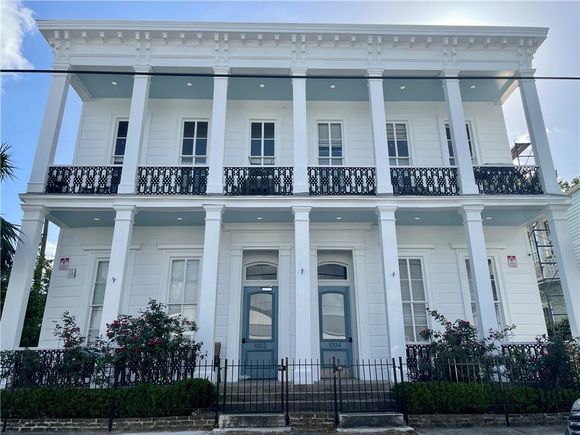
My Scotty series is set in the French Quarter, and the Chanse series was set in the lower Garden District (where I’ve always lived and always default to it for that very reason), so I wanted to do something different this time out. Before I moved here, I had friends who lived in the Channel and I loved their house and I loved their neighborhood. I had already started writing a novella set in their old house, and I thought, why not use that same house for this series? The Channel did used to be considered a bad part of town, too, when we first moved here (so was the lower Garden District, which we didn’t know), and so I thought the gentrification issue would work better there than in my neighborhood. That part of the Channel is one I used to spend a lot of time in. As my character mentions in the book, I used to hang out at the Rue de la Course coffee shop at the corner of Magazine and Harmony–it was where I would meet friends for coffee. I’m still bitter it closed.
Similarities in our series: both widows, both have family mysteries, both live in the Irish Channel, you have jokes about potholes, I have a plot point about them. Let’s talk about NOLA’s potholes.
Oh, the potholes! Ironically, an active one ate one of my car tires a few weeks ago. Usually, if I am going someplace and have to turn around, there’s usually room for me to make a U-turn or I can turned into a driveway and turn around. This particular day the bar on the corner had reopened after being sold, closed, and renovated for a few months. So, there were cars everywhere, including blocking the driveways, and I thought, fine, I’ll just go around the block, which I hadn’t done in years. Because I hadn’t done that i years, I forgot there’s a massive pothole right when you make the turn so you have to jog left to avoid it. I hit the pothole, hard, and when I did, I thought oh that’s not good and as I continued driving I noticed the car was pulling to the left–which was the tire that hit the pothole. Sure enough, it was flat. It had a nail in it, and I happened to hit the pothole perfectly so that the nail dragged, tearing a hole in the tire. So, yes, New Orleans is a city of potholes–all different shapes, sizes, and depths. When the streets flood the water hides the potholes, and if they are really deep…the one on our street (which is reforming after being filled in and paved over for like the fiftieth time) ate a pick-up truck when that end of the street flooded a few years ago, so our street was blocked until the water went down and a tow truck could get in.
You have a Nolier than thou joke – I have OhNo!LA, an app that’s a runner in the book.
I wish I could claim credit for that joke, but I stole it from Bill Loefhelm, another New Orleans crime writer when we were on a panel together talking about writing about New Orleans and the need to get things right. He responded to a question about accuracy by saying something like “Yes, you really don’t want to set off the Nolier-Than-Thou people” and it still makes me laugh whenever I think about it because it’s so true! In all honesty, I am one of those people–nothing is more infuriating to me than reading something set in New Orleans that doesn’t get it right–but I’ve loosened up some as I’ve gotten older. I was even wondering if that was still a thing while I was writing this book…but since it’s come out I’ve seen any number of locals posting reviews and comments about “how (he) got New Orleans right” so it is still a thing. (And I’m glad and grateful people think I get ir right.)
How would you say your past experiences and jobs in life inform your writing?
I always say that life is material, as is every experience you’ve had. I’ve had so many jobs over the years and have been fired so many times I can’t keep track of them all anymore. But I also had a huge variety of jobs–fast food to retail to food service to banking to insurance to an airline to being a personal trainer to managing a health club to being a magazine editor to my present job working in an STI clinic as a sexual health counselor. Whenever I am creating a character and need a job for them, I inevitably fall back on one of my experiences. The main character in The Orion Mask worked at an airport–I’ve written a lot of characters who work for airlines–and so I try to get away from my own experiences once I catch myself doing it again. I have always had jobs that required interaction with other humans, so I’ve gotten to observe a lot of human behavior. I’ve written about high school students in Kansas (where I went to high school). I’ve written about fraternities because I was in one (hard as it is to believe now). I played football in high school, I’ve written about football players in high school. The only places I’ve lived that I’ve not written about are Chicago, Houston, and Tampa (I have written about Florida, but just the panhandle, where I spent of time as a kid).
I read a blog post where you talked about your relationship with the city. How has it morphed over the years and where does it stand now? It sounded like doing promotion and writing about the city reignited your love for it. What’s your writing process? You write in different genres. Is the process different?
As sad as it is to admit, it’s very easy when you live here to start taking New Orleans for granted. As I said before, I usually am so focused on what I am doing–work, writing, errands, chores, etc.–that I don’t pay much attention to my surroundings as I should (I think we are all guilty of this to some degree). About a year before the pandemic, my day job moved. I had worked in our office on Frenchmen Street for well over ten years–right across the street from Mona’s, in that block between Decatur and Chartres, so I was a block outside the Quarter five days a week, and we also used to do a lot of testing in the French Quarter gay bars and passing out condoms during Carnival, Southern Decadence, and Halloween. So I used to spend a lot of time in and around the Quarter. It was lovely–I could go to the Walgreens or the Rouse’s on Royal and there was a bank branch on Chartres Street, too, by the Supreme Court building. Anytime I didn’t have anything in the house to pack for lunch I could just walk into the Quarter and get something not only amazing but inexpensive. I used to walk past where Scotty lives all the time. After we moved into our new building in the 7th Ward, I don’t go into the Quarter much anymore. So I was starting to feel a bit disconnected from New Orleans already before the pandemic shut everything down. But I realized when I started doing promo for this book that I am not disconnected from New Orleans. I’ve just lived here so long that I don’t take as much note of the unusual or the weird as I used to–it’s become normalized to me. I’ve acclimated. It’s still just as weird and wild and crazy here as it always has been, it just doesn’t strike me as weird and wild and crazy the way it used to. I need to take more walks and spend more time exploring the city and checking things out. I don’t know if all the hidden places I used to take friends to eat in the Quarter are still there, either. Maybe after Mardi Gras…

 Queer and Loathing in America