Jungle Love

Well, I finally got those story edits done yesterday, and it wasn’t that hard to do. I don’t know why I was resisting looking them over, reading the notes, and looking at the story; and frankly, the story is stronger for them. I now await whether or not there will be further notes–if I did a good enough job correcting things for the editor–and I feel as though a millstone has been lifted from around my neck. I honestly don’t understand myself sometimes. This wasn’t a big deal, and yet I avoided it for at least three weeks, not only letting it hang over my head like the sword of Damocles but it was always there, in the back of my mind as I worked on other things, nagging at me from the darkened recesses of my brain, worrying me the way I’d worry a loose tooth with my tongue.

And getting it done? Such an enormous relief.

And of course, once I conquered that beast, I went back to that pesky chapter and yep, sure enough, I was able to start whipping it into shape and what’s more, it was relatively easy. I guess I’d had so much trouble getting the damned thing done in the first place–and yes, for the record, it wasn’t the mess I thought it was–that I thought fixing it would be nearly as painful as writing it was. Nope, it wasn’t. Sigh. And now I know I can get back on track and on schedule. HUZZAH!

Seriously. This is why writers drink.

So I, for one, am really looking forward to this weekend and getting a lot of things done. Hurray!

I also read two more Ross MacDonald stories, from The Archer Files.

First was “The Angry Man”

I thought at first sheer terror was his trouble. He shut the door of my office behind him and stood against it, panting like a dog. He was a gaunt man in blue jeans, almost black with sweat and dirt. Short rust-colored hair grew like stubble on his hatless scalp. His face was still young, but it had been furrowed by pain and clawed by anger.

“They’re after me. I need help.” The words came from deep in his laboring chest. “You’re a detective, aren’t you?”

“A sort of one. Sit down and take a little time to get your breath. You shouldn’t have run up those stairs.”

Next was “Midnight Blue” :

It had rained in the canyon during the night. The world had the colored freshness of a butterfly just emerged from the chrysalis stage and trembling in the sun. Actual  butterflies danced in flight across free spaces of air or played a game of tag without any rules among the tree branches. At this height there were giant pines among the eucalyptus trees.

I parked my car where I usually parked it, in the shadow of the stone building just inside the gates of the old estate. Just inside the posts, that is–the gates had long since fallen from their rusted hinges. The owner of the country house had died in Europe, and the place had stood empty since the war. It was one reason I came here on the occasional Sunday when I wanted to get away from the Hollywood rat race. Nobody lived within two miles.

Until now, anyway. The window of the gatehouse overlooking the drive had broken the last time that I’d noticed it. Now it was patched up with a piece of cardboard. Through a hole punched in the center of the cardboard, bright emptiness watched me–human eye’s bright emptiness.

“Hello,” I said.

The stories are pretty good; I’m glad I took a break from reading the MacDonald stories because the style and voice were starting to grate on me. Don’t get me wrong; I think MacDonald–despite the occasional casual racism and misogyny–is one of crime’s best stylists, and I love Archer’s voice. But reading story after story consecutively was starting to grate a bit, particularly since some were clearly better than others. Both of these are gems; both of them wind up twisting and turning far away from their simple, casual beginnings.

I also have to say that reading the MacDonald stories, as well as Sue Grafton’s Kinsey and Me collection, along with Laura Lippman’s Tess Monaghan short stories in Hardly Knew Her have not only inspired me but kind of taught me how to write a private eye short story. We’ll see how my Chanse stories turn out, I suppose…but at least now I am willing to try writing them, whereas last year I never would have dared try.

IMG_1234

Do What You Do

Ah, it’s only midweek and I’ve not made much progress on anything; the kitchen is a mess, and time is just slipping through my fingers on a daily basis. It’s a frustrating feeling, made even all the more frustrating because I know, even as I procrastinate, that I am going to deeply regret the procrastination the following day; and yet, I do it. I suppose this would be fodder for my therapist; why do I defeat myself all the time, or set myself up to fail? Is it a fear of failure, so if I do it to myself it won’t feel like failure?

These are the mysteries of Greg that I ponder on a daily basis.

I did work on a story yesterday, rather than the Scotty book or the website writing I’d promised to do, which I need to do, both of which I should just fucking do and get out of the way. Eye roll.  The story isn’t one I am sure about; it’s one that I originally wrote back in the late 1980s during one of my I’m going to take this writing thing seriously even though I have no idea what I’m actually doing periods when I used to write piles of short stories (rather like I have done this year already), and it’s one that I’ve always thought would work. I’ve taken a run at it again several times over the years, but at last I think I have it in a place where it will actually work. The voice is the key to this story, and I think I’m getting it right; the story itself is working itself out, but once I am finished with it this time around I need to go back and make sure I’ve got the voice right. This is, of course, not one of the stories I’m including in the collection, or the one I need to get the edits done on (of course, see what I mean about being self-defeating?), and the irony, of course, is that the edits aren’t that involved; and yet somehow I just can’t make myself do them.

Idiot.

But so it goes, and how it goes every day of my life. I am often called prolific, which always amuses me to a degree; I think of myself as lazy, because I know how much more I could get–or should be getting–done. I also know about all the time I waste, and how that time could have been used ever so much more productively.

In my own defense, however, I will say that I like this story I am working on–“Fireflies”–and I’ve always liked the story, and am glad that I am finally getting to it. I have so many story partials; so many stories that have been dancing around elusively in my brain for so long, yet whenever I try to finish them they dance away just out of the reach of my fingertips; “Fireflies” is one of those stories. It’s nice to finally be getting it finished, even though I should be working on other things. But I’ve diagnosed what’s wrong with both “Don’t Look Down” and “My Brother’s Keeper” this week; I’ve also figured out what’s wrong with “Once a Tiger” and how I can move forward with it. These are good things, really; and I am getting somewhere with the Scotty book as well with my brainstorming.

I just need to get past this feeling that Chapter Eleven is such a sloppy mess that I don’t want to even look at it again. I either need to go fix it, or move on to Chapter Twelve instead of agonizing over it like an idiot.

We started watching Shooter, a really terrific Ryan Philippe series last night; I think it was a limited series–a one-off, because I don’t really see how it could go another season. He plays one of the top Marine sharpshooter/snipers, who has retired; he is dragged back into the business by an old Marine buddy who now works for the Secret Service to figure out how someone is going to try to assassinate the president. He doesn’t realize he is being set up to take the fall for the assassination, and the conspiracy runs pretty fricking deep; but he manages to get away from the authorities and has to prove his innocence. It’s pretty good–and Ryan Philippe never disappoints. I’ve been a fan since his days as gay teenager Billy Douglas on One Life to Live back in the early nineties; and I am glad to see him keeping his career going on television now that he’s no longer in demand for film roles. He really makes a hot dad.

I also read two short stories for the Short Story Project. First up was “A Bus Ticket to Phoenix” by Willy Vlautin, from Jim Fusilli’s Crime Plus Music:

Otis woke that morning to Lenny in the bathroom yelling on the phone. It was past 11 a.m. at Winner’s Casino in Winnemucca, Nevada. Under the covers he shivered in the cold and could his breath fall out and disappear into the room. He got up to find the window open and the heat off.

He set the thermostat to high, shut the sliding glass window, and looked out to see some snow falling. It covered the van and trailer and the houses behind the motel. He stood seventy-seven years old, tall and thin with greasy brown hair. He found his clothes on the floor, dressed, and walked across the street to the casino. He used the toilet, lost five dollars on video poker, and went to the casino restaurant for breakfast.

Vlautin, the author, is a seasoned professional musician, which explains why this story rings so true and authentic, I suspect. Some old guys, professional musicians who are now getting old and have never made it big, just always managed to find work and have spent almost their entire lives on the road, are now touring with some musclebound young up and comer in country music. The crime is that their stuff keeps disappearing, with something being stolen at every stop on this tour. The singer is kind of a dick, and so is his manager…and while the crime aspect of the story isn’t it’s strength, the depiction of the lonely, melancholy life on the road–and coming to the end of your lives without ever having made it big while continuing on because you can’t do anything else, is the most poignant and powerful part of this story.

I then moved back to Ross Macdonald’s The Archer Files, for another Lew Archer story, “Wild Goose Chase.”

The plane turned in towards the shoreline and began to lose altitude. Mountains detached themselves from the blue distance. Then there was a city between the sea and the mountains, a little city made of sugar cubes. The cubes increased in size. Cars crawled like colored beetles between the buildings, and matchstick figures hustled jerkily along the white morning pavements. A few minutes later I was one of them.

The woman who had telephoned me was waiting at the airport, as she had promised. She climbed out of her Cadillac when I appeared at the entrance to the waiting room, and took a few tentative steps towards me. In spite of her height and her blondness, the dark harlequin glasses she wore have her an oddly Oriental look.

“You must be Mr. Archer.”

A man is on trial in this unnamed northern or central California city for the murder of his much older, much wealthier wife. He clearly killed her for her money, or so the prosecution would have you believe. His only defense is at the time of the murder, he was with another woman–another woman whom he will not name, despite her being his only real chance at acquittal since everyone thinks he’s guilty. It is this woman who has hired Archer, and she has her own reasons for not wanting to be named…and so as Archer goes about his investigation, another murder is committed and he finally solves the case by finding the real killer…and yet everyone involved is guilty to some degree; perhaps not legally, but at least morally. This is the kind of case where the detective needs a long hot shower after to wash the stink off; which is of course, for me as a reader, the best kind of story. (Oh, yes, all that time period racism and misogyny is on display in this story; which kind of, as always, put me off–as you can see in the above opening paragraphs of the story.)

And now, to stop procrastinating and get back to the spice mines.

97612dfb2e439db8a71f6394e6f11103

Be Near Me

It’s a gray Monday, and I have a lot to do today before I return to work tomorrow. Yesterday was a complete waste of a day; I did manage to reread the first half of the first draft of the Scotty novel and spent some time reading/editing “Don’t Look Down”; not really sure how it needs to be fixed but am going to try to get that taken care of today. I need to run an errand at some point, and I must go to the gym today. But I need to get past the schedule I always am stubbornly stuck with; I’ve always done errands/gym around elevenish/noon; which is insane. There’s no required schedule as such; I can do errands or go to the gym at any time I please. So, yes, I am going to  work my way through things this morning, and try not to waste my time with social media, the way I always do.

It really is a time suck.

I’m not sure why I had such low energy yesterday; whether it was the gloom or the cold or whatever; but I had intended to go to the gym yesterday and run the errands. Instead I found myself listless and drained of all energy; I had to force myself to make lunch yesterday afternoon. I spent most of the day lying in bed reading–although I did managed to muster the energy to come downstairs and watch The Ritual on Netflix around eight o’clock last night. I feel better today so obviously the low-energy was something my body insisted on; it’s just been a long time since I’ve had such a day where I couldn’t force myself to do anything. I usually just brush all that aside and make myself do things. It didn’t work yesterday, alas.

I suppose the best thing to do is just accept that it was something my body needed and be done with it.

I also read some some short stories yesterday. First up was  “Taking Care of Business,” by Craig Ferguson, In Sunlight or in Shadow

The Reverend Jefferson T. Adams, beloved and respected minister of this parish for over fifty years, pulled deeply on the long fragile Jamaican-style reefer and held the smoke deep in his lungs. There was no sensation of getting high anymore, or indeed panic or paranoia or any of the other unpleasantness. No sensation at all really but he enjoyed the ritual.

He listened to the music from outside the church. It was too nice a day to go inside. Cold and still with a high milky cataract of cloud diffusing the sunlight enough to flatter the landscape, softening the edges and blanching out the imperfections like an old actor’s headshot.

The sea was guilty and quiet, like it had just eaten.

This is a poignant and sad story, about a minister who is dying from cancer and smoking medical marijuana with an old friend every day as his life fades away from him. The two old men talk about things, reveal secrets to each other they’ve kept hidden away from the world their entire lives, and finally, as every story about death must, it ends with the death of the reverend, but it’s not sad, it’s kind of poignant and beautiful. Craig Ferguson is an actor/comedian/writer; he was on The Drew Carey Show and later hosted The Late Show (or something like that); I was pleased to see he is also quite talented as a writer.

Next up was “Guilt-Edged Blonde” by Ross Macdonald, from The Archer Files.

A man was waiting for me at the gate at the edge of the runway. He didn’t look like the man I’d expected to meet. He wore a stained tan windbreaker, baggy slacks, a hat as squashed and dubious as his face. He must have been forty years old, to judge by the gray in his hair and the lines around his eyes. His eyes were dark and evasive, moving here and there as if to avoid getting hurt. He had been hurt often and badly, I guessed.

“You Archer?”

I’d taken a long break from reading Macdonald’s short stories; while I appreciate and quite like his hard-boiled style, sometimes though it becomes a bit much to deal with, and in the short stories, that is particularly obvious and somehow more difficult to deal with. I do love the way the stories twist and turn and become something far different than they start as; this story has Archer hired as a bodyguard, only to arrive to meet with his client who’s already been murdered, and a blonde woman is seen fleeing the scene. The client had basically been a mob accountant and stole money from them; and was worried they were going to come after him. However, the story has nothing to do with how it’s set up, and it’s quite a twisty and strange tale. This is one of the stronger Archer short stories, but…again, a little of that hardbitten, hard-boiled, macho straight man sensibility goes a long way in my book; so it’ll probably be a while before I return to The Archer Files. I don’t to make it sound like I don’t like Macdonald and these stories…I do. Reading a Macdonald novel is a bit different. Most of the Archer novels are short and they move so quickly you’re so wrapped up in the story–and the focus is on the story more so than the style; the short stories, oddly enough, because they are short the style is more apparent than in the novels. I’m not entirely sure if that makes sense, but I think it does, even if I can’t seem to put it into words properly.

tumblr_p2iqqx41tz1sh6rbgo1_540

You Give Good Love

It’s a gorgeous morning here in New Orleans; glorious because I had a deep and restful sleep overnight; relaxing because I am going to run some errands and do a favor for a friend a little later on. I was exhausted yesterday when I got home; I did some laundry, the dishes and some light cleaning, then settled down into the easy chair to watch this week’s Riverdale, and then ran a few episodes of Versailles on Netflix; as the Affair of the Poisons kicks into higher gear the show is becoming more interesting. We have also been introduced to the Duc d’Orleans’ second wife, Elisabeth Charlotte (Liselotte), the Princess Palatine; whose gossipy letters and diaries about life at Versailles are a treasure trove. Madame Scarron has also shown up as governess to the bastard children of Louis XIV and Madame de Montespan; those familiar with Louis’ story will know precisely who she is, and how important she is going to be.

I also watched Peggy Scott Laborde’s WYES show, Steppin’ Out, last night, because Paul made his debut on it talking about Saints and Sinners, alongside Susan Larson, who talked about the Tennessee Williams Festival. It’s hard to believe the events begin in just a few days; I’ve been so wrapped up in my short story writing that the time has simply flown and I was unaware that they were looming so near until some time this past week.

I also read some short stories last night.

Speaking of short stories, I’m trying to develop a plan and a working schedule for myself over the next few months. I was talking to a friend yesterday over lunch–the same friend I am doing a favor for this afternoon–which was more thinking out loud than anything else. The market for short stories has really dried up so much; there are very few paying markets for short stories out there any more–at least ones that pay decently–so that writing them has to be primarily for the love of the form; and of course, crime stories, being genre, have an even more limited marketability; crime stories about gay men even less so. When I started writing these stories back in January I purposely wasn’t writing about gay characters, themes or tropes for precisely this very reason. But the Chanse stories…well, Chanse is gay, even if the stories I am writing aren’t about gay themed; I will be curious to see how that plays out, as I intend to , once they are finished and polished, submit them to mainstream markets. Two of the other stories also have a gay male main character; so we shall see how that plays out. My story in the Bouchercon anthology is also about a gay character and the sexuality plays a factor in the story. Will it be as well received as “Survivor’s Guilt” was two years ago? We shall see; but that is what makes the writer so crazy, you know; maybe the story simply isn’t as good. There’s no way of ever knowing for sure, which, of course, is the path to madness.

So, anyway, the plan is to wrap up all of these stories by the end of this month, which will require focus and work; April I am devoting to the two novels, before diving back into something else for May. I’d love to start writing this noir novel that’s brewing in my head for years; perhaps with focus and hard work I can get it done in May. This does sound terribly ambitious, and I am very much aware of that. And see–if my under-caffeinated fog this morning I forgot all about the y/a manuscript I need to get revised; that was my original plan for May. Heavy sigh.

I also have read two more of the Lew Archer stories by Ross Macdonald collected in The Archer Files. First up was “The Sinister Habit.”

A man in a conservative dark gray suit entered my doorway sideways, carrying a dark gray Homburg in his hand. His face was long and pale. He has black eyes and eyebrows and black nostrils. Across the summit of his high forehead, long black ribbons of hair were brushed demurely. Only his tie had color: it lay on his narrow chest like a slumbering purple passion.

The sharp black glance darted around my office, then back into the corridor. The hairy nostrils sniffed the air as if he suspected escaping gas.

“Is somebody following you?” I said.

“I have no reason to think so.”

“The Sinister Habit” is the more than slightly sordid tale of the Harlans, brother and sister, who have some money and run a private school in Chicago. It is the brother who engages the services of one Lew Archer. His sister has eloped with a man he feels is going to rob her blind and steal all of their money; the sense is given that the brother–who is fussy and prim– is probably gay but it’s never addressed or talked about; it’s that casual homophobia thing I’ve mentioned before. Their mother ran out on them when they were children with another man as well; the mother lives in Los Angeles. The story becomes twisty and turny after that; the man the sister has run off with is one Leonard Lister, who may or not be a four-flusher, as they used to say. People switch sides, Archer keeps digging, there’s a murder and then a gunfight at the conclusion when the true murderer is finally revealed.

This not the strongest story, not one of Macdonald’s best,  but still a pleasant read; while the characters may not always work and the plot itself gets resolved far too neatly at the end, it is a fun read due to Macdonald’s writing style; there are excellent word choices and incredibly clever phrases.

Next came “The Suicide.”

I picked her up on the Daylight. Or maybe she picked me up. With some of the nicest girls, you never seem to know.

She seemed to be very nice, and very young. She had a flippant nose and wide blue eyes, the kind that most men liked to call innocent. Her hair bubbled like boiling gold around her small blue hat. When she turned from the window to hear my deathless comments on the weather, she wafted spring odors towards me.

She laughed in the right places, a little hectically. But in between, when the conversation lagged, I could see a certain somberness in her eyes, a pinched look around her mouth like the effects of an early frost. When I asked her into the buffet car for a drink, she said: 

“Oh, no. Thank you. I couldn’t possibly.”

The vast majority of the Archer short stories begin with someone walking into his office and engaging his services. “The Suicide” is one of those rare cases when a chance encounter somewhere draws Archer into a complicated investigation; in this case, it’s on a train from San Francisco back to Los Angeles where Archer meets a very beautiful young woman who appears to be in some distress. She doesn’t accept the drink offer because she’s not old enough to drink; but when he offers her food, she is more easily persuaded. She winds up eating two sandwiches and pouring out her tale of woe to Archer; she’s worried about her older sister. She is a student at Berkeley, and her weekly check from her sister hasn’t arrived; she has also called and called to no avail. No one seems to know where her sister is, or what has happened to her. Archer decides to help out this damsel-in-distress, and thus begins a wickedly twisting tale that includes a brutal ass of an ex-husband; Las Vegas mobsters; a fortune in missing money; and a horrific, disfiguring beating of a woman. It’s a clever tale; it works better than “The Sinister Habit,” and all of Macdonald’s writing strengths are here; great brief staccato sentences, whip-like descriptions, the world-weary cynicism. Perfection,

And now, back to the spice mines.

IMG_1995

Strut

FRIDAY!

It’s overcast here in the Crescent City today; rain in the forecast and a slight damp chill in the air. I didn’t sleep well last night, so am more tired than I should be; not as focused and alert as perhaps I could be. But it’s my short day, which is absolutely lovely, and this afternoon I can get home early and do some cleaning, maybe even some editing or (gasp) writing.

The two currently-in-progress short stories, one a Chanse and the other the Italy story I’ve been itching to write since I was there, have stalled; I know what I want to do with the Italy story, and the Chanse needs to be figured out. I know where it went off track, so I am going to have to go back and start writing again; changing things while keeping the base structure of what I’ve already done. I realized last night what’s wrong with it; it’s very important for me to know the character who is the murder victim, and I don’t know him at all; what I had amorphously had swimming around in the fog of my brain is too cliche and too similar to other things I’ve written; something I’m taking away from The Archer Files, the further I get into them, is how breathtakingly similar Macdonald’s short stories are to each other, which makes reading more than one of them at a time problematic. They are, on the other hand, a master class in writing the private eye short story, as are Sue Grafton’s. The most important take-away from reading them is not just the story structure, which I am starting to understand better, but the importance of the character voice. Grafton and Macdonald had those character voices down, and I worry that part of the issue, the things I have wrong not only in the Chanse story I’ve already written but this unfinished one, is that I am not getting the voice right. But that’s what rewrites and edits are for.

I also know how to fix the one I finished a draft of, which is lovely.

Tomorrow is one of those awful days where I have to run errands throughout the day; I am doing a favor for a friend (I know, right? Who am I?) and that includes leaving Orleans Parish; but I also have to go out there anyway to order new glasses and contact lenses; the rest of the day will involve doing the cleaning and organizing I don’t get done today. I managed to get all my tax info to my accountant yesterday, and I still have a few things left on the to-do list that don’t involve writing/editing; I want to finish the Bouchercon anthology this weekend and get it sent off to the publisher on Monday.

I also need to get back on track with the Scotty book and the WIP. I was thinking of spending the rest of this month working on the short stories, as well as wrapping up some other loose ends, so I can get back to work on both in April and get them finished. We’ll see how that goes. I also have another y/a manuscript to revise, rework, and do something with; and then there’s the gay noir I’ve been wanting to write for years.

And on that note, back to the spice mines.

26850334_10214980440847473_4762946342112939082_o


Out of Touch

As a general rule, my blog is something that I simply sit down and write while I drink my morning coffee and wake up in the morning. It’s part of my waking up process, so not only is it unfiltered, it’s unedited; I rarely go back and reread it with an eye towards fixing mistakes, sentences where I’ve left out a word, spelling mistakes that spell check  didn’t catch as I write, etc.

But every once in a  great while, I’ll start writing a blog post and am not entirely comfortable with discussing the subject matter publicly. I’ve said things before publicly that later were removed from their proper context and thus twisted by someone with an agenda determined to make me look bad; so when I am talking about a sensitive topic, I tend to either shelve the blog post entirely, or put it aside to read over again at a later date, or post it so that only I can see it. I worry about posting things because the last thing I ever want to do is deal with an angry on-line lynch mob, or say something that, taken out of context years later, will be used to bludgeon me; lynch mobs don’t care about either context or nuance, alas, and once the torches are lit and the pitchforks hoisted, no one listens.

This has happened to me more than once, as I said, so I tend to be careful.

So, in some ways I’ve become self-censoring; but this self-censoring has also saved me a lot of stress, aggravation, and worry. I also rarely, if ever, go off on one of what my friend Jeffrey used to call my Julia Sugarbaker rants. This has helped lower my blood pressure, for one thing; I still do it, of course, I just don’t make it public anymore. My opinion on anything and everything isn’t so amazing and profound that I feel it needs to be shared because it will change minds and make the world a better place. Simply because I can speak my mind freely on-line doesn’t mean that I should. I have a right to my opinion, as does everyone, but I also have a right to keep my own counsel and I also don’t have to argue with anyone I disagree with publicly; and the reality is, I am never going to be convinced that I as a gay man am not entitled to equality; that transfolk have no right to human dignity; that women are lesser than men; or that white people by virtue of being white are somehow superior to people who are not. I also will never be convinced that people do not have the right to be seen as individuals, rather than any subgroup they might be put into by other people. There is nothing worse than being judged by preconceptions you have no control over.

As you know, Constant Reader, I’ve been engaged in something I call The Short Story Project since the beginning of the year; in which I am focusing most of my fiction reading on short stories rather than novels. I’ve not read any novels since the first of the year; I am still reading nonfiction. The reasoning behind this was twofold; because I don’t think short stories get nearly enough attention from readers, myself included, and because I have always struggled with writing them; this was, for me, a self-improvement exercise as a writer. It has helped in that regard; I have written more short stories in the first few months of this year than I have in any year since I decided to pursue this.

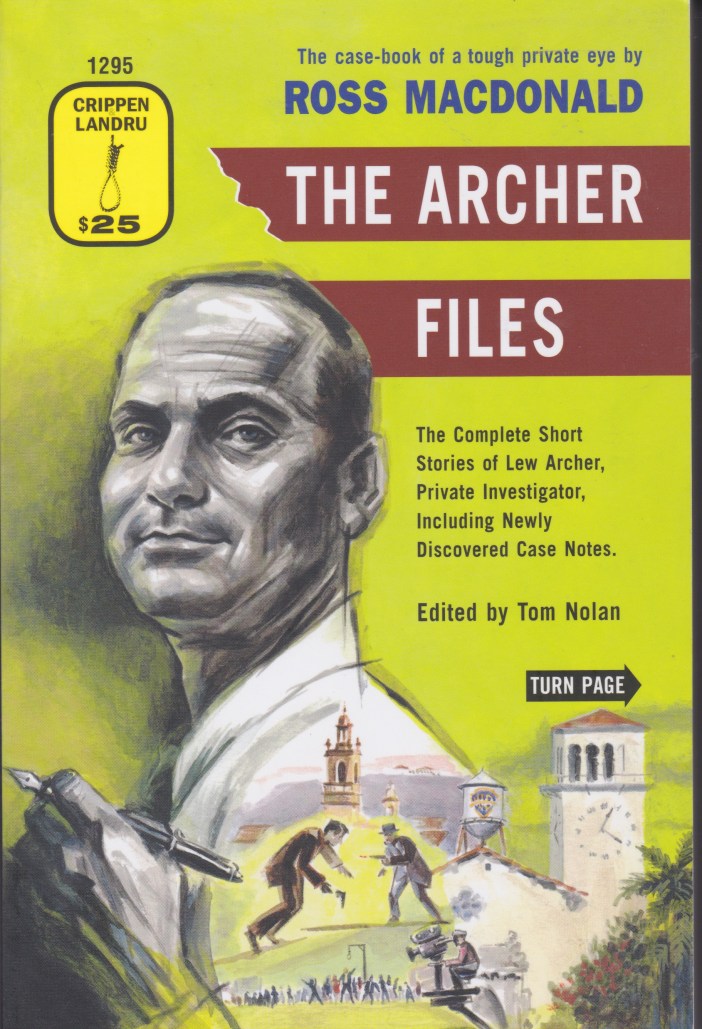
One of my favorite writers from the past is Ross Macdonald; he’s a favorite, but he isn’t up there with James M. Cain and John D. Macdonald and Daphne du Maurier and Shirley Jackson and Faulkner and some others than I consider not only to be iconic but also consider to be major influences on me and my work; Ross Macdonald is an influence, but not as much as the others I named and some others unnamed as well. But I do love Ross Macdonald (I love his wife Margaret Millar more, but that’s another blog entry, methinks), and several years ago I bought a compendium called The Archer Files, in which Macdonald’s short stories, some of which were unpublished, were pulled together in one volume and the editor did some academic discussion of them.

I am still kind of processing one of his short stories; “Strangers in Town.”  I have to give Macdonald credit for writing a short story in that time period (early 1950s)  with characters who were people of color who also drove the story, but…yeah, the casual racism of the period slapped me in the face. That story today most likely would not be published as written, but it has value historically since it stands as an example of how casual and easy systemic racism was in that period. He used parts of it in the next story in The Archer Files, and it also apparently structurally was important to his novel The Ivory Grin, which I think I’ve read; I miss my old ability to recall plots and characters and details of every book that I’d read. It would be a lot more helpful now than it ever was when I retained the skill, you know? Heavy sigh.

One of the issues of this new century involves separating the art from the artist; in other words, can you enjoy art by someone whom, as a private citizen, is problematic? The best examples of this, to name merely two, are Woody Allen and Roman Polanski. I am not a fan of Allen’s art nor have I ever been; but Roman Polanski? He fled the United States to avoid jail on charges of statutory rape. Yet I love his films Rosemary’s Baby and Chinatown; films I saw and enjoyed before he committed his crime.  Distaste has certainly kept me from seeing anything he has done since. But I still love those two films, and rewatch them on occasion; perhaps someday I will rewatch them to look for problematic tropes to unpack.

Likewise, other works from the American past are rife with tropes of sexism, homophobia and racism; the society and culture were sexist, racist, and homophobic; how can the art from that time not be? Yet but it’s how things were back then seems like a feeble response and defense; but I do think it’s possible to enjoy the art as long as one recognizes the presence of things which would never pass muster in today’s society and culture; there is a wonderful essay/book to be done about homophobia in crime fiction of the past, and how gay characters were seen/depicted/represented. I used to want to write that book, but I will undoubtedly never have the freedom and luxury of time to do the necessary research and writing of a book that would prove, ultimately, to have an exceptionally limited audience.

You can’t truly equate racism with homophobia; while there are similarities in oppression and bigotry, both systemic and personal, faced by the two communities, they aren’t the same thing; the differences can be, and are, as significant as the similarities. As a white gay man, I have systemic privilege of skin; unless my car has bumper stickers denoting it as belonging to a gay man I can feel relatively safe in my car from ‘driving while gay’; and while there are certainly levels of homophobia within law enforcement, just walking down the street I don’t need to be worried about being either harassed by law enforcement or profiled. Reading works, or seeing films, that are blatantly homophobic or have stereotypical queer characters who are there to be laughed at, mocked, or held in contempt, while somewhat jarring doesn’t feel the same to me as reading or seeing something current with those same metrics. I am not willing to judge a writer from the pre-Stonewall culture as harshly as I am someone from the present day; it is how things were. You cannot write a realistic novel or short story today about queer characters in the 1950’s, for example, without including homophobic characters and a certain degree of self-loathing in the queer characters themselves: they were outlaws, held in contempt by the society as a whole.

Yet Macdonald’s story bothered me; despite being written in a time when he was undoubtedly considered brave for writing characters of color who weren’t criminals or the kind of “Stepin’ Fetchit” stereotypes so prevalent in films of the time. And yet…and yet…

“Strangers in Town,” by Ross Macdonald, The Archer Files

“My son is in grave trouble,” the woman said.

I asked her to sit down, and after a moment’s hesitation she lowered her weight into the chair I placed for her. She was a large Negro woman, clothed rather tightly in a blue linen dress she had begun to outgrow. Her bosom was rising and falling with excitement, or from the effort of climbing the flight of stairs to my office. She looked no older than forty, but the hair that showed under her blue straw hat was the color of steel wool. Perspiration furred her upper lip.

“About your son?” I sat down behind my desk, the possible kinds of trouble that a Negro boy could get into in Los Angeles running like a newsreel through my head.

That last sentence! Referring to an adult young man of color as a “Negro boy”! And the story goes on with this sentence: She leaned towards me with the diffident and confiding charm of her race.

Yikes. Yup, no stereotyping going on there.

The murder victim was a “light-skinned brown woman.” Another “had straight black hair, trimmed short, and black-rimmed harlequin spectacles that gave her face an Asiatic cast.” Throughout the story, the word “Negro” is used; this is also jarring, because with all due respect, it’s the word that was used politely, rather than the other “n” word. But…no one said “African-American” back then…the police are also willing to view the murder of the light-skinned woman as a possible suicide–which would mean she’d slit her own throat; I can’t imagine anyone ever committing suicide that way–but the white cops’ willingness to believe that a woman of color could or would is also telling.

Other than these issues, it’s a good story; the way it twists and turns and moves away from the original crime and suspects makes for a great detective yarn; the cops never would have solved this, and the son of the woman who hired Archer most likely would have taken the fall for the crime. So, there’s that.

But the next story in The Archer Files, “Gone Girl”,  a different version of the same story, without the people of color, is also a much stronger story.

It was a Friday night. I was tooling home from the Mexican border in a light blue convertible and a dark blue mood. I had followed a man from Fresno to San Diego and lost him in the maze of streets in Old Town. When I picked up his trail again, it was cold. He had crossed the border, and my instructions were to go no further than the United States.

Halfway home, just above Emerald Bay, I overtook the worst driver in the world. He was driving a black fishtail Cadillac as if he were tacking a sailboat. The heavy car wove back and forth across the freeway, using two of its four lanes, and sometimes three. It was late, and I was in a hurry to get some sleep. I started to pass it on the right at a time when it was riding the double line. The Cadillac drifted towards me like an unguided missile, and forced me off the road in a screeching skid.

Rather than being hired by a mother whose son is being accused of murder, Archer now happens onto a strange situation while driving home from a case. He decides to stop for the night at a hotel, and becomes involved in another murder investigation. The basic story after this is the same, both structurally and thematically, but the casual racism is gone and it’s now about white people, and interestingly enough, not nearly so problematic as “Strangers in Town.” The second story works better as well; I’m not sure why that is; did it work better because he didn’t use the people of color, and thus without the stereotyping it worked better?

I am still processing this. As I said, I love Ross Macdonald, and his writing is extraordinary. He’s one of the greats. But what, and where, is that line?

I don’t know the answers; I don’t think anyone does, nor do I think there even is one answer. I don’t recall ever getting any racist vibe from Macdonald’s work before, but on the other hand, I may not have been looking for it, either; the subtleties of systemic prejudices aren’t always apparent at first glance, or even second. Sometimes it takes someone else to point them out.

While I can’t speak to whether racism in American art from the past should not be seen, viewed or read, I can speak, for myself, about art from our homophobic past (while recognizing they are not the same things). Seeing casual homophobia in American art from the past, while jarring, doesn’t bother me as much because that’s the way things were. I don’t think it should be glossed over, or censored out of existence; if we forget the past and how things were, we can’t make things better for the future nor can we understand not only how far we’ve come but how far we have to go; we cannot truly understand the present without understanding our past–and, for want of a better term, in stark black-and-white; we have to understand and appreciate the shades of gray.

And on THAT note, it’s back to the spice mines with me.

Here’s your Monday hunk.

IMG_2015

One More Night

Thursday. I overslept this morning and thus didn’t make it to the gym–I’ll have to go tomorrow night after work–but I also had a really great night’s sleep and so am taking that as a win; now that I am out of bed my muscles aren’t tired or sore. I’ll do some stretching and my abs this morning before getting in the shower. I also have to get up tomorrow morning and go to the eye doctor; instead of my usual wimpy not complaining and accepting things, I called them and told them I can’t read in my progressive contacts so I need a stronger prescription. So, I am going in tomorrow to get a new trial pair and perhaps order my new glasses and a year’s supply of the contacts; depending on how the new ones feel.

The decisions have been made on the Bouchercon anthology, and all the people who submitted have been duly noted. This weekend I will read the chosen again and put them in order. I am currently waiting to hear back from all the selected authors. I think we’ll make the announcement of the table of contents next week. Huzzah!

Yesterday I also started writing, of all things, a Chanse MacLeod short story. I know, right? I don’t think I’ll ever write another Chanse novel, but there are ideas I had for him that I don’t want to really waste, and hey, why not write short stories about him? I always had in mind to write about him returning to the town of his birth; I also had a story in mind involving his younger brother; another with him dealing with his fraternity past in Baton Rouge–all stories my publishers were never interested in since they weren’t set in New Orleans. As I have said before, I’ve never really known how to write a private eye mystery short story, but all this short story reading I’ve been doing has kind of opened my eyes in that regard; so thank you, Sue Grafton, Ross Macdonald, Laura Lippman, etc. I’ve already realized that the opening doesn’t work, and it’s just extraneous crap I don’t need. But I am going to soldier on, and hopefully today I will finish the first draft. I also have an idea for a short story involving Chanse’s partner, whose name I cannot recall; I’ve always been interested in writing about her–the straight girl who paid for college by stripping on Bourbon Street. I cannot for the life of me think of her name right now, which is annoying, but I always thought she was interesting. I’d even thought about spinning her off, even using Chanse as a supporting character in the books–but then, is there an audience for a series about a female private eye who used to work as a stripper? But I think I can make it work as a short story. We’ll see.

Last night while I was making dinner I reread some of the short stories I have in progress, and was quite pleased with them. I am going to try to get those revisions done as quickly as I can, so I can get them out of my hair so I can focus on getting the new project done.

I’m still behind on the Short Story Project, but I did manage to read Raymond Chandler’s “Red Wind” yesterday; someone recently talked about it somewhere on social media as the perfect hard-boiled short story. It had been a while since I’d read Chandler–and I haven’t read all of Chandler, either, something I need to remedy–and so I thought it was a great opportunity to read this story, which I wasn’t familiar with.

There was a desert wind blowing that night. It was one of those hot dry Santa Anas that come down through the mountain passes and curl your hair and make your nerves jump and your skin itch. On nights like that every booze party ends in a fight. Meek little wives feel the edge of the carving knife and study their husbands’ necks. Anything can happen. You can even get a full glass of beer at a cocktail lounge.

I was getting one in a flossy new place across the street from the apartment house where I lived. It had been open about a week and it wasn’t doing any business. The kid behind the bar was in his early twenties and looked as if he had never had a drink in his life.

I’ve not read all of Chandler, or his hard-boiled cohorts Dashiell Hammett, Ross Macdonald, or noir master James M. Cain. What I have read I’ve greatly enjoyed; as I have greatly enjoyed John D. Macdonald. I think I’ve been influenced by all of them to some degree; and there simply isn’t enough time to read. I’d love to go back and not only finish reading all of their works but to reread the ones I’ve already read; The Maltese Falcon, for example, is way overdue for a reread and so are the Travis McGee novels; The Big Sleep, Farewell My Lovely, and The Lady in the Lake, along with Love’s Lovely Counterfeit and of course, the Archer novels (although I am reading the Archer short stories). Anyway, I’ve always loved these writers and their work, and I do need to go back and reread them, problematic as some of them may be to modern eyes.

“Red Wind” is a really good story, complicated and complex, but still moves relatively easily from A to B to C. It opens with Marlowe stopping in at a bar across the street from where he lives in an apartment building, and a murder occurs right in front of him and the other denizens of the bar. After dealing with the police he heads back to the apartment building where he runs into the proverbial ‘dame’ of these types of stories, she lies to him, of course, but also manages to save his life when the murderer shows up to eliminate the witnesses. But while the mystery of the murder is now cleared up, turns out the victim has left some loose ends behind–involving the dame and some others. He was a blackmailer; the murder had nothing to do with the shooting (a very clever shift by Chandler), and Marlowe is on the case, trying to solve the blackmail cases and dealing with the LAPD. The writing is choice, terse, and all throughout the story the Santa Ana wind plays a role, almost like another character, driving people to do things they might not do under normal weather circumstances.

And now, back to the spice mines; since I didn’t go to the gym I need to get other things done.

IMG_3978

I Want to Know What Love Is

It’s been raining pretty much most of the weekend, which is fine. I went to get groceries, pick up a prescription, and get the mail before getting home and starting to work on the mess that is my home; I also finished writing a chapter of one manuscript and started writing another–which was my writing goal for yesterday. Today’s is to do second drafts of two short stories to prepare them for submission. I also have to go to the gym and finish the cleaning of the apartment and organizing my office. I started reading the big y/a best seller One of Us Is Lying by Karen McManus yesterday; I can see why it’s a bestseller and I can also see why it’s being developed into a television series a la Thirteen Reasons Why; it’s a deceptively simple yet surprisingly complex story, and likewise–well, I’ll talk some more about it once I’ve finished.

I’m enjoying writing again for the first time in years, which is a good thing, and I am actually putting a lot of thought and planning into what I’m writing, which is a really good thing. What I’ve written over the last six or seven years has been a lot more organic, coming to me as I wrote it from a basic premise and perhaps knowing what the end was; without putting near as much thought into theme and what I am trying to say, what I am trying to explore with the story, than I used to–I mean, it worked, but it also made the work a lot harder than it needed to be. I think this is particularly true of short stories; I think that’s primarily what I’ve been doing wrong in writing them–my entire approach to short stories has been wrong, and I’ve been, as I said, making it a lot harder on myself than it necessarily needs to be.

Which is, sadly, what I always tend to do for myself: make things harder than they need to be.

Heavy heaving sigh.

In addition to cleaning and everything else I did yesterday, I also managed to start watching Season 2 of Black Sails, which continues to enthrall. I am still liking the idea of finally writing my pirate novel (Cutlass), but not as much as before; it remains one of those dreams that I hold on to for when I am making a living as a writer again and able to not have a day job any longer. (There are several of those; they also require not only making a living but making enough money to travel and do research.)

Some day. I never give up on the dream.

The Short Story Project also continues; yesterday I read a story by Ross MacDonald from The Archer Files and one by Karl Edward Wagner from the gorgeous two volume collection The Best Horror Stories of Karl Edward Wagner, produced by Centipede Press maybe seven or eight years ago.

MacDonald’s story, “The Bearded Lady,” was quite good, as everything written by MacDonald is.

The unlatched door swung inward when I knocked. I walked into the studio, which was high and dim as a hayloft. The big north window in the opposite wall was hung with monkscloth draperies that shut out the morning light. I found the switch beside the door and snapped it on. Several fluorescent tubes suspended from the naked rafters flickered and burned blue-white.

A strange woman faced me under the cruel light. She was only a  charcoal sketch on an easel, but she gave me a chill. Her nude body, posed casually on a chair, was slim and round and pleasant to look at. Her face wasn’t pleasant at all. Bushy black eyebrows almost hid her eyes. A walrus mustache bracketed her mouth, and a thick beard fanned down over her torso.

The door creaked behind me. The girl who appeared in the doorway wore a starched white uniform. Her face had a little starch in it, too, though not enough to spoil her good looks entirely. Her black hair was drawn back severely from her forehead.

Lew Archer, on his way from Los Angeles to San Francisco, decided to stop in the small town of San Marcos and look up an old army buddy, inadvertently stumbling into a murder case. The story is interesting, the writing whipcrack smart, with MacDonald’s trademark, cynical short paragraphs immediately getting to the essence of a character. Don’t we, as readers, already have a strong impression of who that young woman is as a person after those three sentences? I’ve often wondered how one solves a murder in a short story–or writes a detective short story. I’ve tried and failed often enough. But the great thing about the Short Story Project is I am starting to understand how to write them, how they work, and how to make them work; which is a lovely thing. I have several ideas for Chanse short stories that I’ve never written because I didn’t know how; now I rather do, or at least have an idea, thanks to The Archer Files and Kinsey and Me (Sue Grafton). Both books are great learning tools for people who want to write detective stories, and MacDonald’s influence on Grafton is clear. (Although I’d still love to see someone do an essay, or book of criticism, comparing and contrasting MacDonald’s work with that of his wife: The Murderous Millars would be a great title.) MacDonald’s stories usually have to do with damaged and dysfunctional families; “The Bearded Lady” is another one of those, and is very well done. I highly recommend it.

The Wagner story I read was from the second volume of he Best Horror Stories of Karl Edward Wagner, which was titled Walk on the Wild Side, and was titled “The Last Wolf.”

The last writer sat alone in his study.

There was a knock at his door.

But it was only his agent. A tired, weathered old man like himself. It seemed not long ago that he had thought the man quite young.

“I phoned you I was coming,” explained his agent, as if to apologize for the writer’s surprised greeting.

Of course…he had forgotten. He concealed the vague annoyance he felt at being interrupted at his work.

Nervously the agent entered his study. He gripped his attache case firmly before him, thrusting it into the room as if it were a shield against the perilously stacked shelves and shelves of musty books. Clearing a drift of worn volumes from the cracked leather couch, he seated himself amidst a puff of dust from the ancient cushions.

I received both volumes of Wagner when I was judging the Bram Stoker Award for Best Single Author Collection, or whatever it is called; it was so long ago that I don’t even recall who the finalists were or who actually won. My memory is perforated like Swiss cheese nowadays, with holes and gaps; it also works like a sieve as new knowledge, and new books I’ve read, tend to pass through it without catching hold (I used to be able to name every book I’ve read, the plot, the main characters–and even some of the minor; over the years that ability has been sadly lost to time). I don’t, for example, remember the titles or the contents of the Wagner stories I read; but the books are beautiful volumes and I remember being impressed by his writing, so I kept them on my shelves. It was only a week or so ago that I realized, that I remembered, them; and that they might make a good addition to my year-long study of short fiction.

I’ve often said that writing about writers, about the business of writing and publishing, sometimes (often) feels masturbatory to me; only other writers would be interested in such a story. And yet writers pop up in my work all the time; Paige is a journalist and wannabe novelist in the Chanse series (and now that I’ve retired that series she’s migrated, apparently, over to the Scotty); another writer character I’ve created has appeared in several novels of mine–one Scotty, The Orion Mask, and one pseudonymous; he also appears to be the voice I used in several first-person short stories, including “An Arrow for Sebastian.” I have another such short story in process; I’ve not quite worked out how to make the story work, but there you have it. I was tempted to write an entire series about a writer, but as I started to develop my gay male writer character more I soon realized I had turned him into a hybrid of Scotty and Chanse; there was nothing new or original about him other than he was a writer and not a private eye. (I really do want to reread Azimov’s Murder at the ABA, though, and Elizabeth Peter’s brilliant Die for Love and Naked Once More.)

“The Last Wolf” is also about a writer, a writer who firmly believes in himself and his work, and that his work is art, and art should never be compromised for commerce. The world in which he lives is one where he is the last (apparently) person attempting to still write fiction; novels have fallen by the wayside and short stories are no longer published; the world has completely changed and his agent wants him to try to write for television shows–which, as described, sound horrifically awful. The writer refuses, the agent leaves, and he goes back to his typewriter. This story could easily be seen as angry, or even whiny; in the hands of a lesser author, the story would be precisely that. But Wagner paints a picture with his words, and maybe it resonated with me more because I am an author myself, but the sympathy rests entirely with the author. (Although I am one of those whose eyes roll so hard that  they almost unscrew when I hear another author speak of their ‘art’; but that’s a topic for another day.) I am looking forward to digging back into Wagner’s work again this year.

And now, I need to file and organize, perhaps vacuum, before I head to the gum. I want to get some things written today, and I need to revise those stories.

Hello, spice mines.

Sigh.

26196451_321860411641954_3040436925599999815_n

Time Will Reveal

Last night I got home from work early; after stopping at the grocery store to alleviate some of the errands I must run today. I cleaned the living room and worked on organizing the books some, did some laundry, and did the living room floor, as well as laundered the living room blankets and vacuumed the love seat and my easy chair. Mindless chores, as I mentioned on both my panels at Comic Con last weekend, are marvelous for brainstorming and thinking; which I did a lot of. The Short Story Project is also inspiring me, which is really cool, too. The Facebook ban is freeing me up to do a lot more reading, a lot more brainstorming, and so really, I have to thank not only the Puritan trash who keep reporting my pictures of shirtless men but the equally puritanical censors at Facebook, whose word is law and cannot be questioned. As I mused early on in the ban, all this is really succeeding in doing is breaking me of the Facebook habit. How horrible! What a punishment!

Assholes.

So, last night I repaired to my easy chair once I had made myself something to eat and the living room was cleaned and organized. I started looking through my Amazon Prime app on the Apple TV–I can’t tell you how nice it is to have that app now, so I don’t have to switch over to the Prime function of the TV, which doesn’t work as well–and realized that I had subscriptions to both Acorn and Starz through it! I found a bunch of wonderful movies that I’d like to see again, or haven’t seen and want to, on the Starz menu; likewise for some series on Acorn. I settled in with my book and started watching The Towering Inferno, which I had actually never seen. Highly entertaining, badly acted, and starring a smorgasbord of Oscar winners and other interesting casting choices (O.J. Simpson! Mike Lookinland! Soap diva Susan Flannery! Susan Blakely! Richard Chamberlain! Robert Vaughn!), I kept rolling my eyes at the terrible dialogue and immensely stupid situations, not to mention the insane solutions to the fire they kept coming up with–um, it was an electrical fire; yes by all means use water so people will get electrocuted. 

Seriously.

I also noticed a rather obvious theme that runs through all disaster movies–human hubris, and human greed and incompetence always seem to play a part in the disaster. To bring the construction in under budget, Richard Chamberlain cut corners in safety features  as well as in the specifications for electrical wiring. In The Poseidon Adventure the ship is top-heavy because they didn’t take on enough ballast-in fact, removing some–to try to make it to their final port on time as they are running behind; which of course made the ship prone to capsizing in the case of a tidal wave. But next up on my Starz viewing is the 1969 film Airport, based on the Arthur Hailey novel and the blockbuster hit that really kicked the Disaster Movie craze of the 1970’s off–even though the movie is about more than just the imperiled airplane. I’ve not seen this movie, or reread the book, since I myself worked for an airline at an airport; this could make it really interesting.

As for the Short Story Project, I may have mentioned sometime this week that I discovered a collection of Ross MacDonald short stories on my shelves that I’d forgotten I had, The Archer Files.  I read the first two stories in that collection this week. I came to MacDonald rather late in life; I became aware of him in the 1970’s, but his book covers, with their lurid scantily clad women and back cover blurbs that promised machismo and tough guy behavior, didn’t interest me. I didn’t start reading MacDonald until years later, when Christopher Rice recommended him on a panel we both were on. I’d come to love John D. MacDonald in the 1970’s, and so I decided to give Ross a whirl. I think the first one I read was The Drowning Pool, and after that, I was completely in on Ross MacDonald. I have also come to a great appreciation for the extraordinary talent that was his wife, Margaret Millar…I love to imagine what their dinner conversation was like.

the archer files

The two stories, “Find the Woman” and “Death by Water,” were not originally written or published as Archer stories; they were adapted and turned into Archer stories later, after MacDonald was dead and this was authorized by the estate. The stories work as Archer stories, which is really all that matters. I’ve not yet read any of his non-Archer novels, but some of them are in the TBR pile; I’ll be curious to see if there’s a stylistic difference, or a significant change in voice.

I sat in my brand-new office with the odor of paint in my nostrils and waited for something to happen. I had been back on the Boulevard for one day. This was the beginning of the second day. Back in the window, flashing in the morning sun, the traffic raced and roared with a noise like battle. It made me nervous. It made me want to move. I was all dressed up in civilian clothes with no place to go and nobody to go with.

Then Millicent Breen came in.

I had seen her before, on the Strip with various escorts, and knew who she was; publicity director for Tele-Pictures. Mrs. Dreen was over forty and looked it, but there was electricity in her, plugged into to a secret source that time could never wear out. Look how high and tight I carry my body, her movements said. My hair is hennaed but comely, said her coiffure, inviting not to conviction but to suspension of disbelief. Her eyes were green and inconstant like the sea. They said what the hell.

That is how “Find the Woman” opens, and what a great example of the hardboiled, noirish style of crime writing. Not a lot of words, not a lot of sentences, and yet we get a strong sense of Archer’s character, just out of the war and chafing restlessly at his new life and existence, and the danger inherent in Millicent Breen. She is beautiful, older, sexy and dangerous; she wants Archer to find her daughter, a movie starlet who has disappeared, and this leads Archer into the  dangerous world of movie stars and film people, of love gone astray and a slightly sexist depiction of restless women who might love but need someone in their bed every night. I enjoyed it, not only as an example of the writing style but as a time capsule; it was easy to picture this in black-and-white, with Bogart as Archer and maybe Myrna Loy as Millicent Breen.

He was old, but he didn’t look as if he were about to die. For a man of his age, which couldn’t have been less than seventy, he was doing very well for himself. He was sitting at the bar buying drinks for three young sailors, and he was the life of the party in more than the financial sense. In the hour or so that I  had been watching him, he must have had at least five martinis, and it was long past dinner time.

“The old man can carry his liquor,” I said to Al.

“Mr. Ralston you mean? He’s in here every night from eight to midnight, and it never seems to get him down. Of course some nights he gets too much, and I have to take him home and put him to bed. But next day he’s bright as ever.”

And so begins “Death by Water.” Again, note the writing style; the sparse use of words to get a point across, the inherent toughness in the words chosen and how they are put together. Mr. Ralston ends up dead later on, of course; drowned in the swimming pool, and Archer is on the case. It’s a great little crime procedural, with Archer taking mental notes as he talks to witnesses and the people involved, and once the case is actually solved, it’s pretty clear that the solution was right there in front of our faces all along. Well done!

And now, back to the spice mines with me. Paul’s going into the office, I have some errands to run, and we’re going to go see I, Tonya tonight; I intend to do a deep, overdue cleaning of the kitchen today as well, around writing and editing.


Sunglasses at Night

Sunday morning. Last evening I went to a Christmas party and had an absolutely lovely time; but stayed much longer than was probably warranted and got home much later than I should have. But there were lots of laughter, and I got to hang out with friends that I don’t see nearly enough, and so overall, I would classify it as a win. I also slept beautifully and deeply and restfully after getting home, so that, too, was absolutely lovely.

Today I have to do a lot of writing; I finished a project yesterday, which was also lovely, and managed to get the cleaning of the downstairs finished. Today I will move to the upstairs, doing cleaning and organizing when I take breaks from the writing/editing I have to do. I also will read some more of Donna Andrews’ How the Finch Stole Christmas when I can; hopefully wrapping up reading it this evening as well. I’m not sure what I am going to read next; I am rather torn between a reread of George Baxt’s A Queer Kind of Death, Joan Didion’s Miami, Dashiell Hammett’s The Dain Curse (also a reread), or something else in the pile. I also haven’t done my annual reread of Rebecca, but I think I am going to save that for actual Christmas. There are also some other duMauriers lying around the apartment I haven’t read that I need to (The House on the Strand, The Progress of Julius, The Scapegoat), some Ross MacDonalds, many Margaret Millars, and so many other books by writers I adore and am way behind on–I still have Stephen Kings that are languishing on my shelves, unread–and of course, come January it’s going to be Short Story Month again.

I also have another short story to write that I keep forgetting about, which, of course, is insane. (Note to self: put post-it note up on computer.)

But the good news is I am finally feeling motivated again about writing; this past year hasn’t been, for me, a good one as far as writing is concerned. I had a long conversation with my friend Susan last night about the current Scotty and the problems I’m having with it–and of course, while talking about the problems out loud with her I solved the problem. (It really is amazing, isn’t it, how saying things out loud can make a difference and make you see what’s been missing? The same thing happened with the WIP when I was chatting about it with my friend Wendy in Toronto–as I spoke I could see in my head what I needed to add, and then she put her finger right on the problem and pointed it out just as I was coming to the realization, which confirmed that it was the correct one. Again, it’s all a matter of having the time to make these fixes, but now that I know whatI need to fix, well, that makes it all a lot easier.

I also finished post-it-noting Garden District Gothic yesterday while watching the first half of the SEC championship game, so the Scotty Bible also proceeds apace, which is also lovely.

So much I need to get done this month!

And on that note, it’s back to the spice mines.

CalvinKlein11