Need

Ah, vampires.

I never really meant to write a vampire story. For one thing, Poppy Z. Brite and Anne Rice had already done the New Orleans vampire story and set the bar super-high for anyone else wishing to write about vampires in New Orleans; Charlaine Harris also kind of cornered the market on Louisiana supernatural novels, too. It really seemed cliché to do New Orleans vampires, and I never would have, had I not been asked, and offered a lot of money, to do so. I make no bones about writing for money; if that renders me an unreadable hack, so be it.

I was initially asked to write a New Orleans vampire novella for a collection of four to be called Midnight Thirsts, which Kensington was publishing. Once I signed the contract and got paid half the advance, I decided to adapt a vampire short story I’d written, probably in or around 1997 or 1998, called “The Nightwatchers”; the main character was a young wannabe actress with a lot of talent but a lot of insecurity, who discovers that the reason she hasn’t been getting good roles in her theater company is because the woman who does is fucking the director. The story wasn’t good–she is easy prey for a vampire looking for a companion, who kills the director and the competition actress before turning her–but there was some lovely stuff about the French Quarter in the fog and her crumbling apartment–this was when you could still get a decent enough apartment in a crumbling old building in the Quarter for a price that seems unbelievable and unrealistic today–that I thought I could use. I also like the title, and as is my wont, when I started world-building and creating, I went overboard on back story. There were two point of view characters; the main, Philip Rutledge, who works as an escort, and his best friend Rachel, an aspiring singer who works in a coffee shop on Frenchmen Street, as well as a third; an older man who is a “nightwatcher,” member of an ancient society that reins in supernatural threats to humanity all the while keeping them in the dark about the reality of supernatural creatures and beings in the world. He has followed a rogue vampire to New Orleans, who has set his sights on Philip. I left the ending open, because I thought there was more story–if not a book, if not an entire series–in this idea. I decided I was going to write the vampire novel after finishing Mardi Gras Mambo…which wound up being delayed over a year. Then Katrina happened, and by the time I was ready to write about vampires again, too much time had gone by, alas. But they were doing another collection of vampire novellas, and asked me to do a Todd Gregory story for them (they had started publishing the Todd Gregory fraternity novels by this time), and that story became the novella “Blood on the Moon.” But rather than starting fresh, I used the same structure and world I’d created with “The Nightwatchers”–and tied it into the fraternity novel world as well, making the main character a member of the fraternity’s University of Mississippi chapter, visiting New Orleans for Carnival and winding up getting turned (it’s a longer, more complicated story than that, but that’s the bottom line). I brought Rachel and the old man from “The Nightwatchers” back–and when I was doing the anthology Blood Sacraments, I wrote a short story “Bloodletting”, that basically picked up where “Blood on the Moon” left off.

So, when Kensington asked for an erotic vampire novel rather than another fraternity book, I decided to use “Bloodletting” as the first chapter and build on the story from there, also using “Blood on the Moon” as the foundational story and the supernatural world I’d created for “The Nightwatchers.” This was to serve as an introductory work to a new supernatural Todd Gregory series.

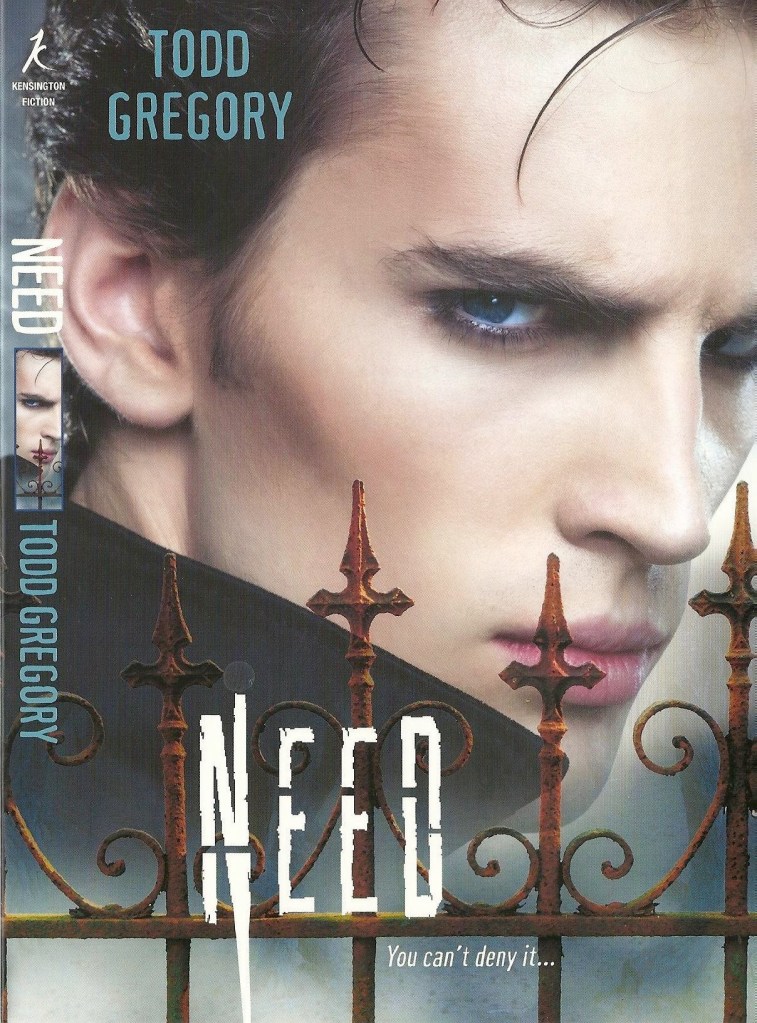
It’s working title was A Vampire’s Heart. The powers that be didn’t like that title, thinking it sounded more like a romance novel title (which wasn’t wrong), and suggested Need, which was a recurring theme in the book.

And I really loved the cover.
The damp air was thick with the scent of blood.

It had been days since I had last fed, and the desire was gnawing at my insides. I stood up, and my eyes focused on a young man walking a bicycle in front of the cathedral. He was talking on a cell phone, his face animated and agitated. He was wearing a T-shirt that read Who Dat Say They Gonna Beat Dem Saints? and a pair of ratty old paint-spattered jeans cut off at the knees. There was a tattoo of Tweetybird on his right calf, and another indistinguishable one on his left forearm. His hair was dark, combed to a peak in the center of his head, and his face was flushed. He stopped walking, his voice getting louder and louder as his face got darker.

I could smell his blood. I could almost hear his beating heart.

I could see the pulsing vein in his neck, beckoning me forward.

The sun was setting, and the lights around Jackson Square were starting to come on. The tarot card readers were folding up their tables, ready to disappear into the night. The band playing in front of the cathedral was putting their instruments away. The artists who hung their work on the iron fence around the park were long gone, as were the living statues. The square, so teeming with life just a short hour earlier, was emptying of people, and the setting sun was taking the warmth with it as it slowly disappeared in the west. The cold breeze coming from the river ruffled my hair a bit as I watched the young man with the bicycle. He started wheeling the bicycle forward again, still talking on the phone. He reached the concrete ramp leading up to Chartres Street. He stopped just as he reached the street, and I focused my hearing as he became more agitated. What do you want me to say? You’re just being a bitch, and anything I say you’re just going to turn around on me.

I felt the burning inside.

Desire was turning into need.

I knew it was best to satisfy the desire before it became need. I could feel the knots of pain from deprivation forming behind each of my temples and knew it was almost too late. I shouldn’t have let it go this long, but I wanted to test my limits, see how long I could put off the hunger. I’d been taught to feed daily, which would keep the hunger under control and keep me out of danger.

Need was dangerous. Need led a vampire to take risks he wouldn’t take ordinarily. And risks could lead to exposure, to a painful death.

You see why they suggested we rename it Need? That opening pretty much says it all.

I had never really put a lot of thought into writing about vampires, in all honesty. To date, I have only published two novellas, one short story, and the novel, of course, but while I was writing Need that world began to expand and grow in my head as I worked on the story. I wanted to tie both “The Nightwatchers” and “Blood on the Moon” together, with Need as the continuation, so I brought back both Rachel and Nigel from the former, while keeping Cord from the latter as the main character. Cord Logan (how is that for a gay porn star name) was, despite being young in terms of being a vampire, quite powerful and growing in his power exponentially by the day. Headstrong, he’d broken away from the coven of vampires that turned him during Carnival, without learning everything he needed to learn first. What he didn’t know–and his former coven also didn’t–was that because of the circumstances involved in his own turning–when a male witch also tried to steal his power from him, he inadvertently wound up transferring his own power to Cord, who was then turned into a vampire to save his own life. This combination of witch/vampire is actually quite dangerous–as are any vampires Cord himself might create, which was the entire problem he faced in the story “Bloodletting” and didn’t understand.

The Supreme Council wants Cord summarily executed, but Nigel wants to keep him alive, to study and learn from, as well as to try teaching him how to control his powers. For me, Need was the introductory tale to a much longer story, where I’d be able to bring in vampires and shifters and witches and faeries and pretty much every kind of supernatural being. The next book was going to be called Desire, and every book was going to have a one-word title. I had a lot of fun with writing Need, and was really getting excited and writing lots of note for Desire…but the book didn’t do very well. It did okay, but not in the kind of numbers that would make a sequel a no-brained, and by then I had already moved on to writing the young adult books. The reviews weren’t great, either–but I never really care or pay much attention to them. The real problem is that there were sex scenes, and I don’t write the kind of gay sex scenes people want to read anymore. Mine are physical, lots of sweats and smells and experiencing how it feels and so on…most people want the sex scenes to be more esoteric and romantic and sweet.

I don’t think I’ve ever had sweet, romantic sex. I’ve certainly never written it.

Every once in a while, when I am writing something more along the lines of horror or with a supernatural tones, I remember my vampires and the world I created for them with a slight ping of sadness.

Maybe someday I’ll write Desire, but it’s highly unlikely at this point.

Vieux Carré Voodoo

Ah, the fourth Scotty.

I know I’ve told this story about a hundred times, but I think it matters to the entire Scotty canon review thing that I’m doing now, and it kind of does shape the rest of the series. One afternoon when I was heading to work at the old CAN office on Frenchmen Street, I always parked on Kerlerec Street, which was one of the few places in the Marigny neighborhood that wasn’t restricted to two-hour parking and a potential ticket (I didn’t get a parking spot until I went full time). I got out of the car, locked it, and saw some people riding towards me on bicycles. I said good morning and they said good morning back and smiled and kept going. I took a few more steps before realizing that was Brad and Angelina and a couple of the kids! I smiled to myself–one of the things I love most about New Orleans is the regular celebrity sightings–and of course, they lived not far from my office at the time. As I kept walking, some thoughts started riffing in my brain: Brad is blond and not all that tall; Scotty is also blond and not all that tall. Brad and Angelina live essentially right around the corner from Scotty. What if Scotty was walking home one night and when he’s in front of their house someone takes a shot at him, mistaking him for a Brad type actor living in the Quarter? Someone is trying to kill him and since Scotty looks like him, they hire him to get to the bottom of it as well as to run interference?

I really liked the idea–Hollywood South Hustle (keeping the “H” alliteration I was going for when the book was going to be Hurricane Party Hustle)–and when I got home that night I wrote the proposal and first three chapters in a fever…spent a few days refining and polishing it, and submitted it to my Scotty publisher–and they turned it down.

Womp womp.

Around the same time, my Chanse publisher–who had yet to make an offer on the next book in the series–suddenly made an offer but gave me a two month turn around on the book. It was do-able, of course, but I thought I deserved something in return for that insane turnaround and so asked for a two book contract and more money; they were clearly desperate since they agreed to both. And I thought, Hmm, I can just turn that Scotty book into a Chanse book and thus it became Murder in the Rue Ursulines (and it wasn’t as easy as I thought it would be but that’s a story for another time).

And then one day, I was walking from the parking lot at my old office to where the Gay Easter parade was lining up (my office had a carriage and I rode) and as I walked underneath a balcony I barely avoided getting drenched (those who turn their balconies into lush gardens have to water them, after all, and the excess water has to go somewhere; it’s one of those Quarter hazards we’ve accepted) and in a flash, I thought that very thing–walking under balconies in the Quarter can be hazardous–and then imagined Scotty on his way to the Gay Easter parade to ride on his parents’ business’ float when he gets drenched by someone watering their balcony garden. And just as quickly as I had that thought, I thought of course Scotty would be dressed as a slutty Easter bunny in a white speedo and rabbit ears and tail and then it just got really funny to me. The next morning I wrote that scene, which grew into the first chapter, and since I needed to wrap up the personal story left hanging in the previous book, I ended the chapter with him seeing someone in the crowd he thought was Colin–a thought he quickly dismisses as impossible, and we were off to the races.

No live organism can continue for long to exist sanely under conditions of absolute reality; even pigeons and palmetto bugs are supposed, by some, to dream. New Orleans, not sane, stood by itself inside its levees, holding darkness within; it had stood there for almost three hundred years and might stand for three hundred more. Within, walls continued to tilt, bricks crumbled sloppily, floors were termite-chewed and doors sometimes shut; silence lay steadily against the wood and stone of New Orleans, and whoever drank there there, drank alone.

Yeah, right. People only drink alone in New Orleans by choice.

My name is Scotty Bradley, and I’m a private dick who works the mean streets of New Orleans. I right wrongs. I help the downtrodden find justice. I punish the guilty. I ferret out crime, and protect the innocent while punishing the guilty. Criminals tremble when they hear my name, and get out of town if they know what’s good for them. Dame Justice may be blind, but I see all too clearly. The helpless come to me when everyone else has failed, when hope is gone, and the night seems darkest. I’ve got a mean right hook and never back down from a fight. I drink my martinis shaken, not stirred—because I like my gin like miscreants who cross my path, bruised and a little battered. I am on a never-ending quest for truth, justice, and preserving the American way of life. I rescue dreams and bring nightmares to an end. Don’t call me a hero, because any one of you would do the same if given the chance. There is no case too small for me to handle, and there is no case so large that it is intimidating. I’ve taken down a corrupt political machine, and would gladly do it again tomorrow. I’ve found lost treasures and stared down the Russian mob. I’ve stared evil in the face until evil blinked and backed away in mortal terror. I have—

Yeah, right. And I have a bridge across the Mississippi for sale, if you’re interested.

My name is really Milton Bradley, like the board game company—my parents have a slightly twisted sense of humor. Scotty is my middle name, but it’s what everyone calls me. I really am a private eye—bonded, and licensed by the state of Louisiana. I was born and raised in New Orleans and have lived here my entire life except for two misspent years at Vanderbilt University up in Nashville. I live on Decatur Street with my partner, Frank Sobieski. We’re business partners, and life partners. We met on a case a couple of years back, and it was pretty much love at first sight. Frank is one of the most gorgeous men I’ve ever seen outside of a porn movie. He’s in his early forties, about six foot two, and when he had hair, it was blond. Now that he’s balding, he shaves it down to a little buzz. He has the most hypnotic blue eyes, a strong chin, and a scar on the right side of his face. He also started lifting weights in his twenties—and there’s not an ounce of fat on his hugely muscled, amazingly defined body.

He also has one of the most amazing butts I’ve ever laid eyes on. Woof!

Well, okay—it was lust at first sight. Love came later.

I love treasure hunts, always have, and have always wanted to write one. One of my favorite series when I was a kid (they’re still actually quite fun to read now) are the Three Investigators series; which was originally called the Alfred Hitchcock Mystery Series as he introduced each case and sometimes even referred potential clients to the boys. Many of those books were treasure hunts, and those were always my favorite books. One of their adventures, which was also a favorite, was called The Mystery of the Fiery Eye and was loosely based on Wilkie Collins’ The Moonstone, which I read as a teenager and have always remembered fondly. I decided I wanted to do an homage to both books; the treasure everyone is looking for is a stolen, notorious jewel that is very important to a south Asian religious cult, and it’s name was Kali’s Eye, because it was mounted in an enormous statue of her in a temple in a very small, remote south Asian country.

And it was stolen during the Vietnam War, and they’ve been looking for it ever since.

After Scotty gets soaked in his slutty Easter bunny attire, he swears very loudly and the person on the balcony hears him. Turns out to be an old family friend–Scotty wasn’t really paying attention to where he was; his mind was elsewhere as he walked–and gets invited up, so the friend, Doc–he was a professor at University of New Orleans when Scotty’s parents went there–can give him a towel and run his outfit through the dryer quickly. While Scotty is there, Doc gives him an old stuffed toy Scotty had left there years ago, when he was a small child. This strikes Scotty as odd, but he humors Doc and takes the stuffed bunny. When he gets to the parade, his mother is thrilled to see Mr. Bunny, so he gives it to her.

And later, when he is walking home, there are cops at Doc’s. He fell to his death from his balcony, and his apartment was ransacked. Then the new tenant on the top floor of Scotty’s building (he and Colin gave up that apartment after Colin disappeared) wants to hire Scotty and Frank to solve a mystery for him–but soon he, too, is murdered–and also turns out to not be who he had claimed to be. Are these two murders connected, and if so, how?

My absolute favorite part of the book to write was the treasure hunt itself; when Scotty and Frank realize that Doc left clues behind for Scotty to solve and find the missing jewel; which takes them on a trail from the apartment on Decatur Street uptown in the rain. That was so much fun, and of course, when I was polishing the manuscript before turning it in, I had to actually go and follow the trail I’d set out for them to make sure it was accurate and worked and was something someone could actually follow…and of course, it was pouring that day so I did it, like they did, in the pouring rain.

I dedicated the book to my friend Poppy Z. Brite, a writer I’ve long admired and whose friendship I have always cherished. He was always a big fan of the Scotty books, and his support meant the world to me. He was actually the person who convinced me–one drunken night at the House of Blues for a Banned Books Night reading–that I could indeed write another Scotty book, and the boost of confidence was just what I needed to get back to work on this series. (And the Vietnam stuff was a nod to a private joke between us.) And it was, indeed, fun to get back to work on Scotty and produce another book.

And here I am, all these years later, writing another one. Go figure.

Christmas Won’t Be The Same Without You

I did not want to get up this morning.

A quick look at today’s temperature–it is currently forty-eight degrees–explains it. It is chilly in the Lost Apartment this morning, and my heavy blankets felt all too marvelous for me to want to get out from underneath them when the alarm began it’s insistent cacophony far too early this morning for my tastes, quite frankly. The first day of winter looms nigh this week–perhaps even today or tomorrow–and then we’re in for the cold spells of winter in southeastern Louisiana, I would presume.

It’s weird–since Christmas is this weekend I only have my three days of work in the office this week, and then I have a four-day holiday. The holiday will be spent, of course, trying to get back on schedule with everything–I had a semi-productive day yesterday, and that productivity needs to continue today–but as my coffee kicks in I am also not tired, I am finding; more like I was groggy and didn’t want to come fully awake just yet. The stiff soreness in my shoulders also isn’t there this morning, so perhaps after work tomorrow I can actually return to the gym and start easing my way back into working out again. Yay? Yay.

I spent some time with Vivien Chien’s delightful Death by Dumpling yesterday, which is also an immersive experience into an Asian business center in Cleveland; which is interesting. I know we have a rather nice-sized Asian immigrant community in New Orleans–there was a section along Canal Street that was once our Chinatown–and there are a lot of Vietnamese families in New Orleans East (Poppy Z. Brite’s Exquisite Corpse explored the New Orleans Vietnamese community)–yet another part of New Orleans’ rich and varied culture/community/history I’ve never touched on in my work. The lovely thing about New Orleans is you can never ever run out of things to research, explore and write about here; the sad thing about New Orleans is realizing there is so much that it’s incredibly humbling; I always kind of laugh to myself when I hear myself being described as a “New Orleans expert”–please. There’s so little that I actually do know as opposed to the actuality; I am always realizing how little I do know about the city and its history and culture.

I also spent some time writing on the book yesterday, and it is beginning to really take shape nicely. If I can maintain a decent schedule on it, I should be able to finish on time–which will be just in time to head to New York next month, barring the trip getting canceled for one reason or another (please please please let that not happen again). I also managed to get the promo recordings done–I hate, as I have mentioned, hearing and seeing myself on recordings, so I can’t rewatch them to see if they are any good or not–but maybe I should start recording myself doing readings from my books and stories as promotional materials? I don’t know, it’s hard for me to imagine that succeeding, but…is that part of the self-destructive mentality that is rooted in my deeply felt Imposter Syndrome, or is that a valid critique of me, my attempts to promote myself and my career, and that very really sense that no one cares whether you do or you don’t?

Heavy thoughts this morning on my second cup of coffee, right?

But at least I got an email this morning from one of the places I recorded a video for–a brief read of “The Affair of the Purloined Rentboy”, from The Only One in the World–and Narrelle Harris, the very kind editor, seemed to have really liked it, so there’s that part going for me this morning. Yay, I think?

I also got the cover artwork for one of these anthologies I have a story in–Cupid Shot Me, Valentine’s Day gay crime stories, and that is the book that “This Thing of Darkness” is going to be revised/edited for (I made a note on my list of stories/manuscripts due this morning to note that this is the one due on January 10th)–and it’s pretty cool. I do love landing short stories, wherever I can. I hate that the short story market isn’t as strong as it used to be; even writing gay erotica was a nice supplemental income back in the days before everyone began truly using the internet to scratch their porn itches…remember the days of porn videos, either renting or buying for the exorbitant price of $89.95? The bargain bins of gay porn videos that had been remaindered? I’ve never pretended not to have written gay porn (or erotica, whichever makes you feel better about it), but it has been a hot minute since I’ve actually written or read any. That doesn’t mean I won’t ever again–there’s some gay noir I want to do that needs to be lusty, sweaty and erotic–but for now…it’s certainly not in my immediate future or in my plans for what I need to get done over the next two months.

And on that note, tis perhaps time for me to head into ye olde spice mines. There’s a lot I have to get done before the holidays this weekend.

Have an awesome Monday, Constant Reader!

Mad Woman

And now we ease into Friday and what will hopefully be an enormously productive weekend for one Gregalicious.

Yesterday was a lovely day, if not as productive as one would have hoped. When five pm rolled around, my mind was fried from the condom packing (I watched The Stunt Man while making them; more on that later) and so instead, I cleaned up around here and did some brainstorming. I did a shit ton of laundry last night, and did some other cleaning as well….but I really hate that I didn’t get to the book yesterday evening. Definitely tonight it’s on my agenda, and hopefully if I stay motivated I can get quite a bit finished this weekend. I am still hoping to get this draft version finished before next weekend, so I can stick to the plan of writing some short stories next week before getting back to the final polish on this manuscript so I can get it turned in. The next deadline–the two months for #shedeservedit–is going to be much rougher on me than this revision was, so getting this one finished sooner rather than later is definitely something I need to be focused on.

We watched The Flight Attendant’s new episodes last night–I’m not sure why the release two at a time, quite frankly–but it definitely feels like the show is being padded to fill it out to the necessary (or needed) length. My mind started to wander during the first of the two episodes, but the second one picked up and became more interesting. Kaley Cuoco is a very charming and likable actress, so playing such an unlikable character is, I am sure, quite a stretch for her as an actress; yet the character is so unlikable–and as the show progresses, becomes more and more unlikable–that it becomes very hard to continue rooting for her as she makes bad decision after bad decision–and of course, she is clearly an alcoholic, and the alcoholic fog helps keep her from dealing with her own deeply problematic past. There were some big reveals in the second episode–although one was pretty predictable from the get-go, and the second one didn’t make nearly as much sense as the writers perhaps wanted it to; I won’t get into it here because SPOILERS, but while the show is very well done there are some things that feel rather self-indulgent and unearned. But Kuoco is, as I said, eminently likable and interesting to watch, so we’ll probably see it all the way through.

I signed a contract yesterday to allow Wildside Press to republish my story “Annunciation Shotgun” on the Black Cat Ebook Site as a “Barb Goffman Presents”, which is very exciting. “Annunciation Shotgun” was one of my first mainstream publications for a story with queer characters–although the queerness wasn’t important to the story, which was part of it’s subversive fun, and made it incredibly fun to write–and I do love the story. It was originally published in New Orleans Noir over a decade ago, and of course, was included in my collection Survivor’s Guilt and Other Stories; in fact, I had originally intended to call the collection Annunciation Shotgun and Other Stories. Ironically, part of the credit for the idea for the story belongs to none other than Poppy Z. Brite; I was reading his novel Liquor and at one point, the book made reference to Ricky and G-man living in a shotgun house on Constantinople Street, and I thought to myself, “Constantinople Shotgun is a great title” and I thought about gay friendships and having that one friend who always seems to be an agent of chaos–the one you’re always have to bail out but he’s so charming and lovable you always, always, get out of bed and throw on some clothes and run bail him out of whatever he’s gotten himself into. It was also born out of my fascination with how we live in such intimate closeness to neighbors here in New Orleans–shotgun houses means you share a wall running the length of the house with someone who might be a complete stranger–and that invasive intimacy with people you barely know is something I’ve turned to, again and again, in my short stories. I started writing it originally when the idea struck; when I was asked to write for New Orleans Noir I was assigned the lower Garden District as my neighborhood, which is where I’ve always lived in New Orleans since moving here–which meant the title no longer worked; Constantinople Street is in Uptown. But Annunciation Street runs through the LGD (it also runs all the way uptown to Riverbend), and it’s an unusual, multi-syllabic name, so I chose it for the title. (I still love the title “Constantinople Shotgun”–but I don’t know that I can get away with writing another “shotgun” titled story; but “Constantinople Camelback” is also not a bad title….hmmmmm.)

But I do love the story, and am glad that this opportunity has presented itself…and I’m making a title note to use “Constantinople Camelback” because of course I am.

I’m also waiting impatiently to get the final cover design for Bury Me in Shadows because I’ve seen it and I love it, and it’s one of my favorites of my own books thus far. The book itself is taking shape nicely; I am refusing to listen to my doubts and imposter syndrome and choosing instead to believe in myself and my abilities and skill as a writer.

So, other than refreshing my mailbox, my plans for the weekend include revising at least four chapters of the book, perhaps some thinking about the short story I want to submit to the newest MWA anthology (I swear to GOD I will get a story accepted into one of those anthologies if it kills me), and I definitely want to finish reading The Spy Who Came in from the Cold.

So, yesterday I watched The Stunt Man. I saw it many many years ago–I think maybe on one of the pay cable networks in the early 1980’s? HBO, perhaps?–and it was so strange and so interesting that it really took my fancy. I fucking loved Peter O’Toole, since I watched him and Richard Burton chew up the scenery in Becket, and this was only the second film of his I’d seen. He got an Oscar nomination for this–losing to Dustin Hoffman in Kramer vs. Kramer, of all things; O’Toole’s failure to win a competitive Oscar is one of the biggest crimes of the Academy–and while this movie isn’t my favorite of his, I’ve always wanted to rewatch it. Essentially, the plot of the movie is this: Steve Railsback (breathtaking in his youthful beauty) is an escaped convict, or is on the run from the cops (and we never really find out why), and he is also a Vietnam vet. While he is running he accidentally stumbles into a movie set and is responsible (this responsibility never really makes sense to me, and over the course of the movie becomes even more and more weird) for the death of a stunt man. The crazed director, Eli, played by Peter O’Toole, doesn’t want to stop filming as he is on a tight schedule and also doesn’t want to deal with the scandal involved with a stunt man’s s death, so he makes a deal with the Railsback character–fill in for the dead stuntman so they can cover it up until the movie is finished, get paid, or turn himself in. Railsback becomes a stuntman–some of the best scenes in the film are him working with a veteran to learn how to do the stunts without harming himself (note: the performance of the guy teaching him to do stunts–an actual stuntman named Chuck Bail–should have gotten an Oscar nomination at least) and of course, O’Toole is stunningly brilliant, as he is in everything. Barbara Hershey is also terrific as the actress Railsback falls for…I also had no idea it was based on a book, which I am now going to have to read. It’s also very cynical–definitely fits in the the Cynical 70’s Film Festival.

Sigh, Peter O’Toole. So talented, so gorgeous. My Favorite Year is also one of my all-time favorite movies, and his failure to win an Oscar as fading star and alcoholic Alan Swann is yet another Academy crime. It’s one of the great performances of all time, and I’ve also always thought someone should turn that movie into a television series–a behind the scenes look at how a television show like that in the 1950’s was made–with a new guest star in every episode and so on. (Just send me my check, Netflix, and you’re welcome.)

Not sure what today’s film is going to be, but it may be another O’Toole 70’s classic, The Ruling Class.

And on that note tis back to the spice mines with me. Have a lovely day, Constant Reader.

All You Had to Do Was Stay

Ironically, yesterday when I was talking about vampires, I buried my own lede; I actually have done some vampire fiction myself. (Clearly, I am terrible at this self-promotion/marketing thing.)

When I first moved to New Orleans, the city was somehow synonymous in my mind with vampires, which was primarily due to Anne Rice’s novels. This doesn’t, on its face, make that much sense; the novels are, for the most part, set in various other places around the world more so than in New Orleans. Louis, the main character of Interview with the Vampire, is from Louisiana, and he encounters Lestat and is turned originally in New Orleans–and while there are passages in the book set here and in Louisiana, the story itself is being told to the reporter in San Francisco. The Vampire Chronicles themselves occasionally return to New Orleans; but for the most part the stories themselves rarely take place here. (It would actually make more sense for me to have had that association from Anne Rice’s work made between New Orleans and witches; as most of The Witching Hour takes place in New Orleans.) After moving here I also discovered local author Poppy Z. Brite; his novel Lost Souls might actually be the definitive New Orleans vampire story. Since that well–New Orleans vampires–had been drawn from so often, so well, and so memorably by other authors already, I never really thought about writing vampire stories set in New Orleans. How could I compete with either Rice (with her legions of adoring fans) or Brite (with his smaller but equally adoring fan base)?

I was writing the Scotty series for Kensington when my editor there suggested I write a vampire novella for a collection they were doing called Midnight Thirsts; they had already done one volume of gay-themed erotic vampire stories that did very well for them, and I was enormously flattered to be asked to write one. As is my wont, when I started writing “The Nightwatchers” I began to slowly create an entire universe of supernatural beings, with rules; it actually grew from an original story I had written several years earlier with a female main character that was set in a theater group; more talented than the woman who always got the lead roles, she and her other actors believed that the woman getting the leads was sleeping with the director; one night at rehearsal a mysterious man shows up in the back of the theater, later approaches the main character and somehow–I don’t remember this part–shows her that her suspicions are true, and promises her eternity; she accepts his gift and then uses her new power to kill the director and the lead actress. It wasn’t a very good story, frankly, and was poorly thought out and poorly written, but it contained a structure that I wanted to use for “The Nightwatchers.” Several thousand words into the rewrite/adaptation I realized it didn’t work, so I got rid of the theater company and turned my gay male lead into a hustler who lived in one of those wonderful old decaying buildings in the Quarter, where you used to be able to get cheap rent if you didn’t mind rotting and tilted floors, insects, poor insulation, cracks in the walls, gaps around the windows, and staircases on the verge of collapse. His best friend, Rachel, lived in the same building in the apartment across the landing from his; she worked at a coffee shop on Frenchmen Street in the Marigny. One night while Rachel is working–one of those wonderful foggy winter nights in the city–an older man with a foreign accent is in the shop and she’s waiting for him to leave so she can close. Philip, meantime, is off to a regular client in Uptown New Orleans. Philip is, unbeknownst to him, being stalked by a vampire; the old man is a “Nightwatcher,” who is aware the vampire is after Philip and is enlisting Rachel’s help to save him.

It’s actually not a bad story, really; (I was rereading it because I couldn’t remember many of the details, like character names and so forth) I had even considered writing an entire novel based on the premise, in which this would serve as the introduction..but I never got around to it. Life has a habit of interrupting my plans.

A few years later, when I was asked to write another novella, this time using the Todd Gregory name, for Midnight Hunger, I wrote “Blood on the Moon,” and used a lot of the same concepts I had originally used for “The Nightwatchers.” (I had originally planned on having Philip, who was turned in “The Nightwatchers,” be the vampire my main character encountered in the Quarter during Carnival; but since I was using a different name, didn’t see any point in trying to link them other than using that same universe.) And since I was writing the “fratboy” books as Todd Gregory, I made the guys down in New Orleans for Carnival fratboys from my fictional fraternity’s Ole Miss chapter. Cord Logan was the main character, and he falls in with a fraternity of vampires when he “gets separated” from his buddies and explores the gay end of Bourbon Street. He also winds up getting targeted by a male witch, having to be rescued, etc etc etc, and the story ended with Cord being completely turned, and joining his new brotherhood. I brought Cord and his best buddy from the actual fraternity back in the story, “Bloodletting,” which eventually became the first chapter of my one and only vampire novel, Need–which I’d hoped to be the first in a series of supernatural erotic gay novels; the next was going to be Desire, and I was going to get deeper into the mythology I had created with that one, as well as bring in the rest of the characters from “The Nightwatchers” (Rachel and the old man were a part of Need).

Cord was a special breed of vampire because he not only had become a vampire but had also drank the blood of the male witch–which to some of the other vampires made him an abomination; and he certainly was one to the witches, which meant the Council of Thirteen, which oversees all the supernatural creatures of the world, wanted him dead–as well as his fraternity brother, whom he’d had to turn. That was going to be the primary plot thread of Desire, which alas never came to be.

Here’s how “The Nightwatchers” opened:

Go home, old man, Rachel thought, tapping her black fingernails on the counter.

It was quarter till nine, fifteen minutes before she could lock the doors. Everything was clean, and the cash register was already counted down. All she really had left to do was dump the remains of the day’s coffee down the sink, lock the cash drawer in the safe, and turn everything off. She’d be gone by ten minutes after at the latest.

She glanced out the big windows fronting the coffee shop. The streetlight just outside cast a yellowish glow in the thick mist pressing against the glass. She shivered and looked back at the old man. He was sitting in one of the tables in the far corner, with the same cup of coffee he’d ordered when he came in around seven thirty. He hadn’t touched it. It was still as full as when she’d filled the cup, only no steam was coming off the black surface now. He didn’t seem to be watching for anyone, or waiting. He never glanced at his watch, which she’d spotted as a platinum Tag Heuer, nor did he ever look out the window. Every once in a while he would look up from his newspaper and catch her staring. He’d smile and nod, then go back to his reading.

Apparently, he was determined to read every word.

She stood up, bending backwards so her back cracked. The night had been really slow. The Jazz Café, even on weeknights, usually was good for at least thirty to forty dollars in tips. Tonight, when she’d counted out the tip jar, yielded less than seven dollars. Just enough to get her a pack of cigarettes and a twenty ounce diet Coke at Quartermaster Deli on her way back to her apartment. It wasn’t, she thought, wiping down the counter down yet again, even worth coming in for.

See what I mean? Not bad.

Although talking about this stuff has made me intrigued by it again; it really is amazing how many book ideas went nowhere for me. Maybe someday I will write Desire.

And now you see why I never get anything done. I call it creative ADHD.

And on that note..let me get back to work.

Vampires

And now we found ourselves at the dawn of a Saturday, the first day of a new weekend, which are always, inevitably, far too short.

I have requested a book from the library which is the beginning of my research into Chlorine; and I will be picking that up today as I run a couple of errands in the heat of the day. My goals for the weekend are to finish reading Blacktop Wasteland and get Chapters 1-10 of Bury Me in Shadows completed; which of course is preparatory to getting the next ten chapters revised and redone and rewritten over the next week. It is a rather ambitious program, to be sure–and I am also certain at some point I’ll get tired and stop, then berate myself all week that I’m not further along with it than I am. You know, second verse, same as the first.

Yesterday–hell, this entire past week–was not a particularly pleasant one, and my usual go-to when I am not having a good week–being kind to people and trying to help them–also blew up in my face, which, while incredibly unpleasant, is actually fine. Usually, when there’s not a pandemic, I get to be kind and caring and helpful to my clients pretty much every day of the week, and that, inevitably, always makes me feel better about the world (and people) in general. I miss having that daily release of kindness and caring, of being sympathetic to people and listening to their concerns and helping them to feel better about things, but…I also need to recognize that outside of my job, in the real world other people don’t necessarily give a shit about my help, or need it, or particularly want it, and that the people I help at work are actually my clients, and they want help, they’re worried and need someone to be empathetic and kind and ease their fears. I also need to remember that people in my every-day-not-coming-in-for-an-appointment life might actually see my offers of help and caring as something else entirely, and not receive it well. I also need to remember that people I only know through pleasant enough internet interactions actually aren’t people I know, and I should save my empathy, caring, and kindness for people who actually are my friends–of whom there are, in fact, a lot.

It was, all in all, a stressful week, an up and down rollercoaster of emotions and triggers and psychological distress. As I tell my clients at the office, it’s normal to feel stress and worry and fear about getting any kind of diagnostic medical test, even when you’re absolutely mostly certain there’s nothing to worry about–there’s always that gnawing fear that this will be the time the news is bad, and being who I am, I inevitably try to prepare myself for the news to be bad. This is no doubt the psychological residue of years of getting HIV tests and nervously waiting the two or more weeks to get the results back while people I knew were going into the hospital and not coming back out; of going in and having the blood drawn and going through the entire session of data gathering and demographics and behavioral risks that always –while not the intent of the counseling, of course–left me feeling like an irresponsible drunken whore who deserved to die. One of the reasons I went into this line of work was to make sure that everyone who comes in to get tested knows that the person testing them cares about them, doesn’t judge them, and is doing everything in their power to make them more comfortable and relaxed. I treat all my clients with dignity and respect and empathy, and I have found that actually works, for the most part, in the world outside of my testing office as well.

I really miss doing my job every day.

And yesterday, of course, I had to take Paul out to Metairie to get his eye cleaned, and while it’s been sixteen years, being reminded by something as innocuous as an eye cleaning appointment inevitably still weighs heavily on me emotionally. Some years I make it through the anniversary without thinking about it; most days it doesn’t cross my mind, and sometimes can go for great stretches of time without thinking about or being reminded of it; it’s now mostly a part of the distant past. Yet it still lives on in my memories, even if they are pushed to the back most of the time, they are still there, and when something like yesterday’s appointment rolls around those memories will crowd their way up to the front of my mind, and even though I try not to allow them to affect (for fuck’s sake, it’s been sixteen years) me emotionally, they still somehow weigh heavily on me and drag me down. All the way to Metairie yesterday I was snapping and cursing out other drivers–okay, I do that every time I drive because New Orleans seriously has the worst and stupidest and most careless drivers of anywhere I’ve ever lived–but yesterday I felt particularly angry with them all for putting our lives at risk with their carelessness and stupidity.

Which is why I never understand how people are amazed about the anti-vaxxers and the anti-maskers; all you ever have to do to see how little most people care about anyone else’s lives or safety is go for a drive. I saw a meme months ago about the “shopping cart test” being an excellent way of determining what kind of person someone is; do you leave the cart abandoned in the middle of the parking lot, blocking a parking space, or do you return it to the front of the store or to a cart corral which is a short walk, at most, from wherever you are parked? (It should come as no surprise to anyone that most people just abandon the carts where they are once they’ve finished using them–which means a low wage employee has to walk around the entire parking lot retrieving the carts, sometimes in the broiling sun. I always either put the cart in the corral or walk it back to the front of the store–but with the caveat being that in college I worked at Toys R Us and sometimes, in the broiling heat of 115 degree summer days, had to go on cart duty. I know firsthand how shitty of a job that is, and so I try to do my little part to make it easier for the unfortunate soul whose job it is. On the rare occasions when I eat fast food I always throw my trash away and leave the tray on the space provided in every fast food place for them, usually on top of the actual trash bin. I honestly don’t think it’s mean-spirited; I think it’s thoughtlessness for the most part–someone else will take care of this for me. And sure, it is someone’s job–but there’s no rule that says we can’t make things easier for someone doing their job by doing something as simple and easy as dumping your trash or returning a shopping cart to a corral–just like I don’t understand why people don’t drive with a concern for the safety of themselves, let alone others.

We finished the second season of Babylon Berlin last night with a massive binge of almost the entire season in one sitting, beginning at seven pm and finishing just after eleven–I hesitate to think we actually watched as many as seven episodes, but I really think we must have, because I seem to recall finishing Season One and watching the first episode of Season 2 on Thursday night. I cannot praise the show nearly enough–Paul and I are getting to the point where we have very little interest in watching American television programs anymore, because the foreign ones are so much better. There are about, on a quick check, three or four books in the series; I do have the first one on hand, and I may move on to it when I finished Blacktop Wasteland, hopefully this weekend.

So, my plan is to shake off yet another shitty week and get my head cleared and back on straight and dive back into my work. I am treating myself to making cappuccinos this morning rather than having my usual coffee; grinding beans and frothing milk and making espresso–it’s really not a lot of trouble, honestly; it’s more about the mess it makes more than the process–a lot of moving parts that need to be cleaned afterwards more than anything else. (I love the smell of beans being ground!) The kitchen/office is, as always on a Saturday morning, messy and in need of being put in order; the ongoing battle to get organized rages on.

Yesterday, after making my phone calls and while making my daily quota of condom packs, I discovered that the old ABC Movie of the Week The Night Stalker was available on Youtube –a lot of those old made for television movies from the early 1970’s/late 1960’s are on Youtube–. but not particularly good copies; whenever I try to watch one I am inevitably disappointed by the poor quality of the film. It seems like someone used their VCR to record them as a general rule, and then uploaded them–with all the usual glitches and scratchiness and poor reproduction one would expect from an old VCR tape (this was the case with some I have watched, like Go Ask Alice and The House That Would Not Die, which was based on Barbara Michaels’ brilliant novel Ammie Come Home); I was delighted to see that this was not the case with The Night Stalker–it was almost like the film had been digitized before uploading. The picture was very clear, the colors bright, and absolutely no fuzziness. The sound quality was also very high. The Night Stalker, and its sequel, The Night Slasher, were two of the more popular ABC Movies of the Week, and wound being the basis for a series, Kolchak: The Night Stalker, which was kind of a mid-to-late 1970’s version of The X Files. The series didn’t do very well, was pretty roundly mocked for cheesiness and poor quality, and didn’t last more than a season, but surprisingly enough, The Night Stalker holds up pretty well, despite being obviously dated and produced on a shoestring budget (the producer was Dan Curtis, of Dark Shadows fame); but the heart of the movie is Darren McGavin’s brilliant portrayal of Carl Kolchak, a world-weary, down on his luck investigative journalist who has been fired from many major newspapers in his career and had wound up working at a paper in Las Vegas, which at the time was kind of a backwater casino town (its still a casino town, but a much bigger city now; I don’t know if one would consider it a backwater or a comedown from Boston or Chicago or Washington anymore; maybe). The premise of the film is young women are being murdered, and their bodies drained of most of their blood; the second body is found in a dried out gulley with no footprints around it; which means it must have been thrown quite a distance to get where it was. Kolchak begins to slowly believe that there’s a vampire in Vegas (Vampire in Vegas is actually a great title), despite resistance from both the higher-ups at the paper and the police, and he begins to gather the evidence. He tracks down the vampire finally, and kills it by driving a stake through it’s heart just as the police arrive–and of course, his story is spiked and he is threatened with prosecution for murder if he doesn’t leave town. The girl he is seeing, who works in a casino, is played by Carol Lynley; she is also forced to leave town without even getting a chance to say goodbye to him. The story holds up pretty well–and it is interesting seeing Las Vegas as it was in the early 1970’s, which is vastly different than it is now; and watching it made me a little sad–the death of print journalism for the most part over the last twenty years has forced that kind of character, once so integral to the crime genre–the crusading, world-weary journalist–into retirement. Journalists and journalism was also a popular genre of television and film, too–remember Lou Grant? I had always wanted to write a book about a newspaper and how it operates, a kind of Arthur Hailey type thing, with characters at every level, from the publisher down to the copy clerks. Maybe it could still be done today; I don’t know. It’s an interesting idea, but one that has languished in my files for decades and will probably continue to do so.

I also think a study of the evolution of the vampire story would be an interesting read, going back to pre-Dracula writings and then tracing its evolution through modern times; how Dark Shadows and Chelsea Yarbro Quinn changed the face of the vampire tale and made Anne Rice’s novels possible; and all the other vampire stories, like ‘salem’s Lot and Poppy Z. Brite’s Lost Souls. Maybe someone already has? I know Stephen King covered some of this material in Danse Macabre, but that is nearly forty years (!) out of date, and I doubt he will be doing an updated version anytime soon.

And on that note, tis back to the spice mines with me. Have a lovely Saturday, Constant Reader.

Delusions of Grandeur

So, we survived yet another manic quarantine Monday, did we not? And here we are, ready to get on with our week with another Tuesday. Huzzah! Or so I think. The jury may still be out on this week.

I am working an early shift today, which is why I am awake while there is still dark pressing against my windows. But I’m on my first cappuccino (of the two I allow myself,  only on days when I have to get up this early) and so soon my mind will be dusted free of cobwebs and I can face looking at my email inbox…ha ha ha, just kidding! The only thing that would prepare me for my inbox is a good belt of bourbon, methinks–and one might not even be enough.

Focus.

I need to focus, for I have too much to do for me not to.  What else is new, though, right?

We started watching a dreadful new Netflix show, Outer Banks, last night. We’d finished the concluding chapter of Tales of the City on Sunday night, and thus needed something new to watch. It’s not good, but it was entertaining enough for us to watch the first three episodes (it’s really hard to decide based on a first episode alone–we made that mistake with Schitt’s Creek initially, and yes, it was a complete mistake)–it’s essentially set up as a locals vs. rich people struggle, Pogues against Kooks, and of course, as always, the poor scrappy law-breaking Pogues are who we’re supposed to root for; and there’s also a treasure hunt and murders involved–a ship carrying four hundred million dollars in gold sank off the Outer Banks back in the 1800’s, our hero’s missing father was looking for the ship, and so on. I doubt we’ll continue–when it was time for bed and turning off the television, we both decided, meh, it’s good as a back-up when we’ve exhausted every other possibility. 

And given how much I love me a treasure hunt story…yeah.

I also started reading Katherine Anne Porter’s story of the Spanish influenza, “Pale Horse Pale Rider,” and am reminded again how much I really dislike Katherine Anne Porter’s writing style. Several pages into the story, I don’t really give a shit about her characters, Miranda and Adam, because I don’t really know anything about them. Porter writes in a strange style, that follows Miranda’s thought processes, yet at the same time gives us nothing to make us care about Miranda. She comes across as relatively cold; living in her boarding house, worrying about money, dating Adam, with the war as a background in the distance that kind of always is in the back of everyone’s mind. The Spanish influenze pandemic is occurring at the same time yet it doesn’t seem real to Miranda; one thing I will give Porter is she does manage to capture precisely how self-absorbed we all are, and how that self-absorption blinds us to what is really going on all around us, but we ignore it until it directly affects us (writing this note in my journal last night I realized this is something du Maurier also does in her stories–distracting her characters with their own little personal dramas so that they don’t pay attention to what is going on right under their noses, especially in “Don’t Look Now”–and that also was a theme in Thomas Mann’s “Death in Venice”). I don’t know that I’ll go back and finish reading the Porter story; as I said, I am not a fan, and yes, am aware that she won awards and was highly acclaimed as a writer. But…just not feeling it, frankly, not on this read nor on previous ones.

It’s funny that I am reading famous fiction about plagues and epidemics during a global pandemic, and it only just now occurred to me that I’ve not read any writing about HIV or AIDS in years. My novella “Never Kiss a Stranger” is, actually, my first attempt at writing this kind of fiction myself–and I am no longer so familiar with current gay literature that I don’t know if that’s something that has passed out of fashion with gay writers. I don’t think the m/m writers ever address it much; I’ve certainly never written about it before–for a number of reasons. When I first came to discover queer lit, there was a lot of it; almost every book or story about gay men being published, or that had been published since the mid-1980’s, involved it on some level or another. When I first started writing, it was still a question being debated in queer lit circles: was it irresponsible not to mention it, even in passing, in queer lit? Was it irresponsible to write erotica without the use of condoms? And while at the time I started publishing the drug cocktail had been discovered and the breakthroughs to extend life and lessen the impact of the diagnosis, when it came. I’ve very deliberately set “Never Kiss a Stranger” in the New Orleans of 1994, when HIV/AIDS was essentially wiping out the gay community in New Orleans, and I’m trying to capture that feeling of impending doom that hung over all of us back then, the sense of inevitability when it came to getting infected and dying, and how that felt to live through and experience.

The panel we did the other night for the Bold Strokes Book-a-thon was about writing during a pandemic; the interesting thing about that panel was two of us–J. M. Redmann and I–had both written during the previous HIV/AIDS epidemic; COVID-19 is our second time around. I think back to those days before I was a writer, when I was reading gay lit left and right, trying to familiarize myself with topics and themes; I think about the questions that we debated about our own work as we did panels and readings and so forth when my first book came out, and the other new writers doing the same. I remember that the big question then was whether or not we considered ourselves gay writers, or whether our books are gay (I distinctly remember Poppy Z. Brite replying to that question on a panel with “I don’t know, I’ve never asked my books if they were gay”); that all seems kind of silly now. (Frankly, it seemed silly then; it didn’t matter whether we considered ourselves gay authors or our books to be gay; that’s how they were going to be classified whether we liked it or not, and it was cute we thought we had come control over that–we had absolutely none.)

One of the things I am trying to do this week is determine how many things I have in some sort of progress–and I am not including the short stories that have lain unfinished in my files for years; I just want to get a handle on everything that’s in progress for now so I can get a better sense of where I stand on my next short story collection(s), and to see how many novellas there are that need completing–off the top of my under-caffeinated brain this morning, I can only think of three, but I think there are four in total–at least “Never Kiss a Stranger,” “Fireflies,” and “Festival of the Redeemer” are the ones I can remember–perhaps later on I can remember more of them; there should be at least one more, because I remember thinking I could publish them all together in one book so there has to be one more–maybe it was “A Holler Full of Kudzu”? I don’t remember.

And on that note–my lack of memory–I’m going to dive back into the spice mines. Have a lovely Tuesday, Constant Reader.

IMG_0529

People Everyday

Hulu is streaming a two-part true crime documentary about a string of unsolved murders of women in Jefferson Davis Parish, Murder in the Bayou. I have a copy of Ethan Brown’s book of the same title, released a few years ago, but haven’t read it yet (instead, it’s sits on a shelf in the mini-bookcase to the right of my desk, where I also keep other nonfiction–histories, true crime, cultural studies–about both New Orleans and Louisiana; books which I delve into periodically in order to come up with ideas for stories (novels and short stories and novellas, etc.), or background for the same. (One of the many reasons I laugh when people refer to me as ‘a New Orleans expert’ is because I am everything but an expert on the city; there are literally hundreds of volumes of reference books information about New Orleans I’ve not read and know nothing about)  Mr. Brown came to the Tennessee Williams Festival a few years ago, but I didn’t get to meet him or see any of his panels, but I did pick up his book that weekend.

So, you can imagine my surprise the other night when I opened the Hulu app on my television (ten years ago that sentence would have been as unintelligible to me as Latin) and I saw it listed as a show I might be interested in. “Huh,” I thought, clicking on it, “I wonder if this is the same story as the book I’ve not read?”

Sure enough, it was.

I finished watching the show yesterday afternoon, and then of course, got the book from the bookshelf and started reading it…and didn’t stop until I was finished. I hadn’t intended to do that; I actually started writing this post after I finished watching the documentary series and simply reached over to the bookcase and pulled it out–mainly to see if there were photographs in it–many true crime books do–and since it didn’t, I started reading…and then couldn’t stop. I’ll talk some more about both the documentary and the book in another entry; I want to think about it some more, and the issues that came to mind while watching/reading–but again, as I said earlier, it was yet another example of how little I know about not just New Orleans, but Louisiana in general. As I read more New Orleans history, and get to know my city better with each read, I find myself expanding my former-tunnel vision view focusing on New Orleans only to expand out into Louisiana as well. It’s a truly fascinating state, really–as someone said in the documentary, there are three Louisianas: New Orleans; north Louisiana; which is really part of the Protestant Bible Belt and could just as easily be part of Arkansas; and south Louisiana, which is overwhelmingly French and Catholic; heavily Cajun, in all honesty. I’ve been thinking a lot about the Atchafalaya basin, too; I sort of have an idea about writing about that area. Most of my Louisiana fiction has been confined to writing about New Orleans, or places on the I-10 corridor between New Orleans and Baton Rouge, and sometimes dabbling on the North Shore. I am sure every state has just as rich and diverse and colorful a history as Louisiana/New Orleans; but I also don’t live there, and Louisiana with its strange mix of Creoles, Cajuns, Spanish, and Americans, with the attendant cultures, brews up a strange and endlessly fascinating gumbo.

I realized also yesterday while going through my blog drafts that I have never published my blog entry about reading Gary Krist’s Empire of Sin, which was what sent me down the Louisiana/New Orleans history rabbit hole in the first place.

empire of sin

“The crime,” as detectives would later tell the newspapers, was “one of the most gruesome in the annals of the New Orleans police.”

At five a.m. on the sultry morning of May 23, 1918, the bodies of Joseph and Catherine Maggio, Italian immigrants who ran a small grocery store in a remote section of the city, were found sprawled across the disordered bedroom of the living quarters behind their store. Both had been savagely attacked, apparently while they slept. Joseph Maggio lay face-up on the blood-sodden bed, his skull split by a deep, jagged gash several inches long; Catherine Maggio, her own skull nearly hewn in two, was stretched out on the floor beneath him. Each victim’s throat had been slashed with a sharp instrument.

A blood-smeared ax and shaving razor–obviously the murder weapons–had been found on the floor nearby.

The book opens with an examination of the strange case of New Orleans’ most famous serial killer: the Axeman. Julie Smith wrote an entire novel  based in the story called The Axeman’s Jazz; it might be the second or third Skip Langdon novel. Poppy Z. Brite wrote a short story with the same name, and of course, American Horror Story: Coven also included the Axeman in its litany of past New Orleans horrors–in the Ryan Murphy version, he stumbled into the Robicheaux School for Girls (read: witches) and they killed him; his ghost haunting the house ever since. The mystery of the Axeman’s identity, of course, has never been solved–as well as the why.

Empire of Sin, however, isn’t about the Axeman entirely; it’s really a history of the Storyville district (again, another notorious part of New Orleans history, probably best known for its appearance in the Louis Malle film Pretty Baby, which probably, with its creepy pedophilia, wouldn’t hold up too well today), and really focuses on the man known as the mayor of Storyville, Tom Anderson, who rose to great wealth, notoriety, and political power through his successful bordellos there–even going so far as to providing the district with its own police force. It’s a story of immorality, the struggle between reformers trying to turn New Orleans into a city free from sin (they won small victories but New Orleans remains New Orleans to this day) and Anderson’s struggle against those “virtuous reforms.” He eventually failed, and Storyville was shut down, but Krist tells a fascinating story, extrapolating his tale of Storyville’s struggle to stay open and functioning (the money being made there brought with it the ability to, of course, buy off the police and politicians), along with the stories of corruption, murder, prostitution, violence and racism extant in the city at the time. It’s also a story of how Storyville also, surprisingly enough, gave birth to jazz music, and provided a way for musicians of color to make a successful living playing music. Storyville was the incubator that provided sustenance to the musicians playing this new form of popular music, enabling them to make a living while developing a wholly American form of music.

Reading Empire of Sin is what sent me down the road to reading history, as I said before, and as I love history, it also made me aware of just how little about New Orleans I actually do know. Discovering little throwaway bits in the book–that there were male prostitutes who serviced men with “more exotic tastes”–reminded me of how frequently, and almost completely, queer history has been successfully erased, and that made me start thinking about, well, doing something more about it. Reading this book inspired two short stories I’ve not finished–“The Blues before Dawn” and “A Little More Jazz for the Axeman”–and also inspired a potential series set during the time. It’s also what gave me the idea for my collection of noir/crime/horror stories that I want to write, Monsters of New Orleans.

I cannot recommend Empire of Sin highly enough.

Allentown

I was so tired last night when I got home from work–and I worked a short day! After work yesterday, a friend and I went to lunch to a place on the corner of Tulane and Carrollton called Namese, and I had an enormous  bowl of beef pho, which was absolutely delicious. I was in the mood for noodles, and having never actually had pho before, was quite thrilled to try it, and it was amazing. I’ve been wanting to try pho since seeing a show on our local PBS channel, WYES, about the big Vietnamese community in New Orleans, and one of the things they talked about on the documentary was pho. I’d been wanting to try it ever since, and got my chance.

DAMN THAT WAS GOOD.

I’d known we have a big Vietnamese community in New Orleans for quite some time–most of them live in New Orleans East, and were devastated by the flooding after the levees failed back in 2005. Poppy Z. Brite wrote about that community in his brilliant (and deeply disturbing) Exquisite Corpse, doing it so well I never had the nerve to try to write about it myself. (Our first, and only,  Congressman from Orleans Parish was a Vietnamese; Joseph Cao, who defeated “Dollar Bill” Jefferson in the post-Katrina scandal created by the fifty thousand dollars in cash he had stored in his home freezer. Cao was born in Ho Chi Minh City (then called Saigon), and only served one term in Congress–but I liked Congressman Cao; he put New Orleans ahead of party, and I was sorry to see him go.

I have an idea for a noir involving the Vietnamese communities of the Gulf Coast that I hope to write some day. I’ve also been toying with an old idea for a horror novel that’s been dancing in my head for the last thirty years or so–I can tell that I am writing another book; my creativity always spikes when I am writing a book.

Honestly. One would think I could get that under control.

Anyway, I also finished reading Margaret Millar’s Do Evil in Return last night. It wasn’t the below edition I read, but rather one of the volumes of The Collected Millar; this volume also contains Fire Will Freeze, Experiment in Springtime, The Cannibal Heart, and Rose’s Last Summer. But I rather like that Gothic-style cover.

millar-do-evil-in-return-lancer

The afternoon was still hot but the wind carried a threat of fog to come in the night. It slid in through the open window and with curious, insinuating fingers it pried into the corners of the reception room and lifted the skirt of Miss Schiller’s white uniform and explored the dark hair of the girl sitting by the door. The girl held a magazine in her lap but she wasn’t reading it; she was pleating the corners of the pages one by one.

“I don’t know if Dr. Keating will be able to see you,” Miss Schiller said. “It’s quite late.”

The girl coughed nervously. “I couldn’t get here any sooner. I–couldn’t find the office.”

“Oh. You’re a stranger in town?”

“Yes.”

“Were you referred to Dr. Keating by anyone?”

“Referred?”

“Did anyone send you?”

Margaret Millar is a treasure, and her work, despite now being dated because of societal and social changes, are worthy of not only being read by modern audiences but also deserving of study. She, along with Dorothy B. Hughes and Charlotte Armstrong, formed a triumvirate of strong women writing suspense novels featuring women protagonists that were the equal of anything written by male contemporaries; there were numerous other women doing the same, but these three had longer careers and are now being rediscovered, in part thanks to the diligent work of Sarah Weinman and Jeffrey Marks. Library of America has released a two-volume collection of works by great women writers of the time; Soho Crime is releasing thick volumes collecting all of Millar’s work, which I am happily acquiring. I read Armstrong when I was young, and loved her; I am in the process of working my way through the canons of both Millar and Hughes, as well as two other great women writers of the same period, the incomparable Patricia Highsmith and my personal hero, Daphne du Maurier.

Do Evil in Return, originally published in 1950, is ultimately a novel about how society and its hypocritical misogynistic treatment of women can destroy them. The main character of the novel, Dr. Charlotte Keating, is a strong, independent woman with a successful practice in a small California coastal town. She is both single and hard-working; owns her own car and her own home–no small feat for a woman in 1950–and the book opens with a young woman coming to her for help. The woman, Violet O’Gorman, is only twenty and married, but finds herself with a particular problem; estranged from her husband, she had a one-night stand with a married man which has left her pregnant, and she is desperate for an abortion, which of course was illegal in 1950. Dr. Keating–Charley to her friends–refuses to break the law and perform this service, but her heart goes out to her patient and wants to help her, but while distracted by a phone call doesn’t notice the girl slipping out of her office. With a local address her only clue as to how to find Violet, she goes looking for her…and soon finds herself wrapped up in a terrible string of events beyond control, a noose tightening around her own neck. For, like her patient, Charley herself is involved in a love affair with a married man–a platonic one, to be sure, for she refuses to become intimate with him as he is married–and the similarities she sees between herself and young Violet is part of what drives her. The following morning, Violet’s body washes ashore, an apparent suicide, according to the police but Charley herself isn’t so sure.

And of course, she is right.

Millar’s particular genius lies in how casually she lays out her cards; she never tells her reader straight out what’s going on, but allows it to unfurl naturally, leaving it to her reader to figure it out. When we meet Charley’s platonic lover, there is no mention of his being married–Millar simply talks about the stifling existence he has at home with Gwen. As the story continues the reader slowly realizes that Gwen is actually his wife, and she is also one of Charley’s patients. Charley has tried to foist Gwen off on other doctors, but hypochondriac Gwen refuses to see anyone else–and is incredibly needy, ringing Charley for help at all hours of the day or night. Charley’s own feelings for Gwen’s husband also aren’t that simple; and in 1950 divorces weren’t as easy to obtain as they are today.

Perhaps the strongest part of the book is how Millar clearly depicts how claustrophobic a woman’s world was in 1950, and the delicate balance a single, independent professional woman had to maintain. Exposure of the relationship would ruin Charley, both personally and professionally; just as Violet’s unexpected pregnancy has ruined her. Society’s expectations of women, and their sexuality, are the true villains, the true evil in this novel; and the realization that this world Millar so brilliantly depicts was only sixty-seven years ago is truly chilling.

I think this book would be excellent reading for a Women’s Studies course; to let young women know how truly awful and misogynistic society was not so long ago, as a reminder to everyone today how far women have come in a short period of time, and how hard they fought to get to where they are today.