Fly Like an Eagle

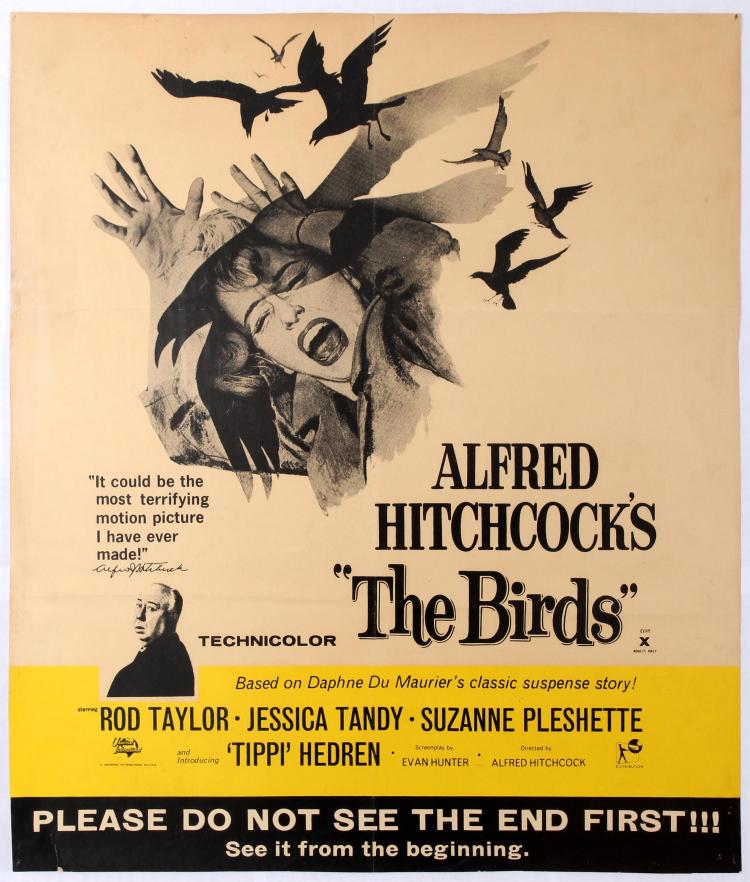
One of the first Alfred Hitchcock movies I ever saw was The Birds. We watched it on our big black-and-white television, and it was absolutely terrifying. What made it even more terrifying was that we as viewers–along with the characters in the film–had no idea what had turned the birds into vicious flocks of attacking predators. The movie was absolutely terrifying to a very young Gregalicious, who ever after always gave whatever birds he saw a wary look. That innocuous scene where the birds start gathering on the jungle gym? First a few that you notice, then you look again and there’s more… you look back another time and there are even more….more and more with every look until you have a sick feeling and think maybe I better get out of here–yes, I related absolutely to that scene in the movie and whenever I see a flock of birds gathered anywhere I have a bit of an uneasy feeling. You never really think about how vicious and terrifying birds–descended from the dinosaurs, after all–can be. Sure, we all know about the birds of prey, with their sharp claws and razor-like beaks; but sparrows? Blackbirds? Crows? How do you defend yourself if a flock comes for you? God, even now, just thinking about it gives me goosebumps.

I recently rewatched the movie (during the Rewatch Project during the pandemic) and it’s not as good a film as I remembered, but it’s still terrifying. I was curious to see how I would react to the movie, because in the intervening years I had read the short story it was based on, and the story is much, much better than the movie.

The fact it was written by Daphne du Maurier didn’t hurt.
On December the third the wind changed overnight and it was winter. Until then the autumn had been mellow, soft. The earth was rich where the plough turned it.

Nat Hocken, because of a wartime disability, had a pension and did not work full time at the farm. He worked three days a week, and they gave him the lighter jobs. Although he was married, with children, his was a solitary disposition; he liked best to work alone, too.

It pleased him when he was given a bank to build up, or a gate to mend, at the far end of the peninsular, where the sea surrounded the farmland on either side. Then, at midday, he would pause and eat the meat pie his wife had baked for him and, sitting on the cliff’s edge, watch the birds.

In autumn great flocks of them came to the peninsula, restless, uneasy, spending afternoons in motion; now wheeling, circling in the sky; now settling to feed on the rich, just turned soil; but even when they fed, it was as though they did so without hunger, without desire.

Restlessness drove them to the skies again. Crying, whistling, caslling, they skimmed the placid sea and left the shore.

Make haste, make speed, hurry and begone; yet where, and to what purpose? The restless urge of autumn, unsatisfying, sad, had put a spell on them, and they must spill themselves of motion before winter came.

I love Daphne du Maurier.

The story was originally published in her collection The Apple Tree and Other Stories; when the film was released in 1963 it was rereleased as The Birds and Other Stories. (One of the problems with trying to read all of du Maurier’s short stories is because her collections inevitably have at least half the stories that have appeared in other collections; so you can wind up buying a collection for the two or three stories in it you’ve not read; for example, my first du Maurier collection was Echoes from the Macabre, which included “The Apple Tree” (title story of another collection) AND “Don’t Look Now” (also the title story of another collection) AND “Not After Midnight” (which, as you probably already guessed, is the title story of another collection). I have yet to find a definitive list of du Maurier’s short stories anywhere, and it certainly is long past time that all of her stories are collected into a single collection (are you listening to me, du Maurier estate?).

The reason I love the story so much is because it really is a master class in tension and suspense. It’s also a much more intimate, small story than the film. Nat is a simple worker, loves his wife and kids, and wakes up one morning to winter and bizarre behavior from the birds. The way du Maurier describes the sight of the seagulls all gathered out on the sea, rising the waves in silence, is creepier than any shot of Suzanne Pleshette sprawled out on the walk with her eyes pecked out. The radio–there only method of communication and getting news from the rest of the world–is reporting on the strange behavior of the birds, and that they are attacking people. Most of the action–the truly terrifying action–takes place inside Nat’s cottage while they are under siege; the attacks have something to do with the tides. During the lulls he boards up the windows and tries to lay in supplies, as he slowly begins to realize that the birds are winning. They wait out the attack one night and in the morning turn on the radio…only to get static. It soon begins to feel like they are, or may be, the only humans left alive. And Nat also realized that it’s just the smaller birds–sparrows, wrens, seagulls–and worries about what will happen when the birds of prey join in….and of course, they do…the story closes with the hawks attacking the front door while Nat resignedly waits for them to get through.

If I were teaching a suspense writing class, I would definitely teach this story. It’s simply brilliant.

Miranda

Monday morning and it’s very bright this morning. The time change–I’d forgotten that it means getting up in the light and coming home from work in the dark. It’s also interesting how much that changes in one day. It was already getting dark before four yesterday, and was completely night by five. I don’t like the change, to be honest; it doesn’t help me get up in the morning and it makes me feel like the day’s been wasted by the time I get home because there’s no more daylight. It’s another one of the reasons I don’t like winter, to be honest, but at least down here in New Orleans it never gets super cold or snows, which does make it somewhat more bearable. I still don’t like coming home after dark, though.

Yesterday wasn’t a great day for me. I was very tired all day, despite sleeping really well, and never really felt like I had any energy. I tried to write for a while yesterday morning but got nowhere with it, which is causing me more than a little bit of stress today, and so I ended up watching a lot of television. We finished off the first season of Interview with the Vampire (more on that later), the first season of The Serpent Queen, watched the most recent Andor, and got caught up on American Horror Story. We also watched a movie called Nobody with Bob Odenkirk, which was interesting and a bit of a different approach to the usual “Dad gets vengeance” movie before finally toddling off to bed. I didn’t sleep especially well last night either–I kept waking up and had trouble falling back asleep, but it was a better night’s sleep than Saturday’s, so I will take it.

I think I had trouble sleeping Saturday night because I was so emotionally caught up in the LSU-Alabama game; I was a bundle of nerves and raw energy and anxiety the entirety of the game (which I still can’t believe we won; who would have ever thought we’d beat Alabama this year; everyone is very high, obviously, on Coach Kelly now). And now, of course, that we’ve actually beaten Alabama (first time in Baton Rouge since 2010) people are talking about LSU running the table this year and making it to the play-offs as the first-ever two loss team to get that far. One thing for sure is that LSU could certainly mess things up for the play-offs this year; who do they take if LSU does the improbable and hands Georgia its first loss of the season and wins the SEC? One loss Tennessee, who lost to Georgia and didn’t win their division? Georgia, defending national champion with one loss but didn’t win the SEC and lost to LSU? A two loss SEC champion LSU that lost to Tennessee? How do you decide between the three of them? And if you take two, as has been done occasionally in recent years, which two? This year is very reminiscent of the chaos of 2007–when a two-loss LSU team won the BCS title over Ohio State; the only two loss team since 1960 to be crowned national champions, and the only one of the championship game era (Georgia also only had two losses that year, and were highly ranked; they had a good argument but losing their division and not playing for the conference championship ruled them out–although both Alabama and Georgia have both won the national title without being SEC champions). It will be interesting. I am that Doubting Thomas still; certain we can win out the regular season by staying focused and disciplined, but I don’t know if LSU could match up with Georgia. I still think it likely that both Tennessee and Georgia are the most likely two to go to the play-offs, if the SEC winds up with two; but I also didn’t think LSU would beat Alabama this year, either.

Which shows how much I actually know, you know?

I wasn’t able to finish this before leaving the house for work this morning–I told you, the time change, combined with some insomnia and low energy days, have really messed with my mind; I was so tired this morning I even considered hitting the snooze button a third time–so here I am on my lunch break, trying to get it finished and posted so I don’t miss a day. (Being a completer can sometimes be a real problem, you know?) After I get off work today I have to run uptown and get the mail as well as pick up some groceries from the store–nothing much, just a couple of things, but might as well stop and get it over with, you know? I also hope to get some serious work on the book done tonight as well. I hate having lost the weekend, but low energy is low energy.

I did manage to read some of Wanda Morris’ new book this weekend (at the rate I’m going I won’t finish it until probably my trip to Kentucky), but also managed to read a new-to-me Daphne du Maurier short story, included in the collection Not After Midnight and Other Stories (it also includes, as every du Maurier collection does, “Don’t Look Now” and “Not After Midnight”). I’d gotten the book from eBay after finding out that it included “A Border-line Case”–which I enjoyed–as well as two other stories I’d not read, “The Way of the Cross” and “The Breakthrough.” This weekend during Georgia’s mauling of Tennessee I read “The Way of the Cross”, and really liked it. It’s long, as all du Maurier stories often tend to be, and it’s actually quite a nasty little story that spins out over the course of a twenty-four period with a small group of British tourists visiting Jerusalem and the Holy Land, most of them from a small village. Their vicar was supposed to be their tour guide for this visit; but he was taken ill and another available minister-type, who doesn’t know any of them and isn’t really completely comfortable taking over, has been asked to fill in. It’s one of du Maurier’s nastier little stories, but the reason it is so nasty is because of its brutal, unflinching honest view of the characters, none of whom really come out of the story well. What is particularly interesting is how illustrative this story is of du Maurier’s own cynical view of humanity, but her gifts make the characters so absolutely real it feels like the reader is literally looking inside their souls. The characters all have definite opinions of who and what they are; as well as their own histories. What happens throughout the course of this story is everyone is gradually humbled and made to take off their own rose-colored glasses and inevitably are forced to look at themselves and their lives very clearly–usually by overhearing two of the other characters talking about them. It’s a terrific story, and one I will definitely be revisiting at some point. (I also like they are visiting the Holy Land but definitely are not very Christian…)

And now it’s time to head back into the spice mines. Have a lovely Monday, Constant Reader–and oh yes, for the record: the reaction to Jayden Daniels’ overtime touchdown and later, the two point conversion did, indeed, register on the seismograph on campus. So, it, like the 1988 Auburn game, qualifies not just as an “earthquake” game but a double earthquake game.

GEAUX TIGERS!