Everytime You Go Away

There really is nothing like your own bed.

My inability to sleep in a hotel bed is becoming increasingly problematic the older I get; it’s hard for me to do public speaking events when I have trouble sleeping. I can rest; I just don’t fall deeply asleep and instead wind up in that half-sleep all night. In the morning I feel rested physically but not mentally, and I start getting tired. I also wind up drinking a lot more caffeine than I need to stay alert and focused, which then further complicates the inability to fall asleep. Heavy heaving sigh.

But the two events I did in Alabama this weekend–Murder in the Magic City on Saturday in Birmingham at the Homewood Library; Murder on the Menu in Wetumpka Sunday at the Civic Center–are wonderful events. They draw lovely crowds, all of whom love to read and also buy books, and are incredibly well organized. A special shout out to Margaret Fenton, who organizes Murder in the Magic City, and to Tammy Lynn Rushing and Fran Holland, who put together the Wetumpka event. If you ever get invited to speak, or have the chance to attend, you really should. Despite my inability to sleep, I always feel creatively invigorated as well as personally rewarded. I also really love the little town of Wetumpka; as weird as it sounds, I would like to go back there and spend a weekend exploring. I’ve always wanted to write about a small town in Alabama; and there’s lots of material, I suspect, there. I love that there’s a casino and a meteor crater there; one of the only concrete suspension bridges in the country; and two rivers. Driving from Birmingham to Wetumpka is always interesting; as at least a third of the trip is on state highways and not interstates, and as I drove, listening to my music and observing my surroundings, again I had many flashbacks to my own childhood and my own memories of Alabama. I also got re-inspired on a short story idea I had a couple of months back, and serendipitously an anthology it would be perfect for just popped up on my radar. Huzzah!

I took today off from work–a wise move–so I can get caught up on everything that slid while I was away this weekend. I have errands to run, some cleaning to do, some writing and editing, and a lot of organizing. *Whew*. Just thinking about it makes me feel very very tired. But I slept really well last night–there’s really nothing like your own bed, as I mentioned before–and I also need to get to the gym. I missed both Friday and Sunday workouts this weekend; I can make up the Sunday workout today but Friday’s, alas, is gone. I do miss it, and my body is all, what the hell man? And with Carnival getting back into full swing on Wednesday; it’s not going to be easy. I am going to skip cardio these next few workouts; I have to walk to and from work every day from Wednesday thru Friday, so those cardio workouts aren’t as necessary. I can go lift weights today, Wednesday, and Friday; I have Lundi Gras off so can replace the Sunday workout with one on Monday, and then get back to my regular schedule after Fat Tuesday. Huzzah!

And maybe I should start looking into eating healthier, too….sob.

I did manage to keep going on the short story project while I was in Alabama; I took Laura Lippman’s Hardly Knew Her collection with me and read the stories “Femme Fatale,” “Honor Bar, ” and  “A Good Fuck Spoiled.” (There were other stories there, like “Pony Girl” and “ARM and the Woman”, which I’d already read in their original publications; I even reprinted “ARM and the Woman” in my co-edited –with J. M. Redmann–anthology Women of the Mean Streets.) I loved these stories, and one of the things I love the most about Lippman’s short stories is how dark they are; they are most definitely hard-boiled and noir. I also love that the stories are about women who aren’t what would typically be called ‘nice girls;’ these are women with shady pasts who aren’t sorry about their pasts and will do what they need to do.

“A Good Fuck Spoiled” though, isn’t about a woman, although in some ways it is; it actually spins the tired trope of the older man/younger woman adulterous affair on its head. This is one of those stories where someone who is basically your average, every day husband and father is pushed over the edge into doing something dark in order to get out of a bad situation his own apathy kind of allowed him to drift into. It’s also exceptionally clever by playing with the entire concept of ‘betrayed wife’ against ‘golf widow,’ and of course, the husband, once he does what he needs to do–sees it exactly that way; I love how Lippman shows how someone can do something amoral and then completely justify it. God, this collection is amazing. Laura Lippman is definitely respected as one of our best crime writers today–but I don’t think she gets near enough credit as a short story writer.

And on that note, I need to make a list and start checking things off it.

IMG_1924

Time Will Reveal

Last night I got home from work early; after stopping at the grocery store to alleviate some of the errands I must run today. I cleaned the living room and worked on organizing the books some, did some laundry, and did the living room floor, as well as laundered the living room blankets and vacuumed the love seat and my easy chair. Mindless chores, as I mentioned on both my panels at Comic Con last weekend, are marvelous for brainstorming and thinking; which I did a lot of. The Short Story Project is also inspiring me, which is really cool, too. The Facebook ban is freeing me up to do a lot more reading, a lot more brainstorming, and so really, I have to thank not only the Puritan trash who keep reporting my pictures of shirtless men but the equally puritanical censors at Facebook, whose word is law and cannot be questioned. As I mused early on in the ban, all this is really succeeding in doing is breaking me of the Facebook habit. How horrible! What a punishment!

Assholes.

So, last night I repaired to my easy chair once I had made myself something to eat and the living room was cleaned and organized. I started looking through my Amazon Prime app on the Apple TV–I can’t tell you how nice it is to have that app now, so I don’t have to switch over to the Prime function of the TV, which doesn’t work as well–and realized that I had subscriptions to both Acorn and Starz through it! I found a bunch of wonderful movies that I’d like to see again, or haven’t seen and want to, on the Starz menu; likewise for some series on Acorn. I settled in with my book and started watching The Towering Inferno, which I had actually never seen. Highly entertaining, badly acted, and starring a smorgasbord of Oscar winners and other interesting casting choices (O.J. Simpson! Mike Lookinland! Soap diva Susan Flannery! Susan Blakely! Richard Chamberlain! Robert Vaughn!), I kept rolling my eyes at the terrible dialogue and immensely stupid situations, not to mention the insane solutions to the fire they kept coming up with–um, it was an electrical fire; yes by all means use water so people will get electrocuted. 

Seriously.

I also noticed a rather obvious theme that runs through all disaster movies–human hubris, and human greed and incompetence always seem to play a part in the disaster. To bring the construction in under budget, Richard Chamberlain cut corners in safety features  as well as in the specifications for electrical wiring. In The Poseidon Adventure the ship is top-heavy because they didn’t take on enough ballast-in fact, removing some–to try to make it to their final port on time as they are running behind; which of course made the ship prone to capsizing in the case of a tidal wave. But next up on my Starz viewing is the 1969 film Airport, based on the Arthur Hailey novel and the blockbuster hit that really kicked the Disaster Movie craze of the 1970’s off–even though the movie is about more than just the imperiled airplane. I’ve not seen this movie, or reread the book, since I myself worked for an airline at an airport; this could make it really interesting.

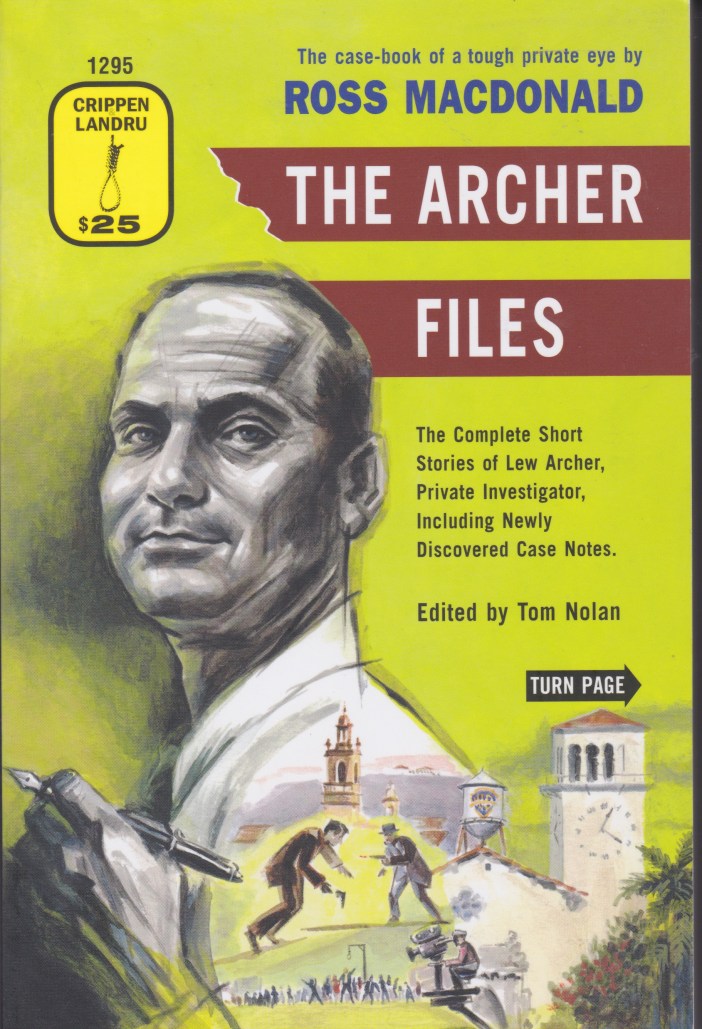
As for the Short Story Project, I may have mentioned sometime this week that I discovered a collection of Ross MacDonald short stories on my shelves that I’d forgotten I had, The Archer Files.  I read the first two stories in that collection this week. I came to MacDonald rather late in life; I became aware of him in the 1970’s, but his book covers, with their lurid scantily clad women and back cover blurbs that promised machismo and tough guy behavior, didn’t interest me. I didn’t start reading MacDonald until years later, when Christopher Rice recommended him on a panel we both were on. I’d come to love John D. MacDonald in the 1970’s, and so I decided to give Ross a whirl. I think the first one I read was The Drowning Pool, and after that, I was completely in on Ross MacDonald. I have also come to a great appreciation for the extraordinary talent that was his wife, Margaret Millar…I love to imagine what their dinner conversation was like.

the archer files

The two stories, “Find the Woman” and “Death by Water,” were not originally written or published as Archer stories; they were adapted and turned into Archer stories later, after MacDonald was dead and this was authorized by the estate. The stories work as Archer stories, which is really all that matters. I’ve not yet read any of his non-Archer novels, but some of them are in the TBR pile; I’ll be curious to see if there’s a stylistic difference, or a significant change in voice.

I sat in my brand-new office with the odor of paint in my nostrils and waited for something to happen. I had been back on the Boulevard for one day. This was the beginning of the second day. Back in the window, flashing in the morning sun, the traffic raced and roared with a noise like battle. It made me nervous. It made me want to move. I was all dressed up in civilian clothes with no place to go and nobody to go with.

Then Millicent Breen came in.

I had seen her before, on the Strip with various escorts, and knew who she was; publicity director for Tele-Pictures. Mrs. Dreen was over forty and looked it, but there was electricity in her, plugged into to a secret source that time could never wear out. Look how high and tight I carry my body, her movements said. My hair is hennaed but comely, said her coiffure, inviting not to conviction but to suspension of disbelief. Her eyes were green and inconstant like the sea. They said what the hell.

That is how “Find the Woman” opens, and what a great example of the hardboiled, noirish style of crime writing. Not a lot of words, not a lot of sentences, and yet we get a strong sense of Archer’s character, just out of the war and chafing restlessly at his new life and existence, and the danger inherent in Millicent Breen. She is beautiful, older, sexy and dangerous; she wants Archer to find her daughter, a movie starlet who has disappeared, and this leads Archer into the  dangerous world of movie stars and film people, of love gone astray and a slightly sexist depiction of restless women who might love but need someone in their bed every night. I enjoyed it, not only as an example of the writing style but as a time capsule; it was easy to picture this in black-and-white, with Bogart as Archer and maybe Myrna Loy as Millicent Breen.

He was old, but he didn’t look as if he were about to die. For a man of his age, which couldn’t have been less than seventy, he was doing very well for himself. He was sitting at the bar buying drinks for three young sailors, and he was the life of the party in more than the financial sense. In the hour or so that I  had been watching him, he must have had at least five martinis, and it was long past dinner time.

“The old man can carry his liquor,” I said to Al.

“Mr. Ralston you mean? He’s in here every night from eight to midnight, and it never seems to get him down. Of course some nights he gets too much, and I have to take him home and put him to bed. But next day he’s bright as ever.”

And so begins “Death by Water.” Again, note the writing style; the sparse use of words to get a point across, the inherent toughness in the words chosen and how they are put together. Mr. Ralston ends up dead later on, of course; drowned in the swimming pool, and Archer is on the case. It’s a great little crime procedural, with Archer taking mental notes as he talks to witnesses and the people involved, and once the case is actually solved, it’s pretty clear that the solution was right there in front of our faces all along. Well done!

And now, back to the spice mines with me. Paul’s going into the office, I have some errands to run, and we’re going to go see I, Tonya tonight; I intend to do a deep, overdue cleaning of the kitchen today as well, around writing and editing.


An Innocent Man

EPIPHANY. King cake season has officially begun! HUZZAH! Although…Christ on the cross, it’s Carnival season already. In fact, a month from tonight there will be parades. As I sit here shivering in my kitchen (although the sun is out) this morning, that thought blows my mind.

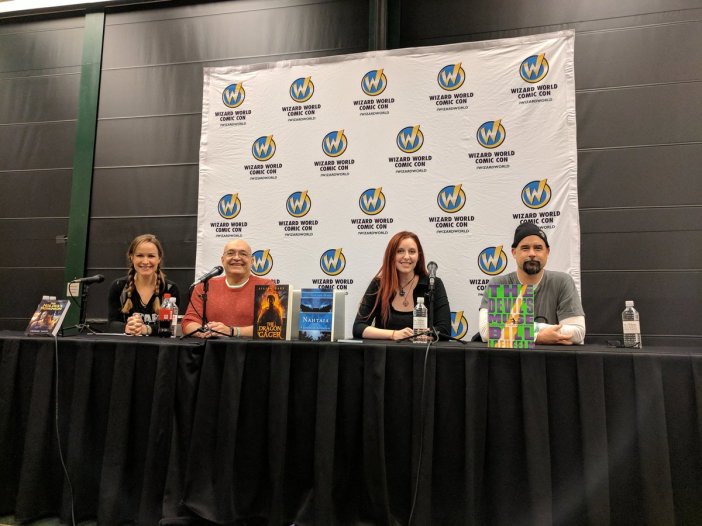
Anyway, Comic Con was very fun yesterday.

DS0NZsWW0AAhYQ4

And this was lovely:

DSz8qtXWkAAKhrF

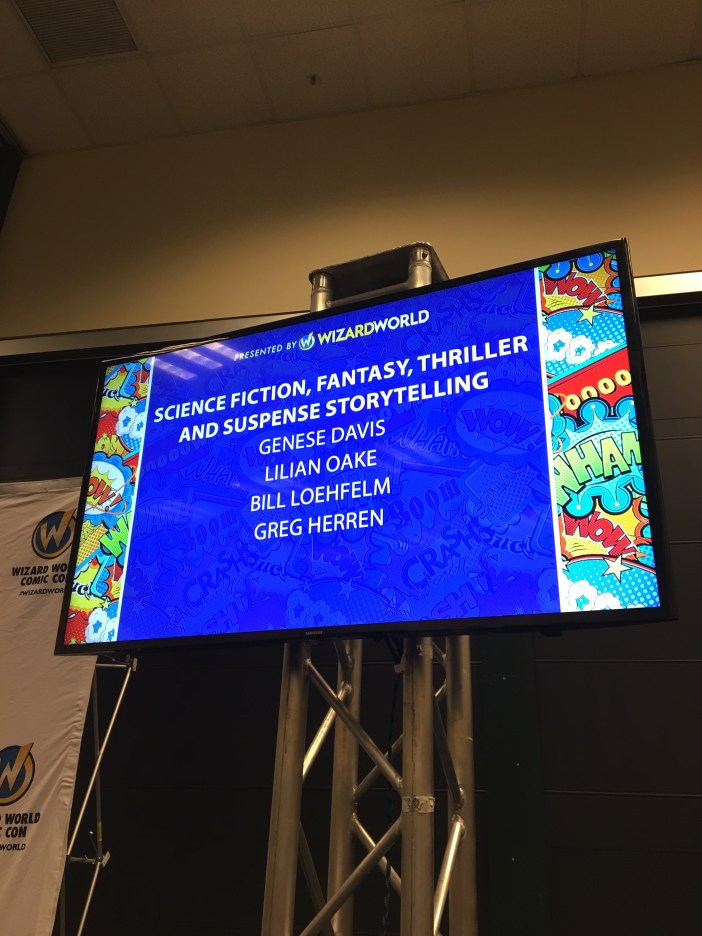
And instead of name plates, they had a MARQUEE:

IMG_3550

How lovely to have one’s name up in lights, as it were!

DS3p5WqX0AIKPpS

It was a great panel, lots of great questions from the audience, and some great discussion and tips and hints about writing.

Then I walked home, and watched the live stream of the US Figure Skating National Championships, which reminded me that I had an idea for a figure skating noir, and even started writing the first scene in the book, so here’s yet another fragment for you:

The move is called a charlotte.

The move is not considered masculine so his coach will not let him do it in a program. But he’s proud that he has the flexibility to do it, and he always gets to the rink early so he can practice the moves he will never be allowed to do until he lets his Olympic eligibility go and scoring no longer matters.

Men don’t do spirals.

He reaches the end of the ice and goes into a curved turn, going to the inside edge and letting centrifugal force pull him back around so that he’s facing the other end of the ice. He turns and glides backward. He brings his arms together, crossing them at the wrists in front of his chest and explodes them out in a straight line at his sides at ninety degree angles. With his chest puffed out he bends at the waist, raising the left leg up, perfectly straight, the toes pointed as he brings his chest down to his right knee, grabbing the right ankle with both hands as he continues to glide toward the other end of the rink, his left leg raised in a perfect split, feeling the stretch in his groin and his hamstring. The stretch feels good and he works to catch his breath, his heart still thudding in his chest and his ears, the cold emanating from the ice slapping his cheeks, a drop of mucus hanging from the end of his nose as the slide slows.

When he is almost to the other end of the rink he pushes with his hands off from the ankle, bringing the back leg down and tapping the toepick on the ice, digging it in and launching himself up into the air, pulling his arms back in and together as he spins neatly in the air, ankles crossed and counting.

One….two…three.

After the third revolution he releases the tight arms, exploding them out at ninety degree angles to the side as his right foot comes down and his left leg goes backward. The blade of his right skate lands off balance, on the inside edge and hits a groove in the ice. There’s no way to save the landing. His ankle gives under the pressure of the force and he falls.

This is going to hurt.

Is all he has time to think before he hits the wet, glistening ice. He lands hard, chest first followed by the rest of his torso and his legs tangle. The impact forces all of his air out of his lungs and the thud sends jolts of pain, dull agonizing pain, through his ribs and he gasps for air as he spins on the ice, out of control and unable to stop himself until his crashes into the boards with his right side and bounces back off out onto the ice, finally coming to a stop with stars dancing in front of his eyes and his lungs gasping to take in the icy cold air. He lies there for what seems an eternity, the wet ice soaking through the sweatshirt he is wearing, his ribs aching, his legs screaming in pain from the lactic acid burning through the muscle fibers. He lies there, knowing he needs to get up and start moving before the muscles seize and tighten, knowing he needs to get back up on the blades and build up speed and try the lutz again, it has been drilled into his head so many times to get back up and skate, when you fall you have to get up and try the jump again and keep trying until you land it, otherwise you’ll become afraid and will never be able to land it, you have to be fearless, get up, get up, get up….

But sometimes he wanted to never get up. Sometimes he wanted to just crawl over to the opening, take off his skates and grab his bag and put on his shoes and walk out of the rink never to come back.

He gets up, his breathing still labored, his legs still aching. He starts doing crossovers, even though his legs are shaking, and he picks up speed, going faster and faster and it feels like he is flying…flying…and nothing will ever bring him down.

A little rough, but not bad.

And here’s Guillaume Cizeron, the sexy French ice dancer, for your Saturday viewing pleasure:

13187978_486739044862306_934340098_n

They Don’t Know

Friday, and this afternoon I am paneling (well, I guess it’s more of an early evening panel, really) at Comic Con, and that should be a lot of fun.

My Short Story challenge has not gotten off to the best start; here it is the fifth day of January already and I have only just now managed to finish reading one story; it’s shameful, I know. But I got out my enormous volume The Best American Noir of the 20th Century, and dutifully read the first story, from 1923 (!). 1923! Who knew noir went back so far? Much as I love noir, and as often as I think about it–I really should do a lengthy study of noir, both print and film–I don’t know much about its history; seeing that stories defined as noir were being published as far back as 1923 was a bit of a surprise for me; I guess I just always assumed noir fiction was something that came about in the late 1930’s, and was primarily pioneered by the great James M. Cain.

Shows you how little I know.

But I love noir; I am more drawn to it than actual more traditional crime fiction, to be honest. Most of my short fiction would be classified more readily as noir rather than as crime; as I have said before, I like to write about damaged people, and the stories of damaged people are more prone to wind up categorized as noir. I am currently in the midst of writing two stories that are noir–more details on them both when they become available–but I am very excited about both of them.

But I read this amazing story, “Spurs” by Tod Robbins, which is the opening story in the Best American Noir omnibus.

Jacques Courbe was a romanticist. He measured only twenty-eight inches from the soles of his diminutive feet to the crown of his head; but there were times, as he rode into the arena on his gallant charger, St. Eustache. when he felt himself a doughty knight of old about to do battle for his lady.

What matter that St. Eustache was not a gallant charger except in his master’s imagination–not even a pony, indeed, but a large dog of a nondescript breed, with the long snout and upstanding aura of a wolf? What matter that M. Courbe’s entrance was invariably greeted with shouts of derisive laughter and bombardments of banana skins and orange peel? What matter that he had no lady, and that his daring deeds were severely curtailed to a mimicry of the bareback riders who preceded him? What mattered all these things  to the tiny man who lived in dreams, and who resolutely closed his shoe button eyes to the drab realities of life?

I’m not sure that I would call this story noir in the classic sense; but who am I to argue with James Ellroy or Otto Penzler? The story, which is centered around the performers in a French traveling circus, is reminiscent both of American Horror Story: Freakshow and of course, the classic film Freaks, and, as it turns out, the film was based on the short story. Courbe has inherited money and an estate; he has fallen in love with one of the bareback riders, a large strong woman who agreed to marry him for his money; despite being in love with another one of the bareback riders–she is marrying him for his money, of course, and assuming he won’t live long; if he does live longer than is convenient, she will poison him, and she and her true love with live happily ever after on the little man’s money. But despite the same set-up, the film deviated from the story from the wedding onward; the story isn’t quite as dark as the film (seriously, what could be?) but it’s plenty dark and plenty creepy; and an excellent way for me to kick off short story month.

And now tis back to the spice mines with me; here is a hunk to ease you into your weekend.

IMG_1967

Twist of Fate

It snowed yesterday in New Orleans, and it is still cold today–albeit sunny. I am sitting at my desk this morning wearing fingerless gloves so I can type, a  knit LSU cap on my head, and a blanket wrapped around my legs. I also have to go to Costco at some point today, and I also have to get some things done. Needless to say, a temperature around fifty at my computer doesn’t make that more likely. I may check into space heaters at Costco today–although I may check the attic. There should be another one around here somewhere.

When I got home last night I turned on the heat and cleaned the upstairs, then grabbed a blanket and headed for my easy chair.I stopped reading The Last Picture Show when I got to the bestiality part (which I’d completely forgotten about) and even though there’s an even more important part of the story after the cow-rape (seriously), I just couldn’t pick the book up again. I know I can skip over that part, but honestly. I didn’t remember it, or the relatively nonchalant way McMurtry talked about it in the book–like it’s very common place amongst farm boys (literally, “every farm boy has done it”)–and I don’t know…I still have fond memories of the book, but despite the fact that it’s still really well written, I don’t know if I’m going to keep reading it; although I suppose if I continue reading it as an example of toxic masculinity…and the homophobia in it–what would toxic masculinity be without some good old homophobia?–is also not easy to read; because it’s so casual. 

Then again, that was the thing about the culture back then (it’s set in the 1950’s); the hate was so casual and matter-of-fact. It’s a short book, I may go back to it later today. (And interestingly enough, Larry McMurtry also co-wrote the screenplay for Brokeback Mountain, so there’s that.)

Speaking of homophobia, I was scrolling through HBO Now last night looking for something to watch, and noticed they had American Gigolo available. I had watched that movie only once, years ago on videotape, when a female friend had rented it. I didn’t remember much about it, other than Richard Gere was so incredibly beautiful and at the end Lauren Hutton came through for him at the end, and Blondie’s “Call Me” played over the opening credits and it was criminal that the didn’t at least get an Oscar nomination for Best Song. It should have WON, damn it. It’s a great song and it still holds up today.

91uUHSjYBpL._SY445_

I also remembered that it wasn’t very good.

That memory was correct, but watching it again…so much wasted potential in this movie. It could have been a noir classic.

Gere plays Julian, or Jules, who basically is a gigolo, and not cheap. He works for several different pimps–one a blonde woman with a great beach house, the other a black gay man–but Jules is so in demand and so good at what he does-and let’s face it, Gere smolders. You can see why he catches everyone’s eye when he walks into a room, and no one wears an expensive suit like he does–but he’s also become incredibly arrogant because he is so good. Both of his pimps argue with him about the split on jobs they get for him–but he’s so good he always gets his way, but both warn him that his attitude and ingratitude to them is going to bite him in the ass one day. The gay pimp sets him up with a kinky job in Palm Springs–he has to be abusive to the woman while the husband watches–which makes him incredibly uncomfortable but he does the job well because the pimp tells him they want him back. Jules throws the word ‘fag’ around a lot–“I don’t do fags” etc., which, as someone who is paid for sex, I can certainly see why he would want to be clear on what he does and what he doesn’t, but again–casual homophobia. He meets and falls for Lauren Hutton in a restaurant at a posh hotel, who turns out to be an unhappy politician’s wife. They embark on a secret affair, but she turns out to be his alibi for the night the Palm Springs wife is murdered…and he can’t tell the police about her. This is also kind of where the movie goes off the rails. The crime itself is treated as an afterthought, and Jules being suspected and investigated–and he is being framed–are all secondary to his development as a character; all of this is just a moral lesson for him about being humble and how you shouldn’t treat people badly because they won’t stand by you when you need him, all the while he’s making this incredible noble sacrifice for the woman he loves.

A woman is brutally murdered as a plot point and pivot so Jules can learn humility.

Whoa. And wow.

And even the resolution doesn’t make sense. Turns out the gay pimp pulled off this elaborate ruse and frame just to teach Jules a lesson in humility? I wasn’t really clear on this at the end; it didn’t make sense to  me the first time I watched and it still didn’t make sense this time. The confrontation with the pimp ends with him accidentally knocking him off the balcony, but Jules tries to save him, but he can’t hold him. He falls to his death with Jules literally left holding his boots. He is taken in by the police and arrested, refuses to speak to his lawyer, but then Lauren Hutton comes forward and alibis him for the original murder, because she loves him…and they speak to each other through glass in the prison’s visiting room when she tells him she’s cleared him because she loves him. The end. And my first thought was, well, your alibi isn’t going to do him any good NOW that he’s killed the pimp, even if it was an accident. So you just blew up your own life for no reason because he’s still going to jail.

None of that was resolved. It’s really a shame, because it could have been a great noir classic. And it many ways it is actually a good film, and highly original: it was one of the first movies to ever focus so heavily on male beauty, and Gere is often in underwear or naked (full frontal, at that) or shirtless; the camera lingers over him lovingly the way it previously only did for women; the soundtrack by Giorgio Moroder was excellent and also the first time electronica music was used for a film score; and the entire film is beautifully shot. But the writer/director didn’t see it as a film noir or a crime film; he saw it as a character study with a redemptive arc, and that was where the film fell flat.

Pity.

And now back to the spice mines.

Hold Me Now

Happy Thanksgiving! We have our deep dish pizza in the refrigerator, which we will be heating up later when our friend Lisa comes over to watch some movies; which is what we do every year for Thanksgiving. (Lisa is the one who introduced us to each other.) Today I am going to take a day off from writing and stressing; no news, no worries. Paul is going in to the office tomorrow, so I’ll have tomorrow to do some writing and editing and so forth and I also have Monday off as well. He’s departing to visit his mom for a week one week from today as well. So, yes, today is the day where I am not going to be stressed about anything and just relax and enjoy the day. I’ll probably spend Saturday doing copy edits and working on the Scotty Bible (which means, going through the books with post-it notes to mark pages with references to regular characters so I can check for continuity).

I finished reading Adam Sternbergh’s The Blinds last night, and it is definitely one of the best books I’ve read this year; it’s a remarkable concept, and Sternbergh delivers on it completely. It’s just exceptional. I’m going to review it here, but I am going to let my thoughts on it brew for another couple of days or so. I also started reading Ivy Pochoda’s Wonder Valley last night, and while I am only a few chapters in, it’s already blowing me away. This is some extraordinary writing and character development, people. I have Ivy’s earlier books in my enormous TBR pile, but I wanted to read this one and review it since it’s more current; her books will be moving up in the TBR pile now. I’ve now read some amazing books back to back; If I Die Tonight by Alison Gaylin, Sunburn by Laura Lippman, The Wife by Alafair Burke, and now The Blinds, and as I said, the Pochoda is also exceptional; I’ll be reviewing the others here closer to their release dates.

Glad I am not judging any awards this year or next. Whoa.

After abandoning the other short story I started working on another one. I wrote its first draft about thirty years ago, and of course, it’s terrible, but I liked the main character and I liked the setting, which are about the only things I am keeping for the story. I have, over the years, realized that the story is actually a great noir set up, so I am revising it accordingly, and while the story was originally about unrequited gay desire…I am changing it to something darker. The gay desire will still be there, but it’s just going to be a lot darker. This draft is just to get the story down; after which I will do another draft to deepen the characters, and then another to make the story itself stronger and more horrific/shocking, and then once more for language. This was the problem with the other story; I couldn’t get the story down and it was taking forever. (Although I am now itching to take another run at it, if you can believe that. Lord.)

And on that note I am going back to the spice mines. I need to get this place looking more ship-shape before Lisa arrives, and I have a shit ton of filing and organizing to do.

Here’s something I have always been thankful for: Calvin Klein underwear ads.

644861

Owner of a Lonely Heart

Tuesday, Tuesday. I managed to slog through another thousand words of the new Scotty yesterday, and some things I want to do with the book are starting to take shape. I also managed another five hundred words on an essay I am writing and need to finish, but it’s a tricky one–one that could easily give offense. I am going to go back to the beginning of it again this morning and see if I can start revising at the start, and maybe then I’ll be able to finish it. I feel a bit rusty–I used to be able to knock off a couple of thousand words in an hour or two, no problem, every morning, and now it’s more of a slog. I am going to blame it on a lack of practice, and that I need to simply get my writing muscles back into shape.

Yeah, that’s the ticket.

I have to say that I finished reading my advance copy of Laura Lippman’s Sunburn this weekend, and was completely blown away by it. I’ll post a review when it’s around time for the book to be released, where I will go into more detail about how incredible this book is, but reading it and the new Alison Gaylin (If I Die Tonight) was truly inspirational. Ironically, I myself have had an idea for a noir thriller lying around in my files for decades now, also called Sunburn–which, obviously, I won’t be able to use now, if I write it I’ll clearly need a new title–but they have nothing in common other than the title and the sensibility. I love noir so much, and I really want to write more of it. I also started reading my advance copy of Alafair Burke’s The Wife Sunday night, and got more into it last night, and it, too, is quite extraordinary.

Reading such amazing work by friends is inspirational, but also a bit humbling. But I also kind of love reading books that make me think, boy, I have to work harder and do better. 

And on that note, I should get back to the spice mines and get to work.

Here’s a Tuesday hunk for you:

IMG_1823

Up Where We Belong

Oh, Florida.

I am connected to Florida, and despite all the negative reactions just saying Florida can often trigger simply by saying the word, I have a genuine fondness for the pork chop shaped state. My grandparents retired there, to the Panhandle, when I was a kid; an aunt owned a summer house a few blocks from the Gulf in Panama City Beach. I spent a lot of time there during the summers when I was young (part of the annual jaunt to Alabama); and I wound up living there in the early 90’s when I worked for Continental Airlines. I visited Miami and South Beach frequently; I have many friends who live (or have residences) in Fort Lauderdale. I’d intended to set my novel Timothy there originally–the house was going to be on one of the islands across the Intercontinental Waterway from Miami. (I did have my couple meet and fall in love on South Beach, although the story moved them back to the beautiful house on Long Island, near the Hamptons.) I’ve always wanted to write about Florida, and I’ve always loved reading about Florida. There’s something noir and gritty and hardboiled about Florida, yet at the same time there’s this zany wackiness to Florida (so people will post link to bizarre news stories about things that happen there on social media and say “Oh, Florida.”)

There are so many wonderful books about Florida; so many amazing writers have set their novels there–from Robert Wilder’s Flamingo Road to John D. MacDonald’s noirs and Travis McGee novels to Elaine Viets’ badass Helen Hawthorne series to Edna Buchanan to the sublime Vicky Hendricks (you MUST read Miami Purity, Constant Reader) to Randy Wayne White’s Doc Ford series–the list could go on and on and on. Everything works in Florida; whether it’s hard-boiled crime or hilariously funny crime or noir.

There’s actually a Florida noir in my mind right now, that I am hoping to get to at some point this year (if I don’t run out of time; if I do, it’ll be next year.)

medium

On the fifteenth of March, two hours before sunrise, an emergency medical technician named Jimmy Campo found a sweaty stranger huddled in the back of his ambulance. It was parked in a service alley behind the Stefano Hotel, where Jimmy Campo and his partner had been summoned to treat a twenty-two-year-old white female who had swallowed an unwise mix of vodka, Red Bull, hydrocodone, birdseed and stool softener–in all respects a routine South Beach 911 call, until now.

The stranger in Jimmy Campo’s ambulance had two35-mm digital cameras hanging from his fleshy neck, and a bulky gear bag balanced on his ample lap. He wore a Dodgers cap and a Bluetooth ear set. His ripe, florid cheeks glistened damply and his body reeked like a prison laundry bag.

“Get out of my ambulance,” Jimmy Campo said.

“Is she dead?” the man asked excitedly.

And so begins my latest Carl Hiaasen read, Star Island. 

I chose to read another Hiaasen rather something heavier and darker because, quite frankly, this entire past week had been so crazy on every level–what with what was going on in the country in general, madness at home, madness at the office–that I wanted something that would help me escape from it all, and Hiaasen always delivers. His books, which seem so zany and wild and yes, fluffy, on the surface are actually much more; there are layers and depth there that may not be readily apparent. Star Island not only has the trademark Hiaasen wacky wit, but it’s also a very subtle critique of our current celebrity culture,  and how an entire media has built up around ‘entertainment news.’

Star Island focuses on the misadventures of a young pop star who rose to fame by selling sex in her videos at age fourteen: Cherry Pye, and her team of handlers who really see her as a cash cow and not as a human being. Cherry is beautiful and sexy, but not much talent–relying on autotune and back up vocalists being dubbed in and over her own off-tune warblings. Cherry is the worst kind of diva: spoiled, selfish, narcissistic, and used to having her team–which includes her awful parents–clean up her messes so she never has, and is wholly incapable of, taking any responsibility. Because she is so frequently in and out of rehab, her team has had to hire a look-alike, Annie DeLusian, an actress, play her in public to cover up overdoses, etc. The book opens with Cherry on the verge of another comeback with a new album, Skantily Klad, and also overdosing on the combination of things in the excerpt above while partying with a young three-named actor. Annie fills in for her to fool the paparazzi while the team slips the girl out the back–and the story is off to the races. Will her team be able to keep Cherry sober and out of trouble long enough for the investment in her new album put her back on top again? Will the paparazzo completely obsessed with her get the shots he needs to get himself out of the hole? And what about Annie, the only decent person in this whole mess? Tired of playing Cherry and dealing with her horrible team, will she be able to find her way out of this and maybe get some gigs that actually use her talent?

Star Island also brings back two Hiaasen characters from past books: Skink, the ex-governor of Florida who now lives in the wilderness and wreaks havoc on corrupt developers and others who work to destroy the complex Florida ecosystem; and Chemo, the criminal sociopath who lost a hand to a barracuda and had it replaced with a weed whacker. (Yes, it sounds crazy. The first Hiaasen I read, over twenty years ago, was Chemo’s first adventure, and was so silly and over-the-top that I refused to read another Hiaasen until I picked up Bad Monkey off a sale table at a Barnes and Noble in DC a few years ago; now I get what Hiaasen is doing with his work and enjoy it.)

Star Island made me laugh out loud several times, and somehow, with all of its twists and turns, everything was wrapped up at the end in a very satisfying package. Hiaasen novels are intricately and complexly plotted, which I admire–plot is always an issue for me, and I am always afraid I am leaving threads hanging when I finish writing a novel.

The book was exactly what I needed to read this weekend.


Jeopardy

So, yesterday was my birthday. Fifty-six officially; although I always add a year to my age on New Year’s Day for the sake of simplicity. I had some trouble falling asleep on Saturday night; a combination of restlessness and heartburn. I wound up sleeping in till almost ten; which is late for me but since I didn’t really fall asleep until around three in the morning it wasn’t that much sleep. But I had a lovely day, really. I kind of just laid around and reread In a Lonely Place by Dorothy B. Hughes, rewatched The Philadelphia Story on TCM (Katharine Hepburn and Cary Grant were both robbed of Oscars), then watched The Nineties and The History of Comedy on CNN before finally watching last night’s Game of Thrones.  I also thought about the new Scotty some; I have today off from work as my birthday gift to myself, so I plan on doing some writing, line editing, and revising, and thinking about what I’m going to write next before actually sitting down at the computer is always a wise thing to do (although usually I never had the time to do that, thanks to deadlines). There’s a serious moral dilemma coming for Scotty in this book; one that really has been needing to be dealt with in the series for quite some time, but I’ve dodged it and avoided it; this is the book where I am finally going to have to have him face up to it, the way I am bringing it to the forefront so he can no longer avoid it is, if I do say so myself, rather clever.

Or it’s just going to be a steaming pile of shit. There’s no middle ground, really.

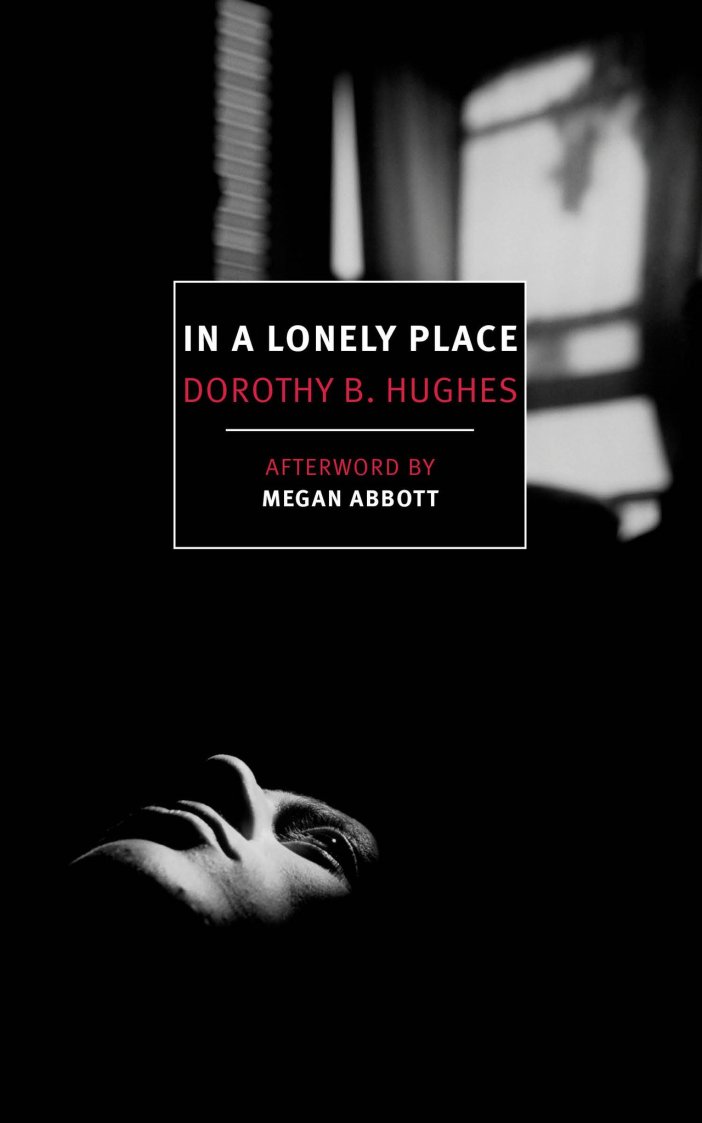
It was kind of fun to reread the Hughes novel; it is a masterpiece of noir that has been sadly overlooked for many years. Hughes was an exceptional writer, and I do admit that opinion is based on my having read only two of her novels, this and The Expendable Man (which, sadly, was her last and published in 1962). It’s not easy to find Hughes’ novels. I do feel safe in calling Hughes one of the best writers of her generation, and certainly one of the best noir writers of all time, based on those two books because they are just that good. I do have a copy of her The Blackbirder, which I want to read before the end of the year. In A Lonely Place was also filmed, directed by Nicholas Ray and starring Humphrey Bogart and Gloria Grahame; the film is significantly different from the novel, but it’s also outstanding. The new edition of the novel, from New York Review Books (who also have republished The Expendable Man and The Blackbirder), includes an afterward by the wonderful Megan Abbott, who is not only one of this generations greatest writers but also one of crime fiction’s most knowledgeable critics; her literary criticism is intelligent, thoughtful, incredibly well-written, and certainly puts me in my place whenever I am lucky enough to read some of it; I would love to read her study of literary and film noir, The Street Was Mine. (Whenever I read her criticism, any thoughts I might have about pursuing academic criticism–gay noir, gay representation in crime fiction, the heyday of romantic suspense from the 1950’s till its unfortunate death in the 1980’s–go out the window.)

Her all-too-short essay in the back of this edition alone makes the cover price worthwhile.

hughes.final_hi-res_2048x2048

It was good standing there on the promontory overlooking the evening sea, the fog lifting itself like gauzy veils to touch his face. There was something in it akin to flying; the sense of being lifted high above crawling earth, of being a part of the wildness of air. Something too of being closed within an unknown and strange world of mist and cloud and wind. He’d liked flying at night; he’d missed it after the war had crashed to a finish and dribbled to an end. It wasn’t the same flying a private little crate. He’d tried it; it was like returning to the stone ax after precision tools. He had found nothing yet to take the place of flying wild.

It wasn’t often he could capture any part of that feeling of power and exhilaration and freedom that came with loneness in the sky. There was a touch of it here, looking down at the ocean rolling endlessly in from the horizon; here  high above the beach road with its crawling traffic, its dotting of lights. The outline of beach houses zigzagged against the sky but did not obscure the pale waste of sand, the dark restless waters beyond.

He didn’t know why he hadn’t come out here before. It wasn’t far. He didn’t even know why he’d come tonight. When he got on the bus, he had no destination. Just the restlessness. And the bus brought him here.

Isn’t that an incredible opening?

Not being an expert in crime fiction–there’s so much of it to read, and there’s more new stuff all the time, so it’s hard to keep up with the new let alone trying to read everything already published–I am unable to place In A Lonely Place into any kind of context as far as the history of crime fiction is concerned, but Abbott does this beautifully in her afterward. But it’s very clear in this opening paragraphs that Hughes is addressing alienation in this book, and toxic masculinity, which may have seen its ultimate pinnacle in the second World War (the alienation of returning veterans, and the difficulty of readjusting from war to peace was also being addressed in films like The Best Years of Our Lives) and by having Dix, her main character, pretend to be writing a novel also took on the glut of post-war war novels that so many returning soldiers were writing; novels that continued to proliferate for several decades beyond the war.

The first time I read the book, having already seen the film, I was more focused on the story itself rather than an examination of how deftly Hughes creates her story, the language and imagery she chooses, and the nuanced way she creates her character. On this read, knowing how it’s going to end, I was able to pay more attention to these things, and was able to marvel at how brilliant the entire package is.

A recurring motif in the novel is fog; Hughes uses the fog as a metaphor for the fog in Dix’s brain; and we are never sure when Dix’s mind changed, making him lethal. He was raised by a puritanical uncle, Fergus, who is currently supporting him while he writes his novel–but there is a limit to the support, and while in our time $250 a month may not seem like much, at the time of the novel it was a fortune, just over $2500 in today’s dollars. Dix’s resentment of the uncle–we never learn what precisely happened to his parents–who is rough on him and has always made him work, even when he was in college at Princeton trying to fit in with the idle rich sons of privilege and then goes into detail how humiliating it all was, doing things for them for ‘tips’ until he could manipulate events to make it look as though he were the wealthy one and the sad unfortunate, unpopular boy he used for money were the dolt. In this way, Hughes also makes a sly commentary about class and privilege (which, in my opinion, she does far better than Fitzgerald did in an entire novel with The Great Gatsby, and she does it only in a few pages). So, there was always some kind of a chip on Dix’s shoulder; the war simply gave him a way to channel that anger and discontent and alienation. Now the way is over, and Dix is having to find a new way to channel those diabolical energies–and he does, in committing murder.

The entire tale is told through Dix’s perspective, which also makes him one of the first unreliable narrators in crime fiction. (It was done before, but never quite so lethally.) So, when we see the other characters–and there are only three: his old war buddy Brub, now a police detective; Brub’s wife Sylvia, whom Dix despises on first sightl and of course, the love interest, Laurel Gray–is she the femme fatale he thinks she is, or is that just a product of his own warped sense of right and wrong? Who is Laurel, of the reddish gold hair and the tempting figure? Is she the hard-as-nails user he thinks she is, or is she an entirely different character altogether?

In  A Lonely Place is a masterpiece of noir, and hopefully, this edition will elevate Hughes to the position both she and the book deserve in the annals of our genre.

And now back to the spice mines.


Never Gonna Let You Go

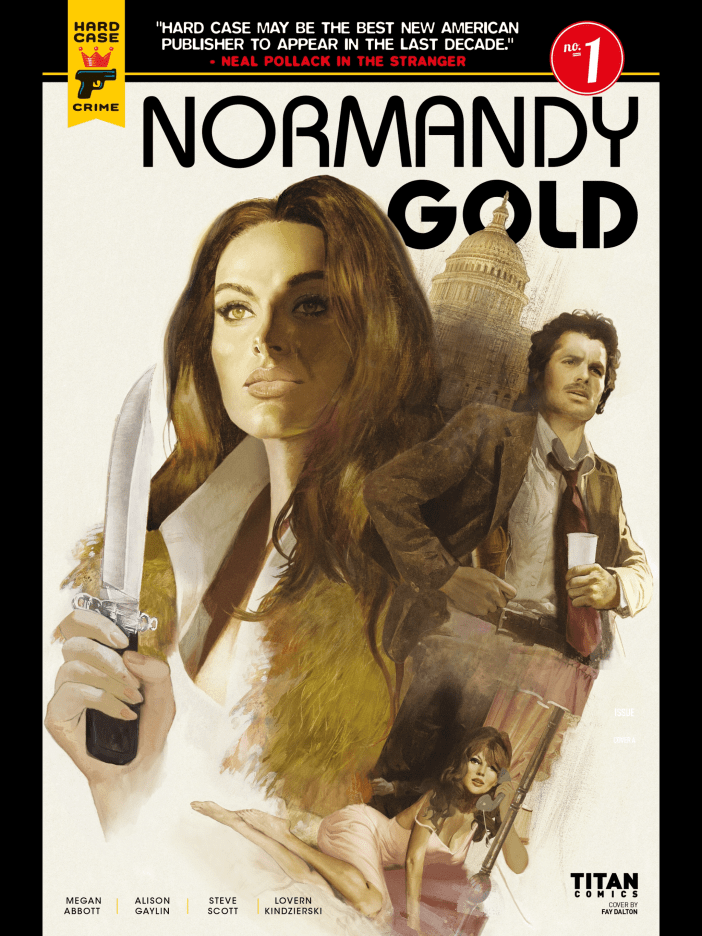
Have you read the comic book co-written by Megan Abbott and Alison Gaylin, Normandy Gold?

IMG_1772

It will come as no surprise that its fantastic. Megan Abbott and Alison Gaylin are two of the best crime writers of our Golden Age of women crime writers.

One of the things that can get confusing with crime fiction is the subgenres and the sometimes slight distinctions between them; take hard-boiled vs. noir as an example. I think the confusion comes because a hard-boiled crime novel, when made into a film, can fit into the film noir category, which is a bit broader than the genre definitions crime novels can use and books can fall into; for example, The Maltese Falcon and The Big Sleep are hard-boiled detective novels; the films, however, are classic film noir. (Your mileage may vary; I am speaking only for myself and how I classify books.) For me, a detective novel that is dark and brooding and cynical in nature is hard-boiled, Sue Grafton and Sara Paretsky’s novels, for me, fall into this category, as do Hammett’s detective fiction and Chandler’s. James M. Cain’s novels were noir, as are Megan Abbott’s. Alison Gaylin’s detective novels are more hard-boiled; her stand alone novels are more noir. For me, a noir novel doesn’t have a professional investigator as the main character; those are hard-boiled.

Charles Ardai’s Hard Case Crime line of novels contains both noir and hard-boiled fiction; the team-up of Gaylin and Abbott with the graphic serial novel Normandy Gold is a fine addition to Hard Case, and one of the best comics/graphic novels I’ve come across in a long while. As I read the first issue on my iPad, all I could think was how glorious this is; excellent, crisp dialogue and incredible storytelling, along with some amazing artwork. If there are awards for graphic novels, just start sending them along to the team that produced this now!

Normandy Gold firmly straddles the line between noir and hard-boiled with guns blazing. Set in the 1970’s, Normandy is a small town sheriff in rural Oregon. Her mother was a prostitute, and she ran away when she was a teen to try to find a better life for herself, leaving her younger sister behind. One day she gets a call from her sister, and is still on the line with her as her sister is murdered. Normandy comes to Washington DC to find out what she can about her sister’s death; the cops have written it off as just another dead whore no one cares about and unsolvable. But Normandy also finds out her sister wasn’t just a prostitute; she worked for a very elite, high level escort service, and decides to go undercover to find what happened to her sister.

This typical-sounding set-up comes alive in the hands of two master storytellers, and the art itself is stunningly beautiful. The story moves very quickly, and the 1970’s setting is perfectly done; not a false note in the entire first issue. This is the kind of story that, as a film in the 1970’s, would have earned a star like Jane Fonda or Ellen Burstyn or Ann-Margret an Oscar nomination, if not the statue itself. Vividly realized, you keep turning the pages to see what happens next…and when you get to the end of the issue, you’re sorry it’s done but can’t wait to read the next.

Highly recommended.