I’m Gonna Make You Love Me

I’ve always considered myself to be a child of the seventies.

Sure, I was a child for during the sixties, but I turned nine in 1970. While I am sure that turbulent decade provided some (a lot of) influences on me, my personality, my likes/dislikes, and my future, I am equally confident that my values and thoughts and beliefs probably weren’t as shaped from that turbulent decade as they were by the 1970’s. The seventies are really the first decade for which I have a lot of recall (recently, a friend was amazed that I remembered those horrible Rag City Blues jeans for women that were, for some reason beyond my thought processes, popular in the latter part of the decade; what can I say–I do remember the decade fairly well for the most part–or at least as far as my memory can be trusted). I’ve always wanted to write books either set in the seventies completely or even partly; Where the Boys Die, my 70’s suburban Chicago novel, keeps pushing its way to the forefront of my increasingly crowded (and clouded) mind. (NO I AM WRITING CHLORINE NEXT WAIT YOUR TURN)

I remember Watergate and how the scandal grew. I remember the 1972 landslide reelection of Nixon, and the country’s negative reaction to the Ford pardon of the man who brought him to power; I also remember Jimmy Carter running for president out of seemingly nowhere and getting elected. There was The Brady Bunch and The Partridge Family and Archie Bunker and Mary Richards; Sonny and Cher and Carol Burnett and Donny and Marie and the Jackson 5 and Grand Funk Railroad. Top Forty radio ruled the AM airwaves; not every car came equipped with FM capabilities, and the only way you could play your own music in your car was with an eight-track player. I started the decade reading the Hardy Boys and Nancy Drew and The Three Investigators; by the end of the decade I was reading John D. MacDonald and Sidney Sheldon and Harold Robbins. It was a very weird decade…of odd color and fashion choices; avocado greens and browns and American cheese orange were ridiculously popular, as was shag carpeting, velour, clingy polyester shirts, corduroys, bell bottoms and slogan T-shirts. Baseball shirts and rugby sweaters also became popular later in the decade. People had feathered hair parted in the center, and there was this weird sense of, I don’t know, missing out? Movies were grittier, harsher, more realistic; actors went from the polished shine of the old Hollywood system glamour to warts-and-all realism. Television was also beginning to change but was still heavily censored. Boogie and truckin’ and shake your booty became part of the vernacular; the decade began with the break-up of the Beatles and ended with disco’s last gasps while new wave and punk and rap started their rise.

It was the decade I went through puberty and realized that I was attracted to other boys instead of girls; I wasn’t quite sure what that meant but definitely found out in the seventh grade it meant I was a faggot, fairy, queer, cocksucker, and all those other lovely words that were burned into my brain that year. It was the decade where I read Harold Robbins’ Dreams Die First (a truly execrable novel) over and over again because the main character had sex with both men and women, and if I am not mistaken, contained the first male-on-male sex scene I’d ever read (oral); it was also the decade where we moved from Chicago to the suburbs to the cornfields of Kansas and I graduated from high school. (Ironically, it was in Kansas that I discovered gay books with explicit gay sex scenes in them–the News Depot on Commercial Street not only carried The Front Runner by Patricia Nell Warren and her other novels, but also Gordon Merrick; and their magazine racks also had gay porn magazines–which, now that I think about it, meant there were others there in Lyon County and environs; I didn’t realize it at the time, of course.) It was when Norah Lofts’ The Lute Player made me aware that Richard the Lion-Hearted was like me, too; and Susan Howatch’s Cashelmara and Penmarric also had gay characters and plots involving them…

I’ve always thought the seventies was a much more important decade than ever given credit for; usually it is merely considered a connecting time from the 60’s to the 80’s…but almost everything that came after–socially, politically, culturally–got started in the seventies. So I was glad to see this book about that frequently dismissed time.
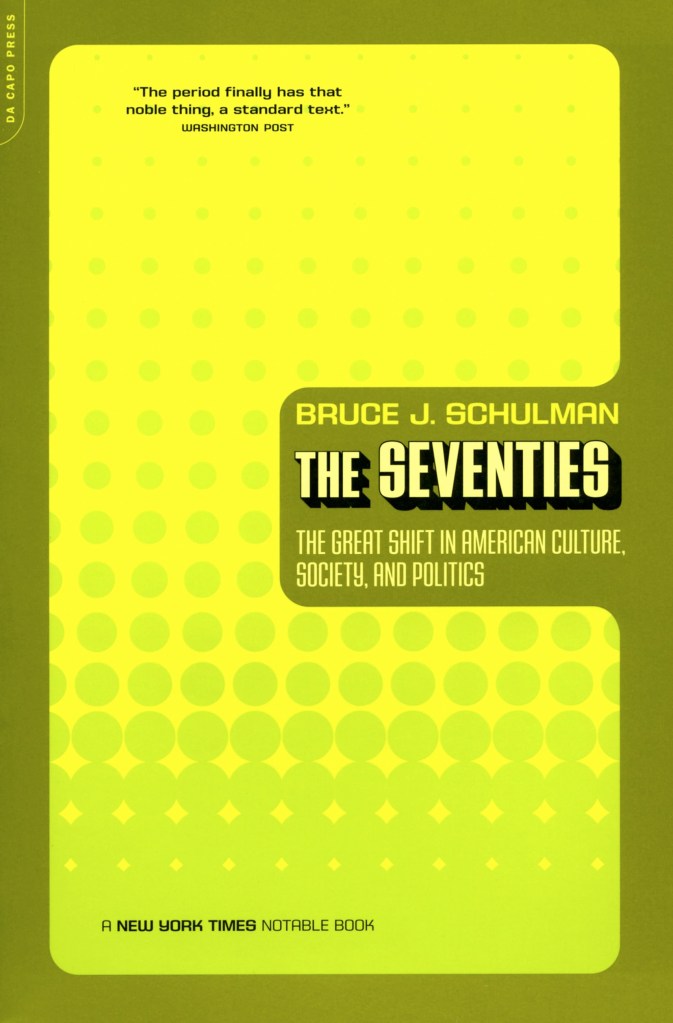
As I mentioned previously, the Seventies were turbulent; they were the decade that also saw the beginning of the end of the post-war economic/prosperity bubble. Gas shortages, skyrocketing inflation, and the insidious use of racism to break the Democratic coalition began–everything we find ourselves dealing with today had its roots in the Seventies–and it did seem, to those of us growing up in the shadow of the mushroom cloud, that the world had lost its mind and our country (or rather, its mythology) had lost its way. Schulman’s study of the decade, breaking down how the shifts in culture, politics, and our society began, were exploited for divisive purposes, and permanently changed attitudes moving forward was a fascinating, if chilling, read. I remember the terrorist attacks. I remember watching the Munich Olympics that ended in bloodshed on an airport runway and murdered Israeli athletes. The book brought back a lot of memories; I am not so sure I agree with all of Schulman’s assertions about the decade–there certainly wasn’t very much about the burgeoning gay rights movement, other than how it chased lesbians off into the Women’s Movement–but it was interesting to read the book and relive the decade a bit, as well as the memories it triggered.

I do highly recommend this book for people who weren’t around for the Seventies and might be wondering how the fuck did we end up in this current mess?

That’ll Be The Day

I was never much of a science fiction fan when I was a kid. I think the first science fiction I actually read was Dune (the original trilogy) when I was in high school; the first book was on my English class reading list. I loved Dune; still think of it fondly to this day, although it’s a bit dense and whenever I return to it kind of think the writing is a bit stiff…but it remains a treasured read of mine. Even Star Wars (I will die on the hill of refusing to call Episode IV A New Hope; when I saw it, it was called Star Wars and they didn’t add this abomination of a title until Return of the Jedi was released years later–I still remember my confusion when viewing The Empire Strikes Back and EPISODE V scrawled across the screen…”What the fuck do they mean, EPISODE V?”) didn’t really turn me into much of a science fiction fan; but as more Dune books were released, I would buy them and read them voraciously. I also read the novelizations of the Star Wars movies, but refused to read anything new and not in the films–the bitterness of being burned by Splinter of the Mind’s Eye (in which Luke and Leia were romantic interests….ewwwwww) still stings to this day; and of course when the sequel trilogy started being released all those books stopped being canon, so it was a wise decision on my part.

But Return of the Jedi did inspire me to try to write science fiction. I wrote a short story in which I created an entire universe–the science undoubtedly didn’t make sense–but it was fun to write, and I realized I needed to be better versed in science fiction if I wanted to write it.

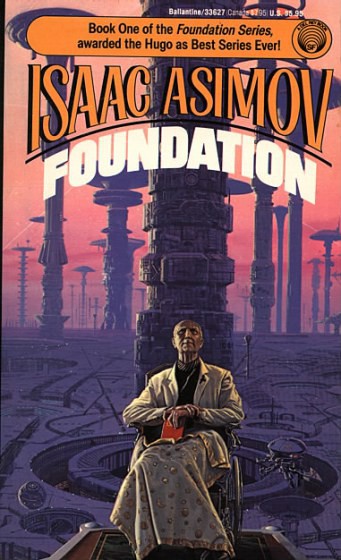
So, I went to the bookstore, asked the clerk “if I wanted to start reading science fiction, where would I start?” She smiled, and retrieved Foundation for me from the science fiction shelves. When she handed it to me, she said, “This book is aptly titled, because it’s basically the foundation for everything published in science fiction ever since.”

And she wasn’t wrong.

His name was Gaal Dornick and he was just a country who had never seen Trantor before. That is, not in real life. He had seen it many times on the hyper-video, and occasionally in tremendous three-dimensional newscasts covering an Imperial Coronation or the opening of a Galactic Council. Even though he had lived all his life on the world of Synnax, which circles a star at the edges of the Blue Drift, he was not cut off from civilization, you see. At that time, no place in the Galaxy was.

There were nearly twenty-five million inhabited planets in the Galaxy then, and not one but owed allegiance to the Empire whose seat was on Trantor. It was the last half-century in which that could be said.

To Gaal, this trip was the undoubted climax of his young, scholarly life. He had been in space before so that the trip, as a voyage and nothing more, meant little to him. To be sure, he had traveled previously only as far as Synnax’s only satellite in order to get the data on the mechanics of meteor driftage which he needed for his dissertation, but space-travel was all one whether one travelled half a million miles, or as many light years.

Having read almost all of the Foundation novels (I didn’t read the prequels that came later; ending with Foundation and Earth), I was very excited to see the Apple TV adaptation–while knowing it would be dramatically different (no doubt) from the books. But it was so different I thought it would be wise to go back and reread (or listen) to the original novel again. (It’s also been a very hot minute since I read them all, and I don’t remember everything I’ve read the way I used to…)

(Side note: I had actually read an Azimov novel in the 1970’s–Murder at the ABA–and still have my original paperback copy, purchased at the News Depot on Commercial Street in Emporia, Kansas. I’ve always wanted to revisit it–because it was very insider-y about the American Booksellers Association annual event–now Book Expo America and in decline–as well as about publishing itself, and I wanted to see how spot-on Azimov was with the book. I remember it fondly, and am also curious as to whether or not it still holds up as a mystery novel.)

There are differences; there are characters in the show that don’t exist in the book, there was no Thespin in the book (Anacreon does, however, play an important part in the book), there’s no Genetic Dynasty running the Empire (in fact, little to nothing in the book about the Empire once the Encyclopedists take off for Terminus), and of course, Azimov wrote about white men–the show is much more diverse as well as gender flips both Gaal and Salvor Hardin. If you’re an Azimov purist, you’ll probably dislike the show, I think; I enjoyed it even as I noticed the significant differences. But listening to the audiobook, I also realized that some of those changes were necessary–what worked in the book and was exceptionally clever probably wouldn’t translate well into a visual medium, but listening and getting refreshed in my memory of what the original work actually was made me appreciate the book all the more. I’d remembered it was incredibly smart and clever, particularly in how everything worked out to solve what came to be called “Seldon crises”–a situation where the Foundation was endangered, both from within and without, but the forces working against it eventually led to a point where only one possible action could be taken, and it was inevitably the right one; which meant they had to have an almost religious-like belief in Seldon and his mathematics (and how much did I love that math was the savior of the galaxy?) and trust that taking no action was the proper course of action. I also loved how the Foundation changed and adapted from its original mission (its true purpose was hidden from them to begin with, because foreknowledge would change things and alter outcomes), and how it even developed a religion around its technology to control inhabitants on other planets.

And, as that bookstore clerk all those years ago at the bookstore in Manchester Center Mall told me, the book–and Azimov, really–influenced every science fiction writer and novel that came in his wake. It truly was a foundational text for science fiction. And it’s also not difficult to see where his own influences came from–his Galactic Empire was very similar to the Roman Empire in decline, and the parallels to the decline of the American empire are almost impossible to miss.

I did enjoy the show–the production values are amazing, and it’s a great story as well, if it does get off to a bit of a slow start (but it picks up)–but I am even more glad that the show drove me to revisit the original novel again. It truly is a superb work.

Storm in a Teacup

I first discovered Stephen King when I was a sophomore in high school. A friend was carrying a paperback copy of Carrie around with her, and I neither recognized the title nor the author. The cover was interesting looking, in that weird kind of alternate reality type way that speculative fiction covers so often got at that time. “What is this about?” I asked when I picked it up and examined the book.

“It’s about a bullied girl with psychic powers,” she replied. “My mom was worried about letting me read it because she’s afraid I’m like her.”

It rather broke my heart a little to hear my friend, who was overweight and had very bad skin but also incredibly kind and intelligent, say this; but I could also relate a bit because I, too, was picked on and bullied. I, too, knew what it was like to walk past a gaggle of kids both pretty and “cool”, notice that they stopped talking as I approached only to whisper and laugh once I walked by…while simultaneously feeling grateful that they had the decency to whisper so I couldn’t hear what was said (and typing that really made me sad).

I opened the book to the first page and there it was, about halfway down the first page, in italics: Carrie White eats shit.

The preceding sentence, not italicized, read: “Graffiti scratched on a desk of the Barker Street Grammar School in Chamberlain:”

The realism of this, its brutal reality and recognition of the horrors bullied kids face, was like a 2 x 4 across my forehead. I started reading, and kept reading, until the bell rang and I was about thirty pages in, completely drawn into the story. I’d never read anything like it before; it was so real, so honest, so like what high school was actually like as opposed to the cutesy stories I was accustomed to reading about teenagers, where the concerns were “who will take me to Prom?” or “should I go ahead and have sex now or do I wait till I get married?” This was visceral, and I regretfully passed the book back to my friend, thinking, “I’ll look for it at Zayre’s when we go there next.”

My friend, who shared my love of reading, just smiled and said, “I haven’t started it yet–why don’t you go ahead and finish it and then give it back?”

I read it instead of paying attention in my next class–it was Drama, the little play we were rehearsing for class had me assigned stage managing duties, so I really had nothing to do since I wasn’t rehearsing–so I sat in a seat in our school theater, reading. I read it on the bus ride home. I read it when I got home, sitting on my bed with my back propped up by cushions. And I finished it that night–establishing a pattern with King’s fiction that lasted for decades: I would read the book as soon as I got a copy from start to finish, usually in one sitting (It kept my up all night because I couldn’t put it down).

When I saw Night Shift on the wire racks of the News Depot several years later in Kansas, I was terribly excited. A new Stephen King! I bought it immediately and took it home…slightly disappointed to discover it was merely a short story collection, and I wasn’t a big fan of reading short stories; I only read the ones I was required to read for a class assignment.

I read the first story, “Jerusalem’s Lot,” and didn’t like it at all; I put the book aside and didn’t return to it until months later…the next story, however, was “Graveyard Shift” and it was amazing…suffice it to say, I read the rest of the book through in one sitting–and it’s also been my go-to for rereads and so far when I don’t have a lot of time, or I want to simply relax and enjoy reading…one of the reasons for years I would often reread a favorite book.

But last night we started watching Chapelwaite, which I knew was an adaptation of that first story I didn’t care for–and have never reread as a result–and so I decided to go ahead and revisit the story.

I am really glad that I did.

Oct. 2, 1850

Dear Bones,

How good it was to step into the cold, draughty hall here at Chapelwaite, every bone in an ache from that abominable coach, in need of relief from my distended bladder–and to see a letter addressed in your own inimitable scrawl propped on the obscene little cherry-wood table beside the door! Be assured that I set to deciphering it as soon as the needs of the body were attended to (in a coldly ornate downstairs bathroom where I could see my breath rising before my eyes).

I’m glad to hear that you recovered from the miasma that has so long set in your lungs, although I assure you that I do sympathize with the moral dilemma the cure has affected you with. An ailing abolitionist healed by the sunny climes of slave-struck Florida! Still and all, Bones, I ask you as a friend who has also walked in the valley of the shadow, to take all care of yourself and venture not back to Massachusetts until your body gives you leave. Your fine mind and incisive pen cannot serve us if you are clay, and if the Southern zone is a healing one, is there not poetic justice in that?

Yes, the house is quite as fine as I had been led to believe by my cousin’s executors, but rather more sinister. It sits atop a huge and jutting point of land perhaps three miles north of Falmouth and nine miles north of Portland. Behind it are some four acres of grounds, gone back to the wild in the most formidable manner imaginable–junipers, scrub vines, bushes, and various forms of creeper climb wildly over the picturesque stone walls that separate the estate from the town domain. Awful imitations of Greek statuary peer blindly through the wrack from atop various hillocks–they seem, in most cases, about to lunge at the passer-by. My cousin Stephen’s tastes seem to have run the gamut from the unacceptable to the downright horrific. There is an odd little summer house which has been nearly buried in scarlet sumac and a grotesque sundial in the midst of what must once have been a garden. It adds the final lunatic touch.

But the view from the parlour more than excuses this; I command a dizzying view of the rocks at the foot of Chapelwaite Head and the Atlantic itself. A huge, bellied bay window looks out on this, and huge, toadlike secretary stands beside it. It will do nicely for the start of that novel which I have talked of so long (and no doubt tiresomely).

When I first read this story (and disliked it so intensely) I was a teenager completely turned off by the archaic style of writing, as well as the concept of a story told in letters and diary entries (I wasn’t aware of the concept of epistolary fiction at the time; it was also why I stopped reading Dracula when I first tried as a teenager), and the story itself was just kind of…weird–with all its references to things inside the walls and “great worms” and “horrors from beyond the cosmos”…it wasn’t until I read King’s study Danse Macabre that I became aware of Lovecraft’s work and eldritch horrors; but remembering how much I disliked this story, it didn’t exactly inspire me to go on to read Lovecraft or works in a similar vein (the cultural war over Lovecraft in the speculative fiction community over the last decade–not sure of the time line, frankly, and don’t care enough to go look; I am loosely affiliated with that community and have many friends in it, so can’t not be aware but simply observed).

But watching Chapelwaite put me in mind of this source material for the show again, and I decided to reread it this morning, since I’ve never reread the story since its initial read back in the 1970’s. I’ve since read Dracula; Les Liaisons Dangereuses was the book that cured me of my disdain for epistolary fiction–the book is extraordinary–but yet, never gave “Jerusalem’s Lot” another try.

I’m glad I did.

This second read made me appreciation the story a lot more than I did over forty years ago. A quick glance at the copyright page for Night Shift shows that the story was an unpublished work included in this collection and seeing print for the first time; a shame, because it not only shows King’s incredible versatility as a writer but also it’s chilling and creepy; it’s almost Gothic in tone, certainly using a writing style from the past (although I don’t know that a man in 1850 would mention needing to relieve his bladder in a letter to a friend); one that is very formal and I didn’t care for much as a teenager but have come to greatly appreciate in the years since. The story is simple: Charles Boone, after some ill health after the loss of his beloved wife, has inherited a family estate on the coast of Maine. There was a family rift between his grandfather and great-uncle; the death of the former master of Chapelwaite has left Charles as the lone survivor of the family. Once he and his man-servant arrive, they begin to experience strange phenomena that they originally tribute to rats in the walls; but rats don’t explain when no one in the nearby town of Preacher’s Corners will come near the place, or will have anything to do with Charles. A few miles from the house is a pristine yet abandoned village: Jerusalem’s Lot (yes, the same name of the town from King’s classic vampire novel ‘salem’s Lot), and Charles–despite being warned (do people in horror stories ever listen to warnings?) investigate the little town, and…yeah.

GREAT story, and the end is *chef’s kiss*.

Very glad I decided to revisit the story, so thank you, Chapelwaite, for getting me to do so.

And I will add there’s another Jerusalem’s Lot story in Night Shift, “One for the Road”–which I deeply love.

And now back to the spice mines.

Don’t Say Your Love Is Killing Me

Ah, Kansas.

Moving between your sophomore and junior years in high school isn’t easy on any teenager. I wasn’t quite as nervous about this move as I had been when we moved from Chicago out to the suburbs–which was a major shift in everything I was used to, moved me away from friends I’d been going to school with since first grade, and made me that thing no one wants to be: the new kid–primarily because I’d already experienced being the new kid once already, and had never really gotten over it. Suburban life wasn’t good for me, really–I got picked on and bullied alot, called gay slurs pretty regularly, kids didn’t want to be my friend because they’d open themselves up to the same bullying I was experiencing. So, while I was going to miss the people I did consider to be my friends–which was yet another eye-opening experience in and of itself, but more on that later–but I wasn’t going to miss the bullying, the being targeted, the snickers after I walked past people in the halls, and worrying about having a place to sit in the cafeteria every day (my sophomore year I joined Choir to get out of the lunch break–we were always dismissed fifteen minutes early so we could eat, so I would grab something quickly and eat it as fast as I could; I still eat fast to this day).

I even thought it could be a fresh start for me, and all of that could stay in the past.

While I sometimes will joke about how glad I was to get out of Kansas five years later, I appreciated my time there. My high school was actually–given its size–a much better school than the enormous one I attended in the suburbs; I actually learned there and participated in class. I was, of course, horribly lonely; it’s never been easy for me to talk to people I don’t know (painful shyness, to the point of anxiety), and as always, when nervous and uncomfortable I resort to humor and jokes and being a clown. I never felt like I fit in there, but it was so much better than my old school experience–and the slurs didn’t start there until the second semester of my senior year. That was fine; I just had to make it through a few more weeks by then and at that point I was ready to get out of there and move on with my life.

Kansas wasn’t a particularly welcoming place for a gay teenager in the mid-1970’s, but then most places weren’t at the time. I remember thinking I was the only gay kid in Kansas, the only one at either school I attended, and there was absolutely no one I could trust to talk to about it. I missed having real friends, ones like I read about in books or saw in movies and television shows; it wasn’t until much later in life that I realized I never had real friends because I never trusted anyone enough to actually be honest with them, tell them the truth about me–and the real basis of friendship is mutual trust. I obviously have always had serious trust issues–the whole no one can find out hell of my first few decades of life–but I never felt close to people because I didn’t trust them enough to not turn on me, walk out of my life, and/or mock me if I told them the truth.

So, for a long time I rather held it against Kansas and the area where we lived for not being more open and welcoming, and it was unfair. Would rural Alabama have been better? New Orleans? Nebraska or Texas or California? Even in the cities with a big queer population at the time–New York, Chicago, San Francisco–I wouldn’t say the life of queer kids going through the hell of being closeted in public school was better there. Maybe it was, maybe it wasn’t; I don’t know. But when you live in Kansas and are a queer kid in the 1970’s…I felt like I was marooned on a distant planet.

Oddly enough, the little book store in the county seat, the News Depot–they had a massive newspaper/magazine section, and also carried comic books; it was there I started reading them again–that I found the books that were my foundational queer reading: Gordon Merrick’s The Quirk, Patricia Nell Warren’s The Front Runner, and Marion Zimmer Bradley’s The Catch Trap (and yes, I am aware of the allegations against her as well as her husband–and his, I believe, actual crimes; but I cannot deny the book was foundational reading for me, either). The clerk didn’t even give me a second glance whenever I bought one of these books; I also had to bury them in my room in stacks of other books so my mom wouldn’t find them (my biggest fear was always one day my mom would get bored, wander into my room to find something to read, and wonder, ‘The Quirk? What’s that about?”). There were sex scenes in them, too–sex scenes I read over and over again, memorizing the page numbers so I wouldn’t have to use a bookmark or turn down a page, which was far too risky. I already had a vague idea of what gay sex was like, gathered from insults and comments in other books; but these were pretty graphic and left no doubt in my mind whatsoever about what was involved.

And boy, I wanted to find out how it actually felt.

(I never actually found a gay bookstore until I moved to Tampa in 1990. But I would spend hours in bookstores in the years prior looking for anything that might even be remotely gay or gay-friendly; and occasionally I would find something like Dancer from the Dance or The Swimming-Pool Library but what I really wanted was something fun to read with positive gay characters. characters who weren’t stereotypes or to be pitied or felt sorry for; gays who lived their lives openly and proudly, and maybe solved crimes, fell in and out of love, experienced life that wasn’t all solemn and dreary and sad. Don’t get me wrong–I am not dogging either of those books; they are wonderful novels and beautifully written, but…I am a genre guy, not a litfic guy, and I wanted to read some gay crime or horror or romance or something entertaining. Once I discovered the wealth of books and authors that actually existed in the genres? There was no turning back.)

I had always felt like I didn’t belong anywhere–my earliest childhood memories are of me being aware I wasn’t like the other kids, in many ways, and how odd and different I felt. That feeling never changed growing up–hell, there are still times when I feel like I am from another planet–and the moving around didn’t help, either…I do remember thinking, every time I moved to a new city and state as an adult, ah, here we go again–no friends, no life, and no idea how to find anyone who is like me–if there are any people like me.

It was often discouraging. I felt like I was going to always be alone.

By the time I was twenty it was time to go, to leave Kansas and never go back. I felt so stunted, and so unhappy, like my potential hadn’t been tapped and never would if I remained there. I knew if I stayed in Kansas I would wind up probably very unhappily married, with kids and a whole life I didn’t want, had never wanted, but was expected of me. I knew I would never be happy there, completely happy–and so when the chance presented itself to move to California (California! You can imagine how exciting that sounded to me), I took it and never looked back.

With the passing of time and more perspective, a lot of the bitterness I used to feel about my experience there has changed. I don’t know that the experience there now would be any different than it was in the 1970’s, but I suspect that even had we stayed in the suburbs of Chicago those last few years of high school and first years of college would have been equally scarring and stifling; that’s pretty much how it was for queer kids everywhere back then. Some of the kids I was friends with, or knew, from my old high school in Kansas have friended me on Facebook, and me being a big ole queer must not bother them too much; it’s not like I hide it anymore (those days are forever gone) and they don’t unfriend or block me (although my feed could be hidden from their walls; I’ve certainly done that). I’ve revisited Kansas some in my work already–some short stories, a novel here and there–but this latest visit there in the world I created for #shedeservedit might be a bit unfair; but in a town where toxic masculinity has been allowed to run unchecked, I can’t imagine it would be a comfortable place for a gay teen.

And that’s enough for today. Hope you have a lovely Monday, Constant Reader, and I will check in with you again tomorrow.