Candy Perfume Girl

Here we are on a college football Saturday1 (GEAUX TIGERS!) and all is quiet in the Lost Apartment. I ran errands yesterday, got the mail, picked up my copy of the new Tananarive Due (yay! Hello, October Halloween Horror Month!), and after working at home, I did the laundry and cleaned up around here–somehow the kitchen had somehow gotten out of control again–while the Real Housewives screamed at each other on my television. I don’t know why I find that so entertaining, but I do and I am not apologizing for it. (And yes, I am going to write about it at some point.) We also watched The Traitors: New Blood and started the new American Horror Story: 13, which hurray for Jessica Lange, and hurray for Joey Pollari, who is playing the male lead–been a fan since catching the young openly gay actor in American Crime, an excellent anthology series from the 10s that didn’t draw near the audience it deserved for its writing and incredible cast, which included Regina King in every season. (I’ll watch Regina King in anything.)

I also went back through the book cases and massive TBR stacks to pick out an ambition list of reading for October, especially given how little I’ve been reading lately. My rereads are going to be The Dead Zone (long overdue for a reread, at least since 2016) by Stephen King and The Amityville Horror by Jay Anson. The new to me reads, if I manage, will be Christina Henry’s The House that Horror Built, A House with Good Bones by T. Kingfisher, and Shadowlands by Peter Straub, which I’ve never gotten around to in the forty years and more it’s been available (people always say their favorite Straub is Ghost Story; mine is Floating Dragon); I started it when it was first out in paperback, but never finished. I guess it didn’t grab me, but I grabbed another copy when I read a really interesting piece about it sometime earlier this century. (I also met Straub at Stokercon in Nassau, Long Island at least fifteen or sixteen years ago–the same conference I first met a pre-Gone Girl Gillian Flynn. Both were delightful and charming.)

I actually started my reread of The Dead Zone, and while I only got a few pages into the prologue, I was immediately reminded of why I love King, and that Johnny Smith is probably one of my favorite King characters, and while this book was always overshadowed in my mind by The Stand, which is my favorite King, as the books were released consecutively. I remember back when King was still a new writer and unappreciated by critics and reviewers while his books were literally flying off the shelves–one of my English professors in college, was very disdainful when he noticed I was carrying a copy of Firestarter with me, again shattering any thought I may have had about pursuing English as an undergraduate major because the professors were the worst kinds of snobs and my fellow English majors put no thought into their reading or analysis that wasn’t spoon-fed to them by the professors, whose egos definitely needed stroking (they all had mediocre minds).2 The irony is that while King has always done work of the highest quality, he was unappreciated while he was doing his actual best work. That run of novels, beginning with Carrie and ending with It, is probably unmatched by any other author in the canon of US authors; certainly in horror and crime….and those earlier works stand the test of time; I’ve reread all of those books numerous times.

Yes, a revisitation of a King classic is de rigeur.

Yesterday was a stunningly beautiful day. When I walked out to the car to run said errands, I was amazed at how gorgeous is was outside: warm but not excessively hot, and a coolness to the air that was very refreshing. Then I got in the car, started her up and looked at the temperature gauge and laughed. It was 86 degrees outside–but it wasn’t humid, which makes all the difference. (It’s currently 77 degrees outside; the kind of weather where you want to sit outside and read….or would, if I had a comfortable place to sit outside and read.) This is how the summer breaks us here. Anyway, as I drove around I was reminded again of how beautiful this city actually is, and again how lucky I am to live here so I can be continually inspired by this stunningly beautiful city.

I ordered myself a pair of Apple Beats Pro to finish off the gift card Dad sent me for my birthday. One of the most annoying thing to me about the new iPhone I got last year was that wired earbuds don’t work when plugged into them–and besides, I can’t use earbuds and my hearing aids at the same time. The other night when Paul came home I realized he uses over-the-ear headphones that wirelessly connect to his phone and a long overdue lightbulb turned on over my head. I can use over the ear headphones too, so I went ahead and ordered them. They came this week, but alas, I haven’t had time to set them up yet, so I intend to do that this morning. Just in time, too–since the weather has changed (hopefully for good) and I can go for walks now with them. My goal is to go back to the gym in January, and I need to start building up my stamina before that return.

At this point, kicking Ed Sheeran when he’s down is a bit mean and bullying, but I did laugh when his shows at Kraft’s stadium wound up canceled because of this huge nor’easter heading for New England, which has me worried about my friends up there. Take care everyone, don’t take unnecessary chances, and stay safe up there, okay?

And on that note, I am going to get cleaned up and head into the spice mines for the day. Hope you have a marvelous Saturday, Constant Reader, and I’ll be here bright and early before the Saints game tomorrow. See you then!
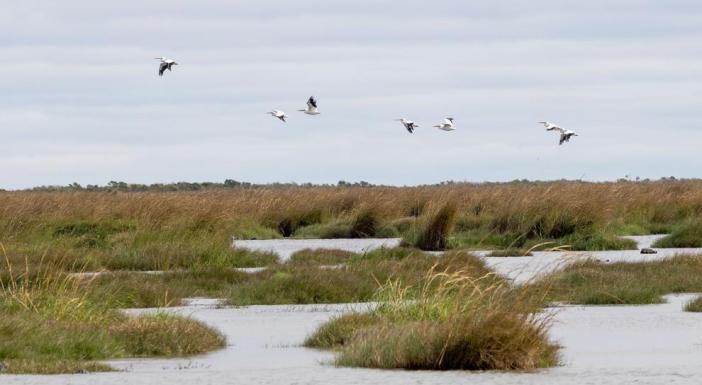
Love this image of birds over a bayou near Lake Borgne.
  1. Very bad news for the Tennessee Vols, though–Trump is coming to their game with Texas today, and wherever he goes, the home team loses. I don’t like either team, but will watch and hope for a good game. ↩︎
  2. My college experience remains the biggest disappointment of my life. I expected so much more than a continuation of high school, you know? But…I also went to two really shitty colleges. ↩︎

Walking in the Underground

Tuesday morning and all is well in the Lost Apartment. I slept deeply and well last night, and as such, feel pretty good so far, at least. I’m alone in the clinic today and I have an almost entirely full schedule, and after work I need to run an errand or two on the way home. Summer is definitely here now–the kind of heat and humidity that just sucks the life right out of you, and even getting cool by going inside isn’t restorative. But I did my chores last night, cleaned the kitchen and did the dishes. Picked up a prescription, and had some groceries made and delivered. It was lovely coming downstairs to a cleaned up kitchen this morning after a restful night’s sleep. Yay!

I did spend some time (more than I would have thought) cleaning out the email inboxes, which got very much out of control while I was gone, and I didn’t even look at it on Sunday–well, I did but recoiled away from it in horror and pushed dealing with it back a day. I was tired when I got home a bit, but got the groceries put away and got the dishes taken care of, at long last. Again, it’s nice to come downstairs to bare counters and an empty sink. I won’t have any chores tonight, but I do have some errands to run on my way home. I still have not adjusted completely to being home, but am getting there. It wasn’t terribly oppressive outside when I get off work (my car did feel like a preheated oven, however) because it had been cloudy all day and so no direct sunlight, which is always brutal. We’re in another heat advisory today–can’t wait to see my next Entergy bill, seriously.

And as Louisiana moves into yet another horrific summer, apparently our European cousins have also been having an insane heat wave which is killing people. One of the more amusing things to come out of the European heat wave is Europeans europe-splaining heat to Americans like we’ve never experienced excessive heat before–particularly the nearly-always condescending British. There was one particularly stupid one I saw trying to explain why the heat is “so much worse over there than in America” because they have humidity. She then used the Southwest climate as proof. Oh, honey, don’t you know in our desert climates it can get into the 110’s and 120’s? Trust me, you condescending superior bitch, you couldn’t handle the dry heat of 117 in Fresno in the summer. And are you seriously telling people who live in the American south, Midwest, eastern seaboard, and New England don’t have humidity? Babe, come try to live in Louisiana without air conditioning sometime. We have this weather every fucking year, and as such, we have things like central heat and air conditioning–which you also mock us for using…then whine when you have to experience what we do every year once in a blue moon?

I also can’t comprehend 80 degrees being a heat wave. That’s our spring.

I was low energy yesterday but I also think a lot of that was food-related; me not eating enough, as I tend to do when I travel. I woke up super-hungry this morning, which leads me to think that I certainly didn’t have enough fuel to get me moving. But I am having a nice breakfast this morning, and I am very hungry. I am trying not to gain any more weight–I need to start doing some exercise at some point–but I also need to fuel my body at the same time. Sigh, I know, I know, I need to eat healthier than I do, or start burning more calories. I no longer burn as much energy when I am not exercising anymore–yay for being older–but some more exercise (even a morning walk around the neighborhood) is better than nothing.

And on that note, I am heading into the spice mines. Have a lovely Tuesday, Constant Reader, and I’ll be back tomorrow on (gulp) pay-the-bills Wednesday. How is that even possible already?

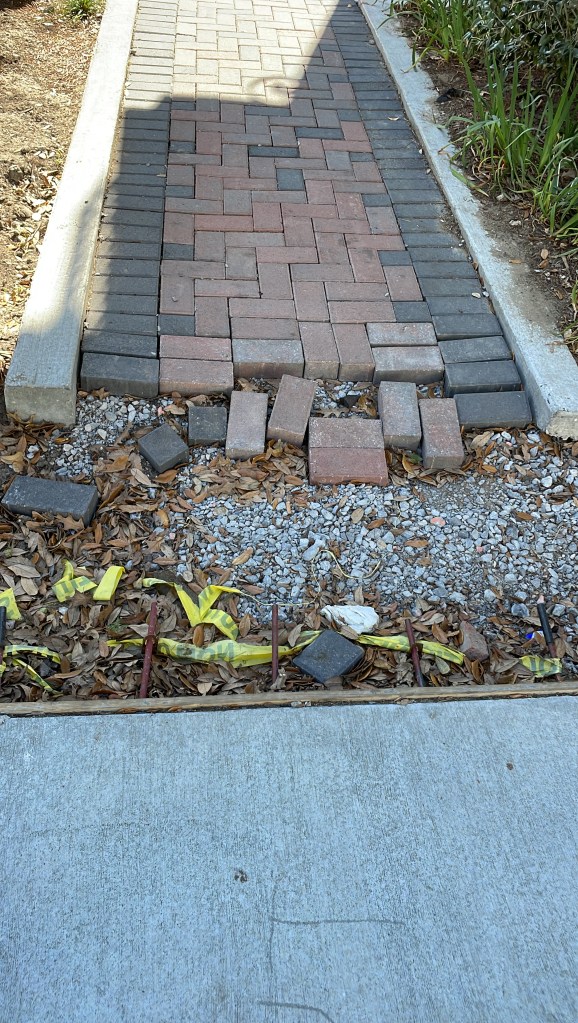
Where the sidewalk ends in the lower Garden District….

Near You

Several weekends ago, I did an on-line panel for Outwrite DC. The moderator was John Copenhaver (whom you should already be reading), and my co-panelists were the always delightful and intelligent Kelly J. Ford, Margot Douaihy, Renee James, and Robyn Gigl. The video is actually up on Youtube, if you would like to watch it. John’s questions were insightful and intelligent (as always), and the conversation was marvelous, inspiring, and fun; there’s nothing I love more than communing with other queer crime writers (or any writers, to be certain), and I always try very hard to not monopolize panels because I do have a tendency to talk too much–especially if and when I get going on a topic I am passionate about. So, I thought it might be fun to take John’s questions and turn them into a long form interview, for thoroughly selfish and totally self-promotional reasons.

The panel blurb claims that “queer characters are riveting and necessary material for crime fiction and how those stories can shape (and perhaps reshape) the landscape of contemporary crime fiction.” Do you agree with this statement—and why do the stories of queer characters have the potential to shape crime fiction?

I completely agree with this statement. Queer crime fiction has a very proud history that was never really recognized or appreciated by the mainstream crime writers, readers, organizations, and conferences. That is changing for the better.

New blood is always necessary for any genre–horror, romance, crime, literary fiction–because genres tend to stagnate after a certain period of time. The cultural shifts of the late 1960’s and 1970’s echoed in crime fiction, for example; you couldn’t write crime in those periods without addressing all the cultural and social shifts; Ross Macdonald’s later novels are a good example of this. The 1970’s saw a lot of anti-hero books being written. The private eye sub-genre had grown quite stale by this time, which was when the women really moved in and gave it a shot of adrenaline–Marcia Muller, Sara Paretsky, and Sue Grafton blazed that trail, and revitalized a sub-genre that had kind of lost its way. Queer writers and crime writers of color are currently doing the same to the entire genre. Voices and perspectives we aren’t used to seeing are now getting into print and changing how we see, not only our genre, but each other. Crime fiction has always given voice to societal outsiders and outliers; queer people and people of color are the ultimate outsiders and outliers in this country. Who better to tell stories of societal alienation?

Why did you choose your sub-genre? How do you think the sub-genre has influenced the types of characters you write?

Well, I write in several different ones. Chanse MacLeod was a straight private-eye series; Scotty Bradley was more of an amateur sleuth/humorous series, but he does have a private eye license in Louisiana. A Streetcar Named Murder was a cozy, with an amateur sleuth heroine who gets caught up in a family mystery. I’ve also done young adult and “new adult,” whatever that is (it’s been described as ages 16-25), and Gothics with a touch of the supernatural. I tend to write things that I like to read, and I have a varied reading taste. I started writing the Chanse series because I wanted to do a harder-edged private eye series with a queer twist and set it in New Orleans. I didn’t know about J. M. Redmann’s Micky Knight series when I started writing Chanse; would I have done something different had I known she’d already covered the hardboiled lesbian private eye in New Orleans? We’ll never know, I suppose. Scotty was meant to be a lark; a funny caper novel and a one-off. And here we are nine books later…

As for Streetcar, I had been wanting to try a traditional mystery with a straight woman main character for a long time. When the opportunity presented itself, I jumped in with both feet. I like trying new things and pushing myself. Having to follow the “rules” of a traditional cozy was a challenge–especially because I have such a foul mouth in real life. I love noir so am working on two different gay ones at the moment.

Why do you think amateur detectives are appealing? Do you think there’s a reason queer characters often find themselves in the role of amateur detective?

I think it’s because we all think we’re smarter than the police? We enjoy seeing a character we can identify with figuring things out faster than the cops, especially without access to all the evidence, interviews, and forensics the cops do. Murder She Wrote has been off the air for about thirty years and yet the books based on the show continue coming out every year. If we start out in mysteries reading the juvenile series–Nancy Drew and the Hardy Boys and Judy Bolton and all the rest were amateurs, so we always cut our teeth in the genre with them to begin with. Scotty is basically an amateur, even though he has a private eye license he rarely uses; he and the boys never get hired (although they kind of do in the new one, coming this November.)

Let’s talk about place. Greg, your books take place in the South. Why is place important to the crime novel—why is it especially important to the queer crime novel?

Place shapes who we are–not just as queer people, but as people in general. There are similarities between growing up in a small town in the Midwest and growing up in one in the South, but the differences are very marked. I’ve lived all over the country–pretty much everywhere but New England or the Northwest–and always felt, as a Southerner (despite no accent and not growing up there) like an outsider. Couple that with being gay in a time when it was still considered a mental illness, and you have someone always on the outside looking in. But I have that Southern pull to write about the South–although many would say that writing about New Orleans and writing about the South are not the same; like me, New Orleans both is and isn’t of the South, and I feel that very strongly. I’ve written books set in California and Kansas, even one in upstate New York, but I very much consider myself a Southern writer.

Place is even more important in a queer crime novel because place shapes the queer people so much. As a writer, I think one of my strengths is setting and place, and I think that comes from being very much a fan of Gothics growing up. Gothics are known for place and mood, and I think those are two things I do well.

All of you write wonderfully flawed characters. Sometimes, as LGBTQ+ writers, we feel the burden of representation and the urge to write only positive LGBTQ+ characters as an attempt to undo history’s (the dominant culture’s) demonization of us. Unfortunately, that can be limiting—even flattening. Clearly, you’ve all struck a beautiful balance with your characters. Talk a bit about how you approached this issue.

The flaws, to me, are what make the characters seem real. Nancy Drew and the Hardy Boys always annoyed me because they were so perfect; no one is that perfect, and anyone that close to perfect in real life would be irritating and insufferable. I am am quite aware that I am flawed (one of my biggest flaws is believing I am self-aware because I most definitely am not), but I am not trying to be perfect; I just want to be the best version of myself that I can be. By showing queer people with all their facets and flaws and failures and blind spots, we’re showing the reader that we are human; despite what those who hate us say or claim, we are human beings just like everyone else, just trying to get through life and do the best that we can. The villain in my first book was a gay man–and the entire book was a commentary on how we, as queer people, tend to overlook flaws and red flags from members of our own community. Just because someone is queer doesn’t mean they are a good person–and queers with a criminal bent do exist, and often take advantage of that sense of camaraderie we feel with each other, especially when we don’t know the person well. I tend to trust a queer person more readily than I will a straight person, and that’s wrong–which is why I think we feel so much more hurt when queer people betray us.

Speaking of the demonization of LGBTQ+ folks … Ray Bradbury of Fahrenheit 451 fame said, “There is more than one way to burn a book. And the world is full of people running around with lit matches.” What do you think about the current tactics to ban queer books from schools, libraries, and even bookstores in places like Florida, Arkansas, and Texas? Why are they targeting queer books?

This is, I hope, the last gasp of the homophobes who’ve never updated their hate speech in over fifty years. What the hate group “Moms for Liberty” are doing and saying is no different than what Anita Bryant said and did in the 1970’s, what Maggie Gallagher and her evil co-horts at the National Organization for Marriage repeated, then came the One Million Moms…all too often it’s the cisgender straight white women who are the real foes of progressive politics who fight to uphold a bigoted status quo. They always claim they’re concerned moms worried about their children–but are perfectly fine with them being shot up at school; working in a meat factory on the night shift at thirteen (have fun in hell, Sarah Huckabee Sanders, when you get there and French-kiss your Lord and Master Lucifer); or shouldn’t have the right to vote…they know better than a child’s actual parents, you see, about what the child needs or wants. Maybe they should spend more time with their own children than worrying about everyone else’s? Phyllis Schlafly, queen skank of the conservative right, ignored her own family while she embarked on her crusade to strip women of their rights and autonomy–all the while shrieking like a hyena into any microphone nearby that she was fighting progress to save the American family while selling some Leave it to Beaver-like nonsense as reality. I always felt sorry for her gay son. Imagine that as your mother.

As for why, it’s about control and power. I actually respected Anita Bryant more, because she truly believed all the vile, horrible, unChristian things she said and espoused. Most of the others, including the unspeakably vile and disgusting Moms for Liberty, are working a grift for money, attention and power. Hilariously, they’ve sold their souls in the worst possible way in the guise of family, religion and God; if they’ve ever actually read their Bibles, they need to work on their reading comprehension skills as they are both apostates and blasphemers who will spend eternity doing the breast stroke in the lake of eternal fire. Hope they enjoy it.

Sorry your husbands and children don’t love you, but who can really blame them?

What are you working on next? What’s coming up?

I have a short story in an anthology called School of Hard Knox from Crippen and Landru (and somehow got a co-editor credit for the book with Donna Andrews and Art Taylor); Death Drop, the first in a new series from Golden Notebook press, drops in October; and the ninth Scotty comes out in November, Mississippi River Mischief. I am writing a gay noir, and may be writing second books for the new series I started with Crooked Lane last year as well as a sequel to Death Drop, and have a couple of short stories I want to finish to submit to anthologies I’d love to be in.

My Little Town

It is quite impossible to have heard of every writer and every book, even in a subgenre; there are simply too many books published in the past, with new ones coming out every day and new ones getting signed for future release every day. When it comes to my own reading, I like to draw from a wide and deep pool of styles, genres, and authors. Most of my reading is generally confined to the crime genre–and I do confess that I need to broaden that pool even further. I need to read more literary fiction, science fiction, horror, romance, and fantasy; more true crime and biography and criticism; and even within my own crime genre I tend to not read as much of some sub-genres as others.

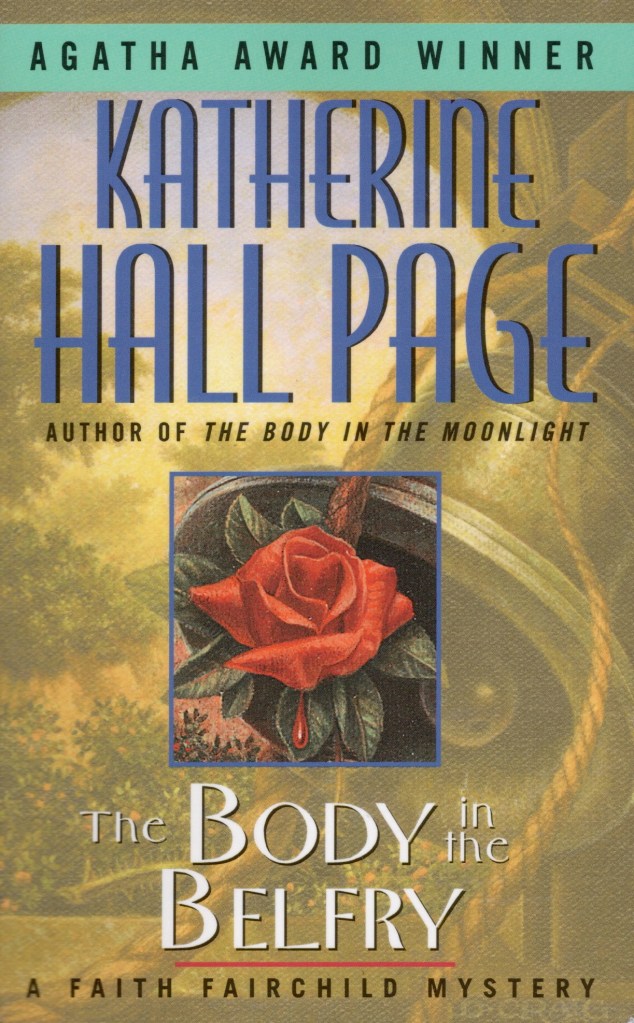
I’ve always liked cozies, and have never understood why they get so much grief and are so readily dismissed by those who neither write nor read them. I don’t read enough of them, to be honest, but again, there are so many terrific cozy writers and there’s only so much time. But recently in a review of my A Streetcar Named Murder, the reviewer mentioned that it was perfect “for fans of Katherine Hall Page.” This intrigued me, because I didn’t know her nor was I familiar with her work. I quickly checked in with some cozy writer friends, who all assured me it was a great compliment, so I decided to check out her Faith Fairchild series.

Faith Fairchild, recently of New York City, paused to catch her breath. Benjamin, her five-month-old son, was sound asleep, securely strapped to her chest in his Snugli. Her aching shoulder blades and the fact she has been focusing on the own path beneath her feet instead of the autumnal splendor to either side reminded Faith that Benjamin was definitely getting a bit too chunky for this mode of transportation. She straightened up and looked around.

It was New England with a vengeance: riotous orange and scarlet leaves beneath enormous, puffy white clouds suspended in a Kodacolor blue sky. A calendar maker’s dream. And of course brisk, clear air as crisp as a bite of a McIntosh apple just off the tree.

Faith hated McIntosh apples.

She walked up the Belfry Hill path a bit farther to a small clearning, which gave her an unobstructed view of the Aleford village green far below. She sat down and sighed heavily.

Her life was becoming terribly quaint, Faith thought. Time was when “village” meant “the Village” and “town” was up or down. And when did she start using phrases like “time was”? She let another sigh escape into the pollution-free landscape and longed for a whiff of that heady combination of roasted chestnuts and exhaust fumes that meant autumn to her.

It didn’t take me very long in reading the book to realize just what an incredible compliment that comparison actually was.

I pointed out in one of my entries about cozies–probably a blatantly self-promotional entry, if I recall correctly–that often-times there’s a “fish out of water” element to a cozy series; the main character is often someone from the big city who has, for whatever reason, found him or herself in a new small town environment that has its charms but at the same time they miss their big city. Faith Sibley Fairchild is no exception to this. Born and raised in Manhattan as the child of a minister and a wealthy heiress, Faith has her own trust fund and her interest in food led her to start her own, hugely successful catering company, Have Faith. But she has since fallen in love with a small-town minister, married him, temporarily shuttered her business and moved to pastoral Aleford in Massachusetts, having now had a baby and is trying to adjust to small town life as the minister’s wife. (I was reminded frequently of the Vicar’s wife in St. Mary Mead in Agatha Christie’s Murder at the Vicarage; the younger woman whom the villagers aren’t quite sure what to make of other than she’s not like any vicar’s wife they’ve ever known.)

On this particular morning she is heading up to the town belfry to just relax and have a little picnic with her baby son–only to discover the body of Cindy Shepherd, a perfectly awful young woman whom no one in the village of Aleford likes very much. Suspicion immediately falls on her long-suffering fiancé, who doesn’t have much of an alibi–and Faith finds herself intrigued by the case and starts asking around. She found the body, after all, and as she starts asking questions and bouncing from villager to villager, she finds herself learning more about her town and the intricate yet almost invisible threads that tie everyone in Aleford together–and soon finds that not only was Lucy unpleasant, she was an outright villain, who only cared about herself and was not above using whatever means at her disposal necessary to get what she wants. The investigation itself is also an excellent way for Page to introduce Aleford (as well as Faith’s own backstory) to the reader in a very organic way that is not only easy to follow but keeps the reader turning the page. Ms. Page also has a lovely, easily accessible and slyly witty voice that engages the reader, and you can’t help liking Faith and rooting for her–as well as looking forward to your next visit. There are currently twenty-six volumes in the series–daunting, to be sure–but I’m excited about that lengthy canon; I won’t be running out of Katherine Hall Page novels to read any time soon.