Moonlight (A Vampire’s Dream)

I often refer to ‘salem’s Lot as “Peyton Place, but horror.” Because while Stephen King’s second novel (and still one of my favorites) absolutely does its job as a wrenching piece of horror fiction, it’s also a truly insightful and meaningful look at a small town (population 1300) and how everyone knows everyone, as well as the way their lives intersect and connect and cross intricately; we get to know a lot of the townspeople before they succumb to the horror that is overwhelming their little town. If you took the vampires out of the story, you’d have to replace them with something, as there’s no story without them, but at the same time, this novel along with Needful Things some twenty or so years later, are remain two of the best books about life in small towns that I’ve ever read.

I used to reread old Stephen King novels a lot for comfort, losing myself in the worlds he creates and enjoying the stories, the writing, and the characters. ‘salem’s Lot is definitely one of my favorites of his; definitely always in the Top 5, with perhaps only The Stand outranking it.
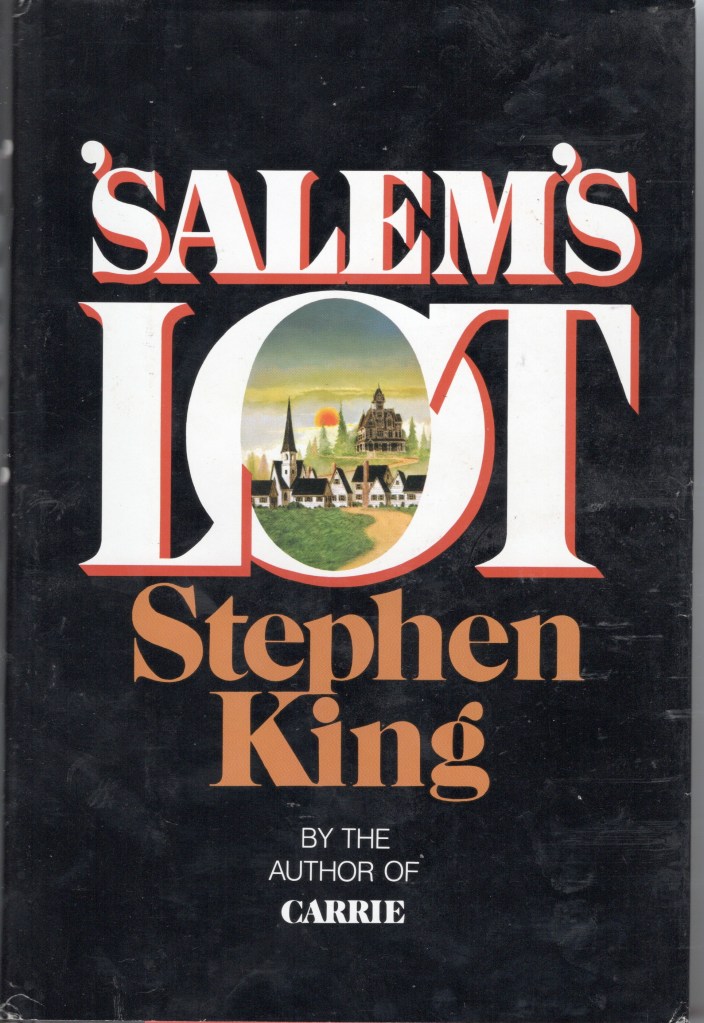
Almost everyone thought the man and the boy were father and son.

They crossed the country on a rambling southwest line in an old Citroen sedan, keeping mostly to secondary roads, traveling in fits and starts. They stopped in three places along the way before reaching their final destination: first in Rhode Island, where the tall man with the black hair worked in a textile mill; then in Youngstown, Ohio, where he worked for three months on a tractor assembly line; and finally in a small California town near the Mexican boarder, where he pumped gas and worked at repairing small foreign cars with an amount of success that was, to him, surprising and gratifying.

Wherever they stopped, he got a Maine newspaper called the Portland Press-Herald and watched it for items concerning a small southern Maine town named Jerusalem’s Lot and the surrounding area. There were such items from time to time.

He wrote an outline of a novel in motel rooms before they Central Falls, Rhode Island, and mailed it to his agent. He had been a mildly successful novelist a million years before, in a time when the darkness had not come over his life. The agent took the outline to his last publisher, who expressed polite interest but no inclination to part with any advance money. “Please” and “thank you,” he told the boy as he tore the agent’s letter up, were still free. He said it without too much bitterness and set about the book anyway.

The boy did not speak much. His face retained a perpetual pinched look, and his eyes were dark–as if they always scanned some bleak inner horizon. In the diners and gas stations where they stopped along the way, he was polite and nothing more. He didn’t seem to want the tall man out of his sight, and the boy seemed nervous when the man left him to use the bathroom. He refused to talk about the town of Jerusalem’s Lot, although the tall man tried to raise the topic from time to time, and he would not look at the Portland newspapers the man sometimes deliberately left around.

When the book was written, they were living in a beach cottage off the highway, and they both swam in the Pacific a freat deal. It was warmer than the Atlantic, and friendlier. It held no memories. The boy began to get very brown.
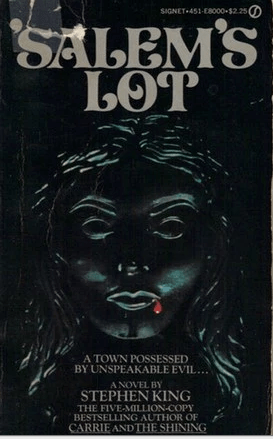
This is the cover of the version I originally read in high school–I bought it off the paperback rack at the Safeway in Emporia, Kansas. I kept that copy for years; eventually replacing it with a hardcover reprint in the 1990′, before finally getting an old copy with the original cover on eBay (which has since turned out to be a first edition; I love finding all the mistakes in it as I reread it).

I had read Carrie in paperback in one night when I’d borrowed it from a friend; it was only in the last decade that I finally acquired a copy of it to keep and reread periodically (I bought it to read the opening shower scene at Banned Books Night; ironically, the objections to the book have nothing to do with explicit talk about menstruation, or bullying, or violence…people object to the book because of its depiction of Christianity, particularly in the case of Carrie’s fanatic mother, Margaret (whom I always see in my head as Piper Laurie, who should have won an Oscar). I don’t think Carrie was the book that made me begin to question Christianity, to be honest; I think I already was questioning it before I read the book, but it was one of the first times I’d see a disparaging representation of someone committing horrifying abuses in the name of Jesus, or how the way the religion viewed sexuality could be taken to such horrific extremes. But I loved the book and became interested in Stephen King as an author. I was aware of ‘salem’s Lot before I found a copy while grocery shopping with my mom; I’d known he’d published a second book because I saw it in the book club ads (Doubleday, Book of the Month, etc.) in magazines. I had no idea what the book was about when I started reading it–I had no clue it was about vampires, and vampires never even crossed my mind when I started reading. It was a Saturday (Mom always drove into Emporia on Saturday to buy groceries), and I repaired to my room with the book (my homework was already done, and whatever college football game was on that Saturday was of no interest to me) and started reading. I finished reading it at around two in the morning, and was completely blown away by it. There was no way I was going to stop reading, and there was no way to stop reading once the big reveal about the vampires happened and the pace picked up.

The book was utterly terrifying, and it started raining later on that day as I read. I was living in a small town (population 973) and my bedroom window looked out at a corn field that was right across the street. I started seeing, as I read, a lot of similarities between Jerusalem’s Lot in the book and my little town–the characters, the interconnectedness of the community, and like Ben Mears, I was still kind of a stranger in the town. I just remember that when I got to the part where Danny Glick comes to Mark Petrie’s window, the storm outside brushed a tree branch against my window and I literally jumped, the book flying out of my hands and landing across the room in the middle of the floor.

It was also the first time I remember reading a book whose main character was a writer–something Stephen King returns to quite regularly, write what you know indeed–which also helped me connect with the book more; Ben Mears was a publisher novelist of minor success, but had published three books already and hadn’t graduated from college. He also seemed like a real person, living and breathing and absolutely real; it wasn’t until this reread that I realized how much physically he’s like King–tall and slender with thick black hair.

But it was also the first time I’d read anything about vampires that was so clearly set in the real world, in the real present, and with real characters I could relate to–which made it even more terrifying. I started thinking about how easy it would be for, say, a vampire to come to our small little town and how quickly people could be turned, primarily because no one would believe it was actually happening until it was too late–which King handled beautifully in the book.

It still holds up, and I am glad I revisited it.

When the Lovelight Starts Shining Through His Eyes

As I mentioned yesterday–these blog post titles taken from the Supremes discography sometimes feel a bit off as I do some Blatant Self-Promotion about my new soon-to-be-released novel #shedeservedit.

I got my first ignorant comment on one of those blog posts yesterday; someone posted a link to a video about “toxic femininity” and how it’s “as bad if not worse” than “toxic masculinity.” Needless to say, I not only didn’t approve the comment but marked it as spam and blocked the user from commenting/reading my blog. For those of you who are new here–I don’t engage with trolls, not do I permit them the energy or the oxygen of allowing their ignorance to be seen by anyone here. This is my blog and I pay for it; therefore I will curate the content here and if you want to troll me, well, it’s just going to earn you a comment marked as spam and get you blocked, so don’t waste your time or energy on me. You may, of course–I cannot stop you, but I won’t engage with you nor will I allow Constant Reader to see your ignorance, so there you have it.

I wrote yesterday, and it felt good to get another chapter down. I only have two more to go and the revisions, and I have to say, pantsing this thing on a tight deadline hasn’t been the easiest way to write this book, but it’s working. I’ve got the plot all worked out now, who the killer is and why, and now all I have to do is cram the resolution into the last two chapters and we are finished, done, ready to go off to the editor with prayers that she likes what I’ve done and doesn’t require a complete overhaul, which is also entirely possible and within the realm of probability–one of the reasons, frankly, that I’ve not signed. a contract to dive straight away into another book when this one is finished; I thought it best to leave my time free just in case. (I am going to start working on Chlorine and Mississsippi River Mischief while waiting for my edits; there’s always something to write, after all–I can also work on the revisions of the novellas in the meantime as well.)

There’s always something…

Today’s BSP is going to focus on writing about small towns, rather than what I’ve been covering (toxic masculinity). The first book I remember reading about a small town that really stands out to me–as an examination of small town dynamics, rather than merely a setting for the story–was Ellery Queen’s Calamity Town, which was, if you are an Ellery Queen fan, the first Wrightsville story. There were several of these novels–the second, I believe, was The Murderer is a Fox–and I enjoyed them all; Queen clearly loved writing about Wrightsville, since he kept returning to the scene of the crimes, as it were, but the best, the true standout for me, was the first: Calamity Town. This book–published well over a decade before Grace Metalious scandalized the world with Peyton Place–also covers the same territory as Peyton Place: scandal and hypocrisy and the paralyzing power of gossip in small town America. Calamity Town remains a favorite mystery novel of mine to this day; I should reread it. It’s plot is ingenious and entirely rooted in human psychology, and it also contains one of the best and most clever misdirections in crime fiction history. It was Calamity Town that made me first start thinking about how small town society is actually a microcosm of American society as a whole, all encapsulated in a small package, and also that made me realize, for the first time, how claustrophobic small towns can be; where everyone knows everyone and you can’t really do anything without someone knowing; and how secrets kept can become very damaging over time. Queen is, at first, struck by the apple-pie Americana of Wrightville…and then he begins peeling back the layers.

Peyton Place, which I found to be far less scandalous than either General Hospital or All My Children by the time I got a copy at a secondhand bookstore in Emporia when I was seventeen or eighteen, also showed me again how claustrophobic small town life could be. Sure, there’s some bad to the point of laughable writing in the book (“your nipples are hard as diamonds”, anyone?) but other than those brief moments, overall it’s a very well-constructed book and a damning indictment on the hypocrisy of American small towns. I also read Sinclair Lewis’ Main Street around the same time for an American Literature class (I still think we should have read Elmer Gantry instead, or It Can’t Happen Here, but I was not in charge of the syllabus), which is also about the falseness of keeping up appearances and worrying what the neighbors think. I find it interesting that “small town American values” are frequently–particularly by conservatives–pointed out as what is the backbone of our country and so on and so forth (part of the entire “cities are BAD” thing we have had going on culturally for decades, if not centuries), but when that veil is peeled back, there is just as much rot and decay as in any “wicked” city. As I pointed out on Susan Larson’s radio show the other day, the vast majority of the soaps were originally set in very small towns, rather than urban centers.

Nobody does small towns quite like Stephen King, and the first time he really addressed small town life was in ‘salem’s Lot–although it can be argued he did a masterwork on small town life with Needful Things–and it was in his tale of small town Maine being overrun by vampires, he also did an incredible job of painting the town, it’s working class citizens and the minutiae of their lives; how circumstances trapped some of them and killed their dreams–and how others never had any dreams to be killed in the first place. The way he interweaves the lives of his small town characters, their relationships and histories and how everything is interconnected is masterful; has anyone ever done a critical analysis of King’s work with small towns? It also falls into this group; what King does with Derry is just as exceptional as his work on Castle Rock and Jerusalem’s Lot in the other works.

I based Liberty Center on Emporia, Kansas, geographically; my town is loosely laid out the same way Emporia is; there’s a small college there, as in Emporia, and there’s a meat packing plant on one side of town that reeks of death and stale blood on the south side of town, and of course, the waterfall on the river on the way out of town heading south and the park that goes with it. Other than that, it’s memory and invention; I’ve not set foot in Emporia in nearly forty years and have no plans to ever do so again. (Likewise, when I write about my fictionalized county in Alabama–it’s loosely based on where my family is from, but I haven’t been there in thirty years and will most likely never go visit again, so it’s all memory and invention for me.) I don’t know if I will write another novel about Kansas–I have some other ideas, of course, don’t I always–but it seems weird to create another fictional small city so similar to Liberty Center, but at the same time it seems even weirder to set another book there after having already done so (although i should probably revisit Sara sometime and see how I did it–and what I called the towns in Kahola County–before deciding one way or the other).

Heavy sigh.

Today I need to write another chapter, and I also need to work on revising a short story as well as writing a promotional article–and of course, there’s the horror that is my email inbox which needs to be dealt with this week once and for all (it’s all relative; answering everything and emptying it out inevitably means generating more emails there; my email responses will trigger emails in response which turns it into a Sisyphean task without end), and today is the men’s US figure skating championships, which naturally I plan to watch so I need to get my writing done before then, don’t I?

So on that note, I head into the spice mines. Have a lovely Sunday, Constant Reader.

Keep Coming Back

It dropped into the forties overnight, and this morning, it’s struggling to get up into the low fifties. This is utter and complete madness; we even are looking at a possible freeze alert by Tuesday–a freeze alert in November. Utter, total, unquestionable madness.

The LSU game…well, they won and let’s just leave it at that.

The Saints play Cincinnati today at noon; I intend to write all morning and then take a break to watch them play, after which I will try to get some more writing done. I wound up spending most of yesterday relaxing and reading. I dove back into ‘salem’s Lot, my Halloween reread for this year (you see how well that went), intending to only read a chapter, but promptly got sucked into the narrative. I finished reading part one, and chose to stop with Part II, “The Emperor of Ice Cream.” The essay about ‘salem’s Lot that is currently brewing in my head–“Peyton Place, But With Vampires”–is slowly taking shape within my head, which is lovely. Whether or not I am ever going to have the time to write it is an entirely different question, of course.

One of the interesting things about rereading ‘salem’s Lot is also seeing how carefully King structured his novel; the book isn’t–which is the point of my essay–so much about the vampires and the fearless vampire killers (well, they are hardly fearless), as it is about the town. I love that King shows how the other people in the town react to what’s going on; they of course aren’t privy to what the main, core characters (Ben, Mark, Susan, Matt, and the doctor–whose name is escaping me now) are; one of the other things King does so remarkably well in this, only his second novel, is depicting how small towns really work–hence the comparison to Peyton Place. His depictions of small towns only got better and more realistic as his career progressed; I think the secret strength of Needful Things is the honesty and truth in how he depicted Castle Rock; with all the resentments and anger and feuds all simmering just beneath the surface (I also need to revisit Needful Things).

I plan to get back to Bury Me in Satin today. I wrote less than three hundred words yesterday, and this shall not stand; I also need to get back on track with this manuscript. I am a little torn about how to proceed–I am also having questions about the time line and so forth–but these things should sort themselves out as I write and move the story forward. We’ll see how it goes today. I also need to work on these short stories. Heavy heaving sigh.

I also managed to read something yesterday for the Short Story Project: “Remaindered” by Peter Lovesey, from Bibliomysteries Volume 2, edited by Otto Penzler:

Agatha Christie did it. The evidence was plain to see, but no one did see for more than a day. Robert Ripple’s corpse was cold on the bookshop floor. It must have been there right through Monday, the day Precious Finds was always closed. Poor guy, he was discovered early Tuesday in the section he called his office, in a position no bookseller would choose for his last transaction, face down, feet down and butt up, jack-knifed over a carton of books. The side of the carton had burst and some of the books had slipped out and fanned across the carpet, every one a Christie.

Last Sunday Robert had taken delivery of the Christie novels. They came from a house on Park Avenue, one of the best streets in Poketown, Pennsylvania, and they had a curious history. They were brought over from Europe before World War II by an immigrant whose first job had been as a London publisher’s rep. He’d kept the books as a souvenir of those tough times trying to interest bookshop owners in whodunits when the only novels most British people wanted to read were by Jeffrey Farnol and Ethel M. Dell. After his arrival in America, he’d switched to selling Model T Fords instead and made a sizable fortune. The Christies has been forgotten about, stored in the attic of the fine old weatherboard house he’d bought after making his first million. And now his playboy grandson planned to demolish the building and replace it with a space-age dwelling of glass and concrete. He’d cleared the attic and wanted to dispose of the books. Robert had taken one look and offered five hundred dollars for the lot. The grandson had pocketed the check and gone away pleased with the deal.

Hardly believing his luck, Robert must have waited until the shop closed and then stopped to lift the carton onto his desk and check the content more carefully. Mistake.

This is actually my first experience with reading Peter Lovesey.  I mean, I know who he is and that he is in the upper stratosphere of crime writers, but I’ve not read him before. Reading “Remaindered” certainly has made me want to change that. The story is multi-layered, and exceptionally cleverly structured. It begins with the sad and sudden death of a second hand bookstore owner; due to a crate of Agatha Christie novels he’s just purchased, as indicated in the excerpt above. And that is where the story starts to twist and turn, changing shapes and throwing out the occasional surprise, twist after twist after twist; all of them organic and foreshadowed, and the story itself does an excellent, highly honest job of depicting the characters, their needs, their wants, and their incredibly surprising histories. I do highly recommend it.

The entire point of The Short Story Project was intended to be a sort of graduate course in short story writing for me. At the beginning of this year, the intent was for me to write a lot of short stories and to work on my craft with them, to improve as a writer. I’ve not had that much success with any of the new stories I’ve written this year; the rejections continue to stack up. But I shall continue to try writing them. I also realized last night that two stories I have coming out in anthologies next year are similarly themed, and I have like two or three more following not only a similar theme but a similar pattern in the works. Ruh roh.

And now, back to the spice mines.

IMG_4342

Wanna Be Startin’ Something

Well, I finished the tragic mess that is currently known as Chapter Seven’s first draft yesterday. And it is a mess; this is easily one of the sloppiest first drafts of a novel I’ve ever written. In fact, I feel so bad about how shitty it is I may even go back and rewrite the entire first half once I finish Chapter Ten. This book is so bad, I can’t even believe how badly I can write a Scotty novel. Oh, well, that’s what rewrites and revisions and future drafts are for.

I also finished rereading It yesterday. Wow, you are undoubtedly saying, that’s a lot of reading. But truth be told, much like the Losers Club when they return to Derry twenty-seven years later, the more I read the more I remembered. And yes, I skimmed some sections, and skipped some entirely. It’s a perfectly fine novel, and I would recommend it..but there are problematic sections, and yes, I do feel like I’m committing treason by saying anything negative about Stephen King and his work, because he is my writing idol, and he has been since I was a teenager. What works in this book works extremely well; no one writes about the lives of children, how they relate to other children, and what it’s like to be a loser as a child (or feel like one) the way he does. I identify with every one of those kids, I feel for them, I desperately want them to succeed and have great lives and live happily ever after. Their return as adults doesn’t work quite as well as the parts that are set in the past; the characters are still richly defined, and their relationships still work–but I still didn’t like the resolution of the story, either when they were kids or when they were adults; I didn’t like the way the book ended (but for the life of me, I couldn’t write such a book nor could I think of a way to end such a book), and it reminded me a lot of Floating Dragon by Peter Straub in many ways (or vice versa; I think I read the King first and then the Straub originally and was struck by the similarities; I do love both books and think of them fondly). I’m not sorry I took the time to reread It and reacquaint myself with Derry and the Losers Club; there are some genuinely good scares in the book, and it’s one of the best books about a small city I’ve read–King really does a great job of depicting life in these smallish towns/cities and how the social dynamics work in them, whether it’s Derry, Castle Rock, or Jerusalem’s Lot. (That was one of the best parts of Needful Things for me; how the town dynamics worked and how the characters and their lives and their petty foibles and feuds all were entwined so intricately together.)

One of the other interesting things I found in rereading It was there was an LSU connection in it; in the town Ben has moved to and currently lives in there was a local kid who was a star athlete and went to LSU, only to party too hard and flunk out, and wound up coming back to the small town as an alcoholic. The town is Hemingford Home, where of course Miss Abigail lived in The Stand; also in that same book when Nick Andros is jumped, one of the assailants was wearing his fraternity ring from LSU–he was the sheriff’s brother-in-law, and he partied too hard and flunked out of LSU as well. Methinks Mr. King knows someone who went to LSU and flunked out for partying too hard. Those are the only two references to LSU in King’s work that I know of; would that Rocky Wood was alive so I could email and ask him.

Maybe someday I’ll get to ask Mr. King.

And of course, It is very reminiscent of the novella “The Body.” which is probably my favorite work of King’s, if pressed to name a favorite–the Losers Club, like the smaller group of friends in “The Body”, has the fat kid, the kid whose brother died and parents haven’t gotten over it, the poor kid (only switched from male to female in It), and the kid who gets beaten up a lot because of his smart mouth.

And there’s also the writer character–King often throws a writer in his work (Ben in ‘salem’s Lot, Jack in The Shining), but this was the first book where he really went all-in on  writer character with Bill Denbrough–and of course, his next novel was Misery, which of course took the writer character, and the dangers of fame, to a whole new level.

But yeah, the gang bang scene has a whole different vibe about in 2017. It didn’t phase me thirty-one years ago, but now it’s just kind of…icky.

As I said, I’m not sorry I reread it; most of it still stands up, and I still think it’s a terrific, if flawed, novel.

Today I need to get this kitchen in order, and I want to work some more on both the WIP and the new Scotty, maybe even a short story. Next up for my reading is Michael MacDowell’s The Elementals.

And now, back to the spice mines. Here’s a hunk to get your week off to a nice start.

17523549_1306428822738512_2755094986544804343_n

Truly

Tuesday! I made it through Monday. I also managed to get a big hunk of edits input into the manuscript, which means I am on the downward slope to getting that finished. I am most likely going to put aside working on Scotty until the edits are finished, now that I’m in a groove, and am very pleased, I must say. I would love to have this done by the weekend, so I can let it sit for another week while I work on Scotty; but I don’t know; that’s going to depend on two things: motivation and energy.

We’ll see how that turns out, won’t we?

Heavy sigh.

I am debating on whether I want to reread It. I bought it the day it was released, back in 1986 (as I have done with everything Stephen King has published since Different Seasons,  and I read it over the course of two days. (I binge-read King’s novels back then; each as they came out, on the day they were released; a habit I have sadly fallen out of.) I also used to reread King novels many times; I can’t count how many times I’ve reread, for example, The Stand, The Dead Zone, ‘salem’s Lot, etc. I still will reread one of those earlier novels on occasion; but I’ve never reread It, though, and I’m not sure why. I think I got out of the habit of rereading King sometime in the mid-1990’s; and what I wouldn’t give for the time to sit down and reread them all, beginning with Carrie and working my way through the most recent. But now that a new film version of It is out, and breaking records, and getting much critical acclaim; it may be time to reread the Big Novel. I loved It the first time, cherishing the characters more so than the story, which did terrify me; but I vaguely remember not liking the ending; which was a first for me with King.

I do love Stephen King, both as a person and as a writer; granted, what I know of him as a person is confined to news reports of things he does, and his Twitter account; plus, I did get to meet him at the Edgars several years ago, which was one of the biggest thrills of my life. It’s hard to describe what King’s work has meant to me; how it’s inspired me as a writer, and pushed me to not only find my own voice as a writer but made me want to figure out how to create characters that, no matter how bad they might be or how awful the things they do, the reader can find some sympathy for. His On Writing is the book I always recommend to beginning writers as a place to start learning to write, and ‘salem’s Lot (with Needful Things running right behind it) is one of the best novels about a small town, and small town life, I’ve ever read. “The Body” is one of my favorite novellas, if not the favorite; and of course the film version, Stand by Me, is one of my favorite films. His uncanny eye for human behavior, his insights into character that are so honest and real and true, are what make the books so damned brilliant for me.

We watched the first episode of American Horror Story: Cult last night as well; it was an excellent start to the season. But that doesn’t mean the show won’t go off the rails as it continues to unfold; it seems like it almost always does. And without the anchor of Jessica Lange giving a balls-out performance at the center, the post-Jessica seasons tend to lose my interest along the way. We never finished watching Hotel, but we did finish the mess that was Roanoke. As Halloween approaches–it’s certainly has felt more like fall around here since Labor Day, with temperatures in the low seventies and no humidity–my mind is turning more and more to reading horror; it’s almost time for my annual Halloween reread of The Haunting of Hill House, and I do have some other horror in my TBR pile I’d like to get through. I promised Katrina Holm I’d read Michael MacDowell’s The Elementals before Bouchercon so we could drink martinis and discuss it; I’ve got some unread Nick Cutter on my shelves, as well as some other things from ChiZine Press (which never disappoints), and there are some Stephen King novels in my collection I’ve yet to read. I also want to reread Peter Straub’s Ghost Story and Floating Dragon; as I said the other day, a horror novel I’ve been thinking about for about thirty years has been percolating in my frontal lobes the last week or so–I finally realized where I could set it, where it would make sense, as opposed to where I’d stubbornly been wanting to set it, where it wouldn’t work so I’ve never been able to write it–and I may start sketching some ideas for it.

And on that note, these edits aren’t going to input themselves.

Here’s a hunk for you, Constant Reader, Eddie Cibrian, in his underwear:

IMG_2636