I have always loved Superman, ever since I accidentally pressed the wrong button on the comic book vending machine at the Jewel Osco on Pulaski Avenue in Chicago as a child and got Action Comics instead of the Betty and Veronica I wanted. I was disappointed, and asked my mom for some more change so I could get what I actually wanted, which was when my mom decided to teach me a valuable life lesson: if you hurry and don’t pay attention you won’t get what you want–and sometimes that’s the end of it. So always, always make sure you’re picking the right thing. (I still do, to this day, and whenever I “forget” and rush–it inevitably ends badly.)
I wasn’t happy about it, but made the best of it. I had a comic book, after all, and while I had never shown any interest in super-heroes and their comics before, I decided to read it when I got home.
Once I did, I was done with the Archie and the world of Riverdale for good. I started reading DC Comics–I already knew about Batman from the television show, which we watched every week with its epic cartoonish campiness–and all the other titles that involved Superman even if only in a peripheral way. Both Jimmy Olson and Lois Lane also had their own titles, there were at least three titles alone devoted to Superman, and of course, Justice League of America. There was a Superboy title, too, and of course we can’t forget Linda Danvers, Supergirl. I read them all, and finally stopped buying them when they reached the (to me then) insane price of a dollar per issue. But I never lost my sentimental attachment to DC Comics and their heroes. I was also terribly bummed when the peripheral titles, like Superboy, Jimmy Olson–Superman’s Pal, and Superman’s Girlfriend, Lois Lane–were cancelled. For the most part, Lois’ adventures that didn’t involve Superman–when she was actually doing her job as an investigative reporter–often involved her in mysteries she had to solve, which were a lot more interesting to me than her schemes to expose Clark as Superman, or to get Superman to marry her. The old television series, with George Reeves, was often shown in reruns on alternative non-network local channels, and while I of course watched, I was kind of disappointed with how bad and cheap the effects looked. Batman’s television show was campy, of course, and highly entertaining–but campy. Wonder Woman was also campy and cheesy, but had Lynda Carter, who personified both the super-hero and her alter-ego, Diana. (When I was watching Superpowered: The DC Story the other night Carter said something I thought was very perceptive and explained thoroughly her role on the show: “I didn’t play them as separate characters–I just played her as Diana, the Amazon Princess, with a strong belief in equality and that there’s a better way than fighting.”)
So, when they Superman movie was announced sometime in the mid-1970’s, I knew I’d go see it, but didn’t have a lot of high hopes. But the tagline was fantastic.
You’ll believe a man can fly.
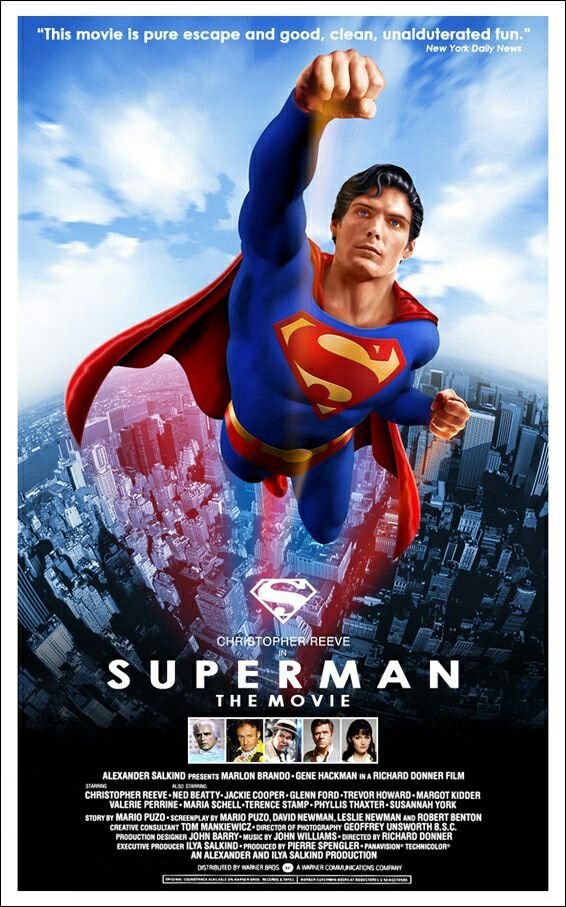
I think I was at the theater, waiting to watch either The Deer Hunter or Animal House, when they played the preview for the upcoming December release Superman The Movie, starring Christopher Reeve and Margot Kidder (among many other major names in supporting roles–from Marlon Brando to Gene Hackman to Ned Beatty to Valerie Perrine). I knew they were making the movie, and I had allowed myself to get a little excited about it as a Superman fan. I’d always found previous Superman adaptations–mostly the television show–to be so inexpensively done that it was almost comical. But special effects had been changed forever by the one-two punch of 1977’s Star Wars and Close Encounters of the Third Kind, and I also knew they were spending a LOT of money on this adaptation, so when the screen and theater went dark, and you just heard a voice saying “You’ll believe a man can fly” and then…there he was, flying. I caught my breath because it looked so real. And when Christopher Reeve turned his face to the camera, smiled, saluted and somehow got his eyes to twinkle, I also knew the movie was perfectly cast. I couldn’t wait for the movie to finally open (I think I also saw the sequel on its opening weekend), and yes, when it finally came to the Petite Twin Theater (apparently still there? No, no movie theater on Commercial Street anymore, alas) I saw it on that first weekend.
I’ve always loved Superman, and Christopher Reeve was fantastic in the part; the bar every actor who puts on the suit has to clear.
Obviously, the recent announcement that David Corenswet has been cast to play Clark/Superman in the new reboot of the film franchise, replacing Henry Cavill, has me thinking about Superman again. I was very pleased, frankly, when Cavill was originally cast; I’d first noted him playing Charles Brandon on The Tudors and thought, “that is one fine-ass man.” I thought he was the perfect choice to play the dual roles of Clark and Superman; he is drop dead gorgeous, for one, and his eyes have the ability to twinkle when he smiles and the dimples? Just take me now, Henry.

Mr. Cavill fills out the suit rather nicely, does he not?
The Henry Cavill version of Superman, which followed on the heels of a failed reboot with Brandon Routh (who returned to the televised DC Universe–the Arrowverse–in Legends of Tomorrow. I always felt bad for Routh, who I didn’t think got a fair break, either), wasn’t the best interpretation of the character but that wasn’t Cavill’s fault; that was the vision of the director and writers and the studio; and while I think I can understand the need to update Superman, the need to darken his story a la The Dark Knight 1980’s Batman reboot was a mistake. Superman is the World’s Biggest Boy Scout; he stands for hope and truth and all those things we used to believe embodied the United States; if anything, Superman was the personification of the idea of American exceptionalism.
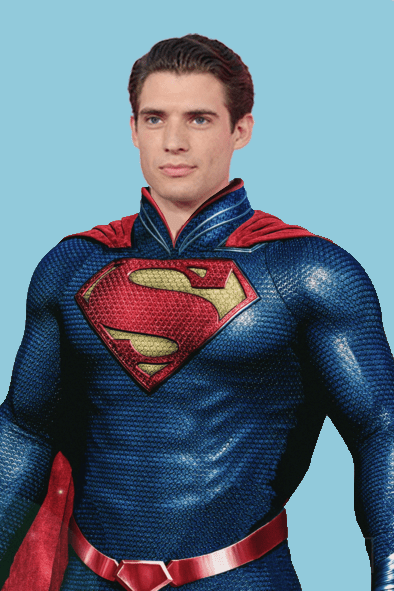
David Corenswet certainly has the right look for the part; he’s from the Ryan Murphy stable of dark-haired blue-eyed square jawed hunks who regularly appear on his television series. I first saw Corenswet in The Politician, and then again in Hollywood. I found the following fan art through a Google search, as there are no available official images of him as the Big Blue Boy Scout. James Gunn’s vision for the DC Universe is one I am interested in seeing; while I didn’t enjoy the second and probably won’t watch the third (I’ve come to detest everything about Chris Pratt over the last few years), I did think the first Guardians of the Galaxy movie was pitch-perfect for a popcorn super-hero type movie.
But I do hope they move away from the dark broodiness of the Cavill version. I enjoyed them (and love Henry Cavill for reasons that should be obvious; look at the posted picture above again), but they didn’t feel right for Superman movies. The underlying theme and element of all the Superman stories is his positive energy and determination to protect people from harm and most importantly, lead by example. One of the core elements of the original Superman series (before the first of many DC reboots of their universe) was that Superman’s most sacred vow was that he would never take a life, no matter who or how much they deserved death. That didn’t matter to Superman, whose pursuit of justice was limited to capturing the bad guys and turning them over to the judicial system. It wasn’t his job to determine justice and punishment.
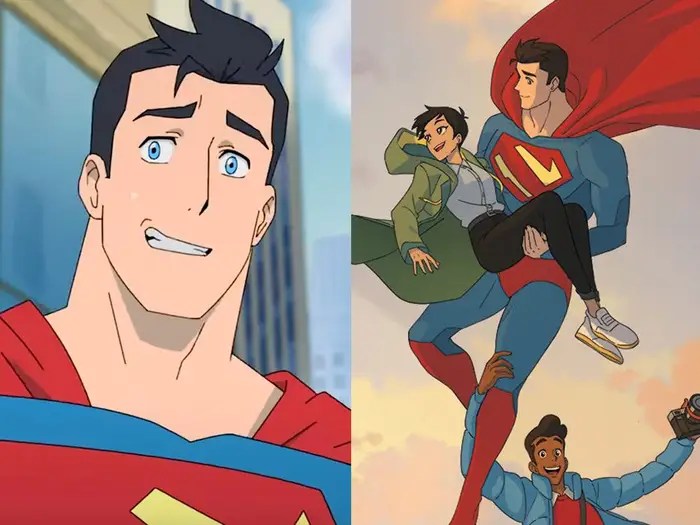
I keep hearing good things about the animated DC movies and series, but have yet to really watch any of them. I don’t know why I have this automatic resistance to animated super-hero shows/movies; I love Disney animation, and there are literally hours of DC animated entertainment available for streaming. I’d been hearing good things about a new DC animated series on MAX called My Adventures with Superman, so while I was waiting for Paul the other night (and was tired of LSU football highlight videos) I decided to give My Adventures with Superman a chance.
Constant Reader, I am so glad I did.
The show is utterly charming. It’s very well animated, for one–Clark/Superman is handsome, which is weird to say about a cartoon–and it’s refreshingly well-written with more emphasis on the characters and who they are, as well as their relationships with each other, over the adventure aspects of it, which makes it all the more likable and enduring. The premise is that Clark, Lois, and Jimmy Olson are all interns at the Daily Planet; Clark and Jimmy are just starting, and Lois is given the job of breaking them in and showing them the ropes. Lois is ambitious and determined to become a star reporter, and her impetuosity and ambition quickly leads them all into trouble–not only with the bad guys, but with Perry White back at the paper. Fortunately, Clark is, well, Superman, so all turns out for the best and Lois gets the scoop of all time: there’s a super-man amongst us! Which gets all three of them hired on staff. Clark is exactly the way he should be: kind, thoughtful, empathetic, a little bit shy–and the cold open of episode 1, which has young Clark suddenly discovering that he can, actually, fly; and his excitement and wonder at discovering this sudden new ability slowly begins to fade–imagine learning at age ten or eleven that you have super-powers–and he begins to wonder not only who he is, but what he is….then after the opening credits it flashes forward to Metropolis and Clark and Jimmy–roommates–getting ready for their first day as interns. The chemistry between the three of them–truly the Holy Trinity of the Superman stories is Clark, Lois and Jimmy (it’s so nice to see Jimmy Olson finally getting something to do and being included as something more than just a bit part, which is a nice nod to Superman history), and I am really looking forward to watching more of it.
And the art is fantastic.


Well done, DC. I hope this series lasts and is a hit–and I hope James Gunn is watching so he can see how to do the Big Blue Boy Scout properly.

 Queer and Loathing in America