And here we are at a manic Monday yet again, and shortly I will be heading into the office for yet another exciting week of the day job. Hurray and huzzah? I slept really well on Saturday night, getting up just after seven yesterday despite not going to bed until almost midnight; I found myself reading some things Saturday during the games that I shouldn’t have started–one of them being Queen Margot by Alexandre Dumas; I have the ebook–and I was also reading legends and stories about Louisiana’s past as well as Alabama’s; I have an ebook called Warrior Mountains Folklore: An Oral History by Rickey Butch Walker (which is an Alabama name if I’ve ever heard one); which isn’t necessarily about the Alabama county I’m from, but the ones directly north, including notorious Winston County, which contains the Bankhead National Forest. It also tells stories of the indigenous people of the area, and reminded me that Tuscaloosa actually is the Creek words for “black warrior,” meaning the Black Warrior River is actually the Tuscaloosa (tusca loosa); this will all go into the construction of my fictional Alabama county, which is ongoing. (And yes, the irony that one of the greatest–if not the greatest–college football programs is in a town named Black Warrior in the native tongue is hilarious.)
(It has occurred to me that I don’t necessarily have to connect all of my Alabama stories just as I don’t need to connect all my Kansas stories–which I realized while writing #shedeservedit–which was kind of freeing. I need to think in terms of multiverses rather than one single interconnected universe with my writing, don’t I? It certainly makes things easier than trying to keep the continuity and so forth going.)
Anyway, I am sure my Alabama just-for-fun research will undoubtedly pay dividends in future writing, no doubt. I also have been having ideas for more stories set there; I may give Jake’s boyfriend Beau his own story at some point; I keep going back to the legend of the Blackwood witch from antebellum/early statehood days, because the witch story is one I’ve always wanted to tell. Beau, being an archaeology major with a minor in Alabama History, is just the perfect person to tell the story of the witch I’ve always wanted to tell. But is it weird to have another vengeful spirit in the woods behind the Blackwood place, and the Civil War ruins? Or could it be tied to the lost family cemetery, still out there in the woods somewhere? As you can tell, I’ve been thinking about it lately.
I managed about a little more than twenty-five hundred words on the new Valerie yesterday, which felt great to do, really. I wanted to write some more on the Jem sequel, too, but after finishing the Valerie chapter I just felt mentally fatigued. I’m not used to writing this much in a short period of time anymore (just over an hour or so) and it’s going to take me a while to get back up to the proper writing speed I cannot maintain year-round. But it felt great to be creating again, and I do love the plot of this book. I also spent some quality time with Shawn Cosby’s marvelous All the Sinners Bleed, which is going in a direction I did not see coming and one that I am really enjoying. Shawn is such a master story-teller! I can’t wait to finish this so I can write about it–and I hope I finish it in time to read Lou Berney’s new one before I switch to October Halloween Horror Month. I think I may try out a Grady Hendrix novel for one of my horror reads and of course, I am terribly behind on Stephen King, and there are also some other lovely horror novels and collections in my piles of books to be read that could make for a fun reading month: Stephen Graham Jones, Silvia Moreno-Garcia, Paul Tremblay, Christopher Golden, Sarah Pearse, and Katrina Monroe, among so many others–I need to get back into the habit of reading for at least an hour every day. The only way to get through all the books i want to read is to make a daily time allowance for reading and stick to it.
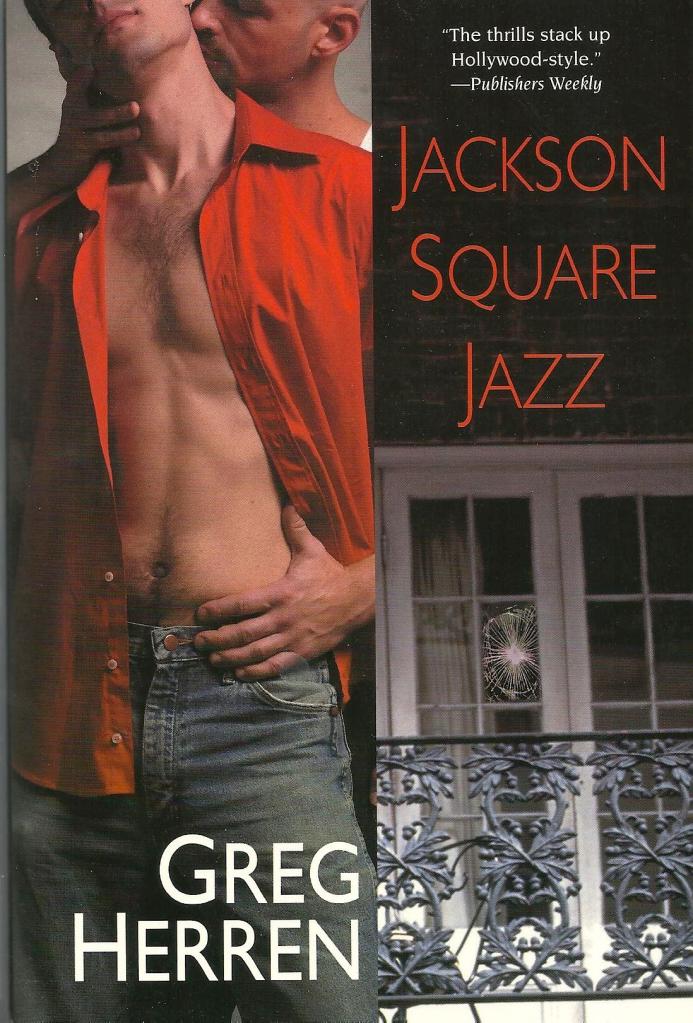
After the abysmally disappointing Saints game, I went back to my easy chair and rather than delving back into Shawn’s book, I decided to start reading Jackson Square Jazz, the finished and published edition, to get a better handle on the story again. It’s been a long time, and I knew it had to do with a young figure skater, the Napoleon death mask, and the Cabildo fire, but not really much beyond that–although I think it’s actually the book where Scotty is in his first canonical car accident. Again, I am distant enough from it now not to immediate go into editing mode as I read it–ironic, since I need to re-edit it–and just read it. I really need to stop being so hard on myself. I know I’ve already made great strides in that direction, and I like my new positive attitude toward writing and publishing. I think analyzing why I am so hard on myself, recognizing the mentality I defaulted to when reading my work meant needing to flip a switch in my brain and going into a different mode other than editorial and doing it consciously makes a lot of difference. I was pleased rereading my short story collection, and was pretty pleased with rereading Jackson Square Jazz, particularly since it’s an early book in my canon and it’s been over twenty years since I wrote it.
(It’s kind of awe-inspiring and terrifying at the same time to realize just how long I’ve been doing this. Bill Clinton was president when I signed my first book contract.)
Well, that made me feel rather elderly.
I slept super-well last night, too. I was very tired and falling asleep in my chair, so I went to bed around nine and only woke up once, around two, and then woke up again half an hour before the alarm (as usual). Hopefully, I will not be too tired to function later today.
And on those two rather sad trombone notes, I am heading back into the spice mines. Have a lovely Monday, Constant Reader, and I will be back before you know it.
I’ve told this story any number of times; how the writing of the book was derailed by two awful things that happened in my life, and how I finally got back to writing again in the spring of 2005, managing to finish this and turn it into literally two or three weeks before Hurricane Katrina came barreling ashore and changed everything in my life, and the long recovery time from that paradigm shift, trying to adjust to the new reality I was facing every day. It felt weird going over the copy edits, weirder still doing the page proofs (I actually had the incredibly sharp-eyed Becky Cochrane and Timothy J. Lambert do it for me while I was visiting the Compound, thanks again, guys!), and even stranger having to tour and promote a book about New Orleans set before Katrina while still dealing with the recovery.
I’ve told those stories before, and that isn’t really what these entries are about; these entries are about the books themselves and how I came up with the stories and so forth, and the writing of the books. The primary problem, of course, is that I wrote this book between and around tragedies; the two year period I call the Time of Troubles that began on Memorial Day weekend in 2004 and ran through about 2008, really; because that’s about how long it took after all those issues for me to feel like my feet were beneath me again and I once again had a grasp on my life. I don’t remember what the original story was about, other than it centered on the Krewe of Iris, Scotty’s Diderot grandmother’s best friend who’d married a much younger muscle-stud Russian, and that’s really about it. The Russian would have something to do with a Colin case–and it would turn out actually be the case that brought him undercover to New Orleans in the first place during Southern Decadence; in Jackson Square Jazz we find out what Colin’s real job is, and that he was in town originally about the Napoleon death mask–but he was also in town to keep an eye on the young muscle-stud Russian who’d married Scotty’s grandmother’s best friend. It wasn’t really working, and I didn’t much care for the story, to be honest; I’d already asked for an extension before Memorial Day weekend in 2004 when all the shit started happening; after Paul was attacked they took it off the schedule and told me not to worry about it. (I appreciated the courtesy greatly at the time, but at the same time had this sinking feeling in the back of my head uh oh, they may not want another one after this–which turned out to be correct. But I dismissed the fear as part of my on-going struggle with Imposter Syndrome. It took me about six months, more or less, to get back to writing. I started my blog right after Christmas that year, and there I was writing every day again, and by January of 2005 I was ready to get going on this book again. I remember rereading everything I’d already done, not liking it, and deciding to scrap it and start over with the same essential premise: rich older society woman in New Orleans has married a much younger Russian boy-toy; Colin is investigating the boy-toy; and it’s Carnival season. Shortly after getting about halfway into a new first draft, the Virginia thing happened and I was derailed again. After that was over and I went back to the book…once again I didn’t like what was happening in the story and I threw it all out and started over again.
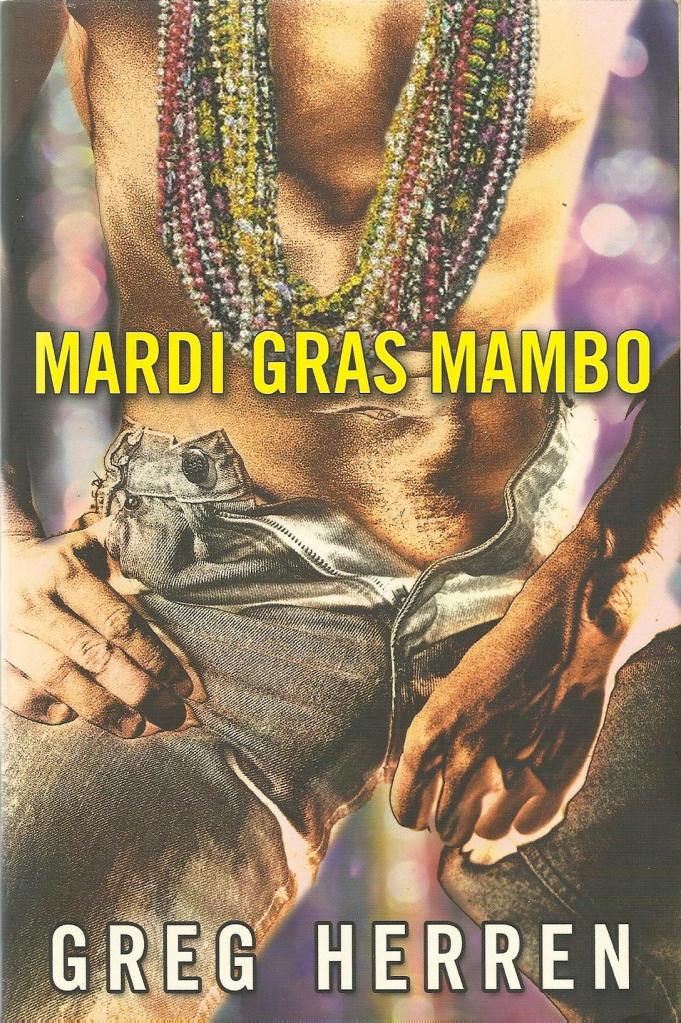
But this time, I hit my stride and four months later I turned the book in at long last, along with a proposal for a fourth, Hurricane Party Hustle, which was going to be set during an evacuation and would wrap up the loose ends left at the end of Mardi Gras Mambo.
And of course, three weeks later Katrina changed everything, and Hurricane Party Hustle went into the drawer.
Last night I dreamed it was Mardi Gras again. It seemed to me I was standing inside an iron gate, watching one of the night parades go by. The sidewalks in front of the gate were crowded with people, all shouting, with their grasping eager hands up in the air. Out beyond the edge of the curb, I could see people sitting in lawn chairs. Still others were up on ladders, with coolers and plastic bags of booty piled around them on the ground. Fathers and mothers were holding up babies, while black kids with the crotches of their pants down around their knees walked behind the crowd, weighted down by the ropes of beads around their necks. Beads were flying through the air, some getting caught and tangled in the branches of the towering gnarled oaks lining the avenue. The heavy upper branches of those oaks also blocked out the glow of the ancient street lamps so the night seemed even darker than it should. I could hear a marching band, playing a recent hip-hop hit, and the strange clicking sound of the baton girls’ tap shoes on the pavement. The air was heavy with the heavy fragrance of hot grease, corn dogs and the strange melted yellowish-orangey substance the vendors put on nachos that purports to be cheese—but no one is really sure what it is. A group of flambeaux carriers were passing by, dancing that odd little circular dance they do, their propane tanks popping and hissing, throwing long and twisted shadows that also danced inside the iron fence I was behind. Right behind them a huge float pulled by a tractor was coming and the crowd’s shouts became louder, more desperate, more pleading. On the float’s front was a huge white clown face, its bright red lips parted in what passed for a smile but seemed to me to be a frightening leer. The masks on the float riders glowed supernaturally at the hordes begging them for generosity in the strange light cast by the moon when it cleared the thick clouds in the cold night sky. I stood inside the black iron fence, my arms wrapped around me against the cold as an increased sense of menace and dread built inside me. Something bad was going to happen—
Oh, get real, Scotty!
If I do have bad dreams, I don’t remember them when I wake up. I’ve certainly never been troubled in my sleep, even though crazy things always seem to happen to me. I’m just one of those people, I guess. For whatever reason, the Goddess has decided to throw some wild stuff at me—she always has, even when I was a kid—and what can you do? I just don’t think I am one of those people who were destined to have a nice, normal, quiet life. Maybe it’s because I was named Milton Bradley at birth. Yes, that’s right. Milton Bradley. My older brother started calling me by my middle name, Scotty, before I started school and thank the Goddess, it stuck. Can you imagine how cruel the kids would have been to someone named Milton, let alone Milton Bradley? And then of course there’s the gay thing. I was lucky—my parents are pretty liberal and were delighted to have a gay son—like it somehow proved how truly cool they really are or something. They are pretty cool, actually.
By now, I’d taken to starting all of my New Orleans novels with a Tennessee Williams quote; for this one I chose a line from Vieux Carré: “You’ve got a lot to learn about life in the Quarter.”
I had opened Bourbon Street Blues with a parody of “The name’s Bond, James Bond” and I’d done something similar with Jackson Square Jazz–“Danger is my middle name”, riffing on Trouble is My Business. I decided to open this book with a parody of the opening line of Rebecca: “Last night I dreamed I went to Mardi Gras again.” But that entire opening paragraph of du Maurier’s is so fucking brilliant, I couldn’t help myself and made my entire first paragraph a parody of that opening. I then decided that from then forward, every Scotty book would have a Williams quote and each prologue–where Scotty introduces himself and his cast of characters and gives backstory so I don’t have to do it in the text of the story itself–would parody the opening paragraph of a famous novel, rather than just the first line (I am actually struggling to find the proper opening to parody to start the prologue for this one. I’ve used Rebecca, Peyton Place, The Haunting of Hill House, and Lolita, among others so far already; I’ve tried with this one to use An American Tragedy, Atlas Shrugged and The Great Gatsby thus far, with no luck. I’ve tried Valley of the Dolls several times for other books in the series already, but I can’t ever get it to work for me).
I do remember that the one thing that didn’t come across in those earlier drafts that I had abandoned was the sense of insanity that Carnival always brings with it; that feeling of “controlled anarchy” we experience those two weeks of parades, of knowing you have to schedule your entire life around a parade schedule–true even for those who do not live inside the box, as we say here; the box being the Uptown parade route–I always have to schedule my job, my trips to run errands uptown, everything, predicated around having to get home at least two hours before the parades start, and am incredibly lucky if I can get a parking spot within three blocks of the Lost Apartment. The thing I kept forgetting in those earlier versions was the books are meant to be fun. Granted, I was hardly in a mental space to write something fun…and of course the decision to really take it completely over the top the way I did was something I still think about to this day and wonder, where on earth did you get the idea for identical triplets?
Which, while crazy, made more sense than the cloning story I tried to write the second time.
Maybe those bad things happened for a reason? Because I couldn’t be more pleased with how the story and the book turned out. I also ran out of room to finish the personal story…but I also was operating on the assumption I’d get a contract for a fourth book. If not for Katrina, Kensington might have made another offer and Hurricane Party Hustle might have been the fourth Scotty than something just sitting in the files.
The book was released on Fat Tuesday, 2006. Paul and I had been out of town–the truncated Carnival/parade season seemed almost too sad to handle, so we’d accepted a gig to speak at the South Carolina Book Festival. We flew back to New Orleans the Sunday morning before Fat Tuesday. I’d checked my email that morning before boarding the flight to Atlanta (we changed planes) and then our cab driver couldn’t get closer to St. Charles than Baronne Street. A parade was going as we got out of the car, and we had to cross the parade (it was in the high seventies and sunny) with our luggage–I’ll never forget looking up as we got ready to cross and catching a bag of beads with my hand just before it connected with my face–and got home. I checked my emails and my word! SO MANY EMAILS.
You see, that day’s edition of the Times-Picayune carried Susan Larson’s review of the book, and it was a rave! Everyone emailed me as soon as they saw it–I still bask in the glory of that review–and I was about to embark on probably the most ambitious book tour of my career.
I just didn’t see, though, how I could write another funny, light book about a city still in ruins whose recovery was still questionable.
The series was, for the moment, over–with the personal story not resolved the way I would have wanted, but it could stand as it was, should there never be another Scotty story.
Rereading it, I couldn’t but laugh at some of the outrageous twists and turns the plot took.
That’s not entirely true, you know. Yes, Bourbon Street Blues was always supposed to be a stand alone (I know you’re tired of the story) and they offered a two book series deal and I took it, thinking I would just figure it out later. Well, I did figure it out later; and when I started writing Bourbon Street Blues I already knew there would be a second book and so I had to set it up in the first as well as plant seeds for the next one after that–if there was going to be another one after that. I didn’t know for sure or not whether there would be a third, so when I was writing the first I kept the personal story as simple as I could in case there wouldn’t be a third and I could wrap it all up with the second if need be. But by the time I finished writing Jackson Square Jazz I was already pretty confident there would be a third (the first had just come out and was doing extremely well) so even if the third still ended up not being contacted, everything wrapped up as nicely as possible at the end of Jackson Square Jazz.
I decided the main mystery plot of the book would have to do with the Cabildo Fire of 1988.
When Paul and I had first moved here, sometime within that first year we saw a documentary on our local PBS station (WYES, for the record, thanks for asking, you there in the back) about the Cabildo Fire. I can only imagine how the city reacted to the news that a fire had broken out in one of our most beautiful buildings and recognizable landmarks–especially given its proximity to the landmark of the city: St. Louis Cathedral, and on its other side, the Presbytere. The documentary focused on the remarkable methods the New Orleans Fire Department went to, not only to fight the fire and prevent its spread to other historic buildings nearby, but to preserve the contents of the inside. The Cabildo is the Louisiana State Museum, and it’s filled with all kinds of artifacts and art documenting the history of New Orleans and the Louisiana territory. They brought fire-fighting boats to the levee, and borrowed more from the Coast Guard. They began hosing down the buildings around the Cabildo so they’d be too wet for the fire to spread.
And firemen were sent inside to remove as much of the contents before they turned the hoses on the Cabildo itself.
They literally lined paintings, framed historic documents, and various other historical artifacts with a variety of values along the fence surrounding Jackson Square, delaying until they had no other choice but to turn the hoses onto the Cabildo.
How easy it would have been to walk off with something priceless in its historic value, I thought, thinking of Robin Cook’s marvelous Sphinx and its opening with the tomb of Tutankhamun being robbed before flashing forward to the present day where a young female Egyptologist happens upon a magnificent statue from antiquity; a golden statue of Pharaoh Seti I. I pictured another young woman, in an antiques shop in the Quarter, happening upon something that looks like an artifact lost during the Cabildo Fire (they saved over 80% of the museum’s contents, by the way), and decided upon the Louisiana Purchase treaty. I could also call the book Louisiana Purchase (which also is the name of the state’s food assistance program; you get a Louisiana Purchase card with an amount loaded onto it every month), and possibly weave something about a food assistance program scandal of some sort woven into it as well. I viewed this as a spin-off stand alone for my character Paige Tourneur from the Chanse series (I had always wanted to write about her), and I thought, you know, the Cabildo Fire and some McGuffin gone missing from the museum would make a great plot for the second Scotty book.
The more I thought about it, the more I liked it.
And, being a dutiful writer, I contacted the administrative offices of the Louisiana State Museum and made an appointment to discuss my book and the fire with Executive Director Jim Sefcik.
And when I met with Jim, I discovered, to my great surprise, that not only had he been working there the day of the fire…it was his first day on the job.
“I was sitting in La Madeleine having coffee and a pastry,” he said (where Stanley is now used to be a La Madeleine; I used to get coffee there all the time during the Williams Festival), “when I heard a fire engine. I looked out the window and saw a firetruck pull up onto the pedestrian mall and stop in front of the Cabildo. As I thought that can’t be good another one pulled up from the other direction and THAT was when I saw the smoke.”
He gave all the credit to the fire chief for how everything was saved–“I just kept saying yes yes, whatever you think is best”–and I remember saying, “Well, at least you got it over with on your first day.”
He laughed, and replied, “Yes, now whenever there’s a crisis of any kind I just think well, at least the Cabildo isn’t on fire and that kind of puts things into perspective.”
He even gave me Polaroid snapshots of the aftermath of the fire; they’d scanned the originals long since to archive them. I just found them again Saturday when I was cleaning out cabinets, you can imagine my delight to stumble over them all these years later.
He also explained to me why the Louisiana Purchase treaty wouldn’t work as the MacGuffin (the original is stored in a vault at the Library of Congress; the display in the Cabildo is a copy and it is multiple pages long) and suggested the Napoleon death mask as a suitable alternative–even telling me a wonderful story about how the one in the Cabildo (there were four or five made) disappeared and then turned up in trash dump about thirty years later.
And he was right. It worked perfectly.
Danger is my middle name.
Okay, so that’s not strictly the truth. My middle name is Scott. But when you’re first name is Milton and you’re last name is Bradley, you’ve got to do something. Yes, that’s right, my name is Milton Bradley, and no, I’m not an heir to the toy empire. My parents, you see, are counter-culturalists who own a combination tobacco/coffee shop in the French Quarter. They both come from old-line New Orleans society families; my mom was a Diderot, of the Garden District Diderots. Mom and Dad fell in love when they were very young and began rebelling against the strict social strata they were born into. The Bradleys blame it all on my mom. The Diderots blame my dad. My name came about because my older brother and sister were given what both families considered to be inappropriate names: Storm and Rain. According to my older brother, Mom and Dad had planned on naming me River Delta Bradley. Both families sat my parents down in a council of war and demanded that I not be named after either a geological feature or a force of nature. After hours of arguing and fighting, Mom finally agreed to give me a family name.
Unfortunately, they weren’t specific. So she named me Milton after her father and Scott, which was her mother’s maiden name. Hence, Milton Scott Bradley.
My older brother, Storm, started calling me Scotty when I was a kid because other kids were making fun of my name. Kids really are monsters, you know. Being named Storm, he understood. My sister Rain started calling herself Rhonda when she was in high school. Our immediate family still calls her Rain, which drives her crazy. But then, that’s the kind of family we are.
So, yeah, danger really isn’t my middle name, but it might as well be. Before Labor Day weekend when I was twenty-nine, my life was pretty tame. I’m an ex-go-go boy; I used to tour with a group called Southern Knights. I retired from the troupe when I was twenty-five, and became a personal trainer/aerobics instructor. The hours were great, the pay was okay for the most part, and I really liked spending a lot of time in the gym. Every once in a while I would fill in dancing on the bar at the Pub, a gay bar on Bourbon Street, when one of their scheduled performers cancelled—if I needed the money. That Labor Day weekend, which is Southern Decadence here in New Orleans, I was looking forward to meeting some hot guys and picking up the rent money dancing on the bar. I certainly wasn’t expecting to be almost killed a couple of times or to have my apartment burn to the ground. I also didn’t expect to wind up as an undercover stripper for the FBI.
It’s a really long story.
The one good thing that came out of that weekend was I met a guy: Frank Sobieski, this mound of masculine, hard muscle with a scar on his cheek, who also happened to be a Fed. They don’t come any butcher than Frank. We hit it off pretty well, and he decided that once his twenty years with the FBI were up, he’d retire and move to New Orleans. I’ve always been a free agent. It’s not that I didn’t want to have a boyfriend, I just never thought I would find one. I enjoyed being single. I mean, young, single and gay in New Orleans is a lot of fun. It doesn’t hurt that people find me attractive, either. I’m about five nine, with wavy blondish hair that’s darker underneath. I wrestled in high school, mainly because the other kids were bullying me because they sensed I was gay. I’ve been working out ever since. Anyone who tells you being in shape doesn’t make a difference in your life is lying. It does.
But I needed a reason for the death mask-MacGuffin to come across Scotty’s path.
So, I turned back to the personal story of Scotty again.
It’s October now, been about five or six weeks since Labor Day and Halloween looms. There’s not been another word from Colin since the end of Bourbon Street Blues and Frank has put in for his retirement while he and Scotty are doing the long-distance thing; Scotty is finding it a bit restraining and having never really wanted or care about being in a relationship, is starting to have second thoughts about giving up his freedom. He has just come back from visiting Frank in DC and that visit has set his teeth on edge and made him even more nervous about Frank moving to New Orleans. David picks him up at the airport, hands him a joint, and Scotty goes on a bender…
…and wakes up with a massive hangover in bed the next morning, realizing to his horror that he is not in bed alone.
How relatable is that? I know I’ve been there more times than I care to remember.
And I realized, the trick is the key linking Scotty to said MacGuffin and the mystery, and as a big figure skating fan I decided to make him a figure skater, in town for Skate America. Scotty doesn’t know he’s a skater until he’s actually at the event and sees him warming up on the ice–and then he gets a note to meet him at his hotel room at the Hotel Aquitaine later that evening, along with the room’s key card–but Scotty shows up only to find a dead man with a knife in his chest.
This one was fun, and having Scotty’s weird ‘psychic’ power allow him to commune with the ghost of a long-dead fireman who knows the answer everyone is looking for was also a lot of fun. (I liked the concept of having Scotty and his mom go down to watch them fight the fire when he was a little boy.)
What a fun book this was to write!
I introduced a very fun Texas millionaire who collects things and doesn’t care how he acquires them (I even brought him back in Baton Rouge Bingo); was able to bring Colin back only to find out he’s not really a cat burglar but actually an international agent-for-hire working for the Blackledge Agency and thus created the “who will he wind up with” romantic triangle; and even had Scotty living in half of David’s shotgun while his home on Decatur Street was being rebuilt (which I had forgotten about until the skim-rereads and changes something with the new book). I also had Scotty get kidnapped again, and this book had the first of his many car accidents. It also contained Scotty’s first trip (in the series) to the West Bank.
One thing I forgot to mention when I was writing about Bourbon Street Blues the other day was how the series (books) were always intended to be insane and over-the-top*; always. The problem I always have with writing this series is stopping myself because something strains credulity and then I have to remind myself, “this series was always intended to be like New Orleans itself: completely unbelievable until experienced personally, and always over the top and ridiculous.”
Which is part of the fun, you know?
*For one example, Bryce Bell, the young skater, lands a quad-axel at Skate America. To put that in the proper perspective, to date no one had landed one competitively, although there’s a young American skater who can land them in practice….eighteen years later.
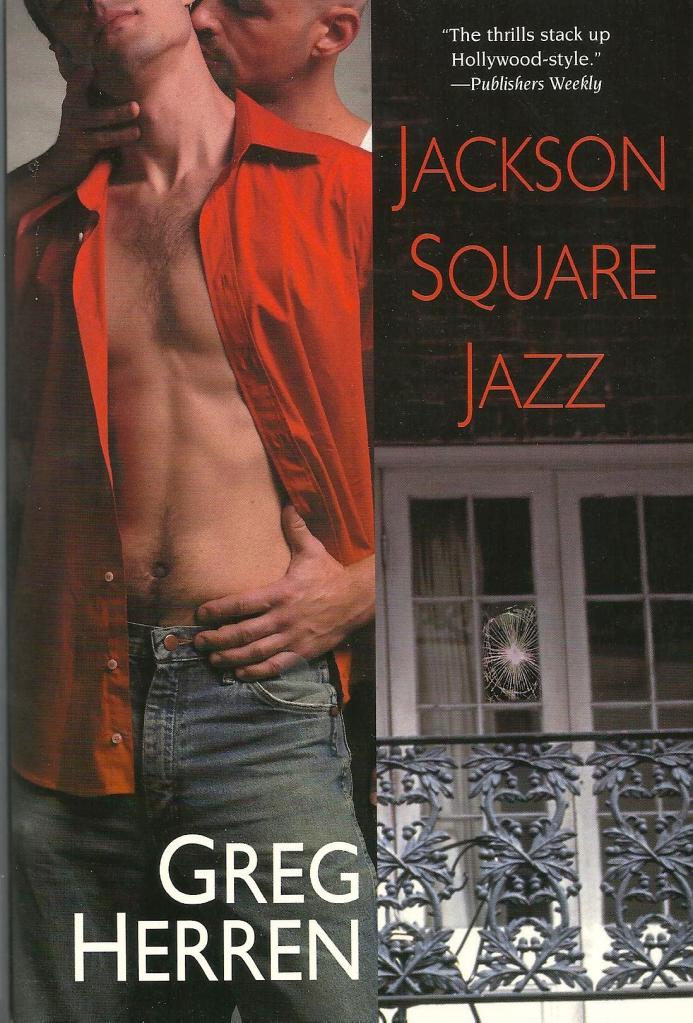
PS: When this book was released, I got asked a lot if I had posed for the cover; the same thing happened with Bourbon Street Blues; I was always apologizing for not being the cover model. With this book, I assumed it was the same thing…but later I realized they weren’t asking about the guy in front with this shirt open but the guy in back kissing his neck. At the time, I had a goatee and shaved head; this guy also has this and he does kind of look like me. What can I say?
As I get ready to write another Scotty book, I am busy making his acquaintance all over again. It might seem strange, but yes, although I’ve written eight books about my ex-go-go boy/personal trainer/private eye, it remains true in this as in all other aspects of my life that my memory is not what it once was; in fact, I don’t think I’ve ever written a Scotty book since the first three without having to go back and revisit the series again. I have made continuity errors over the years (Scotty’s mother’s name changed over the course of the series, from Cecile to Marguerite and back to Cecile again), and I may forget things about his past and things I’ve written in previous books, but the one thing I never ever forget is his voice.
No matter what else is going on in my life, Scotty’s voice is very easy for me to slip back into, like a house shoe, and it somehow always feels like coming home to me in some ways. This is odd–because I would have always thought Chanse was the series character I was more connected to rather than Chanse, but that’s not the case at all. Scotty just won’t go away; but I ended the Chanse series and only every once in a while do I regret it (although I am beginning to suspect that I am going to probably end up writing another Chanse novel at some point in my life; I have two ideas that he’d be perfect for, but it also might be better and more challenging for me to simply come up with a whole new character for those stories rather than resurrecting Chanse); Scotty just won’t ever go away.
The idea for the Scotty series famously came to me during Southern Decadence, 1998.
(Well, I don’t know about famously, but I know I’ve told this story before many, many times. Feel free to skip ahead if you don’t want to see how I remember the birth of the character and the series now)
It was a Sunday afternoon, and Paul and I had somehow managed to get prime balcony standing spots–at the Bourbon Pub/Parade, right at the corner of St. Ann and Bourbon where the railing curves at the corner to head alongside the upper floor down the St. Ann side; so we could look down directly into the roiling mass of sweaty, almost completely naked bodies of hundreds of gay men from all over the country. That was my favorite spot for Decadence sight-seeing (Halloween, too, for that matter), and as I looked down into the crowd, I saw a guy in booty shorts and a very very loose fitting tank top, carrying a bag and trying to get through. I recognized him as one of the out-of-town dancers working at the Pub/Parade that weekend (I may have tipped him the night before) and as I watched in sympathy as he tried to get through that tightly-packed crowd of gays in various stages of being wasted, I closed my eyes and an image of him–or someone like him–fighting his way through the Decadence crowd while being chased by bad guys with shaved heads popped into my head just as Paul said, next to me, “You should really write a story set during Decadence” and then it popped into my head: someone escaping the bad guys has slipped a computer disc into one of the dancers’ boots on Friday night as he danced on the downstairs bar, and the bad guys want the disc back.
I didn’t have any way to write it down, obviously–I was wearing booty shorts, socks, and half-boots that came to my ankles, with nothing underneath the shorts and I had my tank top tucked through a belt loop like a tail in the back–yet even the title popped into my head: Bourbon Street Blues. The idea clearly stuck, because when I got home the next morning at about six or seven, dehydrated, drenched in sweat and having lost the tank top at some point during the night, I remembered it and wrote it down.
At some point over the next two years, I wrote a short story called “Bourbon Street Blues” about my stripper–only instead of being from out of town, I made him a local, filling in for someone booked from out of town for the weekend who had to cancel–and wrote about seven thousand words. It felt very rushed to me–the story–and I kept thinking it’s too long for a short story, it would have to be a novel but I also wasn’t sure there was enough story there for a novel. But I liked the idea, no one (at least, to the best of my knowledge) had written anything like it, and I thought, someday I’ll get a chance to write this story and develop this character.
Flash forward to 2001. This was during the time Paul and I had moved to DC to work for the Lambda Literary Foundation, we were miserable there and wanted to move back to New Orleans but didn’t have the money to do so, and the release of Murder in the Rue Dauphine was still at least a year away. I was talking to an editor on the phone about one of his new gay releases, and out of the blue I just pitched Bourbon Street Blues to him. He loved the idea, and asked me to write a proposal and email it to him. I had never written a proposal before, but I thought what the hell, how hard can it be? and so I wrote a two page proposal for the book. Two months later they made me a two-book offer–and the money was good enough to pay for Paul and I to move back to New Orleans as well as to live on for a while. I had only seen the book as a one-off, but they wanted a series. I needed and wanted the money, so I thought I can figure this out later and signed it.
Three months later, we moved back to New Orleans and I started writing the book.
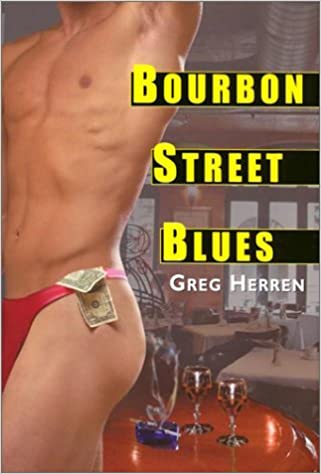
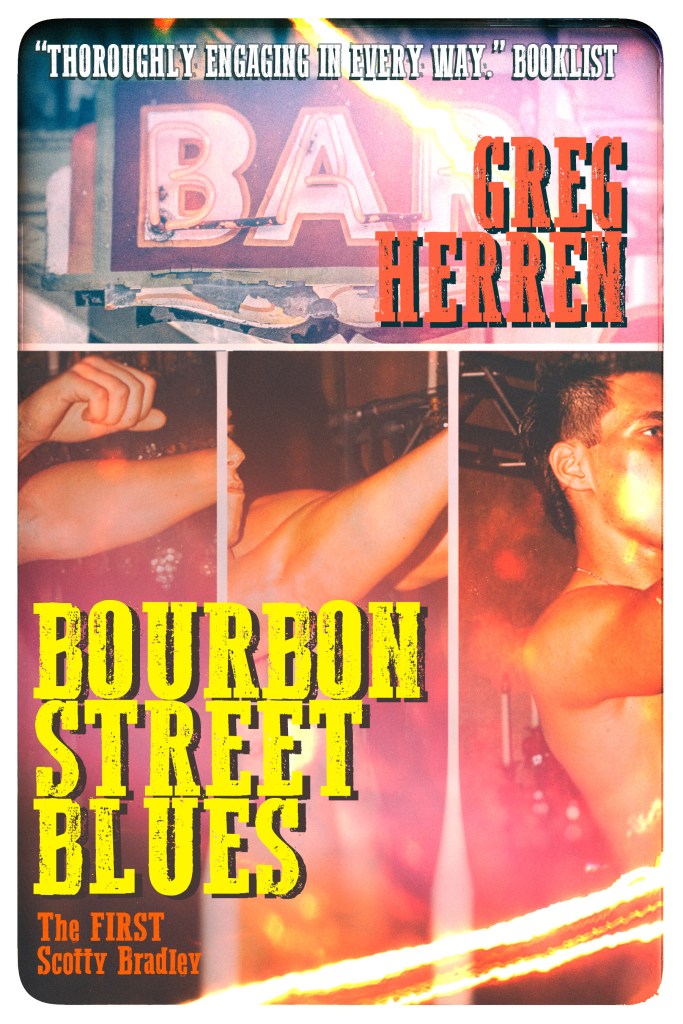
The original cover is on the left.*
The one thing I wanted to do with Scotty was make him unabashedly, unashamedly, gay. I didn’t want him to have any hang-ups, a sad backstory, or parental issues. I wanted him to be a free spirit who embraces life with both hands, lived in the Quarter, and loved having sex, loved being found desirable, and never really said anything or thought anything mean about anyone else. I made him a personal trainer, and his poverty–he agrees to do the dancing gig for Decadence because he’s behind on his rent and other bills; he teaches aerobics and was a personal trainer–comes from his grandparents freezing his trust funds when he dropped out of college to go to work for a booking agency for male dancers. He has since stopped doing that, but fills in when needed (and when he needs the money) at the Pub/Parade. I also based the shitty politician running for governor–and trying to mount a Christofascist takeover of the state, beginning with an attack on Southern Decadence–on an actual politician who ran for the US Senate shortly after we moved here; we saw him being interviewed on the news and couldn’t believe it wasn’t a joke, some kind of performance art–but forget it Greg, it’s Louisiana.
I also want to let you know that while I was working on this manuscript my first book, Murder in the Rue Dauphine, was released–and I got a “damned with faint praise” review from the Bay Area Reporter, which complained that “it would have been nice to see inside the heads of the other characters”, which took me aback as the book was a first person narrative, which made that impossible. What the reviewer I think was trying to say was that she wished the book had been told in the third person; that to her that would have made the book more interesting to her. But in my baby-author naïveté, all I could think was how can you see inside the heads of other characters in a third person narrative unless the main character was psychic?And the proverbial lightbulb came on over my head. Make Scotty a psychic. This was also an integral key to the puzzle of who Scotty was; the reviewer also yawned over my “gay stereotypes” in Rue Dauphine, so I decided to make Scotty the embodiment of all the worst stereotypes of muscular gay men who worked out and had a lot of sex. Just writing that down now, I realize how incredibly insane it was for me to use my new series book and character to respond to criticism o my debut novel; and when the book came out I braced myself for the inevitable backlash to come.
No one was more surprised than I was at how readers embraced him. The book got great reviews, even from Publishers Weekly and Library Journal (Kirkus, of course, has always pretended I don’t exist). Bourbon Street Blues was even nominated for a Lambda Literary Award for Best Gay Mystery of 2003 (I lost, I think to John Morgan Wilson?) shortly after the sequel, Jackson Square Jazz, was released.
Jackson Square Jazz’s story was actually a recycled idea I had for a spin-off book for Chanse’s best friend Paige. The original concept was that someone would steal the Louisiana Purchase from the Cabildo–and somehow Paige stumbled onto the theft, and knew that the one on display currently there was a copy. (I was calling it, originally enough, Louisiana Purchase.) I decided to make that the basis of the second Scotty book. (This was inspired by a documentary I’d seen about the Cabildo fire of 1989–that may be the wrong date–and how the fire department tried saving everything in the museum before fighting the fire. I remembered how in the documentary they literally were placing historical objects and paintings against the fence at Jackson Square and thinking, anyone could have walked off with something during the fire…and my imagination immediately was off to the races.) Unfortunately, when I met with the museum director–whose actual first day on the job was the day of the fire–I found out that 1) the copy of the Louisiana Purchase at the Cabildo was actually only a replica and the original was stored in the weather-protected underground archive at the Library of Congress and 2) it was more than one page long–I’d imagined it was one large document like the Declaration of Independence; it is not. However–he also suggested I make the MacGuffin the Napoleon death mask–one of the three originals made when Napoleon died–and gave me some great backstory on it as well that I don’t remember if I used in the book or not; but it was a lot of fun talking to him (his name escapes me at the moment, alas) and was a great example of why it is important to actually do research and talk to people.
I also wanted to include figure skating–the working title for the book was Death Spiral, which the publisher made me change, asking for something alliterative, like Bourbon Street Blues–and so I decided to open the book with Scotty having a horrific hangover and then realizing someone was in the bed with him (it’s to this day one of my favorite book openings; what slutty gay man hasn’t been there?)…and then I remembered I’d introduced two love interests for Scotty in book one, and here he was in bed with someone else entirely. (The young man he woke up with was a figure skater in town to compete at Skate America, being held in the Smoothie King Arena.) I loved both of his love interests, and knew I was going to have to bring both of them back somehow, and then I was going to have to figure out which one he’d end up with. (Spoiler: I couldn’t decide, so he wound up with both of them.) I also threw in a ghost, a billionaire artifact collector, and pretty much everything but the kitchen sink. I turned in the book, along with a proposal for Book Three, in which I finally decided I was going to resolve the threeway relationship personal story, and that would be the end of the Scotty trilogy.
Man plans and God laughs. (Jackson Square Jazz was also nominated for a Lambda; I think this was the time I lost to Anthony Bidulka.)
Mardi Gras Mambo turned out to be an entire other kettle of fish.
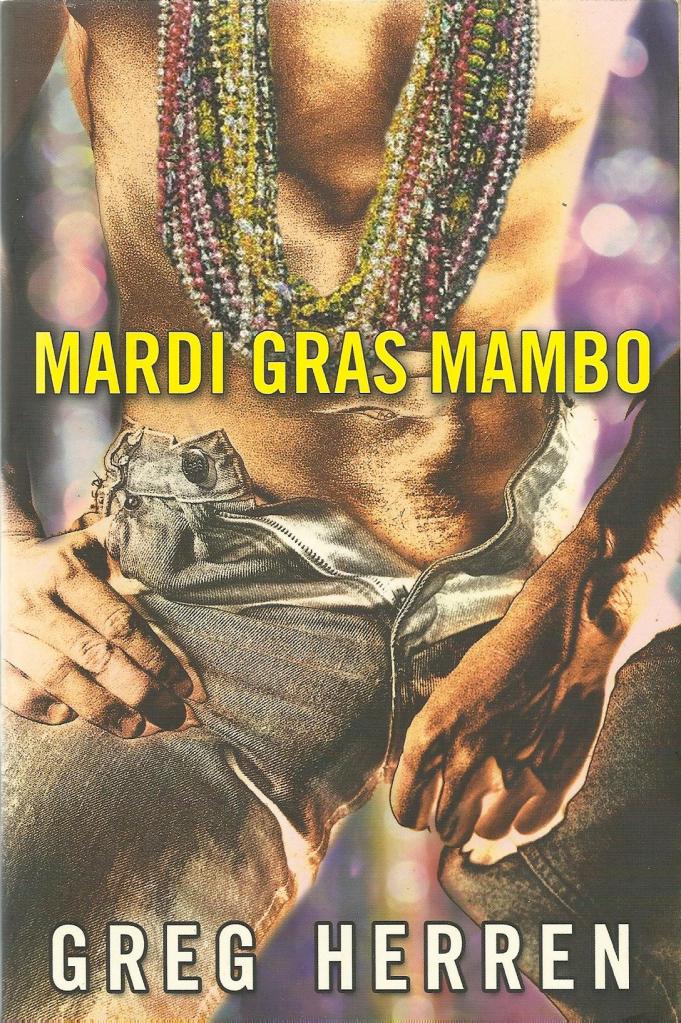
I’m not entirely sure I remember exactly what the original plot of Mardi Gras Mambo was going to be, but I know it had to do with the Krewe of Iris (Scotty’s sister Rain belongs) and the book opened at the Iris parade on the Saturday morning before Fat Tuesday. It was due in June of 2004, and of course, I wasn’t nearly finished by the time Memorial Day rolled around, and was planning on asking for another month on the manuscript on the Tuesday after. Of course, that was the Memorial Day weekend when Paul was attacked and everything went to hell in my personal life. My publisher was incredibly kind; they took the book off schedule, told me to take care of Paul, and get the book done whenever I got the book done.
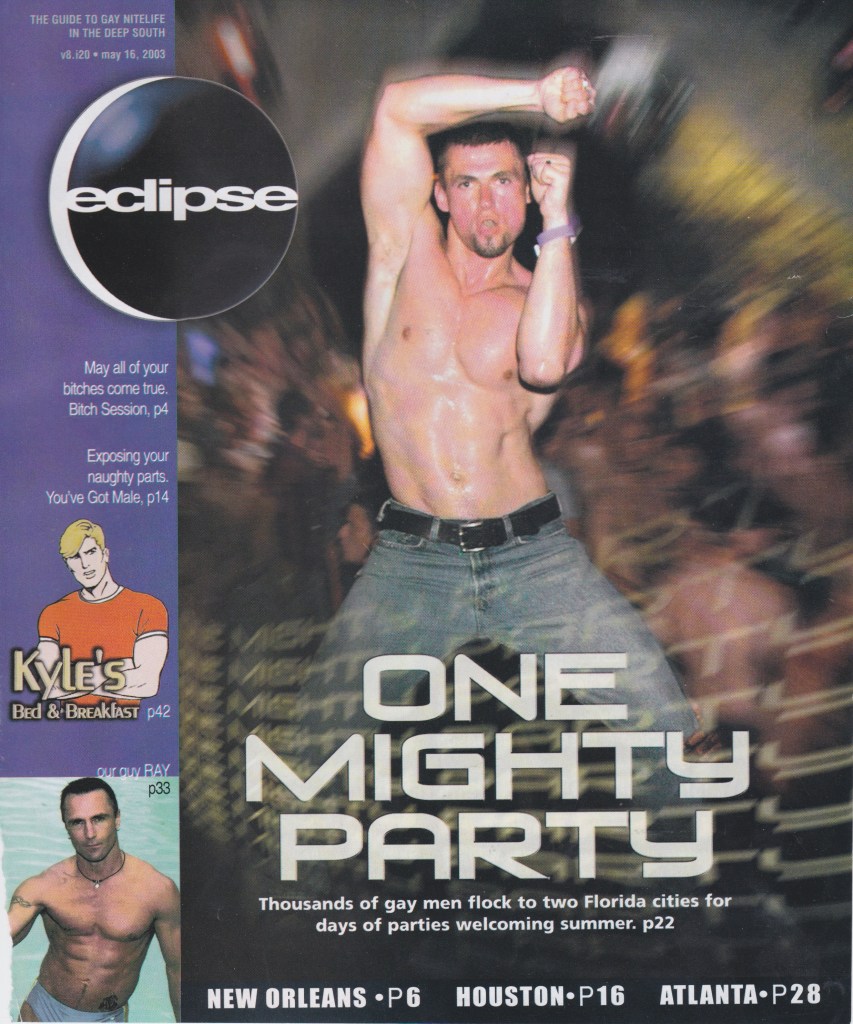
I started writing it again in January of 2005, shortly after I began keeping a blog in order to get me writing again. That was when the Christian/Virginia nonsense happened, and everything got derailed again. When I started writing the book again, I threw out everything except that first chapter at the Iris parade–which did wind up in the final book–and I do not recall what the second plot I chose to write was at this time, other than I knew I was bringing in a Russian character, inspired by someone I’d seen around in the bars for years and had always been just awestruck by his body–and yes, that Russian turned out to eventually be Wacky Russian, my personal trainer. I actually kept this as an inspiration–Eclipse used to be the nightlife insert for IMPACT News, a queer newspaper that died out in the early aughts:
Finally, it was April 2005, and I started writing Mardi Gras Mambo again. I had the plot all figured out–it was completely insane–but I also realized I couldn’t end the personal story with Scotty the way I had hoped and wrap it all up with Book Three. There had to be a Book 4, and so when I finished the book at last and turned it in, I included a proposal for a fourth Scotty, Hurricane Party Hustle–which was going to be set during an evacuation for a hurricane that missed New Orleans…I always thought it would be interesting to write a mystery story set during such an evacuation.
Of course, I turned the book into Kensington on August 14th, 2005. Fourteen days later, Paul, Skittle and I fled from New Orleans in the face of Hurricane Katrina.
I wouldn’t come back for good until October 11. Paul didn’t come home until after Thanksgiving.
Of course, I wrote to my editor a day or so after the levee failure to say, well, I don’t think I can write that book I proposed now.
I didn’t see, for a very long time afterwards, how I could write another Scotty book–light, funny, zany–in the aftermath of Hurricane Katrina. Then one day I was walking to work from where I’d parked my car and some people on bicycles came riding toward me. They smiled and waved and I smiled and waved back…and realized oh my God, that was Brad and Anjelina. Their house wasn’t far from my office–in fact, it was quite literally around the block from where Scotty lived–and I thought, you know, Brad kind of looks the way I describe Scotty–wouldn’t it be funny if someone tried to kill Scotty because he looked like a movie star who lived in his neighborhood? The more I thought about it, the funnier it became, and I started writing the proposal for Hollywood South Hustle when I got home from work that night. I was so certain they would take it that I started developing the characters and writing out a detailed synopsis…and they turned it down.
I wasn’t expecting that, but it was a marketing decision. Even if they signed the book immediately, it would still be another year before it would come out, and they felt by then Scotty’s audience was long gone, if it wasn’t already. It was disappointing, but right around the same time Alyson came back to me for a fourth Chanse book but they needed it right away–like within ten weeks–so I turned the Scotty story into Murder in the Rue Ursulines. I finished the book, turned it in, and figured the Scotty series was dead, alas.
Shortly thereafter, during the Gay Easter Parade an idea for a different Scotty book occurred to me . The parade was over and I was walking back to my car to drive home when I walked underneath a balcony…just as they started watering their plants. I got soaked–you can’t get mad, it happens in the Quarter periodically and it’s just one of those New Orleans things–and I thought, you really need to write about this. As I walked to the car, dripping, I pictured Scotty hurrying to catch a ride on his parents’ business’ float for the Easter Parade–and of course, he’d wear a white bikini, rabbit ears, and have a rabbit tail–when the exact same thing happened to him, only his bikini would become see-through when wet. By the time I’d driven home, I’d figured that the person on the balcony would be an old friend of his parents’, he’d invited Scotty in to dry off, and when Scotty was on his way home from the parade, the cops would be there because the friend had been murdered. Using The Moonstone as my inspiration, I came up with another MacGuffin story, a way for Colin to come back and explain everything that happened during Mardi Gras Mambo, and I had the perfect ending to Scotty’s story. I just didn’t have a publisher.
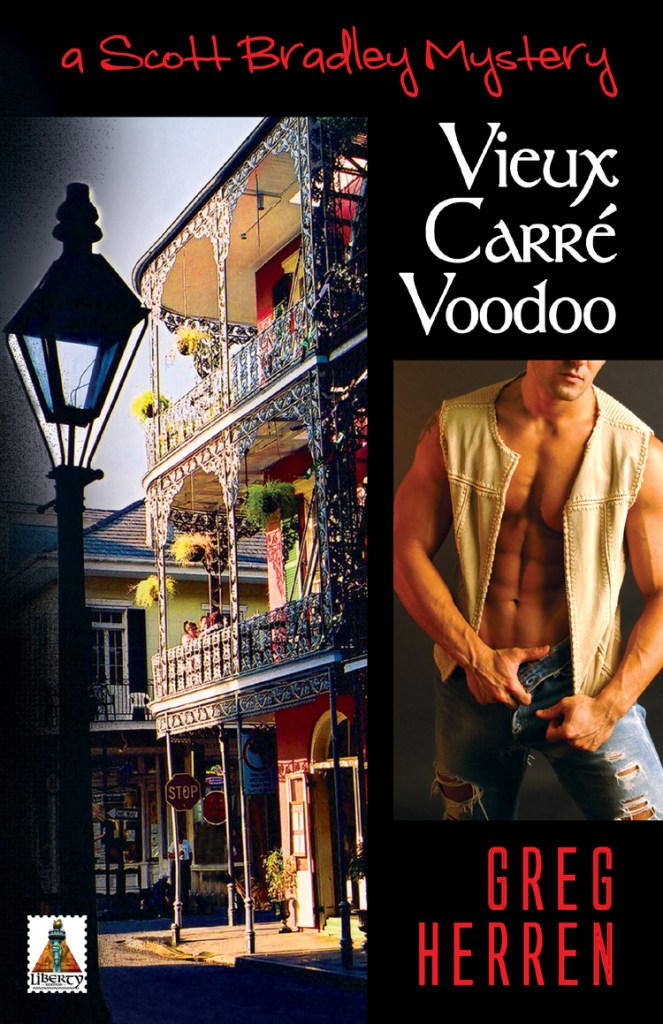
But Bold Strokes Books, a primarily lesbian publisher, had started doing books by and about gay men. I’d taken an erotica anthology to them when it was orphaned by the death of its original publisher, and so I wrote and asked if they wanted a Scotty story. They did, and thus Scotty came back to life one more time…and I figured that was the end of it. I wrapped up the personal story about the three-way relationship in a way that was organic and made sense; and I also added a new wrinkle to Scotty’s personal life: Frank’s late-in-life decision to become a professional wrestler. (One of the things we locals learned from Hurricane Katrina was to not put off following or chasing dreams or goals; my attitude thus became go for it and I started chasing down dreams I’d pushed to the side for years.) Mardi Gras Mambo and Vieux Carré Voodoo were both nominated for Lambdas, but at this point I can’t remember who I lost to in both of those cases–for the record, Lambda has never rewarded a Scotty book with an award–probably because they are inevitably funny and over-the-top, which never wins awards because funny is seen as “not serious,” despite the fact that humor/comedy is much harder than drama/tragedy.
I didn’t think I was going to write another Scotty book then, either. But then something miraculous happened: the New Orleans Saints won the Super Bowl, and I wanted to write about what it was like to live here during that incredible time. It didn’t seem like the right story for another Chanse book, so I thought, well, I can pull Scotty back out and write it from his point of view.
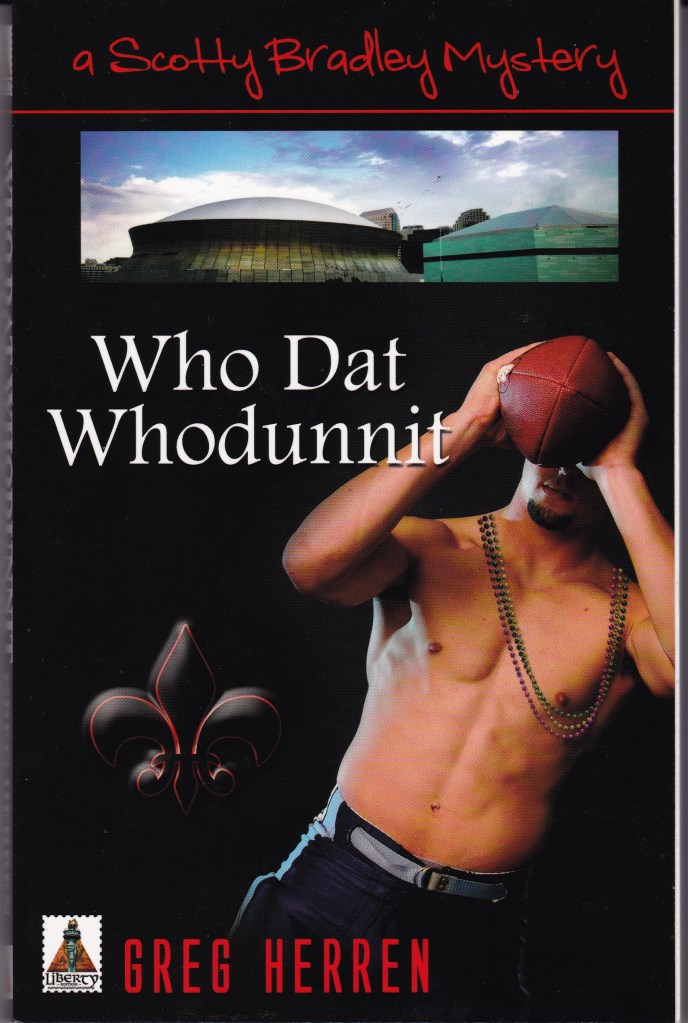
And of course, Who Dat Whodunnit was just sitting there for the title. How could I not write that book?
I had already established over the course of the series that the two sides of his family–the Diderots (maternal) and the Bradleys (paternal) didn’t really get along. The Diderots go back to Iberville and the 1718 settling of New Orleans; the Bradleys were Americans who came after 1803, and thus are not only parvenus to the aristocratic Diderots, but also l’Américains. Perish the thought! We’d also established that the Diderots were not nearly as conservative as their State Street living in-laws, but we’d never actually seen much of the Bradley side of the family, so I thought why not do the Bradleys and let us get to know the other side of Scotty’s family? It was around the same time I started reading about a megachurch out in Kenner (or Metairie? I don’t recall) that was rising to prominence in local politics and was, as you can imagine, homophobic. The same-sex marriage wars were also being fought at this time; and during one of those pageants (Miss America? Miss USA?) the reigning Miss California was asked about same-sex marriage during the question portion by judge Perez Hilton (why was he judging a beauty pageant for women is a mystery for the ages) and she responded that her faith had taught her that marriage was between a man and a woman (the audience started jeering) and she apologized by saying “I’m sorry, but that’s how I was raised!” She wound up as First Runner-Up, and some felt, rightly or wrongly, that her “politically incorrect” answer cost her the title. In some ways, I felt bad for her (although it’s not my fault it’s how I was raised I have always thought was an incredibly stupid thing to say; you have free will, and you should be capable of making up your own mind rather than simply parroting things without question you were raised to believe. So if your parents were racist white supremacists…) but then of course, the Right tried to turn her into a martyr and heroine, and she dove right into that headfirst, erasing any sympathy I might have felt for her (I still think the question was inappropriate for a pageant, as would be anything polarizing–and yes, well aware that same-sex marriage shouldn’t be polarizing, but here we are), and of course, Miss Upright Moral Christian had a bit of a shady past that eventually came out and that was that. I decided to base the murder victim in the book on this girl, and tried to explore the influence of this megachurch on her. I also gave Scotty a first cousin who was the darling of the Bradley grandparents because he was a jock and was on the Saints team as a player–but also a homophobic asshole. The Bradleys were like something out of Tennessee Williams–I think I even named Scotty’s uncle (the football player’s dad) Uncle Skipper as an homage to Cat on a Hot Tin Roof.
There’s a lot of story there left in the Bradley side of the family, now that I think about it–and I’ll be digging into that in the new one, rest assured!
Funny story: After I wrote Who Dat Whodunnit, I decided I was not going to write another Scotty book. This had been Book 5 of what started as a stand-alone and then became a trilogy and yet somehow, I’d kept going on top of that. I kind of felt played out a bit with Scotty, and the longer the series went on, the more problems I was having with things like character ages–Scotty was getting older, which meant his parents were getting older, which meant his grandparents were getting older, too. I didn’t want to deal with the deaths of his grandparents (or Aunt Sylvia, who was his grandmother’s age and had married Uncle Misha), and so I had two options: pretend they weren’t getting older and not talk about their ages, or let the series go. I was still writing Chanse at the time, and I kind of figured that would be the series that went on longer. But I was on a panel at Saints and Sinners and someone from the audience asked me if there would be another Scotty.
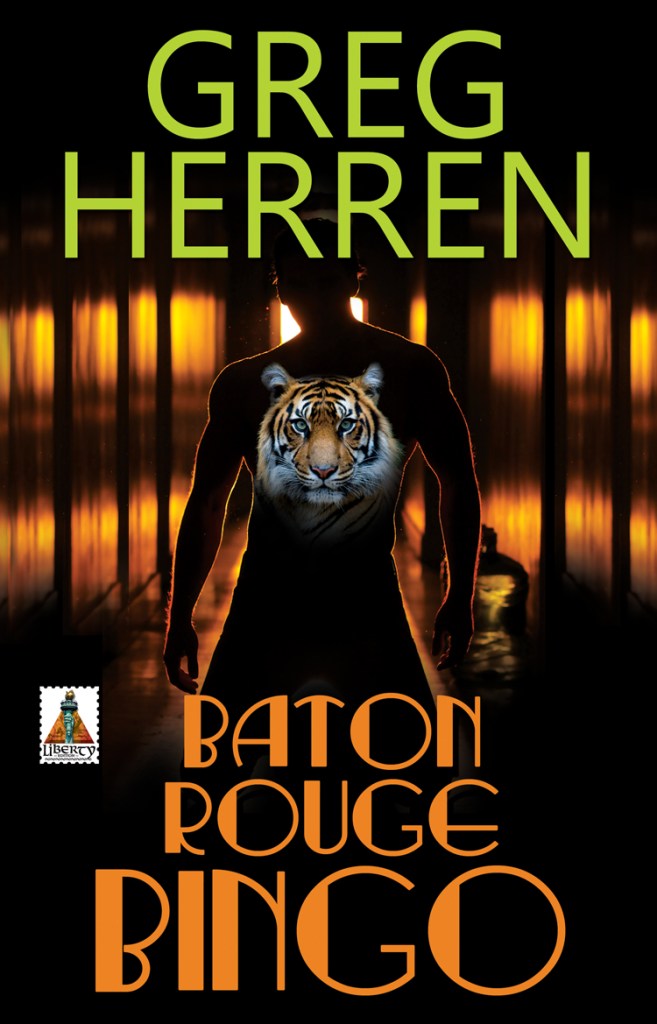
GREG: Probably not, but if I can figure out a way to include Mike the Tiger (the live tiger mascot at LSU), Huey Long, and a treasure hunt for Huey’s deduct box, I will.
(I had read T. Harry Williams’ award winning biography Huey Long and had become fascinated completely with him. All I had known about Long going into reading that biography was that he’d been a demagogue (thanks, US History textbook from high school) and Robert Penn Warren’s All the King’s Men had been loosely based on his life and career. Mention Long’s name to anyone and they immediately reply with “oh, he was so corrupt”–which amused me, since every Louisiana politician is corrupt to a degree–and I knew Roosevelt and others had worried about him as a populist politician who reminded them of Hitler (and the way he crushed his opposition in Louisiana and essentially became the state’s dictator, who could blame them?), but what was the real story? And Huey Long made me start to have what was at first a grudging admiration for him which grew into a kind of fandom the more I learned. (There are some similarities–more than one would think–between Long and LBJ in the Caro biographies, as well as with Robert Moses, another Caro biography; which would make for a very interesting comparison/contract essay at some point.) But the more I read about Long, the more I wanted to write about him. He fascinated me, and the fact that his trove of cash–the deduct box–was never recovered after his murder was even more fascinating to me.)
And don’t you know, later that night, it came to me. A few months earlier there had been a bomb threat at the LSU campus, and there had been some controversy about how the administration had handled the situation–they’d evacuated Mike the Tiger off the campus before the mass evacuation call for the students. It made sense to me (but I didn’t blame the students for being upset because it absolutely looked like the administration cared more about the tiger’s safety than the students’)–in the chaos of evacuating the campus, getting the tiger out safely would have been a nightmare, and God forbid something happen and Mike got loose. Then it hit me: what if some animal rights’ activists had staged the bomb threat in order to steal the tiger in order to set him free somewhere? (Mike is a frequent target of PETA, who often calls for him to be released into the wild–not in the US, of course–, or sent to a big cat sanctuary.) So, I had the tiger kidnapped, and since Huey Long was responsible for LSU being what it is today, it only made sense for the treasure hunt to have to do with his missing “deduct box”–Huey always used cash, after his assassination the deduct box containing thousands and thousands of dollars in cash disappeared–and there we had it: a plot involving Mike the Tiger, Huey Long, and the deduct box.
This was also the book where I decided to extend Scotty’s family a bit further by adding a new, younger gay character to the mix: Taylor, Frank’s nephew, disowned by Frank’s sister and her homophobic husband after he comes out to them after a semester in Paris, and so he comes to live with Scotty and the boys in the house on Decatur Street. I wanted to bring in someone younger, and gay, with literally hardly any gay experience in the world to reflect the change between generations of gay men and how they view being gay and the rest of the world.
I also figured this would be the last one, but like I said, Scotty just won’t go away.
SIDENOTE: I had to write to the administrators of the Huey Long website for permission to use some quotes from the site in the book. Needless to say, they were very wary of me when they responded, so I emailed them the chapter where I would use the quotes–Scotty was doing some research on Long, and came across the website. Like me, Scotty had always been told Long was corrupt and a demagogue…but demagogues also don’t get things done, which Long did. Some of Long’s programs–like the Homestead Exemption–still exist as public policy in Louisiana. They wrote me back, granting permission…and that was when I found out the person I was talking to was Long’s great-granddaughter, who was rightfully suspicious of anyone writing about her great-grandfather. I sent her a copy of the book when it was finished, and she sent me a lovely thank you card, which is probably one of my favorite writing souvenirs.
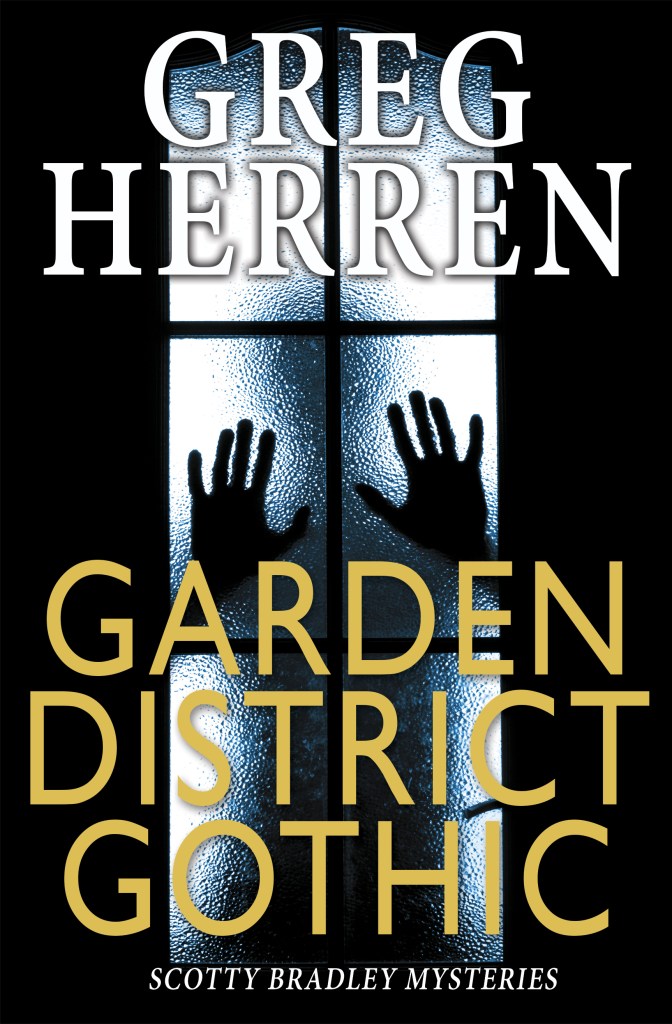
The genesis of Garden District Gothic was weird, but yet serves as yet another example of my adage never throw anything you’ve written away.
I had always wanted to spin Chanse’s best friend, journalist Paige Tourneur, off into her own series. I had always intended to do so; from the first time I thought her up for Murder in the Rue Dauphine I thought, “she’s fun and witty and interesting and that weird name–there’s so much more story there than we can get to as a supporting player in a series about someone else.” I have so much written down about Paige and her origin story; how she came up with that name and why; how she wound up at LSU; and so on and so forth. A friend started an ebook publishing company, and wanted me to write Paige novellas for her; I did two–Fashion Victim and Dead Housewives of New Orleans–but the sales, frankly, weren’t there and I didn’t have the necessary time to put in marketing them to help drive the sales, so even though I’d started a third, The Mad Catter, we agreed to kill the series and pull the first two from availability; ultimately, I was working too hard for too little pay-off. I was disappointed, obviously; Paige was kind of a passion project for me–I’d made any number of false starts writing a series book for her, and it was sad to see that there wasn’t an audience for her after all. But I had about four chapters of The Mad Catter in place, and I didn’t want to waste the time spent on them…so I decided to turn them into a Scotty book, which became Garden District Gothic.
I also brought in a new character–a true crime writer with a shady past of his own–who actually wrote a book, a la Midnight in the Garden of Good and Evil, about the case. The name of his book? Garden District Gothic. I brought him in, thinking I would spin him off into his own book/series–I thought it might be fun to write about a writer…(I thought about using him as the main character in another book based on an actual unsolved string of murders in a rural Louisiana parish, but very quickly realized he was simply an amalgamation of Scotty and Chanse, so that book–The Bodies in the Bayou–went onto the backburner. I think I may have created the character before, in the Chanse series, but I could be remembering that wrong. I also used this book to sort of set up the next; I will explain that further when I am talking about Royal Street Reveillon. I also crossed the character of Paige Tourneur over from the Chanse series into the Scotty series (I loved the character, hated to sideline her after I ended the Chanse series and the novella series didn’t pan out); not that she will be a big part of the Scotty series, but hey, every so often I need a journalist, and why not use a character I am very fond of already and wasn’t ready to stop writing about?
The book was loosely based, obviously, on the Jon-Benet Ramsey case–a decades old notorious murder of a child in the Garden District that was never solved. I wanted to examine and explore issues of class in New Orleans, but I am not entirely sure I pulled off what I intended with the book.
Then again, I think that with every book, don’t I?
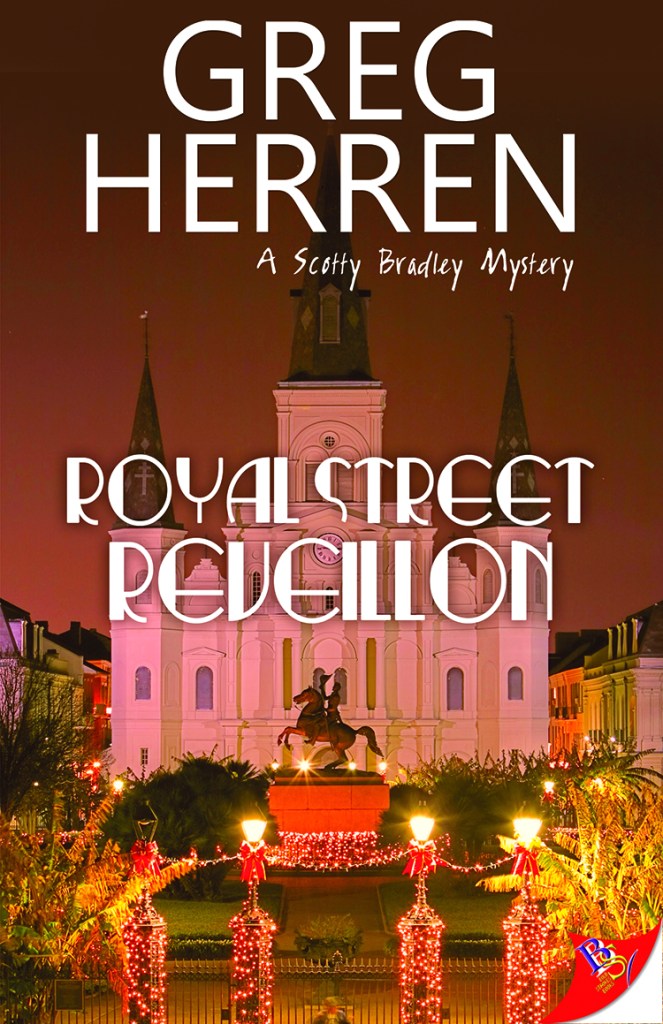
And we now come to the (so far) most recent book of the Scotty series, Royal Street Reveillon.
Originally I’d envisioned the Scotty trilogy (when it morphed from a stand-alone) as encompassing the three big gay holidays in New Orleans: Southern Decadence, Halloween, and Mardi Gras. Jackson Square Jazz wound up taking place just before Halloween, alas; Scotty talks about their costumes in the epilogue, but I hit the other two holidays out of the park. When I added a fourth book, I tied it to the Gay Easter Parade–Scotty is on his way to ride on the Devil’s Weed’s float when the book opened–and then of course the next book was sort of Christmas/sort of Mardi Gras/sort of the Super Bowl. Baton Rouge Bingo was the first book that wasn’t tied to a holiday of some sort; neither was Garden District Gothic. But for the next Scotty book, I wanted to do a Christmas book. I’ve never really written much about Christmas, and I do love the season, especially in New Orleans. I wasn’t sure what kind of plot I was going to use, but I knew it was going to be set during Christmas season and I knew I wanted to use reveillon, the Christmas season meal you use to break your fast for Mass, in the title. I had introduced one of the characters from Dead Housewives of New Orleans in Garden District Gothic, so it only made sense to me (or so it seemed at the time) for me to take the framework of Dead Housewives–the entire Real Housewives spoof I wanted to write–and build this new story around it. I changed a lot–made the overarching story much more complicated, and especially complicating the “whodunnit” aspects of the three murders that all occurred within twenty-four hours of the premiere party for Grande Dames of New Orleans.
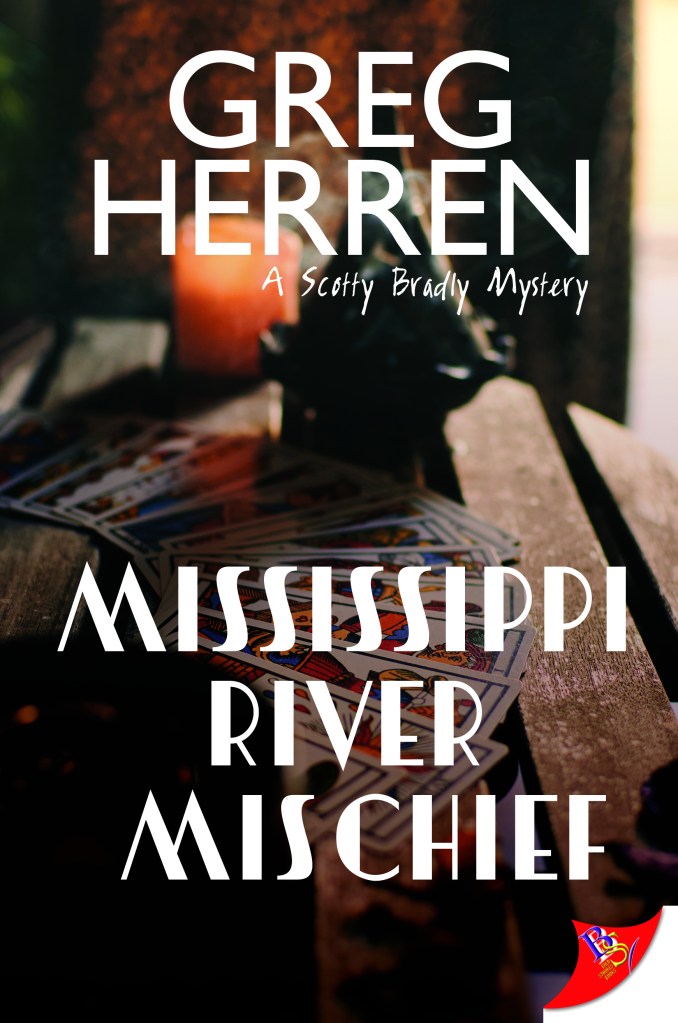
I also did a couple of horrible things to Scotty and his loved ones over the course of this book…which will have to be dealt with in the new one, alas. I hate when I do this to myself! But with Royal Street Reveillon and its darker themes, I wanted to show how much Scotty has grown and changed over the course of the series; he’s evolved as a person, partly because of the changes to his life and partly because of what he experiences through the murders he finds himself involved in. Do I wish, as I start writing Mississippi River Mischief, that maybe I hadn’t given so many growth opportunities over the years to Scotty and his gang of family and friends? Absolutely. But that’s part of the challenge of writing a series, and what makes it so much fun.
*Funny story about the original cover of Bourbon Street Blues. Back in the day, publishers used to meet with reps from Barnes & Noble and Borders to show them covers and get their input; covers were changed based on those meetings. The Bourbon Street Blues cover was so in-your-face it took me aback when I first saw it; and they had toned the original image down dramatically, mainly smoothing down the bulge so it wasn’t so in-your-face. The Barnes & Noble buyer told them, “he needs a bigger bulge” so they made it bigger–but were still cautious; the image’s original bulge was still bigger. I do think that story is hilarious.

 Queer and Loathing in America