It was the sixth Chanse, and I was trying something different with the opening of this one. I hadn’t read Ross Macdonald before I became a writer, and I was very much in the “John D. is my favorite Macdonald crime writer” camp. I had been on panels with Chris Rice a few times and he raved about Ross every time, so I kept thinking you need to read Ross Macdonald and so, sometime after Katrina, I started reading the Archer novels, moving on to stand alones and the short stories eventually. When it was time for me to write this book, I thought, tryto write an opening in Ross Macdonald’s style, and try to keep that world-weary, cynical pov through the whole book.
The house was a tired-looking single shotgun, badly in need of paint and listing to one side. It was in the middle of a block on Constance Street, facing the river. There was a rusted cyclone fence around the front yard. A statue of the Blessed Virgin Mary sat inside a circle of stone to the left of the walk leading to the front gallery. I put my car into park and verified the address—sorry I’d quit smoking for maybe the ten thousandth time.
In my line of work, it’s never a good idea to make a decision when you’re tired.
But I’d given my word, even though I’d been ready to fall asleep. It didn’t mean I had to take the job—whatever it was. All I had to do was find out what the problem was, maybe even just give some advice—which would most likely be eithernothing anyone can do or this is a job for the police.
Besides, whoever lived in this dump sure as hell couldn’t afford a private eye.
I shut off the engine and got out of the car. It was already over eighty degrees, and it wasn’t even noon yet. Beads of sweat popped out on my forehead. Early April, and it felt like summer already. I sighed and pushed the gate open. It only opened about six inches before it caught on the cracked pavement of the walk and stopped. I sighed and stepped through, catching my jeans on the fence with a slight ripping sound. I swore under my breath and examined the tear. The jeans weren’t new, but it was still annoying.
This book had several different inspirations.
First, the casino used to have MMA fights every weekend, so we had MMA fighters in the city. One of their requirements to fight was they had to have a current negative HIV and Hep C test, and guess what we do at my job? For the longest time, all these hot young fighters would come into the office every Saturday to get cleared to fight, and they came in fairly regularly. I used to talk to them a lot–I wrestled, and MMA is a lot more violent–to get some kind of idea why they did this, how they got into it, and so on. I had thought about writing a mystery about a murdered MMA fighter, but could never really get my mind around it…and then I decided, what if he was the client? Interesting.
The second source of inspiration came from a decision of the Archdiocese of New Orleans to close some churches/parishes in the city, and my friend Billy Martin was involved in the protests to save Our Lady of Good Counsel (it was a gorgeous church), even getting arrested. I wanted to do something around this as it was something that actually happened, and I also got to skewer the Archdiocese (any place that could hire David Vitter’s horrific wife to be their legal counsel deserves every skewering it gets)…so I filed that thought away.
The third and final inspiration was serving on jury duty for a civil trial. It was, of all things, a Katrina insurance fight–in which the insurance company was trying to not pay out a claim (all of us in the jury were like, “why on earth would you allow a Katrina insurance case to go to trial in New Orleans? We fucking hate insurance companies.” The fact that it was Lloyd’s of London (who became famous in the wake of the San Francisco earthquake when the president of the company wired the San Francisco office, “pay every claim”) made it even more of an eyeroll for me. An apartment complex on the west bank had sustained damage in the storm, and the insurance company was claiming they didn’t have to pay out “because the claim is for issues that predated Katrina and the place was a shithole” while claiming the complex could have reopened after Katrina “because it was gorgeous” and so they didn’t have to pay out for lost income. The first person who was called to the stand was the complex’s forensic accountant who corroborated all of the plaintiff’s claims and basically made it clear that Lloyd’s was just trying to get out of a huge payment. After he testified, we took a long lunch as they were all in conference…and the claim was settled. I think the lawyers from Lloyd’s hoped that the plaintiff would eventually back down and wouldn’t go to court–and they called that bluff and were decimating Lloyd’s in court.
I mean, the place couldn’t be a shithole and a beautiful property available for rental. Make up your fucking minds, trash at the insurance company.
And what if the MMA fighter’s mom was fighting the closing of her church, had worked for someone suing an insurance company, and then she disappears?
Yes, that was a lot of fun to write. And I was pretty pleased with how it turned out in the end, too. It was also my first Chanse novel with Bold Strokes, and they gave me that beautiful cover above that I love. It made a lovely transition for the series.
(NOTE: I started writing this post back in January, after I’d returned to New Orleans from my last Mystery Writers of America board meeting–this is to give context to the opening paragraph– as you are no doubt well aware, Constant Reader, that I’ve not been back to New York since January; so this is that same trip where this happened and I started thinking about these things, which have never been far out of the forefront of my mind since then.)
While I was in New York recently, walking around to and fro, here and there, hither and yon, I was always checking my phone (and yes, I hate that I’ve become one of those people) and then shoving it back into my pants pocket without putting it to sleep first or closing the app that was open. As I walked around, of course this led to my phone doing all kinds of weird things –closing an app and opening another, etc.; but at least there were no butt dials, right? At one point, when I pulled out my phone as I took a seat on the subway, somehow what was open on the screen was a google search for my book A Streetcar Named Murder–and when I went to close that screen I touched one of the images by mistake, which took me to the Goodreads page for the book. Bear in mind, I never look at Goodreads for any of my books, let alone Amazon–the temptations to start reading the bad reviews is too great, and while I can usually laugh them off, occasionally–and it depends entirely on my mood, of course–one will get under my skin and it will annoy me, and that’s not good for anyone.
This particular day on the subway the Goodreads page opened to the bad reviews first–its average is four stars, which I will always take because I am not Lauren Hough–and the very first one made me laugh out loud on the subway. Paraphrased, it was basically someone taking umbrage at “someone who doesn’t live here or know the first thing about New Orleans” writing a book about New Orleans. The reason they had come to this conclusion was because Valerie referred to Mardi Gras as “Fat Tuesday”, and according to this one-star reviewer, no one from New Orleans would ever say Fat Tuesday instead of Mardi Gras.
Well, I’ve lived here for twenty-seven years and I have heard any number of locals say Fat Tuesday rather than Mardi Gras, and so of course I had to click on the reviewer’s profile…and grinned to myself when I saw that they actually live in Metairie, not New Orleans…which to locals is a bigger crime than getting something wrong about New Orleans: claiming to be from New Orleans when you actually live in Metairie. (the rejoinder is usually along the lines of “bitch, you live in Metairie.”)
It was also kind of fun to be accused of inauthenticity when it comes to writing about New Orleans, because I personally have never claimed to be an expert on anything New Orleans (others have said that about me, and I always am very quick to reply not even close); the more I learn about the city the more I realize how little I actually know about the city. There’s an extremely rich (and often incredibly dark) history here; it’s hard for me to wrap my mind around the fact that the New Basin canal was there as long as it was, or that there were several train stations around the French Quarter (including one that essentially was in Storyville–rather convenient for the whores and pimps, right?), or that where UNO is now used to be the lake shore resort of Milneburg, or that the only way across the river or the lake was by ferry until Huey Long built a bridge at the Rigolets (the narrow inlet between lakes Pontchartrain and Borgne).
I was on a panel once at the Tennessee Williams Festival with Bill Loefhelm (if you’re not reading Bill’s books, shame on you and correct that immediately) and the question of New Orleans authenticity came up, and Bill’s response (paraphrasing) was that New Orleanians have a tendency to play a game called “NOLier than Thou,” in which they try to one-up each other to see who the true New Orleanian actually is–which is, of course, gatekeeping. (And yes, I immediately turned to him and said, “I like that and am going to steal it” SO CONSIDER IT STOLEN.)
It does bother me somewhat when I read books set in New Orleans written by people who have never lived here; you can tell, but I also get over it pretty quickly; who is to say who can and can’t write about a place? There’s a significant difference between visiting and living here, which I realized almost immediately after we moved here, and that also becomes very apparent in fiction. I had started writing the book that would become Murder in the Rue Dauphine before I moved here, and I realized, once I did live here, that everything I’d written about New Orleans was completely wrong. I didn’t work on the book for another two years; and even then I wasn’t entirely sure I’d lived here long enough to write about the city. So…I kind of cheated by making Chanse MacLeod not a native either; he’d moved to New Orleans after getting his degree in Criminology from LSU, and had been here about six or seven years when the story opened. So he was an outsider, too; so his views on the city and how things work around here were from an outsider’s perspective, like mine; that was easier. With Bourbon Street Blues, I decided that Scotty was not only a native but came from two old-line society families, from the Garden District and Uptown. One of the greatest joys of my publishing career was having the Times-Picayune’s mystery reviewer, as well as the Books Editor, both say repeatedly that I got New Orleans right in my books. (Thanks again as always for all of your support, Diana Pinckley and Susan Larson!)
And I never really worried about it too much from then on. I wrote about New Orleans as I saw it–the potholes, the cracked sidewalks, the leaning houses, flooding streets, oppressive weather and hurricanes. As the years passed, I became more and more aware that my New Orleans writing was primarily confined to the Quarter, the Marigny, the CBD, the Lower Garden District, the Garden District, and Uptown–a very narrow slice of the city, but those were also my slices of the city, so that’s I wrote about. Sometimes I’d venture into another neighborhood–Lakeview, the Irish Channel, English Turn–and sometimes the story would take the characters to another part of Louisiana–the bayou and river parishes, the Maurepas swamp, the Atchafalaya Swamp, Baton Rouge–which, oddly enough, I had no qualms about fictionalizing. I’ve created numerous fictional towns and parishes surrounding New Orleans; I’ve even invented a sleazy gay bar in the Quarter (the Brass Rail).
So, was I doing New Orleans (and Louisiana) right by making stuff up, inventing places like the Royal Aquitaine Hotel, the Brass Rail, Bodytech Health Club, Riverview Fitness, etc.? Sometimes you have to fictionalize things, even if they are based on something that really exists. I never really thought much about it; I felt like I was getting the feel of New Orleans right, that my characters talked the way people in New Orleans do and react the way people here do, and that I was putting enough reality into the books for them to ring true to locals, natives, and tourists. Sometimes the cases are based on, in or around something that actually happened or exist; like the Cabildo Fire, the Fire at the Upstairs Lounge, Hurricane Katrina and the ensuing flood; termite swarms; Huey Long’s deduct box; and even the court case in, I think, Murder in the Irish Channel that triggered the murders was actually based on a civil trial I served as a juror on.
When I started writing A Streetcar Named Murder, I realized a lot of things I was writing about had to be fictionalized; I couldn’t set a murder at a Mardi Gras krewe ball and use an actual krewe that exists in real life, for one thing (like I had to invent a French Quarter hotel for a couple of murders to occur in) and while I didn’t want to use the cheat that Valerie had moved here again, like I did with Chanse, I wanted her to be of New Orleans but not be of New Orleans…so her parents are from Georgia and moved here after college and marriage, so Valerie was born here, went to school here, met and fell in love with and married her husband here–but her roots aren’t very deep, so she is both insider and outsider at the same time. I liked that idea; like how I am of the South but not of the South, she was of New Orleans but not of New Orleans at the same time. When creating Jem Richard in Death Drop, again, he’s a recent transplant to the city but his father is from New Orleans but relocated to Dallas, where Jem was born and raised. Jem spent a lot of his summers in New Orleans when he was growing up with his paternal grandmother, so he too is of New Orleans but not of New Orleans; which I am really liking as a method of storytelling about the city. I also moved Jem to a different part of the city; he lives in the 7th ward, on St. Roch Avenue in what is known as the St. Roch neighborhood (aka what realtors are trying to redefine and rename as the “new Marigny”, in order to raise prices) which is also very close to my office. Part of this was to move the action out of the neighborhoods I usually write about (although he does wind up in both Uptown and the Quarter) and so I could explore another neighborhood/part of the city than what I usually write about.
I also had recently–prior to the pandemic–started feeling more disconnected from the city than I ever had before. Primarily I think this was due to my office moving; we had been on Frenchmen Street in the Marigny, one block from the Quarter and where Scotty lives, so whenever I needed some Scotty inspiration I could walk a block, stand under the balconies of his building and just look around, drinking in the sights and sounds and smells of the block. To get past this, I started joining New Orleans history pages on Facebook, like Ain’t Dere No Mo New Orleans or the HNOC page and various others–you do occasionally run into Confederate apologists and racists there (they usually cry about the “crime” in New Orleans–you know, the usual dog-whistles from the white flight racists who fled to Jefferson Parish or the North Shore to escape desegregation of the public schools) and reading more histories of the city, state, and region–which are incredibly fascinating. That reading/research helped me write my historical Sherlock in New Orleans short story, “The Affair of the Purloined Rentboy”–but I have also since realized I got some things wrong in the story too, but there is just so much to know. I set the story in 1916 for example….without knowing New Orleans was hit by a MAJOR hurricane in 1915 that wiped out any number of settlements and villages around the lakes and the bay shores (that will turn up in a story sometime; the destruction of the lake front village of Freniere is just begging to be fictionalized and written about). When I mentioned this to another writer, who primarily does historicals, she snorted. “It’s impossible to know everything, and would people in 1916 still be talking about a hurricane from 1915?”
Probably, but if it doesn’t have anything to do with the story being told, why would I mention it?
A very valuable lesson, to be sure.
So, yes, lady from Metairie: you caught me. I’m not from New Orleans, you’re correct. But I’ve also published over twenty novels and umpteen short stories set here, and have even won awards for doing it.
And I’ll call it Fat Tuesday if I fucking want to.
The Huey P. Long Bridge at sunset, photo credit Marco Rasi
I often talk about how my education in the so-called “classics” is somewhat lacking; this is also true, not just of the great canon of literary fiction, but within my own genre as well (which is why I never pose as an expert on crime fiction; I am not one). I had never read Ross MacDonald–I was aware of him, and Lew Archer–but never had any real desire to read him until I was on a panel with Christopher Rice, who mentioned MacDonald as one of his favorite writers and an inspiration. Hmmm, I thought, perhaps I should give MacDonald a try.
So, in the years following that panel, I started reading the Archer novels, and enjoyed them tremendously. I’ve not read all of them, and I’ve not read any of his stand-alones…but what I liked the most about them was the style; how MacDonald put words and sentences together to create not only character, but mood and a kind of dark, noir-ish hard-boiled sensibility that I really admired. Early in my writing career, I patterned Chanse–both character and series–after John D. MacDonald’s Travis McGee series; later, after I started reading Ross MacDonald, I tried to see if I could create my own version of that sensibility and writing style; influenced by both MacDonalds but trying to create my own version, if that makes any kind of sense. I’d say Murder in the Irish Channel came the closest of any of the books to perfecting that style; I don’t know if Murder in the Arts District replicated the feat (which means I am going to have to reread it, even if cursorily, damn it).
There’s nothing more tedious than rereading your own work.
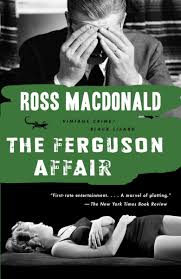
But I recently decided it was past time to give one of Ross MacDonald’s stand-alones a shot, and chose The Ferguson Affair.
The case began quietly, on the women’s floor of the county jail. I was there to interview a client, a young nurse named Ella Barker who had been arrested on a stolen-property charge. Specifically, she had sold a diamond ring which was part of the loot in a recent burglary; the secondhand dealer who bought it from her reported the transaction to the police.
Our interview started out inauspiciously. “Why you?” she wanted to know. “I thought people in trouble had a right to choose their own lawyer. Especially when they’re innocent, like me.”
“Innocence or guilt has nothing to do with it, Miss Barker. The judges keep an alphabetical list of all the attorneys in town. We take turns representing defendants without funds. My name happened to be next on the list.”
“What did you say your name was?”
“Gunnarson. William Gunnarson.”
“It’s a funny name,” she said, wrinkling her nose.
Reading books written in the past–no matter how far back–can often be jarring. One has to take into consideration the context of the time in which the book was written; The Ferguson Affair, for example, was published originally in 1960, and if you don’t think the world and society and culture have changed dramatically in the time since the final full year of the Eisenhower administration, you might want to think again. The book was published the year before I was born, so technically the book is only slighter older than I am, and it came out in a world without color television, cable, cell phones, etc. Technology had advanced so far in those fifty-nine years it might as well have been published a hundred years ago.
The Ferguson Affair was published in the midst of the period when he was producing the Lew Archer novels, and a lot of the Archer hallmarks also appear in this book; a complicated, winding plot that begins as something very small–in this case, the arrest of Ella Barker for pawning stolen property–and then continues, over the course of the investigation, to expand outwards into something much bigger, most dastardly, and more deadly. William Gunnarson, the main character of the book, is an attorney in a small California city named Buenavista, reminiscent of the town of Santa Teresa where some of the Archer books are set (and was later borrowed by Sue Grafton for her Kinsey Millhone books in a homage to MacDonald). Gunnarson is married and his wife is nine months pregnant and ready to give birth at any moment; more on that later. He is interviewing his client when word comes that someone had tried to kill the pawnshop owner who turned her in; Gunnarson is allowed to ride along to the pawnshop, which is on Pelly Street–clearly the wrong side of the tracks, and the Latin side of town. Ella was given the diamond ring she pawned for her engagement to Larry Gaines, the lifeguard at the fancy Foothill Club (the Buenavista country club), after discovering he was stepping out on her with retired screen star Holly May. The ring was loot from a robbery; the police suspect Ella knows more about the gang of robbers than she is letting on–because the victims of the robbery have all been patients at the hospital where she works as a nurse.
The book proceeds from there, with twists and turns involving kidnapping and extortion, murder and robbery; and while it is a fun ride as all MacDonald novels are, there is definitely some 1960’s era um, that’s a bit racist stuff when it comes to the Latinx people he comes into contact with over the course of the story.
And that doesn’t even take into consideration how Gunnarson treats his pregnant wife, Sally. Nine months pregnant and about to give birth at any given moment, he can’t be bothered to call her to tell her he’s coming home late for dinner which she is preparing. He never checks in on her to see if she’s okay; and in fact, he’s not around when she finally does go into labor, and someone else has to make sure she gets to the hospital in time for the birth. There’s none of the modern sentimentality about pregnancy and childbirth; he actually teases and mocks her about being so pregnant during the brief time he gives her any attention at all. I’m not really sure why it was necessary for her to be pregnant, to be honest; it bore no relation to the story in any way, and all it did was make Gunnarson seem, to my modern eyes, like an asshole.
It did occur to me that this story could have just as easily been an Archer novel/story; only set in the past, to give a key insight into who Archer was as a character, and how he developed. I could totally see this being Archer’s marriage, and Archer being the kind of husband who would always put his wife and family last; as was expected of men at the time, and the wife getting tired of it and divorcing him. (I am not an Archer expert; I’ve read some of the books, not all, and while I do enjoy them when I do read them, I don’t have details memorized. I do seem to recall that Archer had been married and divorced; I think his ex-wife is mentioned a few times…but like I said, this works as an early Archer story, but back then it wasn’t common for series books to be written out of order; maybe that was why this wound up not being an Archer? I don’t know, but it’s an interesting theory.)
Reading the book, though, made me think more about writing another Chanse novel, which I think may happen at some point in the next few years. I’d recommend it to you if you’re a MacDonald fan and want to achieve completion with his works; it’s probably not the best place to start with MacDonald if you haven’t read him before.


 Queer and Loathing in America