NOLier Than Thou

(NOTE: I started writing this post back in January, after I’d returned to New Orleans from my last Mystery Writers of America board meeting–this is to give context to the opening paragraph– as you are no doubt well aware, Constant Reader, that I’ve not been back to New York since January; so this is that same trip where this happened and I started thinking about these things, which have never been far out of the forefront of my mind since then.)

While I was in New York recently, walking around to and fro, here and there, hither and yon, I was always checking my phone (and yes, I hate that I’ve become one of those people) and then shoving it back into my pants pocket without putting it to sleep first or closing the app that was open. As I walked around, of course this led to my phone doing all kinds of weird things –closing an app and opening another, etc.; but at least there were no butt dials, right? At one point, when I pulled out my phone as I took a seat on the subway, somehow what was open on the screen was a google search for my book A Streetcar Named Murder–and when I went to close that screen I touched one of the images by mistake, which took me to the Goodreads page for the book. Bear in mind, I never look at Goodreads for any of my books, let alone Amazon–the temptations to start reading the bad reviews is too great, and while I can usually laugh them off, occasionally–and it depends entirely on my mood, of course–one will get under my skin and it will annoy me, and that’s not good for anyone.

This particular day on the subway the Goodreads page opened to the bad reviews first–its average is four stars, which I will always take because I am not Lauren Hough–and the very first one made me laugh out loud on the subway. Paraphrased, it was basically someone taking umbrage at “someone who doesn’t live here or know the first thing about New Orleans” writing a book about New Orleans. The reason they had come to this conclusion was because Valerie referred to Mardi Gras as “Fat Tuesday”, and according to this one-star reviewer, no one from New Orleans would ever say Fat Tuesday instead of Mardi Gras.

Well, I’ve lived here for twenty-seven years and I have heard any number of locals say Fat Tuesday rather than Mardi Gras, and so of course I had to click on the reviewer’s profile…and grinned to myself when I saw that they actually live in Metairie, not New Orleans…which to locals is a bigger crime than getting something wrong about New Orleans: claiming to be from New Orleans when you actually live in Metairie. (the rejoinder is usually along the lines of “bitch, you live in Metairie.”)

It was also kind of fun to be accused of inauthenticity when it comes to writing about New Orleans, because I personally have never claimed to be an expert on anything New Orleans (others have said that about me, and I always am very quick to reply not even close); the more I learn about the city the more I realize how little I actually know about the city. There’s an extremely rich (and often incredibly dark) history here; it’s hard for me to wrap my mind around the fact that the New Basin canal was there as long as it was, or that there were several train stations around the French Quarter (including one that essentially was in Storyville–rather convenient for the whores and pimps, right?), or that where UNO is now used to be the lake shore resort of Milneburg, or that the only way across the river or the lake was by ferry until Huey Long built a bridge at the Rigolets (the narrow inlet between lakes Pontchartrain and Borgne).

I was on a panel once at the Tennessee Williams Festival with Bill Loefhelm (if you’re not reading Bill’s books, shame on you and correct that immediately) and the question of New Orleans authenticity came up, and Bill’s response (paraphrasing) was that New Orleanians have a tendency to play a game called “NOLier than Thou,” in which they try to one-up each other to see who the true New Orleanian actually is–which is, of course, gatekeeping. (And yes, I immediately turned to him and said, “I like that and am going to steal it” SO CONSIDER IT STOLEN.)

It does bother me somewhat when I read books set in New Orleans written by people who have never lived here; you can tell, but I also get over it pretty quickly; who is to say who can and can’t write about a place? There’s a significant difference between visiting and living here, which I realized almost immediately after we moved here, and that also becomes very apparent in fiction. I had started writing the book that would become Murder in the Rue Dauphine before I moved here, and I realized, once I did live here, that everything I’d written about New Orleans was completely wrong. I didn’t work on the book for another two years; and even then I wasn’t entirely sure I’d lived here long enough to write about the city. So…I kind of cheated by making Chanse MacLeod not a native either; he’d moved to New Orleans after getting his degree in Criminology from LSU, and had been here about six or seven years when the story opened. So he was an outsider, too; so his views on the city and how things work around here were from an outsider’s perspective, like mine; that was easier. With Bourbon Street Blues, I decided that Scotty was not only a native but came from two old-line society families, from the Garden District and Uptown. One of the greatest joys of my publishing career was having the Times-Picayune’s mystery reviewer, as well as the Books Editor, both say repeatedly that I got New Orleans right in my books. (Thanks again as always for all of your support, Diana Pinckley and Susan Larson!)

And I never really worried about it too much from then on. I wrote about New Orleans as I saw it–the potholes, the cracked sidewalks, the leaning houses, flooding streets, oppressive weather and hurricanes. As the years passed, I became more and more aware that my New Orleans writing was primarily confined to the Quarter, the Marigny, the CBD, the Lower Garden District, the Garden District, and Uptown–a very narrow slice of the city, but those were also my slices of the city, so that’s I wrote about. Sometimes I’d venture into another neighborhood–Lakeview, the Irish Channel, English Turn–and sometimes the story would take the characters to another part of Louisiana–the bayou and river parishes, the Maurepas swamp, the Atchafalaya Swamp, Baton Rouge–which, oddly enough, I had no qualms about fictionalizing. I’ve created numerous fictional towns and parishes surrounding New Orleans; I’ve even invented a sleazy gay bar in the Quarter (the Brass Rail).

So, was I doing New Orleans (and Louisiana) right by making stuff up, inventing places like the Royal Aquitaine Hotel, the Brass Rail, Bodytech Health Club, Riverview Fitness, etc.? Sometimes you have to fictionalize things, even if they are based on something that really exists. I never really thought much about it; I felt like I was getting the feel of New Orleans right, that my characters talked the way people in New Orleans do and react the way people here do, and that I was putting enough reality into the books for them to ring true to locals, natives, and tourists. Sometimes the cases are based on, in or around something that actually happened or exist; like the Cabildo Fire, the Fire at the Upstairs Lounge, Hurricane Katrina and the ensuing flood; termite swarms; Huey Long’s deduct box; and even the court case in, I think, Murder in the Irish Channel that triggered the murders was actually based on a civil trial I served as a juror on.

When I started writing A Streetcar Named Murder, I realized a lot of things I was writing about had to be fictionalized; I couldn’t set a murder at a Mardi Gras krewe ball and use an actual krewe that exists in real life, for one thing (like I had to invent a French Quarter hotel for a couple of murders to occur in) and while I didn’t want to use the cheat that Valerie had moved here again, like I did with Chanse, I wanted her to be of New Orleans but not be of New Orleans…so her parents are from Georgia and moved here after college and marriage, so Valerie was born here, went to school here, met and fell in love with and married her husband here–but her roots aren’t very deep, so she is both insider and outsider at the same time. I liked that idea; like how I am of the South but not of the South, she was of New Orleans but not of New Orleans at the same time. When creating Jem Richard in Death Drop, again, he’s a recent transplant to the city but his father is from New Orleans but relocated to Dallas, where Jem was born and raised. Jem spent a lot of his summers in New Orleans when he was growing up with his paternal grandmother, so he too is of New Orleans but not of New Orleans; which I am really liking as a method of storytelling about the city. I also moved Jem to a different part of the city; he lives in the 7th ward, on St. Roch Avenue in what is known as the St. Roch neighborhood (aka what realtors are trying to redefine and rename as the “new Marigny”, in order to raise prices) which is also very close to my office. Part of this was to move the action out of the neighborhoods I usually write about (although he does wind up in both Uptown and the Quarter) and so I could explore another neighborhood/part of the city than what I usually write about.

I also had recently–prior to the pandemic–started feeling more disconnected from the city than I ever had before. Primarily I think this was due to my office moving; we had been on Frenchmen Street in the Marigny, one block from the Quarter and where Scotty lives, so whenever I needed some Scotty inspiration I could walk a block, stand under the balconies of his building and just look around, drinking in the sights and sounds and smells of the block. To get past this, I started joining New Orleans history pages on Facebook, like Ain’t Dere No Mo New Orleans or the HNOC page and various others–you do occasionally run into Confederate apologists and racists there (they usually cry about the “crime” in New Orleans–you know, the usual dog-whistles from the white flight racists who fled to Jefferson Parish or the North Shore to escape desegregation of the public schools) and reading more histories of the city, state, and region–which are incredibly fascinating. That reading/research helped me write my historical Sherlock in New Orleans short story, “The Affair of the Purloined Rentboy”–but I have also since realized I got some things wrong in the story too, but there is just so much to know. I set the story in 1916 for example….without knowing New Orleans was hit by a MAJOR hurricane in 1915 that wiped out any number of settlements and villages around the lakes and the bay shores (that will turn up in a story sometime; the destruction of the lake front village of Freniere is just begging to be fictionalized and written about). When I mentioned this to another writer, who primarily does historicals, she snorted. “It’s impossible to know everything, and would people in 1916 still be talking about a hurricane from 1915?”

Probably, but if it doesn’t have anything to do with the story being told, why would I mention it?

A very valuable lesson, to be sure.

So, yes, lady from Metairie: you caught me. I’m not from New Orleans, you’re correct. But I’ve also published over twenty novels and umpteen short stories set here, and have even won awards for doing it.

And I’ll call it Fat Tuesday if I fucking want to.

The Huey P. Long Bridge at sunset, photo credit Marco Rasi

All You Had to Do Was Stay

Well, we survived yet another week, Constant Reader, and here we are on Saturday morning. Huzzah! Congratulations–I do think even such small accomplishments definitely need to be rewarded in this year of Our Lord 2020.

It rained yesterday while I was making condom packs, and I just rewatched the LSU-Georgia game from last year–the SEC title game–because, well, frankly because after watching Fright Night on Thursday I was kind of not in the mood to watch any more horror, at least not yesterday; Fright Night was so disappointing I allowed that to carry over into another day (April Fool’s Day from last week was also disappointing).

This has been a very strange week; one of low energy, regularly occurring irritations and concerns and stressors, among other things. I finally got that damned essay revised and approved by the editor (thank you baby Jesus) and now today I intend to whip that short story into shape, work on a chapter of the book, and get some cleaning and organizing done around here. I’ve also found myself not on social media nearly as much as I used to be, and it’s really not a bad thing, after all. Sure, engaging with friends from across the country, commiserating about the slog of writing, etc. is often fun and satisfying, but emotionally there’s so much nastiness and negativity in the world that seems to take over so much of it that I don’t really miss being there nearly as much as I thought I might; I kind of miss the days when my feed mostly consisted of people taking pictures of their food or asking for recommendations for things to watch or read. I found a lot of terrific books and TV shows and films from my social media feeds; but now they are so emotionally and intellectually exhausting that I am not really terribly sure that I want to spend more time there than i have been lately.

The bloom is rather off that rose, as it were.

And yet another example of how and why we can’t have anything nice.

I slept marvelously last night; I even slept later than usual this morning, which was equally lovely. I do feel rested as I swill my coffee this morning, and I am currently working on backing up my back -up hard drive to the cloud, so that everything recent is kind of there. (I have done back-ups before, so I really don’t need to back-up anything past a certain date from the back-up hard drive, really; something i just realized, which means I don’t really need to spend as much time with it as I have been; I really only need to back up things from the last few months or so because it all should have already been backed up to the cloud already.) I’m still a bit foggy this morning as I type this, but the caffeine will eventually turn the trick and I’ll be ready to go tackle the revision of “The Snow Globe,” before preparing to take on the book again. LSU doesn’t play until six tonight, which gives me the entire day to write and read and clean and organize. Tomorrow morning will be my “try to answer all my emails” morning, before moving on to writing again. I want to read some more short stories this weekend–I may even move back into the Reread Project; I’ve had a hankering for a reread of Christine ever since I rewatched the film recently, and there are any number of Mary Stewart and Victoria Holt and Phyllis Whitney classics loaded into my iPad for me to reread quite easily; I actually queued up Sara the other night–why not reread one of my own, particularly my only previous Kansas book; particularly since I need to be certain I am not reusing character names from it in the new one–and I’ve also need to be certain that I am making time to write going forward.

Writing (and reading) really needs to become more of a priority in my life again.

I have been thinking about writing–whether in short or long form, I have yet to decide–about the yellow fever epidemics in New Orleans. The worst one was in 1853, when one in fifteen died; but the last was in 1905. (Bubonic plague paid a visit less than ten years later, something I noted in my Sherlock story “The Affair of the Purloined Rentboy”) I particularly like the note that people actually believed that yellow fever was spread by miasma, pollution in the air, or foul odors (they hadn’t discovered that mosquitoes spread it yet) and so they used to occasionally fire a cannon during fever season in an attempt to clear/clean the air. As always, the epidemics primarily targeted the poor, the enslaved, and the immigrant populations of the city; the wealthy used to abandon the city for their country estates or visiting relatives when it was fever season (little known fact: the reputation of Marie Laveau was primarily earned because she worked as a volunteer nurse during epidemics and never became ill herself; people began to believe this was further proof of her supernatural powers). It’s also really interesting to me that where the campus of the University of New Orleans sits now used to be a lake resort area called Milneburg; people used to catch the train at Elysian Fields and Esplanade to ride out there to catch the gentle breezes and experience the cooler air on the lakefront, renting little cabins out there as a vacation of sorts. I am very interested in New Orleans in the period between the Spanish-American War and the first world war; I also recognize that the period is one that most historians love and history fans love to read about, as it was the heyday of Storyville. But in fairness, all of the twentieth century in New Orleans is interesting to me, much more so than the previous centuries. I do have an idea for another Sherlock story or novella having to do with Storyville, based on an actual true story; “The Mother of Harlots” about the murder of a Storyville madam whom I have running a bordello called Babylon–my fictional Mrs. Fournier was the kind of women who embraced the sin of what she was doing and made sure everyone knew it, yet at the same time she had a very secret–and respectable–life with a daughter she was trying to pass off to society (there actually was a madam who did this very thing!), which, on its face, is the perfect set up for a murder, don’t you think?

I also want to set one in Milneburg, but I don’t have anything other than the Sherlockian title of “A Scandal in Milneburg”, which doesn’t really thrill me. I don’t see the need for me to parody Holmes canon titles, really; I can certainly mimic the style of the titles, as I did with the one I already wrote and sold. It’s interesting how writing that story has fired up my imagination as far as Holmes and Watson is concerned–I’ve written before about not being a huge fan of the stories–but actually writing about them has whetted my appetite to keep giving my own spin on the two characters, and I genuinely liked Watson as I wrote through his point of view.

Who would have ever thought I would come to the fandom by actually writing about them? Interesting, isn’t it?

And on that note I am heading into the spice mines. Have a lovely day, Constant Reader!

Please Remember Me

I am often, incorrectly, referred to as a “New Orleans expert.”

Nothing, as I inferred in that sentence, could be further than the truth.

Don’t get me wrong–I absolutely, positively love New Orleans, for many and varied reasons. The short, elevator-pitch answer is always Because I’m not the weird one here. And it’s true; New Orleans is an eccentric city filled with eccentrics. No other city in North America is like it, even remotely; New Orleans is a city that doesn’t abhor strangeness, but rather embraces it. When I came here for my thirty-third birthday in 1994, when I got out of the cab at the intersection of St. Ann and Bourbon that first night, my actual birthday, to go out to the gay bars of the Quarter, I knew I was home. There was no doubt in my mind, no question; just an immediate and instant connection with the city and I knew, not only that I would eventually live here, but that if and when I did all my  dreams would come true.

And that feeling was right. I fell in love with New Orleans, I fell in love in New Orleans, and after I moved here, all of my dreams did, in fact, come true.

So, when I write about New Orleans my deep and abiding love and passion for the city inevitably comes through. But I always kind of smile inwardly to myself when people call me an expert on the city; I am hardly that, and libraries could be filled with what I don’t know about the city. Sure, I do know some things, but an expert? Not even remotely close.

A perfect case in point is Milneburg. What, you may every well ask, is Milneburg? Milneburg was a resort village on the lake shore that many New Orleanians would escape to during the wretched heat of the summer (and I am vastly oversimplifying this); I’ve read about it in history books and so forth. I even thought Murder in Milneburg might make for an interesting historical mystery. I always saw it, though, in my mind’s eye, as close to the parish line between Orleans and Jefferson parishes; closer to Metairie and the causeway. So, you can imagine my shock when I saw a map of Milneburg posted on one of the New Orleans historical Facebook pages I belong to, and realized that I was completely wrong: there was a railroad line from New Orleans to Milneburg (which I knew) that ran along what is now Elysian Fields Avenue. 

So, Milneburg was actually where the University of New Orleans is now located; and the train line continued along east, crossing at the Rigolets.

Some New Orleans expert I am, which is why I decided to start reading more histories of the city over the last few years. It’s been quite an education, and there are still some things I don’t quite grasp–like when the Basin Canal was filled in to become Basin Street, and what relation that had to Storyville and Treme, because the train station also used to be located near Storyville (this was part of the reason why the drive to clean up Storyville and end legal prostitution in New Orleans was successful; the other part was because New Orleans was an embarkation point for the military during World War I and the Pentagon frowned on delivering green military recruits to whorehouses).

So, yeah, some expert I am.

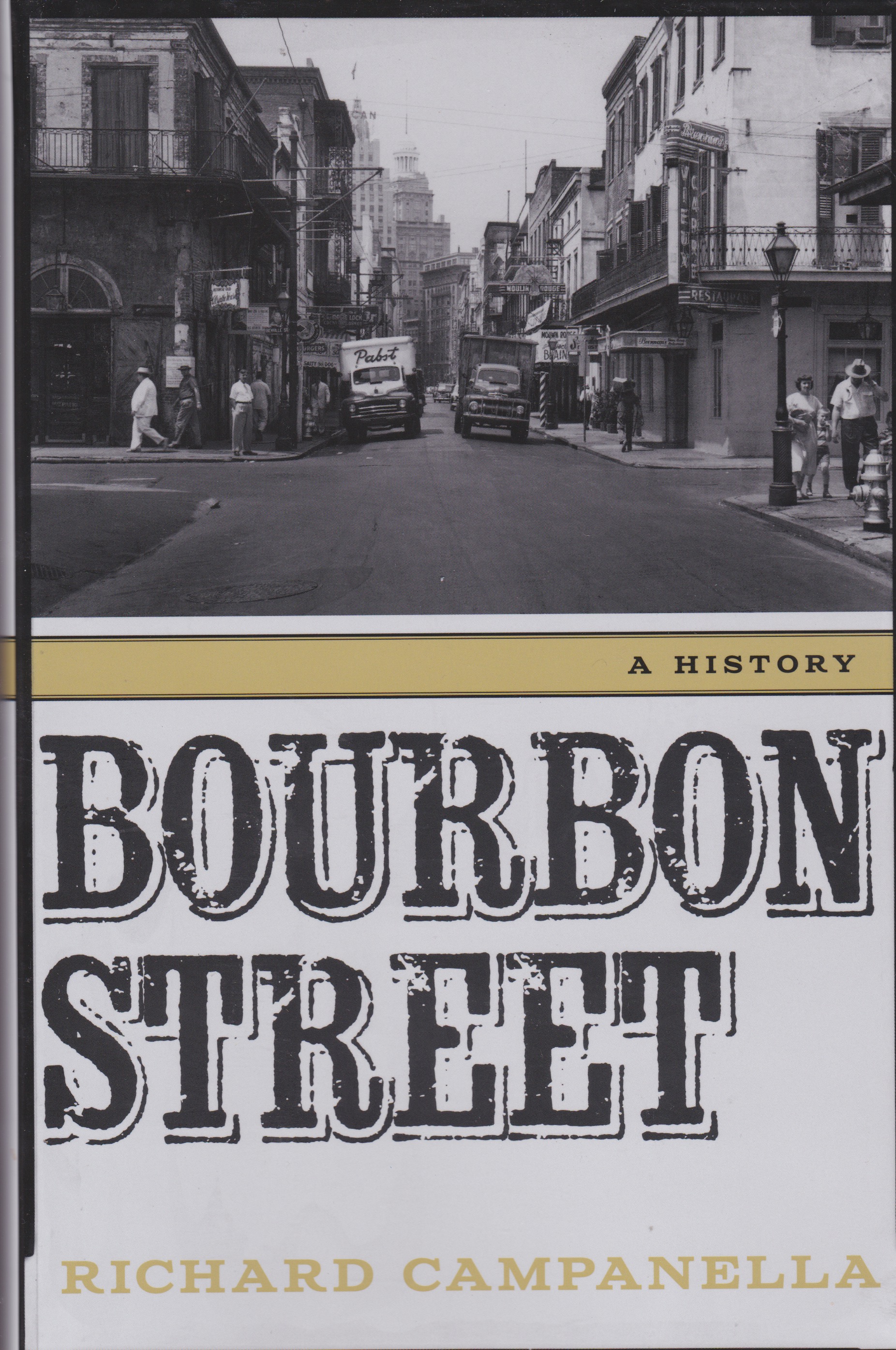
But I really enjoyed Richard Campanella’s Bourbon Street.

bourbon street

There are no straight lines in nature. Nor are there any right angles. Rather, intricate arcs and fractures merge and bifurcate recurrently, like capillaries in a plant leaf or veins in an arm. Nowhere is this sinuous geometry more evident than in deltas, like that of the Mississippi River. Starting eighteen thousand years ago, warming global temperatures melted immense ice sheets across North America. The runoff aggregated to form the lower Mississippi River and flowed southward bearing vast quantities of sediment. The bluffs and terraces that confined the channel to a broad alluvial valley petered out roughly between present-day Lafayette and Baton Rouge in Louisiana, south of which lay the Gulf of Mexico.

Into that sea disembogued the Mississippi, its innumerable tons of alluvium smothering the soft marshes of the Gulf Coast and accumulating upon the hard clays of the sea floor. So voluminous was the Mississippi’s muddy water column that it overpowered the (relatively weak tides and currents of) Gulf of Mexico, thus prograding the deposition farther into the sea. Occasional crevasses in the river’s banks diverted waters to the left or right, creating multiple river mouths and thus multiple depositions. High springtime flow also overtopped the river’s banks and released a think sheet of sediment-laden water sideways, further raising the delta’s elevation.

In this manner, southeastern Louisiana rose from the sea. The process took about 7,200 years, making the Mississippi Delta, as Mark Twain put it, “the youthfulest batch of country that lies around there anywhere.” Young, dynamic, fluid, warm, humid: flora and fauna flourish in such conditions, as evidenced by the verdant vegetation and high productivity of the delta’s ecosystem. Humans, on the other other, view these same conditons as inhospitable, dangerous, even evil, and endeavor to impose rigidity and rectitude upon them, so as to better exploit the delta’s resources.

If New Orleans is known for anything, it’s Bourbon Street. Everyone has heard about Bourbon Street, it seems; just as they’ve heard about Carnival/Mardi Gras, beads, and show us your tits (which locals do NOT do–either yell it or bare them). Campanella’s book traces the history of the famous street, and by extension, the French Quarter itself, from its very beginnings when the French arrived and designed the streets, to its modern day incarnation as a street of endless partying and no little debauchery. It’s very well researched, and Campanella, who I believe teaches at Tulane, is the true expert on the city; I follow his pages on Facebook, and I can’t even begin to tell you how much inspiration and information Bourbon Street  has given me. I’ve put so many page markers in my copy that I’m worried about breaking the spine!

One thing that my reading of New Orleans history has further emphasized to me–and it also really comes through strongly in Campanella’s book–is how New Orleans has always been a city of neighborhoods, and how each neighborhood of the city had (has?) its own unique  sense of itself, and how those who lived in those neighborhoods so strongly identified with them. The evolution of the French Quarter from the original city and seat of its government, to the original French leaving and being replaced by immigrants (as late as the 1960’s the lower quarter was known as ‘little Sicily’ because of all the Italian immigrants and their descendants who lived there), and then evolved again into a different type of neighborhood, with mixed incomes and everything from inexpensive apartments to gradiose condos; and a variety of ethnicities, races, sexualities, and gender identities.

One of the primary concerns modern-day New Orleanians have is the fear of the loss of those neighborhoods; because those neighborhoods were the incubators for all the things that makes New Orleans so special and unique: the music, the art, the literature, and the characters. Short-term rentals are carving up neighborhoods and the rents/property values are currently climbing, with no peak in sight, and people are rightfully concerned about these things.

But one thing I’ve learned from reading these histories, and Campanella’s in particular, is that New Orleans has always changed and evolved, yet has also always managed to keep that unique strangeness that make it New Orleans somehow intact.

If you love New Orleans or find it at all interesting, I cannot recommend Bourbon Street enough to you.