All She Wants to Do is Dance

Hello, Wednesday, how are you this morning? I’m a little out of sorts this fine spring morning in New Orleans; my sleep has been restless this week and thus I am not as rested as I would prefer. The book has turned once again into a slog, but the best thing about the slog is–as I was slogging through Chapter Fourteen yesterday–I had one of those “only when I am writing a Scotty book” moments: when I get bored with what I’m writing so I toss in a plot twist out of nowhere. And it’s a good one too; I can’t believe it never crossed my mind to do this. It also makes sense with what else is going on. I do think this book is going to eventually turn out to be something pretty decent; it’s just getting this slog of a first draft finished. It’s going to be a lot more sloppy than the first drafts usually are; because I am not going back and polishing whenever I get stuck, I am simply forcing myself to keep going.

It also occurred to me yesterday that since it was May 1, I am officially further behind than I’d wanted to be. I wanted to have the first draft finished by now, and obviously, I am still slogging through the middle, with at least another eleven chapters to go. Zounds! Zoinks! Heavy sigh! I also need to finish revising/rewriting some short stories, and need to remember to buy and send a mother’s day card to my mother.

Must. Make. List. Must. CONSULT. List. Regularly.

There’s no point in having a list if you don’t look at it, after all, and avoiding consulting the list for fear its length, and the things still to be crossed off, is not an excuse. It’s simply enabling the procrastination.

So, despite being tired, I am determined to get Chapter Fourteen finished today, and I am going to go back and polish/revise “My Brother’s Keeper.” That is the goal for the day (well, that and paying bills since its payday; avoiding thinking about it because it’s depressing isn’t going to make it go away).

Sad, harsh truths.

What was really funny was yesterday I was looking through real estate listings for a part of New Orleans where one of my characters in the book lived; I’d found a house the day before whilst working on Chapter Thirteen and described it. But the website was still up yesterday, and I looked at it again, and the perfect house for this character was sitting right there, a couple of rows below the one I’d used; one of those ‘faux Tara’ type houses that pretentious nouveau riche southern people like to build and live in; with the wide veranda and, of course, the ever-present, stereotypical COLUMNS. But I wasn’t feeling particularly witty at the time, nor did I want to take the time to revise the entire section, so I simply put in a note in bold, revise this and make it a plantation style house and make lots of snarky Gone with the Wind jokes.

I do love when that happens.

We are also still watching The Terror, which is quite well done. I am always amazed when the credits roll because the episodes go by rather quickly, despite the fact that the story actually moves rather slowly. I did comment last night, after we had watched two episodes, that I couldn’t believe we were only five episodes in, because the show is so complex and layered yet seems so simple on the surface, that it seems we’ve been watching for a long time and should be closer to the end than we actually are. That’s some pretty masterful storytelling, I think. I think I’ll be terribly sorry when this is finished.

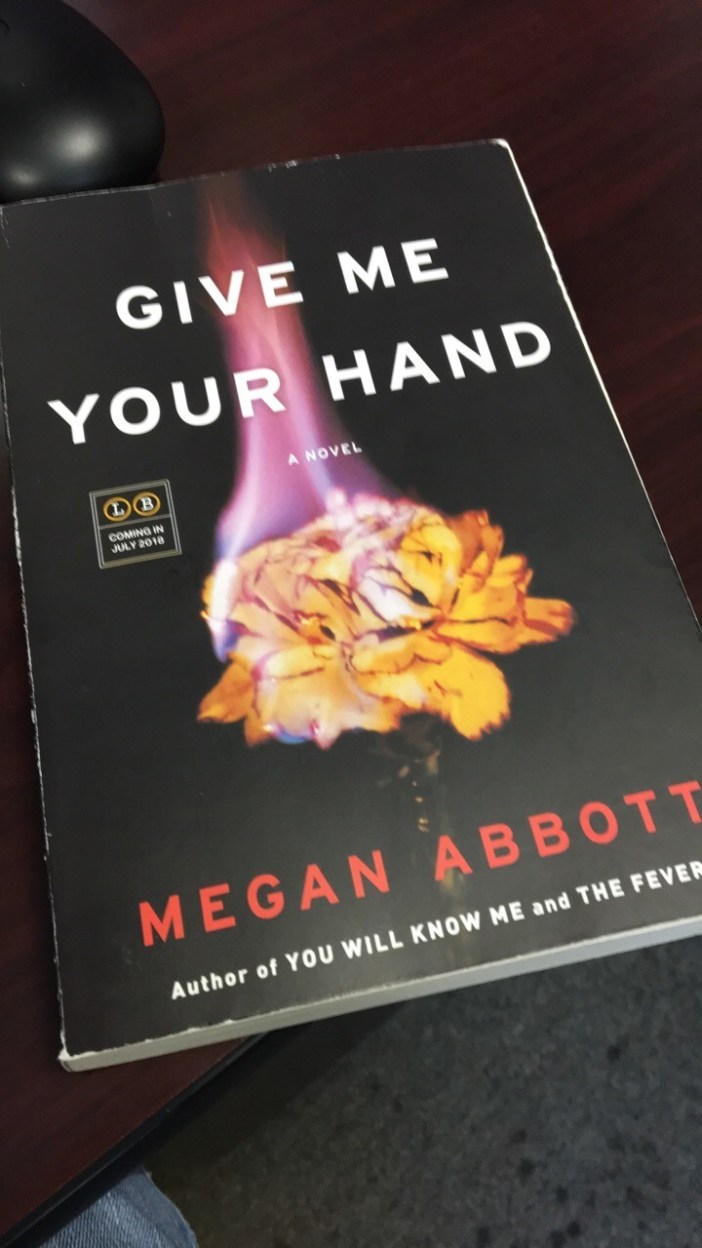
In other exciting news, I got an ARC of Megan Abbott’s forthcoming Give Me Your Hand in today’s mail, which has me thrilled to no end. I love her work; and she somehow manages to surpass herself with each successive novel, which is no easy trick. Now, to find the time to read it. I also have ARCs of Lori Roy’s new novel as well as Alex Segura’s, and I simply have got to find the time to read these books.
give me your hand

I know I’ve not been keeping up with the Short Story Project, but I have read a shit ton of stories already this year! I’ll get back to it, I promise, but I also think I’m going to proceed a little differently than I have been. I’ve been talking about every story I’ve read here, and I don’t think I am going to do that from now on; instead, I am only going to talk about ones that hit it out of the park for me. That may also mean I don’t post about newly read stories every day, but I think I would rather do this than try to find something to say about stories I didn’t care for as much as others; this ends up diluting the Short Story Project, and not allowing me the time nor the opportunity to delve as deeply into the stories I really enjoy.

And now, back to the spice mines. I only managed two thousand words yesterday; and as I said, I am behind. So, must make daily word counts!
A View to a Kill

God, yesterday.

Have you ever had one of those days where you took the morning off from your day job to drive out to the suburbs for an appointment with your eye doctor, only to arrive and find out that you don’t have an appointment after all–and the doctor isn’t even IN–and then after further investigation it turned out that when you called to make your appointment for March 2nd they made it for February 2nd? Yeah, that was how MY day started yesterday. So, I left with a new appointment for next Friday, which means taking ANOTHER morning off from work, and means I still don’t have my new contact lenses and my new glasses are still off somewhere in the future.

Honestly. It’s amazing there was no body count. Seriously. And, as always when something goes wrong in a day, everything else the rest of the day just seemed to go wrong, too. But today is going to be better.

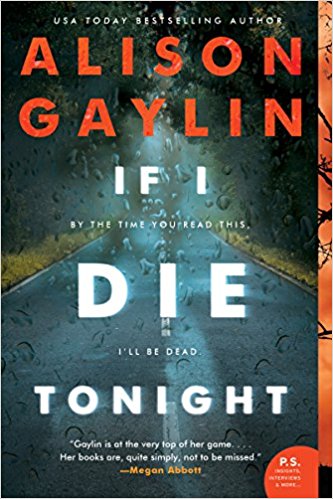
Speaking of better, Alison Gaylin’s new novel comes out this week, and if you haven’t already preordered it, you need to do so. RIGHT NOW.

51G2hiEFpEL._SX331_BO1,204,203,200_

From the Facebook page of Jacqueline Merrick Reed.

October 24 at 2:45 am

By the time you read this, I’ll be dead.

This isn’t Jackie. It’s her son Wade. She doesn’t know where I am. She doesn’t even know I can get on her FB page, so don’t ask her. This isn’t her fault. I am not her fault.

I am writing to tell my mom and Connor that I’m sorry. I never meant to hurt anyone. I wish I could tell you the truth of what happened, but it’s not my truth to tell. And anyway, it doesn’t matter. What matters, what I want you both to know, is that I love you. Don’t feel sad. Everything you did was the right thing to do. I’m sorry for those things I said to you, Connor. I didn’t mean any of it.

Alison Gaylin has been nominated for an Edgar Award three times: Best First Novel, Best Paperback Original, and Best Novel. (For the record, let it show there are many many horrible things I would do to be nominated once, let alone three times.) Her most recent novel, What Remains of Me, was a tour-de-force (Best Novel nominee), juggling two different time-lines as she told the story of two murders thirty years apart and yet connected. But somehow she has managed to surpass that novel with her latest, If I Die Tonight, which is powerful, compelling and beautifully written.

The book begins with the above Facebook post, which immediately pulls the reader into the story. Who is Wade? What is he talking about? Why is he going to kill himself? And from there, the book goes back to five days earlier, where the story truly begins. Jackie, mentioned in the post, is a single mother, estranged from her ex-husband and his current wife. The father of her two children has also pretty much abdicated any responsibility for his sons, other than the monthly check. Jackie is a realtor, and struggles to make ends meet. Her eldest son Wade is her primary worry: over the last few years he has withdrawn, become more insular, barely speaks to her. Friends don’t stop by to visit him or hang out, he doesn’t leave the house much. He is also no longer close to his younger brother, Connor. Jackie’s co-worker at the real estate agency is also her best friend; Wade used to be infatuated with her daughter but is no longer.

The peace and quiet of this little town in the Hudson Valley, Havenkill, is abruptly shattered in the early hours of a weekend morning when an attempted carjacking ends with a popular young athlete at the high school, Liam, hospitalized in critical condition; he and a friend came to the rescue of the woman being carjacked, but the car was stolen anyway and the comatose boy was run over. Who would do such a thing? The woman in the car is a one-hit wonder from the 80’s, Aimee En, and yet pieces of her story don’t make sense. What happened that night? And when Liam dies and it becomes a murder investigation, Jackie becomes increasingly more terrified that Wade was involved somehow.

Gaylin’s mastery of character is on full display in this novel; every character is real, believable, and alive. Even when they behave in ways that are either self-destructive or selfish, it makes sense and fits with the character; no one ever does anything that doesn’t make sense in order to advance the narrative. The plot is devilishly complex and layered, with twists and turns that make the truth almost impossible for the reader to ferret out. Gaylin makes you care for and understand every character, even if you don’t approve of what they’re doing.

But the heart of this novel, its true theme, is the relationships between parent and child. Jackie and Wade, police detective Pearl Maze and her estranged father, her co-worker Helen and her daughter–every step along the way Gaylin is examining those relationships: what goes wrong between them? Can distance, once it develops, be overcome? What is and isn’t acceptable for a parent to accept from their child in terms of behavior, and vice versa? How well can a parent know a child, and vice versa? What is enough space, and what is too much?

And every twist in this novel is earned, as it barrels along to its satisfying conclusion.

This is going to be one of the top books of the year; in fact, 2018 has–with Gaylin’s, Laura Lippman’s Sunburn, and Alafair Burke’s The Wife–already gotten off to an amazing start for crime fiction, and there’s a Megan Abbott coming this summer. If these women are indicative of how high the bar is being risen in crime fiction…it’s going to be a great year in our genre.

Let the Music Play

I had already decided to make January a theme month on the blog, and to once again make it Short Story Month, with the goal to read a short story every day. As such, I was looking around the shelves of the Lost Apartment for anthologies and single-author collections, and it occurred to me that I have a book at the office that would be absolutely pitch-perfect for this: The Best American Noir of the 20th Century, edited by James Ellroy and Otto Penzler. It’s a gorgeous volume; absolutely beautiful, and it’s also signed by Otto. I must have picked it up one year at the MWA Board event at the Mysterious Bookshop. But it literally is a time capsule of great noir stories, going back to 1923, and what better education in not only short stories, but noir, than to read this marvelous collection, one story at a time, day by day?

I’ve also ordered Lawrence Block’s latest anthology of crime stories inspired by pictures, Alive in Shape and Color.  I may have to extend Short Story Month to Short Story Quarter, and read a story a day until April. Which really isn’t a bad idea, frankly. This is also the period where I’ll be putting together Sunny Places Shady People, the St. Petersburg Bouchercon anthology, so reading short stories should be a priority, don’t you think?

I certainly do.

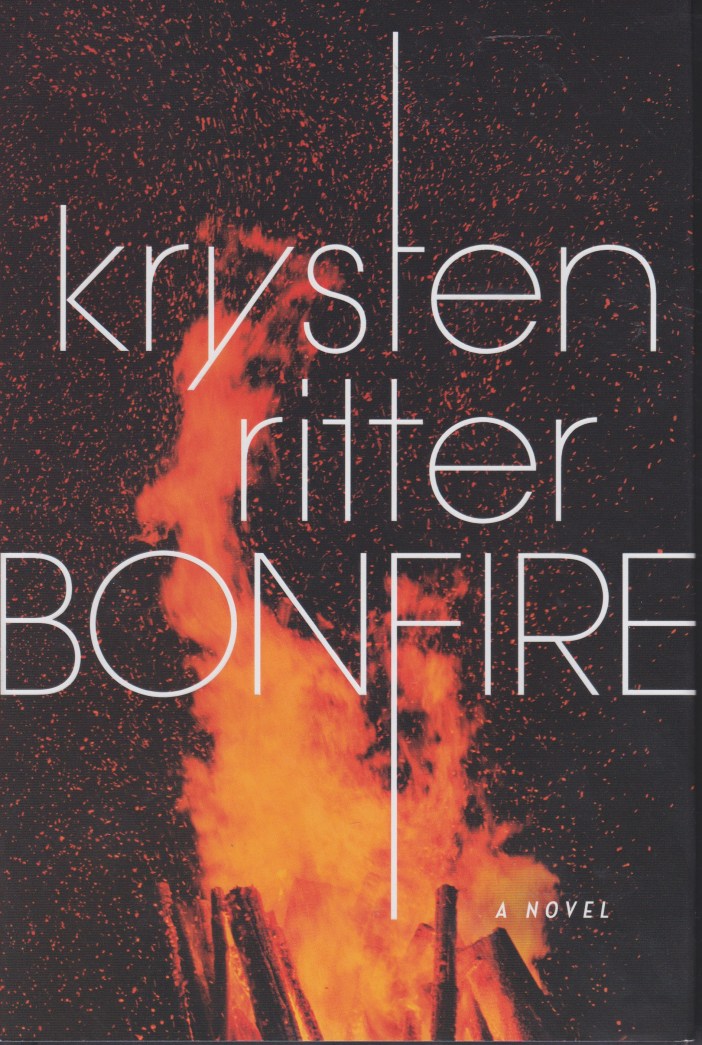
I also finished reading Krysten Ritter’s Bonfire last night–Paul was at a play.

bonfire'.jpeg

 State Highway 59 becomes Plantation Road two miles after the exit for Barrens. The old wooden sign is easy to miss, even among the colorless surroundings. For years now, on road trips from Chicago to New York, I’ve been able to pass on by without any anxiety. Hold my breath, count to five. Exhale. Leave Barrens safely behind, no old shadows running out of the dark woods to strangle me.

That’s a game I used to play as a kid. Whenever I would get scared or have to go down to the old backyard shed in the dark, as long as I held my breath, no monsters or ax murderers or deformed figures from horror movies would be able to get me. I would hold my breath and run full speed until my lungs were bursting and I was safe in the house with the door closed behind me. I even taught Kaycee this game back when we were kids, before we started hating each other.

It’s embarrassing, but I still do it. And the thing is, it works.

Most of the time.

Alone, locked in a gas station bathroom, I scrub my hands until the skin cracks and a tiny trickle of blood runs down the drain. It’s the third time I’ve washed my hands since I crossed the border into Indiana. In the dinged mirror over the sink, my face looks pale and warped, and the memories of Barrens bloom again like toxic flowers.

This was a bad idea.

The trauma that is high school is something that many of us apparently never get over, and it’s certainly becoming a crime fiction trope. But this isn’t a bad thing. As I said, almost all of us have traumatic memories of high school, and therefore can relate to the characters and the stories in these types of books. Hell, I’ve drawn from my own high school traumas enough times in my own work to recognize it as a trope of my own (Sara, Lake Thirteen, and both Chanse and Scotty have moments of reflection on their own past that are directly drawn from mine).

Bonfire is a compelling read, and very well written. Abby Williams, our main character who is telling the story in a first-person point of view, fled her hometown of Barrens after a traumatic childhood that included the painful death of her mother from cancer, her father’s religious mania and the resultant brutal parenting that came from it, being not popular, and having her best, childhood friend, Kaycee Mitchell, turn on her and terrorize her with a group of mean girl new friends. But towards the end of their senior year, Kaycee and her friends all became ill–with very odd and strange symptoms. It turned out they were faking it, and Kaycee disappeared. Now, there are some complaints about the factory near town, Optimal Plastics, that has revitalized the dying town but may possibly be poisoning it. Abby, now an environmental lawyer for a non-profit firm that handles such cases, is leading the investigative team and thus has to come back to Barrens to not only run this investigation but deal with her own demons. But are her theories and investigation tainted by her past, and her relationships with people from when she as a child? And why is she so obsessed with the missing Kaycee–whatever happened to her? Was she really faking it, or were the girls really sick? And what the hell is going on in Barrens?

Obviously, the sickness of the girls reminded me a lot of Megan Abbott’s brilliant The Fever from a few years ago; which was based on an actual case. And Ritter’s debut novel is crisply written, with a powerful sense of scene, character and plot that continues to build until it comes to its conclusion. I really enjoyed the book tremendously, and resented not having the time to actually sit down and read it through; I did manage to do so last night while Paul was at a play. It’s probably one of my favorite reads from the year, and I highly recommend it. Well done, Ms. Ritter.

And now back to the spice mines.

The Warrior

Yesterday I wrote approximately 3300 words of a short story that is due by the end of the month, and I am rather pleased with how it’s going, if I might be so bold. It flowed rather easily from my keyboard also; I’m hoping that mojo will still be there as I try to finish the draft today. It’s dark–when are my stories anything but dark, really–but I am very happy it’s getting close to completion in this draft. I would love to have it finished so I can spend my weekend revising and editing this and another short story I finished in a first draft recently.

I also mapped out a young adult novel over the weekend I’ve been wanting to write for years. I originally wrote it as a short story back in the 1980’s, calling it “Ruins”; I’ve always thought it would make a really good y/a novel if I could figure out how to deal with some societal and cultural issues with it which really couldn’t be ignored. And then I realized, this weekend, that the best way to deal with them is to face them head on. It will get criticized, of course, and I may even get called out, but you can’t not write something because you’re afraid of repercussions, can you? And hope that good discussion comes from it.

Then again, it could just come and go without notice. That happens, too.

This year has mostly been, for me at least, a struggle to write. I’m not sure what has caused this for me; the year had some remarkable highs–the Macavity Award nomination; the Anthony Award win–but for the most part it’s been a struggle with self-doubt and it’s horrible twin sister, depression. I don’t know why this happens to me; I always find that writing–even if I have to force myself to do it–always makes me feel better, even if the work isn’t going particularly well. Sinking my teeth into a story, feeling the characters come to life in my mind and through my keyboard, always seems to make me feel better. I also can use the writing as a way to channel things that upset or bother me; writing is an excellent way to channel anger and rage and heartbreak and every other emotion under the sun. But as this bedeviled year draws to a close, I am feeling creative and productive again; and most importantly, driven.

Then again, tomorrow I could feel like crap and be all ‘why bother’ again.

This is why writers drink.

I’m also really enjoying Krysten Ritter’s Bonfire, even as it is reminding me of Megan Abbott’s The Fever. There are some similarities; although in Abbott’s novel the mysterious illness in the girls is current and in Ritter’s it’s in the past. But it’s very wwell written, and there is some diversity of representation in her characters. It also reminds me a little of Lori Rader-Day’s Little Pretty Things, with it’s small town Indiana setting and it’s strange story from the past. (If you’ve not read Abbott or Rader-Day, buy their books NOW. You’re in for a magnificent treat!) The book also makes me think of my own Kansas past…and book ideas I have that mine that past. Reading good books always inspires me…and that really is the ultimate compliment I can give Ritter’s book. It’s inspiring me.

And that’s terrific.

And now, back to the spice mines.

Patrick-McGrath-90s-Inspired-Shoot-005

Straight from the Heart

Well, I tried to make pho last night and it was an absolute disaster. Heavy sigh. But hey, you gotta try sometimes, right? I’m not entirely sure what I did wrong–but it tasted terrible, and I overcooked the noodles, and yes, Gregalicious does have the occasional epic fail in the kitchen. I shall try again another time, of course, but I am certain it will most likely be a really long time before I try again. It was so disappointing, and I really wanted some pho last night. Ah, well.

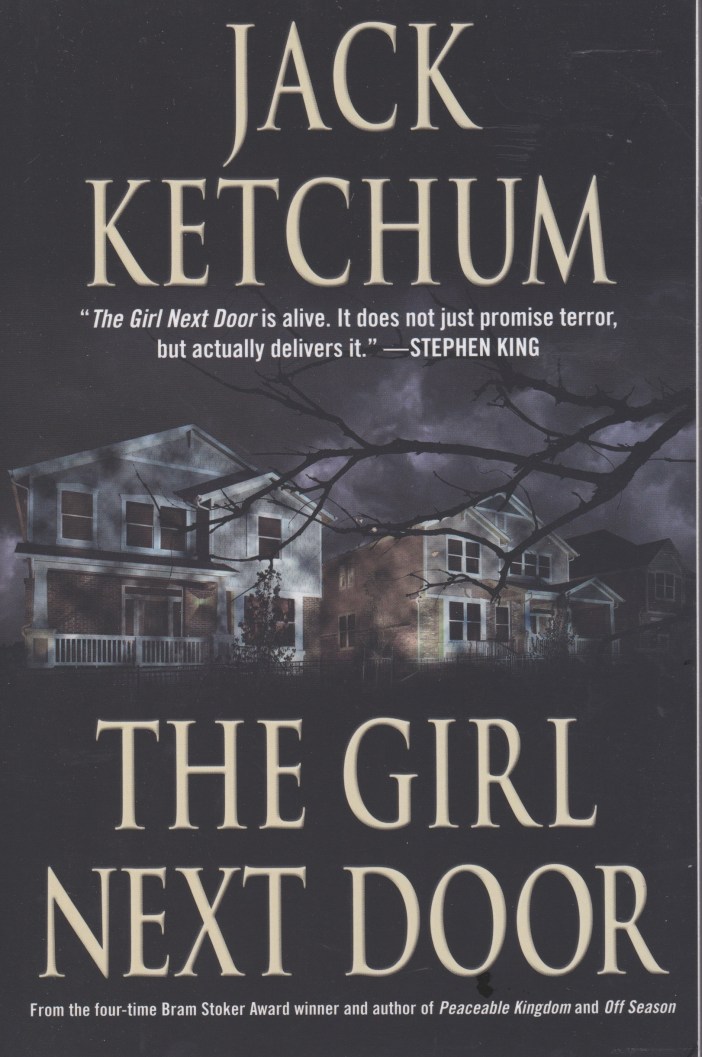
Paul went to see a local play production last night, so I was left to my own devices. After I trashed the pho, I went on to make tacos–always so reliable–and sat in my easy chair and finished reading Jack Ketchum’s The Girl Next Door.

Well, THAT was disturbing.

the girl next door

You think you know about pain?

Ask my second wife. She does. Or she thinks she does.

She says that once when she was nineteen or twenty she got between a couple of cats fighting–her own and a neighbor’s–and one of them went at her, climbed her like a tree, tore gashes out of her things and breasts and belly that you can still see today, scared her so badly she fell back against her mother’s turn-of-the-century Hoosier, breaking her best ceramic pie plate and scraping six inches of skin off her ribs while the cat made its way back down her again, all tooth and claw and spitting fury. Thirty-six stitches I think she said she got. And a fever that lasted days.

My second wife says that’s pain.

She doesn’t know shit, that woman.

That’s a pretty amazing image for the start of a book, don’t you think?

I was on a panel with the divine Megan Abbott several years ago where she mentioned that the suburbs are incredibly noir; I’d never really thought of it that way before, but I soon realized she was absolutely right (as she so frequently is). One of the major disconnects in our culture and our society is our idealization of children and childhood; as well as the time when children are at the in-between stage between childhood and adulthood, hormones raging and passions and emotions are their height; she has explored this beautifully in novels like The End of Everything and Dare Me. Stephen King writes beautifully about children; idealizing the innocence of childhood against the very real terrors that exist in that time; nowhere is this more evident than in his novel It. That idealized world is partly because of 1950’s sitcoms like Father Knows Best and Make Room for Daddy; a sanitized, unreal world that everyone seems to look back on and thinks was real–when it was anything but.

Jack Ketchum’s The Girl Next Door is also set in that time; 1958, to be exact, in a small suburb/town in New Jersey, a tranquil world of fairs and carnivals and playing pick-up games of baseball in the park; of trying to catch crayfish in the creek and beginning to wonder about the way your body is changing. But this ‘idyllic’ world has some dark edges–there’s a sociopathic bully up the street, beaten by his alcoholic father who also beats his mother and sister; and the three boys next door don’t seem quite right in the head, either. Their single mother, Ruth, is the “cool mom” of the neighborhood, who lets the kids drink beer and smoke in her presence. The death of her brother and his wife brings two more kids–girls–into her home, Meg and Susan. And then the dynamic begins to change…and Ruth’s own sociopathy begins to reveal itself…and soon Meg is tied up and being tortured in the basement…and the other kids in the neighborhood also soon are slowly drawn into the terrifying game in the basement.

And the main character, whose first person POV this is told in, is not exactly innocent. Told in reminiscence; looking back on what happened as an adult, exploring why he didn’t blow the lid off what was going on and how he himself got roped into helping in the torment, is as terrifying as what is going on. The descent of these kids into monsters, how easy it is for that thin line between being decent and moral as opposed to criminal and animalistic to be crossed is what truly makes this horrifying. The fact that it is based on a true story makes it even worse…because this may be fiction, but things like this happen in the real world. Every day.

And it is written beautifully; Ketchum is a great writer, knowing how to build suspense and unease, able to use words and construct sentences and paragraphs to create a chilling mood; and you keep turning the pages not only to find out how the story is going to resolve itself–obviously, it has to–but to see how the main character, Danny,  resolves his own inner conflict about what’s going on…and it is clear, just from the way the story is told, that adult Danny is still damaged by what happened, what he witnessed, what he was involved in.

The book is classified as horror, but it’s more suburban noir than anything else.

It’s also a pretty chilling indictment of how powerless children are.

And now, back to the spice mines.

Hungry Like the Wolf

Ah, Thursday. I am very tired this morning; my sleep last night was restless and of course, after a long day yesterday (twelve hours), which included bar testing and all the walking that entails, I am very low energy this morning. I didn’t get much writing done yesterday morning; I am still in the midst of Chapter Two of the new Scotty but part of that problem is trying to make sure I have the voice and tone right–which is, of course, ridiculous; it can always be fixed in a later draft. I need to plow through this first draft and get the story done. Everything else can be repaired later.

Why do I always try to make it right the first time? So stupid. How many books have I written? Some people seriously never learn, you know what I mean?

The line edit continues as well, and is beginning to feel like my own personal invasion of Afghanistan; an endless quagmire I’m never going to get out from under. I still want to have it all finished by the end of the month and the clock is seriously ticking. Heavy heaving sigh.

The lovely thing is I have a three day weekend to look forward to; my birthday is this weekend and as such, I took Monday off as a treat for myself. We’re going to go see Dunkirk Saturday evening, and have a lovely dinner out afterwards. I also hope to be able to use the extra time off to get some work done and do some reading; I want to get the Ambler novel read this weekend so I can reread Dorothy B. Hughes’ sublime In a Lonely Place in its new edition with an afterward by the sublime Megan Abbott. I read it several years ago on the recommendation of Megan, Margery Flax and the wonderful Sarah Weinman, and I became a huge fan of Hughes as a result. I went on to read everything she’d written that was still in print, and started hunting down used copies of the rest on eBay and second hand booksellers on-line. If you’ve not read Hughes and are a fan of crime fiction, you really should read In a Lonely Place. You owe it to yourself to read it.

The film, while different from the book, is also extraordinary. You can’t go wrong with Humphrey Bogart and Gloria Grahame.

All right I need to hit the spice mines. Your Throwback Thursday hunk is actor/model Ed Fury.

IMG_2419

Never Gonna Let You Go

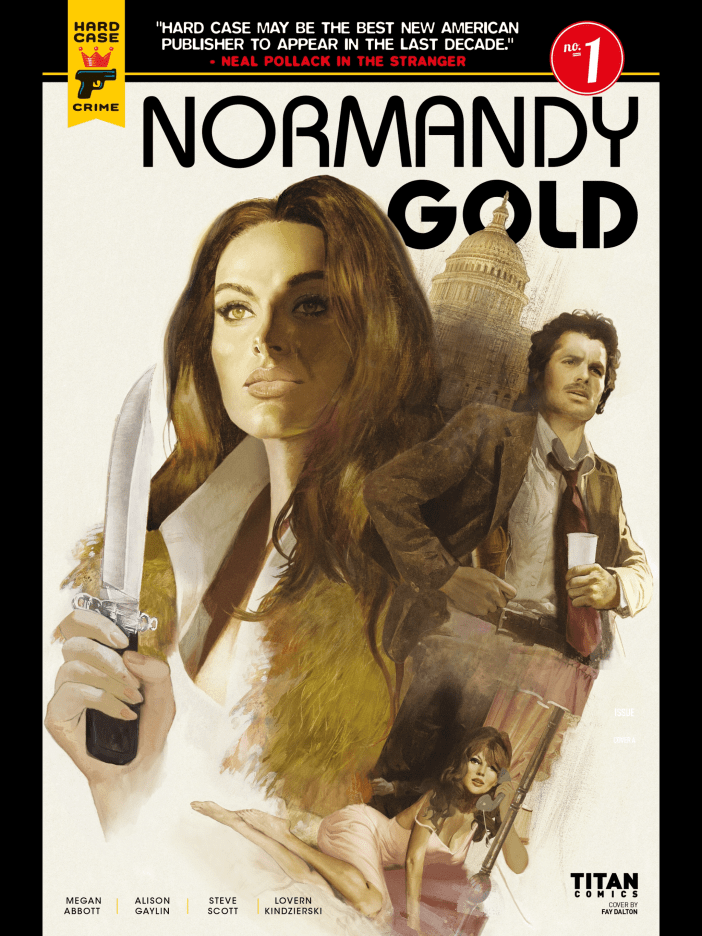
Have you read the comic book co-written by Megan Abbott and Alison Gaylin, Normandy Gold?

IMG_1772

It will come as no surprise that its fantastic. Megan Abbott and Alison Gaylin are two of the best crime writers of our Golden Age of women crime writers.

One of the things that can get confusing with crime fiction is the subgenres and the sometimes slight distinctions between them; take hard-boiled vs. noir as an example. I think the confusion comes because a hard-boiled crime novel, when made into a film, can fit into the film noir category, which is a bit broader than the genre definitions crime novels can use and books can fall into; for example, The Maltese Falcon and The Big Sleep are hard-boiled detective novels; the films, however, are classic film noir. (Your mileage may vary; I am speaking only for myself and how I classify books.) For me, a detective novel that is dark and brooding and cynical in nature is hard-boiled, Sue Grafton and Sara Paretsky’s novels, for me, fall into this category, as do Hammett’s detective fiction and Chandler’s. James M. Cain’s novels were noir, as are Megan Abbott’s. Alison Gaylin’s detective novels are more hard-boiled; her stand alone novels are more noir. For me, a noir novel doesn’t have a professional investigator as the main character; those are hard-boiled.

Charles Ardai’s Hard Case Crime line of novels contains both noir and hard-boiled fiction; the team-up of Gaylin and Abbott with the graphic serial novel Normandy Gold is a fine addition to Hard Case, and one of the best comics/graphic novels I’ve come across in a long while. As I read the first issue on my iPad, all I could think was how glorious this is; excellent, crisp dialogue and incredible storytelling, along with some amazing artwork. If there are awards for graphic novels, just start sending them along to the team that produced this now!

Normandy Gold firmly straddles the line between noir and hard-boiled with guns blazing. Set in the 1970’s, Normandy is a small town sheriff in rural Oregon. Her mother was a prostitute, and she ran away when she was a teen to try to find a better life for herself, leaving her younger sister behind. One day she gets a call from her sister, and is still on the line with her as her sister is murdered. Normandy comes to Washington DC to find out what she can about her sister’s death; the cops have written it off as just another dead whore no one cares about and unsolvable. But Normandy also finds out her sister wasn’t just a prostitute; she worked for a very elite, high level escort service, and decides to go undercover to find what happened to her sister.

This typical-sounding set-up comes alive in the hands of two master storytellers, and the art itself is stunningly beautiful. The story moves very quickly, and the 1970’s setting is perfectly done; not a false note in the entire first issue. This is the kind of story that, as a film in the 1970’s, would have earned a star like Jane Fonda or Ellen Burstyn or Ann-Margret an Oscar nomination, if not the statue itself. Vividly realized, you keep turning the pages to see what happens next…and when you get to the end of the issue, you’re sorry it’s done but can’t wait to read the next.

Highly recommended.


Sunday Morning Coming Down

Summer humidity finally arrived yesterday in all of its noxious glory. This morning, there is rain in the forecast for most of the day and my windows are covered on condensation. I slept very well last night, and also got most of my weekend chores done yesterday so today I can devote myself to writing, revising, and editing. It’s very lovely, you know, to wake up feeling rested. I think there’s another load of dishes that need to be run through the dishwasher, but other than that (and straightening up) I have my entire day free. I am trying to decide what novel to read next, and am leaning towards Viet Thanh Nguyen’s The Sympathizer, but there are also some other books in the running. I’ll make up my mind at some point later today when I need to take a break from writing/revising/editing.

Last night, I did read Megan Abbott’s brilliant short story, “Girlie Show,” from Lawrence Block’s In Light or In Shadow. As always with Abbott, I was immediately drawn into the story; her remarkable gift for choosing just the right words, and for coming up with new, extraordinary word choices to describe something that create the picture in your head perfectly. She is also a very spare writer, able to do things with a five or six word sentence that other writers would need a lengthy paragraph to get across. The book itself is gorgeous, with reproductions of the Hopper paintings that inspired the writers. It’s also an incredibly impressive list of name authors–everyone from Block himself to Stephen King to Lee Child to Joyce Carol Oates to Jeffrey Deaver to Abbott herself; it is actually an incredible honor to be nominated in the same Anthony category as this book, frankly.

But back to Abbott’s story.

“She went udders out.”

“No pasties even?”

“Like a pair of traffic lights.”

Pauline hears them on the porch. Bud is telling her husband about a trip to New York City a few years ago. Going to the Casino de Paree.

Her husband says almost nothing, smoking cigarette after cigarette and making sure always has a Blatz in hand from the metal cooler beside him.

“Nipples like strawberries,” Bud is saying. “But she never took off her G-string. And she never spread her legs.”

The story is a return to period pieces, stories set in our more societally repressed past, like her early novels The Song Is You, Bury Me Deep, and Queenpin. I love her more recent novels, that are set in the present day, but no one writes period pieces quite as beautifully as she does. I’ve tried writing period stories, but am incredibly terrible at them, and I envy the ease with which Abbott spins her tales. She gets to the heart of her characters is such minimal yet insightful and clever ways; almost like she is tossing off a sentence so casually that at first it seems to just be another sentence, but there is so much truth and meaning contained within those few words that the reader gets an almost complete picture of who that character is…kind of like the story of Bette Davis, trying to understand her character Margo in All About Eve, and asking writer/director Joseph Mankieowicz for some insight. Davis later recalled, “He just shrugged and said ‘Margo is the kind of woman who treats a mink coat like a poncho,’ and I immediately knew exactly who she was.”

Abbott has that ability, and it’s always a pleasure to get lost in the richness of her words, the textures and layers of her stories.

And isn’t it way past time for a collection of her short stories? Just sayin’.

As I head back into the spice mines, I shall leave you with a Sunday hunk.

17991425_10155374829879274_490566174030675529_o

Another Saturday Night

Well, it’s early afternoon in New Orleans. I’ve done my workout, run errands for both myself and Paul–including the always dreaded grocery run–and now am home, a bit worn out and needing to hop in the shower. The humidity is thick out there today, so thick I’ve already had to take a Claritin-D, and my kitchen is a mess and I have lots of laundry to do. I don’t think I’m going to do any writing today–my brain is tired; that may change later, one never knows–but I think I am going to just spend the rest of the day relaxing, reading, and slowly but surely getting the apartment straightened up and cleaned up and organized; the never-ending struggle not to live in a slovenly dump. Heavy heaving sigh. I also want to get back to reading About the Author, and select what I am going to read next (although I suspect, having gotten two anthologies in the mail–Storm Warning: Chesapeake Crimes and In Sunlight or In Shadow: Stories Inspired by the Paintings of Edward HopperI may just curl up with some exceptional short stories.

Stranger things have happened.

We got all caught up last night on both The Handmaid’s Tale (which continues to be incredibly gripping while horrifying) and The Mick, which is a truly demented sitcom we are enjoying tremendously. I’m not sure what we are going to watch tonight–we’ve started watching the new season of American Crime, which seems to be about migrant worker, sex trafficking, and the opiod addiction crisis, and it really looks really gripping and good; I am really sorry the show has been cancelled. We never did watch the first season, so we can also always go back and watch it, but it’s a shame. Then again, a highly intelligent show about crime that shows the same crime from many different perspectives, with all the necessary nuance and complexity, without clear cut villains and heroes–well, it was bound to not last long.

Okay, some time has passed, and I indeed curled up in my easy chair with About the Author, and finished it. It’s terrific, full of twists and turns and surprises; and the author, John Colapinto, did a most excellent job of making an extremely unlikable protagonist, well, likable. I can highly recommend it; it still holds up, even though it is nearly twenty years old–obviously, technology has moved on–but other than that, it is so well done and so well told that you don’t really notice that sort of thing. Most, most excellent. I am currently grilling hamburgers while reading Megan Abbott’s story, “Girlie Show”, in Lawrence Block’s Edward Hopper anthology; it is, thus far, quite sublime.

And now, I need to go flip the burgers.

Here’s a Saturday hunk for you.

IMG_2120 (1)

The Winner Takes It All

I wrote over three hundred thousand words’ worth of novels last year.

That is only the final word counts on the books I wrote last year. That doesn’t count any words written and discarded; essays; this blog; short stories; or even emails.

I realized this yesterday afternoon when I got home from work; I walked into the Lost Apartment and saw that the scaffolding was finally down (I’d forgotten how much space there actually is in the living room; no worries, it still needs to be painted though); this startled me so much that I just put the groceries away and decided to sit down and read for a while. I still haven’t finished reading the Pelecanos novel; not that it isn’t good–it most definitely is–but I am trying to read a short story a day and that, of course, has cut into my reading time. I plan to finish reading that this weekend, though–it’s not one of the books I am taking on vacation with me so it must be finished before I go.

But realizing that last year I probably wrote close to half a million words (at least) was a bit of a shock; one that I am still reeling from this morning.

So, when it was time to retire to my easy chair, I looked at the pile of anthologies, single author collections, and magazines for my short story reading…and had that weird feeling of…well, nothing there moved me. The only thing I wanted to read was another story from Laura Lippman’s Hardly Knew Her, and having just done one of her stories I wasn’t sure that I should do another. I looked through my bookcases and a book I’d forgotten about’s spine screamed at me from the shelf: The Best American Mystery Stories 2014, edited by Laura Lippman. I grabbed it and retired to my chair, opened it up…and giggled.

The first story was by Megan Abbott.

As I curled up and started to read, I smiled to myself in cat-like satisfaction. Abbott AND Lippman, I thought to myself as I started to read, does life get better than this?

The story was originally published in the Dangerous Women Volume One anthology, edited by George R. R.Martin and Gardner Dozoir in 2014.

He waited in the car. He had parked under one of the big banks of lights. No one wanted to park there. He could guess why. Three vehicles over, he saw a woman’s back pressed against a window, her hair shaking. Once, she turned her head and he almost saw her face, the blue of her teeth as she smiled.

Fifteen minutes went by before Lorie came stumbling across the parking lot, heels clacking.

He had been working late and didn’t even know she wasn’t home until he got there. When she finally picked up her cell, she told him where she was, a bar he’d never heard of, a part of town he didn’t know.

“I just wanted some noise and people,” she had explained. “I didn’t mean anything.”

He asked if she wanted him to come get her.

“Okay,” she said.

On the ride home, she was doing the laughing-crying thing she’d been doing lately. He wanted to help her but didn’t know how. It reminded him of the kind of girls he used to date in high school. The ones who wrote in ink all over their hands and cut themselves in the bathroom stalls at school.

Almost everyone who writes novels about crime–well, probably every author, my familiarity runs to crime writers–always get asked in interviews where they get their ideas from. I can’t speak for other crime writers, but I know I often get inspired by the news. I’ll see a story, either in the paper, on-line, or on the news, and will think to myself, “Hmmm. I wonder what really is going on there?” True crime is often much more twisty and fascinating than actual fictional crime. I sometimes do think that I read crime, and write about it, in order to understand it better, make some sort of sense out of it because MY mind doesn’t work that way. Who are these people, where did they come from, what made them the way they are?

Megan Abbott’s wonderful story from this collection, “My Heart is Either Broken”, is about a Casey Anthony-type mother whose daughter is stolen from her from a coffee shop. She asked a stranger to watch the little girl while she ran to the bathroom; when she came back the stranger and her daughter were gone. No one believes that she didn’t kill and dispose of her child; her behavior doesn’t seem normal for a grieving mother, nor does she seem to particularly miss the child that much–at least in the public eye. She is one of those people–I’m one of them–who reacts to stress or tension or nervousness by smiling; which of course gets her reamed in the court of public opinion and in the press. The story is told from the point of view of her husband, the baby’s father…who wants to believe his wife, desperately wants to believe the woman he married couldn’t have killed their child…but the mounting evidence is making him doubt her, and hate himself for doing so. The story is genius, really; in conception and execution. The end is a real punch in the mouth, too.

And where is the single-author collection of Megan Abbott short stories?

And now, back to the spice mines.