Rockin’ Around the Christmas Tree

It just doesn’t feel like Christmas until I’ve read this year’s new Donna Andrews Christmas murder mystery, and spend a little time in my favorite small town in North America, Caerphilly, Virginia. It’s a marvelous place, where everyone (or most everyone) is kind, everyone goes out of their way to help people who need it without a second thought, where all the churches get along and collaborate, and there’s even a small college. I always, always, always love every chance I get to go back there and visit–and I even put aside my utter disdain and hatred for cold weather and snow when it comes to Caerphilly Christmases. I’m not sure (without actually counting) how many Meg Langslow Christmas mysteries there have been so far, but Andrews always manages to come up with something charming, fresh, and new every year, and I always get excited when I see the announcement of the pub date for the new Christmas book, and the preorder is an absolute no brainer.

“You can still change your mind, you know.”

I closed my eyes and counted to ten. Then I opened them again. I crawled out from under the rough-hewn medieval-style trestle table I’d been repairing and looked up. Alec Franzetti was staring down at me with a pleading expression on his broad, bearded face. both of his enormous, hairy hands were clutching a clipboard that held an untidy, inch-thick sheaf of paper. He gripped it tightly enough to turn his knuckles white. He looked so stressed that the temptation to snap at him vanished. I made sure my tone was gentle. Gentle, but firm.

“No, Alec,” I said. “I’m very happy doing what I’m doing.”

His face fell, and he sighed loudly.

“Is there anything I can help you with?” I stood up and gestured at the clipboard.

“Probably.” He flipped through a couple of the top papers. “Let me think.”

He glanced down at the clipboard, then wandered off, looking distracted and lost.

“Change your mind about what?” came a voice from behind me.

I jumped at the sound. Alec’s anxiety was rubbing off on me. I turned and smiled when I saw my old friend Caroline Willner.

As I said, others may think it’s not Christmas until it snows, or they’ve seen Frosty or It’s a Wonderful Life or Rudolph or A Charlie Brown Christmas, but for me it’s not Christmas until I’ve read the new Meg Langslow Christmas mystery. Caerphilly is one of my favorite fictional places, and Meg’s enormous network of friends and family never ceases to amaze me every time I dive into the pages of one of her books. What an absolutely marvelous place it is, where everyone is welcomed and everyone is treated fairly and even the little feuds that inevitably spring up between people are gently amusing. Caerphilly is a popular tourist destination, especially at Christmas; Meg’s husband does an annual one-man show reading A Christmas Carol, and even when something goes awry and someone gets murdered–every year–everything is usually handled in time for everyone to have a delightful, and love-filled holiday. The books always make me feel warm inside, and every time I close the book when I’ve finished, I smile, enormously pleased and satisfied. Somehow, Andrews has the magic touch of how to make people feel warm and happy about the holidays, without becoming treacly, melodramatic, or overly sentimental.

This year round, there’s a competition reality show filming in Caerphilly, out at the local retired heavy metal rock star’s (Ragnar Ragnarson) goth castle–Blades of Glory–and Meg is resisting being cast so they have a woman blacksmith in the competition. (Distinction, pointed out early: the show is actually about blade smithing, making weapons, which is an entirely different skillset from black smithing. A blacksmith can make blades, but can also make other things. A bladesmith specializes, obviously, in making weapons–knives, daggers, swords, etc.) Meg’s mentor and trainer, Faulk, is competing in the show–but when he is attacked from behind on the castle grounds with a baseball bat, his arm broken–Meg agrees to take his place, but only when she finds out Faulk has invested money in the show and the show falling apart could ruin him and his partner. Who could have attacked Faulk? Someone in the crew of the show, or one of the other competitors? Then there are shenanigans during the filming of the first competition being filmed; one of the contestants sabotages the others, but Meg has proof on film; she became suspicious when her forge was set at the wrong temperature, so had mini-cameras set up to record, and she has the culprit red-handed. Later on that same night, he is murdered–and the case is off and running.

This book was an absolute delight. I laughed aloud several times, and yes, sighed in satisfaction when I closed it after reading the last page.

But now I have to wait until August of next year for the next book to come out so I can visit again.

Seriously, folks, you need to read this series. I can’t rave enough about it.

I Know There’s Something Going On

I love cozy mysteries.

I do, and while they may not make up the majority of my reading pile, it’s always a joy to find a new cozy series I enjoy. One of my favorite mysteries of all time, James Anderson’s The Affair of the Blood-Stained Egg Cosy, is definitely a cozy mystery–a house party murder, with secret passages and international espionage and a jewel thief–and is LONG overdue for a prestige mini-series, preferably by either Acorn or Britbox. (I should reread that book; it’s been a hot minute) I don’t think cozies and their writers are given the respect they deserve, ever–rarely do you see a cozy on a Best of the Year list or making the short-list for awards (besides the Agathas), and I’ve heard crime writers slag off the sub-genre, way more times than I would prefer. Anyone who thinks a cozy is lesser or somehow “easier” to write than any other kind of crime novel is more than welcome to give writing one a try. It’s always amusing to me to see the hypocrisy of crime writers whining that literary writers don’t take them seriously…and then in their next breath go on to mock cozy writers. (I did have a wonderful “gotcha” moment with a straight white male mystery writer once; he was complaining about how crime fiction isn’t considered literature, and later on in the same conversation he made a snide remark about cozy writers…and boy did he stumble for words when I replied, “So when lit writers treat you like a cozy writer you don’t like it?” He won’t talk smack about cozies in MY presence again…)

Anyway, I digress. One of my favorite series of all time is the Meg Langslow series by Donna Andrews, and we are on book thirty-three now, with thirty-four on my chair sidetable, halfway finished reading, and Book 35 available for preorder already.

That is a pretty impressive track record, and career. If I wrote a Scotty per year from now on, it would take me until I am eighty-eight to get to book 35. YIKES.

“This is the life,” I said, as I wriggled into an even more comfortable position in the hammock.

I wasn’t talking to anyone in particular. As far as I knew, there was no one within earshot. But just in case there was, I was going to do my best to look–and sound–like someone who was deeply contented and should not be disturbed for anything short of an actual emergency. Although the people most apt to – me were safely occupied elsewhere–Michael, my husband, was teaching his Friday classes at Caerphilly College, and my twin sons, Jamie and Josh, were at school until three.

My-notebook-that-tells-me-when-to-breathe, as I called my comprehensive to-do list and calendar, was nearby, but I’d already checked, and nothing in its pages had to be done right now. For the next hour I was on hammock time. I could read. I could put on my headphones and listen to some music. Or I could just lie here and enjoy the balmy May weather, the masses of blooms in our flower beds, and the fascinating aerial ballet of hummingbirds darting to and from the nearby feeder.

The hummingbirds. I sat up with a frown. The last time I’d found the time to watch them, there had been half a doxen of them, impossibly small, their iridescent jewel-toned bodies sparking in the sunshine as they paused, sipped, and darted away. Now there was onlyone, flitting around the feeder. And he didn’t seem to be feeding–just darting about.

And that title is a gem.

The entire series has bird-puns for titles, which is amazingly hard to do, and if you don’t think so–try coming up with thirty-three bird pun titles for crime novels without looking at Donna’s backlist. I suggested one to her many years ago that I keep hoping she’ll use–but she hasn’t yet, and I despair my bird pun title will ever make it into her canon.

I do feel that I also should, in the interest of full disclosure, let you know that Donna Andrews is not only one of my favorite writers but one of my favorite people in this business. We first met years ago when we were both on the MWA board (she was on The Good, the Bad, and the Emus back then), and I found her to be intelligent, kind, charming and funny. That was when I started reading her, and what a joy this series has been for me all these years. Donna’s books, to me, are the perfect example of why this sub-genre (amateur sleuth, no blood or sex or violence–at least not much, and little to no swearing) is called “cozy”–because that’s how reading one of her books makes me feel, cozy. Honestly, there’s nothing better than curling in my easy chair with a blanket, a purring kitty in my lap, as I revisit my friends in Caerphilly again.

Because she writes so well it seems like a real place, one that I am happy to escape my life into twice a year.

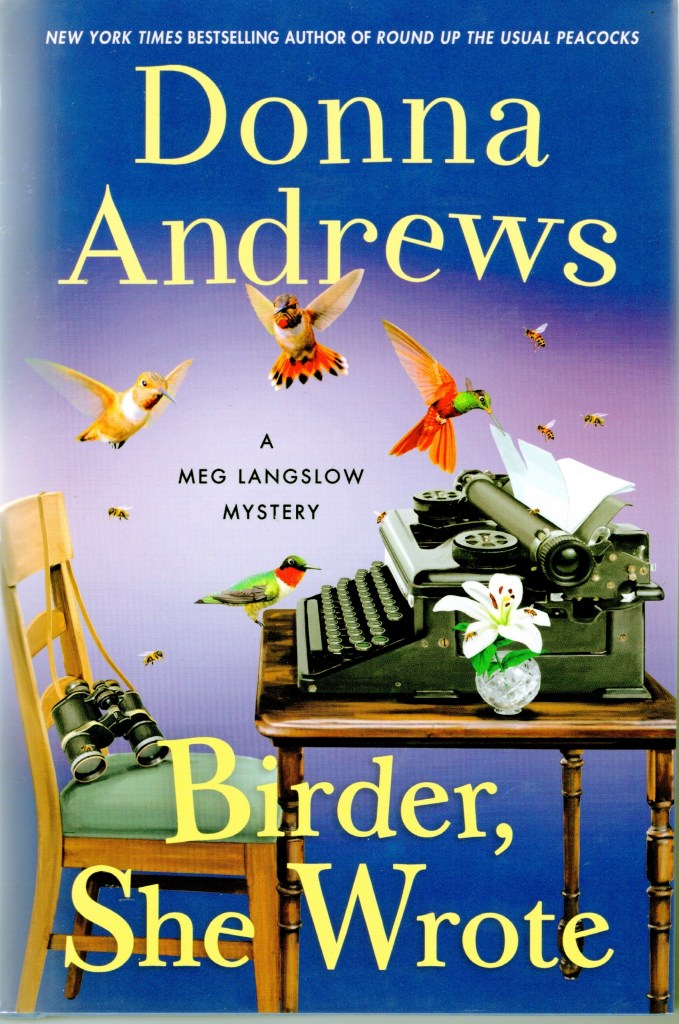
I could talk about this series all day, I love it and the characters so much. Caerphilly reminds me a lot of Schitt’s Creek and Ted Lasso–ensemble casts in places where everyone is kind and looks out for one another, but also doesn’t interfere and lets you make and learn from your own mistakes. This time out, Donna has added a new McMansion style neighborhood to the town, Westlake, with people retiring from major cities to the “rustic” charms of Caerphilly–only to complain incessantly about those very rustic charms to begin with–and beekeeper Edgar is square in their sites, his hives just across a small stream from their backyards. Meg calls them the NIMBYs (not in my backyard), and I think we’ve all encountered these types (which is why dumps and toxic waste always ends up around poorer communities). Someone has poisoned all of Edgar’s bees–and Meg agrees to look into who could have done something so heinous. But while looking for an old African American cemetery, Meg and her friends not only find the cemetery deep in the woods, but they also find the dead body of one of the worst of the NIMBYs, and the game is afoot.

The sadness at finishing the book was derailed by knowing this year’s Christmas Meg murder mystery was already in my TBR pile, which I immediately started reading when I finished Birder She Wrote. Don’t be daunted by the massive backlist, either–if you’ve not read any of these books, you can start anywhere and then work your way through the series; there are never any spoilers other than those from Meg’s personal life–and frankly, I don’t mind those kinds of spoilers, because its fun to go back and see how she met her husband, when they got married, the twins, etc.

Hey Apple TV–this series is a natural for y’all.

Jingle Bells

You really can never go wrong with Donna Andrews.

There aren’t many authors who’ve written as many novels as she that I’ve managed to somehow not only get caught up on but stayed current with, but every Andrews novel is an absolute delight that doesn’t miss the mark. It’s actually a master class in how to keep a long-running series going while managing to keep it fresh and interesting without repeating one’s self or ever letting the quality–in character, writing, and plotting–ever slip or slide. (As someone currently struggling with volume nine of a series, I do not make those kinds of claims without foundation.)

It’s always a pleasure to revisit Caerphilly and Meg’s enormous group of family and friends; it’s also lovely to revisit an idealized small town with such a strong sense of community that everyone gets along, everyone cooperates, and everyone pitches in to help out a friend or neighbor in need. Caerphilly is not only a great place to visit, but it’s also a great place to live–the winter and snow that inevitably plays a large role in the annual Christmas murder mystery that Andrews does every year notwithstanding. Even with my faulty memory, I can somehow manage to keep the enormous cast of recurring characters in this series straight, to the point where I smile delightedly when someone I’ve encountered and liked in the series reappears again in the latest. I also love the idea of making Donna’s Christmas mystery an annual tradition for me to read over the holiday.

“Blast! You scared it away!”

My grandmother Cordelia turned around and frowned at me. She held a pair of binoculars and stood in front of one of the kitchen windows, so I deduced my arrival had startled some rare bird into flight.

“And a Merry Christmas to you, too.” I strode over and gave her a hug of greeting in spite of the frown. “Did you just get here?”

“Sorry,” she said, hugging me back. “It’s just that we were so hoping…ah, well. Either it was or it wasn’t.”

“But unless you see it, you won’t be able to add it to your life list,” I said. “What unique and fabulous feathered creature did I deprive you of seeing?”

“Nothing rare,” she said. “I’ve seen thousands of Junco hyemalis in my life. It’s just that it would be encouraging to see one here today.”

Turns out, juncos are supposedly harbingers of snow, and everyone is hoping for a white Christmas in Caerphilly (past Christmas novels have involved blizzards and other catastrophic winter weather events), but so far it’s just been cold with no sign of snow. As usual, Meg has a houseful of people–really, almost every Meg book could be considered a “vintage house party murder mystery”–which not only includes numerous relatives and cousins, but people from a company called AcerGen, a Canadian genealogical website that has hired Meg’s brother’s software company Mutant Wizards to develop some programs for them as well as to beef up their website. The company’s owner, Ian Meredith, is a self-absorbed jerk with questionable ethics and morals. Within a few chapters his shitty personality has been well-established, as well as several potential killers for the man–because rest assured, in a Meg Langslow mystery, the victim is rarely lamented–and a new addition to Meg’s farm has been completed as a gift for Meg and family from her father: a skating rink in one of their pastures.

Naturally, it’s at the rink that the murder takes place, and Meg’s sleuthing cap is firmly planted back on her head–and with her ubiquitous lists, connections with the law in the county, and her family–Meg is soon on the track of the killer.

Written with her trademark wit–I laughed aloud several times during the course of reading the book–and charm, the book flows smoothly and you get so caught up in Meg’s world and point of view that before you know, dozens of pages have been flipped and chapters read, and you don’t want to put it down and get back to your own reality.

An enormously satisfying and delightful entry in the Meg Langslow series. You can start here, if you’ve not read the series already, but I would highly recommend starting at the beginning so you don’t miss any part of Andrews’ brilliant world-building.

The Irish Channel

Writing a cozy set in New Orleans seemed, at first, to be a little daunting.

One of the key tenets of a cozy is the sense of community one gets while reading it (see Donna Andrews’ Meg Langslow series for the perfect example; I love Caerphilly, Virginia, and enjoy revisiting twice a year to see how everyone is doing), and it took me a moment to readjust my thinking from “community means a small town” to “no, you moron, anything can be a community; and you can certainly find community in New Orleans.” And then I remembered Leslie Budewitz’ superlative Spice Shop series, which is set in Pike’s Market in Seattle. Seattle is a city, just as New Orleans is; and sure, it might be easier to just invent an entire new fictional small town to set a cozy series in, but if anything, there’s more sense of community in New Orleans than I’ve ever felt in other cities…and it was really about creating a community around my character, Valerie, and picking a neighborhood for her in which to live took me a while as I weighed pros and cons; the only thing that was definite was she was NOT going to live in the French Quarter (there’s a throwaway line where she thinks about how long it’s been since she’s been to the Quarter, and maybe she and her two best friends should arrange to have dinner at Galatoire’s or Antoine’s–yes, I used two of the better known restaurants in the city and the Quarter for the examples, but I also knew I could mention them without needing to explain them to the reader). I did go back and forth about the Marigny or Bywater, but finally decided to put her into a neighborhood that did not flood during Katrina, which narrowed the choices dramatically.

New Orleans is a city of neighborhoods, and those neighborhoods used to be so distinct that knowing what part of the city someone lived would automatically create some assumptions–just as how the ever-popular question of where’d you go to high school used to be another way to connect with someone you’ve just met–there are any number of differences between those who went to Newman or Jesuit or Holy Cross or Ursulines or Ben Franklin or Warren Easton or McMain Magnet. New Orleans is a small enough city that chances were, you’d also know (or ar related to )someone else who’d gone to that high school at the same time, or you also knew other people who lived in their neighborhood. Obviously, the French Quarter is perhaps the most famous neighborhood in New Orleans, followed by the Garden District, working down through the Marigny, the Bywater, Mid-city, Gentilly, Lakeview, Broadmoor, etc. (With the gentrification of the city over the past sixteen or so years, realtors have also started creating new neighborhoods–which can be confusing. For example, they are trying to rebrand the Central Business District–the CBD–into SoMa, South of Market, which makes no fucking sense whatsoever as there is no market for the area to be south of; I often will have someone mention one of these new neighborhoods by name to me and I have no idea what they are talking about. They are also trying to rebrand the 7th Ward as the “new Marigny”…good luck with that.)

Scotty lives in the Quarter, and Chanse lives in the Lower Garden District–I’ve also written a lot of stories set in that neighborhood, which is also where I’ve always lived, and is quite distinct from the actual Garden District–I used to joke that we lived four blocks and three decimal points from the Garden District. So having done those neighborhoods already extensively, I wanted to pick a new place for Valerie to live and for me to write about.

I’ve always kind of been partial to the Irish Channel, although we’ve always lived in the Lower Garden District (distinct from the Garden District). I wrote one book about the Irish Channel already (aptly titled Murder in the Irish Channel), and of course, when I needed a place for Valerie to live, I decided the Channel would be the perfect place for her. Twenty years or so ago there will still blighted and crumbling houses in that neighborhood just waiting to be purchased, renovated and gentrified. The stretch of Magazine she lives near used to be one of my favorite parts of the city–I met any number of people for coffee at the Rue de la Course that used to be there, I used to really enjoy the Semolina’s restaurant as well as the Middle Eastern place whose name I can’t remember now (Byblos? it was the last restaurant meal in New Orleans before Hurricane Katrina), and of course I sometimes shopped at the A&P or the Walgreens–before I realized Prytania and Tchoupitoulas were the easiest and quickest ways to get uptown; I wasted a lot of time stuck in Magazine Street traffic back in the day. Our friends Carrie and Lisa used to rent half of an enormous Victorian house near Third and Constance; I loved that enormous, drafty and dusty old house (it’s actually where my main character in my in-progress novella Never Kiss a Stranger lives), and was very sorry when they moved further uptown. Paul and I used to have a lot of fun looking for costumes and other home decor in the numerous thrift shops on Magazine; the one for St. Vincent de Paul (at the corner of Robert and Magazine, which eventually closed and became a Vitamin Shoppe; I don’t think the space is currently in use) was amazing. They used to sell handmade wooden tables and bookcases, made by monks in a monastery somewhere in northern Louisiana, and this furniture was not only solid, but it was inexpensive. We still have the bookcases and tables–one of them is my desk, the other is Paul’s–and I don’t think we spent much more than a hundred dollars on the two tables and the four bookcases. We must have bought that all after we moved back here after the year that should be forgotten; we didn’t move much furniture there or back.

But oh, how I would love to get some more of those bookcases. They are sooooo solid…

Plus, putting Valerie in the Irish Channel gives me the opportunity to write about St. Patrick’s Day–which I’ve never done with either of my other series–at some point in the future.

The Irish Channel obviously takes its name from the fact that many Irish immigrants settled there when they came to New Orleans. The Historic Landmarks Commission defines its boundaries as Jackson Avenue to Delachaise Street and Magazine Street to Tchoupitoulas. However, the New Orleans City Planning Commission defines the boundaries of the Irish Channel as these streets: Tchoupitoulas Street, Toledano Street, Magazine Street, First Street, the Mississippi River and Napoleon Avenue.

See what I mean about how confusing the city can be? We can even properly define the boundaries of our neighborhoods. I’ve always considered the Channel to start at Jackson (as does the Garden District proper) and end at Louisiana; with the other boundaries Magazine and Tchoupitoulas.

But I did think having her live so close to Louisiana Avenue–between Seventh and Harmony–would put her right smack dab into the heart of that neighborhood and in walking distance of practically anything she might need. I wanted her to be able to be able to do her errands most of the time on foot, because that also (in my mind) cemented the sense that it was a neighborhood and a community, if that makes sense? And once I’d picked where she lived, I was able to start building her community around her.

But that is a tale for another time.

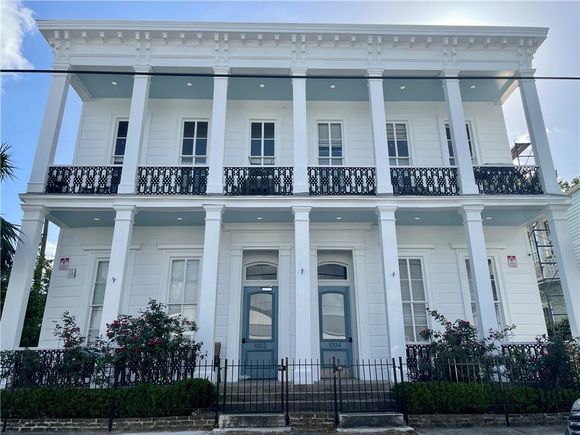
I love these kinds of double houses!

She Loves Him Still

I absolutely adore the Meg Langslow series by Donna Andrews.

When I was taping Susan Larson’s radio show the other day (oooh, how fabulous do I sound?), one of the things she asked me about was, simply, what exactly is a cozy mystery? I don’t remember what I said–something about how the primary point of them was to make the reader feel comfortable, and escape the worries of the every day, or something equally moronic–and of course, as always, later on I came up with the perfect example of how to define a cozy. Cozies are about communities, pleasant and warm communities where neighbors take care of neighbors and everyone watches out for each other and primarily is operating from a good place. The main character has to be someone the reader can not only identify with but has to like; and whenever there’s a new volume in the series it feels like we as readers are getting another lovey vacation to visit with dear old friends we only get to see once or maybe twice a year (fortunately, Andrews is on a two-book per year schedule; her Christmas crime caper for this year just landed at the Lost Apartment this week).

This is precisely the feeling i get when I read one of the Meg Langslow novels; like I’ve taken a lovely little vacation to my favorite little city in Virginia, Caerphilly (which I always pronounce “carefully”), and see Meg and her friends and family. It’s a place where everyone is neighborly or nice–and those who aren’t, everyone tries to steer clear of or just accepts that they just aren’t as nice as everyone else (they inevitably end up dead, anyway). Caerphilly College, where Meg’s husband is chair of the Drama Department, has served up any number of choice murder victims over the years–there was that horrible English department for awhile, and of course everyone loathes the Business Department; which is the source for the mystery in this exceptionally fun and funny mystery.

“We need more peacocks!”

I glanced up from my notebook-that-tells-me-when-to-breathe, as I call my combination to-do list and calendar. Dad was standing just inside the back door. He wore elbow-length white leather gauntlets and a pith helmet with heavy netting thrown back to reveal his face. His beekeeping outfit.

“If you’re looking for peacocks in the beehives, that’s probably why you’re not finding any,I said. “The pair you gave us for Christmas tend to hang out at the far end of Rose Noir’s herb field.”

“I know,” Dad said. “I was tending the hives when I noticed them. They’ve lost all their feathers.”

“It’s called molting,” I said. “I hear they do it every year.”

“Well, I know that.” He knocked some mud off his garden boots and clomped over to sit across the kitchen table from me. “I’ve already called Clarence Rutledge.”

I looked down at my notebook. I was up earlier than I liked and had a busy day ahead of me–busier than usual, thanks to all the things Mother had asked me to take care of in preparation for my brother Rob’s upcoming wedding to Delaney, his fiancée, now only a few days away. Then I glanced up at the clock. Already eight o’clock. Which said everything about how I expected my day to fo. Most mornings I’d have said “only eight o’clock.” But if there was something wrong with our peacocks…

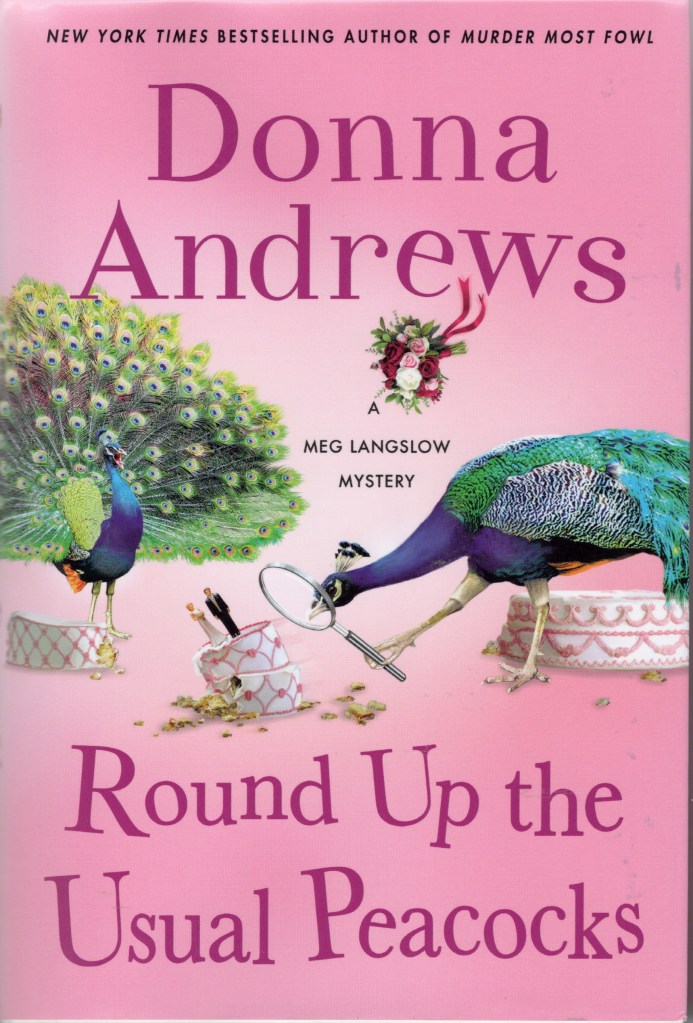
The series comes full circle with this volume; the first in the series was Murder with Peacocks, and our first introduction to Meg came with her heavily involved in the planning on not just one, but three weddings, including her mother’s and her brother Rob’s; Rob’s fiancée is the one with the bright idea for peacocks as wedding decor (I remember thinking as I read this, that woman has no knowledge whatsoever about peacocks) and here we are again, with Meg heavily involved in planning another wedding for her brother Rob…and once again, peacocks are involved (there’s one hilarious scene in which Meg has to take a truck to “borrow” peacocks for the wedding since hers are molting, and she gets trapped in the truck when the peafowl launch an attack).

But as Meg goes about her day to day life with all the added burdens of the wedding planning, her nephew Kevin asks her for help. He and a friend have been doing a podcast about cold cases in Virginia, and someone tried to run his partner over with a car the previous weekend. Could this be connected with one of their cold cases? Meg, mainly to get out of wedding duties, agrees to look into the cold cases–which include a cheating scandal at the business school and a suicide, as well as the disappearance of an exceptionally talented coffee house singer from Charlottesville–which leads her to a lot of questionable antics (such as breaking into the business department to look at donor records) that are not only hilarious and improbable but Andrews always makes it completely realistic and completely believable, which is one of the many reasons I love this series so much: each volume is hilarious, completely unexpected, and absolutely marvelous, with Meg managing to never be caught off-guard or nonplused by anything that happens or comes up.

I absolutely love this series, and it’s always a delight when there’s a new one to read–and I do have the new one to read already! Huzzah!

The Ledge

And here it is, Tuesday morning and dark outside my windows as I have my morning coffee preparatory to getting ready for work. It’s getting to be that time of year where I drive to and from work in the dark, which is always a bit debilitating; you feel like you’ve spent the entire day at work when you don’t get to spend any time outside–even if just going to and from work–in the sunshine. The weather has cooled here a bit over the last week, which has been lovely (and early in the season for coolness). My back is much better–there’s still some tightness and slight pain involved–but I think i can actually head to work today and not be in the kind of pain I was in last week, which is kind of nice. It’s still there, but I am learning how to not trigger it–the irony of which is that I am having to use good posture at all times so as not to inflame the pain, which means had I been using good posture most of my life I might not have this problem right now.

But it’s something I can live with today; something I wasn’t so sure about as recently as Sunday. So taking the days of rest, with the alternating hot and cold, was probably a very smart thing to do. I will be taking the generic Ben-Gay with me to work today, too–just in case. But I can sit comfortably without it, which is something I can honestly say was not the case as recently as Sunday. And now of course I have to start digging myself out from under–which is a lot of catching up I need to get done. I also have to do some digging around and figure out what is missing from some projects that I need to get finished, and I also need to get back to writing. There’s an anthology deadline next month–more like three weeks from now–that I wanted to submit something to, but I seriously doubt I am going to be able to have the time or the energy to revise anything the way I want it to be revised to submit to this anthology, so I am probably going to have to let it go once and for all.

We watched Cold Blooded: The Clutter Family Murders last night, a documentary series about the In Cold Blood murders and of course Truman Capote’s famous book that was written about the case (which remains, to this day, one of my favorites) as well as the film made from the book (which I’ve never seen, but Paul’s friend the actress Brenda Curran was in, playing Nancy Clutter). I’ve been to both Holcomb and Garden City, back when I lived in Kansas and when I also had no idea Holcomb was where the crimes happened (I didn’t read In Cold Blood until I lived in California). One of the things I’ve always found interesting about these old rural crimes is how they always talk about how the “community changed” after it happened and how people never used to lock their doors…and everyone could just knock and enter other people’s homes. I wasn’t raised that way; my mother was very obsessive about always making sure everything was locked up–cars, homes, wherever–and used to get mad at me when, as a lazy not really paying much attention teenager used to sometimes leave the car unlocked. Paul is much the same as my mom; sometimes I forget to lock the car, and when I am home by myself I forget sometimes to lock the front door–someone would have to scale the fence, which isn’t easy, to get back to our apartment door–but that’s also a part and parcel of the false sense of security we all have about being safe in our homes. Once I am inside I am safe.

Which really isn’t true.

I spent some more time with Donna Andrews’ delightful new Meg Langslow novel last night while I waited for Paul to finish working so I could make dinner, and it’s delightful. I don’t know how she manages to do this with a series that has lasted as long as hers has; I think there may be more than twenty volumes in the series now? But each one is a delight. I love the town of Caerphilly, I love her family, and most of all I really enjoy Meg. I love highly accomplished, confident, efficient women like her; she’s yet another drily humorous main character in the vein of Elizabeth Peters’ Amelia Peabody and Laurie R. King’s Mary Russell (I really am overdue for reading another book in that series) and while my own poor Valerie is hardly in the same vein as these remarkable women characters, I’d kind of like to keep developing her into a series because, well, I kind of grew attached to Valerie and her friends while writing A Streetcar Named Murder, and I’d kind of like to revisit them again in another book. I have a title and an idea for the next book in the series, should Crooked Lane want another, and while I felt fairly confident they’d hate the title, I just this weekend came up with a potentially better title for it…and now that I am writing this, i cannot for the life of me remember what that title was, nor do I think I made a note of it (which is why you should always make a note of it).

Ah, well, perhaps it will come back to me at some point.

I also woke up to proofs of an anthology I contributed a story to that has been in the works for many years now, which means the book is finally going to be released which is great news. My story is called “A Whisper from the Graveyard” and I really don’t remember much, if anything, about the story because it’s frankly been so long. But I will need to proof it–check for typos and missing words and such–which will be a nice way to get reacquainted with the story, at the very least. I vaguely have some idea about the story–I know it’s a private eye story, with a gay detective who has just tested HIV positive and it’s set in the early 1990’s, so it’s a death sentence as far as he knows–and is hired by someone to find someone else? I don’t remember–it really has been a long time since I wrote this story.

But I am also completely overwhelmed with work and being behind on everything and I really need to start making a to-do list so I can sort all this shit out and get things done that need to be done. I know I need to go back to work on Scotty and my other project; there’s any number of other things I need to get done, and I also need to start figuring out promo for A Streetcar Named Murder else no one will buy it and that will be the end of that.

The great joy of being a writer.

And on that note, I am heading into the spice mines. Happy Tuesday everyone (except Buccaneer fans)!

Do You Know What I Mean

The traditional mystery often gets a bum rap by mystery fans. I’m not sure why that is; these books have never gone out of style, have never decreased in popularity, and have always been the backbone of the crime/mystery genre. They are often (wrongly, I think) identified with Agatha Christie–if anything, Christie should be identified with every sub-genre of crime/mystery fiction. She wrote private eye novels (Poirot); dark noir (Endless Night); spy fiction (N or M?, The Man in the Brown Suit, They Came to Baghdad); historicals (Death Comes as the End); and even romantic suspense (as Mary Westmacott). Sure, she often relied on the amateur sleuth–her most famous amateur being probably Miss Marple–but she literally did everything first, really.

Probably why everyone refers to her as the Queen of Crime Fiction.

But the traditional mystery, for some reason, gets short shrift in our modern world, despite being one of the most popular subgenres of crime fiction. Why? I don’t really understand it. Sure, there’s not any blood or sex or violence–the sort of thing generally used to sell everything from television shows to movies to laundry soap and deoderant. Many of us grew up reading books about amateur detectives, from Nancy Drew to the Hardy Boys to Trixie Belden. So why do so many turn their noses up at the traditional mystery, also known as the cozy mystery?

I think it’s much harder to write about crime without using the tough guy male lead (stereotype), blood, violence, swear words, and sex. Is it this lack of the “rougher” aspects of crime that earned these books the nickname “cozy”?

What precisely does the word cozy mean, used as a book descriptor in this way? Ask five mystery fans/writers, and you will get five different answers. It’s often hard to quantify the variety of subgenres within the mystery/crime field. Everything else aside, I think the most important thing, the key, for a mystery novel to get this kind of classification is that the book focuses, on one level, on a sense of community; the reader develops a warm, comfortable feeling, the kind that you usually get from visiting family and friends you don’t get to see all of the time. You open the book and start reading and already feel relaxed and at home; happy to see people you care about, are interested in, and are excited to find out what they have been up to. Donna Andrews’ Meg Langslow series is an excellent example of this; so is Leslie Budewitz’ Spice Shop mystery series (both series, obviously, are favorites of mine). These books welcome you in, invite you to put your feet up, get comfortable, and spend some time with your old friends you’ve not seen in a while.

This, naturally, is very difficult to establish when writing the first book in a new series of this kind; how do you immediately establish this warm environment where the reader feels comfortable enough to kick off their shoes and relax? It’s not the easiest thing to pull off for an accomplished writer; so it’s all the more remarkable when someone nails it in their very first book.

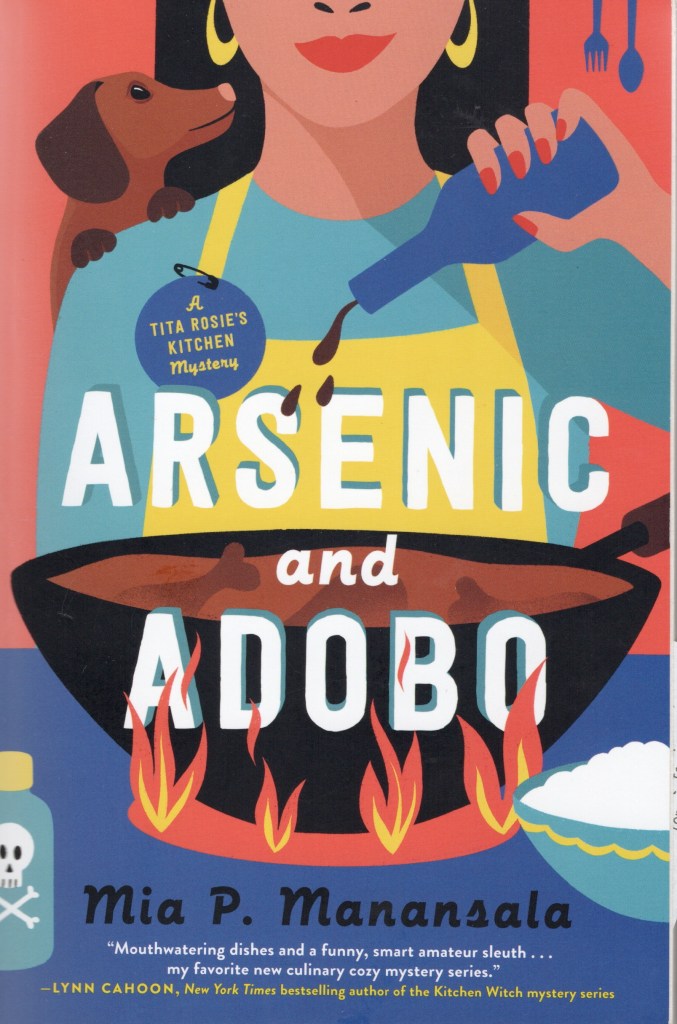
Mia P. Manansala nailed it in her debut.

My name is Lila Macapagal and my life has become a rom-com cliché.

Not many romantic comedies feature an Asian-American (or dead bodies, but more on that later), but all the hallmarks are there.

Girl from an improbably named small town in the Midwest moves to the big city to make a name for herself and find love? Check.

Girl achieves these things only for the world to come crashing down when she walks in on her fiancé getting down and dirty with their next-door neighbors (yes, plural)? Double check.

Girl then moves back home in disgrace and finds work reinvigorating her aunt’s failing business? Well now we’re up to a hat trick of clichés.

And to put the cherry on top, in the trope of all tropes, I even reconnected with my high school sweetheart after moving back to town and discovered the true meaning of Christmas.

Okay, that last part is a joke, but I really did run into my high school sweetheart. Derek Winter, my first love.

First of all, can we talk about the voice?

It is impossible not to fall in love with Lila’s voice from the very first sentence of the book. She is smart and funny and eminently likable, which is important in a traditional mystery (no one wants to read a cozy whose main character is an unlikable bitch) and much harder to do than most people who don’t actually write books think it is. Lila is a remarkable character; very clear-eyed about what she wants and what she doesn’t, as well as who she thinks she is and wants to be. She’s returned from her big escape to the big city to the small town she wasn’t terribly happy in when she was growing up–her past experiences continually are reminding her, and not in pleasant way, of why she left in the first place. She never intended to return home (as Thomas Wolfe said, you can’t go home again), but she is back and rather than focusing on what she is certain everyone she knows or is related to sees as her “failure,” she intends instead to focus on helping save her aunt’s restaurant business.

The immense strength of this story rests upon those family bonds, and Lila’s recognition of just how important those bonds–family, friends, community–actually are to her; and her growing realization, over the course of the books, that those things she once thought were strangling and restraining her are actually where her own power comes from.

The mystery itself is also strong: Lila’s wretched local ex, whose mother has since married a businessman who rents Tita Rosie’s building to her and is a total dick, has taken to writing shitty reviews of local restaurants, apparently targeting one and trying to destroy its business before moving on to another. Lila’s relationship with him is also strained; and she also doesn’t like the dickish stepfather either. It is while she is serving them lunch that her ex keels over face-first into his plate–dead from arsenic poisoning. In the food Lila fed him, and came from her aunt’s kitchen. The financially strapped business is shut down pending an investigation into the murder and a health department inspection, and there is the very real fear that Tita Rosie may lose her restaurant. Lila takes it upon herself to investigate and find the real culprit, to clear herself as well as her aunt and the beloved family business of any wrongdoing and scandal. The journey, which introduces us to her friends and family, and welcomes the reader into their charming world and community, twists and turns and is full of surprises every step along the way–as Lila also learns just how much the restaurant, her family, and her friends really mean to her.

This book is absolutely charming, well-written, and very fun. I cannot wait to revisit Lila and her crew in the second book, Homicide and Halo-Halo. Mia P. Manansala is definitely one to watch, and it’s going to be fun watching her career reaching even more heights than she has already achieved.

Just One Look

I am now almost completely caught on the Donna Andrew canon, with only The Twelve Jays of Christmas, this year’s Christmas Meg mystery, to go. I have already decided to save it for Christmas Eve and Christmas day reading; what better way to celebrate the holiday with yet another visit to Caerphilly at Christmastime? I have also realized that I have done something I try to never, ever do; once I have finished that particular Meg story, I won’t have another to read until next year’s release. Insane as it may sound, I never want to run out of books to read by favorite authors; it’s oddly comforting to know there’s still another one left for me to read. I still have about three to go with Sue Grafton, and there’s one Elizabeth Peters novel still left unread for me to sink my teeth into with a heavy sigh someday. I know it makes little to no sense to think this way, and it’s kind of irrational, but I’ve never claimed that my brain and its peculiarities and weird ways of working makes sense to anyone who is NOT me

And in complete honesty, I’m not entirely certain I understand how my brains works. It certainly mystifies me most of the time.

“Mom?”

I kept my eyes firmly closed and focused on breathing in and out in the slow, deliberate way that was supposed to make you feel better when you were stressed. One…two…

“Mom,” Jamie repeated. “I know when you’re doing your yoga breathing we’re not supposed to interrupt you unless there’s actual bleeding involved.”

“Or open flames,” his twin brother, Josh, added.

“But I kind of think this might qualify,” Jamie went on.

My eyes flew open.

All I could see for a second were the muddy shins and baggy knees of the woolen hose they were wearing as part of their medieval costumes. I craned my neck to see upward, past the well-worn lether doublets to their faces. Josh was leaning on his longbow as if it were a staff. Jamie had his lung over his left shoulder. Neither appeared to be injured. But they both looked…anxious. And that wasn’t a look I saw very often on the faces of my not-quite-teenage sons.

“What’s wrong?” I asked.

They exchanged a glance. Were they deciding what to tell me? Or just sorting out who had to do the telling?

“We think we found a body,” Josh said.

“A dead body,” Jamie clarified.

As always, Meg has her hands full as the book opens. Not only have the twins discovered what may be a dead body in the woods near the house, the reason they are dressed in medieval costume is because Michael, her husband and a professor of drama at the local college, is mounting a production of Macbeth, and the twins have (small) roles. Because of insane and arcane academic inter-departmental politics, the Drama department has had to enlist the assistance of the History department in a skirmish against the villainous English department, which has resulted with a group of re-enactors camping out in the field on her parents’ neighboring property; the leader of the group is a royal pain in the ass. There’s also a house full of relatives, as per usual, and due to the on-going housing situation in Caerphilly, many of the cast of the show are having to stay, if not in Meg’s and Michael’s house, then camping out around it. There have also been some incidents of vandalism, inside and outside the house–and oh, yes, there’s a documentary filmmaker staying in his trailer, also on the property and also proving to be a bit of a handful.

Never ever a dull moment in Meg’s life, certainly!

If that’s enough, the area is in the middle of a drought, and someone has been lighting campfires in the woods. Rose Noire, Meg’s cousin and an herbalist/naturalist/holistic healer type, is convinced that whoever is lighting the campfires is up to no good–and the discovery of a page torn from a book with an evil spell written out in nearby only seems to back up Rose Noire’s intuition (Rose Noire is becoming a favorite of mine; I love all the characters in this series–the ongoing feud between Meg’s grandparents is a personal favorite on-going subplot of mine–but Rose Noire was a bit irritating at first, but as I’ve spent more time with her she has definitely grown in my estimation; and her devotion to protecting animals–as happens throughout this book–played no small part in that rise) that the miscreants are definitely up to no good.

I don’t want to give away too much of the plot–which is, as always, interwoven with various subplots and minor mysteries, which only serve to complicate and confuse the reader (not so much Meg) while trying to solve the central mystery–but the book is, as always, a charming experience that engaged me throughout, making me laugh aloud several times, and while I was glad to get to the bottom of the mystery, and the ending was enormously satisfying…at the same time I was a little morose to be done with my latest visit to Meg’s world.

And I only have one more to read. Heavy sigh.

Do You Hear What I Hear?

What I am hearing is that Donna Andrews is a master of writing about Christmas.

It’s incredibly easy to become cynical about Christmas; American capitalism’s infection of the holiday has made such cynicism almost de rigueur. The commercialization of what is supposed to be a religious holiday has been a concern for decades–A Charlie Brown Christmas was, after all, produced in 1965–and it is has even been politicized for the last thirty or so years (war on Christmas, anyone?). And while the argument over whether one should say “Merry Christmas” rather than the more inclusive “Happy holidays” has always struck me as particularly stupid (in a multi-cultural society where one cannot easily identify which particular holiday a stranger might celebrate, why would anyone want to risk giving offense? I really don’t understand this modern sensibility that good manners no longer matter), it becomes easier and easier to become tired of the entire thing and want to wash one’s hands of it all.

But Donna Andrews’ Christmas mysteries hit precisely the right chord, and can revive that holiday spirit in even that most cynical of hearts and souls, my own; so much so that I may even revisit the books every December as a necessary reminder of what this season is really supposed to be about.

“Cow manure?”

I was talking into my cell phone, but my friend Caroline Willner, who’d just popped into the kitchen with an armload of brightly wrapped presents, must have thought I was talking to her.

“Is this part of the whole not-swearing-in-front-of-the-boys thing?” she asked. “And what did I do to deserve–oops!” Her voice sank into a whisper. “Sorry! I didn’t realize you were on the phone.”

Although I could see her curiosity was aroused.

“We have access to a variety of manures–cow, horse, sheep, goat, and llama,” I said into the phone. “Much of it’s even organic. Is there a particular reason you want cow manure?”

“Well, any of those would be acceptable,” my caller said. “Especially the organic ones. I just don’t want chicken manure.”

“Of course not,” I said. “It’s so apt to be infected with salmonella. Give me your address and let me know when I can drop by–would sometime later today work? If you can show me the area you want fertilized, I can figure out how much manure is required and how many volunteers we’ll need to spread it.”

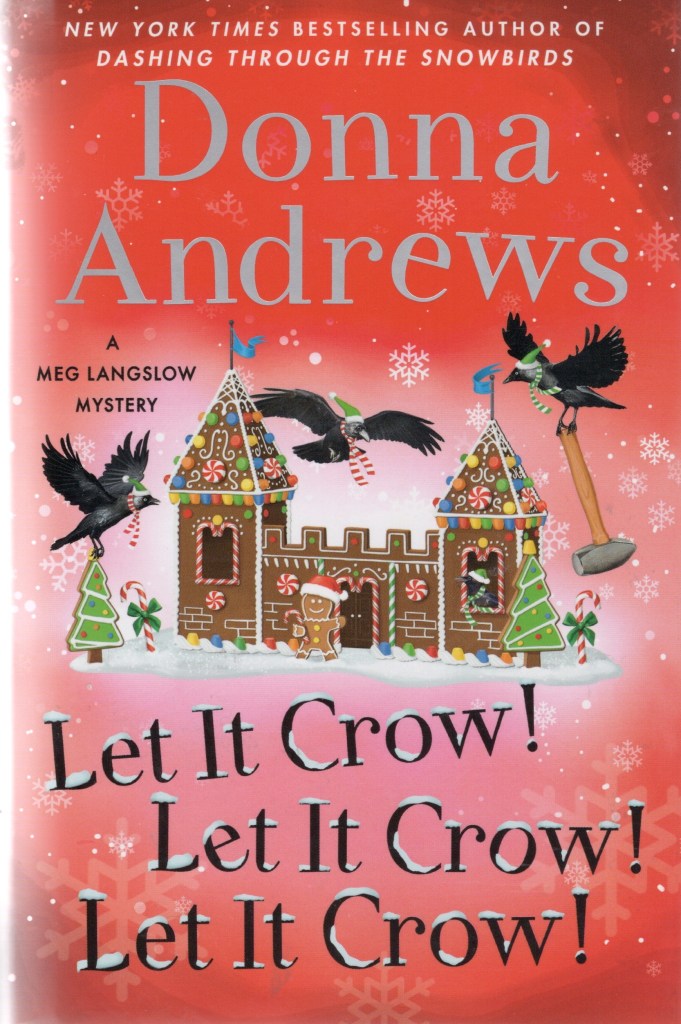
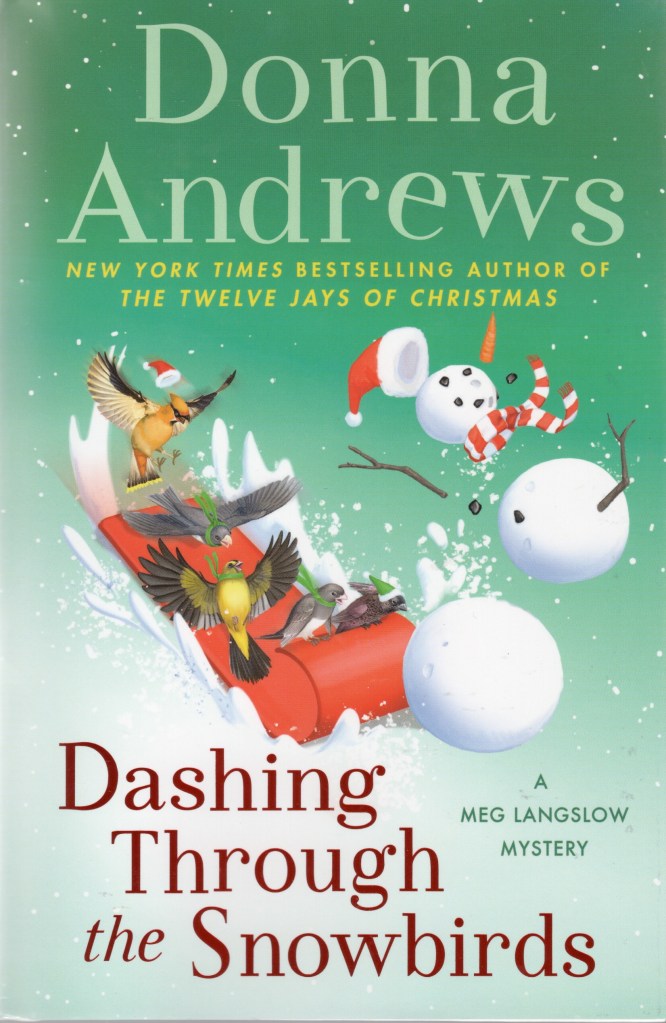
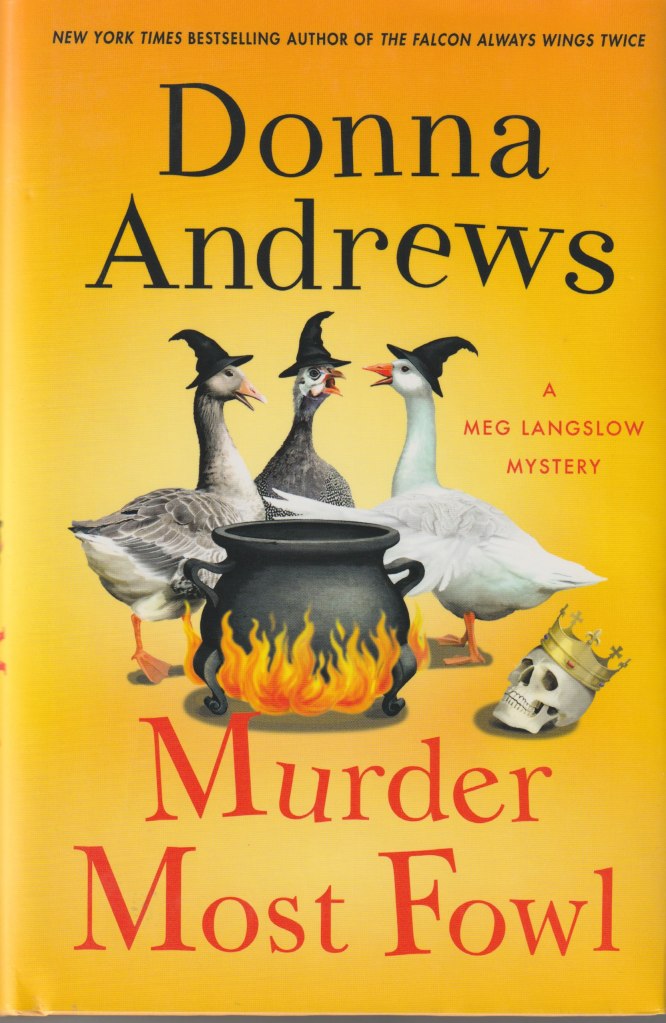
It is, as one can assume by the cover and title of this particular Meg Langslow mystery, Christmas time in Caerphilly again, and as always, Meg has her incredibly capable hands full with everything that is going on that she needs to make sure gets taken care of (her competence, list-making, and multi-tasking are all things that I aspire to, and inevitably always fall short on). Caerphilly’s Interfaith Council has, this particular year, come up with an amazing idea to help people out called “Helping Hands for the Holidays”–in which those in need of help can ask for assistance, and Meg and her group will find volunteers to get things taken care of for those in need. It’s an absolutely lovely idea, and who better than mayoral assistant Meg to take charge of such a program as part of her official duties? A Caerfully Christmas, which has become a major source of tourist revenue for the small town, is also in full swing; her house is filled with relatives; and she is hoping, for once, to have a relatively peaceful Christmas.

But that is not to be. One of the projects involved helping Harvey Dunlop (aka Harvey the Hoarder) declutter and de-hoard his home. Harvey’s neighbors loathe him because of his hoarding tendencies (the town has already helped him declutter his yard to mollify his neighbors), and naturally he is suspicious of the de-hoard assistance he is being offered at first, but with so many people willing to chip in and help out–with Meg there to assure him that the purpose isn’t to get rid of everything, but to help him sort and decide what to keep, as well as moving it all out so the house can get some much-needed repairs, Harvey begins to slowly come around. It would be easy to make Harvey the butt of many jokes here, and a lesser writer would probably do so. However, Andrews completely humanizes Harvey, and as we the reader get to know him better, understand his loneliness and sadness and how the hoarding has so completely overwhelmed him…we can’t help but root for him. The lovely people of Caerphilly even throw an impromptu holiday party for Harvey in the warehouse his things are being stored in (honestly, my bitter old cynical self would love to live in this marvelous lovely town full of kind, caring people who look out for everyone), and Harvey actually begins to come out of his shell, has a lovely evening, and everything is look up for him…

..until later that night when he is brutally attacked, and later dies in the hospital.

This was, for me, a complete and total shock. I had suspected that Harvey–with his hateful neighbors and even more hateful relatives–was going to be the murder victim at the heart of this story, but kept hoping he would be the suspect whom Meg would have to clear instead, and as the book progressed and I came to like him as a character more and more, finding so much joy in the way everyone in Caerphilly was working with him to make his life better and the way he was responding to the kindnesses he was being shown, it was a horrible shock to me…which, of course, is yet another testament to Andrews’ gifts as a novelist. I mean, I was seriously upset that he was murdered.

So upset, in fact, that I grimly looked forward to the murderer being caught and thinking of the most horrible ways for them to be punished, and as I kept reading to find out who this monstrous villain was, I was actually angry and outraged and was certain that whatever their fate might be, it wouldn’t be horrible and gruesome enough to satisfy the bloodlust I was feeling.

But this is Caerphilly, and Donna Andrews, and a Christmas book. There are some major twists along the way to the final denouement, and as always, there was a most satisfying conclusion to the mystery and the book, which enabled me to close it with a happy sigh, again reminded of what the season is truly about, and wishing the world was more like the fictional one that exists in this magical series.

It’s So Easy

I honestly don’t know how I used to survive long drives without audiobooks.

I used to worry about listening to audiobooks on those long drives, primarily out of worry that I would get so absorbed in what I was listening to that I would lose track of what I was doing (when one is easily distracted–hello, ADHD! how’s the wife and kids?–one tends to avoid things that might be distracting) and that isn’t good when you are hurtling along a highway at speeds between sixty and eighty miles-per-hour. This is why I have massively long playlists on my phone (both in iTunes and Spotify); they were created so I would have music to entertain me on these lengthy drives. But while music can make the time pass more quickly, audiobooks make it seem to fly past. It doesn’t distract me to listen to a book being read (I’ve always hated being read to, another reason I avoided them for as long as I have); if anything, sometimes I miss things in the book when I am having to pay attention to something on the road (like construction or heavy traffic) but have found I don’t lose the thread of what I am listening to; my subconscious is still listening and and so I don’t lose my place–which does happen with an actual book, and I have to sometimes go back and reread parts when I get lost.

But…never happens when I am reading Donna Andrews.

“I think they’re plotting to bump off Terence today,” Michael said.

“Bump him off?” I echoed. “Not for real, I assume.”

“Don’t get your hopes up. Bump off his character. In the Game.”

“I could love with them bumping him off for real,” I said. “Just as long as they pick a time when we both have alibis.”

Michael chuckled. No doubt he thought I was kidding. Of the two dozen actors, musicians, and acrobats my husband had recruited to perform at the Riverton Renaissance Faire, Terence was my least favorite by a mile. He was rude, selfish, greedy, lecherous, and just plain obnoxious. Unfortunately, he was also an intergral part of what we’d come to call “the Game”–the ongoing semi-improvisational entertainment that had become so popular with visitors to the Faire.

“Most Renaissance fairs just replay the story of Henry the Eighth and one or another of his wives,” MIchael had said when he’d explained the idea to my grandmother Cordelia, the Riverton Faire’ss owner and organizer. “Or Queen Elizabeth beheading Essex. What I have in mind is something much more exciting. We have this fictitious kingdom, and all the actors belong to one or another of the factions fighting to control it, and they plot and scheme and duel and seduce and betray each other. And they do it loudly and publicly at regularly intervals all day long, in period costume and elegant Shakespearean prose.”

As I have undoubtedly made very clear on this blog over the years, I love Donna Andrews’ Meg Langslow series. It’s one of my happy places; revisiting Caerphilly (or wherever she has sent the cast of this delightful series) is like watching Ted Lasso or Schitt’s Creek; I know I am going to put the book down with a satisfied smile upon completion, be in a very good mood, and just be happy and content with life in general. That’s a real gift, as a reader, and one I am very grateful to receive. I do worry, however, as I get closer to being caught up with this marvelous series that once I am, that there will be a tinge of sadness when I finish the most recent release, akin to when I get to the end of a season of Ted Lasso–sad that there’s not another one to read, but happy to know that there will inevitably be two dropping within months of each other. (While I can completely understand the stress and hard work involved in producing two such lovely and intricately plotted novels per year–those subplots! All the regular supporting cast! The history of a series going on so long!–I am quite happy that Ms. Andrews has such a dedicated work ethic.)

When I saw this was set at a Renaissance Fair, my heart leapt with joy. Andrews positively excels at writing books set at events and/or conferences (the one set at a fan convention for the fantasy series Meg’s husband starred in is a particular favorite, as is the one set at a Battle of Yorktown reenactment), and the fact that the RenFair is being held at, and hosted by, Meg’s grandmother Cordelia (who first turned up in another favorite, The Good the Bad and the Emus–well, they’re all favorites, really) made it even more joyous for me. I love the relationship between Cordelia and Meg’s grandfather, Dr. Blake–as well as their relationship with their joint son, Meg’s father. The ins-and-outs of a RenFair are of particular interest, particularly since this one has a story running through it, known by participants as ‘The Game’; hired actors playing parts, acting out the struggle over who will succeed Good Queen Cordelia (played by Meg’s grandmother, natch) on the throne of Albion? Costumes and swords, duels and jousting, crafts and mead and underhanded skullduggery!

And the skullduggery doesn’t stop at the Game, either.

The book, as all Andrews novels, is an absolute delight. Her wit makes me laugh out loud–I am sure any number of highway drivers on I-75 or I-59, glancing over at me as we drove along, were curious (or concerned) as I occasionally would burst out laughing as I listened. I resented having to stop for gas or a bathroom break, or to get something to eat–scarfing down food as quickly as I could so I could get back to the car and get the audio going yet again. (I am certain the pleasure of listening to this book had something to do with the trip home being an hour shorter than the trip up) The only complaint I could possibly have with this book (any of hers, really) is that I want more of it, more of the regular cast…I would absolutely read a book about them even if there were no mystery involved at all. But Andrews always delivers a solid mystery to go along with the delightful characters she creates–and she also often slips in some social commentary so slyly and sneakily that unless you’re attuned to looking for it, you might miss it.

The afore-mentioned Terence is the villain of this piece, as one might well expect from that witty opening quoted above. An egomaniacal actor in the grips of a severe case of narcissism, he’s not nearly as witty and talented and attractive as he thinks he is, and his constant practical jokes on other cast members–or attempts to add new subplots to the Game, naturally involving his own character–are looked at askance by the others; fortunately, Meg and her grandmother are quick-witted enough, along with Michael, to improvise on the spot and divert the story back to where it should be.

A particularly funny bit involves Dr. Blake, her grandfather, and why he shows up at the RenFair: a noted ornithologist and environmentalist (with a particular liking for birds of prey), he shows up with a cage of wrens…thinking it’s WrenFest (a throwback to the previous book in the series, which featured OwlFest). They find him a wizard’s costume and staff, and he takes to the role with relish, which leads to even funnier scenes.

But one an early morning owling expedition, our intrepid cast stumbles over a dead body in the woods…but no worries. Meg is on the case, and manages, with wit, style and verve, to untangle the various subplots and motives and machinations of the various suspects to eventually unmask the killer…which leads to a hilarious, if dangerous, confrontation in which she saves the day.

And resolve all the various problems of everyone in the book.

I actually had about five minutes of the book left when I pulled up in front of my house–and despite being incredibly glad and grateful to finally be home after eleven hours in the car…I stayed in the car to finish listening.

I cannot think of any higher praise than that.