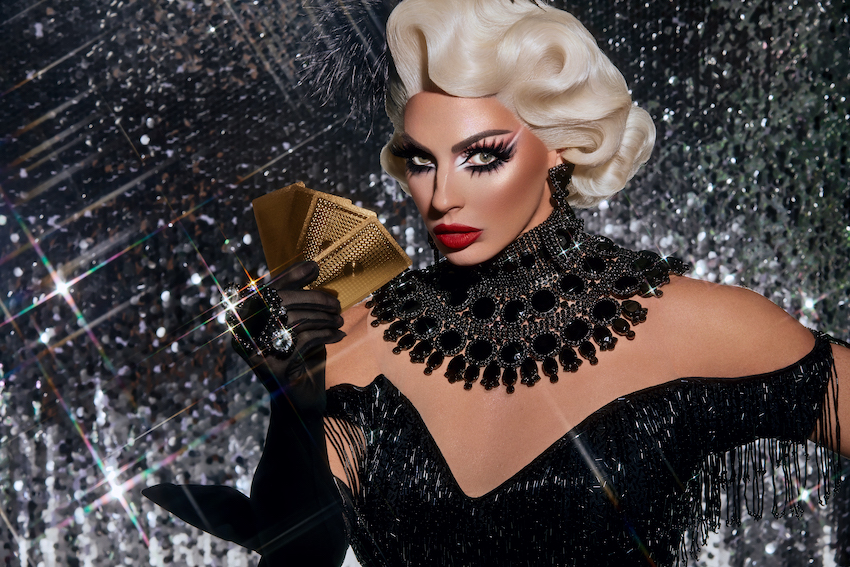
I love Alyssa Edwards. She’s the perfect reality star; a completely delusional human living in her own reality, yet also funny and witty with a highly expressive and thoroughly meme-able face, and basically harmless. I’ve always meant to catch her reality show on Netflix about her dance studio–which is so fricking cool that she does that–but have never gotten around to it. I was amused by her on her initial season, but really hated her feud with Coco Montrese, and of course that was also the season won by the marvelous Jinkx Monsoon. Alyssa was also terrific on All Stars 2, which made the rigging of the season all that much more disappointing. (We also gave up on Project Runway after one season where it was clear they’d already decided who was going to win at the start of the season. Don’t give me a rigged competition, thank you very much; if I want that, I’ll watch professional wrestling, thank you very much.)
Which makes it interesting for me to write a book about a drag pageant. I already have tons of ideas for the book, and it’s going to be very brutal in how it approaches the homophobes who have wrested control of Florida from the sane people (hey Moms4Liberty, how’d those elections turn out for you, you pathetic soulless pieces of shit? Your tears are as delicious as mimosas at a gay Sunday drag bunch, you miserable fucking bitches.) and have taken the state, once a beautiful place with scenic beaches and lovely weather, on its final steps to a complete and utter hellhole. Bravo, by the way; nicely done.
Anyway, back to drag; sorry about that sidebar. But that kind of shit will always enrage me. Nothing makes me angrier than misplaced self-righteousness. I may no longer be a practicing Christian, but I know that faith far better than many–if not most–of its most ardent public proselytizers and purveyors.
Gender-bending, of course, is nothing new. For centuries, women weren’t allowed on the stage so female roles were always played by men. This was certainly true in Shakespeare’s day, and often he wrote plays with characters pretending to be the other gender. So there’s a long, proud history of men doing drag in theater and performance art. Who decides what is masculine and what is feminine, anyway? As I have said numerous times, I love this new young generation of leading men and actors who are abandoning traditional black-tie male drag for new and inventive outfits that showcase their youth, beauty, creativity, and personal style; there’s nothing quite so stifling as toxic masculinity and it’s regular insistence that there is only one way to be a man–which is not only stultifying but incredibly limiting. Film and television (and theater, to a far lesser degree) have long influenced what is considered masculine in this country–the prototype being, of course, John Wayne. (Probably the funniest scene in both La Cage aux Folles and it’s American version The Birdcage is when the more butch of the gay couple tries to get the more feminine partner to be more masculine–telling him to walk like John Wayne…which was the first time I ever noticed how peculiarly John Wayne walked. Also amusing is that Mr. American Macho Man John Wayne–and Mr. Patriotism Ronald Reagan–didn’t serve in World Was II…but played war heroes in movies about it. Style over substance.)
But the history of the colonizing of this continent is very queer. Do we really believe those frontiersmen, trappers, hunters and explorers simply went for months and even years without having sex? There weren’t enough women to satisfy the need–and cattle drives? Pshaw. In any purely male society like that–the cattle drive, the explorations, etc.–there is always male/male sexual contact; “helping a buddy out.” This has been erased from history as effectively as if it had never happened–as though homosexuality is some modern thing that never existed before.
It’s always struck me as odd that the masculine ideal (as shown to us by Hollywood, at any rate) inevitably is depicted in all male environments–war movies, cattle drive movies, Westerns–with the occasional token female thrown in as a supporting love interest. These women are often set up to be abused–spanking was often popular in these films; how many times did John Wayne spank a woman in a movie?–and mocked and made fun of; if they had any kind of mind of their own, well, they had to be tamed.
Anyway, I digress.
I also know there are women who despise drag, see it as mocking women and misogynistic. I can actually see how they could feel that way, and far be it from me to tell a woman–any woman–how she should or shouldn’t feel about something, particularly when it comes to misogyny. (I sure don’t want anyone telling me what to think is homophobic or not.) I don’t think drag is misogynistic; if anything, it’s critiquing the misogyny of society. Dolly Parton also exaggerates femininity to the point of being a drag queen–she even says it about herself. Mae West was so good at this exaggeration that people believed she was an actual drag queen for years. Marilyn Monroe, Jayne Mansfield, and Jane Russell became sex symbols (and stars) by exaggerating their bodies and the way they dressed and their make-up and hair; how is that not female-drag as the converse of over-exaggerated masculinity (John Wayne, Charles Bronson, Clint Eastwood); establishing exaggerated norms of masculine and feminine that subconsciously altered what the over-all culture thought in terms of gender roles.
If I had a dollar for every time someone has told me to be more manly…
But the reason gender roles exist are because they are more comfortable for most people than thinking about it at any great length. You were born with a penis, so you should be interested in sports and guns and hunting and wear pants; your parents don’t have to think about it and neither do you. But for those of us who weren’t comfortable in those comforting boxes society so gladly constructed for us all to fit into–it’s not quite that easy. I hated having to do “boy” things and hated the expectations that since I was a boy I should like something in particular–and being incredibly stubborn, being told that I should like something was much more likely to make me disdain it. I didn’t want to play sports or even watch them when I was a kid; I just wanted to read. My struggles with wrapping my head around my gender and my sexual identity as a child were difficult, and those scars are still there–some of them are still scabbed over and not healed. All the messages I was being sent through popular culture, school, and society were telling me that something was wrong with me–and you don’t get over that overnight. I’m still unpacking a lot of that to this very day.
Writing Death Drop forced me to start thinking about these things again–gender markers, gender identities, the duality of our natures (no one is 100% one or the other, I think; I will always believe that gender and sexuality are a lot more fluid than anyone thinks)–and what makes one male and what makes one female. I hope, in writing more about Jem in the future, that it will help me understand myself better as well as society.
And what more could a writer ask for?

 Queer and Loathing in America