Zero to Hero

I came to Disney later in life. You also have to remember that I grew up in a different world than the one everyone who grew up in the 1970’s or later did; we couldn’t rent movies, there were only three television networks plus PBS and whatever local independents there might be, and so the only chance to actually see classics of Disney’s past was if they were re-released, and that didn’t happen very often. My parents, despite their youth, weren’t going to spend the money to take us to see something they didn’t care about seeing, either; money was tight, and Mom used to take us to see movies when we were little in the summer to get out of the heat. I do vaguely remember seeing The Happiest Millionaire on the big screen–my only real memory of it was he owned an alligator–but for the most part, we never really saw many Disney movies, and especially not animated ones.

Yes, when I was a child I watched Disney’s Wonderful World of Color every Sunday night after Mutual of Omaha’s Wild Kingdom for years. But my childhood was also not a great time for Disney, either in animation or live action. Sure, some films were gems, but not in the same vein as the big classics, like Snow White and the Seven Dwarves and Peter Pan and Cinderella. Disney was more focused on live animation movies (this was the period of The Love Bug movies and Kurt Russell’s college student movies (and beautiful Jan-Michael Vincent in The World’s Greatest Athlete.) at this time.

It was the Disney renaissance of my late twenties/early thirties, timed with my self-discovery journey about who I was and wanted to be and figuring out everything, really, that turned me into a Disney Queen. It was hard not to get up caught up in Disney’s beautiful visuals and songs about misunderstood outsiders who eventually find where they belong, from The Little Mermaid to Beauty and the Beast to so many others. All the films essentially had the same basic story beats: someone who doesn’t feel like they belong goes on an adventure, where they find themselves and what they were meant to be, and wind up with a great final reward of love and acceptance. How does that not resonate with gay men in the time of HIV/AIDS? The fact that songwriter Howard Ashman was a gay man dying of AIDS while working on The Little Mermaid and Beauty and the Beast1 only made the films resonate with gay men all the more–and I went whole hog on the Disney Queen roleplay. (My favorite character of all Disney animation remains Malificent, of course.)

But I also always had a very soft spot for Hercules, even though it wasn’t one of the more popular animated Disney films. I’m always a little curious when Disney announces it’s making an animated film out of something that hardly seems kid-friendly; like The Little Mermaid, which is a horrible Hans Christian Anderson fairy tale. Likewise, when I heard they were making Hercules I arched an eyebrow. I loved Greek mythology and ancient Greece when I was a kid (my three favorite ancient civilizations were Greek, Roman, and of course Egyptian), and I was always interested in Hercules–although as a child I knew the correct Greek name was Heracles–because I kind of saw him as an ancient Greek Superman; the heavily muscled physique he was always depicted as having was just a bonus for little gay Greg, and I always wanted to write about him; discovering that in the original myths he had both male and female loves once I became an adult was just more fire to the flame. The Disney film, of course, altered a lot of the not-so-kid-friendly aspects of the myth, obviously; they made Hera his mother rather than his principle enemy, they cut the Muses down from nine to five, and eliminated his cruelty, his bouts of madness, and his insane all over the map sexuality to make him another Disney prince, who grows up an outsider and has to prove himself and that he not only belongs but is a hero.

The Muses were the narrators of the movie, and they were a delight. Their songs were all done in the style of old-time girl groups, and I thought they were a terrific narrative device. I loved the soundtrack, too.

Imagine my delight when I found out local New Orleans author Farrah Rochon, who is an highly acclaimed romance writer, was writing the backstory for the Muses in a young adult novel called Bemused.

And Reader, it was utterly charming.

I loved it.
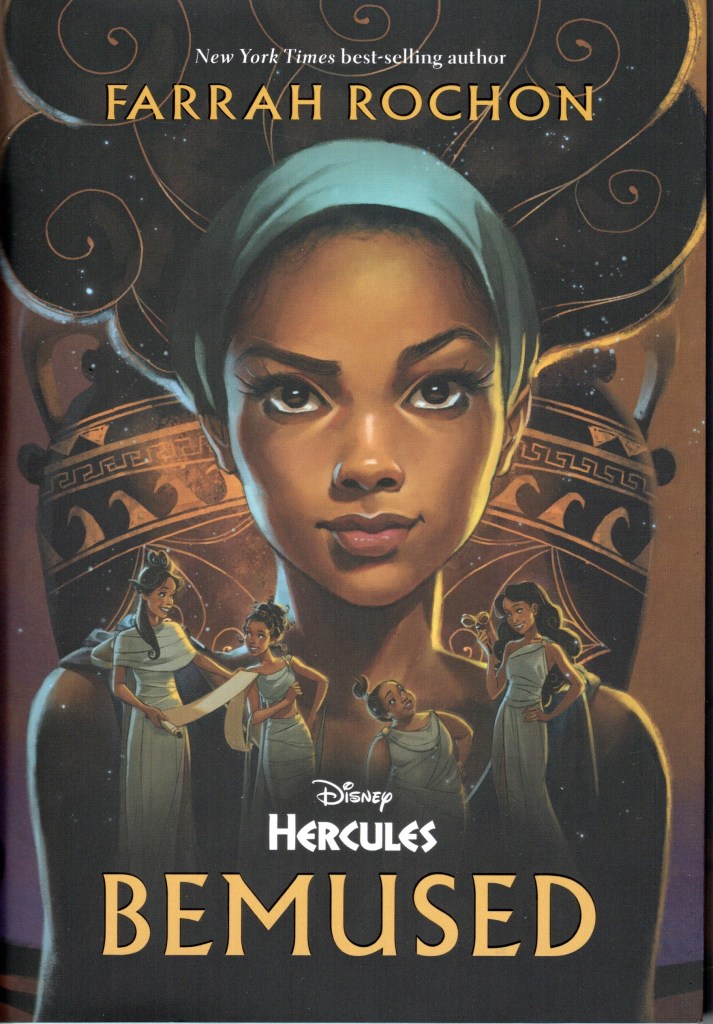
Mnemosyne stood on the edge of the craggy cliff, listening to the whistle of the brisk windblowing through the barren tree branches below. The blanket of thick gray storm clouds that had shrouded the valley for the past few days had finally lifted. She took in a lungful of the clean mountain air. It was invigorating. And comforting.

And she was far enough away from the oppressive demands of Mount Olympus that she could finally feel a sense of calm. She had not experienced true peace in so long that even she, the Goddess of Memory, could barely recall what it was like.

Her fear had lessened with every moment that passed after she’d fled from Mount Olympus, the place where she’d spent so many onerous years. Now, she had a new destiny to fulfill. Had the time finally come?

A loud crack, followed by a harsh, high-pitched squawk, sent Mnenosyne scrambling for cover. She looked up just intime to see a bird swooping overhead, its wings extending out several feet on each side.

Mnenosyne, you see, was a Titan who didn’t fight Zeus and his siblings in their war to take over the heavens. She stayed on Olympus, and eventually developed relationships with several of the other goddesses in the pantheon, namely Athena and Artemis. But (this is the Disney universe, not the ancient Greek one) Hades spends a lot of time undermining her faith in capricious and fickle King of the Gods, Zeus, whom he resents for giving him the underworld to rule over and wants to overthrow (straight up from the film) him. He wants Mnenosyne on his side due to her control over memories; she can convince all the gods that Hades has always been the King of the Gods and Zeus the lord of the underworld, and so she is key to his plans. But she flees Olympus, making all of them forget she ever existed–but Hades kept a journal so she couldn’t do that to him as there was a written record. Hades is the big bad in this book, just as he was in the movie (which was probably the last time I’ve enjoyed James Woods in anything), and she creates her daughters, but keeps their gifts hidden as she keeps moving them around to avoid scrutiny and coming to the attention of the gods. But Hades finds her and kidnaps her, and her daughters now must use their powers to find her and save her from the clutches of Hades, so it’s also a very charming coming of age story as well as an interesting adventure.

This is an excellent read, and belongs on your shelves next to your Rick Riordan novels.

  1. Miss me with the “Stockholm syndrome” takes on Beauty and the Beast, thank you very much; the entire point of the film is that someone monstrous becomes capable of love and caring for someone besides himself, which finally breaks the curse on him. It’s actually a beautiful story, it makes me cry every time I watch it at least three times (when he loves her enough to let her go; when he dies; and when he transforms back), and at some point I am going to write about this masterpiece of a movie. ↩︎

Nice To Be With You

Monday morning and back to the office with me today; huzzah? It was a nice, lovely weekend around the Lost Apartment, one in which I felt really good about my writing life and resettling into what is the new normal for my life these days. I’ve kind of gotten off the treadmill of endless deadlines and volunteering, and all this lovely extra free time has been spoiling me a bit, which is why I’ve not really been getting anywhere with my writing lately; I’m not used to the luxury of time, and now instead of scheduling my days to within an inch of their lives…I don’t have to do that anymore, and it’s nice. I need to adapt to reading every evening again, and doing some writing before calling it a day and repairing to my easy chair.

I actually overslept this morning. I set my alarm, but forgot completely that the power had been off, taking my alarm setting back to 12:00. Fortunately, Sparky was hungry, and he is relentless when he’s hungry (of course, he has no ability to feed himself, so ignoring him to sleep a little longer is actually kind of mean), and I looked at the clock and was like oh shit that was a close one. So he saved the day, kind of, which is always appreciated. As I sit here swilling coffee, I still have time to get to work on time this morning, despite having to assemble the carrot cheesecake and put the frosting on (I also need to make the frosting; I’m just doing homemade whipped cream–you can never go wrong with whipped cream, ever), and then load it into the cake carrier and hope I don’t have to suddenly slam on the brakes in the car. It’s generally not a great omen to start your work week by oversleeping, but I feel fine and I’ll get to work on time. The morning feels a bit off, but it’ll straighten itself out before long, I am sure. But I made the cake yesterday and pretty much have the mess already cleaned up, so there’s not too much to do once I get home from the gym today. I am thinking about making meatballs when I do, but I don’t know how much trouble I want to go to after the gym (yes, I am stopping at the gym on my way home from work; I even brought clothes to change into), and then it’s home to do some more writing.

I pretty much have decided that the next thing I am going to work on is Never Kiss a Stranger, and I am going to take it from novella to novel. It simply doesn’t work as a novella; one of those “way too much story to condense here” but we’ll see how it goes. I am not limiting myself on how long it’s going to be, and I am also not going to force it to be a novel, either. If there’s only enough story for forty thousand words, I’ll write another and combine them into one book. I also think the Chanse story I was going to write as a novella might actually be a novel, too. I also have another Chanse novel idea that I am going to explore, too. I am also not limiting myself to the Murder in the titles anymore, either.

The “christian” author who came for Dolly last week is really sorry she made everyone mad by claiming Dolly is not a good person because she doesn’t call out sin. Ericka Andersen isn’t sorry for any of her foul, unchristian values and beliefs; she’s just sorry she used Dolly as her example–which is hilarious; her entire piece is predicated on Dolly and her goodness; there’s really no one else she could have used. The backlash is everything she deserves and more; The Federalist also needs to apologize to everyone for running that disgusting hit piece, and whatever editor okayed it is too stupid to work as an editor at any time. Imagine signing off on a piece attacking Dolly Parton for not being Christian enough! Everybody loves Dolly; her icon status is only limited because we haven’t reached the stars yet with the good news of Dolly. Ericka Andersen–an admitted alcoholic who only got sober thanks to God (which begs the question, didn’t God make her an alcoholic? She clearly didn’t learn the lesson She intended Ms. Andersen to learn from her struggle with alcohol)–is the absolute worst kind of Christian, and I hope this follows her for the rest of her life.

Christ, not even Newsmax or OANN would have signed off on that piece. Jesus.

I did have a lovely weekend. It was extremely hot all weekend, so I spent most of the weekend indoors as much as I possibly could. Going to make groceries yesterday was absolutely miserable. I also need to get a window screen thing for my car; it gets so hot inside that it’s miserable getting inside after work, or any time during the summer. The car was so hot yesterday that when I closed the hatch after unloading the groceries I touched the metal and pulled my hand back, almost certain it had been scalded. It was not, but I used the handle after that–and even it was hot to the touch. Yay, and it’s not really summer yet!

We did watch more of The Acolyte last night, and followed that up with Easy A, the movie where I originally fell for Emma Stone, and the movie is very interesting, particularly from a “teen movie” perspective. It owes some to The Scarlet Letter, of course, and maybe what I should do at some point is a “teen movie” blog; how it evolved from the beach movies and Disney family comedies (think Kurt Russell as a teenager) to the teen sex comedies and John Hughes and so forth. But Easy A could have never been filmed back in the 60s and 70s, and probably not even in the 80s or 90s–because female-centered sex comedies are rare, and her character would have been seen as a “bad influence” on teen girls of the time. But the movie also parodies teen rom-coms, too, which elevates it over your average teen movie.

And on that note, I am heading into the spice mines. Have a lovely Monday, everyone, and I’ll probably be back later.

Gorgeous

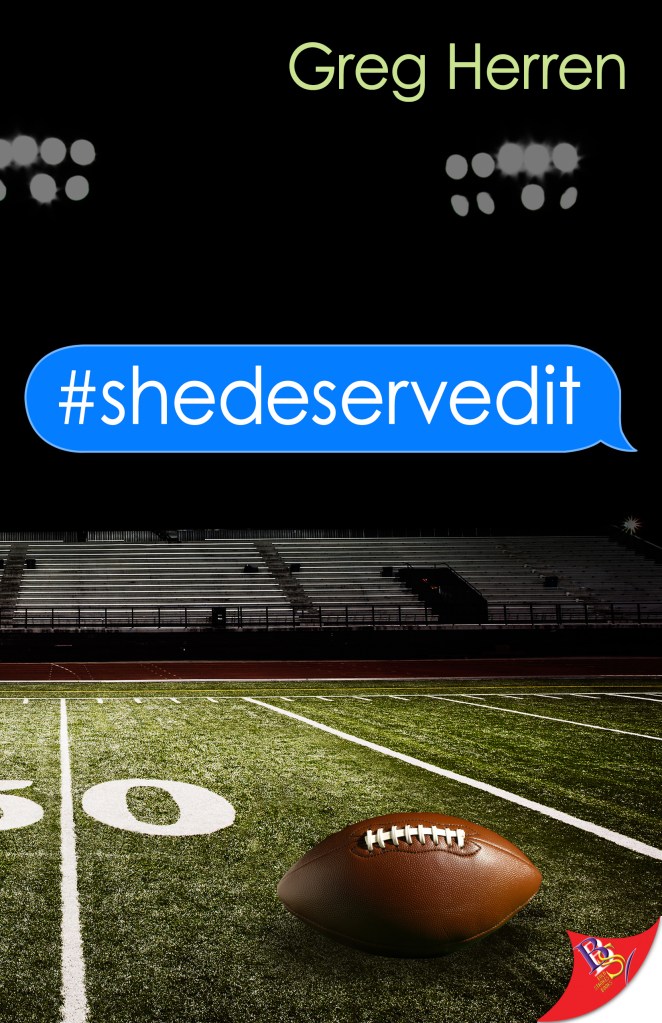
So, as Constant Reader is aware, I’ve been working, off and on, since 2015 on something that I referred to for years as “the Kansas book”, whose actual title is #shedeservedit.

It will be released on 1/11/22 officially; if you pre-order it from the Bold Strokes website, it will ship actually on January 1 (well, probably the 2nd since the 1st is a holiday).

Here’s the cover copy:

Liberty Center High School’s football team has a long history of success, and the dying small town has nothing else to cling to. But when Lance, the star quarterback, is found dead, Alex Wheeler becomes the prime suspect in his best friend’s murder. Alex thought he knew Lance’s secrets–but Lance was keeping his sexuality private and someone else found out. How well did Alex really know Lance, and what else did he keep hidden? 

To prove his innocence and figure out what really happened to Lance that last night, Alex starts connecting the dots and finds that everything leads back to the recent suicide of a cheerleader who may have been sexually assaulted at a team party. Did online bullying and photos of her from the party drive her to suicide? Or was she murdered? Alex and his girlfriend India soon find their own lives are in danger as they get closer and closer to the horrifying truth about how far Liberty Center will go to protect their own.

I’ve been writing what I had taken to calling “the Kansas book” since I was in high school, really. While I was in high school I wrote several stories about a group of kids at a fictional high school, completely based on my own, and while it was certainly melodrama…we also didn’t have shows for teens like Beverly Hills 90210 and movies for teens like Sixteen Candles, Fast Times at Ridgement High, or Risky Business yet; all “teen fare” at the time was mostly from Disney, G-rated, and farcical; likewise, television programs targeted toward younger viewers were mostly for really young kids or what we now call “tweens.” And while I had crushes on both Kurt Russell and Jan-Michael Vincent (who didn’t?), those Disney films were little better than The Brady Bunch. I think it was in 1980 when I decided to take those stories and extrapolate them into a longer story, thinking it would be my first novel–and it expanded from the kids to include their older siblings and parents and teachers as well. I moved the story from the rural county to the county seat, and over the course of three years I painstakingly wrote about three thousand notebook pages. It was a sloppy mess, to be honest; I was thinking in terms of writing something along the lines of Peyton Place–the story of a town over the course of five years–but as I wrote I dropped characters and storylines; changed character names when a better name occurred to me; as I said, it was a total mess…and when I completed it, in the days before computers, I realized that I needed to type the entire thing up, and alas, I didn’t know how to touch type and whenever I typed anything I consistently made errors. So, I simply set it aside and went back to writing short stories before starting, in 1991, to try my hand at novels again.

In the years since, I cheerfully pulled elements from that ancient manuscript out to use for other books and other stories–there was a murder mystery at the heart of the book, and I actually used that as the basis for the plot of Murder in the Garden District; apparently I have always had crime in mind when it came to my writing–and I also pulled character names and other stories from it to use elsewhere. I reverted back to the rural county aspect of the original short stories to write Sara; one of the things I had to do recently was go through Sara and anything else I’ve written and published already having to do with Kansas to record the character names to make sure I wasn’t using them again in this book. I also originally began the basics of this book sometime before Katrina–the star quarterback’s dead body being found on the fifty yard line of the football field, and originally the primary POV character was the only detective on the small town’s police force. What I wrote was really good–I believe I got up to about five chapters–and it was also a flashback story with parallel time-lines; one in 1977, when the quarterback was murdered, and the present day, with someone who was in high school at the time becoming convinced that the person convicted of the crime was actually innocent and railroaded as a cover-up. I could never get the whole plot worked out, and it went through several changes and stages as I worked on it, still being called “the Kansas book.”

Two real life crimes–the rapes in Steubenville, Ohio and the other in Marysville, Missouri, in which girls were either drugged or pressured into over drinking and then when too wasted to even speak were sexually assaulted by athletes–inspired me to drag the framework of this story out and use it to tell a similar style story. I was, like anyone with a conscience or a soul, horrified by these rapes, and even more horrified by the aftermath; the way the girls were humiliated and shamed publicly and on social media, and I couldn’t get a hashtag that the kids in one of the towns used while shaming the victim: #shedeservedit.

That, I felt, was my title, and I could build the story from there. I could still have the dead quarterback; I could still have the town reeling from the one-two punch of the rape and the murder, only now I could layer in the victim-blaming and shaming. (I will never forget female newscasters talking about how sad it was that the boys convicted for the Steubenville case’s lives were ruined; I saved my sympathy for the poor girl they victimized; how on earth would she get past this?) I wrote the entire first draft in one month in the summer of 2015, and have tinkered with it, off and on, ever since. It was early last year, I think, pre-pandemic, when. I finally decided that two books I’d been working on between others over the last few years needed to be done and out of my hair; and the best way to force myself to finish them both once and for all was to offer them to my publisher. I did that, was given deadlines, and now, as I am finishing the final version of #shedeservedit, I also have a release date (1/11/22) and a cover to share with you all, so here it is (obviously, see above).

Writing this has been a journey, as writing any book can be; the Imposter Syndrome reared its ugly head numerous times during the writing of this book–should a man be writing a book about this subject? Is telling such a story from the point of view of a young man, friend to both the rape victim and the rapists, the right way to tell it? Am I centering a young man in a story about sexual assault and the toxic rape culture that has grown up around a small town’s athletic success?

I guess time will tell.

The Long Run

Not only do I write two private eye series, erotica, and the occasional stand alone,  I also, sometimes, write what’s classified as young adult fiction. I have not published anything that could remotely be considered y/a in quite a while, and therein lies a tale (I think the last book I published that could be considered “young adult” was Dark Tide; I could be wrong. I no longer remember when and in what order my non-series books came out).

To be clear, the fact that I even call those books “y/a” even though I don’t really think of them as young adult fiction is a marketing thing, really; in my mind, they’re simply novels I wrote about teenagers. I started writing about teenagers when I actually was one; the stories I wrote in high school weren’t bad, for a teenager, and were the first indication–from my fellow classmates, and my English teacher–that I could seriously become a published writer if I chose to try to do so; the utter lack of seriousness my writing aspirations received from my family was kind of soul-crushing. But I always wanted to write about teenagers, from the very beginnings; I wanted to do my own Nancy Drew/Hardy Boys style series, and then progressed to other stories.

I progressed as a reader pretty quickly when I was growing up; I went from the series books, like the Hardy Boys and Nancy Drew, and the Scholastic Book Club mysteries, to Agatha Christie, Charlotte Armstrong, and Ellery Queen when I was around eleven or twelve, if not younger; I know I read both Gone with the Wind and Antonia Fraser’s Mary Queen of Scots when I was ten. The few books I read that were considered “children’s books” (there was no such thing as young adult fiction then) were books like The Outsiders and The Cat Ate My Gymsuit and I did enjoy them; I just didn’t think of them as either being particularly authentic or realistic. Nor did they have any bearing on my life, or the lives of my friends–I viewed them like youth-oriented television shows like The Brady Bunch, existing in some bizarre alternate universe that has no basis in actual reality or what those of us who were that age were actually experiencing. I always thought there was something missing–complicated and authentic books about the lives of real teenagers and the real issues they faced everyday, without getting into the insanity of the preachy-teachy “issue” books that usually wound up as ABC After-school Specials, which I loathed. 

Not all “issue books” were bad, in all fairness; some, like Lisa Bright and Dark, about a girl struggling with mental illness whose parents refused to face their daughter’s reality, so her friends tried to help her by serving as amateur psychologists, and  I Never Promised You a Rose Garden, about a teenaged girl in a mental hospital dealing with her illness were actually quite good. But I loved books like The Cheerleader, about a poor girl in a small New England town with ambitions and dreams that far exceeded those of most of her friends…dealing with issues of popularity, sex, and first love.  David Marlow’s Yearbook was also a favorite, and while not marketed to kids, was about high school, but had some themes and plot-lines considered far too heavy for teens to digest in the 1970’s. You can also see it in the pap that was considered movies for teenagers; G-rated bubble-gum like The Computer Wore Tennis Shoes, and inevitably came from Disney and starred Kurt Russell. (These movies are an interesting time capsule; I did try to watch one of them recently on Disney Plus and didn’t last three minutes in that squeaky clean, sex-free college environment.)

(Also, I would like to point out at this time there were terrific books being published in the 1970’s for teens that dealt with major issues and were groundbreaking; Sandra Scoppetone was writing about queer teens back then, and there were some others doing terrific work at the time–I just wasn’t aware of those books until much later.)

My first three young adult novels–Sorceress, Sleeping Angel, Sara–were written as first drafts in the early 1990’s, put in a drawer, and forgotten about for nearly twenty years. Sorceress  had no queer content in it at all; it was my version of the truly popular trope of romantic/domestic suspense where an orphaned girl goes to live in a spooky mansion far away from her old life (Jane Eyre, Rebecca, almost everything written by Victoria Holt), and slowly becomes aware that everything in the house isn’t as it seems. It was a lot of fun to write–I loved those books and I loved putting a modern spin on them. Sleeping Angel’s first draft was never completed, and the published version is vastly different than what the original first draft contained; there are still some vestiges of the original plot there in the book that are never truly explained, and by the time I realized, after many drafts, that I hadn’t removed those vestiges from the book it was too late to do anything about it other than hope no one noticed. The book did well, won an award or two, and is still a favorite of my readers, according to what I see on social media. One of the things I added to the story was a queer subplot about bullying, which is what I think readers truly responded to, and I also feel like adding that to the story in addition to the other changes I made to it made it a stronger book. Sara was always intended to have gay characters and a gay plot; I originally started writing it as a novel for adults and realized, over the course of writing it, that actually the teenage story was the most interesting part and I could deal with some issues there if I switched the focus of the book to the teenagers. One thing that changed from the 1991 first draft to the draft that was published is that the character I originally had being bullied for being gay, even though he wasn’t (another character, one of the biggest bullies, actually was), was actually not only gay but had come out, and so the book also talked about the reverberations of a popular football coming out, and what impact that had on the school social structure and hierarchy.

Sara, incidentally, is one of my lowest selling titles–which also kind of breaks my heart a little bit.

Since those three, there have been others I’ve written–Lake Thirteen, Dark Tide–and I’ve also dabbled in what is called “new adult fiction”–books about college-age or just out of college-age characters–this is where The Orion Mask and Timothy and the current one I’m working on, Bury Me in Shadows, fall on the marketing spectrum.

One of the questions I had to deal with in writing young adult novels with queer content was the question of sex. I had already been through being banned in Virginia because I had written gay erotica (a really long story that I revisited recently with Brad Shreve on his podcast; I really do need to write in depth about the entire experience); what would happen if ‘notorious gay porn writer’ Greg Herren began writing fiction specifically aimed at teenagers? But the truly interesting thing about being used as a political pawn by the right-wing fanatics in the power games they play is that once they’ve made use of you, they forget about you and move on. My young adult fiction was released without a single complaint, protest, or any of the sturm und drang that my speaking at a high school to a group of queer and queer-supportive youth created scant years earlier.

Interesting, isn’t it?

And yet…there is no sex in any of those books. None. I don’t  remember my gay teens even getting a chaste kiss, let alone a sex life, or fantasies, or a boyfriend.

And what about desire?

A couple of years ago someone tagged me on Facebook on an article about just that very subject; that was when I started writing this post (three yeara ago, looks like) but I never finished writing this until this morning.

Go ahead and read it. I’ll wait.

Okay, welcome back. Some interesting points, no?

Now, check out this one. 

I know, it’s a lot of information to process, but it’s something we should all be thinking about, particularly as the calls for diversity in publishing and popular culture continue. Sex is, quite obviously, a touchy subject when it comes to young adult fiction, but when it comes to questions of sexuality and being a sexual minority, what is too much and what is not enough? Even depictions of straight sexuality is frowned on and controversial when it comes to young adult fiction. (For the record, that is also considered the case for crime fiction–no explicit sex scenes–or at least so I was told when I was first getting started; doubly ironic that my mystery series were what the right-wing Virginian fanatics considered porn–I really do need to write about that.)

I also have noticed the elitism evident in hashtags like #ownvoices and #weneeddiversevoices that have come and gone and return periodically on Twitter; those actively involved in promoting those tags, when it comes to queer books, make it abundantly clear they only care about those published by the Big Five in New York–which is a good target, I agree, and they do need to be doing better when it comes to diversity and “own voices” work–but this focus also ignores the small presses, particularly the queer ones, who have been doing this work all along and making sure queer books were still being published for all ages and getting out there and made available to those who want and need them. I am absolutely delighted to see queer books by queers being published by the Big 5, and young adult work in particular…and yet…there are some serious issues still with the Big 5–and with what is called ” young adult Twitter”.

I do find it interesting to see who they decide are the “cool kids” and who they banish to the outer tables with the freaks and geeks.

It’s part of the reason I don’t engage with young adult twitter, to be honest. I really have no desire to return to the high school cafeteria at this point in my life.

And I’ll write about teenagers whenever there’s a story I want to tell involving teenagers–which currently is the Kansas book; I turned my protagonist in Bury Me in Shadows into a college student because it actually works better.

And on that note, tis back to the spice mines with me. (And huzzah for finally finishing this post!)