Mean

Weird.

I’ve always been weird, even when I was a little boy. I was different from other kids. I didn’t want to play outside, I wanted to read or play with my toys and make up stories. My parents were always urging me to go outside to play, so I’d just take a book and go sit on the back stairs of that little apartment on Komensky in Chicago. When I started school, I remember it being a bit of a shock to me. There were other kids in our neighborhood, but I didn’t really play with them much; they were mostly girls and friends of my sister’s, and while she let me tag along a lot (a running theme of her unfortunate childhood–always being saddled with her weird younger brother), I preferred my solitude and a book. School was strange for me; thrust into a world where I was surrounded by kids I didn’t know, and I didn’t understand how they all seemed to know each other and be friends already. I stayed by myself for the most part until someone asked me to join a game or something, and entertained myself for the most part. No one picked on me, no one said anything hateful to me or called me names, and for the most part I got on with my classmates. I got up in the morning, went to school, went to Mrs. Harris our babysitter’s house for lunch, back to school and then finally home. We only lived a block away from my elementary school, which made life ever so much easier for my parents; they didn’t have to worry about us coming and going to school safely. We only had to cross two streets to get there–down one block and across to the other side–and there were crossing guards. I knew instinctively that somehow I was different from the other kids; no one liked to read as much as me1, and only as an adult did I find other people who read as much, if not more so, than I do.

But reading–and watching television and movies–began defining “normal” to me; and I couldn’t understand in my childish brain (so advanced in so many ways but lacking in just as many) why the real world was so different from the fictional realities I lost myself in while consuming media. Riverdale in Archie comics seemed like such a nice place, but that was definitely not my high school experience. Whenever I took a chance on reading something age-appropriate (ah, those Scholastic book fairs!) I generally didn’t like it unless it was a mystery. I read so many of the kids’ series books for many different reasons; ironically liking the two most popular (Nancy Drew and the Hardy Boys) the least (Ken Holt, Judy Bolton, and the Three Investigators were much better).

It was when we moved to the suburbs that I began to realize that I was not only different but I was weird. I was a boy who didn’t care that much about sports, didn’t want to play them, and there was all kinds of stuff messing with my brain. Sixth grade wasn’t too bad, but that was also the first time that other kids began to wonder about my masculinity, but the worst it got was being taunted by other boys as a “sissy,” and then the next day the group of boys in the neighborhood I met through school acted like nothing had happened the day before–which was when I first learned that you couldn’t really trust other people; they would be your friend one day and cruel the next; and then back to being your friend again. (That group did turn on me completely in junior high school one day; it was weirdly coordinated with other kids at school who weren’t in our neighborhood.)

I hated being shamed more than anything else, for something I couldn’t control. It was in junior high also that I began to understand my sexuality at the same time so many kids began understanding mine and laughing and mocking me for it. I was always in fear of violence, and the kids in my middle-class mostly white desegregation-refugee suburb weren’t above ganging up on one person and beating them. (The suburbs, where we moved for “more stability” and “to have our own house” was far more dangerous for me than living in the city.) I ignored it all, but inside I burned with shame and embarrassment because I also knew the other kids were right about me; I did like boys, and how on earth did I ever learn, in a world that in which homosexuality was erased from public view, what men did together sexually? How did I know? I don’t remember reading about it anywhere, and whenever a gay person appeared in any media it was very negative. But there we were.

The irony lies in the fact that I never really cared that much about having friends or being popular–but media convinced me otherwise; that it was important to be liked and popular and have lots of friends. So I would always allow myself to try to imagine what that would be like. So, I kind of made myself miserable as a teenager, more so than I should have been, because it had been made very clear to me that no one could ever find out. I felt like a pariah, and I also felt like the few actual friends I had weren’t really my friends, because if they knew I was gay they wouldn’t like me anymore. It wasn’t even that I really wanted to be popular, but I thought if I was, the cruelty would go away and no one would question my sexuality.

In other words, I wanted a better closet2.

High school and college was more of the same, really. Lonely and wishing I had friends, forgetting that I didn’t need any. I even joined a fraternity, but even that wasn’t enough; some of the brothers were homophobic trash who loved making fun of me and laughing at me behind my back–which is where I also learned the valuable lesson that men are bigger gossips and much crueler about it than women. Such fraternal love, right? But it was in the fraternity that the seeds of not giving a fuck were beginning to be sown. It was a very bad decade, and it was the last decade of darkness controlling my life.

I was tired of being afraid all the time, you know?

I decided, when I was thirty, to leave that closet behind and get on with my life. It took another three years before I started the long reboot of my life, and when I found Paul I realized I don’t need anyone else, do I? I had long thought, for any variety of reasons, I would always be alone for the rest of my life, and once I’d accepted that (also, part of the shame PTSD went along with believing that I wasn’t deserving of someone’s love) I decided to embrace being weird and different from everyone else. The one piece that was still missing was being a writer…and once that really got started, I didn’t need anyone else. I had Paul, and I had my characters, and devoting myself to a writing career made things a lot easier. I mean, I still prefer being liked–who doesn’t–but if people don’t like me, it’s not my problem.

I’m weird that way. I think everyone who is a creative is weird. You have to be disconnected from the main fabric of society in some way to create; I don’t believe you have to suffer in order to create, either; but I’ve done my fair share of suffering over the years. I am always startled to hear how other people view me and my work; I prefer being liked, as I said, but it’s really not essential for me. It makes writing conferences a lot more fun to have friends to hang out with, but I always have my guard rails up.

Being weird, to me, is a good thing. It’s who I am and I don’t want to fight it anymore. I’m not going to worry if people like me or not; and I don’t owe any apologies to anyone. As Bette Davis once said, “other’s people’s opinions of me are none of my business.” I don’t mind being disliked; no one is liked by everyone and there certainly are a lot of people I wouldn’t cross the street for if they were on fire unless I’m carrying a can of gasoline (you know who you are, but you wouldn’t be reading this anyway because you’re sewage).

And people who dismiss me because I’m gay–or whatever surface reasons they may have–aren’t people I want to know in the first place because homophobes are never good people. Homophobia is usually the first step on the ladder to a soul full of bigotry and prejudice, and rarely if ever do homophobes stop with hating queer people.

Who wants to be normal? I saw that as a horrific existence when I was young, and part of my own misery for the first thirty years of my life was from being gaslit so constantly into what I knew would be a hellish adulthood that would most likely end in suicide.

One of the reasons that the MAGAts hate being called weird so much is because their entire identity is vested in being “normal”–it’s everyone else who is weird, strange, and different. But it’s not normal to want to check everyone’s genitals. It’s not normal to interfere in other people’s lives and tell them how they should live. It’s not normal to think you and your fellow believers are the only ones who have it right and everyone else is going to hell. It’s not normal to think skin tone makes a difference to intelligence, ability, and work ethic. It’s not normal to fetishize Israel because of your apocalyptic religious fantasies. It’s not normal to worship guns over other people’s lives. It’s not normal to see attacks on your faith when no one is even thinking about you. It’s not normal to want to regulate and track women’s menstrual cycles and fertility. It’s not normal to prioritize the unborn over the living. It’s not normal to hate your country unless your golden calf is elected. It’s not normal to claim to be religious but not follow the teachings of your holy book.

They’ve never been normal. Never. But they think they are, and it’s really all PTSD from NOT being popular in high school. They weren’t homecoming queens or cheerleaders or football players; and if they were, they peaked then and are still bitter that their personal glory days are far behind them. (Also: not normal.) Being called “weird” in a dismissive, you don’t matter way gets under their skin because they are not used to be questioned. They claimed to be the normal ones, the correct ones, the true American patriots–and we just let them without challenge. They aren’t used to being challenged, and when they are, it just causes them to melt down completely. They wore their hates and prejudices proudly–embracing being racists and homophobes and TERFs and misogynists3—but challenging their normality hits them hard because they know they aren’t really normal deep down inside.

The best way to deal with bullies? Withering scorn and contempt and outright mockery, as well as constant reminders that they aren’t normal and actually have sociopathic tendencies.

And it’s working. They have no response other than “no, you’re weird!” That doesn’t work on me because I am weird and I’ve embraced my individuality rather than being bullied into being like everyone else. I have no desire to go back to some fantasy halcyon past for straight cisgender white men, where everyone else is merely here to be used for their convenience. I’ve lived in that world and I have no desire to go back to it, in any way.

And wanting to? Is very fucking weird.

  1. I also recently realized that the reason I loved to read and watch movies/television is because that was the only time I could get my brain to calm down and focus. So…my bad mental health as a child set me on the path to being a writer, which is also why getting the anxiety under control–which also has helped dramatically with mood swings–has me worried about being able to write again. But again–anxiety. ↩︎
  2. Ugh, the agony of anxiety. ↩︎
  3. While claiming the be Christians, which is antithetical to their actual behavior, because Jesus never ever said “Thou shalt hate…” ↩︎
Weird Science

I loved kids’ series when I was, well, a kid. I still have fond memories of reading and collecting as many of the books as I could–I still have all my copies–and while of course times have changed, I feel bad for kids today who don’t have the plethora of series to choose from that I did when I was a kid.

Of course, I chose all of them, pretty much.

And while the most popular kids’ series were Nancy Drew and the Hardy Boys, my favorites were the ones that weren’t as well known, didn’t last as long, and vanished from print during the late 1960’s and through the 1970’s. I always preferred Judy Bolton, Trixie Belden, and Vicki Barr to Nancy Drew; I enjoyed The Three Investigators, Ken Holt, and Rick Brant far more than I liked the Hardy Boys, but you could get Nancy Drew or Hardy Boys books almost anywhere, whereas the others were incredibly hard to find. Our babysitter used to take us to the Goldblatt’s Department Store on 26th Street in Chicago when she went, pulling her buggy behind her (Dad says Mom used to pull me and my sister in hers to the grocery store, but I don’t remember that). Mom would always give my sister and I two dollars each to spend, and I loved going there because in the basement was the kids’ section, and while my sister was looking at dolls or single records (remember 45’s?) I discovered the remainder table, where Goldblatt’s marked down some of the lesser known Grosset & Dunlap/Stratemeyer Syndicate books on a big table, for like thirty-nine cents, which was a big deal because I could get a lot of books at that price. They were all series books I’d never heard of, but they sounded interesting. It was off that table that I got my first Ken Holt. Rick Brant, and Biff Brewster mysteries. The Biff Brewster books weren’t as good as the other two series, but today I want to talk about Rick Brant, and why I loved the series so much.

Rick Brant, being tall for his age, had no trouble making the final connections on his latest invention. He screwed the bell on solidly, then stepped back to view his handiwork.

The doorbell was now in an unusual position. Instead of being at waist level, it had been moved to the inside of the doorframe and placed up high.

It looked fine. A stranger might have to hunt a little before he saw the push button, but he’d find it all right. Rick went inside and threw the switch that would send electricity into the gadget and went to collect the family.

Mrs. Brant was in the kitchen, supervising the supper preparations for the family and the scientists who made their home on Spindrift Island.

Rick sampled the cake frosting in a nearby bowl and invited, “Can you come out on the porch for a minute, Mom? There’s something I want to show you.”

Mrs. Brant looked up from the roast she was seasoning, a twinkle in her eyes. “What is it now, Rick? Another invention?

“Wait and see,” he said mysteriously. “I’ll go get Dad and Barby.”

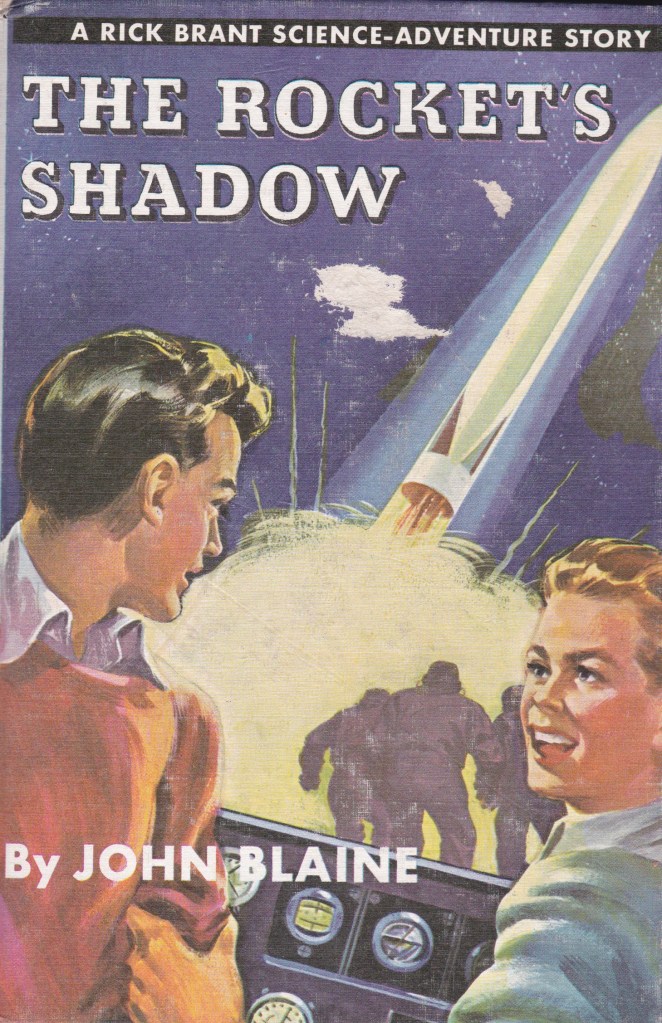
And so opens the first Rick Brant Science Adventure. I bought four Rick Brant books that day (The Rocket’s Shadow, The Egyptian Cat Mystery, The Flying Stingaree, and The Flaming Mountain), all of which had some appeal to me. I wasn’t really that much into science or rocket ships, but I did buy the first because it was, well, the first in the series, and OCD Child Greg had to read the first book. I didn’t have to read the series in order–I did try that with the Hardy Boys, but gave up when it was time for Book 4 and the title, The Missing Chums, didn’t excite me so I got one of the later volumes, The Mystery of the Aztec Warrior instead. There was a pyramid on the cover. I’ve always been a sucker for pyramids–but I always felt obligated to eventually get to the first volume of every series. It wasn’t always necessary, but in some cases–The Three Investigators, Trixie Belden, Judy Bolton–they really did set the stage for the rest of the series and it helped to have read the first one.

I’ll be completely honest here, too: I was never good at science. I don’t know why that was, but I just was never good at any of it–biology, chemistry, physics; math and science were my two Achilles heels. I only read a couple of the Tom Swift books, and even those were because one was reissued in paperback and renamed In the Jungle of the Mayas (the Mayans built pyramids!) but I got the impression the Swift books were more about science than a case or a mystery or anything. The Rick Brant series, on the other hand, while having some insane titles (The Electronic Mind Reader, The Wailing Octopus) like all series did, there were also some that were called “mysteries.” So, yes, science, but also mystery.

I also had no idea it was going to become one of my favorite series.

When I first read The Rocket’s Shadow in the late 1960s/early 1970s, it was already significantly dated. Originally published in either 1946 or 1947, the background to the story was that the scientists on Spindrift Island, off the coast of New Jersey, were trying to build a rocket to send to the moon. Several different groups were trying to accomplish this, and whoever succeeds first was going to get a very lucrative government contract…and their efforts are being sabotaged. Rick’s father, Dr. Hartson Brant, is world-renowned, and of course Rick is very interested in science and is always inventing things to either save time or effort, and they aren’t usually very practical, even though they do work. Rick and his younger sister Barby go to school on the mainland–Spindrift is separated from the coast by tidal flats that are underwater during high tide–but everyone on the island is determined that their rocket will succeed and they’ll catch the saboteurs.

Rick soon figures out a clue and gives chase to some of the saboteurs, who turn on him and attack him–only he is rescued by a blond hitchhiker carrying a military duffle. He and Rick run the attackers off, and then Rick brings his new friend, Don Scott–“Scotty”–home with him because he has no place to go. He’s out of the military and has no family, was just wandering the roads to see where he wound up. The close bond between Rick and Scotty1 resonated with me, especially their sense of camaraderie and affection for each other. They had no girlfriends or even any girls who might be potential dates at first (some were introduced in the series later, Barby growing up for Scotty and a new scientist comes to the island and has a teenaged daughter Jan who is sort of an interest for Rick–but the girls are never more important to them than they are to each other.2

Obviously, by the time I got and read the book we were already into the Apollo space programs from NASA, and we landed on the moon in 1969–so all the science in The Rocket’s Shadow was off and wrong–also the rocket got there in like twenty minutes, not possible even now–and as such, the series could never really be updated and revised like the Hardys and Nancy Drew. The Rocket’s Shadow would have had to have been completely rewritten, and I’m not sure how you could introduce Scotty as a hitchhiker/war vet (he lied about his age) today.

I enjoyed all the books in the series. I did eventually get them all over the years and read them, and many of them are dated. High tech walkie-talkies don’t seem so impressive in a cell phone world, and of course, there are some trips to foreign lands (Asia and Pacific Islands) that are probably more than a little racist and dated now. But I loved The Lost City, where they are off to Tibet to set up a radio receiver on the opposite side of the world from Spindrift to triangulate with the rocket on the moon, and they discover a lost city of Mongols and the tomb of Genghis Khan. They also meet, in that book, an Indian youth named Chahda who helps them out and becomes basically a member of the family, and they take him off the streets of Delhi and pay for him to go to school. Chahda was incredible smart and adventurous too–but not sure how he’d hold up under modern scrutiny in these more evolved times.

And maybe when I’m retired I’ll reread the series critically. The books can be found on ebay and second-hand sites; some are available as ebooks, either on Amazon or Project Gutenberg.

  1. I am even now wondering if this character is why I’ve always liked the name Scotty, and have used it repeatedly for characters of my own creation. ↩︎
  2. I do find in also amusing that my parents–so worried about me reading books about girls instead of boys; did they not understand just how homoerotic the relationships between boys in these books were. This amuses me greatly now. ↩︎

Judy in Disguise

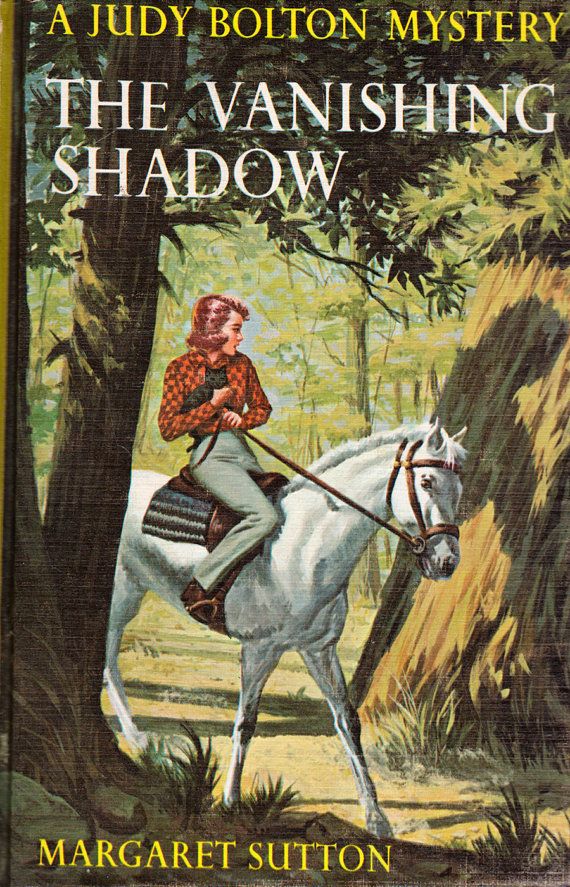
Judy Bolton was never quite as popular as Nancy Drew, but she has some very loyal and very partisan fans. Unlike Nancy Drew and the Hardy Boys (and perhaps some other Stratemeyer Syndicate series), there was only one writer for the entire length of the series, Margaret Sutton, and she wrote about her native Pennsylvania–the state is never mentioned in the series, but it’s close enough to New York for a short train ride to take you into the city, and it was pretty clear she had set the series in a fictional town in her native state. The series was also unique amongst kids’ series in that Judy aged–she was fifteen or sixteen in the first book, The Vanishing Shadow, eventually graduated from high school, and got married. The grandmother she is staying with at the farm in Dry Brook Hollow in that first book eventually passes away and leaves the farm to Judy, who moves into the old farmhouse with her husband and former high school boyfriend, Peter Dobbs.

I discovered Judy Bolton at Bargaintown USA, which eventually became Toys R Us. Their book wall, which was the back wall of the store, had every kids’ series in print at the time. I just stared at the wall in wonder, wondering how I would ever choose just one book out of the vast array of choices. I liked the title The Vanishing Shadow, and my parents–eager to get me to read about boys instead of girls–didn’t notice it was a “girls” book because the spine was green–Nancy Drew was a very bright yellow, and they’d trained themselves to watch out for those telltale yellow spines in time to negate the purchase. Like most kids’ series, the Judy Bolton books had never been revised or updated; they weren’t Stratemeyer Syndicate books and had a single author, for one (Sutton always felt Grosset & Dunlap “favored” Nancy Drew in marketing over Judy Bolton; and that her series would have been just as successful with the same marketing Nancy got), and so this initial book, originally published in 1932 (!!!) seemed a bit old-fashioned. I was also a bit surprised because Judy was kind of unpleasant and unlikable. She was especially mean and vicious to her younger brother Horace–who was timid, shy, and weak; dismissed as a coward by everyone including his sister–and she was incredibly bored, staying at her grandmother’s–which I could also related to as I often was bored when I spending the summer at my grandmother’s. Judy and her family actually lived nearby in the small city of Roulsville, which sat in the shadow of an enormous dam and reservoir. Judy overhears some suspicious characters talking about a weakness in the dam–and so she entertains herself trying to figure out what’s going on. There’s a very exciting climax where the dam itself does rupture, and Horace rides a horse into town to warn everyone to flee for safety, becoming in the process the hero of the Roulsville Flood. This surprising act of heroism for the formerly “cowardly” Horace has a strong effect on him, and he becomes a completely different person from then on–strong, confident, courageous. Judy also solves her mystery, involving shoddy construction of the dam and corruption, and all’s well that ends well–except the Boltons are now homeless.

My junior high school had a lot of the kids’ series in its library, and I checked out and read as many as I could–not just Judy Bolton, but other series like Biff Brewster and Ken Holt, that I also enjoyed (more on them later)–and in the second book of the series, The Haunted Attic, the Boltons move into an old but beautiful, reputedly haunted mansion in the nearby, much bigger than Roulsville city of Farringdon. Judy’s transition from her old high school to the new one in Farringdon brought its own set of challenges; her adventures in the first book also made Judy grow up some and become a little less self-centered and more concerned about helping other people, with a strong sense of right and wrong. The Judy Bolton series was kind of amazing and vastly different from the others in that Judy not only grew and evolved, but so did her friends. The books also tackled social issues, like class and snobbery and mean girls, while Judy also solved mysteries. She became friends with a group of kids, with both wealthy Arthur Farringdon-Pett and Peter Dobbs interested in her; Arthur’s sister Lois became Judy’s friend, but Lois’ other best friend Lorraine Lee was a bitch who was extremely jealous of Judy–but rather than dragging her for the filth she is, Judy feels more sorry for her than anything else, and is always kind to her.

One of the other things I really liked about this series–besides Judy aging and growing and changing from a teenager to an adult married woman over its run–was often Judy’s mysteries involved reuniting long lost children with their families. The Haunted Attic put her squarely in the sights of a criminal gang, who had a sad teenaged daughter Judy took pity on and befriended…eventually discovering she was actually Peter Dobbs’ sister, who everyone thought had died at birth. Judy and Peter eventually married, and they wound up living in her grandmother’s house in Dry Brook Hollow, which she inherited when her grandmother dies (off camera). Another thing I liked about the series was its careful attention to continuity–many of Judy’s later adventures were tied to the Roulsville Flood, or have long-running characters like Holly Potter who eventually have a mystery that needs clearing up by Judy; she and Peter also took in a little girl named Roberta who lived with them for several volumes before Judy finds out the truth about Roberta’s past and reunites her with her parents (The Clue of the Stone Lantern). Judy even deals with racism against Muslim-Americans in The Search for the Glowing Handwhich was pretty fucking far ahead of its time for the 1960s, don’t you think?

As you can see, advertising played up the fact that Sutton based her stories on real places and real events.

The last Bolton case written by Sutton herself was The Secret of the Sand Castle, which, of all things, takes Judy to FIRE ISLAND to solve a mystery. I know, right? When I finally got a copy of it (in very good condition, and far cheaper than I would have ever guessed it would be) I wasn’t surprised to read that Judy encountered no partying gay men, never wandered into the Pines at night by mistake, and so on. It was also set in the off-season, so there was no one else–or not many people, at any rate–out there on the barrier island with her.

I also liked that Peter, Judy’s husband, became an FBI agent after they were married, and sometimes Judy inadvertently got involved in one of his cases. Her cat Blackberry, originally gifted to her as a kitten in volume one, is “loaned” to Congress to catch mice in the basements of the Capital when she and Peter are living in Washington briefly because of his work–The Whispered Watchword involves a conspiracy against the US by a foreign enemy–before they return back to Dry Brook Hollow. Peter is also often away (gosh, sounds like Frank and Colin, doesn’t he?) so Judy is usually on her own when a mystery comes across her path. I also liked that Judy didn’t just become a wife when she married; she continued having adventures, even if she is a bit more deferential to Peter than I would have liked, but marriage neither changes her nor makes her settle down into domesticity, the way an actual baby would have; that was my biggest fear reading the series…that Sutton would eventually make her a mother. But that wouldn’t have flown with the audience or the publisher, I suppose (SEX! OMG JUDY AND PETER HAVE SEX!), so that’s why Roberta came along–to give Judy that “normal” look of having a child to look after now that she’s a wife.

Fans completed some of Sutton’s unfinished manuscripts after she died; while I am sure they are marvelous stories, maybe someday I’ll have an interest in reading either of them. But it’s hard for me to read someone else’s take on a long-running series; it just feels wrong to me, somehow and I know it’s irrational. I did like Ace Atkins’ take on Spenser, and I am going to read Alison Gaylin’s take on Parker’s Sunny Randall. (I also used to not like watching movies that were subtitled, either, so…change is possible.)

It would be very cool if someone could update this series, but I’m not sure if it can be done. The first book came out almost a hundred years ago (!), and times have changed dramatically since then. I always thought if I wrote a girl detective, she’d be a cross between Judy Bolton and Trixie Belden.

If Not For You

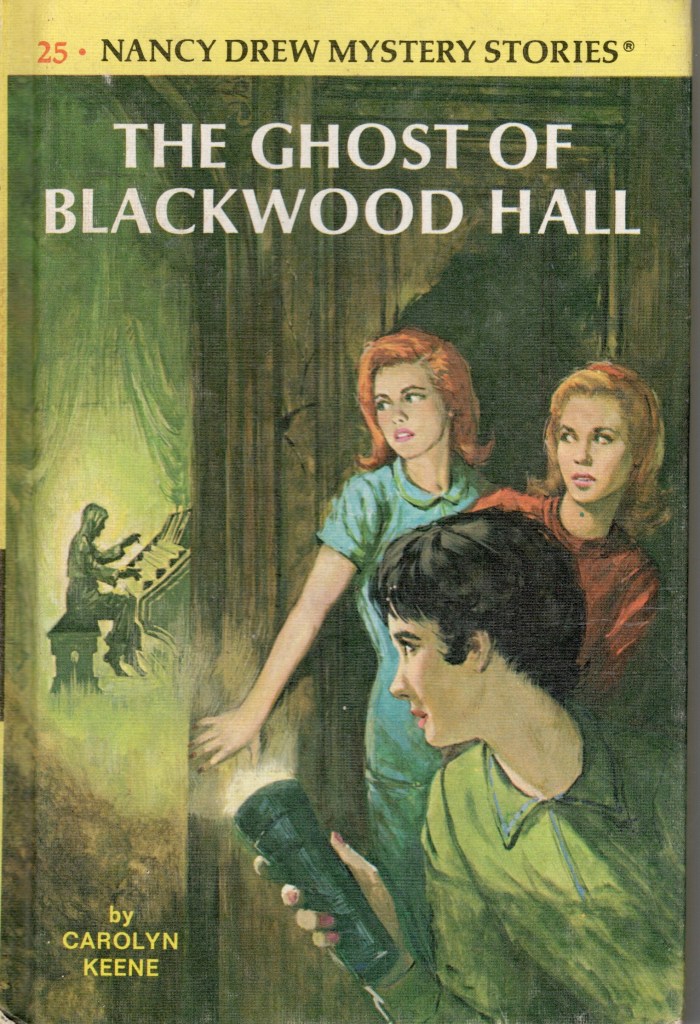
One of the most fun, for me, things about being a writer is being able to pay homage to books and writers I’ve enjoyed or felt a connection to in some way. I do this in at least every book I write–sometimes it’s as little a thing as having one of my characters reading a book I greatly enjoyed–and sometimes it’s a little more sly and tongue in cheek. For one example, I wondered occasionally while writing Bury Me in Shadows if anyone would notice that the name of the plantation house that burned during the Civil Was was Blackwood Hall–I only called it that once or twice; I usually referred to it as “the ruins”–and that it was a ghost story…hence The Ghost of Blackwood Hall, which had always been one of my favorite Nancy Drew mysteries when I was a kid (my favorite books in any series were ones that dealt with ghosts, hauntings, or the supernatural–it never was anything supernatural–in them; even as a kid I had, apparently, this morbid fascination with death and the afterlife that has continued into my adulthood). Vieux Carré Voodoo was also inspired, in some ways, by The Mystery of the Fiery Eye, one of my favorite Three Investigators mysteries–a jewel stolen from an idol that cultists will kill to get back is at the heart of both stories, and I also took inspiration somewhat from Wilkie Collins’ The Moonstone, which I had also read and loved as a child.

I’ve not picked up a Nancy Drew mystery in years to read through, until recently. I remember the series fondly–it wasn’t my favorite, nor was the Hardy Boys; but those books were more easily accessible and easier to find in stores and libraries than the other kids’ series, and with the kind of obsessive behavior I’ve always had–which hasn’t tempered much with the passage of time–once I started reading a series I wanted to read (and own) the complete set. This odd childhood obsession has never abated, even as I am now past sixty; I don’t have room to have all my series books out displayed on bookshelves (they are some of the boxes in the attic and the storage unit) and I think I am missing a few volumes from each series I do collect–but without being able to put them out, it’s hard for me to know which ones I am missing, so I’ve kind of held back on collecting them over the last decade or so. Discovering eBay in the wake of Hurricane Katrina was a big impetus in getting me to start collecting (trying to finish collecting) again, but the lack of space for storage–let alone putting them out on display in bookcases–inhibited me and I began to wonder about the advisability and the point of collecting children’s book series if I was simply going to put them in boxes and store them. It seemed kind of dumb, in all honesty, and so I stopped.

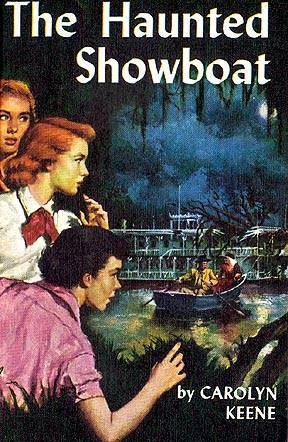
But the kids’ series had an enormous impact on me growing up and as a developing writer. I honestly think that The Haunted Showboat, number 35 in the Nancy Drew series, was my first actual encounter with New Orleans and Mardi Gras; it was either the fourth or fifth Nancy Drew mystery I had actually read (I started with The Secret of Red Gate Farm, The Mystery at Lilac Inn, and The Hidden Staircase; I think the next I read was The Haunted Showboat or Password to Larkspur Lane) and I do believe it was Nancy Drew who introduced me to New Orleans (outside of US History; I knew the Battle of New Orleans and the Louisiana Purchase and all of that, but this was my first non-historical introduction to the city).

I used to be able to list the books in order as well as give some background on the story; my memory isn’t quite as reliable on that score as it used to be. I joined some fan groups on Facebook, primarily to see if there were other alternatives than eBay and scouring second hand stores for the copies of the series books I am missing (and that’s a whole other story; there’s definitely a murder mystery novel that can be built around adult fans of kids’ series, seriously), and have been taken aback by the toxicity that can show up in these groups: hatred of anything new or daring or different to do with the characters (they have gone to TOWN on the new television series for both Nancy Drew and The Hardy Boys–hating changes and updates with the fiery white hot passion of a dozen burning suns–and it inevitably comes down to ‘political correctness’ and ‘being woke’–despite knowing that all the earlier series books were revised in the 1950s thru the early 1970s to get rid of dated stereotypes and racism), but that is a subject for a different time (I’ve not watched Nancy Drew–literally forgot about it–but I’ve liked The Hardy Boys).

Anyway, as I am writing a new Scotty book, I decided to do some research into Nancy Drew and New Orleans–mainly deciding to reread both books that were set, at least in part, here.

So, I went on line (much easier than going through the boxes in storage–which is yet another example of how stupid it is for me to keep storing books) and ordered copies of both The Haunted Showboat and The Ghost of Blackwood Hall, which, according to a synopsis I read on a Nancy Drew website, had Nancy, Bess and George come to New Orleans–which I didn’t remember. I remembered that the book was about Mrs. Putney being swindled out of her jewelry, and it had something to do with spiritualism, which eventually led Nancy and her friends to the abandoned, haunted Blackwood Hall–but I did not remember them coming to New Orleans. This struck me as strange–I certainly vividly remembered other parts of the story, particularly a scene when Ned and Nancy stumbled into quicksand (which, according to everything I read and saw on television and/or movies as a child, I thought would be more of a danger to me at every point of my life).

Both books arrived on the same day, but since I do remember The Haunted Showboat more than I remembered anything New Orleans with The Ghost of Blackwood Hall, I decided to look through the latter and read the New Orleans section again.

Yeesh.

Despite my obsession with collecting and reading the entire series, as I mentioned earlier, Nancy Drew was never my favorite of the kids’ series; I liked The Three Investigators and Ken Holt most of all, and I always thought both Trixie Belden (the original six) and Judy Bolton were better written and more interesting than Nancy (Judy was also a goody two-shoes, but she was more rounded and developed, as were her friends), and looking through The Ghost of Blackwood Hall made me remember why she was never a favorite; the books aren’t very well written. (The original texts were much better than the revised ones, but it was a very low bar to hurdle, seriously.) And yet I had to have all the books and read them all; I watched the 70s television series with pre-Dynasty Pamela Sue Martin; and I still sort of have a soft spot for good ole Nancy; but man, these revised texts are simply terrible–and the later, newer books steadily declined in quality–I remember one where Nancy and her friends, being chased by a bad guy, duck into a room and–this is so stupid, it was even shown as an illustration–hide by sitting in chairs and holding up picture frames because of course the bad guy would look at them sitting still and believe they were a photograph or a painting.

Even as a kid, I knew that was fucking stupid.

Anyway, so Nancy is hired by a jeweler to help out his client Mrs. Putney–who clearly isn’t the sharpest tool in the shed–who is a widow and received a message from “beyond the grave” from her husband that she needed to bury her most valuable jewelry in the woods for safekeeping. (She’s also told to tell “no man or woman” about this; which is why the jeweler brings her to Nancy because she’s a “girl”–but the jeweler is a man…I guess in her mind he doesn’t count because he’s the one who spots that her jewelry is all fake, once she’s reconsidered her stupidity and dug the jewels back up.) There’s a lot of gullibility and superstition in this book, for the record, that doesn’t really make any logical sense. In a weird sequence of events, Nancy winds up with the name of a man from New Orleans who was an accomplished jewelry designer and “capable of making fakes that look real”–so she decides to follow the clue to New Orleans to look for information on the man. Because of course. Anyway, despite the fact that Mrs. Putney isn’t paying for this trip and in fact warns her not to go–Carson Drew, Nancy’s father, decides to foot the bill for her, Bess and George to fly down to New Orleans and follow this laughable clue that could only be a valuable one in a Nancy Drew mystery. (As I was reading this part again, I started thinking about how expensive this would be back then–the revised text was written in 1967, the original in the late 1940’s–and how amazing it was that all three eighteen year old girls had nothing else to do and could hop on a flight to New Orleans just like that; I am sure even back then it was more expensive to buy a ticket at the last minute.)

None of this mattered, of course, to young Greg when he was reading it the first time…and yes, I am being harsh about a kids’ series book which I am clearly too old for, but c’mon. And I knew when I was a kid that the books weren’t well written. (One thing that always annoyed me about this series and the Hardy Boys was they never really deduced anything or solved an actual mystery; really, the books were usually about catching a criminal whose identity was known almost from the start through a series of contrivances.)

But…

Once they are in New Orleans–after Bess tells a strange woman on their flight where they are staying in city: Nancy, seated in front of them, was sorry their hotel had been named. She had wanted to keep their visit to New Orleans as secret as possible. Um, you’re on a flight to New Orleans. So, since it’s too late to call on the suspect’s former boss, they go sight-seeing–but Nancy ducks into every jewelry and/or pawn shop they come upon.

The trip proved to be pleasurable, if not profitable. Their inquiries led them into many sections of New Orleans. The French Quarter, where the buildings were charming in their elegance of a bygone day, interested them most. Beautiful ironwork, delicately tinted plaster walls, old courtyards, once the center of fashionable Creole family life, fascinated the girls.

On a balcony, a brightly-colored parrot chattered at them in friendly fashion. A smiling woman, bearing a basket of flowers, stopped to sell a flower to each girl. On all sides, the visitors saw interesting characters, and heard the soft-spoken dialect which was a blend of French, Cajun, and Gumbo.

GUMBO IS NOT A LANGUAGE.

And since Cajun is a derivative of French…sigh. And by 1967 New Orleans wasn’t really bilingual anymore. It had begun to die out around the turn of the twentieth century, and it’s definitely a rarity here now to find anyone native who speaks both English and French, or speaks French as their first language.

The next day they visit their suspect’s former employer, who knows nothing, and then do some site-seeing before lunch “in a quaint restaurant.”

“New Orleans is wonderful!” Bess exclaimed. Counting on her fingers, she added, “We’ve seen the banana wharf, the market, the garden district, and that old cemetery where all the dead are buried in tombs above the ground.”

“That’s because this place is below sea level,” said George. “Say, do you suppose that guide that we believed the story about the tomb which is supposed to glow at night with an unearthly light?”

“He said spirits come out and weave back and forth like wisps of fog,” said Bess.

“That’s just what they are–fog,” George declared practically.

“Oh, I don’t for a minute believe in ghosts,” Bess replied quickly.

“I wish we had time to go to Grand Isle, the haunt of Lafitte and his men,” said Nancy.

“Who is he?” Bess asked.

“He was a famous pirate,” Nancy replied. “According to tradition, when burying treasure, he always murdered one of his band and left his ghost to guard the hidden loot!”

I guess Bess never studied about the Battle of New Orleans–and no one at either the Stratemeyer Syndicate or Grosset & Dunlap knew that you capitalize “Garden District.” Then comes a really weird section where the girls visit a spiritualist photographer on whose works sometimes “spirit writing” appears. Naturally, Nancy’s image has a warning to stop sleuthing, and then the lights go out and when they come back on, the photographer is unconscious, along with Nancy, are gone! This for me is a particularly weird section. Nancy is the point of view character, even if at a distance. Why would you then switch to Bess and George frantically searching for Nancy rather than showing her capture and abduction and eventual escape? WHY HAVE THE ACTION TAKE PLACE OFF THE PAGE?

Oh, and when Nancy regained consciousness, she was tied up and trapped in a basement near the Quarter.

A basement. Near the French Quarter. In New Orleans, which we’ve already learned is below sea level and therefore bodies can’t be buried in the ground. So of course we have basements.

But Nancy leads the cops back to the house, where all evidence of her being tied up and so forth have disappeared:

To their surprise the policeman remarked soberly, “This isn’t the first time queer things have happened in this section of the city.”

Ah, so it must be the Faubourg Marigny. Lots of queers lived there and in the lower Quarter back then. But I guess the girls should consider themselves lucky that they found an English-speaking cop–who would never say “this section of the city.” He’d name the neighborhood–“this isn’t the first time queer things have happened in the Marigny.” So anyway, the girls decide to go home, and fortunately, there’s a flight from New Orleans to River Heights within an hour. They pack and head for the airport just in time to catch their flight home–when Bess mentions something else mysterious that is going on that she knows about and just hasn’t mentioned before for some reason, and of course, as always, this side story subplot is connected to the main one.

And that’s where I stopped, since that was the end of Nancy’s adventures in New Orleans.

Sigh.

The Haunted Showboat, on the other hand, opens with an immediate eye-roller for New Orleanians:

“Would a trip to the Mardi Gras interest you, Nancy, and also a mystery to solve?” Bess Marvin asked.

Mardi Gras is French for Fat Tuesday, so basically Bess just asked her if she would interested in a trip to “the Fat Tuesday.” Yes, I am well aware that outside of New Orleans it’s all lazily considered Mardi Gras, but it’s really Carnival. Mardi Gras is quite literally Fat Tuesday, the final day of Carnival, and while I’ve grudgingly come to accept that there’s no way that people will ever not refer to the entire event as “Mardi Gras”–even I have a tendency to get lazy and say”Mardi Gras” when I mean Carnival–it will never not bother me. Of course, Bess isn’t from Louisiana and she can be forgiven for getting this wrong, and even using “the” as unnecessary definitive article can be forgiven. But–and this is something that always annoyed me about both Nancy Drew and the Hardy Boys–never is it mentioned in this book that Nancy and her friends have been to New Orleans before, and never was it mentioned on that previous trip in The Ghost of Blackwood Hall that Bess and George have New Orleans relatives.

Wouldn’t you think that would have come up in The Ghost of Blackwood Hall? Of course it didn’t, because when book 25 was written they had no idea that Book 35 would return Nancy and friends to New Orleans and Louisiana. (This kind of continuity thing used to drive me nuts; Nancy and the Hardys were ‘well known’ as amateur detectives, and every book opens with a reference to their first series book as well as the most recent, and closed with a teaser for the next, despite the fact that really, every mystery they solved was a stand alone with no connections to the past or the future. A couple of other continuity errors that always bugged me with Nancy is that Ned is mentioned as her boyfriend in the revised text of Number 5, The Secret at Shadow Ranch even though she meets him for the first time in Number 7, The Clue in the Diary; she finds her dog Togo as a stray at the opening of The Whispering Statue’s original text; but she already has Togo in the revised text of earlier volumes and yes, I am aware that I have spent way too much time in my life obsessing about Nancy Drew and continuity errors in the series–and there are a lot.)

Anyway.

If anything, The Haunted Showboat is actually worse than The Ghost of Blackwood Hall in so many ways, and not just in the aforementioned minor ways. First of all, the cousin of Bess and George’s, who invited them down, is named Donna Mae, because back in the day you could always make your audience know “hey this is set in the South” by giving a female character two first names–and always something Mae. (Ellie Mae Clampett is another example; for the record, out of dozen and dozens of southern women relatives there is exactly one whose name was “Something Mae”.) It takes a while for them to get to Louisiana–Nancy’s car is stolen once, and the replacement is sabotaged–because of course the criminals down in Louisiana will stop at nothing to keep this teenager from the midwest to interfere with their plans!–but there’s one part of their trip that is absolutely hilarious: they drive through Mobile on their way to New Orleans, but somehow get to the Mississippi River before they get to New Orleans or the plantation outside of town they are visiting:

Soon the girls reached the broad Mississippi and gazed at the peaceful, somewhat muddy river.

SOMEWHAT MUDDY?

Nancy then follows the River Road and turns inland. This geography makes literally no sense at all. But..it’s Nancy Drew, and the worst is yet to come.

You see, the Havers–who live at Sunnymead–have two black servants: Mammy Matilda and Pappy Cole. And oh yes, it’s just as racist and horrible as you can imagine–especially when you add in the “voodoo drums” they hear when canoeing through the swamp to get to the wrecked and haunted showboat, the River Princess. Anyway, yes, you can just imagine how dated and awful these depictions are. And everyone calls it “the Mardi Gras,” which no one does in the real world, either. The Quarter is referred to (correctly) as the “Vieux Carré”, but an aside says “or the old city”–it means “old square”, not old city–and of course they have lunch at Antoine’s.

There’s also an Uncle Rufus, who lives in the swamp in a tiny cabin and does voodoo spells.

There’s also a swamp episode and a wrecked, haunted showboat in an episode of Scooby Doo Where Are You?, which I’ve always wondered whether it was inspired (or stolen) from this edition.

So, neither book has aged particularly well–I’m still trying to wrap my mind around Gumbo as a language–and I suppose I shouldn’t be surprised by the racist depictions of Black characters in The Haunted Showboat, but the book is still in print and kids are still reading it. Everyone knows that the original texts of the Hardy Boys and Nancy Drew series were updated in the 1950’s and through the 1960’s to get rid of problematic depictions of non-white characters; it might not be a bad idea for them to do it again now. No one should be reading The Haunted Showboat as it stands today, really.

But it was an interesting time travel to revisit the books again. At some point I’d love to talk about all the kids’ series I read when I was a child, but…time.

Everyone Everywhere

Happy Mardi Gras everyone!

Yesterday was simply a dreadful day, weather-wise; I imagine today isn’t going to be very much better, in all honesty. It’s 26 degrees in New Orleans right now, give or take. I am sitting at my desk in layers, the space heater going full blast, water is dripping out of every faucet to protect the pipes, and I’m about to go look for my fingerless gloves. FOUND THEM! I am glad Carnival has essentially be canceled for the most part–it’s too fucking cold, seriously. The high for today is predicted to be 36…which would usually be some kind of record low. But looking outside the windows I don’t see snow anywhere—at least we don’t have that to deal with. I am kind of dreading getting up at six tomorrow morning to go to the office. It’s going to be incredibly miserable, but at least then I have two work-at-home days. This cold snap is only supposed to last through the weekend, but during the ays it will get up to the 50’s and finally, by Sunday we’ll be back to the normal winter weather for New Orleans. It won’t be easy, but we’ll make it through somehow.

Our heat doesn’t work, by the way, so if it’s 26 outside it’s about that inside, give or take a few degrees. If I didn’t have to do a ZOOM thing later this morning I’d repair back to the bed with iPad and laptop and a book to read; I still may do that after the class ZOOM thing is finished.

My goal for yesterday was to get caught up some on my emails–I managed to get that accomplished, although even more have shown up this morning–and to print out the manuscript preparatory for the big edit/revise. This last one, while I may have called it the last draft, is actually a part of preparing the final draft; I wanted to get through the entire thing changing it from past tense to present tense, while also reading and getting an idea of what all needs to be added or deleted. This next pass through the printed pages will be where I make the notes to revise the language used, and then figure out where the new pieces I need to write need to go. The last and final pass will be a line edit, basically, where I try to catch all the mistakes and things that got missed when I changed things before. I am on track to be finished by the end of the month, or at least by the end of the first weekend of March, with any luck.

We got deeper into season two of Mr. Mercedes last night, and are still enjoying it; we only intended to watch one episode, and wound up getting through four, with only four left, which at some point today–it’s Fat Tuesday, after all–we will most likely finish the show off. After a slow start the season has really picked up; I didn’t really want to stop watching last night, but it was already past eleven and I needed to get to bed–getting up at six tomorrow is going to be hard enough, given the cold, and sleeping in really late today would not have helped that situation in the least–but it’s nice to know that it’s there waiting for us when we finally are ready today. I’m not sure if Paul is going to work today–well, he’s not going to the office for sure, but whether he is going to make phone calls or send emails remains to be seen. It’s so weird to be up at this hour on Fat Tuesday and not hear a crowd at the corner or the drums of the marching bands. I really do miss the high school marching bands; especially the public school ones and the Marching 100 of St. Augustine’s; “St. Aug’s”, as we call them down here.

While I was printing out the manuscript yesterday morning I did a deep dive into the Internet about the Three Investigators, which, in my humble opinion, is one of the best (if not the best) of the kids’ mystery series. One of the other things I was doing yesterday involved contracts for MWA’s upcoming mystery writing handbook, How to Write a Mystery, edited by the amazing Lee Child and Laurie R. King; so as I was reading an interview with the ghost writer for several of the Three Investigators books–including several of my favorites–and the name seemed familiar, as did that of his wife–so I made notes on the notepad that always sits next to my mouse to look them up and see why the names seemed familiar. Imagine my surprise when someone responded to the emailed contracts with an issue, and it turned out to be the ghost writer’s wife! That was why the name was familiar; I had seen it very recently. One of those weird, synchronistic elements of my life, I suppose, but it was still kind of cool to be corresponding with the wife of a Three Investigators ghost writer. The original author of the series, who created it and wrote ten of the first eleven volumes, Robert Arthur, also deeply interests me.

I also realized that, in some ways, I had mimicked The Three Investigators with the Scotty series: while the series is written in the first person, there are three of them; Scotty, Frank, and Colin. My original plans when I was a child for my own series initially began with a single character to hang the series on; it eventually evolved into three friends solving mysteries–and yes, the concept of there being three was not unique to, or originated by, the Three Investigators–the Hardy Boys and their pal, Chet; Nancy Drew with Bess and George; Judy Bolton and two separate groups of three (either with Irene and Honey, or with Lorraine and Lois); etc. (I’ve also always wondered, in the back of my mind, if having three precluded any notions of homoeroticism; it certainly existed in the Ken Holt series with his best bud Sandy, or in the Rick Brant with his buddy Scotty–which has also made me wonder lately if that’s where the name for my Scotty came from… since having three meant including a chaperone).

So, I intend to spend the rest of the morning straightening up the kitchen to serve as the backdrop for my ZOOM session, swilling coffee and trying to stay warm. So, on that note I am heading back into the spice mines, and will catch you on Ash Wednesday. Have a great day, Constant Reader, as always.

Only the Wind

While the official first day of the summer season isn’t here quite yet, it’s already summertime in New Orleans–with everything that means. The thick heavy wet air that clings to you like a warm wet wool blanket; the beautifully bright and yellow sunlight that burns your skin red as it pierces through the windows of your car; and the climbing electric bills as your air conditioning unit desperately tries–and only occasionally succeeds–to keep the temperature livable and breathable inside your home. Tourists who come to New Orleans often complain about the extreme difference in temperature from going inside to out and back inside again; how cold it is everywhere in doors; that the shorts and tank tops, soggy and wet from sweat, aren’t enough covering as the they dry in the cold frigid inside air. It is really impossible to know how to dress in New Orleans when it’s hot; but those of us who live here are used to it, but you never get used to how just existing and moving around outside sucks the energy right out of you, and sometimes–like when you’re lugging all the shit you bought at Costco in from the car–you have to just sit for a spell, chug some cold water or Gatorade (or a daiquiri if you planned ahead), and collect yourself.

That was my yesterday. As you may have noticed had you paid close attention, I had been unwell for a while; primarily from forgetting that I have to be more cautious dealing with heat and more careful and mindful of the maintenance required for my older body. This whole thing started with me being unable to sleep for several nights in a row, and the moved on to severe dehydration and exhaustion and stomach issues. This led to another COVID-19 test, being sent home from work, and a slow recovery. But after days of drinking lots of water, avoiding caffeine (much to my own detriment when it comes to productivity), and good sleep–as well as staying inside as much as possible–I am finally, this morning, feeling like myself once again; energetic and creative and ready to go. I took two more vacation days this week–Wednesday and Thursday–to continue my rest and recovery, and it seems to have done the trick (I was really worried about the Costco trip being a setback; but I am stubborn and I wanted to get it out of the way; but I downed lots of water before I went, took a Gatorade with me, and had another after I got home).

And this morning, yes, I feel like me again for the first time in what seems like an incredibly long time.

I’m working from home today, which means data entry and making condom packs while streaming things on the television; I should finish the first season of Jonny Quest today, since the episodes are only about twenty-four minutes long; which makes me wonder if that’s why it had such a short run on Saturday mornings when I was a child–not enough time left for commercials. Scooby Doo Where Are You? episodes are 21-22 minutes. Money is key, and despite some problematic issues with the show (it was produced in the 1960’s, after all) it still holds up pretty well. It did put me in mind of another kids’ book series I read when I was younger–the Rick Brant Science Adventures by John Blaine, which was yet another one of the many Grosset & Dunlap series. Like the Ken Holt series I talked about recently, the Rick Brant series was never as popular as the Hardy Boys (nothing ever achieved the popularity of Nancy Drew), but were much more interesting, more action-packed, involved actual detective work, and were far better written. The similarities between Jonny Quest and Rick Brant are staggering; the Quests live on an island; Rick and his family also lived on Spindrift Island, separated by tidal flats from the coast on New Jersey. The Quests sort of adopted Hadji, who became Jonny’s best friend; Rick’s best friend is Don Scott (Scotty), and the Brants unofficially adopt him into their family. Jonny and his family go all over the world having adventures and solving mysteries having to do with science, for the most part; Rick and Scotty do the same. Jonny’s father is world-famous scientific genius Benton Quest; Rick’s father is world-famous scientific genius Hartson Brant.

The first few Rick Brants I read, like Ken Holt, I obtained off the sales table in the bargain basement at Goldblatt’s in Chicago: The Rocket’s Shadow, The Egyptian Cat Mystery, The Flying Stingaree, and The Flaming Mountain. Over the years, I found more of them at swap meets and flea markets and used bookstores; I think I met have an almost complete set of them now (I did acquire some via eBay after Katrina). Some of the books are now available for download on Project Gutenberg; several volumes from a variety of those old kids’ series–including Ken Holt, Judy Bolton, and Biff Brewster–are there (and yes, I downloaded all of them). I want to start revisiting some of these series, since they influenced me into becoming a mystery writer, and while scientific knowledge has proceeded incredibly rapidly since the Brant series were published and went out of print, it’s kind of fun to go back and revisit the world of cutting-edge science (or what was seen as futuristic science) at the time; The Rocket’s Shadow was basically about how the Spindrift Island scientists (other scientists and their families also lived on the island) were racing to build and launch a moon rocket–the case involved Rick trying to solve the mystery of who on the island was a traitor and leaking secret information about the rocket project to a competitor; Scotty rescues him from the bad guys in the first chapter. Scotty was a military veteran who lied about his age to enlist and fight in the war (World War II; the book was originally published in 1947)–which was glossed over and ignored as time passed and the series continued, which would have aged him. This was twenty-two years before the actual moon landing, so to kids reading this in 1947 and the years after, it was kind of science fiction.

We will finish the final two episodes of Elite that are available tonight, and then will have to wait for season four. They had started filming before the world shut down, alas, so there’s no telling how long it will be before we get another season to binge and love. I also am not sure how the show is going to continue; this season has them all graduating and the crime this season is focusing on occurs at the graduation party. I can’t praise this show enough; it’s completely addicting, and there are never any slow parts. The way they have developed the characters and their relationships with each other make total sense and are completely believable, despite the sometimes completely over-the-top situations they find themselves in. Once we finish watching, I will devote an entire entry to discussing the show. But seriously–you won’t be sorry if you watch.

And now back to the spice mines. Have a lovely day, everyone.

If You’ve Got the Money, I’ve Got The Time

One of the things I find fascinating about many people is their dedication to nostalgia; their insistence that some past time of their life was somehow this incredibly magical time of innocence (which it could conceivably have been); a utopia paradise of some sort where everything was right with the world and everyone was so happy and–you get the picture. It’s like how people glowingly refer to high school as one of the “best times of their lives” (which, frankly, is terribly sad and tells me more about their present circumstances than I’d care to know); the past wasn’t magic and neither were our childhoods. If they mean I liked life better before I knew how awful it can be, that I can understand–and I do think that is what they actually mean, even if it isn’t what they are actually saying: they preferred life when the bills and putting food on the table was someone else’s responsibility; when the biggest worries were who will I go to the Homecoming dance with and I have to study for that History test and so forth. But my teenaged years weren’t halcyon and rosy. The 1970’s was a very strange decade of reaction to the 1960’s–and for a queer kid, first trapped in a middle to upper middle class suburb of Chicago and then a small rural town in Kansas, it was hard. I’ve no desire to ever relive high school or go back to being a teenager. Sure, it might be easier to be a queer teen  in a Chicago suburb now–but I suspect it’s not that different in a rural high school in Kansas now than it was forty years ago.

Reading was always my escape from the pressures of a world into which I really didn’t fit–and one that from my earliest memories as a child I knew I didn’t belong in. Reading was a godsend for me, and I read ravenously. I was always being told to go outside and play instead of reading; the most effective punishments were the ones either prohibiting me from reading or limiting how much I could read, and the earliest signs of my obsessive/compulsive disorder were evident with my discovery of the mystery series for kids, which was the next gradual move for me as a reader from the Scholastic Book Fair mysteries. My goal has always been to finish collecting all the series I read and collected as a child: the Hardy Boys, Nancy Drew, the Dana Girls, The Three Investigators and Trixie Belden, as well as the lesser known ones like Biff Brewster, Ken Holt (over whom I had a weird bonding moment with James Ellroy), Rick Brant, Vicki Barr, Judy Bolton, Cherry Ames, Kay Tracey, and Connie Blair. (I also collected the Chip Hilton sports series.) I still have the copies I had as a child, and in the aftermath of Hurricane Katrina, I discovered eBay and tried to finish collecting the series. I don’t have room in the Lost Apartment to display them proudly in a bookcase–I have far too many books; and many of them are boxed up and stored–but I refuse to rid myself of them, because I keep holding out hope that someday I will live in an apartment or condo or house where I can have a room filled with bookcases that will also serve as my office.

But eBay gradually led me to collectors’ and fan pages of these books on Facebook..occasionally someone on one of those pages will be selling a copy of something I need to complete my collections.  There is a generic page for series books in general, and then there are individual pages for Nancy Drew and the Hardy Boys, respectively–and probably still others for the other series that I don’t know about. I know there are also fan websites and serious scholarship on the kids’ series–some of them make for interesting reading, if you have some free time (or are wasting time you should be spending on writing). Some of the fan websites also have conferences and trips–the Nancy Drew group, for example, has an annual trip to where one of the books was set, and tours and so forth to visit the places Nancy also went to look for clues in the course of her investigation. (They were in New Orleans a few years ago; I was going to register–it’s not cheap–until I realized it was more about being a fan than anything else.)

And boy, do these people take their series fandom seriously. I’m not as rabid or as devoted as the majority of them; periodically I might reread one of the series books (I’d love to write an essay about the Ken Holt series, which was darker and more hard-boiled than any of the others; which was why James Ellroy and I bonded over them–which is still so weird to me), but I don’t reread an entire series from beginning to end, and while I used to remember plot details quite vividly, as I’ve gotten older those memories are fading.

I’ve not watched the new CW series Nancy Drew–well, I watched the first episode but didn’t keep watching; primarily because I haven’t had time and Paul and I usually watch shows together–at least, I like to give him a chance to watch something I might enjoy before moving on to watch it on my own (like Riverdale). Maybe he’ll be interested in Nancy Drew, maybe he won’t; I thought he’d like Riverdale but he didn’t. Maybe Nancy Drew is something I’ll wind up watching while he’s working in the evenings; I don’t know. But I’ve also not seen the recent film adaptation, Nancy Drew and the Hidden Staircase, either. But boy, do these Nancy Drew fans take their Nancy Drew seriously. They were outraged that Nancy Drew had sex in the first episode (because Nancy of course never had sex in the series; I don’t even think she even enjoyed a chaste kiss from Ned in all 58 of the original books) and Ned Nickerson was black! Nancy Drew was not only having sex but she was having sex with a black teenager!

The pearls were clutched so tightly! And if you stuck a piece of coal up these people’s asses, it would have come out a diamond. There was a lot of moaning and whining about people’s childhoods being ruined (really? Mine is still just fine) and the “horrors of political correctness” and on and on and on. In other words, Nancy should be a virgin and only know white, straight, cishet people. Got it.

Anyway, Hulu recently announced that they are doing a Hardy Boys series; however, instead of Bayport the town is Bridgeport; their first case is their mother’s murder; and rather than being 18 and 17, their ages will be 16 and 12. Their father is off investigating the murder and so he deposits them with their aunt in Bridgeport, but they soon realize their mother’s death is somehow connected to the town–and everyone in town is a suspect.

Yes, these are significant changes to the original canon of the Hardy Boys, but also remember: The Mickey Mouse Club did two serialized versions of the Hardy Boys, making them also about 13 and 14. The Hardy Boys fans are fan with this, of course, and with the other changes Disney made…so what’s the problem? As someone pointed out, in response to all the whining and moaning about ruining characters and childhoods and “political correctness”, someone also commented, grumpily, “I suppose Chet will be slim, gay, and black”–which actually sounded kind of good to me, frankly. The character of Chet is overweight and loves to eat (kind of like Bess in the Nancy series) and also like Bess, his appetite and weight are the subject of lots of jokes, teasing and sometimes humiliation. Not really cool, if we’re being completely honest.

And yes, all of these people are grandparents with graying hair and are white people. All of this whining and complaining over two television series based on characters that have evolved and changed and been rewritten multiple times in the nearly hundred years they’ve been around–to appeal to  new generations of readers. The original versions of the books were all revised in the 1950’s and 1960’s because they were loaded with racial and ethnic stereotypes that were beyond offensive; naturally, the nice old white people prefer the original texts (big shock, right?).

And if any kids’ series need to be turned into television programs, can I vote for The Three Investigators and Encyclopedia Brown?

I am really tired of this whole “you’re ruining my childhood” nonsense. Unless they are traveling back in time to do so, your childhood hasn’t changed.

I’ve always wanted to write a book about kids’ series fans and conventions; I might just have to now. I mean, I get it–people don’t like change, and something that was beloved when you were a child you want frozen in amber forever. But I just wish these people would unpack their issues with the updates and changes–and nothing gets my gorge going more than the ever popular whine of every racist, misogynist, and homophobic piece of shit out there: politically correct. Sorry you don’t feel safe expressing your hateful bigoted opinions any more without consequence.

I’ve also always wanted to write my own middle-grade series; I used to think about that all the time when I was a kid, even up to coming up with characters and titles for the books in the series because of course I did. I don’t know if I can write middle-grade or not; but it’s worth a shot sometime.

And of course, I can talk for hours on the subject of the kids’ series. Perhaps someday I will.

1801217_10152346389544050_285672915_o

U Got the Look

This week, The CW debuted a new version of Nancy Drew. I sort of watched it Thursday night, and will probably watch again so I can pay better attention. It’s definitely a reboot, with a lot of changes–Nancy’s mom died much later in her life, for example, and there’s no Bess. The story is also set in Horseshoe Bay rather than River Heights, and Nancy has hung up her sleuthing cap since her mother’s death and is now working as a waitress in a diner. George Fayne isn’t a close friend but now her boss, and they don’t get along–I expect that to change. Ned Nickerson is not white–a change I liked a lot–and prefers to go by Nick. It’s also a bit more in the vein of Riverdale than the classic Nancy Drew stories, but let’s face it–the real Nancy as originally written is kind of insufferable–bit more on that later.

I’m also sure these changes will enrage the Nancy Drew fanbase–anything other than the way she was originally written by a lot of ghostwriters generally sets them off. I am not such a purist–I recognize that changes have to be made for a different medium, for one thing, and for another–as I said earlier, Nancy was a bit insufferable as originally written.

I did enjoy the movie a few years ago with Emma Roberts (it might be the only time I’ve ever actually enjoyed an Emma Roberts performance, frankly); a lot was changed from the books to the series.

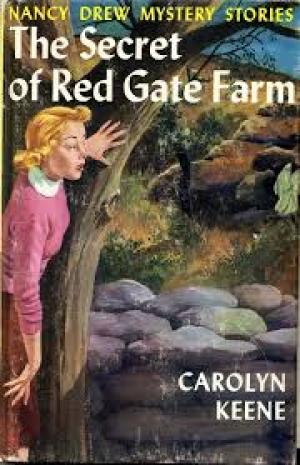
Nancy Drew and I go back to my fifth grade year at Eli Whitney Elementary in Chicago. I was already reading as many mysteries as I could get my hands on–those Scholastic Book Fairs were my favorite part of school–and I was checking out as many mysteries from the library as I could. (This was also the period of time when I discovered Phyllis Whitney’s mysteries for children; the first I read was The Secret of the Tiger’s Eye.) My fifth grade teacher had a big table in the back of the room with books for kids on them; we were on the honor system. We could borrow a book but we were supposed to return it when we finished reading it. The first day of school I wandered back there and looked at the books on the table; the first title to jump out at me was The Secret of Red Gate Farm. Above the title was NANCY DREW MYSTERY SERIES, and on the cover was a picture of a girl with wavy blonde hair, wearing a sweater and a long skirt, hiding behind a tree and looking, her mouth wide open in shock, fear or surprise, staring at the entrance to a cave  as some strangely robed figures entered it. I took it back to my desk, and started reading it.

red gate farm

“That Oriental-looking clerk in the perfume shop certainly acted mysterious, ” Bess Marvin declared, as she and her two friends ended their shopping trip and hurried down the street to the railroad station.

“Yes,” Nancy Drew answered thoughtfully. “I wonder why she didn’t want you to buy that bottle of Blue Jade?”

“The price would have discouraged me,” spoke up Bess’ cousin, dark-haired George Fayne. Her boyish name fitted her slim build and straight-forward, breezy manner. “Twenty dollars an ounce!”

“Oriental-looking.”

Sigh. The great irony is that both the Nancy Drew and Hardy Boys series were rewritten and revised to remove racist stereotypes and language…

Anyway, The Secret of Red Gate Farm enthralled me, as Nancy and her friends tried to help a young girl and her grandmother save Red Gate Farm from mortgage foreclosure while also trying to expose a ring of counterfeiters. There was a list of intriguing-sounding Nancy Drew titles on the back of the book, and back on the table in my fifth grade classroom there were three more titles: The Mystery at Lilac Inn, The Haunted Showboat, and The Clue of the Leaning Chimney. As I scoped around, there was another series novel, but it wasn’t Nancy Drew; it was the Dana Girls The Secret of the Old Well, allegedly written by the same person: Carolyn Keene.

Nancy Drew introduced me to the world of Grosset & Dunlap series–which were actually all produced, for the most part, by the Stratemeyer Syndicate. I eventually found myself reading–and collecting–many of those series, including the Hardy Boys, Dana Girls, Ken Holt, Rick Brant, Biff Brewster, Chip Hilton, and Judy Bolton, among others–I also wound up collecting Trixie Belden and the Three Investigators, too.

I always wanted to write a series like these when I was a kid; I even came up with a list of about forty titles I could use. I wrote one, actually, when I was in the fifth grade–called The Secret of the Haunted Mansion–which, to the best of my recollection, might be the first fiction I ever wrote; alas, it is lost in the mists of time. Periodically, I come back to the thought of writing such a series, but I don’t know that there’s a market for them anymore. Most of the series have gone out of print, with only Nancy Drew and the Hardy Boys, as far as I know, still available; Trixie Belden might be but I’m not sure. I still collect the books–it really pleases my OCD to have the series completed. I’m still missing a few from some of the harder to find series–like Biff Brewster and Ken Holt, and I do think I am missing a couple of Judy Boltons and Dana Girls as well–but I’ve stopped scouring eBay over the last few years because, well, money.

But at some point, I imagine I will go back and try to complete the series.

I do credit these series with a lot of my devotion to the world of crime and crime writing; while I always loved mysteries, it’s entirely possible I would have moved on to something else had I not discovered, and become addicted, to these series. These series led me eventually to Agatha Christie, Mary Stewart, Charlotte Armstrong, and Ellery Queen; and those authors eventually led me to others…and wanting to write crime fiction of my own.

So, thank you, Nancy Drew. It’s kind of your fault.