Sussudio

Ah, Thursday.

Yesterday I pulled a couple of wisdom teeth–i.e. worked on two short stories, only managing to drag about two thousand words total out of me between the two–so I suppose, over all,  the day was a win. Two thousand words are two thousand words, but neither story is finished; neither story is half finished; I know how to end them but I don’t know how to get there. So, I need to spend some time with the peacock book, scribbling thoughts and ideas and figuring some things out before going back to work on them In a moment of augh what a fucking mess I organized and filed the stuff piling up around my desk here in the kitchen–being able to file away two stories that are sold, for example, and stacking up the ones in progress. Imagine my surprise to find that right now I am working on–not counting the two I was mentioning previously–nine stories, for a total of eleven in some degree of progress. JFC. That wears me out just thinking about it. But one I think is for an anthology that has a due date coming up, so I need to get it polished and into submission shape; and I’ll start whipping some of these others into shape between now and End of Festivals, at which point I need to seriously focus on WIP and the Scotty book again. I also have another story out for submission right now, and am about to hit send on another this weekend (this one is one of the eleven aforementioned; the other is not). So, since January 1, I have worked on/written somewhere around thirteen or fourteen short stories.

Yeesh.

And, since each story is roughly, on average 4500 words….that’s 63000 words approximately since the beginning of the year…which isn’t counting the Scotty or the WIP.

Fuck me. I guess I can stop beating myself up about being lazy.

That’s another thing about short stories, though; because each is an individual project, all on its own–unless and until you take stock, like I did last night, you don’t realize how much actual work you’ve done. Granted, all of them are in various stages of production; first drafts, second drafts, some are closer to being finished than others, some are finished. But when you’re working on a novel, and know your word count, you always know how much work you’ve done and how much you have left to do. And focusing on writing these stories–which are almost enough for a collection all on their own–which is also something I’m considering. I had already published enough crime and horror short stories to put a book together. Hmmmm.

I also read a couple of short stories. First up is “You’ll Always Remember Me” by Steve Fisher, from Best Noir of the 20th Century, edited by James Ellroy and Otto Penzler.

I could tell it was Pushton blowing the bugle and I got out of bed tearing half of the bedclothes with me. I ran to the door and yelled, “Drown it! Drown it! Drown it!” and then I slammed the door and went along the row of beds and pulled the covers off the rest of the guys and said:

“Come on, get up. Get up! Don’t you hear Pushton out there blowing his stinky lungs out?”

I hate bugles anyway, but the way this guy Pushton all but murders reveille kills me. I hadn’t slept very well, thinking of the news I was going to hear this morning, one way or the other, and then to be jarred out of what sleep I could get by Pushton climaxed everything.

Set in a military school, this is an absolutely chilling story told from the point of view of Thorpe, a student at the school. A girl he is dating’s older brother has been convicted of murdering their father; they are waiting for either a pardon or a commutation of the death sentence. Thorpe comes across, at first, as a typical self-absorbed teenager who sees events and the world only in how they directly affect and impact him. But as the story progresses and we get to know Thorpe better…the suspense and tension builds as the story moves forward to its inevitable, inescapable end. Very well done, and creepya s fuck.

I also read a Shirley Jackson story, from the collection Just an Ordinary Day, “The Smoking Room”:

He was taller than I imagined him. And noisier. Here I was, all by myself, downstairs in the dormitory smoking room with my typewriter, and all of a sudden there was a terrific crash and sort of sizzle, and I turned around and there he was.

“Can’t you be a little quieter?” I said. “I’m trying to work.”

He just stood there, with smoke rolling off his head. “This is as quietly as I can do it,” he said apologetically. “It takes a lot of explosive power, you know.”

“Well, explode somewhere else,” I said. “Men aren’t allowed in here.”

It’s a very short story, and clever and witty in that way only Jackson could manage: it’s a deal-with-the-devil story that turns the traditional trope on its head; not only is the young woman–who never has a name–unimpressed with the devil and what he can do for her, she’s also smarter than he is. I enjoyed this five page story, which leads off this collection, very much.

And now, back to the spice mines.

IMG_2260

New Moon on Monday

I made it to the gym again yesterday, which felt fantastic–despite the fact that I added a set to everything, and upped the speed of the treadmill by .2 miles per hour. The stretching helps; I can’t believe I worked out all those years without bothering to ever take the time to stop and stretch (okay, yes, I was naturally flexible, but I wouldn’t have lost the level of flexibility I had if I’d been stretching all those years). I also organized a bit, did some chores around the house, and wrote the first draft of a story for an anthology with a deadline of February 15th. The story’s not quite there yet, but I think it’s not only a good idea but one that revisions and rewrites will only make stronger. Huzzah! And yay for me!

It was also in the seventies (!!!) yesterday; considering just three days ago we had a hard freeze…yeah, the weather in southeastern Louisiana might be a bit bipolar. I also had a breakthrough on how to revise the first chapter, not only of the WIP but of the Scotty as well. Hallelujah! I really think this focus and positivity mantra might actually be working. Granted, it’s still only January, but between the working out, and the writing…yeah, this is turning into a much better year already than last.

I also read some short stories!

First up was “Music for Chameleons.” by Truman Capote, from his collection Music for Chameleons:

She is tall and slender, perhaps seventy, silver-haired, soigne, neither black nor white, a pale golden rum color. She is a Martinique aristocrat who lives in Fort de France but also has an apartment in Paris. We are sitting on the terrace of her house, an airy, elegant house that looks as if it was made of wooden lace: it reminds me of certain old New Orleans houses. We are drinking iced mint tea slightly flavored with absinthe.

Three green chameleons race one another across the terrace; one pauses at Madame’s feet, flicking its forked tongue, and she comments: “Chameleons. Such exceptional creatures. The way they change color. Red. Yellow. Lime. Pink. Lavender. And did you know that are very fond of music?” She regards me with her fine black eyes. “You don’t believe me?”

During the course of the afternoon she had told me many curious things. How at night her garden with filled with mammoth night-flying moths. That her chauffeur, a dignified figure who had driven me to her house in a dark green Mercedes, was a wife-poisoner who had escaped from Devil’s Island. And she had described a village high in the norther mountains that is inhabited entirely by albinos: “Little pink-eyed people white as chalk. Occasionally one sees a few on the streets of Fort de France.”

I love Truman Capote’s work–I reread In Cold Blood every few years or so, and his short fiction is also pretty compelling. I started reading this story before, but never finished; but in reading it now I realize I kind of borrowed the opening of this one for the opening of a chapter of Garden District Gothic, when Scotty goes to see Vernita Godwin, who is sitting on her front gallery in the Garden District sipping absinthe. I really love that image, of two people on a gallery sipping absinthe while ceiling fans turn overhead. The story isn’t really a story, in the classic definition of what comprises a story; this is more of the slice of life school of short stories, because it’s really just about a conversation between two people after dinner, about life in Fort de France, Guadeloupe. Part of the conversation is about a homophobic hate crime that had occurred on the island in the past; surprisingly, justice was actually served because, as the lady puts it, ‘we don’t tolerate murder here.’ But the strongest image of this poetically written story is the lady, sitting at the piano playing classical music for the iguanas, who listen in the doorway to the terrace and bob their colored heads in time with the music. That’s what I read Capote for–those poetic images.

Next up was “The Intoxicated” by Shirley Jackson,  from The Lottery and Other Stories:

He was just tight enough and just familiar enough with the house to be able to go out into the kitchen alone, apparently to get ice, but actually to sober up a little; he was not quite enough a friend of the family to pass out on the living-room couch. He left the party behind without reluctance, the group by the piano singing “Stardust,” his hostess talking earnestly to a young man with thin clean glasses and a sullen mouth; he walked guardedly through the dining-room where a little group of four or five people sat on the stiff chairs reasoning something out carefully among themselves; the kitchen doors swung abruptly to his touch, and he sat down beside an enormous white enamel table, clean and cold under his hand. He put his glass on a good spot in the green pattern and looked up to find that a young girl was regarding him speculatively from across the table.

“Hello,” he said. “You the daughter?”

“I’m Eileen,” she said. “Yes.”

I’m also a huge fan of Shirley Jackson who, as Stephen King once said, ‘never had to raise her voice.’ This story, like the Capote, is a slice of life type story, with a bit of a bizarre twist to it. The drunk party guest and the teenaged daughter have a lengthy conversation about how his generation has ruined the world and how it is up to hers to burn everything to the ground so it can start over, and be the better for it. It’s unsettling, but the end–when he returns to the party a little more sober than when he left it–leaves you to wonder what is going to become of Eileen–and what that story would be like.

I haven’t read a lot of Jackson’s short fiction–I’ve not read “The Lottery,” although I’ve seen the short film made of it in grade school and in an Acting class in high school we did the play, but I intend to remedy this grave error and lack in my reading history during this Short Story Project.

The third story I read was “Pastorale” by James M. Cain,  included in Best American Noir of the Twentieth Century, by editors  James Ellroy and Otto Penzler;

Well, it looks like Burbie is going to get hung. And if he does; what he can lay it on is, he always figured he was so damned smart.

You see, Burbie, he left town when he was about sixteen years old. He run away with one of them traveling shows, “East Lynne” I think it was, and he stayed away about ten years. And when he came back he thought he knowed a lot. Burbie, he’d got them watery blue eyes what kind of stick out from his face, and how he killed the time was to sit around and listen to the boys talk down at the poolroom or over at the barber shop or a couple other places where he hung out, and then wink at you like they was all making a fool of theirself and nobody didn’t know it but him.

This was Cain’s first published story, and it is not only a macabre, dark little story but it also, as the editors point out, contains themes Cain would return to again and again in his short novels; amoral man has affair with beautiful woman and they plan together to kill her husband. “Pastorale” though, isn’t told from the point of view of the amoral man, like The Postman Always Rings Twice or Double Indemnity; the story is told by a third party, someone who knows what happened and is telling the story to someone–the reader, but it’s told almost entirely in vernacular and in that man’s voice, which is arresting and very strong and very rural; the voice reminded me a lot of his Appalachian saga of incest and murder, The Butterfly, and it also reminded me of Faulkner. The tale teller passes no judgment on Burbie or his lady love for their adultery and murder; if anything, he thinks they were fools because Burbie’s own vanity is what wound up bringing them down. It also gave me some thoughts about voice, and point of view, and story-telling.

If you cannot tell, Constant Reader, I am greatly enjoying my self-education in The Art of the Short Story, and I hope you are enjoying following me on this path half as much as I am enjoying going down it.

And now, back to the spice mines.

They Don’t Know

Friday, and this afternoon I am paneling (well, I guess it’s more of an early evening panel, really) at Comic Con, and that should be a lot of fun.

My Short Story challenge has not gotten off to the best start; here it is the fifth day of January already and I have only just now managed to finish reading one story; it’s shameful, I know. But I got out my enormous volume The Best American Noir of the 20th Century, and dutifully read the first story, from 1923 (!). 1923! Who knew noir went back so far? Much as I love noir, and as often as I think about it–I really should do a lengthy study of noir, both print and film–I don’t know much about its history; seeing that stories defined as noir were being published as far back as 1923 was a bit of a surprise for me; I guess I just always assumed noir fiction was something that came about in the late 1930’s, and was primarily pioneered by the great James M. Cain.

Shows you how little I know.

But I love noir; I am more drawn to it than actual more traditional crime fiction, to be honest. Most of my short fiction would be classified more readily as noir rather than as crime; as I have said before, I like to write about damaged people, and the stories of damaged people are more prone to wind up categorized as noir. I am currently in the midst of writing two stories that are noir–more details on them both when they become available–but I am very excited about both of them.

But I read this amazing story, “Spurs” by Tod Robbins, which is the opening story in the Best American Noir omnibus.

Jacques Courbe was a romanticist. He measured only twenty-eight inches from the soles of his diminutive feet to the crown of his head; but there were times, as he rode into the arena on his gallant charger, St. Eustache. when he felt himself a doughty knight of old about to do battle for his lady.

What matter that St. Eustache was not a gallant charger except in his master’s imagination–not even a pony, indeed, but a large dog of a nondescript breed, with the long snout and upstanding aura of a wolf? What matter that M. Courbe’s entrance was invariably greeted with shouts of derisive laughter and bombardments of banana skins and orange peel? What matter that he had no lady, and that his daring deeds were severely curtailed to a mimicry of the bareback riders who preceded him? What mattered all these things  to the tiny man who lived in dreams, and who resolutely closed his shoe button eyes to the drab realities of life?

I’m not sure that I would call this story noir in the classic sense; but who am I to argue with James Ellroy or Otto Penzler? The story, which is centered around the performers in a French traveling circus, is reminiscent both of American Horror Story: Freakshow and of course, the classic film Freaks, and, as it turns out, the film was based on the short story. Courbe has inherited money and an estate; he has fallen in love with one of the bareback riders, a large strong woman who agreed to marry him for his money; despite being in love with another one of the bareback riders–she is marrying him for his money, of course, and assuming he won’t live long; if he does live longer than is convenient, she will poison him, and she and her true love with live happily ever after on the little man’s money. But despite the same set-up, the film deviated from the story from the wedding onward; the story isn’t quite as dark as the film (seriously, what could be?) but it’s plenty dark and plenty creepy; and an excellent way for me to kick off short story month.

And now tis back to the spice mines with me; here is a hunk to ease you into your weekend.

IMG_1967

Let the Music Play

I had already decided to make January a theme month on the blog, and to once again make it Short Story Month, with the goal to read a short story every day. As such, I was looking around the shelves of the Lost Apartment for anthologies and single-author collections, and it occurred to me that I have a book at the office that would be absolutely pitch-perfect for this: The Best American Noir of the 20th Century, edited by James Ellroy and Otto Penzler. It’s a gorgeous volume; absolutely beautiful, and it’s also signed by Otto. I must have picked it up one year at the MWA Board event at the Mysterious Bookshop. But it literally is a time capsule of great noir stories, going back to 1923, and what better education in not only short stories, but noir, than to read this marvelous collection, one story at a time, day by day?

I’ve also ordered Lawrence Block’s latest anthology of crime stories inspired by pictures, Alive in Shape and Color.  I may have to extend Short Story Month to Short Story Quarter, and read a story a day until April. Which really isn’t a bad idea, frankly. This is also the period where I’ll be putting together Sunny Places Shady People, the St. Petersburg Bouchercon anthology, so reading short stories should be a priority, don’t you think?

I certainly do.

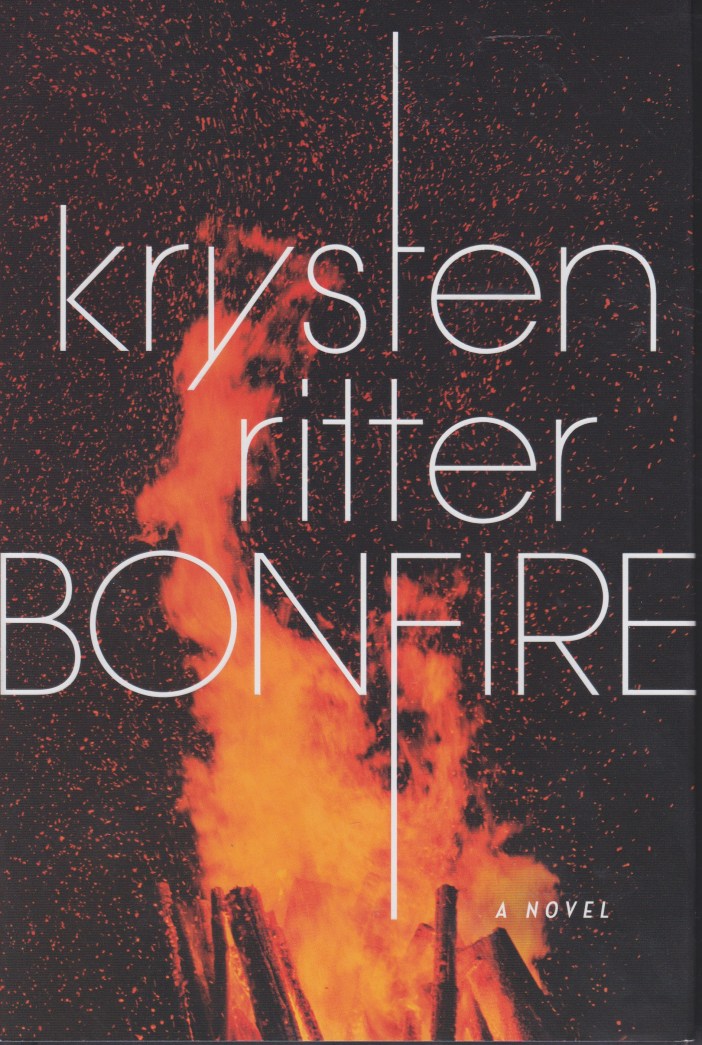
I also finished reading Krysten Ritter’s Bonfire last night–Paul was at a play.

bonfire'.jpeg

 State Highway 59 becomes Plantation Road two miles after the exit for Barrens. The old wooden sign is easy to miss, even among the colorless surroundings. For years now, on road trips from Chicago to New York, I’ve been able to pass on by without any anxiety. Hold my breath, count to five. Exhale. Leave Barrens safely behind, no old shadows running out of the dark woods to strangle me.

That’s a game I used to play as a kid. Whenever I would get scared or have to go down to the old backyard shed in the dark, as long as I held my breath, no monsters or ax murderers or deformed figures from horror movies would be able to get me. I would hold my breath and run full speed until my lungs were bursting and I was safe in the house with the door closed behind me. I even taught Kaycee this game back when we were kids, before we started hating each other.

It’s embarrassing, but I still do it. And the thing is, it works.

Most of the time.

Alone, locked in a gas station bathroom, I scrub my hands until the skin cracks and a tiny trickle of blood runs down the drain. It’s the third time I’ve washed my hands since I crossed the border into Indiana. In the dinged mirror over the sink, my face looks pale and warped, and the memories of Barrens bloom again like toxic flowers.

This was a bad idea.

The trauma that is high school is something that many of us apparently never get over, and it’s certainly becoming a crime fiction trope. But this isn’t a bad thing. As I said, almost all of us have traumatic memories of high school, and therefore can relate to the characters and the stories in these types of books. Hell, I’ve drawn from my own high school traumas enough times in my own work to recognize it as a trope of my own (Sara, Lake Thirteen, and both Chanse and Scotty have moments of reflection on their own past that are directly drawn from mine).

Bonfire is a compelling read, and very well written. Abby Williams, our main character who is telling the story in a first-person point of view, fled her hometown of Barrens after a traumatic childhood that included the painful death of her mother from cancer, her father’s religious mania and the resultant brutal parenting that came from it, being not popular, and having her best, childhood friend, Kaycee Mitchell, turn on her and terrorize her with a group of mean girl new friends. But towards the end of their senior year, Kaycee and her friends all became ill–with very odd and strange symptoms. It turned out they were faking it, and Kaycee disappeared. Now, there are some complaints about the factory near town, Optimal Plastics, that has revitalized the dying town but may possibly be poisoning it. Abby, now an environmental lawyer for a non-profit firm that handles such cases, is leading the investigative team and thus has to come back to Barrens to not only run this investigation but deal with her own demons. But are her theories and investigation tainted by her past, and her relationships with people from when she as a child? And why is she so obsessed with the missing Kaycee–whatever happened to her? Was she really faking it, or were the girls really sick? And what the hell is going on in Barrens?

Obviously, the sickness of the girls reminded me a lot of Megan Abbott’s brilliant The Fever from a few years ago; which was based on an actual case. And Ritter’s debut novel is crisply written, with a powerful sense of scene, character and plot that continues to build until it comes to its conclusion. I really enjoyed the book tremendously, and resented not having the time to actually sit down and read it through; I did manage to do so last night while Paul was at a play. It’s probably one of my favorite reads from the year, and I highly recommend it. Well done, Ms. Ritter.

And now back to the spice mines.