Cool, Cool Considerate Men

We are taking a break from our regularly scheduled blog to talk about US History and current affairs, which is something I don’t do very often here. But since it’s the 4th of July, how can we not reflect on our most imperfect union and the journey to where we are now?

Today’s title is from the musical 1776, which doesn’t get near enough attention. I was thinking about using something from Hamilton, but…I don’t think Lin-Manuel will mind, do you? I saw the film version of 1776 when I was in junior high school (I think it was; we used to go see movies periodically; which is how I saw both Fiddler on the Roof and Jesus Christ Superstar1). But 1776 seems to have been largely forgotten.
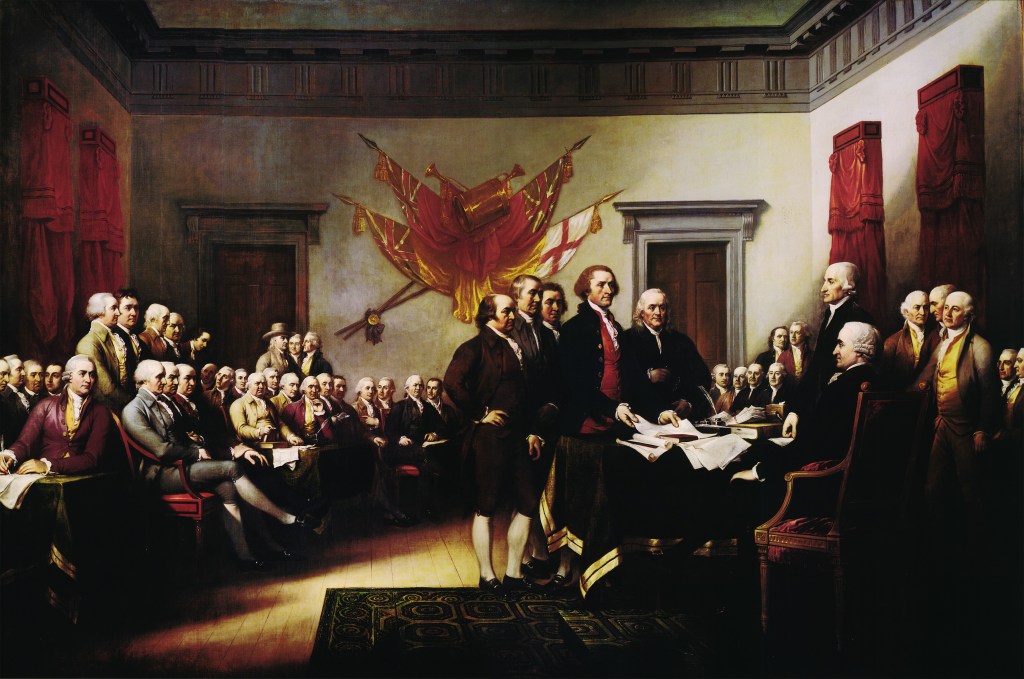
It’s hard to imagine, really, how courageous the American rebels actually were. They were farmers and lawyers and doctors; yet they believed in their cause enough to defy and stand up to, and take on, the mightiest Empire the world has ever seen. 2They were imperfect humans, as we all are; the attempt by the Right to frame them as infallible gods, guided in their work by the Christian god, is offensive and insulting. The greatest of humans are still human, and all humans have frailties and flaws, and enshrining any human as an infallible instrument of God is, at the very least, blasphemy. The Founding Fathers were both racists (more than a few enslaved people) and misogynists (where are the rights for women?), which made them….fallible. They weren’t gods, they were men.

I grew up in the 1960s and 1970s, and my education was tailored to the times. We were in a Cold War with the “evil” Soviet Union, when the possibility of nuclear annihilation was always in the back of our heads. Communists were the enemy, and they were evil; so…we all had to be brainwashed into the mentality of American exceptionalism. The right of white Europeans to the continents of the Americas, despite the fact people already lived there, was never to be questioned…the ends justifying the means, I suppose. The true horrors of enslavement weren’t taught; it was just something that happened, we fought a civil war to end it, and then it was over…we weren’t taught about the racism baked into the country and society from colonial days that continues to the present day.

And a lot of the failures of the Constitution were primarily due to the Founding Fathers being unable conceive of things that are just taken for granted by us today–politics as a profession; primaries and elections as a multi-billion dollar industry, and the levels of corruption in our political class, as well as the failures of the news media to hold the government accountable.

The passage of yesterday’s foul and evil legislation was the final betrayal of the Founders, and I think people are finally waking up to the clear and present danger in Washington. Funny that the people always screaming about their freedom and their liberties are too blind to see how their freedom and liberties are being taken from them–and how happy they are to give them up so long as they think other people will suffer. I see a lot of social media posts since yesterday talking about the new authoritarianism, yet have never noticed how the Right has been building to this point for decades. The police state’s foundational legislation was the PATRIOT Act–which has never been repealed and has been reauthorized by Congress several times.

I don’t see a great future for us over the next ten years, frankly. I do not see a way out of this situation we’re in without it becoming really ugly. MAGA isn’t going to go down in any electoral defeat because, as we have seen, they will not accept the results and are more than willing to use violence to get their way. That will get ugly, don’t you think? And let’s face it, our current situation isn’t much different than the one the country was in during the 1850s–when enslavers controlled the Supreme Court, Congress, and the White House. Losing that control led to the Civil War, because enslavers weren’t willing to give up the power they’d enjoyed for so long because they feared losing their slaves.

How long before the people in the prison camps are contracted to work in the fields and doing the grunt work we’ve pushed off onto immigrants for decades?

I always suspected our system was collapsing, rotting from the inside and spreading the foul disease across the nation. I always hoped I was wrong, but the logical side of me couldn’t deny the evidence of the decay.

My one hope was that if I was correct, I wouldn’t live long enough to see the collapse. Ah, well. That ship has sailed, hasn’t it?

Yeah, not up for celebrating seventeen million people losing their health insurance, or the many millions of children who will go hungry.

But there’s always hope, no matter how bleak it seems. As Winston Churchill once said, “You can always count on Americans to the do the right thing–after they’ve exhausted every other possibility.”

I also believe this will not end well for corporations and billionaires–as it did not for the French and Russian aristocracies.
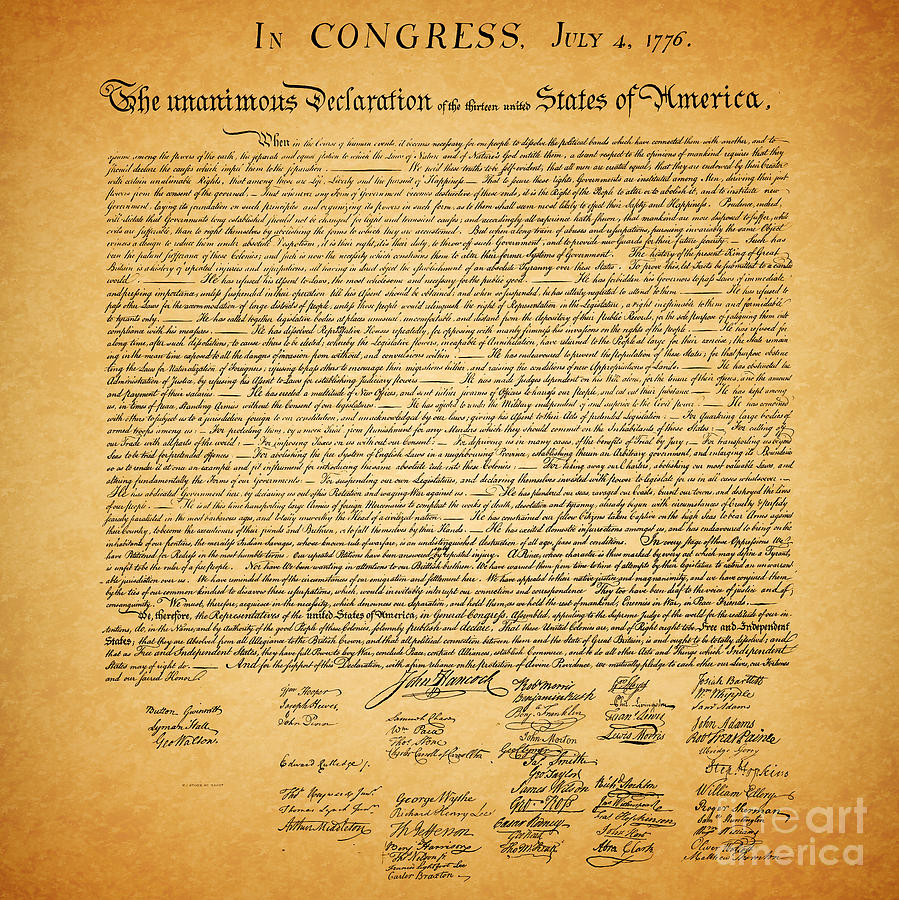
And in case you’ve forgotten (or never knew) the text:

When, in the course of human events, it becomes necessary for one people to dissolve the political bands which have connected them with another, and to assume, among the powers of the earth, the separate and equal station to which the laws of nature and of nature’s God entitle them, a decent respect to the opinions of mankind requires that they should declare the causes which impel them to the separation.

We hold these truths to be self-evident, that all men are created equal, that they are endowed by their Creator with certain unalienable rights, that among these are life, liberty, and the pursuit of happiness. That, to secure these rights, governments are instituted among men, deriving their just powers from the consent of the governed. That, whenever any form of government becomes destructive of these ends, it is the right of the people to alter or to abolish it, and to institute new government, laying its foundation on such principles, and organizing its powers in such form, as to them shall seem most likely to effect their safety and happiness.

Prudence, indeed, will dictate that governments long established should not be changed for light and transient causes; and, accordingly, all experience has shown, that mankind are more disposed to suffer, while evils are sufferable, than to right themselves by abolishing the forms to which they are accustomed.

But, when a long train of abuses and usurpations, pursuing invariably the same object, evinces a design to reduce them under absolute despotism, it is their right, it is their duty, to throw off such government, and to provide new guards for their future security. Such has been the patient sufferance of these colonies; and such is now the necessity which constrains them to alter their former systems of government. The history of the present King of Great Britain is a history of repeated injuries and usurpations, all having in direct object the establishment of an absolute tyranny over these states. To prove this, let facts be submitted to a candid world.

He has refused his assent to laws the most wholesome and necessary for the public good.

He has forbidden his governors to pass laws of immediate and pressing importance, unless suspended in their operation till his assent should be obtained; and when so suspended, he has utterly neglected to attend to them.

He has refused to pass other laws for the accommodation of large districts of people, unless those people would relinquish the right of representation in the legislature; a right inestimable to them and formidable to tyrants only.

He has called together legislative bodies at places unusual, uncomfortable, and distant from the depository of their public records, for the sole purpose of fatiguing them into compliance with his measures.

He has dissolved representative houses repeatedly, for opposing, with manly firmness, his invasions on the rights of the people.

He has refused for a long time, after such dissolutions, to cause others to be elected; whereby the legislative powers, incapable of annihilation, have returned to the people at large for their exercise; the state remaining in the meantime exposed to all the dangers of invasion from without, and convulsions within.

He has endeavored to prevent the population of these states; for that purpose obstructing the laws for naturalization of foreigners; refusing to pass others to encourage their migrations hither, and raising the conditions of new appropriations of lands.

He has obstructed the administration of justice, by refusing his assent to laws for establishing judiciary powers.

He has made judges dependent on his will alone, for the tenure of their offices, and the amount and payment of their salaries.

He has erected a multitude of new offices, and sent hither swarms of officers to harass our people, and eat out their substance.

He has kept among us, in times of peace, standing armies, without the consent of our legislatures.

He has affected to render the military independent of and superior to the civil power.

He has combined with others to subject us to a jurisdiction foreign to our constitution, and unacknowledged by our laws; giving his assent to their acts of pretended legislation:

For quartering large bodies of armed troops among us;

For protecting them, by a mock trial, from punishment for any murders which they should commit on the inhabitants of these states;

For cutting off our trade with all parts of the world;

For imposing taxes on us without our consent;

For depriving us, in many cases, of the benefits of trial by jury;

For transporting us beyond seas to be tried for pretended offenses;

For abolishing the free system of English laws in a neighboring province, establishing therein an arbitrary government, and enlarging its boundaries, so as to render it at once an example and fit instrument for introducing the same absolute rule into these colonies;

For taking away our charters, abolishing our most valuable laws, and altering fundamentally the forms of our governments;

For suspending our own legislatures, and declaring themselves invested with power to legislate for us in all cases whatsoever.

He has abdicated government here, by declaring us out of his protection, and waging war against us.

He has plundered our seas, ravaged our coasts, burnt our towns, and destroyed the lives of our people.

He is at this time transporting large armies of foreign mercenaries to complete the works of death, desolation, and tyranny, already begun with circumstances of cruelty and perfidy scarcely paralleled in the most barbarous ages, and totally unworthy the head of a civilized nation.

He has constrained our fellow citizens, taken captive on the high seas, to bear arms against their country, to become the executioners of their friends and brethren, or to fall themselves by their hands.

He has excited domestic insurrections amongst us, and has endeavored to bring on the inhabitants of our frontiers, the merciless Indian savages, whose known rule of warfare is an undistinguished destruction of all ages, sexes, and conditions.

In every stage of these oppressions, we have petitioned for redress, in the most humble terms. Our repeated petitions have been answered only by repeated injury. A prince, whose character is thus marked by every act which may define a tyrant, is unfit to be the ruler of a free people.

Nor have we been wanting in attentions to our British brethren. We have warned them from time to time of attempts by their legislature to extend an unwarrantable jurisdiction over us. We have reminded them of the circumstances of our emigration and settlement here. We have appealed to their native justice and magnanimity, and we have conjured them by the ties of our common kindred, to disavow these usurpations, which would inevitably interrupt our connections and correspondence. They too have been deaf to the voice of justice and of consanguinity. We must, therefore, acquiesce in the necessity, which denounces our separation, and hold them, as we hold the rest of mankind, enemies in war, in peace friends.

We, therefore, the representatives of the United States of America, in General Congress assembled, appealing to the Supreme Judge of the world for the rectitude of our intentions, do, in the name, and by authority of the good people of these colonies, solemnly publish and declare, that these United Colonies are, and of right ought to be free and independent states; that they are absolved from all allegiance to the British Crown, and that all political connection between them and the state of Great Britain is and ought to be totally dissolved; and that, as free and independent states, they have full power to levy war, conclude peace, contract alliances, establish commerce, and to do all other acts and things which independent states may of right do. And for the support of this declaration, with a firm reliance on the protection of Divine Providence, we mutually pledge to each other our lives, our fortunes, and our sacred honor.

Funny how some of their indictments of George III also apply today…

  1. I still can’t believe we saw Jesus Christ Superstar and no parents complained. That wouldn’t happen today. The show and movie and music were highly offensive to Christians back in the day, but they don’t complain much about it anymore. ↩︎
  2. I’m always amazed at how the people screaming the loudest that they are the REAL American patriots…would never put themselves at risk for their values and beliefs. For the record, conservatives in 1776 were called…Tories. ↩︎


Of Thee I Sing

This is a weird 4th of July for me.

It’s always been a strange holiday for me, having grown up as an outsider drenched in Americana and taught American mythology rather than US history. (The more I use the word American to describe things that really only involve the US the less comfortable I am with it, particularly as I grow older. It’s simply a shorthand, obviously, for the much more awkward “US citizens,” but its use erases the fact that Canadians, Mexicans, and those from Central and South America are also Americans, and others them to US citizens. USAmericans also is an awkward construction. And can people of non-indigenous descent have a right to call themselves Americans in the first place? Once you start parsing, it’s a bottomless well.) It isn’t really our nation’s birthday, either–it’s Independence Day; the anniversary of the day the Declaration of Independence was ratified. Our actual national birthday is the date the Constitution was ratified and we actually became the United States from the thirteen colonies–and after the British defeat at Yorktown and the Peace of Paris, we actually were thirteen independent states in a loose alliance with each other for self-protection, and it was entirely possible those states might not have ever unified into a single nation. That was the real miracle of our nation’s founding–that, and the fact that thirteen disunited colonies who agreed on very little somehow took on the largest and most powerful global empire the world have ever seen and managed to defeat them–without checking I cannot be entirely sure, but it might be the only war the British Empire lost before it’s post-World War II collapse.

So, this year’s celebration is a bit muted. We are losing our freedoms and our rights–losing them to a bizarre political coalition that claims they are the real Americans, what they believe is the only way to believe and/or think about politics and the country, who scream and whine and protest about their freedoms and their liberties as cover for the fact they want to steal the freedoms and liberties–and citizenship–of people who do not agree with them. We have a “supreme court” that uses the Constitution, and almost 250 years of precedent and decided law, to wipe their asses with because it doesn’t really fit their vision of a theocratic nation ruled by a minority that forces the majority to put up with their bullshit because they have gerrymandered, legislated, and ruled in such a way as to entrench their power. This has happened before, of course–it always has happened before (which is why our lack of interest and education about our short national history is so deliberately encouraged; so we won’t learn from the mistakes of the past)–and I feel like we are living in a situation very similar to that in which the country was in between 1850 and 1861: an extremely loud and belligerent minority had been controlling and running the country since almost the beginning, in defense of a completely indefensible belief that it was okay for white Americans to either own people with differently hued skin, or to kill them with impunity. The slavery supporters had packed the Supreme Court with their supporters, and the compromises over the admissions of MIssouri and Kansas to the union were fraught because the slave states saw they were in danger of being outnumbered and thus losing their hold on the government.

And now this illegitimate body currently sitting on our highest court–deciding law for a majority even though most of them were appointed by presidents who didn’t win the popular vote–has started legislating from the bench under the guiding conservative principle that “it’s for each state to decide”–abortion rights, same sex marriage, racial equality, etc.

Because that worked so well with slavery?

The entire point of a federal, centralized government is to have the final say on law and rights; the Constitution also makes it very clear that the laws of one state should be honored by the others. But the framers of the Constitution also knew that there would be times when one state’s laws would come into conflict with another’s, and the federal government would have to decide which law was Constitutional–as they both might or might not be; but the idea was the law that restricted or prohibited rights more would be the one thrown out. This balancing act, naturally, was already in trouble because of slavery; a free state could not be forced to recognize the property rights laws of a slave state, and a slave state would never recognize the laws of a free state that outlawed slavery outright. The conflict and battle between states’ rights and the Federal government was baked into the document from the beginning, because the Southern states refused to give up their right to own people in a nation that was predicated on freedom and equality of all men.

The notion that a state like Texas could criminalize abortion (or anything) to the extent they have, and that they expect pro-choice states to not only comply with their laws but turn over documents and accused violators of said law is just the Fugitive Slave Act all over again: conservative states are all about federalism when it comes to enforcing their own laws…but will scream “States’ rights!” to protect their own.

The cognitive dissonance it must require to be a conservative astounds me sometimes.

I’ve spent most of my life with my sex life making me a criminal in almost every state in which I lived. Lawrence v. Texas guaranteed that the government had no right to tell me who I could sleep with and what I could do in my bedroom with that consenting adult. I remember the day that decision came down; it was something I never thought I would see in my own lifetime. One of the things I was trying to recapture (am trying to recapture, really) in “Never Kiss a Stranger” is that sense of criminality; of how it felt to be a sexual outlaw; how every time you went into a gay bar you knew there was a chance the place would be raided by the police–or that every time you left a gay bar you were in danger from the police until you made it safely home. It wasn’t something conscious you’d think about back in those days, but it was always there in the back of your mind. Gay bars inevitably (with the exception of the French Quarter in New Orleans, the Castro on San Francisco, West Hollywood, and the village, among others) were in a sketchy part of town, and often they were own by the Mob for money-laundering purposes. The marriage between the gay bars and the Mob was an uneasy one, of course–a marriage of convenience. The Mob needed to launder their money, bars are an excellent way to do so, and the Mob could also pay off the cops to prevent raids–a corruption-go-round, if you will. (Gay bar raids inevitably wound up being extortion for corrupt cops to get more bribe money from the mob…this weird marriage between criminals–gay men and the Mob–is something I want to explore in fiction more. And the police, for the record, have never been friends or allies to my community; quite the obverse, in fact.)

I should make a note to reread this next year on the 4th of July. Will things be better or worse? My money’s on worse.

And on that note, I am heading into the spice mines.

One More Big Time Rock and Roll Star

And now it’s Friday, Three Day Weekend Eve.

It rained again yesterday, so it wasn’t terribly awful while running my errands after work last night. I came home, put away dishes and did some laundry, provided a lap for Scooter–who stayed there all night, and even when I would get up he would just jump back into my chair and go back to sleep (Paul didn’t get home from work until after I’d gone to bed, so he was feeling abandoned the way he always does when there’s only one of us at home), and did some more brainstorming and plotting for the stuff I am working on. I feel good and rested again this morning (I did get a bit tired yesterday afternoon), and hope springs eternal for another productive long weekend at home. The theme for the weekend is clearly editing, since i have copy edits for two manuscripts to start working through, and two short stories to edit–I also need to go through my “call for submissions” folder and see what is possible and what is not ( as well as tossing the ones that have already passed).

It seems weird to be celebrating Independence Day this year, since the radical, highly politicized “supreme” court continues to demolish every right and protection anyone non-white and not male have fought for and earned since the second World War–even going back as far as JOHN FUCKING MARSHALL to overturn decisions–as they work to establish a Fascist state once and for all. I was thinking about this last night while watching Real Housewives Ultimate Girls’ Trip 2 and remembering why I didn’t miss seeing Jill Zarin on my television, and I was also thinking about memoirs and memories and writing about my life. One of the primary reasons I’ve always backed away from it (and yes, I am aware that I am talking about being reluctant to write personal essays about my past and life in MY FUCKING BLOG) is not only because I know my memory to be faulty, but also because I know that–like most other people–I also have a tendency to rewrite my memories to make me look better or to justify bad behavior on my own part, and that isn’t fair to the other people in said memories who don’t have a platform (no matter how small) to tell their side of the story (which has also been undoubtedly rewritten in their own minds to make themselves look better). No two people ever see the same situation exactly the same; our interpretations and reactions to things are often predicated and formed by our life experience, our education, our opinions, and our beliefs and values that have also developed over a lifetime. An event that may have seemed completely throwaway and inconsequential to one person can be life-changing to another.

I’ve also begun recognizing and finding holes in my memory. For some reason I had always believed we’d moved, for example, from the south side of Chicago to the suburbs in the winter of 1969. That was firmly cemented in my brain as fact…until a year or so ago when I realized I was ten when we moved to the suburbs, which means we didn’t move out there until the winter of 1971. That’s a significant difference, which has skewed the order of memories in my head.

Some friends have been encouraging me to write personal essays, but I’m not really sure I should or not. For a long time I shut the door on my past as much as I could; it was painful to remember and it was simply easier for me to shove everything into a corner of my brain and lock the door behind them. When I started rebooting my life at age thirty-three, I still looked back a lot with sadness and heartbreak and bitterness–but I also began trying to put it all behind me at the same time because it was sad and heartbreaking and I didn’t want to be trapped into that quagmire of negativity. After Paul and I had met and we’d moved to New Orleans and my new life was beginning to take shape–the life I’d always wanted and had dreamed of for years; those dreams sustaining me through even the darkest of times–I decided to put it all behind me once and for all, deciding that I loved my life and was very happy with it, which meant that everything that had happened–no matter how terrible–was necessary to put my feet firmly on the path that led to my happiness and so therefore I should have no regrets about anything. It was helpful to distance myself from my past and never look back, so I tried never to do so. But now that I’ve reached sixty–I’ve started reflecting about the past a lot more over these past few years, plus writing my last two books (Bury Me in Shadows and #shedeservedit, respectively) required me to start digging around in those inner rings of the giant redwood of my life, as did watching It’s a Sin, which, despite being set in London, took me back to the 1980’s and brought a lot of painful memories back. It made me realize that while that coping mechanism of “no regret, not looking back” was necessary for my growth into who I am now, and for me to build a writing career, it wasn’t long-term healthy because a lot of unprocessed pain, anger and grief (and joy and laugher, as well) had never been recognized, processed, dealt with, and moved on from. I think part of the reason I decided to finish those two in-progress-for-years books was precisely so i could start processing and dealing with my past…and sometimes that means revisiting painful memories. It’s also part of the reason I moved “Never Kiss a Stranger” up on the lengthy list of things I want to write and finish and get out there; I want to remember the mentality of what it was like to be a gay man in New Orleans in 1994, just really coming to terms with your sexuality after being closeted at least most of the time for most of your life, and beginning to explore what it means to be gay while the specter of AIDS hung over your head like a death sentence just waiting to be pronounced. As prevention and treatment options continue to lower the risk of infection as well as the threat of death over the last decade or so, people are slowly beginning to forget what it was like back then–and the literature of the period is going out of print and disappearing. I now have clients who don’t remember what it was like because they weren’t alive then, and while it is so wonderful and lovely that they didn’t come out and experience life with that shadow hanging over their heads, periodically I feel a bit of pang remembering all those wonderful bright lights that were extinguished so cruelly, and the old embers of white-hot anger at the societal and governmental neglect, often deliberate and intentionally cruel, that allowed them all to die returns.

Which is why unveiling a commemorative stamp honoring Grendel’s mother, aka Nancy Reagan, during Pride Month was tone-deaf as well as a slap in the face to those of us who survived in spite of that miserable bitch and the raw sewage she married.

I also think this most recent pandemic and the memories it stirred up, timed with watching It’s a Sin and some other things, is why I am so exhausted all the time (well, that plus being sixty); it’s a sign of depression from all of the unprocessed emotions and feelings from locking away my past and turning away from it. It may have been necessary in 1995 to move forward, but it wasn’t healthy, and the longer I kept those memories locked away without dealing with them the worse it became. So I am going to set a goal of trying to write an essay every two weeks about something from my past, unlocking a memory and trying to find the meaning in it, how it impacted and affected my life–and not with regret, but with the cold, unflinching eye of the non-fiction writer. I also feel like something snapped inside my head this past week–I know how weird that sounds–but Wednesday I was really down. Memories flashing through my head, triggered by the reversal of Roe (I remember a pre-Roe United States, and also remember when the decision came down) and what that meant for other decisions revolving around personal privacy/freedom and government overreach. The four or five days following the Dobbs decision were dark ones for me (I cannot imagine what they were like for women), and yet, somehow, in writing something Wednesday afternoon something snapped in my head and I got past it all–and I realized I’d been dealing with a lot more anxiety and depression than I thought I was (and I thought I was dealing with a lot as it was). I have felt much better since getting over that hump on Wednesday, but I am also not foolish enough to think I am past it all, either–it will come back.

If I learned anything from Hurricane Katrina, it’s that trauma and depression come in waves. There will be good days, and there will be bad days. I usually deal with darkness by writing–not writing makes the darkness even darker–which is something I also need to remember: writing always makes things better for me.

And on that introspective note, I am heading into the spice mines.