You’ve got to ro-oh-oll me, call me the tumbling dice…
Good morning out there to my daily (or periodic) Constant Readers! I really didn’t want to get up this morning, in all honesty; it was so comfortably cozy under my blanket pile and Sparky was cuddling (and only occasionally attacking my feet), which was very blissful. My legs feel a little fatigued this morning, which isn’t a good sign for my fatigue. But yesterday at work wasn’t at all bad, or a struggle to get through; it actually went by pretty quickly and I had energy when I got home. I got started on my chores (didn’t finish them) and sat in my chair to read with Sparky in my lap, and of course, the purring curled up kitty puddle started putting me to sleep. I woke up at just past nine and went up to bed before Paul even got home from the office.
I read deeper into the manuscript (before dozing off last night), and it’s not bad; it’s just kind of awkward and unpolished, which naturally is a bit of a relief about the revisions that need to be done in addition to the chapters that need to be finished before I can turn it in. I am taking it with me to work to read over lunch and breaks, and may get started on writing the rest of it tonight. LSU has one of those throwaway games this weekend–against Southeastern Louisiana, out of Hammond–so while I do want to watch (if it’s even on television) it’s not one of the big games of the season and I am not even sure who else is playing this weekend. I’ve not even bothered to look into who’s playing yet! I hope to have a successful writing/editing weekend; fingers crossed!
One can hope, at any rate.
My creativity is coming back, though; which usually happens when I am coming down to the wire on another project. Working on that short story to finish it Monday night kicked that door open–not like it was, back in the day, but I’ll take it–and started thinking about other short stories to write and what to work on with this book and how to get it all under control and working and something that my Constant Readers will like. I think I am going to finish Chlorine after this; probably work on it and Muscles at the same time, most likely. I also have some short stories I want to finish by the end of the year, and it has been a very hot minute since my last newsletter, hasn’t it? The Katrina one was, I think, the last one; and that was around two-three weeks ago, wasn’t it? I am really at sea; did Bouchercon and the return of the fatigue really set me that far back on everything?
Apparently so.
And on that note, I am heading into the spice mines. Have a great Wednesday (mine already feels like a Thursday) and I shall return on the morrow. Cheerio!
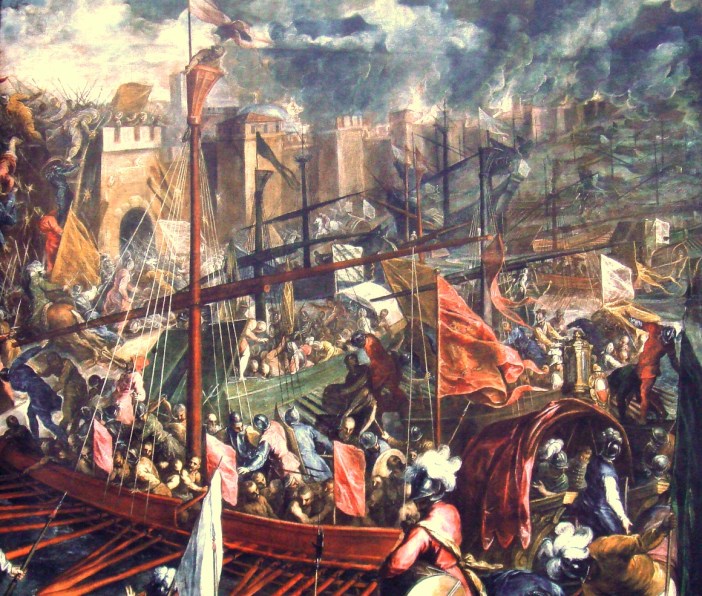
The sack of Constantinople by the 4th Crusade, 1204
If you will recall from my last entry about the Chanse series, I had a new editor for the second book in the series. I had also written a proposal for the follow-up, Murder in the Rue St. Claude, which was going to be about a nursing home and an angel of death. The second book ended with a tragedy for Chanse, and the last scene of the book was Chanse saying goodbye to someone before their life-support was turned off. I did a trickery and was going to have the person be in the nursing home, still living, only a suspicious death happens there and one of the workers talks to Chanse about her fears. The editor wasn’t the most professional or organized person, and I had to send the proposal to her three times on request with no contract offer. I was very irritated by this, but there were also a lot of changes going on there–including moving the offices from LA to New York, which I thought was an incredibly stupid business decision…and I wound up with yet another new editor right before Katrina hit. I honestly wasn’t sure if I would go back to writing ever again–one of the lulls in my career–but things eventually settled down and I started house sitting for a friend in Hammond over on the north shore while I waited for the city to reopen so I could drive into the city and get some more things from the house. I did, my friends’ trip was cut short, and I was going to return to Kentucky to my parents’ after one more swing by the apartment to pick up things. Imagine my surprise that my mail service was open, my grocery store and bank were open, and so was my gym. We’d moved into the main house from the carriage house, which hadn’t been rented yet as it needed some work before the hurricane, and so….I just moved back into the carriage house and cleaned up around the property and kept an eye on the main house, as well as emptying out the water from the machines that were trying to keep the insides of the apartments dry (the roof was gone).
While I was in Hammond, my new editor got me to reluctantly co-edit an anthology about New Orleans called Love, Bourbon Street (a title I hate to this day), and he was trying to talk me into writing a Chanse book about Katrina. I didn’t really want to, but he kept insisting and finally, I gave in and agreed to write it. However, the nursing home I was researching was a place they left people to die in–wasn’t touching that with a ten foot pole–and it occurred to me that I could wrap the case around Hurricane Katrina. He was hired by the client the Friday before Katrina, and obviously he couldn’t do the job now.
And that was the seed from which Murder in the Rue Chartres (no title at the time of contract) grew.1
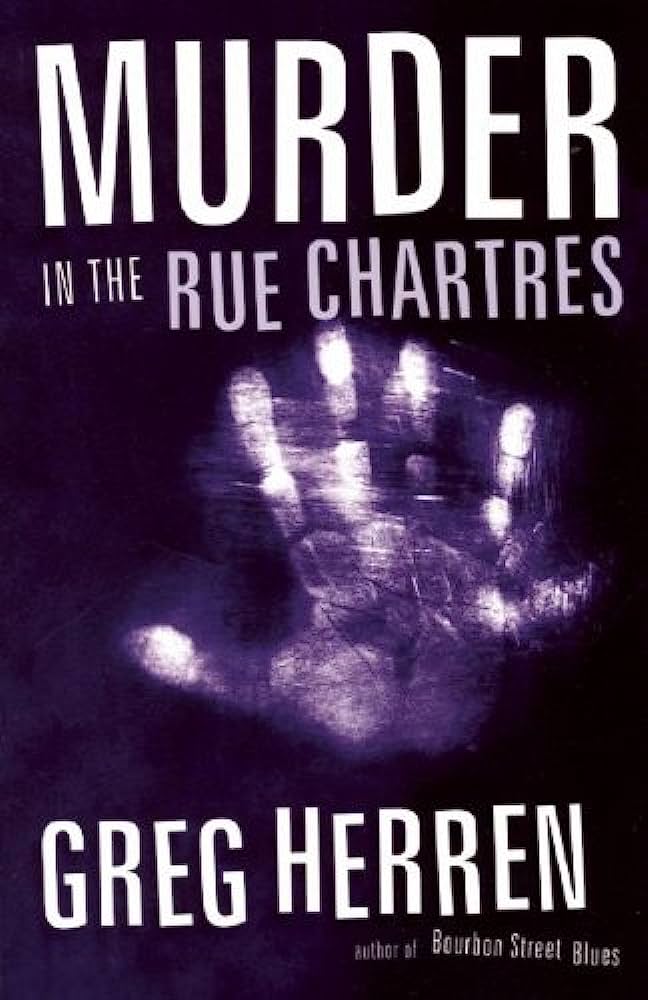
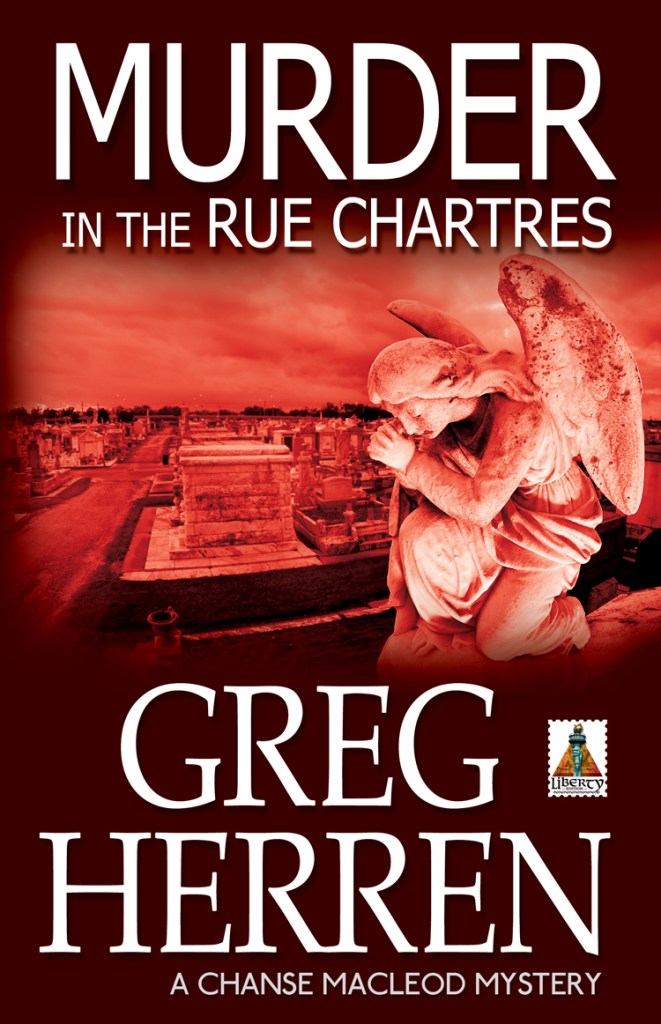
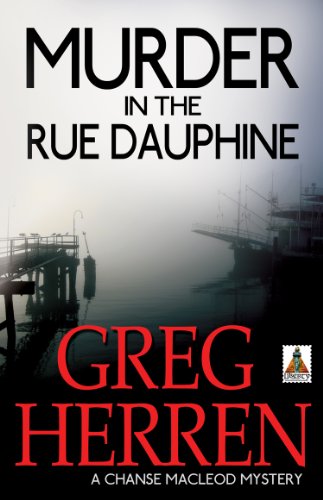
This is the original cover from Alyson Books.This is the new cover for the Bold Strokes ebook
It was six weeks before I returned to my broken city.
Usually when I drove home from the west, as soon as I crossed onto dry land again in Kenner, excitement would bubble up inside and I’d start to smile. Almost home, I’d think, and let out a sigh of relief. New Orleans was home for me, and I hated leaving for any reason. I’d never regretted moving there after graduating from LSU. It was the first place I’d ever felt at home, like I belonged. I’d hated the little town in east Texas where I’d grown up. All I could think about was getting old enough to escape. Baton Rouge for college had been merely a way station—it never occurred to me to permanently settle there. New Orleans was where I belonged, and I’d known that the first time I’d ever set foot in the city. It was a crazy quilt of eccentricities, frivolities, and irritations sweltering in the damp heat, a city where you could buy a drink at any time of day, a place where you could easily believe in magic. I couldn’t imagine living anywhere else. Any time I’d taken a trip before, within a few days I’d get homesick and started counting the hours until it was time to come home.
But this time wasn’t like the others. This time, I hadn’t been able to come home, and had no idea how long it would be before I could. Now, I was nervous, my stomach clenched into knots, my palms sweating on the steering wheel as I sang along to Vicki Sue Robinson’s “Turn the Beat Around” on the radio. It was everything I’d feared for the last few weeks when I thought about coming home, the anxiety building as the odometer clocked off another mile and I got closer to home.
It was different.
The most obvious thing was the lack of traffic. Even outside the airport, the traffic was usually heavy, sometimes slowing to a complete standstill. But other than a couple of military vehicles, a cement mixer, and a couple of dirty and tired looking sedans, I-10 was deserted. There was a film of dirt on everything as far as I could see, tinting my vision sepia. Huge trees lay toppled and debris was everywhere. Signs that used to advertise hotels, motels, restaurants, storage facilities, and pretty much any kind of business you could think of were now just poles, the signs gone except for the support skeleton. Buildings had been blown over, fences were wrecked and down, and almost everywhere I looked blue tarps hung on roofs, their edges lifting in the slight breeze. My breath started coming a little faster, my eyes filled, and I bit down on my lower lip as I focused back on the road.
No cars joined at the airport on-ramp, or the one at Williams Boulevard just beyond it. No planes were landing or taking off.
Most of the writing I did in the fall of 2005 was my blog, which at the time was on Livejournal. (The old stuff is still there, but I started making things private after a year because of plagiarism; I guess people thought they could steal my words if they were on a blog.) I documented as much of the experience as I could, so people outside of Louisiana could see that the city wasn’t fully recovered despite no longer being in the news. American attention had moved past New Orleans by the spring of 2006.
When I started writing the book, I was really glad I had done that with the blog, because more than anything else it reminded me of the emotions I was going through, that horrible depression and not remembering things from day to day, the need for medications, panic attacks, depression, and the way the entire city just seemed dead. I did repurpose a lot of stuff that was on the blog–rewritten and edited, of course–and I could tell, as I wrote the book, that I was either doing some of the best work of my life to that point or I was overwriting it mercilessly. You never can be sure.
But I also needed to flesh out the murder mystery I came up with, and I also wanted to write about a historical real life tragedy of the Quarter. The client who hired him that Friday before Katrina roared into the Gulf and came ashore was engaged, and she wanted Chanse to find her father, who’d disappeared from their lives when she and her brothers were very young. But what happened to her father? Who killed her, and why? Was her murder a reaction to her looking for him?
I had started using Tennessee Williams quotes to open my New Orleans novels with the third (Jackson Square Jazz: “A good looking boy like you is always wanted” from Orpheus Descending) and I liked the conceit so much I kept doing it. I knew someone who’d built a crime novel around the basic set up of Cat on a Hot Tin Roof, and I thought, what if the person who knows all the answers has been in a mental hospital for decades? Then what if Mrs. Venable had succeeded in getting Catherine locked up with all of Sebastian’s secrets lobotomized out of her head?
I named the family Verlaine as a nod to the Venables, and aged Mrs. Venable as well as gender swapping her (this was also a bit influenced by The Big Sleep), and I was off to the races.
My editor wrote me when he finished reading the manuscript and told me it was one of the best mysteries he’d ever read. The reviews! My word, I still can’t believe the reviews, and how good they were. I got a rave in the Times-Picayune, Library Journal and Publishers Weekly.
And yes, it won a Lambda Literary Award for Best Gay Mystery.
The irony that two books I wanted nothing to do with, let alone write or edit, ended up with each winning Lambda Literary Awards, does not escape me. ↩︎
My first series will always be special to me, even though I’ve retired Chanse MacLeod…at least for now, at any rate; I’ve learned (sometimes the hard way) that I shouldn’t ever say never when it comes to my writing career. Chanse will always be special for me in that he was the main character in my first book to be published as well as the first series of mine to see print. I originally created Chanse in 1989–can you believe that? Thirteen years from the time I first started constructing the character and him getting into print.
When I left California and moved to Houston that year, I decided to put the miseries of the 1980’s behind me, forget the past, and try to move on to the future I wanted for myself. I still had no idea what I wanted to do to make a living, but I knew I was never going to become a writer unless I actually, you know, wrote. When I moved to Houston, I moved away from reading mostly epic fantasy and horror to reading crime and horror. Sue Grafton’s F is for Fugitive had just been released, and the bookstore–Bookstop?–I frequented in Houston had a store catalogue that had book reviews and author interviews, and Sue Grafton was on the cover. I thought the alphabet titles was a great idea, so I bought the first three and took them home. I loved them, and started diving back into the crime fiction genre headfirst. I also started reading the Erle Stanley Gardner Perry Mason novels again–I’d read some when I was a kid–and I also started reading the rest of the Travis McGee series (I’d read, and not liked, The Dreadful Lemon Sky when I was thirteen; I wasn’t old enough to appreciate the series) and absolutely loved them. I loved McDonald’s writing style more than anything else, and the descriptions of McGee sounded, well, hot.
I started creating Chanse MacLeod as a blend of Kinsey and Travis McGee, really; I was driving to work one day and crossed a bayou. noticing the sign for the first time, and thought “The Body in the Bayou would be a great title for his first book” and so i started constructing the character and his world. He was a former cop turned private eye in Houston; he’d played college football at Auburn but suffered a career-ending injury his senior year and so he went into law enforcement, eventually going out on his own. He had a secretary named Clara that he shared with a couple of lawyers in an office suite in downtown Houston, and most of his work involved trying to get evidence of adultery for wealthy and suspicious spouses. In 1994. after I fell in love with New Orleans, I moved Chanse to New Orleans and his college experience to LSU; I also was discovering gay crime novels around this same time, so I decided to make Chanse a gay man; from a small town in Texas with homophobic parents and family, playing a sport where homophobia is rife, and he too discovered and fell in love with New Orlean…so he became a cop when his football career ended, eventually becoming a private eye. I started rewriting the four or five chapters I’d written with the story set in Houston…but once I moved to New Orleans and began to grasp what it was actually like to live here, I threw the entire thing out and started over.
That manuscript I started over became Murder in the Rue Dauphine, and the first place I submitted it to offered me a contract six weeks after I mailed them the manuscript. Alyson was home for the first five books in the series…before Alyson Books went belly-up, without paying me the advance for the fifth book and no longer paying me royalties on the others (the entire series was still in print when Alyson folded).
Burn in hell, corporate trash who bought Alyson.
(The company had been doomed for a while, and the unfortunate last minute attempt to rescue it failed, which I thought was horrifically unfair to the person who they brought in to save it. The final collapse was hardly his fault; his predecessors had made so many unbelievably stupid mistakes there was no saving the business, really. And ebooks and so forth started eroding away at the reader base, at the same time the business began to crumble. I’ve always felt bad for the poor dude who was the last to hold the title of publisher. I don’t think he had any staff and he was the only person working there by the bitter end.)
But when Alyson went belly-up and chose to stop honoring their contractual obligations to pay their writers, I’d already moved the Scotty series to Bold Strokes Books and was doing not only anthologies for them but also editorial work for them, so moving the Chanse series there was a no-brainer.
The last two books in the series were done with Bold Strokes Books.
As with anything with my career, I had a plan for the Chanse series but of course, man plans and the gods laugh. I had always intended the series to be seven books, from the very beginning, and I had this emotional journey for him all mapped out: the series would chart his progression from lonely, damaged and scarred loner with a snide sense of humor to more centered, more grounded, more mature and more settled into his life. So, when the series opened, he was–against his better judgment–seeing a hot flight attendant, and wondering if he was actually falling in love and had the opportunity to be happy for once in his life. I really did give him a miserable backstory; alcoholic mother, abusive drunk redneck father, grew up living in a trailer park in a snotty small Texas town where no one would let him forget he was trash until he showed some football playing ability–and he was just cynical enough to understand they still considered him trash, but trash with a skill they appreciated. He went to LSU and joined a fraternity in a final attempt to banish the homosexuality from his brain (it didn’t work), and then was injured in a bowl game so his career was over–he’d been considering going for the NFL draft. He was a big man, as such; and spent a lot of time in the gym working out and keeping fit. I also had to make a horrific decision while writing the second book–with every intention of walking that ending back in the third.
And then Katrina happened, and everything changed.
My editor at Alyson Books at the time, Joe Pittman, was new. He had come on board shortly after my previous editor was let go (I had a different editor for each of the first three Chanse books, and in fact had a different for the last two–so the Chanse series went through five editors at Alyson…now I would see that as a sign), and I was assigned to him as a gay mystery writer. He got in touch with me after Katrina to check in on me and of course, to encourage me to write about Katrina, which I did NOT want to do whilst I was in the middle of experiencing the aftermath still. I was still unhoused at the time, staying with my parents in Kentucky, before moving back to Hammond, Louisiana, just before Rita to housesit. Paul and I talked on the phone one morning and suggested we do a fundraising anthology for Katrina victims…but I wasn’t interested. Joe called me that afternoon and with the same suggestion, so I told him Paul wanted to do one and that was how Love, Bourbon Street came to be. Joe also kept insisting to me that I should write a post-Katrina book as the next Chanse book, and despite my reluctance I decided to go ahead and do it. Part of the problem, as I saw it, was, how do you end a book on a hopeful note when the city is still in ruins and most of the population still displaced? Joe kept pushing me, and I finally agreed to write Murder in the Rue Chartres–and I really don’t remember anything about writing the book other than I did actually write it, and it turned out to be one of my best books. It won the Lambda, for one thing, and got great reviews everywhere.
The fourth Chanse novel was, in my opinion, the weakest of the series. They’d fired my editor before I signed a contract for the fourth book, and when that finally happened, they needed me to write in like eight weeks. I asked for a two book contract so I would never have to write another book in eight weeks again (LOL at my naivete), and they were so desperate for the fourth they agreed. (I had already written a Scotty book that was just sitting in a drawer; I turned it into the fourth Chanse and to this day I think it was a mistake.) Of course, they did publish the fifth, but they never paid me a dime for Murder in the Garden District. The only money I’ve made off that book is from the ebook Bold Strokes put up–I gave them the entire Chanse backlist for ebooks, and those Chanse books still sell.
Maybe I shouldn’t have ended the series at seven?
But it felt like the right place to stop. Chanse’s personal story of personal growth and how it happened kind of got lost along the way; he grew and changed as the series progressed, but writing the last two–which I also think are good–felt a little paint-by-the-numbers for me; I felt that writing the sixth and when I felt it again in the seventh, I decided to stop there. I wasn’t getting any satisfaction for writing the books anymore, there was no joy derived from doing them, and since I’d already planned to stop at seven…I stopped at seven.
I still get ideas for Chanse books, of course. I have an LSU fraternity murder that would be a perfect Chanse story–I planned it as a novella–and of course, I’ve always wanted to fictionalize the Jeff Davis Eight murders as a Chanse novel, too. Maybe I could do three Chanse novellas published in one book?
That would make a lot more sense, and could be even more fun to write than one long single story novel.
Or I may not do anything with Chanse at all, and use those stories/plots for something else.
It’s literally amazing how much stuff fell by the wayside over the last couple of weeks, really. I realized yesterday that it was already the 26th and thought how can that be? Mom just died on Valentine’s Day–twlve days ago? But I went to the office the rest of that week and drove over for the funeral last weekend, and then I was on bereavement leave and worked at home–the Fat Tuesday holiday fell in the midst of my leave–and today I am going back into the office, which feels like a step in the right direction towards normalcy, of a sort. Life does goes on, and as I’ve moped around this last week, it also kind of feels like I’ve been in a fog of sorts for quite some time. I should be used to this sort of thing, as it always happens with a paradigm shift–like how the weekend before Katrina we’d gone to Hammond to celebrate my birthday and had a great time…and while we were evacuated, that seemed like was a different life, a different world, and even happened to different people. Murder in the Magic City/Murder on the Menu seems like it was months ago. And hadn’t I just turned in the manuscript that week before I left, with plans to get back on it as soon as I recovered from that trip? Then Mom had her stroke and everything went up into the air, and now I’m trying to find all the balls I dropped somewhere that I had been somehow managing to keep up in the air.
Yesterday was a gorgeous day; it was eighty degrees when I made groceries and gassed up the car. I kept the toe elevated and iced for most of the rest of the day while I read more of Abby Collette’s marvelous Body and Soul Food–which I am really enjoying–and then around five gave up on everything for the rest of the day. I printed out a short story I need to read to see if I can revise it into something that I can turn in for this anthology I’ve committed a story to, and of course I have to dive back into the manuscripts. I have to write something for Paul for Saints and Sinners; and I think I may have agreed to write something else? I need to do thank you cards and I need to mail the books to the winners of the Facebook page takeover giveaway that I did. I need to check in on my dad and sister, and of course at some point this week the fuse for the dryer is going to arrive so I can see if I can get that working again (prayers are appreciated and welcomed; not having a dryer has really sucked). I also ordered some other things I need. I just feel like I don’t have a grasp yet on my own life, and I don’t really like the way it feels. It’s almost like I am swimming through a fog, and things I used to easily remember and keep track of now just go right out of my mind like they were never there in my head in the first place. I don’t like this feeling; I don’t like not being able to trust my memory anymore–but even now as I write this I am wondering hasn’t this been the case for a while? Isn’t that why you started making lists in the first place–because if you didn’t write it down you’d forget?
I can’t even trust my memory about my memory. There’s a Kafka novel in there somewhere.
I’m also more aware of how quickly I tire now, too. I know that’s been going on for a while–since last summer’s horrific bout with Long COVID–but I am hoping that once I get back into the gym I will start building up my endurance again, and I also have to accept that it won’t be quick and my body won’t change at the speed that it used to. For one example, I was overweight when I moved back to New Orleans in August of 2001; I’d lost twenty pounds and tightened up everything by Halloween so I could wear a slutty costume. I’m not going to be able to return to the gym and be able to dress slutty again within eight weeks. (Not that I would dress slutty now–I’m in my sixties, for God’s sake, and I don’t care whether people think I look good or not anymore. It was never the priority of the gym for me in the first place. Yes, I liked looking good and yes, I liked getting flirted with and hit on, but for me that was a nice side effect to having the endurance to dance for hours, or feeling good physically.
God, I used to be so vain! I don’t really miss vanity, though.
One of the things I was working on before Mom had the final stroke was building a website–just something to play around with when I have time (ha ha ha ha ha, sure, Greg, that’s going to happen) and of course, that was the same fucking day I got the text from my sister, so I’ve not done a whole hell of a lot there, you know? I did get the domain registered, and I loaded a picture as well as info on A Streetcar Named Murder, but it’s going to take me some more time to learn how to do all the things I want it to do.
Because I am just swimming in free time.
I’m a bit groggy this morning, mainly because I am out of the habit of waking up to the alarm now–it actually jolted me awake, as opposed to me already being awake when it goes off, which means a retraining of myself yet again as this does not feel natural to me. It feels weird having to go back to the office this morning, as well. My toe’s not quite as painful this morning, either–it still hurts, mind you, but I can walk without limping and it’s not as bad as it has been, which is progress. I am still going to message my doctor today, though. We’ll see how it feels at the end of the day, won’t we? I suppose I can always ice it again once I am home tonight.
And on that note, I am heading into the spice mines. Have the best Monday you can, Constant Reader.
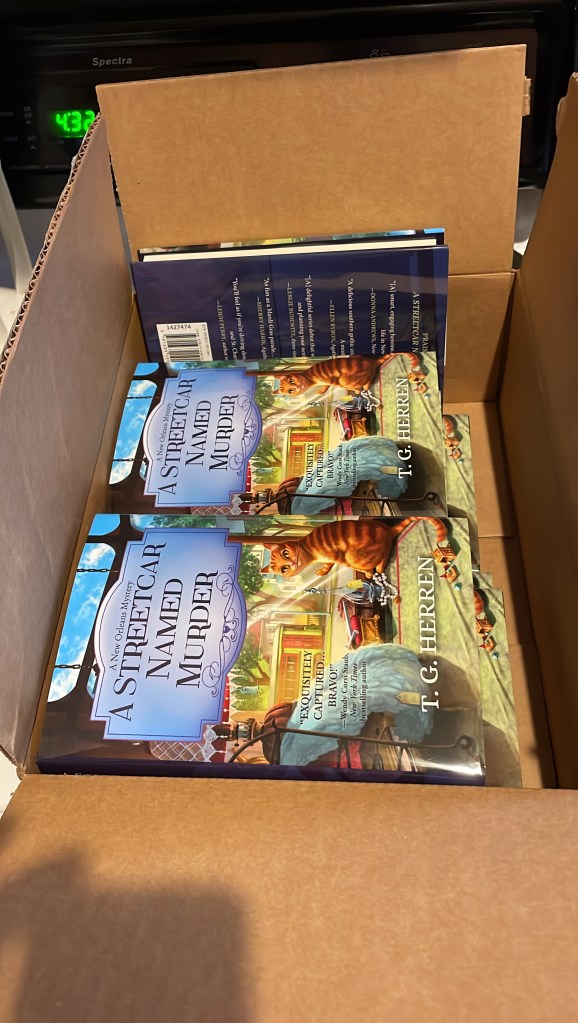
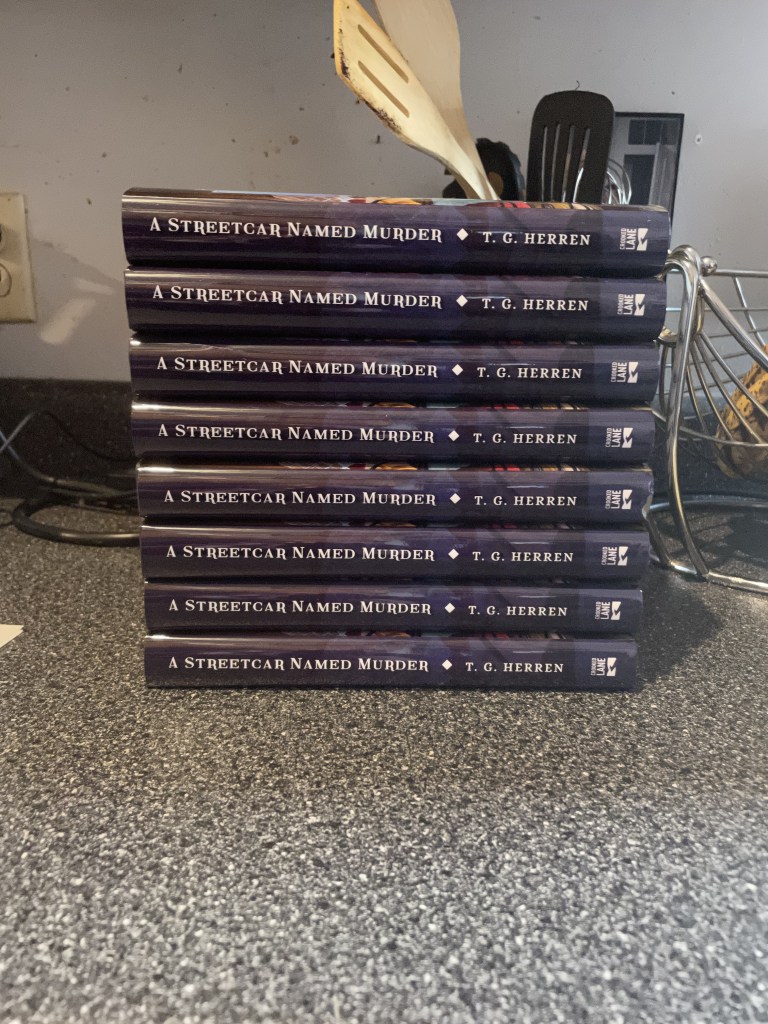
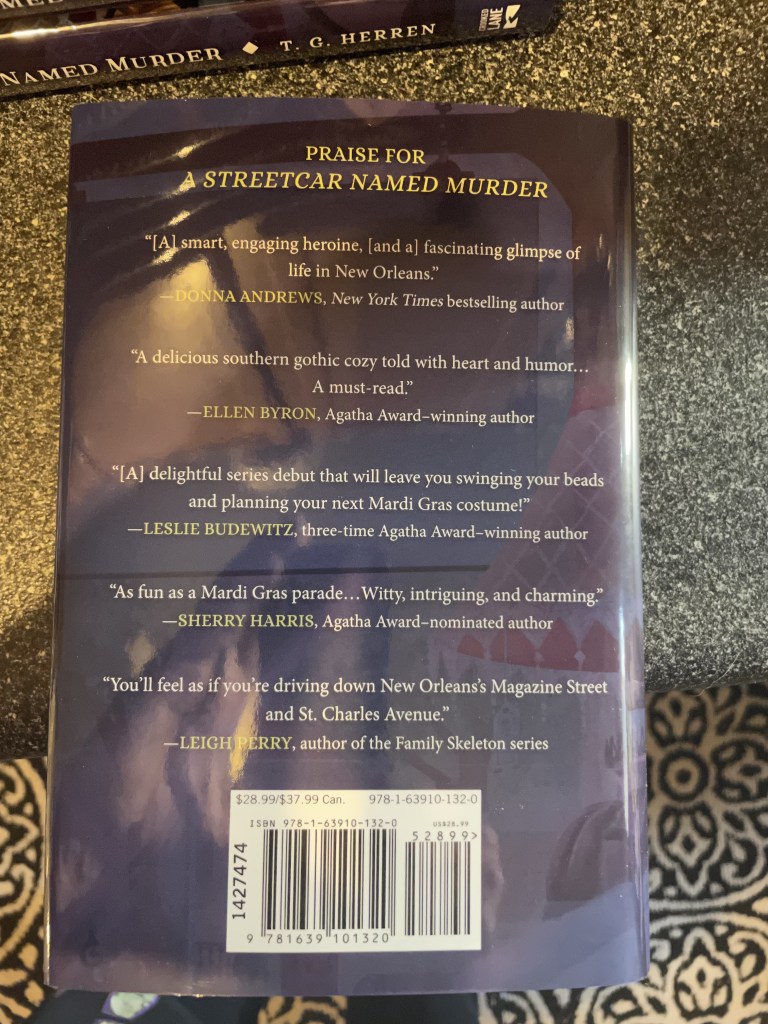
If you follow me on social media you will know already that I got my box o’books of A Streetcar Named Murder this week. The book looks stunningly beautiful, seriously; I couldn’t be more pleased with everything about the book’s packaging. The cover is gorgeous; and stacked up together they look especially gorgeous, as you can see in these delightful images from my kitchen counter.
So, Greg, why did you write a cozy mystery?
The same reason I write anything–primarily because I wanted to, and to see if I could, you know. actually write one. I’ve always liked them–I love traditional mysteries, always have–and have always admired how authors pull off the crime aspect of the story. Sure, there’s a bit of an imaginative stretch required to read a series–how realistic is it that an every day citizen will continually get involved in the solving of a crime, through no fault of their own? But…no one bats an eye about the realism of private eye series, and let’s face it: private eyes involved in murder investigations are just as rare. They spend most of their time on insurance claims or, you know, infidelity. Likewise, police investigations are often very straight-forward, without the usual twists and turns and surprises a writer needs to include to keep the reader turning the pages. The Scotty series–despite him actually becoming a licensed private eye, fits more into the cozy genre than it does the private eye; for one thing, it’s funny, and for another, Scotty is never hired, he always stumbles over a body somehow–to the point that it’s almost a running joke in the series.
I had always wanted to write a mainstream series centered around a straight woman, to be honest. I mean, let’s face it, I’ve done that queer mystery, both series and stand-alones, and I always like to keep my work fresh and interesting for me–I cannot imagine the hell writing something that bores me would be. Early on, before I sold my first book, a major figure in the crime fiction world told me that every so often she wished she could write something else, but “all anyone wants from me is *series character*,” but very quickly added, “But I’m still grateful people want that.” I always remembered that–obviously, I still do–and so while I would be eternally grateful were I ever to achieve that level of great success, I tried to always diversify my writing so I’d never get bored. The Chanse series was very different from the Scotty series; the stand-alone novels are rarely set in New Orleans; and so on.
I’ve tried spinning off my Paige character from the Chanse series into her own series; I always liked the character and thought she was a lot of fun and could carry her own stories quite nicely. I still think so, but audiences didn’t respond to her when I did finally give her those own stories–but there could have been any number of reasons why that didn’t work. The books were marketed and sold as cozies–which I think was a mistake, because I didn’t write them as cozies. Sure, Paige was a single woman, working for Crescent City magazine and a former crime reporter for the Times-Picayune, which gave her some credibility as an investigator, but Paige was sharp-tongued and foul-mouthed. Had I known that the books would be marketed to the cozy audience, I wouldn’t have used Paige–she was too centered in my head as who she was for me to change her significantly in her own series–and would have simply come up with someone new. The books were also electronic only, and oddly enough, my readers tend to prefer to read me in print hard copies.
I had actually tried writing a cozy series before–I had this great idea for one, about an English professor at a university in a fictional Louisiana town on the north shore (based on Hammond); I called it A Study in Starlet and wrote a strong introductory chapter, trying to channel my inner Elizabeth Peters/Vicky Bliss; sarcastic but not bitchy, but it never got anywhere. I actually became rather fixated on my fictional Hammond (which I called Rouen, pronounced “ruin”, and I did want to call one of the books The Road to Rouen), which I may still write about at some point–I never say never to anything–but I am digressing. But I always had it in the back of my head that I should try writing a mainstream cozy at some point in my career. And this came about in a very weird way–it’s a long story–but I wound up pitching the idea I had to Crooked Lane and they offered me a contract, which was quite lovely. (Incidentally, I signed the contract electronically on the Friday before Hurricane Ida; the last email I got from Crooked Lane that Friday afternoon after signing the contract said you’re going to be getting some emails from the team next week so keep an eye out for them and welcome aboard! So, of course the power went out on Sunday morning…)
I originally was going to write about a costume shop. There’s one across the street from Paul’s office that has a showroom and an enormous warehouse; they do a lot of costume work for film, theater, and television, which seemed like a great backdrop for a series with all kinds of potential stories for the future. Crooked Lane didn’t like that, and asked me to come up with something else, so I walked down Magazine Street writing down the kinds of businesses I saw. An antique shop was one of them, and that was what they liked. My working title for the book was Grave Expectations, because it involved an inheritance, but they didn’t like that title either, and I reached back into my archives for a title for the original spin-off idea I had for launching the Paige series–I wrote like 100 pages of the first Paige book in 2004 and it never got used–and grabbed the title from it: A Streetcar Named Murder, and hence, the title was born.
And…I had three months to finish the book, as they wanted it by January 15th. And of course there was the power situation in New Orleans, and…
Heavy sigh. I will leave the rest of the story for another day and time.
I slept really well last night; woke up again at five and since it wasn’t the alarm yanking me out of the clutches of Morpheus this morning, I feel rested. I was very tired last night when I got home; I hit the wall around three yesterday afternoon and when I got home it was the easy chair for me. We watched more Big Mouth, and then I retired to bed around ten. I am working at home tomorrow, so am hopeful this will be a good weekend for writing. I do want to watch both the LSU-Arkansas and Alabama-Mississippi games this weekend–as they could determine who wins the SEC West for the season (and I cannot believe that LSU is in the driver’s seat; I was hoping for an 8-4 season and feared that was unlikely), but I also need to get caught up on my writing and everything. Yikes.
And on that note, I am heading into the spice mines. Have a lovely Thursday, Constant Reader!
Eight or so years ago at this time Paul and I were in Italy. Sigh, Italy. God, how I love that country. I would love to live there in a village in Tuscany–well, really, anywhere in Italy would work just fine, really. I do so hope we’ll be able to go back someday. I’d love to see Pompeii, Milan, and Rome. And both Corfu and Capri–especially after reading (listening) to Carol Goodman’s wonderful The Night Villa. (One of the real life incidents she mentioned in the book from Capri’s history fascinated me, and took me down a wormhole and now I want to write about that historical incident, of course.) I have since written a short novella (or long short story) set in Italy called “Don’t Look Down,” which was included in Survivor’s Guilt and Other Stories, and I have another novella-in-progress set in Venice called “Festival of the Redeemer,” which I hope to polish and edit at some point before the end of the year. Sigh, Italy. What a beautiful country, with lovely friendly people and the most amazing food and….so beautiful. You can see why the Renaissance flourished there.
I got the final edits on “Solace in a Dying Hour”–two questions (one in which I had made a mistake) and the rest was copy edits and the deletion of a paragraph. So that’s a wrap, methinks, and I am really fond of the story, too. It was my first venture into Louisiana urban legends and myth; well, really the second, because I did write “Rougarou” about a decade ago, but it’s been a while since I’ve turned to Louisiana legend and folklore to write a story, and writing about le feu follet was a lot of fun. I want to do more of these, of course; as Constant Reader may remember, I’ve become fascinated by the story of Julia Brown and the Great Hurricane of 1915, when her town, Freniere, was wiped off the map. Freniere was located on that narrow strip of land running between Lake Maurepas and Lake Pontchartrain; if you’re driving west out of New Orleans on I-10, and then take the Hammond exit north on I-55, that’s the land the bridge is built on (when you’re actually driving over dry land, that is). I’ve always called that swamp the Manchac Swamp, but I don’t think that’s it’s real name (and I’ve called it that in books, too. Yikes!). You cannot get to the location where either Freniere or Ruddock (the other town in that area that was wiped away by the Great Hurricane of 1915) any way except by boat; apparently some of the swamp tours will swing by the old location where the graveyards still are, but the wreckage and remains of the towns are long gone. Both towns were only reachable by train or boat when they actually existed; there were no roads in or out of town, which always makes me think why would anyone want to live in such a remote and isolated place? But yes, you can bet the witch Julia Brown will appear someday in something I write.
I also got a rejection for a story yesterday, but it was one that I expected so it didn’t sting. I knew it was a long shot to begin with, so that’s fine, and I can certainly send it to another market, which I will most likely do after reading it again to make sure it’s actually quite terrible and I was in a complete state of denial about it being publishable in the first place. Rejection is just part of the game, of course, and there are any number of reasons your story doesn’t get accepted that have nothing to do with the story’s quality itself. I like my story and I think it’s clever, but that doesn’t mean it doesn’t need to be looked over another time, you know?
I feel rested this morning. I was very tired when I got off work yesterday afternoon, which is fine; I’d rather be tired after work then during it, you know? I didn’t get much of anything done once I got home, either–I had to pick up the mail and a prescription on my way home; today I can just come straight home–and I have some things I need to get taken care of when I get home from work tonight. Which is cool, I think I can spend a bit of time preparing (I have to make a promotional video–which clearly I’ve been putting off as it is due to be turned in tomorrow) and of course, I have to make the kitchen in the background behind me look–well, not embarrassing for me, at the very least. (Although I don’t know how much more embarrassed I can get filming myself. I hate the sound of my voice and I hate the way I look on video recordings–mainly because the actuality of how I look does not come close to the way I see myself in my head–pictures, recordings and the mirror often provide deeply disturbing shocks for me.)
And on that note, I am going to head into the spice mines this morning. Y’all have a marvelous day, and I’ll be back tomorrow for another entry. See you then!
Yesterday was kind of lovely, really. As I took a vacation day to get caught up on things, get some rest, and try to get the Lost Apartment under control again (I also discovered, among other things, that vacuum cleaners have filters you are supposed to clean monthly, which explains so much), it was kind of a nice day. I did get the bed linens laundered and a load of laundry done; I did the dishes and ran the dishwasher, and I also intended to vacuum, which is when I realized my vacuum cleaner has not been sucking properly in quite some time (I’d even looked into buying a new one, several times) and then thought, why don’t you google it and see if it’s something you can fix, which of course led to the shocking discovery about the filters. I removed it and washed it thoroughly (so disgusting, really). But, embarrassing as that was, it was also lovely to realize that I do not, in fact, need to buy a new one–at least until the filter has finished air drying, I reinstall it, and see if it starts picking things up again.
I also got a lovely notice on Facebook that my former editor at Alyson, Joe Pittman, had tagged me in a post, and when I went there to see what it was, was greeted with a reminiscence of his days at Alyson, and:
Hi everyone, it’s Joseph. It’s September. I’ve got another story of my publishing life, one of the most rewarding moments from my varied career. Let’s call it Love, Alyson Books.Okay, let me go back in time. It’s 2005 and I was hired by a small publisher named Alyson. The company had just relocated from Los Angeles to New York, and they were searching for a new staff. I applied for the Executive Editor position I saw advertised, got called in that day for an interview. I wasn’t exactly dressed for a job interview, but the woman I spoke with said that was fine. “I assume you have grown up clothes.”
I got the job, and two weeks later started. Every staff member had just been hired, and we had lots of manuscripts and contracts to cull through. From the publisher, to the marketing director, an editor, a production editor, and an assistant and me. That’s it, six of us. We had a big task set before us. Alyson had a storied history in the world of LGBT publishing and had released many iconic books. There was a lot on our shoulders.Our job? To bring Alyson into the 2000s, and show how LGBT themes had hit the mainstream. We had to totally revamp the list. We published 50 books a year, we had a very small budget, and as Executive Editor, I was told by the boss that I would be “the face of the imprint.” I embraced the role until it came to an ignominious ending.But in two and a half years, I felt I did some of the most important work of my career.
It started, horribly, with Hurricane Katrina, but led to a book and a series that would help define the LGBT past, present and future. It was a series with titles that began with the word “Love.” And that’s what these books were, love stories dedicated to a certain city, to a movement, to a community.The thing about working at Alyson, it wasn’t like traditional publishing, where agents sent you a manuscript, you read it, you liked it, you acquired it. Sure, we did a bit of that, but mostly we had to come up with our own ideas, track down authors who would be ideal in crafting our idea into a book. I hit the jackpot with an existing Alyson author, mystery writer Greg Herren. Greg lived in New Orleans, and he and his partner Paul Willis went through hell that late August. Katrina ripped their lives apart, as it did to so many others in the region. My idea, let’s get a bunch of writers together to pen nonfiction stories about their city. Why they lived there, what they loved there. Greg was reticent at first. The wounds of the city too fresh. But the book happened.
LOVE, BOURBON STREET was published to great acclaim, and that next year it won the prestigious Lambda Award for Best Anthology. I remember sitting in the audience when the book was announced the winner. I couldn’t have been more proud of Greg and Paul’s dedication to the project, I couldn’t have been happier for the city New Orleans.
Love, Bourbon Street is a book I don’t really remember much about, to be perfectly honest. It happened, and came about, in that gray time after the evacuation and before we were able to move back into the Lost Apartment (which, to me, closed the circle, even though the city’s recovery would still take more time–a lot more time); I think it even came out while we were still living in the carriage house amidst the clutter and boxes and praying every day that the Lost Apartment would be suitable for living again soon. I remember I was still house sitting for my friend Michael on the North Shore in Hammond when Joe called me with the idea–the great irony was earlier that day Paul had called me, and suggested we do a fundraising anthology about New Orleans by New Orleans writers, and I had emphatically said no. Most every one of the writers we knew were still displaced, no one could come back to New Orleans even if they wanted to, and we were all, from the blogs and emails I was reading, in bad places emotionally. I didn’t even know if I could write anymore; I was grimly writing a blog post almost every day so that the creativity wouldn’t completely stagnate, but other than that–nothing was happening. I had pitched a fourth Scotty book to Kensington, but at some point while I was on the road I’d emailed my editor there to say obviously I cannot write that book now–it was, ironically, going to be called Hurricane Party Hustle and be set during a hurricane evacuation when most everyone in the city had left, only for it to turn east at the last minute and spare the city (which had happened at least three or four times since we’d moved to New Orleans in 1996)–and I certainly never thought I was going to write another Chanse book; the second one had come out the previous year while Paul and I were still getting over the Incident and I think I did one signing for it; it came and went with very little fanfare and I had pretty much figured that series was dead in the water as well. I had been rewriting the manuscript that would eventually be published as Sara because an editor at a Big 5 publisher had asked me to write a y/a for them earlier that year and I’d decided that was what I would do after I, if I, ever finished Mardi Gras Mambo.
But I wasn’t sure if I would ever write about New Orleans again, or if there would even be a New Orleans for me to write about.
Given the fact, though, that Paul wanted to do this and my publisher called me later the same day to suggest it, my superstitious lizard brain decided it was something we needed to do; I don’t remember how long it took for me to either call Joe back or email him that we would do it, but we did. It was difficult to do, primarily because recruiting people spread out all over the country wasn’t easy, nor was getting people who were terribly depressed to try to write something about why they loved New Orleans when 90% of the city lay in ruins was a bit much. Also, people would agree to write something and then change their mind right before the deadline, which kept pushing the delivery date–already a tight turn around, because Alyson wanted to release it on the one-year anniversary–back. Finally, I pulled all the essays together into a single document, saw how many words were left to reach the contracted minimum, and started pulling together my own essay, the anchor piece, “I Haven’t Stopped Dancing Yet.” I remember I worked on it over the weekend that Paul had his eye finally removed, and so he was asleep thanks to painkillers most of the time and would only wake up for me to clean the socket before going back to sleep. It ended up being almost thirty thousand words, and I really don’t remember very much about writing it, if I’m going to be honest; I don’t. I just remember pulling it into the word document of the manuscript, seeing that we now had the length requirement covered, saved the document, and hit send.
That same fall, as we were doing the whole Love Bourbon Street, Joe was also calling and emailing me, trying to convince me that I had a duty and obligation to write another Chanse novel. “You’re right there,” he kept saying, “and who better to let the world know how it felt, how it feels, and what’s it like to go through something like this?” Again, I kept resisting. I didn’t know if I could write, I didn’t know when i would write, I didn’t know anything. And then, in late September, I drove back into the city once it was reopened, to check out the damage to the house and see what all we had lost, as well as to see if anything clothes-wise was salvageable from the upstairs. As I crossed the causeway bridge and saw all the damage to Metairie, I recoiled from it all, felt sick to my stomach and a headache coming on; by the time I got onto I-10 I had gone numb again so I could handle it all. As I noticed the mud-line on the walls along the highway, the words It was six weeks before I returned to my broken city popped into my head, and as I came around the curve in the highway, right near the Carrollton exits and the Xavier campus and the Superdome came into view, the words started coming into my head and I knew that not only could I write this book, I needed to write this book.
As soon as I got back to my sanctuary in Hammond, I emailed Joe and said, I am going to do the Chanse book and it’s going to be called Murder in the Rue Chartres.
And yes, both books won Lambda Literary Awards (my only wins, out of 14 or 15 nominations in total) in back to back years.
So that’s the story of how a very kind and generous editor essentially saved my career as a writer.
It’s funny, because whenever I think about possibly doing a collection of essays, it always takes me a while to remember, well, you’ve already published one that will take up a quarter of the book.
And now, to have some serious cleaning joy with my clean-filtered vacuum cleaner.




 Queer and Loathing in America