We Are Family

I got all my sisters with me!

“We Are Family” is one of those songs from the disco era–the ones that still get played on oldies nights in queer bars and continues to live on. Obviously, it’s an iconic gay anthem–about our found families rather than the blood ones that so often want nothing to do with us–and it’s also really popular with sororities…at least it was back then. It’s a very joyful and uplifting song, lyrically, so it’s also fun to belt out at the top of your lungs. Disco was a really fun time for a gay boy in sparsely populated Kansas…it’s where my love of dancing really took off. The dance floor was, for many years, the only place where I felt free.

Yesterday was a decent day. We were very fortunate to not have any of that bad weather that was forecast, at least not here in the Lost Apartment. I’ve not checked on the storm toll throughout the rest of the South yet, primarily because I’ve not even finished my first cup of coffee yet. But I did see yesterday some horrific weather was happening throughout the South as the result of that storm cell yesterday, so I hope everyone got through it okay and is doing well this morning. Weather events are both terrible and terrifying. It’s kind of ironic that my current book I am writing is set during a weather event. But I feel rested this morning and I got up early (Sparky wasn’t quite as kind about letting me sleep later), and am about to start my second cup. I did okay yesterday. I was still mentally fatigued yesterday so wasn’t able to get a lot of creative work done, but managed some. I also did some chores and picked up around here, and walked to Walgreens in the morning to get butter, which I’d forgotten at the store on Friday (and I need a stick of butter for today’s dinner). Aside–Walgreens actually had stock. The one-two punch of Hurricane Ida and the pandemic dealt it a blow I didn’t think it was going to ever recover from; there were empty shelves everywhere, empty refrigeration cases, and you could never be sure they’d the one thing you needed–which happened more than once over the years since then. But I was very pleasantly surprised to see they had finally restocked, and they had things….not just the butter I needed but some other things I also needed and didn’t think they would have. NARRATOR VOICE: They did have those things, which was most pleasing to mine eyes.

This is delightful news–not quite “oh they opened a new Rouse’s in the CBD that’s actually on my way home” delightful, but it’s nice to know that I don’t have to get in the car to go get things necessarily anymore. I love when my life becomes more convenient.

I spent some more time with Moonraker yesterday, and it’s…something. There’s an unemotional distance in Fleming’s voice (he also uses the distant third person omniscient narrator style of writing, which I was trained so long ago not to use–I always use first or close third person, and it always surprises me when I read a legendary author’s work to find they use it), and there’s no sentimentality to it, either. The casual misogyny of the time is an eyeful, as well as the way Bond (and by extension, the secret service and the culture/society as whole) doesn’t really view women as people, but rather as almost ignorant children who need the guiding of a man). It’s also a good reminder that the Bond novels weren’t as over-the-top and tongue-in-cheek as the films1. The original novels definitely have a completely different feel from the movies, that is for damned sure. Fleming died around the time the first film was being made, so he never saw what Hollywood did to his characters and stories. I suspect he wouldn’t have cared much for them; the books are very cold. But it’s interesting to revisit it, and the similarities/prescience of Hugo Drax to Elmo Dusk are definitely eerie and make the book more compelling to read than it would have been a year ago.

Three out of four of the Lefty Awards last night went to friends–James L’etoile won Best Novel; Rob Osler won Best Humorous; and John Copenhaver won Best Historical–and two were openly queer writers writing about openly queer characters! Woo-hoo! The times, they are a-changing! There were also a number of other friends also nominated, so shout out to one and all the nominees and winners! Huzzah!

We did finish watching Running Point, which was a lot of fun and we greatly enjoyed it. We then watched the first three episodes of Adolescence on Netflix, which is disturbingly real. It opens with a 13 year old boy being arrested for the murder of a classmate, and the child is very definitely disturbed. We’ll finish that today probably, but I also have a lot of writing to do. We’ll see how everything goes.

And on that note I am heading into the spice mines. Have a lovely Sunday, all, and I’ll be back at some point.
  1. Ayn Rand, in writing about “heroes” in film and novels, wrote about the early Bond films in an essay about art. I remember how much she loved Dr. No–really one of the only Bonds to be done as a serious film–and how much she hated Goldfinger. ↩︎
Mystery to Me

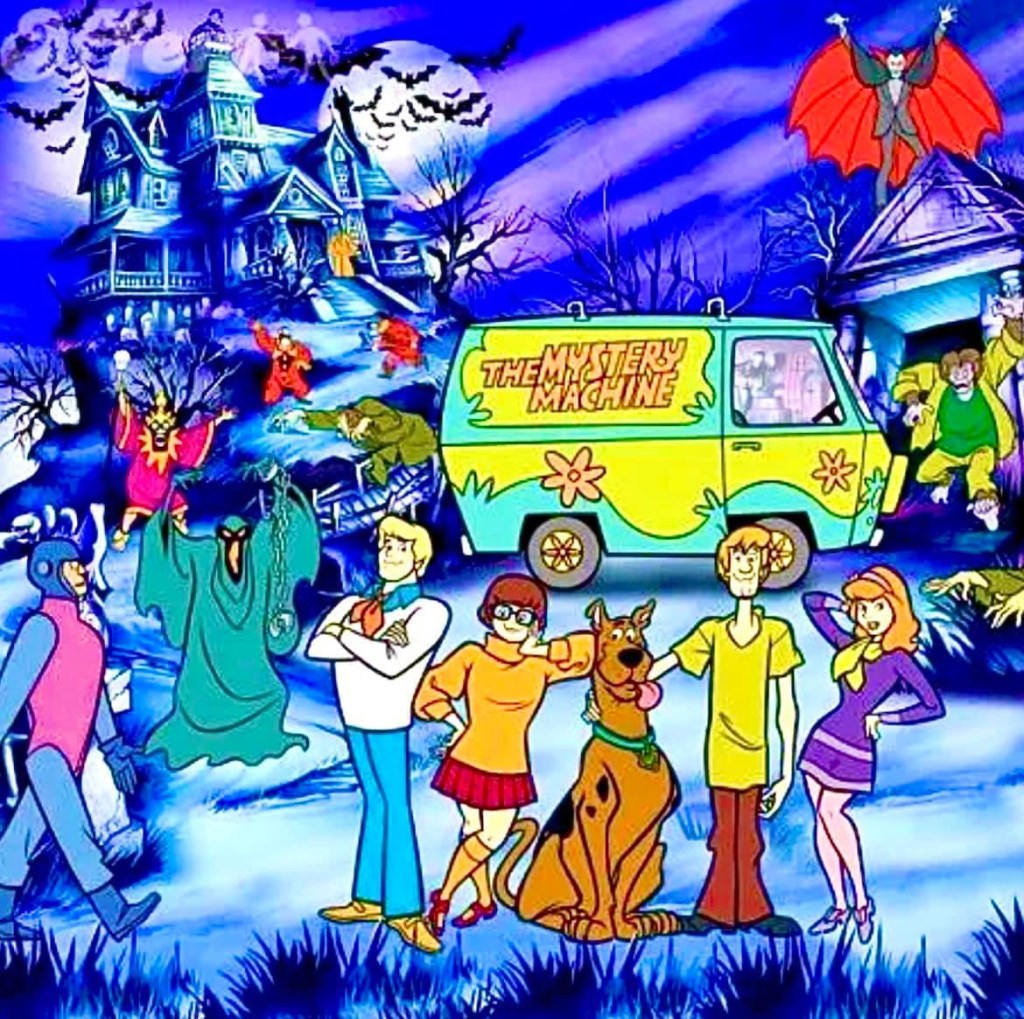
The other day after work I was too tired to write and so I settled into the easy chair with one Sparky for cuddle time, but needed something to watch. I finished burning through the news to get caught up as I do every day, and then started searching for something else to watch when I saw Scooby Doo, Where Are You? in my “Up Next” list as I scrolled through it. It’s always tricky when I need something to watch on my own without Paul–it has to be something he’s not interested in watching–and at some point over the last four years I started revisiting this show from my childhood but never finished the rewatch–mainly because I am now in my sixties; far too old for the audience they were going for.

While I wouldn’t say Scooby Doo Where Are You? was necessarily a huge influence on me and my life, I did love it and watched it every Saturday. It started sometime after Jonny Quest and The Hardy Boys cartoon was cancelled, and a kid who was devouring kids’ series books by the stacks and checking out every book in the school and public library that had the words mystery, secret, clue, haunted, ghost, riddle, or phantom in the title, the adventures of the Scooby gang was usually the highlight of my Saturday morning cartoon experience. I have not been a fan of anything that came in the wake of the original half-hour show (we will never discuss the abomination/hate crime that was Scrappy Doo), and for the purpose of this entry (and really, in my heart and mind) we will pretend that the show was cancelled after the original series run and nothing was rebooted, restarted, revamped, or overhauled in the years since the original Scooby Doo money train was derailed.

But saying Scooby Doo didn’t cement my interest in mysteries wouldn’t be true. The show did, silly as it was (watching as an adult I couldn’t help but wonder, “why would the bad guys go to such extremes to scare people off?”–which also is a contrivance often used in the Nancy Drew/Hardy Boys type books, too), but I watched it every Saturday morning. I kept watching through the next iteration, the hour long show with guest stars, but after that I was too old and had better things to do on Saturday morning than watch cartoons. I’ve always had a soft spot for Scooby, just as I did for the animated Hardy Boys show and Jonny Quest, and unlike many others, I never see reboots or remakes or re-imaginings as “destroying my childhood” because I am not a moron. I can see how the show appealed to kids–you can never go wrong with a sentient Great Dane with limited speaking abilities–and I remember writing Scooby fan-fic when I was young. I started out “novelizing” episodes, and started writing my own. I’d forgotten about that when I was originally rewatching, but in my head the kids’ series I eventually came up with was linked very much, not only to other kids’ series, but Scooby Doo as well.

I don’t want to adapt Scooby or write Scooby books anymore, but I do occasionally want to go back to my kids’ series and think, why don’t you give this a try? Often times, the reason I don’t write things I think might be fun challenges is mostly cowardice and Imposter Syndrome. Can I really write kids’ fiction? Can I really write historicals? However, writing Jonny Quest might be interesting, especially with a reading of the Quests as a queer family.

One of the things about Scooby Doo that always interested me as a kid, and continues to interest me as an adult: Velma. Velma was clearly the smartest of the gang1, which was fun and unusual, and Daphne (‘danger prone Daphne’) wasn’t dumb despite being the pretty one, even though she often needed rescuing. Over the years the character of Velma was really interesting to me–being a brain, of course, meant she had to wear glasses and was hopelessly far-sighted–because she wasn’t easily scared and she was often the one who figured everything out. It was also interesting to me over the years to see many people read Velma as a coded lesbian, which begs the question why? She never has any interest in the opposite sex, but none of them do, really–it’s not that kind of show. We have no background on the gang, either–how are they able to just drive around the country at their age without having to check in with parents, and where does their money come from?

Of course, this is asking a lot out of a children’s cartoon series, which is also why I find it odd to revisit these shows looking for queer coding, and you can usually find it. The all-male environment of Jonny Quest, which is also a kind of “found family” show or Velma not being a late 1960’s/early 1970’s stereotyped girl are good examples of this.

I’ve always wanted to do a reread of all the kids’ series (I still have the books) to reread them for queer coding. I’ve already mentioned before that there was homoeroticism in both the Ken Holt and Rick Brant series–deliberate or not, it’s hard to say–but does this exist in the more popular Nancy Drew and Hardy Boys books. Is tomboy Trixie Belden a budding butch lesbian, with Honey her future femme wife? What about cousins Bess and George in the Nancy Drew series, who are also almost a parody of butch/femme dynamics?

This is the kind of stuff I would love to write–critical queer theory about kids’ mystery series, books, and television programs.

Maybe when I retire.

  1. Calling themselves that also always amused me, since gangs usually are criminals of some sort or another; gang is usually mean that way, even though it’s just a descriptor for a group of people with a similar interest. ↩︎