Take It Any Way You Want It

And here it is Saturday in the Lost Apartment and as far as I can tell, all is well–at least for now. WE did get some rain last night–leftovers from Arthur, best I can tell–but the sun is shining and bright this morning, but everything outside is glistening and wet. I overslept big time this morning, which isn’t a big deal–I must have needed the rest, and Sparky was a cuddlebug, too, which made getting up even harder. I don’t think I am going to leave the house the rest of the weekend, unless I make a quick run to the Rouses in the CBD. I do feel rested and good this morning, which is a very good thing. I am going to try to do some reading and writing today around picking up and organizing; I got the dishes and laundry taken care of yesterday. The kitchen looks good, and really, picking up and doing the floors is all I have to do, other than organize, for housework.

I wasn’t fatigued yesterday so much as I was low-energy, so I did a lot of relaxing around the chores. I watched a lot of videos ofWorld Cup tourists enjoying the US for the first time, while hating the fact that MAGA is making compilation videos of how “great” America is after the Europeans have been “lied to by their leftist media” about America. Question for the closeted MAGA influencers making this “gotcha” videos: what do you think Europeans thought of the videos from January 6th? And actually, isn’t this proof that America is already great? But then again, logical thought processes aren’t exactly MAGA’s forté, are they? We also watched most of America’s Sweethearts, with one left to go, and I don’t think I enjoyed this season as much. This is the first of their three seasons that filmed after the earlier seasons truly started airing and becoming globally popular–and that they are all too aware of how they are coming across to the audience and the cameras. Judy and Kelly aren’t the same as they once were, and seem to be a lot more concerned about coming across as mothering and nurturing and supportive, instead of the relentless bitches who know what they want when they see it and aren’t settling for anything less. Loving but tough isn’t, sadly, as fun to watch; they were kind of endearing in their relentless drive to preserve and expand their brand; the Netflix show was a smart move for them, but I think they weren’t expecting a significantly larger audience than they used to get on TNN. There’s also something to be said about the Madonna/whore dichotomy on display here, too, but I will leave that to the feminist scholars to deconstruct and examine. Today, we’ll finish the cheerleaders’ show, get caught up with Cape Fear and Maximum Pleasure Guaranteed, and probably start the new Harlan show on Netflix.

I was pleased to see the US men’s team defeated Australia in Seattle yesterday, and yes I am actually thoroughly enjoying all the fans from other countries living their best lives. I love the Norwegian rowing chant, and watching the international fans all dance and sing and cheer and do their traditional chants has been absolutely delightful. I don’t remember the World Cup from 1994, the last time it was here, but that was also pre-Internet and social media. (I also love watching Europeans talk about why so many of us don’t have passports–“Because you never have to leave to experience a different culture, landscape, weather!” I love that the diversity of each state from one another fascinates them. I also watched a group of English guys driving from Dallas to Nashville; one mentioned it was a longer drive from the top of Scotland to the bottom of England) I’ve also enjoyed the hell out of Freddya78’s voyage through the US and reactions to everything he sees. I do have to confess, though, my favorite of all the fan reactions is the cute Italian guy thrilled to death by free refills on soda, or his shock at the size of a Whataburger medium cup. The tourists were originally joking about the “FIFA 15,” like the “freshmen 15” in college, only they’ve now upgraded it to the “Fifa 50.” I also love how the American culture they are enjoying so much is the stuff we take for granted and don’t give a second thought to–I only eat fast food, as a general rule, when I am on the road or as a “I don’t feel like making lunch” thing. I never go to a Chili’s or the Cheesecake Factory or any place like that; I live in New Orleans and I like to actually cook, but it does my heart no amount of good seeing them loving their stay here so much.

Also, loved the joy in New York when the Knicks won. These things always remind me of the year the Saints won the Super Bowl, and what an amazing time in New Orleans that was. We need more joy in this country, seriously.

And on that note, tis time for me to head into the spice mines. I am going to take my coffee and read for a bit before I take a shower, and hopefully will spend some time on my work space and the kitchen today as well. May you have a lovely Saturday, Constant Reader, and I will be back tomorrow morning.
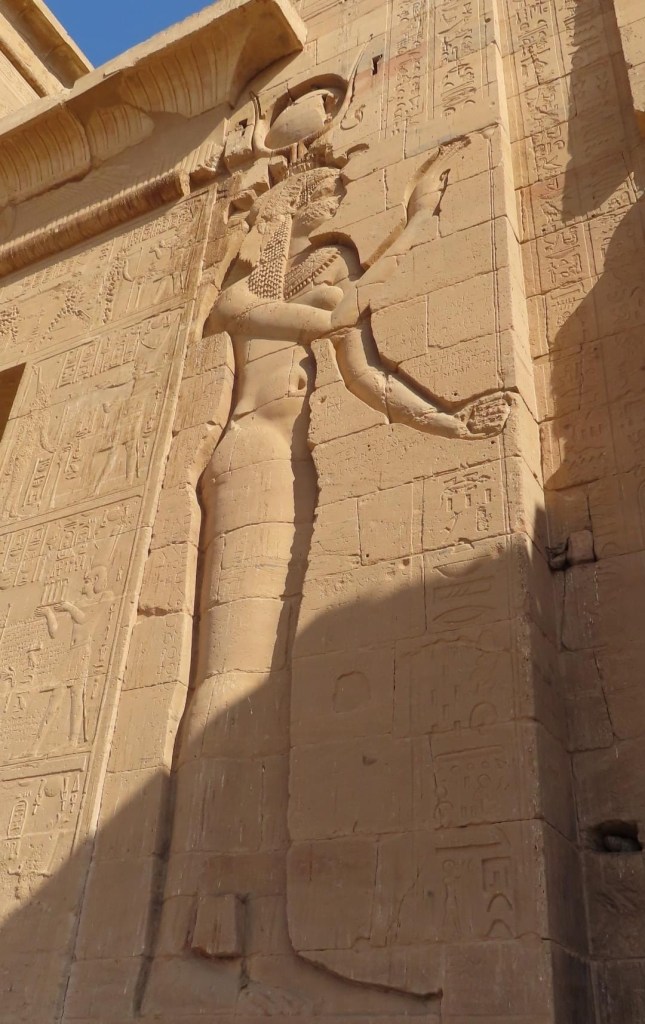
O Mighty Isis! Relief at Karnak

Old Man River

Can you believe I’ve written all these Blatant Self-Promotion* posts about New Orleans and my book A Streetcar Named Murder and haven’t yet written about the most defining thing about the city–the Mississippi River?

Why, we would not be here if not for that mighty river, the Father of Waters.

Sometimes, just for shits and giggles, I try to imagine what it was like for the Europeans to see the Mississippi for the first time. Imagine you’re a colonizer, heading west and hacking your way through the Forest Primeval, and you suddenly come upon this enormous river. Or imagine you’re on a boat powered by the wind, following along the coastline of the Gulf of Mexico and suddenly the water becomes muddy and messy and dirty, as opposed to the sparklingly clear blues and greens you’d been seeing since sailing into the Gulf in the first place? And then to come into the delta, trying to find the primary channel, and finding yourself in the fast-moving currents of an enormous river? Spaniard Hernando de Soto was the first European (well, probably one of his men, but he was the leader so naturally took credit for it) to lay eyes on the river inland just below Natchez; a Spanish navigator had already mapped the Gulf coastline by this time. Father Marquette explored the river, as did Joliet later (Marquette and Joliet played a very big role in my learning of History as a child in Chicago; a nearby suburb of Chicago was named Joliet. So learning the history of the Chicago area taught me about the exploration of the river by the French, coming south from Quebec and along the St. Lawrence through the Great Lakes). De la Salle discovered the mouth of the river and claimed it and all the land in its valley for France; Iberville rediscovered the mouth about fifteen years later and began exploring up the river, eventually deciding to settle a port/town/colony on the shores of the river where there was high ground…and that settlement became New Orleans.

For the record, the location was actually the perfect place for a city to be built, despite the climate, the water and the swampy land. New Orleans is the southern-most point on the river that is protected from the sea enough to accommodate shallow water ships but where it’s also deep enough to handle ocean-going ships. (The river is incredibly low right now–too low for barges to make it down here.) New Orleans became a vitally important city as the continent was slowly and gradually colonized by Europeans and later their descendants; water was the easiest mode of transportation before railroads and roads, and you can get almost everywhere within the two mountain ranges of the northern American continent by water. I think you used to be able to actually sail into the St. Lawrence down through the Great Lakes and down the Chicago and Illinois rivers to connect to the Mississippi and the Gulf, but am not sure if that is still true.

Because of the river and the Gulf, New Orleans became one of the most important ports in the western hemisphere and gradually one of the largest cities in the United States, and certainly one of the wealthiest.

I love the Mississippi River. It’s fascinated me since childhood; this enormous river that divides the country in two. As a child fascinated by history–beginning with US history–the importance of the Mississippi, and how it was linked to how the country grew and developed over the centuries, and how it was vital strategically and economically to a developing nation. The early fall of New Orleans during the Civil War guaranteed the Confederacy would fail. When Thomas Jefferson offered to buy New Orleans from Napoleon, the French conquerer, recognizing that without New Orleans the rest of the Louisiana territory was essentially worthless, threw in most of the North American continent in for a few million more. The primary takeaway for me from reading Mark Twain was his love of the river that I came to share. I also loved that I moved to New Orleans, practically the furthest south you can live on the river, from Minneapolis, practically the furthest north you can live on it. I can remember on a trip to the South from Chicago that we detoured and went to where the Ohio and Mississippi meet; I actually stood on that corner of Kentucky with the Ohio to my left and the Mississippi to my right. (The Ohio used to fascinate me as well; another river pivotal to the colonization and conquest of the continent.) I remember thinking how cool it was that the Ohio was blue and the Mississippi brown; that the wall of blue ended at the wall of brown–but there was a blue streak running down the middle of the brown for a good distance.

I love living here by the river, and one of the things I miss the most about working on Frenchmen Street is I don’t get the opportunity to walk down to Jackson Square, climb the levee, and stroll along the Moon Walk beside the river. It’s so massive that sometimes we forget how truly huge the river actually is; how when you fly into New Orleans over the river you can look from the window and see massive freighters that look like toys in a bathtub. Standing on the levee looking at the big freighters coming in or going out, they do seem almost like toys. I love how the city is below the river level, so when you’re driving down Tchoupitoulas the big ships are higher than the street.

I’d love to read about folk legends about the river, too–the size of the catfish and other creatures in its depths. And I want to write more about the river, too.

*Technically, I should be doing more of them, frankly.