zombie

Paul Tremblay has managed to turn himself into one of my favorite authors currently writing horror; I can’t think of a single novel of his that hasn’t been utterly fantastic, or that I haven’t enjoyed. He manages to make his characters absolutely real–with flaws and hang-ups; so much that sometimes you want to shake some sense into them–and the situations they find themselves in, while certainly horrific, are realistic. That, of course, is what makes the so horrible and terrifying; it’s easy to see yourself in his characters and stories. I also love his writing style; there’s something lyrical and poetic about his sentence construction and word choices, creating rhythms that make the words kind of sing in your head.

I wasn’t sure if I should, in that case, listen to one of his novels as an audiobook–would that musical sense of language carry over?

I needn’t have worried.
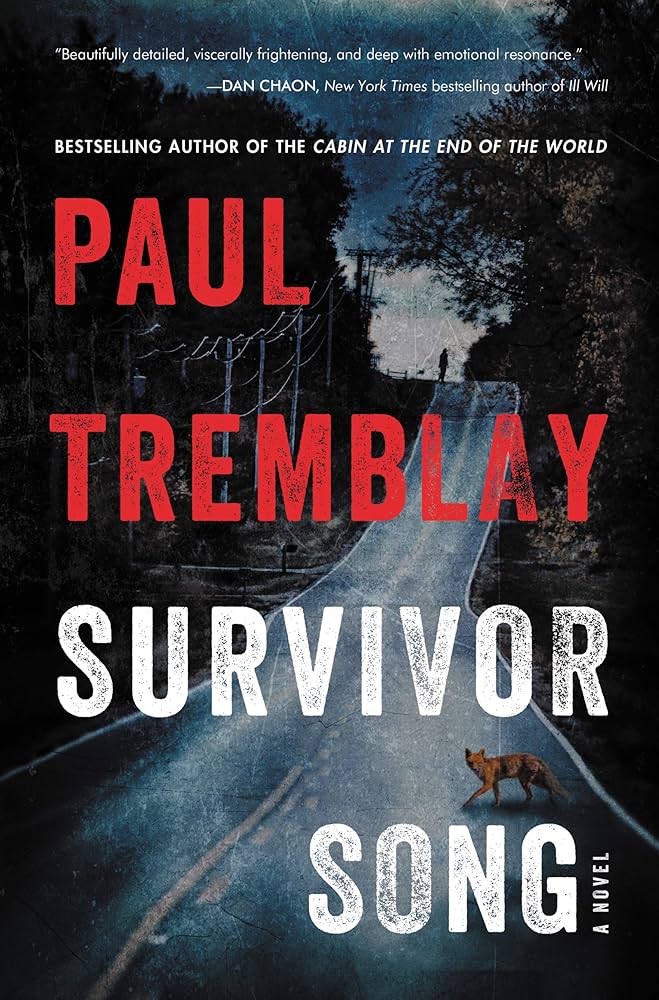
This is not a fairy tale. Certainly it is not one that has been sanitized, homogenized, or Disneyfied. bloodless in every possible sense of the word, beasts and human monsters defanged and claws clipped, the children safe and the children saved, the hard truths harvested from hard lives if not lost than obscured, and purposefully so.

Last night there was confusion as to whether turning off the lights was a recommendation or if it was a requirement in accordance with the government mandated curfew. After her husband, Paul, was asleep, Natalie relied on her cell phone’s flashlight in the bathroom as a guide instead of lighting a candle. She has been getting clumsier by the day and didn’t trust herself to casually carry fir through the house.

It’s quarter past 11 a.m. and yes, she is in the bathroom again. Before Paul left three hours ago, she joked she should set up a cot and an office in here. It’s first-floor window overlooks the semi-private backyard and the sun-bleached, needs-a-cost-of-stain picket fence. The grass is dead, having months prior surrendered to the withering heat of yet another record-breaking summer.

The heat will be blamed for the outbreak. There will be scores of other villains, some heroes too. It will be years before the virus’ full phylogenetic tree is mapped, and even then, there will continue to be doubters, naysayers, and the most cynical political opportunists. The truth will go unheeded by some, as it invariably does.

To wit, Natalie can’t stop reading the fourteen-day-old Facebook post on her town’s “Stoughton Enthusiasts” page. There are currently 2,312 comments. Natalie has read them all.

This was a book I didn’t want to read at the time of its release; and I am kind of glad I waited to get into it for a few years; while I was certainly reading a lot of plague fiction in the summer of 2020, when this book was released, the thought of reading something new about a plague whilst in the midst of one seemed–I don’t know, too real for me? The older stuff I revisited, both fiction and non, were things I had already read at some point in my life and therefore couldn’t be applied to the quarantine situation we were experiencing at that time. Of course, four years later, my own time-line is kind of fuzzy and off; it was a disorienting time, and it clearly broke the brains of a lot of people. Reading (listening) to the book four years later–without access of any kind to the pub date of the book, which I couldn’t remember in the car–I thought, wow, he really captured the insanity of the quarantine AND how people would react to it, so you can imagine my surprise to see it actually was written and already moving through the publishing pipeline for release before the pandemic began, which is frightening how eerily prescient Tremblay’s book actually is/was. (Although, imagining the right launching into conspiracy theories and blowing off quarantines and safety precautions and arming themselves–is it that prescient?)

The pandemic/plague in Tremblay’s book is a highly infectious, rapid onset variant of the rabies virus–so animals get it and become dangerous, and the infections can spread to humans. Once bitten or exposed, the human doesn’t have long before the virus takes over and leads, after a mad frenzy of attacking anyone or anything, to a painful death. Natalie and her husband Paul are coping with the quarantines, the breakdown in supply chains, the shortage of necessary supplies; a trip to the grocery store, never more than an hour to and from, including the shopping, can now take up to or more than four hours, as she is finding out that morning as she waits for him to come home. She’s in her ninth month of pregnancy, and that’s what she primarily focuses on, like most normal people do. Unfortunately shortly after Paul comes home, an infected man breaks into their house, kills Paul, and manages to bite her in the arm before she can finally kill him and escape. Natalie calls her best friend and college roommate–a doctor named Ramola–for help.

Ramola comes to pick up her friend, and the rest of the novel is the two women desperately trying to get to a hospital to try to get her treatment as well as a c-section to deliver the baby in case the treatments don’t work. It’s a race against time, and the suspense ratchets up to a unbearable level, as the two women–and everyone they encounter–encounter difficulties and roadblocks, not sure who they can trust and who they can’t, as they try to save both mother and child. Tremblay also takes the opportunity, whenever it arises, to chastise the anti-science movement in this country (which was saw in force that summer of 2020) for it’s radical views and beliefs that endanger everyone because of their own selfishness; again, was that prescience or simply the obvious conclusion to make? Even Ramola and Natalie, in their desperation, sometimes act in an incredibly selfish manner to achieve their own ends that makes me want to shake them both–which is another terrific insight on human behavior; we will always put our own individual needs ahead of the abstract “group” needs.1

It’s a very good book, and like the best fiction, it make me think. A lot, not just about American privilege and selfishness, but about dystopian fiction and disaster-type novels like this–which will inevitably become a Substack essay at some point.

Definitely recommended.

  1. This is something that often irritates me in these types of novels; leaders in these books will inevitably always put their own selfish needs ahead of those of the group (looking at you, Cell). ↩︎

No Charge

Good morning, Constant Reader! Hope this Tuesday morning finds you alive and well and alert and happy to get going on your day.

It rained again last night, a marvelous soaking downpour that was so loud I even could hear it without my hearing aids in. It was a nice day back at work yesterday, too–I wasn’t all that tired when I got home, which was lovely. I didn’t have to run any errands last night, so I was able to come straight home and write for a while. I managed 1400 painful words, but again–transition chapter, and I always have trouble with those, so nothing to see there, really. I felt good writing though, even if it was a struggle, and that means I am really back at it again. I’m just so grateful that I haven’t lost that ability. I think it’s realistic for me to stop fearing that will happen. It’s not likely at this point. I am writing my forty-third (I think) novel, and if the writing thing didn’t dry up after some of the things we’ve been through here ever since my first book was published, as long as my brain functions it shouldn’t be a problem. Ah, the loss of anxiety is a really lovely thing.

We watched the first episode of Fallout last night; I was reminded of it during the Emmys the other night. I’d not heard a lot about it, so we gave it a try. It’s dystopian, of course (I’ve clearly had that on the mind for a while lately), and the point is that just over two hundred years after a nuclear war essentially altered the world completely. There are people who live and have a civilization in huge underground bunkers, where an below-the-surface civilization has taken hold, and the underground dwellers are afraid of the surface and what has changed in the centuries since the war; there’s also some kind of discord between surface and below surface dwellers. The show seems to focus on three characters; a young woman who lives below ground and ventures out to find her kidnapped father; a soldier in a surface military; and the bad guy–a ghoul who is dug up from his grave by some criminals who want him to help them do bad things which aren’t specified. It was well-produced, and very well put together; the attention to details was greatly appreciated and helped make it seem fairly realistic. It reminded me a lot of The 100, only in reverse, with the survivors underground instead of in space…but there are tropes in this genre, and so there are always going to be similarities between dystopian shows/movies. I’m not sure if we’ll continue watching, but it wasn’t terrible. I try not to judge shows based on the first episode, as first episodes are often working too hard on setting up the show and the characters and their relationships to each other, and this show also has to world-build, so we’ll probably give it another go before crossing it off entirely.

Likewise, we started watching the new gay show, English Teacher, and while the first episode was fine–a little preachy, a little soap-boxish–the second episode really took off, and we were howling with laughter. Highly, highly recommend, if for no other reason than the Trixie Mattel guest spot! Looking forward to watching more of this show, for sure for sure. (And it’s so nice to see gay male lead characters on television…so a refreshing change from the past.)

I feel pretty good this morning, honestly, and it’s a very nice feeling. I am feeling more in control of things these past few months; at least it’s better than the treading water trick I’ve been doing over the last few years or so. I was also thinking about the Scotty series last night, as I am working on Book Ten (which is a truly scary thought; have I really written that many books in a series?), and wondered if it’s time to let him go? I still have ideas for more Scotty books, mind you, and I think of titles all the time (I thought up one this morning: Pearl River Peril), but going through the Scotty Bible and pulling that all together made me start thinking about potentially winding the whole thing down. It’s not the longest running series with a gay male lead by any means; I think Mark Zubro’s series have vastly more volumes in them than I have in mine, but I’m proud of the accomplishment and the haphazard, meandering way the series developed over time. Alas, that also led to continuity errors, but rather than making me cringe I just kind of laugh at my laziness. Before the new meds, this would have created a spiral of a professional wouldn’t have made those mistakes and all those people who discouraged you from pursuing writing were correct and….yeah. Don’t miss those episodes any more, and I also like being able to look at my writing and my career with the proper distance I could never have achieved on the old medication protocol.

Better living through chemistry is, indeed, a thing.

And on that note, I am heading into the spice mines. Have a lovely Tuesday, and I may be back later, and I may not. One can never be certain with me!

King of My Heart

I went down a wormhole thought pattern of sorts this morning, triggered by reading a Crimereads essay about spy novels, and their genesis; it mentioned that Rudyard Kipling’s Kim was one of the first spy novels, and I also realized that only had I not read Kim, I’m not entirely sure I’ve ever read Kipling; however, a quick Internet search just not has reminded me that I have, indeed, read Kipling: Rikki-Tikki-Tavi, The Jungle Book, Captains Courageous, but I really don’t remember anything about them (let’s be honest, all my memories of The Jungle Book are naturally from the Disney animated film). I may have also even read Just So Stories, but am not entirely sure. I’m sure Kipling’s work does not stand the test of time–just the title of the poem “The White Man’s Burden” made my eyes almost pop out of my head when I came across it this morning–as they undoubtedly reflect the white supremacist view of Imperialism and the need for the British Empire.

On that same note, I feel relatively certain that the M. M. Kaye novels I once enjoyed (Shadow of the Moon and The Far Pavilions) probably wouldn’t hold up well, either.

I always read for pleasure and for enjoyment; to escape the world in which I found myself inhabiting and feeling like a changeling for the most part; I still do, for the most part. I haven’t been paid to write a book review in over a decade; I’ve always felt that as an author myself, there was a conflict of interest in accepting pay to read and critique another author’s work, and there was always, inevitably, the possibility that an honest view on something that didn’t work for me as a reader would be seen as a vindictive move on my part to torpedo another author, out of jealousy or spite or both. There are any number of these reviewers being employed, and paid quite handsomely, by major newspapers, and I don’t want to be one of them. I don’t like writing negative reviews, and if I am reading something I don’t care for, having to finish reading it because I am being paid to write about would inevitably make me resent the book and its author and would thus color the review.

I generally read things I think fall under my purview as a writer–mostly crime novels, some horror now and then, and maybe something every once in a great while, that would be considered literary. Often these are books by writers I already have discovered, or new ones recommended to me by others whose tastes I respect–The Coyotes of Carthage came to me in this way; Lisa Unger was recommended to me by numerous friends; and yes, Paul Tremblay came to me as a recommendation from a friend. I know I need to expand my horizons to improve as a writer, which is why I am not only committed to the Diversity Project (books by marginalized writers) but also to the Short Story Project. The Diversity Project has been a terrific learning experience, and the Short Story Project has helped me become a better short story writer. I’ve been trying to read New Orleans history lately–with a dash of Louisiana thrown in for flavor–in order to get a better sense of the city and state, so that I can write about them both more knowledgeably; plus there is so much inspiration in reading about the past of both city and state! It’s also incredibly humbling to know how little of that actual history I did know, and even though I knew how rich that history was, I had no idea just how much of a gold mine of inspiration and ideas it would prove to be.

Like I said, I tend to read things I think I will enjoy, and if I am not enjoying the experience, I inevitably stop reading. I have started things and put them aside, only to go back to them again and greatly enjoy them; Paul Tremblay’s A Head Full of Ghosts being the best and most recent example of this I can remember; I started it, got several chapters in, and wasn’t feeling it. I went back to it months later and couldn’t put it down, and frankly, after The Cabin at the End of the World, Tremblay is becoming one of my current favorite authors.

So, I’ve been wrong about books before, and I’ve also been wrong about authors before. Hence the dilemma in being a book reviewer, and why I have chosen for many years now to seek extra income by reading for reviews. I enjoy writing about books I enjoyed on here, my blog; that’s part of its reason for existence, and I also curate what I read and write about here. No one chooses for me what I read or what I write about; and I will only review something negatively if the writer is, frankly, long dead; and even then, it’s simply an explanation of why the book didn’t work for me (an example of this latter type was Night Has a Thousand Eyes by Cornell Woolrich; I appreciated the book but there were things about it I didn’t like, that I felt didn’t “play”, but since he is long dead–over fifty years–I wasn’t overly concerned about hurting his feelings….and I have enjoyed other works of his).

I often talk about how my education in what the Academy considers to be classic American literature (British, too, for that matter) is sorely lacking. It’s something that I occasionally wonder about; should I go back and read these so-called classics as decided by a group of people whose opinion I generally don’t respect very much? It’s entirely possible, I know, that books I was forced to read as a teenager in high school and college were actually better than I thought at the time because I loathed being forced to read anything and I despised the way they were taught by pompous pseudo-intellectuals with tenure (I really enjoyed mocking that world in my story “Lightning Bugs in a Jar”, and will probably mine it again at some point as story fodder).

But I can honestly say I went back twice to reread The Great Gatsby only to discover that I loathed it even more than I remembered loathing it the first time; I also spent some time in my twenties trying to read other works by the writers I was forced to read and found that I did, in fact, enjoy some of them. I hated Sinclair Lewis when I was forced to read Main Street in college; I later went back and enjoyed both Elmer Gantry and It Can’t Happen Here very much. I disliked Fitzgerald’s This Side of Paradise very much, and I loathed the Hemingways I was forced to read (The Old Man and the Sea, A Farewell to Arms) so much that I just can’t bring myself to read anything else of his. I was very surprised, actually, to find myself enjoying Faulkner quite a bit, and I keep meaning to go back and reread both The Sound and the Fury and Sanctuary–but there are also a lot of other Faulkner novels I’ve not read, and probably should. I also despised Tom Sawyer and the other, celebrated Mark Twain short stories I was forced to read; but as an adult greatly enjoyed Puddinhead Wilson, The Prince and the Pauper, A Connecticut Yankee in King Arthur’s Court, and Life on the Mississippi.

But I am not someone who became a writer because I wanted to have a legacy, or be lionized; I became a writer because I wanted to tell stories, and I wanted to tell the stories that I wanted to tell. I never had any desire to have my work be taught in colleges, or for students to be forced to write papers about my work. I always say that sort of thing isn’t up to me to decide, and it’s never been my aim. If I’m forgotten after I die, well, I won’t be the first.

I justify to myself not reading a lot of literary fiction by saying there simply isn’t enough time for me to read everything that I actually want to read, let alone find the time things people think I should read. But I also have this sense in my mind that perhaps I am missing out on something; I know I’ve read books that have gotten critical acclaim that were more on the literary side and liked them very much and learned from reading them. Colson Whitehead, for example, is simply brilliant while also writing genre fiction–The Nickel Boys and Underground Railroad were stunningly brilliant; I really need to read more of his work–and thinking about Colson Whitehead led me to thinking about, of all people, Cormac McCarthy. I’ve not read McCarthy, but from what I have gathered from what I have heard about his work is it technically is also genre fiction; The Road is a post-apocalyptic dystopian novel, after all–a friend whose opinion I respect read and hated the book, so I’m probably not going to go there–so I started going through his canon on the web and I finally settled on one to add to my TBR pile at some point, Outer Dark, because it too sounds like genre fiction. We shall see how that goes, shan’t we?

Laura Lippman often says that genre fiction is literature, and by claiming literary classics as genre (the most common is, of course, Crime and Punishment) we are demeaning the great genre work, which stands on its own without the necessity of claiming Dostoevsky or Faulkner’s Sanctuary as crime fiction (although I do believe Sanctuary is pulpy noir of the best kind). I do agree with her to some degree; as I said, I do think Sanctuary is noir, and an argument could be made that An American Tragedy by Dreiser is as well. (I’ve also pointed out numerous times that The Great Gatsby is really a murder mystery told in reverse) But her point is spot on: genre fiction doesn’t need to claim classics from the Academy in order to be recognized as literature, and claiming those books does make it seem like trying to make fetch happen.

I also like to believe that my best work is still ahead of me.

Of course, that means I actually need to do it.

And on that note, tis back to the spice mines.

Also Sprach Zarathustra

Yesterday was a day.

Never mind why–it is simply too tedious for me to get into any detail and trust me, you’d be bored to tears–but the one nice thing about it was once it was finally over and donw with and I was safely inside the Lost Apartment and in my LSU sweats, with a purring kitty sleeping in my lap, I was able to rate rested and relaxed and now, hopefully I’ll be able to get my life back under some kind of control. That would be so lovely.I work a longer day now on Fridays–five hours instead of four–but shifting to coming in later in the day was an extremely smart move.

But the good news is that I was able to finally finish reading Rob Hart’s wonderful novel, The Warehouse.

the warehouse

Well, I’m dying!

A lot of men make it to the end of their life and they don’t know they’ve reached it. Just the lights go off one day. Here I am with a deadline.

I don’t have time to write a book about my life, like everyone has been telling me I should, so this’ll have to do. A blog seems pretty fitting, doesn’t it? I haven’t been sleeping much lately, so this gives me something to keep myself occupied at night.

Anyway, sleep is for people who lack ambition.

The rise in popularity  in dystopian fiction since the turn of the century isn’t really that difficult to understand; the world is kind of on fire and each day we seem to be inching our way to the inevitable collapse of civilization as we now know it. I do recognize how pessimistic that thought is, but it’s one I’ve been finding myself having more and more as the years have passed since the century dawned with so much promise back in 1/1/00. Remember how exciting the new century seemed back then, when it was fresh and new and full of promises? Yeah, well. Who knew? I wonder if people felt the same way in 1919…but given they’d just gotten through the first world war and the Spanish flu pandemic that killed millions, probably.

Early in the 1990’s, as queer equality issues began to become more and more mainstream–with the inevitable holier-than-thou nasty religious pushback–I wrote down many pages of thoughts and ideas I had about a dystopian future world, one in which queer people finally obtained equality only for there to be a horrific and horrendous pushback, similar to the one depicted in Margaret Atwood’s The Handmaid’s Tale that pushed back against feminism and women’s equality. I saw an America where evangelical Christianity was encoded into our law; where people of color and other undesirables began to disappear as they were blamed from everything wrong with modern society and the economy; and where those unaffected by those prejudices and legalized bigotry turned a blind eye to the suffering of fellow Americans as long as they could pay their bills and buy nice things for their family. Since that original idea–which was easy to scoff at by friends I talked about it with, as they weren’t queer or marginalized–I’ve come back to that idea, time and again, as the idea sometimes seems to be taking root in reality. I tend to avoid dystopian fiction, as a general rule; I’ve read Brave New World, 1984, The Stand, Alas Babylon, The Handmaid’s Tale and many others; I’ve watched the Mad Max films. I generally try to avoid it, to be honest; I find our the dystopia evident in our reality far more frightening and oppressive than anything I might find in fiction.

But I couldn’t get into The Hunger Games  or any of the others published in the twenty-first century to great sales and acclaim; just had zero to no interest. I got into the zombie apocalypse stuff for a while, with The Walking Dead, but even it eventually devolved into misery/torture porn and I lost interest.

But Rob Hart’s The Warehouse…I don’t know; for some reason as soon as I heard the concept behind it, months before its publication date, I knew I wanted to read it. Part of the exhausting frustration I’ve felt over the last few weeks as I slogged away at the volunteer project has partly been due to my inability to spend more than twenty minutes or so at a time with the book; the one good thing, as I said already, about today’s errands was the ability to sit in a waiting room for long stretches of time with nothing to do other than read–and occasionally delete emails from my phone.

What a wonderful, frightening, and all too realistic book Rob Hart has gifted the world with!

The Warehouse is set in a world in the not-too-distant future where almost everything has collapsed. This collapse of functionality of the general society isn’t explained; but it has to do with climate change and economic shifts and rising seas. One company, Cloud, which allows everyone to buy everything they need on-line and have it delivered quickly via drones, with MotherClouds scattered all over the United States, has pretty much monopolized means of production and delivery; their employees are given free housing and so forth and live in climate controlled dorms that are all connected with the warehouses and entertainment complexes; enclosed cities, where your every move and your every purchase is monitored. There’s health care and communal bathrooms and showers and you need your Cloud wristband to get anywhere or do anything.

Sound all too frighteningly familiar?

The story is told from three different points of view; the book opens with with a blog entry from Gibson, the man who thought up and founded Cloud and became worth billions as he essentially took over the United States; Paxton, a small business owner who invented a thing called Perfect Egg, so that you could make a perfect hardboiled egg in the microwave and peel it perfectly every time, a business that flourished until Cloud’s demands for deeper and deeper discounts eventually forced him out of business and has now landed a job there; and Zinnia, a young woman we don’t know much about who is also starting work there, but she has an ulterior motive. Zinnia and Paxton eventually cross paths, become friends, and as he works security, she begins manipulating him for information as she also starts to develop feelings for him.

It’s a terrific story, very well told, with very smart things to say about capitalism, consumerism, and how easy it is to compromise your principles in exchange for security. Bright and intelligent and well-written, you can’t help rooting for both Paxton and Zinnia to somehow make it through everything and somehow come out on top.

Most dystopian tales deal with the aftermath of nuclear war, or Big Government taking over, or some kind of religious fascism, but rarely, if ever, has the dystopia arisen out of capitalism and consumerism, and Rob Hart hits the bull’s eye squarely with this one. (Well, also Atlas Shrugged by Ayn Rand, but Ayn Rand deserves many posts all by herself, and she wishes she had one tenth of Rob Hart’s story-telling skill)

This is destined to be a classic, and I do hope Ron Howard does the story justice on film.

In closing this, I’d like to thank Rob–and other writers like him, like Ben Winters and Adam Sternbergh–for pushing the envelope of the crime genre, melding crime and speculative fiction in clever, innovative stories that broaden our genre and enable them to tell bigger stories than we customarily see in crime fiction. I loved this book from start to finish, and it’s so layered and clever–the development of Gibson, through his blog entries, his justifications for his egotism and so forth, was chillingly genius.

Read this book. It’s amazing.

Everything About You

Saturday morning. A good night’s sleep had me up earlier than I would have thought this morning, but I feel rested and good; I was exhausted last night for some reason; Friday, perhaps? I don’t know. But I feel good this morning, I only have one errand to run–which is the grocery store, and I’ll try to get that out of the way momentarily–and some cleaning and organizing needs to be done. I also need to do some writing and editing today; yesterday I was too tired to work on the Scotty revision when I got home, so I need to get caught up on that today.

GEAUX TIGERS!

LSU plays their fifth ranked opponent today, Mississippi State. The Bulldogs roll into Tiger Stadium tonight ranked 22nd in the country. They have some nice wins under their belt, and some losses to quality teams–last week they surprised Auburn–and so this is by no means going to be an easy game for LSU. There could be a let down after last week’s huge, physical win over Georgia; Mississippi State is going to come in hungry; and LSU has to be careful not to be over-confident, must stay focused, and try not to look ahead to the big Alabama game in two weeks–which won’t be as important should LSU lose to Mississippi State. I will undoubtedly be extremely tense during the game, but am going to try my best not to get overwrought and overly involved in the game. It’s supposed to be fun to watch for Christ’s sake.

I also have some reading to do, and some editing that needs to get done, and an author interview I need to get started. My intent is to clean out my email inbox before leaving for the grocery store, as well as get some morning cleaning done here in the kitchen/office. My day job is moving at the end of this month, and I will no longer, in the new building, have my own office; I shall be in a cubicle like everyone else–and so have had to empty the bookcases in my office as well as take down all the pictures from my walls. I do not have the wall-space here in the Lost Apartment to adorn my walls with these pictures–mostly of our trip to Italy–and I’ve been trying to squeeze the books in wherever I can, which for obvious reasons has not been easy to do.

I’m still reading Empire of Sin, and am hoping to get further along in that this weekend as well; it may be in my lap during the game tonight. My reading has slowed down dramatically; and I still haven’t done a blog entry about Alice Bolin’s Dead Girls. Maybe later today.

I finished watching season three of The Man in the High Castle last night, and by far and away, this third season is the best of the show so far. It is interesting to me how well they’ve done with the character of John Smith, an American who fought against the Axis during the lost war and has switched sides, climbing the ladder in the American nazi hierarchy and also being groomed for leadership by Himmler himself. Underplayed beautifully by Rufus Sewell, the personal journey of this monster has sort of humanized him–which is, in and of itself, terrifying; this man is a monster and the antithesis of a patriotic American; everything a true American patriot would despise–and yet, those personal problems and tragedies and little heartbreaks in his family life make him almost win the audience’s sympathies…then he does something monstrous and you remember, there are no good Nazis. This show, and its message, are particularly real and powerful and important, given these times in which we live.

In the early 1990’s, I has an idea for a dystopian series of novels, built around the collapse of the American republic and the rise of a totalitarian state in its place; which I was going to call There Comes a Tide. I have all my notes and ideas in a folder somewhere, which means I might take a look at them sometime soon and see if it’s something I want to write in the next year or so. I have a y/a on deck to write after I finish the Scotty revision, and I am also going to be working on the WIP in the meantime as well; I kind of wanted to try writing a cozy after the first of the year and I also have a noir I want to write, in addition to a paranormal suspense thriller I’ve been toying with the last few months. There’s simply never enough time to write everything I want to write, and all the procrastination doesn’t help.

Heavy heaving sigh.

I’ve also decided to pull a long story from my collection and replace it with two shorter stories; the longer story will probably go up as a Kindle single at some point, and I also am in the midst of another long story that will probably turn into a Kindle single as well: “Never Kiss a Stranger.” I’ve recognized that story needs to be longer but it’s not enough of a story to be a novel…and there’s always Kindle single.

And now, back to the spice mines. I need to wash the bed linens, put some dishes away, get these floors cleaned, organize and file….and stop procrastinating.

Have a lovely Saturday, Constant Reader!

IMG_4283