Friends

After we moved to the suburbs and had not only a house but a second car, my mother decided that maybe religion was missing from the lives of my sister and I, and began taking us to church–not the Southern Baptist faith she herself was raised in, but the Church of Christ, which was my father’s family’s faith. It wasn’t like my sister and I hadn’t been to church before; whenever we visited relatives in Alabama we were inevitably dragged to church with them, whether we wanted to go or not. It wasn’t even up for debate, so yes, in some ways, my father’s family kind of forced religion on us when we didn’t really go to church at home with our parents. I never knew why Mom decided we needed to start going–she wound up having an off-and-on relationship with the church for the rest of her life–but we did. Dad played golf every Sunday morning and often hit buckets of balls after or maybe went out for lunch with the other players; I don’t know. But not only did we start going to church, she rewarded us by taking us to Ponderosa for lunch (where I first discovered Catalina French salad dressing, a favorite to this day) and then we’d go see a movie. Most of the movies are forgotten now, collecting dust and cobwebs until I think about that movie again and remember it was one Mom took us to.

The Last of Sheila was one of those movies, and I fell in love with it as I watched. It had everything I could possibly want: an incredibly clever murder mystery, a cast of movie stars I recognized, and it was about Hollywood, even though set and shot along the Riviera. It was an inside look at the rich and glamorous–something I felt was like another planet to me in my subdivision house, in my lower middle class existence which was a place where I felt like I didn’t belong.

Shortly after seeing the movie, I was at Zayre’s with a couple of bucks to buy books with, and there were three I wanted–The Last of Sheila and two others, but I could only afford two of them, and I regretfully put The Last of Sheila back because I’d already seen the movie and I could get it the next time.

Constant Reader, it wasn’t there when I went back. I never forget there was a book, either–but I didn’t know whether it was a novelization or an actual book the film had been based on; and I didn’t mind reading novelizations, either. When I rewatched the film again during the pandemic, I remembered there was a book and started looking for it on-line. It was clearly rare and beloved, because whenever a copy would come up for sale on second-hand sites it was always priced anywhere from $150-$300, and I didn’t care about the nostalgic aspects of it that much. Then last summer two popped up on ebay; both more expensive than I would have liked but still–reasonable enough to consider. I put in a bid on one and then realized the other was a “buy it now”, so I went ahead and bought it. A few days later I won the bid–and a little confused, decided to go ahead and honor the bid since I had put one in but simply forgot about it, and I gave the other away to a friend who also loved the movie for Christmas.

And finally, I settled in to read it–after another, recent rewatch.
The Sheila rode at anchor, stern to the quay, stern lines fastened securely over the bollards. The Mediterranean sun glanced off the brightwork and made of the white hull a dazzling blur. Her eighty-seven feet dwarfed the sleek ketch on her port side, a racing vessel owned by the pretender to the Spanish throne, but the Sheila was in her turn outclassed by the ninety-five-footer on her starboard, a powerful yacht owned by a South African diamond billionaire. The Palma marina was, as usual in the summer, crowded with the pleasure craft of the wealthy, berthed as tightly together as possible, their anchor chains frequently fouling.

Lee Parkman swung her long slender legs out of the taxicab and stood somewhat shakily on the quay, shielding her eyes from the too-bright noonday sun that pierced even through the lenses of. her oversized sunglasses. Her legs still felt rubbery from the long, bumpy tide over the dursty roads that led from the Palma Airport to the marina. Mallorca was like that, she thought. The paradox of moderan airport and luxurious anchorage linked by an ancient and ill-kept road.

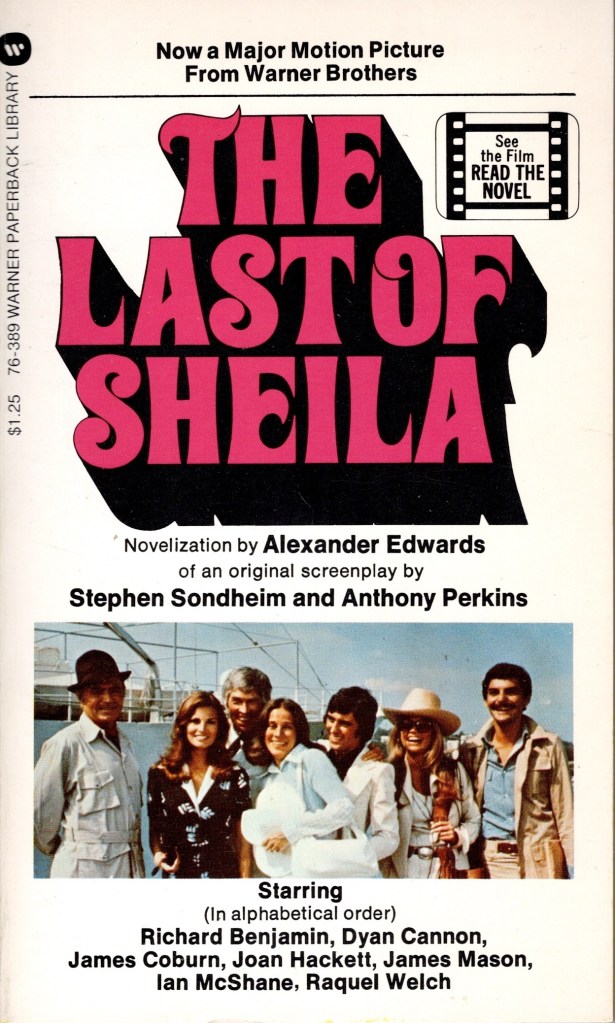
I don’t know if they still do novelizations of popular films as a merchandising gimmick–the cover of this one has a little admonition to see the film READ THE NOVEL and of course, the ever-popular Now a Major Motion Picture From Warner Brothers. There’s also a lovely cast photo prominently featured on the book cover–with the cast posed together in the same way they are in the photograph in the book, which holds the key to the very clever puzzle at the heart of the book, and what a cast of early 1970’s luminaries it contained! James Mason, Joan Hackett, Dyan Cannon, James Coburn, a gorgeous young Ian McShane, Richard Benjamin, and the fabulous Raquel Welch. All play, in a way, traditional Hollywood archetypes: Mason is the director fallen on hard times; Benjamin the writer who can’t get a script film so works on rewrites of other people’s work; Cannon the blowsy loud shark-like Hollywood agent (based on Sue Mengers, anyone remember her?), Coburn as the asshole abusive producer; Welch playing the stunningly beautiful actress with little talent; McShane as her loser husband/manager; and Hackett as the Hollywood heiress, whose father was a monstrous tyrannical producer like the Coburn character, married to the Benjamin character and the only thing keeping him out of hock.

Coburn’s character, Clinton, invites all the others for a week-long trip along the Riviera on his boat, the Sheila, named after his late wife, killed by a hit and run driver about a year earlier. Sheila was a gossip columnist that Clinton truly loved, but she was also a typical Hollywood rags-to-riches story. She started out as a call girl and worked her way up to gossip columnist and married a rich producer before her tragic death. The driver of the car that killed her was never found. He claims to want to produce a picture, a way to honor his dead wife, called The Last of Sheila, which he wants Benjamin/Tom to write, Mason/Philip to direct, and Welch/Alice to star in. They will also spend the week playing a game–each person is assigned a card, and every night they will get clues they will have to solve to figure out who has the card. Once the person who has the card solves it, the game is over for the night so you have to find out who has the card before the cardholder does to get a point. None of them really want to play–but once the first night gets underway, some of them get into it and some of them don’t. There are also all kinds of clues and hints that something a lot more sinister is going on below the surface, as the guests become uncomfortably aware that the game is really about them and their secrets…and then there’s an attempted murder, and then Clinton himself is murdered on the second night.

It’s a fantastic set-up, and it’s an incredibly clever plot. The film’s screenplay, from which the novelization was adapted, was written by closeted gay actor Anthony Perkins and Stephen Sondheim (yes, that same Stephen Sondheim), which also lends depth and insight into this world of cutthroat behavior, backstabbing, and vengeance. The novelization itself is one of the better ones I’ve ever read; they were usually cranked out quickly by a pseudonymous writer trying to make a quick buck (no harm there; I’d certainly write them if the price was right and they were still a thing) who basically simply turned the screenplay into a book, without getting much into the story or layers or character development. But this one of The Last of Sheila is the rare one that you put down when finished and think, Oh, there was so much more that could have been told there–and it even fleshes the characters and the backstory–and the motives–out even further. It actually helps with your appreciation of the film by giving necessary back story to the relationships between them and their individual motives, and I am very glad that I read it.

The Last of Sheila will always be one of my favorite films, because it remains fresh and interesting and its cleverness never stops amazing me every time I watch it.

And of course, Bette Midler’s “Friends” plays over the closing credits–after the perfect ending–which was also my first real exposure to the Divine Miss M, whose debut album I bought shortly after seeing the film and I’ve been a fan ever since.

How did anyone not know?

But I’m Not

Sunday and I slept late this morning and i am not a bit ashamed of it, quite frankly. The opportunities to sleep in are rare these days–getting up early so often for so long has adjusted and shifted my body clock in ways I’m getting used to but don’t like, and chief among those ways is the inability to sleep in. Yesterday I was up before eight, for example, but this morning it wasn’t even nine when I got up, and I could have easily stayed in bed longer. But there’s spice to mine today, and while there is still a lot of it to get done, I am feeling very good about things this morning. I actually felt really good about them yesterday if I am going to be completely honest. I got two chapters done and finished editing a manuscript (not my own) and turned it in to the publisher, which felt marvelous to be finished with that. Deadlines and juggling projects is something I’ve always done, but something I’ve noticed since the pandemic shutdown is deadlines are much more stressful and demanding on me, and take a bigger emotional toll than they used to. Probably part and parcel of the long COVID rewiring of my brain, but whereas before, I relished the pressure and it drove me to work harder, now it shuts me down and/or depresses me, which has the exact opposite reaction it used to have with me: instead of driving me, I think oh I’ll never get this all done so why bother and I end up blowing things off completely. Depression is quite the bitch, you know.

But I am very pleased with the work I got done yesterday and look forward to today’s work. I also did a load of dishes and laundry yesterday, and some cleaning. But after I was finished with work for the day, my brain was too fatigued to read so I watched movies on television, discovered two gems I’ve been wanting to revisit: Cruising and The Last of Sheila. I wanted to watch Cruising because I remember all the controversies about the movie while it was being filmed (yes, even in rural Kansas we heard about the gays being mad about the movie). I eventually watched it in the mid-1990’s. Paul is a huge Al Pacino fan, and when we moved in together he owned almost the entire Pacino filmography on videocassettes, so one night we watched Cruising. I didn’t much care for it when I watched it the first time, but I’ve wanted to watch it again–when I watched I wasn’t yet a published crime writer–because the story itself is interesting to me. A hot young ambitious cop sent undercover into the gay BDSM/leather community to look for a serial killer? The question of identity and sexual confusion that could arise from playing the part, which entailed going out and picking up (or being picked up) by gay men expecting some sex? I mean, you have to admit that’s a great set-up and concept for story. The Oscar winning director William Friedkin (he won for The French Connection but was much better known for directing The Exorcist) failed and ended up with a deeply flawed film. Pacino was also robbed of a far greater performance due to the homophobic cowardice of the either the director or the studio. Rewatching, the film’s flaws are even more apparent, but it’s a shame. It could have been a great film–and it does remain one of the few Hollywood films that actually depicts gay bar culture of the late 1970s the way it was–but I don’t know what went wrong with it, but it’s still a great idea. I also liked seeing New York as dirty and grimy, the way it was during that time period before gentrification came to Manhattan. It’s also fun seeing old movies where people who went on to greater stardom later had bit parts or cameos; Ed O’Neill popped up on screen at one point, as did several others that made me think, hmmmm.

If I had the time or inclination, I would take that basic framework of an idea and turn it into something stronger than the film. There was also a book it was based on, but it’s rare and used copies are insanely expensive. It also reminded me of a gay crime novel I read as a teenager living in Kansas; I may have been in college, I don’t remember, called A Brother’s Touch by Owen Levy. The book was about a brother who comes to New York to look into his estranged brother’s life after he is murdered–they were estranged because the dead brother was openly gay–and begins to question his own sexuality after being enmeshed into the gay community of Manhattan at the time. It was reprinted recently and I got a copy (by recently I mean in the years since Katrina; I have no concept of time and its passage anymore); I should move it closer to the top of the TBR pile. I wish I could still read as voraciously as I used to…something else that has slowed down with getting older.

After watching this I wanted to rewatch a classic old crime film of the old school, The Last of Sheila, which I’ve always loved. Co-written by Stephen Sondheim and Anthony Perkins and directed by Herbert Ross, it’s a whodunit worthy of Christie herself, in which a widowed producer invites some film community members on hard times for a week on his yacht. Everyone invited was at the party a year before where the producer’s wife Sheila wound up being killed by a hit-and-run driver, and the producer, whose known for loving to play games, has come up with a game for his guests to play. Everyone gets a card, and every day they will stop somewhere they will look for clues to the identity of whoever holds the card of the day–the first is a shoplifter, the second is a homosexual–and of course, the game turns dark and ugly when the producer host–played to sadistic asshole perfection by James Coburn, is murdered…and it turns out the game their host was playing had layers none of the guests knew about going in. The cast is a perfect time capsule of early 1970’s stardom: Richard Benjamin, Raquel Welch, Dyan Cannon, James Mason, Joan Hackett, a beautiful young Ian McShane, and of course, Coburn. It has twists and turns and surprises, and is so markedly clever that it’s hard to describe without spoiling anything…and the surprises are what make it such a great and fun film. This was one of our Sunday movie-after-church movies, I think; I do remember seeing it in the theater and being impressed and amazed. One thing I absolutely loved in the rewatch was the books scattered over every set–they are all mystery novels by Agatha Christie, Ngaio Marsh, Ellery Queen, and Erle Stanley Gardner, which should tip the viewer off that you are in for a mystery influenced by the master crime plotters of the time. It’s really a shame the film wasn’t a success, because it would have been amazing if Perkins and Sondheim had collaborated on more scripts like this one. As I was watching, I kept thinking how much I would love to write a puzzle-type mystery like this one; I’ve always feared such a thing was outside of my wheelhouse so I have always been afraid to try. Who knows? Maybe I will.

I feel very rested this morning and I am not dreading diving into the book this morning, which is nice. I don’t think I have the mindspace and bandwidth to work on multiple things all at the same time anymore, if that makes sense. I don’t know if it has to do with the long COVID rewriting of my brain waves or what, but the last few books I’ve written or worked on–going back to Bury Me in Shadows–have been more stressful than fun for me to write. Writing on a deadline is always stressful, and I rarely, if ever, actually make deadlines. But having multiple projects going on at the same time now feels like I am not devoting enough of my time and attention to any of them, let alone all of them, and that makes me feel uncomfortable about the work. Of course, my last three books–and my last anthology–have all gotten a lot of mainstream award attention, which makes it seem weirder. Which, of course, makes me wonder if the stress and the heavy burden pressure of multiple projects going is somehow making me produce somehow better work than before, and do I really want to mess with that at all? It never ceases to amaze me how neurotic I am about being a writer, and how afraid I am that any change or variation means it’s all over for me now.

I do wonder sometimes if other writers have that same secret fear: that the well will eventually run dry or that we’ll forget how to do what we do. People like to call me prolific; I’ve slowly come to the conclusion that I am and that it’s not a bad thing (I always try to figure out if being called something is bad–which goes back to being called a fairy as a child and thinking he was saying ferry and being very confused). John D. MacDonald was prolific; so were Ellery Queen, Agatha Christie, and Erle Stanley Gardner. I think my insecurities came into play when people started calling me prolific; I am so used to being insulted that I assumed it must be an insult as well, like it was something I should be ashamed of or something. I’ve decided to embrace it as a compliment. I am sure there are literary writers who produce one novel every ten years or so who would think it an insult, but I don’t respect them so don’t really care much what they think. And if I am not as prolific as I used to be–which I am not–it’s nothing to be ashamed of; I’ve gotten older, have gone through some things, and I don’t have the energy that I used to have. My imagination still rages out of control at any and all times, of course, but I don’t have the energy to fool myself into thinking every idea I have will turn into a short story, an essay, or a novel. I certainly won’t live long enough to turn all the ideas I already have into longer works of whatever style and kind.

And on that note, I am diving back into the book. I am getting another cup of coffee and putting some bread in the toaster for later, and I may or may not do another Pride month entry later today. Anyway, you have the loveliest Sunday possible, Constant Reader, and I will check in with you again later.

Missing You

Sunday morning, and after a glorious night’s sleep I am wide awake this morning and pretty ready to give the day my best shot. The Lost Apartment needs to be cleaned, as always, and I am wanting to do some writing/editing today as well. I am going to go to the gym later today–it is my experience that going earlier wears me out, despite the endorphin high, with the end result I often don’t get any writing done. I want to work on revising and polishing a story to get it out of my hair–early submission, since the deadline is a long way’s off–and the same with another. I also want to get that Chanse story–the first one–revised and sent off somewhere as well; and in addition to all that revising I want to work on the Italy story.

My work, as it were, is cut out for me today, is it not? I’ll also probably finish watching season 2 of Versailles as well this evening.

Yesterday I got my contacts ordered and did some shopping at Target, which was lovely. I also went car shopping with a friend; he needed a ride and I took him out there. I merely sat there and read short stories from Sue Grafton’s Kinsey and Me; I finished all the Kinsey short stories yesterday, and read some others as well. I was, frankly, worn out by the time I got home but managed to finish the laundry somehow, despite being so tired; I also watched several episodes of Versailles before finally retiring for the evening once the laundry was finished. Paul moves into the hotel this Wednesday; tomorrow morning I am touring the FBI offices in New Orleans with the local Sisters in Crime chapter, and then Tuesday is my usual long day. Then of course the festivals kick into gear, and the rest of the week/weekend is utter and complete madness.

There’s also some filing needing to be done, as always. I’ve also renamed both the Italy story and the Chanse story–the Chanse title, “Glory Days”, only worked if it were his high school reunion, which I dropped from the story–and I think the new title of the Italy story is better.

Here are two of the short stories I read yesterday”

First up is “Trapped! A Mystery in One Act” by Ben H. Winters, from Manhattan Mayhem, edited by Mary Higgins Clark.

Setting

Studio L, an unremarkable rehearsal studio in a warren of unremarkable rehearsal studios, collectively known as the Meyers-Pittman Studio Complex, located on the sixteenth floor of a tall nondescript building in Chelsea, a couple blocks south and one long avenue over from Port Authority. The walls are mirrored; the floor is marked with tape; tables and chairs are clustered to represent the location of furniture on the real set.

Downstage right is a props table, laden with all manner of weaponry. The play in rehearsal is the Broadway thriller “Deathtrap” by Ira Levin, and the table displays the full range of weaponry called for in that show, viz., “a collection of guns, handcuffs, maces, broadswords, and battle-axes.”

This is an incredibly interesting twist on the short story; it’s actually a short story written in play form, and it’s also an homage to the classic thrilled play Deathtrap by Ira Levin. The play was an enormous hit on Broadway, and featured the wonderful Marian Seldes in a supporting role; she set a record for most consecutive performances by one actor in this play. Ira Levin is also one of my favorite writers. Deathtrap was made into a film; not as successfully as the play, alas; the film starred Michael Caine, a young post-Superman Christopher Reeve, and Dyan Cannon. What makes this story/play so clever is it’s a play on Deathtrap; which is a play about a play which basically tells the same story of the play–and this is a play about a murder during a production of a play about a play; complete with the requisite twists and so forth. Winters is an Edgar-winning author (for The Last Policeman), and one of my favorite novels of the last few years, Underground Airlines. if you’re not familiar with Winters, you should make yourself so. I loved this; clever clever clever.

It also reminded me of a crime short story I wanted to write about the production of a play. *makes note*

Next up is  “Fat” by Raymond Carver, from the collection Will You Please Be Quiet Please?

I am sitting over coffee and cigarets at my friend Rita’s and I am telling her about it.

Here is what I tell her.

It is late of a slow Wednesday when Herb seats the fat man at my station.

This fat man is the fattest person I have ever seen, though he is neat-appearing and well dressed enough. Everything about him is big. But it is the fingers I remember best. When I stop at the table near his to see the old couple, I first notice the fingers. They look three times the size of a normal person’s fingers–long, thick, creamy fingers.

When I talked about Barry Hannah several weeks ago, I mentioned that the other writer my professor in my second attempt at taking Creative Writing wanted us to read, whose glory we should bask in, was Raymond Carver. The only texts for the course were Airships by Barry Hannah and Will You Please Be Quiet Please? by Carver. We read two stories before starting on our short stories; I was unimpressed with both writers. Several years ago I decided to repurchase the collections and try them again (I’ll talk about Hannah another time) thinking that perhaps now, as a more mature adult and reader, I might appreciate them more. It wasn’t the case with Hannah, and it certainly isn’t the case with Carver, either.

I am not sure what the point of this story is; waitress waits on a large gentleman, everyone else on staff is mean and cruel about him whereas she is fascinated in him in some way; it’s rather oblique in its meaning, and in its ending; when she says she feels like her life has changed in some way, why? Why did this man have such an effect on her? It isn’t clear and maybe that’s the intent; is it the recognition of the casual cruelty of her co-workers and her boyfriend? Why is she so fascinated by this customer and how much he eats?

It’s a very small story, and rather intimate; I like the way Carver does his writing and tells his story, yet I fail to see the genius here in the actual story itself. I learn nothing about the waitress, not do we learn anything, really, about her customer other than he is polite, well put together, and enormous. Is it about the waitress seeing, and disliking, the casual cruelty of her co-workers and her lover, seeing them in a different way in their inability to see her customer as anything other than enormously fat, that his size somehow strips him of his humanity? Is that what Carver’s intent is, to be so vague and uninvolved with the story that it’s left to our interpretation? I honestly don’t know, and what’s more, I don’t care. I don’t care about this waitress. I don’t care about her friends. The authorial distance just doesn’t work for me. I’ll keep reading his stories, though–I read “Neighbors” for the class, and I remember it fondly–although it didn’t drive me to read more of Carver’s work.

I suppose this is why I am not a literary writer, and could never be one; my purpose is writing a story is to not only to tell the story but to make the reader understand the characters, get to know them, and hopefully empathize with them; to make, in the case of anything I write, to make the inexplicable explicable. I don’t get that from either Carver or Hannah, to be honest. Ah, well.

And now, back to spice-mining.

IMG_1980