Work at home Friday, and all is well, at least as well as can be expected on this fine morning. I do have some meetings to attend via ZOOM this morning, and then I am going to get all my data entry and quality assurance finished before running an errand or two and doing chores–I am thinking about saving the really big cleaning efforts for tomorrow during college football. The LSU game is in the morning (v. Arkansas; my supervisor went there and is going to her first game in Tiger Stadium…as a fan for the visitors; I don’t know that I would do that, honestly–go to an away LSU game. Fans can really be assholes), which is an example of how far both programs have fallen, and I don’t even know who’s playing during the rest of day nor do I care; it’s going to be background noise while I write and clean and read.
It’s kind of nice not being vested in this season, actually.
My friend Angel Luis Colon posted a hilarious burn on pro-pedophile skank Megyn Kelly yesterday; More like Megyn R. Kelly…which was incredibly spot on. It’s also been a lot of fun watching MAGA and their spokes-trash, like Kelly and bottom feeder Jesse Waters and CNN’s sad excuse for a man Scott Jennings desperately spinning, after ten years of calling Democrats pedophiles and screaming for the Epstein files….that, you know, Ghislaine Maxwell, a trusted source and not biased at all, denied their foul god-emperor was involved despite all evidence to the contrary, or “fifteen isn’t really pedophilia it’s barely legal”1, or any of the other horrible talking points that were sent out to the loyal state media…if you weren’t convinced before that GOP stands for “guardians of pedophiles” or they are all lying liars who only care about power and oppression, I don’t know how you can deny any of it today, or play “what about.” My morality isn’t partisan, for the record, and if Obama and Clinton or any other Democrat is in the files, lock them up.
The fact these trash have spent the last decade fear-mongering queer and trans people and calling us pedophiles and groomers only to walk it all the way back and now defend grooming and pedophilia is really something to see.
I will never stop hating MAGA, ever. They’re unspeakably vile, monstrous excuses for human beings, and wrapping their monstrosity in religion is even more vile. Talk about taking their Lord’s name in vain…
I ran my errands after work and came home a bit tired, but not too terribly bad. I did the dishes, another load of laundry, and while I didn’t pick up or clean a whole lot around here last night, I did get some things done, so I am a little bit ahead of the game this morning. I have my meetings, as I mentioned, and then have some data entry to do. Later on, as I said, I’ll probably run some errands and make a bit of groceries so I can be in for the weekend. The weather has warmed up–I went outside to put the wagon away and it’s really nice out–which is a nice change (the cold is coming back; we’re getting a freeze, apparently, on Thanksgiving day itself); I do need to wash and clean out the car, but might wait until the weekend before I drive to Kentucky to do that.
I also want to do some writing and reading over the weekend, which is made easier by the LSU game being so early in the day. It’ll be over before three, and then I can get other things done around here as well. Last night when I got home I mostly got caught up on the news (not paying attention to it while I’m at work every day has been a blessing, really; I can focus on doing my job without my blood pressure–already medicated–rising, and that has made a difference. I am almost completely caught up on all day job duties; after today I think I will be current on everything, which is a really nice feeling. Now if I can apply the same logic to my writing….
And on that note, I am heading into the spice mines for the day. You have a lovely day in whatever way you so desire, Constant Reader, and I’ll be back tomorrow before the LSU game.
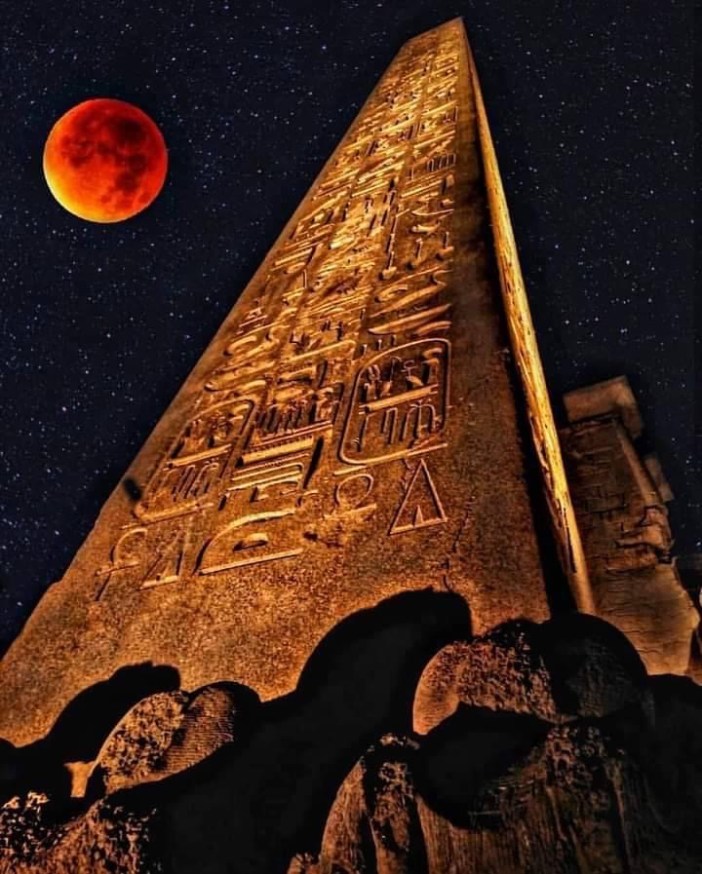
This stele from the Karnak temple at Luxor looks other-wordly in this light…
Barely legal means legal, you stupid fucks, not legal in three more years.↩︎
Hey there, Tuesday. How are you today? Yesterday wasn’t bad. I didn’t feel awake completely for most of the day, but I also think that had a lot to do with calorie deficits. I didn’t eat a lot over the weekend because my mouth was sore, which made biting and chewing hard. It wasn’t so bad yesterday, but I was so hungry all day, and I am sure that had a lot to do with feeling run down and tired. My mind was sharp, though, for the most part. I just felt like I needed to lay back down for another half-hour or so, if that makes sense? I did have a productive day at the office, though. I also managed to get the book outlined up through where I’ve written, and I also reread the most recent two chapters. Chapter Three needs a sex scene at the end, and Chapter 4 needs a strong revision before I move on to Chapter 5; but I didn’t know that until I reread and outlined, so we are ahead of the game for the moment right now.
The question about the sex scene is how to write it. From the very beginning, I’ve written very explicit, matter of fact sex scenes, because I wanted the reader to experience it in the same way the characters are experiencing it. My sex scenes are too graphic, athletic, and sweaty for most readers; it’s why I never tried writing a romance novel. They want prettier, frillier, more romantic sex scenes rather than the graphic depictions of what it’s really like, which is how I write them. I’ll probably write it graphically, and then tone it down and make it more palatable to modern tastes, I suppose.
Which reminds me, is mary still a gay slang term? I’m never sure about these things, and now that we’re more aware of how problematic things we took for granted are once we unpack them, I have to wonder about things like this. Mary was always a kind of slur for gay men, but we took it back and reclaimed it…and it became a kind of shorthand for gay men–“muscle Mary,” etc.–and sometimes you’d use it to address someone (“let it go, Mary”) but I was never sure where that came from in the first place, in all honesty. Hamburger Mary’s is a very well known queer restaurant chain (I love eating at the one in Palm Springs). Gay men always called each other “gurl” or “she” and so on; I’m not sure if that’s still okay or not. I don’t see anything offensive in it, but I am also not trans, and so not the best judge of that sort of thing. I don’t know where mary came from and why gay men used it with such abandon, but it has something to do with blurring gender lines with gay men–and since we weren’t “men” the way society defined them, so we started using female pronouns and adapted other non-masculine language for use. Gay men often use gendered slurs for each other without offense–slut, whore, bitch, hooker, skank–or second thought.
At least, we used to. I don’t know if we still do. Like I said, it may be problematic, and if people see it that way, then we should let it die and never mention it again.
But I will say this: it was never, ever intended to mock or insult women, just like drag wasn’t and still isn’t. It was mocking masculinity, if anything. Drag mocks and critiques gender roles, the same thing feminists have fought from the very beginning, and if you think gay men are your enemies1… I’m not going to tell women what is or isn’t misogynist, but lumping gay men in with straight men as misogynist sexists is also misandrist and homophobic. And you don’t get to tell me you’re not, either. See how that works? If you get to tell me I am a misogynist, I get to call you a homophobe when you’re homophobic. (Some allyship only goes as deep as free drugs and drinks at the gay bar.)
And how awesome was it that the US Men’s Gymnastics team won the first team medal at the Olympics in who knows how long (Okay, it was 2008, but it seemed like longer)? (The women, of course, still have a shot at gold) They also were a lot closer to the gold and silver medalists, too–so it’s entirely possible the men’s team is going to start climbing and getting better the way the women did all those years ago. We certainly can hope, and that kid on the pommel horse is phenomenal. GO USA!2 Their joy was infectious, and that young man with the glasses (Stephen Nedoroscik) was absolutely adorable in a geeky kind of way; I think we all fell a bit in love with him after he positively nailed that pommel horse routine to lock up a medal.
And that is why I love the Olympics, and will never boycott watching them. I love seeing the pride and joy of the athletes, even the ones who don’t medal or make the finals in their discipline: because the goal is always to make it there, the dream is to get a medal. Naturally, America’s pathetically weak-faithed Christians got their panties in a twist over something they completely misunderstood, and had their anchors actually been given the proper information from their producers, could have explained the Dionysian panorama to narrow-minded morons like Candace Cameron Buré (just as much trash as her fucking weird-ass brother) and Rob Schneider.
I slept really well last night, and feel more rested and alert and energetic today than I did yesterday, which is awesome and great. The coffee is really hitting this morning, and I feel like I am going to have a really good day. Go figure, right?
And on that note, I am heading into the spice mines.
It’s so much easier to attack gay men, who aren’t the ones who’ve spent millennia oppressing women, isn’t it? It’s always the gays who are at fault with straight white women for their oppressive tactics, isn’t it, and not their husbands, fathers, brothers, and sons? ↩︎
Unlike some of my “patriotic” fellow citizens, I intend to continue watching the Olympics and rooting for our young athletes. Call me weird, but punishing the young athletes for something they had nothing to do with doesn’t sound particularly patriotic or American, but I’m gay so what do I know? ↩︎
RuPaul likes to say we’re all born naked–everything else is just drag, and she isn’t wrong here.
Everything we wear is a form of drag. We always try to dress properly for whatever occasion, but yes–there’s work drag and formal drag and casual drag and gym drag and sports drag and around-the-house drag and pretty much any way you want to look at clothing…it’s all kind of a costume, really. And those costumes also depend on the time period.
I used to always think that I had no fashion sense–straight women and other gay men have often been astounded at how little I care about clothes or fashion or style. I have slight color-blindness, too–it’s hard for me to differentiate between darker shades; the darkest shades of blue and purple and brown and gray and green all look black to me. I also have some difficulty determining whether colors actually go together or not–which is why when it comes to formal/dressier clothing I tend to stick to black, white and red; I have so many red dress shirts, Constant Reader, you have no idea–so as I got older, I tend to go with what is easiest and less anxiety-inducing for me.
Of course, I also worked at an airport and had to wear a uniform for over two years: airline work drag. And after years of being a personal trainer, where all I wore was workout clothes or sweats, so yeah–my fashion sense has always been untrained and severely lacking for the most part.
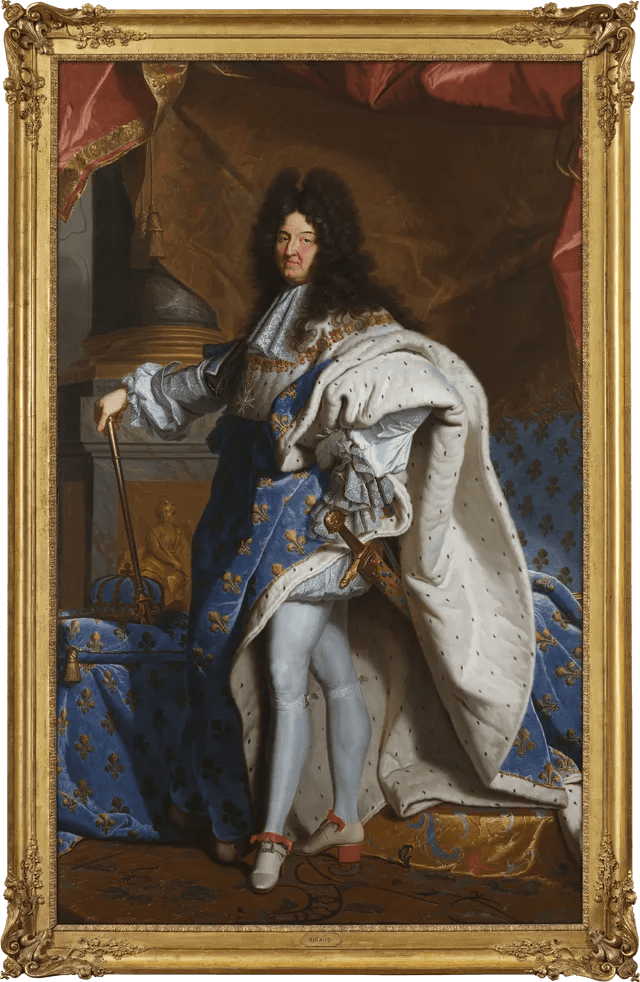
Louis XIV, the Sun King–but those tights! That wig! Those shoes! More like La Reine Soleil, am I right?
I also always used to deplore the fact that men’s clothes gradually became so incredibly boring from the heydays of Beau Brummel-type male fashion icons. Look at the above painting of Louis XIV. Now imagine a man wearing that outfit to an awards show or a film premiere. Even our own Founding Fathers wore tights, powder, wigs, and heeled shoes.
But somehow, those clothing items became feminized and gender swapped–of course, women in the past also wore heeled shoes, wigs, powder and tights beneath their skirts and bustles and hoops. But even in the 1930’s and 1940’s, men’s clothes were far more stylish–trench-coats and linen pants, fedoras and other hats, spats and Oxford shoes, argyle socks. I hated the “traditional” styles of dress for men that developed in the post-war period. and the utter rejection of those same styles in the 60s and 70s. Men’s clothing began to evolve a bit more during this period–and some serious fashion faux-pas were prevalent during the last decades of the century.
As I said the other day (and as so many others have pointed out), men have always dressed as women for one reason or another that had nothing to do with gender expression or identity for years. The Sun King’s gay younger brother (he also had a gay bastard son by Louise de la Valliere; homosexuality was rampant at the Sun King’s court) Philippe duc d’Orleans (whose son was the namesake for New Orleans) had many male lovers and often dressed as a woman for appearances at court. I’ve always wanted to write about Philippe, who has always fascinated me–the young gay bastard son of Louis XIV, who died young, was Louis duc de Valentinois; I’ve also had some minor interest in writing about him as well, or just gay life at Versailles in general.
There is a long-standing drag tradition in New Orleans as well. The Red Dress Run, for example, may not be full drag as we know it, but it’s essentially all about men in red dresses for charity.
One of the things I really enjoy about the modern young generation is they don’t subscribe to the antiquated rules of fashion for men and women. I love seeing young actors and celebrities showing up at red carpet events in daring outfits instead of that tired old tux look. Yes, men look dashing in tuxedos; I’ve always wanted to go full tuxedo with hat, cane, tails and gloves–but again, not the ordinary or expected.
I wore a kilt twice when I went to the Edgars, and wore it again at Bouchercon in Albany for our Real Housewives of Bouchercon panel. I loved wearing it–skirts are sooooo much more comfortable than pants–and it was definitely a fashion risk; people who didn’t know me but saw me wearing it undoubtedly thought ah, that one must be gay. I love the way the Musketeers dressed in The Three Musketeers–I think the seventeenth century was probably my favorite era for men’s clothes; I also love a pirate look from the early eighteenth as well.
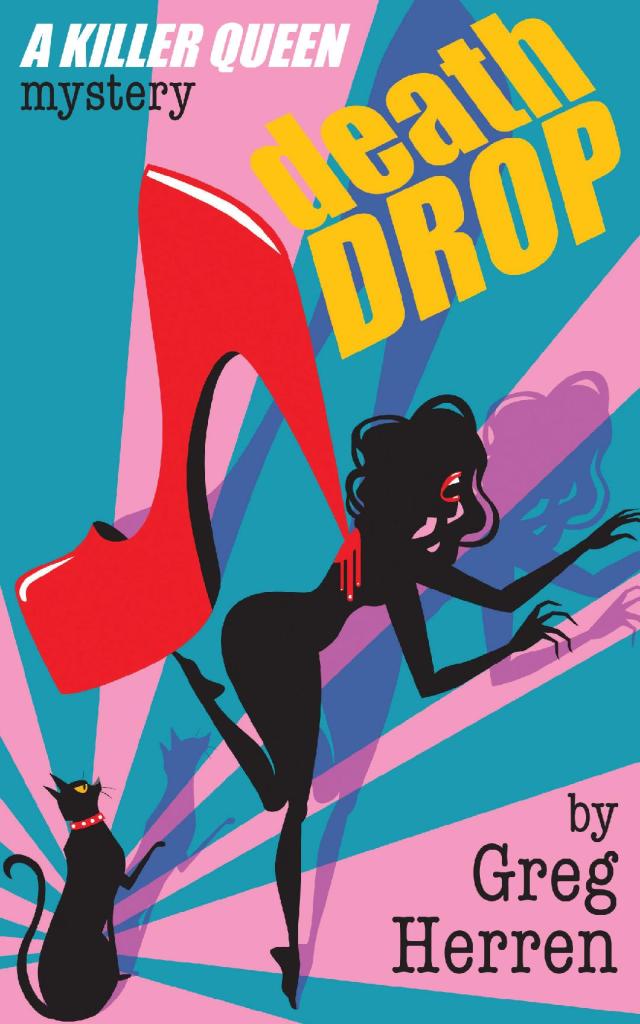
One thing I definitely need to explore more with Jem is not only his sense of fashion for his clients, but for himself–both in and out of drag. Those are critical decisions for a queen–because while a particular look or style for a queen can evolve over the years, it’s very unusual for them to do something radically different than their usual; again, it probably has to do with ease more than anything else; it’s much easier to fall back on a regular look and color palette than to reinvent yourself every time or to come up with something new every time. I do think I am going to have Jem do the Madonna constant reinvention thing–mainly because it’s more interesting that way for me–because it is part of who he is as a person; Jem thinks he’s boring but he’s actually quite adventurous. Jem has very little confidence in Death Drop, which is easy for me to write because I know how that feels. One of the goals of the series is to show him develop self-confidence and self-assurance and becoming more comfortable with himself, and part of that is going to come from performing in drag and another part from actually solving crimes…which makes him start believing in himself more.
And that is always fun to write–character growth and development.
Drag is a part of queer culture I’ve always known about but has also been something primarily on the periphery of my gay life and world; I’ve only occasionally ever thought about perhaps doing it–as a gag or as a costume at some point; a very dear friend has always wanted to dress me up as Joan Crawford (narrow waist, big shoulders, enormous eyebrows), which is something I would consider doing if it wasn’t so much work–I am way too lazy to ever do drag properly and respectfully. I did a very poor attempt at drag many years ago, for a Showgirls themed birthday party for a friend; the result was far from pretty. I did sometimes used to use mascara and eye liner when I would go out; it emphasized my enormous and expressive eyes which most people have always considered my best feature (although aging has deprived me of my eyelashes). Drag was just another part of the community and culture, like leathermen, bears, and gym queens–another patch on the quilt that makes up our queer world.
My primary interest in drag has always been historical and cultural; drag culture has always been a part of the gay bar scene, since time immemorial, it seems. I have always been interested in every aspect of gay culture since coming to terms with my own sexuality and recognizing that not coming to terms with it meant a lifetime of guaranteed misery, and shouldn’t I really take a chance on being happy? There was always a lot, for me, of misunderstanding about drag culture and its place in the gay community; but that also primarily came from people outside of the community and therefore didn’t have the slightest grasp of it–i.e. ignorant slurs that all gay men dressed like women whenever they had the chance, you know–not “real men.”
But seriously, who wants to buy into the cult of toxic masculinity? No fucking thanks.
I don’t know the history of drag, but I did know–from the very beginning–that there was a significant difference between drag and the trans experience; there’s definitely crossover, but the Venn diagram of drag and trans is not a complete circle. I understood this always, even when I knew very little of either. This was always the issue I had with To Wong Foo Thanks for Everything Julie Newmar–the queens in the movie didn’t just do drag for performance or pageants, but dressed as women in their everyday life…which made them transwomen who also did drag. The failure of that film to define the difference between the two, I think and believe, has a lot to do with the current-day conflation by the Right of drag queens with transwomen. Likewise, was the Nathan Lane character from The Birdcage (and the French original) a transwoman or a drag queen?
And the fact that I, knowing as little about gay life and culture as I did in 1994, knew that the Wong Foo movie was conflating two completely different things as the same certainly means that other, better-educated people should have, as well.
But it’s also important to remember that the movie wasn’t made for the queer community–no Hollywood studio film with queer characters is intended for a queer audience, and thus there’s a falseness to them that rings hollow to me (don’t even get me started on Philadelphia); what Sarah Schulman once (paraphrasing) described as “the creation of a fake public homosexuality that will play in Peoria.”
There’s an essay in that, methinks.
The first time I went to a gay bar in Houston is my first true memory of seeing someone in drag performing on the bar in person. She was doing Liza as Sally Bowles from Cabaret, and as I walked in the door with some co-workers from That Airline, the first thing I saw was her up on the bar, with a musclebound dancer on either side of her in bikinis or thongs, and I can remember thinking wow this is decadent like Isherwood’s Berlin–but I liked it. I felt at home there, in a way I never did in gay bars in Fresno (or anywhere else I was able to sneak away and visit one), and felt like that night was when my gay life actually began: I was with co-workers, I was going to a gay bar openly, and the co-workers knew I was gay but had never really experienced being gay as anything but misery and depression and a curse. I don’t remember the name of the queen, but ever since then, “Mein Herr” always brings a nostalgic smile to my face.
But again, I didn’t go out much or do much during those two years in Houston as I still wasn’t completely comfortable being totally out. I moved to Tampa in 1991 and started living as an out gay man…and started spending more time in gay bars. A popular night for airline employees as Tuesday Nights at Tracks, where cocktails were only fifty cents and no cover before ten. There was also a drag show at midnight, with an actual stage in a show room, and that was my first real experience watching drag queens perform. There was a gay paper there–I cannot remember what it was called to save my life; I know the one in Texas was This Week in Texas, called TWIT by everyone–but it often had information about performances and other night life ads and so forth. I began to get a better understanding of drag, its place in the community, and its importance to gay culture, period.
And of course, once I moved to New Orleans, there was Bianca del Rio.
The mainstreaming of drag actually began in the early 1990’s, with RuPaul having a surprise hit record out of nowhere, “Supermodel (You Better Work)”, which started exposing more people to drag who ordinarily would have never seen one. RuPaul was everywhere in the early 1990’s, and even had her own talk show on MTV for a while. The Adventures of Priscilla Queen of the Desert and its homogenized American version To Wong Foo, Thanks for Everything, Julie Newmar were both incredibly popular. (I enjoyed Priscilla, and I’ve already touched on my issues with Julie Newmar–which will probably become an essay at another time.)
There were, of course, other successful queens out there before RuPaul’s big breakthrough and later, comeback with Drag Race, but few had as large a profile in the culture as RuPaul. Lady Bunny, Miss Coco Peru, Miss Richfield 1998, and Varla Jean Merman were all making a pretty decent living as performers before the drag explosion that followed the launch of Drag Race.
I’ve met numerous drag queens on the local scene both in and out of drag–I’ve always been fond of Princess Stephaney and Blanche Debris (who is retired now), and the drag community of New Orleans was always incredibly supportive of the NO/AIDS Task Force. I met Bianca out of drag a couple of times, but I doubt he remembers me…but Drag Bingo at Oz on Sundays with Bianca and Blanche (I just realized their first names both translate into English as white) was always a blast–and I made a point of never trying to get Bianca’s attention because she was always quick and that tongue was sharp as a scalpel always.
I also work with several co-workers who either did drag or have started doing it while I’ve known them, which indirectly helped me with the writing of Death Drop and my original story for a drag queen. Jem is sort of patterned in some ways on one of my former co-workers who actually went to a drag school here in New Orleans–and eventually quit his full-time job to do drag full-time. He’s been in Queer as Folk and numerous other shows filmed here, and has been booking gigs all over the country–check out his Instagram, isn’t he fucking gorgeous? So that gave me the idea to make the first book with Jem his drag origin story.
Learning about drag to write this book–and its sequel–has been an enjoyable learning experience for me. At some point I know I am going to have to do a transformation; I need to know how it feels to have the make-up and the padding and the wig and the dress and shoes on. I can imagine it all from doing theater in high school, but it’s not the same.
And yes, I will share the pictures when and if it does happen.
So, Greg, you have a book coming out from a new press in October, and the main character is a drag queen? What the actual hell?
Well, therein lies a tale.
I never thought I would write about a drag queen, in all honesty. It’s not that I’m opposed to drag or anything like that; drag has always been an important part of gay culture (I really wish someone would do a history of drag that’s not academic in tone and therefore accessible to everyone without a PhD) and I’ve always appreciated it as an art form. Yes, some queens are better at it than others, and there are some who are just really tragic…but I admire and respect every single one of them who puts on the dress and wig and heels and make-up and goes out there to perform. My own anxiety manifests itself whenever I have to perform or speak in public (although I managed to successfully control it and get through Boucheron panels swimmingly; I don’t think my stage fright is a thing of the past yet but I’m getting better); I can’t imagine the courage it takes to do drag that first time.
I also never considered doing drag because of my vanity–I wouldn’t look pretty in drag and I would want to be pretty. Shallow, party of one, your table is ready. I’ve seen many performances over the year and even have friends who do it, but my primary interest in drag has always primarily been in it as an art form and political statement critiquing gender roles, masculinity, and femininity; and it holds a very important place in queer culture. I once did drag, for a Showgirls-themed birthday party–I looked like Stockard Channing, which isn’t a bad thing–but it was more of a costume than a real attempt at doing drag. My friend Mark always wanted to make me up for Halloween or Fat Tuesday as Joan Crawford–it was the shoulders, the eyebrows, the narrow hips, and the shape of my face more than any striking resemblance to Ms. Crawford, I think–and while I was interested in being transformed into Ms. Crawford, one of the things I hated the most about doing plays in high school was the make-up. I hated having that shit all over my face, and it never did what it was supposed to in the first place (I inevitably always played old men, so they had to try to age me, and it’s not like we had make-up artists who knew what they were doing in high school.). And the padding? The wig? The dress? Not to mention the lack of pockets and the difficulty in using the bathroom– yeah, not for me. Drag does show up in my work sometimes–not very often–and the most fun thing for me about that is coming up with drag names for the characters. I know I’ve used Floretta Flynn a number of times, to the point where in my New Orleans universe she’s probably one of the bigger and most successful queens in New Orleans. Two of the biggest names in drag came from New Orleans–Varla Jean Merman and Bianca del Rio are both from here. We used to go to Drag Bingo hosted by Bianca and Blanche Debris at Oz on Sundays before she left for New York after Katrina–and Bianca was just as funny and just as big of a bitch then as she is now. She always drew crowds, and of course I met her a few times out of drag (I am quite sure Roy doesn’t remember me).
And believe me, I was very careful not to attract her attention while she was holding a microphone.
I also once wrote a short story that opened with one character saying in the Clover Grill, “You sure see a lot of tragic drag in this town at four a.m.”
Paul and I also were fans of RuPaul’s Drag Race for awhile, too–but like Project Runway, we stopped watching one season when it was obvious that it wasn’t being judged fairly (it was fucking blatantly obvious) and that was it for us. Don’t serve me competition reality when the competition is obviously rigged for a particular competitor. I do love some of the queens we did watch on there–it’s been amazing watching Jinkx Monsoon’s star take flight–and I always liked Tatianna, and just to name a few–Ben de la Creme, Adore Delano, and Manila Luzon are all fabulous. Paul follows a lot of them on Youtube, and of course I do enjoy Trixie and Katya’s We Like to Watch on Netflix.
And naturally, we love Bianca because she’s a New Orleans queen.
But it never crossed my mind to write about one as a main character. It wasn’t my milieu, so to speak (and just typing that made me want to bang my head on my desk. Take risks! I should always take risks in my work!), and so while every once in a while I’d think “maybe I should write a drag queen into this story”, I never did.
Last summer, I am not exactly sure when (2022 was pretty much a blur of misery), I got an email with a request for a ZOOM meeting with two very dear friends, along with another friend of theirs I may have met once over twenty years ago, James Conrad. He wrote Making Love to the Minor Poets of Chicago back in the days when I was a reviewer/worked for Lambda Book Report, and the purpose of the call was they wanted to talk about a possible project for me. You know me, I am always up for a new project and a new possibility…so you can imagine my surprise to find out what they wanted was for me to write a cozy with a drag queen main character. James owns and operates the Golden Notebook bookstore in Woodstock, and decided to start a publishing company through the store and wanted this to be their first venture into crime. I pointed out that I a) knew next to nothing about drag and b) I’m not really a cozy writer (the Scotty series can be classified that way except for a lot of cozy rule-breaking; and yes, I did write A Streetcar Named Murder, which wasn’t out yet and I wasn’t sure if it was even any good), they pointed out that I am a writer who can write anything (this is true, but there are some things I can’t and won’t ever write–and yes, as I typed that I was thinking there you go limiting yourself again–maybe those are the things you should be trying to take on), and then I also remembered a few things–some of my co-workers at the day job do drag, and in fact, my former supervisor had attend a “drag school” here locally, started by a queen who’d retired here from San Francisco after a lengthy and successful career in drag; Paul even knows the queen who runs it. I sent James an early electronic uncorrected proof of Streetcar, so he could get an idea of my writing style, and waited to hear back.
While waiting, I asked some of my co-workers if they’d be okay with me asking them questions–which of course they were more than happy to do–and the more I thought about it, the more it made sense for me to approach this in the same way I approached writing Streetcar–I knew nothing about antiques, so I made my character the same. So, if I am going to write about a drag queen, I needed to write her origin story first–and I decided to make her an accidental drag queen; forced to step in when a queen doesn’t show for a performance. But how would that work? I realized my character had to already know about hair and make-up, so I decided to make him a glam artist, hired to do make-up for women on special occasions and styling them. How did he wind up doing glam? His grandmother, who was from New Orleans, used to have her own Uptown beauty shop on Magazine Street that was frequented by upper class New Orleans women, who would also hire her for special occasions to style them. He spent his childhood summers in New Orleans; his grandmother was the only family member who had no problem with his sexuality, and she taught him all about hair and make-up (and classic Hollywood). He went to cosmetology school instead of college (his grandmother paid for it) and he worked in a high-end salon in Dallas until his grandmother died, leaving him the house and most of her money.
I also had a great idea for the opening, which I quickly wrote up and James liked it…and so we moved forward with the plans for it. I had a Scotty book under contract, and I knew I could juggle the two and get them both done on time.
Of course, I didn’t realize how much work it would be to turn MWA over to my successor, I didn’t know Mom was going to go into the final decline ending with her death during this time, and….well, hindsight is twenty-twenty, isn’t it?
“I don’t know, Jem,” Lauralee Dorgenois said, frowning and raising a perfectly plucked eyebrow as she looked back over her shoulder into the three-way mirror set-up in her dressing room. “You’re sure that this dress doesn’t make my butt look big?”
Okay, I’m going to take a sidebar right here to give y’all some free-of-charge advice that is more than worth its weight in gold. There is only one correct answer to be given without pause or hesitation any time a woman asks you if something she is wearing makes her butt look big: “No.”
You always, always,ALWAYSsay no.
If that is, in fact, a lie—you say “I don’t know if that cut drapes right” or “I don’t like what that color does to your skin”.
There are literally a thousand other options besides making the incredibly foolish mistake of saying ‘yes’ or the seemingly safe, non-comital ‘maybe.’ Marriages, engagements, friendships, and relationships have all ended over this question being answered incorrectly—and no, it’s not a trap question. Women are bombarded from childhood with images of what they are supposed to look like and what they are supposed to wear. They are taught to fear fat cells and fatty foods, spend millions on diets and gym memberships and personal trainers. They are gaslit into thinking that being any size larger than zero and not having big firm breasts and not having a wrinkle-free face aglow with the dewiness of youth means they are doomed to grow old alone and unloved. So, they try to fight aging—and the fear of being traded in for a younger model—by having poison injected into their faces, excess skin surgically removed, and their hair constantly colored and touched up. Centuries of societal and systemic misogyny, of telling women they don’t measure up, echo in those sad, simple words: does it make my butt look big?
My heart breaks a little every time I hear them.
However, I get paid to make them look good. My opinion must be honest, but I still need to be delicate. Why be hurtful when you don’t have to be?
I tilted my head to one side and brought my eyebrows together as I looked her up and down yet again. “You’re curvy, Lauralee,” I replied finally, fluffing the peacock feathers on her shoulders to spread them out further. It was true. Lauralee was about five seven, and maybe could stand to lose a pound here and there. Her hourglass figure had thickened a slight bit once she hit forty, but it was barely noticeable. I’d picked out a green silk dress for her because the color made her green eyes sparkle like emeralds. It clung perfectly to her hips and was cut low in the front to shove off the ample bosom, highlighted by an emerald pendant handing from a gold chain just above the cleavage. I’d braided her long auburn hair into a French braid that dropped about half-way down her back. I’d woven some extra pieces of auburn into the braid to make it thicker. “And there’s nothing wrong with that, you know. We’d put Marilyn Monroe on a diet today.”
Several years ago, I tried writing a third series set in New Orleans with a gay male protagonist. It was a character I had already created; he showed up in a couple of Scotty books: true crime writer Jerry Channing, who’d gotten rich on a true crime novel about a child murder case in the Garden District in the 1990’s called Garden District Gothic, (which also became a Scotty title when he and the boys got sucked into that ancient cold case) and wound up solving it. I had wanted to write a fictional story based on the very real Jeff Davis Eight murders, and thought who better to center in the story than a true crime writer researching the case for an article or perhaps even a follow-up book than Jerry Channing? But as I started developing the character out from the sketchy details provided in earlier Scotty books, I suddenly realized what I was actually doing was combining Chanse and Scotty into a single person, so I shelved the story–or at least, the new series, because if all I was going to do was just merge two previous characters into one, there was no point in bothering. I had then gone on to create a new series with a straight woman as the main character (A Streetcar Named Murder), and I was determined that, with this new potential series set in New Orleans, the last thing I needed was to just rip-off previous characters.
So meet Jem Richard, twenty-something glam artist and New Orleans home owner. Jem lives in the 7th Ward (not far from my day job office, actually; over on St. Roch Avenue between Claiborne and St. Claude), and the house flooded during Katrina–Jem remembers coming down with his family to help work on the house for his grandmother, Mee Maw of sainted memory–and I gave him a pole-dancing roommate who also works at Crescent Care. (Another Easter egg is the book opens with Jem being enormously disappointed to be ghosted by someone with whom he had several dates –a Tulane grad named Tradd. Bury Me in Shadows readers may remember Tradd as the asshole who broke up with Jake and sent him into the alcohol/drug spiral that landed him in the hospital when that story opens. I also want to use Tradd again somewhere else…but that is indeed a tale for another time.) Jem does well for himself, but has no health insurance and never is guaranteed work–but he also really doesn’t want to go back to working in a salon again, either. (He also sometimes books gigs with film, theater and television companies.) He’s kind of a lost soul, not really sure what he wants or what he wants to do with the rest of his life–but he also is lucky: he owns his own home, for one, and has several marketable skills. He kind of feels like he’s been spinning his wheels and not getting anywhere since coming to live in New Orleans. Jem has considered doing drag before–he’s very into costuming, and has won the Bourbon Street Award for Best Drag Costume on Fat Tuesday the previous two Carnivals–but he (like me) is haunted by stage fright. He did a play while in high school and the stage fright was such a horrible experience he gave up his dream of being a performer and started working as the make-up and hair person for the school productions.
So, when he’s hired to be a back-up glam artist for a fashion show at Designs by Marigny, only to find out the models were drag queens. A little taken aback, he rolls with the challenge, and when one doesn’t show, Jem gets pressed into service (he can fit into the dress). The show is being managed by the same person who runs the local drag school–a sweetheart named Ellis, whose drag name is Mary Queen of THOTS. Jem has a bad history with Marigny the fashion designer–she’d hired him todo the make-up for a previous show, and her check bounced–so the friend who recruited him to do the show makes sure he gets paid in advance. Of course, since the models are drag queens, the show attracts anti-drag protestors–there’s a suspicion that the designer, Marigny, deliberately used queens hoping to attract a protest and more publicity. Throughout the course of the evening Jem overhears Marigny arguing with several different people, and the next morning wakes up to the news she’s been murdered–and somehow Jem is not only a suspect but he’s also a target.
But why?
Jem also has a black cat named Shade.
As I said, while it had never occurred to me previously to write a drag queen character, the more I thought about it, the more I wanted to do so. Drag queens are currently under attack by the forces of bigoted evil. Part of this comes from the right-wing demonization of transwomen, spear-headed by hateful bigoted lying trash like Libs of TikTok (if you’ve ever retweeted the Axis Sally of the Proud Boys, know that’s why I blocked you and we will never, ever be friends again) and Moms for Liberty, who are both so fucking ignorant and clouded with hate that they think drag queens and transwomen are the same thing. The idea that children need to be protected from drag queens at all costs because it’s somehow sexualizing them is disgusting and ignorant and offensive on its face; merely rephrasing Anita Bryant’s vile claim that queers need to recruit children, i.e. all queers are pedophiles. They prove they’re liars on a daily basis and that it really has nothing to do with “concern” for children and everything to do with bigotry and hatred, because they never go after religious organizations, youth pastors, Boy Scout troop leaders, and Republicans–you know, the ones who are being convicted of child rape and child porn on a regular, almost daily basis –but only the queers are their primary concern. First off, not all drag queens are transwomen and not all transwomen were drag queens. Yes, some transpeople start their transition by doing drag, to get a better idea of whether or not they are more comfortable as a woman than as a man. I work with a lot of transpeople, and have for quite some time. I’ve witnessed people transition and evolve, and I’ve also seen the change in demeanor, confidence, and emotional well-being when they do.
What better way for a writer to fight back against ignorance than writing about it? And I loved the deliciousness of fighting homophobic and transphobic bigotry by writing a cozy series.
I got up early because of that weird stress-inducing dream I’d had, and then spent the morning doing things–organizing the kitchen, doing some laundry, taking out trash, vacuuming (God, what a difference a good vacuum cleaner can make; I am so glad I bit the bullet and spent the money on a good one Saturday–and I am reading the manual AND will be taking care of this one, to make it last), and yes–I actually spent some time writing “Festival of the Redeemer,” which was lovely. I am actually enjoying writing this novella or whatever it is going to be–I can’t get it out of my head, so I keep writing on it, even though I should be working on other things, but there’s no deadline for anything and so why not while I wait for my edits on the two manuscripts I turned in? I am trying for a Daphne du Maurier Gothic style, but am trying very hard not to reread “Don’t Look Now” or “Ganymede”–her two Venice stories, much as I desperately want to because I don’t want it to be derivative; I really like the voice, and I like my untrustworthy narrator a lot. (oops, shouldn’t have said that, I suppose) It’s also interesting writing about a dysfunctional couple, one where there is an enormous power differential as well as an undefined relationship; which helps keep my main character off-balance–he wants to know but then he’s afraid to have that conversation because he is afraid of the answer–and while I know how I want this story to end, I am finding my way there slowly; I am just writing in free form without any real sense of what I am writing and where it is going and you know, just seeing where it is going to wind up as I keep writing. I’m not writing at the pace I generally do–but I am writing, which is kind of nice, and there is an element where I kind of want to get this finished instead of putting it aside; I kind of want to finish something since I’ve had so many false starts since turning in the Kansas book. (I’ve also had a few more ideas while working on this, but am just writing notes and coming back to this.)
We had quite a marvelous thunderstorm last night–which was undoubtedly why it was so oppressively humid yesterday; I think I must have sweated out ten pounds of water walking to and from the gym. Oh yes, I made it to the gym again yesterday and the stretching and weight lifting felt absolutely marvelous. I was actually a little surprised that my flexibility gains hadn’t been lost during the fallow weeks of not going, and as the summer continues to get hotter and more humid daily, there will undoubtedly be days when I won’t want to go. But I also need to remember how good I feel during and after–especially the next morning. I also took a lot of pictures on the walk home for Instagram, which I am really starting to enjoy doing. I don’t know why I never really got into Instagram before, but since I love to take pictures and I live in one of the most beautiful–if not the most beautiful–cities in North America…it seems like it’s only natural that I bring them all together into one user app. I’ve talked about how I’ve felt sort of disconnected from New Orleans for a while now–several years at least; I feel like I’m no longer as familiar with the city as I used to be; the changes and gentrification plus all the working I’ve been doing in the years since Katrina have somehow weakened or lost my connection to the city. Yesterday, walking home and detouring a bit around Coliseum Square, I felt connected to the city again in a way I hadn’t in a long time. I also took and posted a picture of the house where Paul and I first lived when we moved here in 1996; the house, in fact, where Chanse MacLeod lives and runs his business from…we were living there when I wrote Murder in the Rue Dauphine, in fact…and I started remembering things from when we lived there and were new to the city. This is a good thing, making me feel anchored and tethered to the city again, and if I am going to write another Scotty book–well, the strength of my books set in New Orleans is that sense of love for the city I always feel and try to get across in the work.
I also had weird dreams last night. I rested well, but drifted in and out of sleep most of the night. I’m not sure what the deal is with the dreams; I dreamt that someone I went to high school with in the Chicago suburbs came to New Orleans with some of her friends from her current life and wanted to connect again; and I did so, primarily out of curiosity other than anything else. (Maybe it was all the tourists I saw out and about yesterday?) But it was very strange–going to the casino and watching them drink the insane tourist-targeted colored drinks; meeting them at their hotel on the West Bank, listening to them talk about New Orleans to me in the insane and often offensive ways tourists will speak to locals about the place where we live, not even realizing they are being insulting and offensive. I don’t know; I cannot say for certain what is the deal with the weird dreams lately, but I’ve been having them.
We rewatched Victor/Victoria last night–we’ve been talking about rewatching it for a while now, and it recently was added to HBO MAX. I don’t remember what brought it up, or what made us think about it–I know it was Paul who did; I had already added it to my watchlist when it dropped and when he said he wanted to watch it again, I replied, “Its on the HBO app so we can, whenever we want to” and so last night we did–primarily to see if it still worked, if it was still funny, and watching it–a relatively tame movie, really–last night I remembered (rather, we remembered) how incredibly subversive it was at the time it was released in 1982; it depicted homosexuality and drag in a nonjudgmental way years before being gay was less offensive to society at large, as well as bringing drag into the mainstream years before RuPaul’s Drag Race. The performances are stellar–especially Robert Preston and Lesley Anne Warren in supporting roles–and the humor is kind of farcical and slapstick, which never really ages; as Paul said, “that kind of humor is kind of timeless.” It also struck me that it was very Pink Panther-like; the film, not the cartoon–which makes sense since Blake Edwards wrote, directed and produced both. Some of it wouldn’t play today, of course, and the movie probably couldn’t be made today–some of the sex humor was misogynistic, not to mention men trying to spy on “Victor” to find out if he was really a man or a woman, which is incredibly invasive and horrible, plus it was very binary about gender and gender roles. 1982 was also the year of Tootsie, which I also kind of want to rewatch now to see how it holds up as well. It would seem that both films–which were both critical and box office hits , rewarded with scores of Oscar nominations–seemed to signal a new direction for Hollywood when it came to queerness and gender; it was also around this time that the soapy Making Love was released as well. but HIV/AIDS was breaking around this time as well, and soon the repressive politics of the 1980’s would change everything.
Tonight after work I am going to run some errands and then I am going to be guesting on Eric Beetner’s podcast, along with Dharma Kelleher, to talk about three queer writers everyone should be reading year-round, not just during Pride Month. That should be interesting; I am also appearing on a panel for the San Francisco Public Library tomorrow night being moderated by Michael Nava–one of my heroes–which should also be interesting and fun.
And on that note, it is time to go back to the spice mines. Have a lovely Monday, Constant Reader.

 Queer and Loathing in America