When You Close Your Eyes

Well, Constant Reader, we made it to Wednesday, didn’t we? I’m going to do this blog and then run off to the gym for my second workout of this week; sorry if this is getting tedious, but I worry that if I don’t say anything that’s when I’ll start slipping and NOT doing my workouts; a slippery slope I am reluctant to set my foot on, if you will. It’s so lovely to be doing this again and being motivated to do it; it’s more than a little infuriating that I allowed myself such a long break from taking it seriously, and doing it so little. But there’s no sense in crying over spilled milk at this point, is there? I am just happy that I’m at where I am at with it.

I am also very stoked to be jazzed about writing again. It’s interesting, on every level, how gong back to the beginning (both with working out and writing) has turned out so well, isn’t it? I am really pleased with these short stories I’ve written over the last week or so, the chapter of the WIP I wrote Monday, and the rethinking of the Scotty book I’ve done. I am definitely going to keep moving positively forward; and I am going to keep seeking an agent once I get this first fifty pages of the WIP whipped into better shape. This weekend I plan on rewriting and editing the four short stories I’ve done, plus I need to start working on the Bouchercon anthology, which I am also excited about–how long has it been since I was excited to edit an anthology, well might you ask? It’s been a long frigging time would be the proper answer, I am afraid.

I also finished reading Sarah Weinman’s sublime anthology Troubled Daughters Twisted Wives, and am the better for it. If you’ve not read this collection, you really should; particularly if you’re a writer. These stories hold up incredibly well, with only the occasional dated reference–and none of them so jarring that they take you out of the story. I’ve also added several new-to-me authors to my TBR list; alas, I shall have to track down copies of their works via secondhand dealers and eBay, as so much has sadly fallen out of print. I am also disappointed in myself for waiting so long to read this collection; but now that I have, I am glad. I am also grateful to Weinman for her hard work in pulling this together and shining a light on these terrific writers of the past.

It also occurs to me that a similar volume could be done for gay and lesbian crime writers whom modern readers don’t recall or remember; I doubt, though, that there would be a market for such a thing. That’s the tricky thing, isn’t it? Finding a market?

Sigh.

troubled daughters twisted wives

First up was “Lost Generation” by Dorothy Salisbury Davis:

The school board has sustained the teacher. The vote was four to three, but the majority made it clear they were not voting for the man. They voted the way they had because otherwise the state would have stepped in and settled the appeal, ruling against the town…

Tom and Andy, coming from the west of town, waited for the others at the War Memorial. The October frost had silvered the cannon, and the moonlight was so clear you could the words FOR GOD AND COUNTRY on the monument. The slack in the flagpole allowed the metal clips to clank against the pole. That and the wind made the only sounds.

Then Andy said, “His wife’s all right. She came up to Mary when it was over and said she wished he’d teach like other teachers and leave politics alone.”

“Politics,” Tom said. “Is that what she calls it?”

This was my first experience reading Mystery Writers of America Dorothy Salisbury Davis; despite being aware of her for quite some time. Sara Paretsky wrote a brilliant tribute to her after she died a few years ago; she’d been on my radar before that, but again, this is my first time reading her. This story is dark and amazing. We never know what the teacher’s politics are, but given the time period it’s not too hard to imagine what they were, given the fact that the group of men who gather to take care of him also include police officers–which was an all-too true and horrible aspect of the anti-Civil Rights whites of the South; the men paid with tax dollars and charged with protecting everyone were racists who abused their privilege and power to abuse and kill people of color and civil rights workers. There’s an amazing twist in this story, and the denouement is eminently satisfying and dissatisfying at the same time–not an easy thing to do.

Some of Ms. Davis’ books are now back in print, so snap ’em up, peeps!

“The People Across the Canyon” by Margaret Millar

The first time the Bortons realized that someone had moved into the new house across the canyon was one night in May when they saw the rectangular light of a television set shining in the picture window. Marion Borton knew it had to happen eventually, but that didn’t make it any easier to accept the idea of neighbors in a part of the country she and Paul had come to consider exclusively their own.

They had discovered the sight, had bought six acres, and built the house over the objections of the bank, which didn’t like to lend money on unimproved property, and of their friend, who thought the Bortons were foolish to move so far out of town. Now other people were discovering the spot, and here and there through the eucalyptus trees and the live oajs, Marion could see half-finished houses.

But it was the house directly across the canyon that bothered her the most; she had been dreading this moment ever since the site had been bull-dozed the previous summer.

I’ve written about Millar before; I’ve become an enormous fan of her work, and have been slowly making my way through her canon over the past few years. I do have the wonderful reprinted set of her books Collected Millar; a quick glance over at Amazon shows that many of her books, including the Edgar Award winning Beast in View are available as ebooks at fairly reasonable prices.

This story, about a couple and their young daughter, whose increasing obsession with the new neighbors across the way makes the stay-at-home mother not only jealous but concerned about the intensity of the obsession, strikes several chords: the mother becoming aware that her child is growing away from her and lamenting the ways her own every day life has allowed time to slip away, regretting that she didn’t spend more time paying attention to her child; the growing realization that you can influence and affect your child’s personality, behavior and temperament unknowingly; and ultimately, the exquisite torture and pain of being a parent. Millar only had one child, a daughter; it’s not hard to imagine where the roots and inspiration for this story came from. Quite excellent.

“Mortmain” by Miriam Allen Deford

“I’ll be back on Thursday, Miss Hendricks, and I’ll drop in here in the afternoon. It’s only three days, and I don’t anticipate any change. You know what to do. If anything happens, you can call Dr. Roberts; he knows all about the case. I wouldn’t go away, with Marsden like this, but–well, it’s my only daughter, and she’ll never be married again–at least, I hope not!–and she’ll be heartbroken if her old dad weren’t there to give her away.”

Dr. Staples turned to his patient.

“Good-bye, old man; I’m leaving you in Miss Hendricks’ charge till Thursday. You won’t be sorry to have three days free of me, eh?”

This gem of a creepy short story is straight out of what (thanks to Stephen King) I call the EC Comics playbook. The sad, dying patient has a load of cash in his safe; the nurse in whose care the doctor has left him for three days wants it to start a new life with the cad she’s in love with, and there we have the setup for a most clever game of cat-and-mouse in which each sentence builds the suspense and tension. If you want a great example of how to write suspense, this short little tale is all you need. In fact, if I ever teach writing again, this story is going to be one of the things I teach. It may even be one of those stories, like du Maurier’s “Don’t Look Now,” that I reread every now and again, to savor in its delightful brilliance.

And finally, “A Case of Maximum Need” by Celia Fremlin:

“No, no telephone, thank you. It’s too dangerous,” said Miss Emmeline Fosdyke decisively; and the young welfare worker, only recently qualified, and working for the first time in this Sheltered Housing Unit for the Elderly, blinked up from the form she was filling in.

“No telephone? But, Miss Fosdyke, in your–I mean, with your–well, your arthritis, and not being able to get about and everything…You’re on our House-Bound list, you know that, don’t you? As a House-Bound Pensioner, you’re entitled–well, I mean, it’s a necessity, isn’t it, your telephone? It’s your link with the outside world!”

This last sentence, a verbatim quote from her just-completed Geriatric Course, made Valerie Coombe feel a little bit more confident, She went on, “You must have a telephone, Miss Fosdyke! It’s your right! And if it’s the cost you’re worrying about, then do please set your mind at rest. Our Departmenet–anyone over sixty-five and in need–“

“I’m not in need,” asserted Miss Fosdyke woodenly, “Not of a telephone, anyway.”

The tale of Miss Fosdyke, and why she doesn’t want a phone, is the perfect ending to this wonderful collection of short stories. This story is chilling, surprising, and turns around so brilliantly at the end in a way that you do not see coming, and then everything makes sense. Superb, dark, macabre…you name it, it’s all there in this story…and I’ve added Celia Fremlin to my TBR list. Some of her books are currently in print, and if this story is indicative of the pleasures that await in her novels…well, I just can’t wait.

Well done, Ms. Weinman, well done.

And now, back to the spice mines.

Give It Up

It rained overnight, and is still damp and gloomy this morning. There really is nothing like sleeping during a downpour, is there, the constant strumming of the rain, the comfort and warmth of the mattress and under the blankets, is there?

Yesterday was a crazy busy day for one Gregalicious, who got up in the morning and did some work, cleaned, and then walked to Comic Con for a signing and a panel. The signing was fun, and the panel discussion about creativity and creativity triggers was also a lot of fun; as exhausting and draining as it is to do public appearances, I also always somehow forget, in the nervousness and terror of having to speak in front of a room full of people, how much I actually enjoy talking about writing and creativity. So, there’s that. I then came home, watched the ice dance final at US Nationals, and then the Saints play-off game, which was a nail-biter down to the very last play of the game (GEAUX SAINTS!). We stayed up and watched the Golden Globes before going to bed; I also managed to get some brainstorming done in my journal, and I also read a short story, to keep the Short Story Project going.

One of the truly fun things about the panel was that Tom Cook was on it. Tom was an animator/director for Hanna-Barbera in the late 1960’s/1970’s, and of course, one of the shows he worked on was Scooby Doo Where Are You, which tremendously influenced me in the direction of mysteries and crime when I was a kid. So meeting Tom, and thanking him for the influence, was kind of a thrill for the weekend for me. I am starting to feel energized about writing again, which is very cool.

The short story I read was “East Wind,” from Daphne du Maurier’s The Doll and Other Lost Stories.

the doll

Nearly a hundred miles west of the Scillies, far from the main track of ships, lies the small, rocky island of St. Hilda’s. Only a few miles square, it is a barren, rugged place, with great jagged cliffs that run deep into deep water. The harbour is hardly more than a creek, and the entrance like a black hole cut out of the rock. The island rises out of the sea a queer, misshapen crag, splendid inits desolation, with a grey face lifted to the four winds. It might have been thrown up from the depths of the Atlantic in a moment of great unrest, and set there, a small defiant piece of land, to withstand forever that anger of the sea Over a century ago few knew of its existence, and the many sailors who saw its black outline on the horizon imagined it to be little more than a solitary rock, standing like a sentinel in mid-ocean.

“East Wind” is an early du Maurier tale, from early in her career (which people seem to want to divide into ‘pre’ and ‘post’ Rebecca); and in some ways the inexperience shows. The story is, as so many of her later stories are, very matter-of-fact; simply told with a move this  to that to the other; unemotional and simple. However, what is actually missing from this story that shows up in her later stories are layers of detail and complexity; stories like “Don’t Look Now” and “The Birds” have so many layers to burrow through, so much detail, and so much creepy, quiet horror that they continue to haunt the reader once the story is told. “East Wind” is an equally unpleasant tale, but doesn’t have the impact of the later stories in its telling.

As I started reading it, it reminded me of one of my favorite Stephen King stories, “The Reach”, which was the final story I think in Skeleton Crew, and was originally called “Do the Dead Sing?”, which is, in my opinion, a far superior title. That story was from the point of view of an old woman, dying in her bed on a cold, blustery winter night, and remembering something that happened many years ago–while also hearing her beloved dead one’s calling to her to join them. The story was brilliant and beautiful and haunting, and as I said, remains one of my favorite King stories to this day.

The du Maurier tale is similar in that it is about a remote island, where the inhabitants have very little contact with the outside world and because of a limited pool, have become more than a little inbred. The east wind of the title is brutal, blasting away at the little island and making the seas rough, so a brig of foreign sailors is forced to take shelter in the harbor, foreigners who don’s speak the same language. These exotic to the islanders strangers have an odd impact on the islanders, who become intoxicated in the strangeness and newness of this experience, which eventually leads to seduction and murder, changing and scarring the island forever; and of course, once this has happened and the east wind stops blowing, they get back in their ship and sail away because, of course, it was nothing to them. This is, of course, a terrific theme that du Maurier returns to again and again in her work; the dionysian influence of an outside force that causes trouble and then moves on without a care, leaving damage in its wake. The story itself, which is short and unemotional, is important as an early work because the reader, the duMaurier afficionado, can see how she developed themes she used extensively in her later career; her fascination with the concept of the unfeeling outside force on ordinary people’s lives, and the disruption such an influence can cause.

And now, back to the spice mines.
Sunglasses at Night

Sunday morning. Last evening I went to a Christmas party and had an absolutely lovely time; but stayed much longer than was probably warranted and got home much later than I should have. But there were lots of laughter, and I got to hang out with friends that I don’t see nearly enough, and so overall, I would classify it as a win. I also slept beautifully and deeply and restfully after getting home, so that, too, was absolutely lovely.

Today I have to do a lot of writing; I finished a project yesterday, which was also lovely, and managed to get the cleaning of the downstairs finished. Today I will move to the upstairs, doing cleaning and organizing when I take breaks from the writing/editing I have to do. I also will read some more of Donna Andrews’ How the Finch Stole Christmas when I can; hopefully wrapping up reading it this evening as well. I’m not sure what I am going to read next; I am rather torn between a reread of George Baxt’s A Queer Kind of Death, Joan Didion’s Miami, Dashiell Hammett’s The Dain Curse (also a reread), or something else in the pile. I also haven’t done my annual reread of Rebecca, but I think I am going to save that for actual Christmas. There are also some other duMauriers lying around the apartment I haven’t read that I need to (The House on the Strand, The Progress of Julius, The Scapegoat), some Ross MacDonalds, many Margaret Millars, and so many other books by writers I adore and am way behind on–I still have Stephen Kings that are languishing on my shelves, unread–and of course, come January it’s going to be Short Story Month again.

I also have another short story to write that I keep forgetting about, which, of course, is insane. (Note to self: put post-it note up on computer.)

But the good news is I am finally feeling motivated again about writing; this past year hasn’t been, for me, a good one as far as writing is concerned. I had a long conversation with my friend Susan last night about the current Scotty and the problems I’m having with it–and of course, while talking about the problems out loud with her I solved the problem. (It really is amazing, isn’t it, how saying things out loud can make a difference and make you see what’s been missing? The same thing happened with the WIP when I was chatting about it with my friend Wendy in Toronto–as I spoke I could see in my head what I needed to add, and then she put her finger right on the problem and pointed it out just as I was coming to the realization, which confirmed that it was the correct one. Again, it’s all a matter of having the time to make these fixes, but now that I know whatI need to fix, well, that makes it all a lot easier.

I also finished post-it-noting Garden District Gothic yesterday while watching the first half of the SEC championship game, so the Scotty Bible also proceeds apace, which is also lovely.

So much I need to get done this month!

And on that note, it’s back to the spice mines.

CalvinKlein11

Allentown

I was so tired last night when I got home from work–and I worked a short day! After work yesterday, a friend and I went to lunch to a place on the corner of Tulane and Carrollton called Namese, and I had an enormous  bowl of beef pho, which was absolutely delicious. I was in the mood for noodles, and having never actually had pho before, was quite thrilled to try it, and it was amazing. I’ve been wanting to try pho since seeing a show on our local PBS channel, WYES, about the big Vietnamese community in New Orleans, and one of the things they talked about on the documentary was pho. I’d been wanting to try it ever since, and got my chance.

DAMN THAT WAS GOOD.

I’d known we have a big Vietnamese community in New Orleans for quite some time–most of them live in New Orleans East, and were devastated by the flooding after the levees failed back in 2005. Poppy Z. Brite wrote about that community in his brilliant (and deeply disturbing) Exquisite Corpse, doing it so well I never had the nerve to try to write about it myself. (Our first, and only,  Congressman from Orleans Parish was a Vietnamese; Joseph Cao, who defeated “Dollar Bill” Jefferson in the post-Katrina scandal created by the fifty thousand dollars in cash he had stored in his home freezer. Cao was born in Ho Chi Minh City (then called Saigon), and only served one term in Congress–but I liked Congressman Cao; he put New Orleans ahead of party, and I was sorry to see him go.

I have an idea for a noir involving the Vietnamese communities of the Gulf Coast that I hope to write some day. I’ve also been toying with an old idea for a horror novel that’s been dancing in my head for the last thirty years or so–I can tell that I am writing another book; my creativity always spikes when I am writing a book.

Honestly. One would think I could get that under control.

Anyway, I also finished reading Margaret Millar’s Do Evil in Return last night. It wasn’t the below edition I read, but rather one of the volumes of The Collected Millar; this volume also contains Fire Will Freeze, Experiment in Springtime, The Cannibal Heart, and Rose’s Last Summer. But I rather like that Gothic-style cover.

millar-do-evil-in-return-lancer

The afternoon was still hot but the wind carried a threat of fog to come in the night. It slid in through the open window and with curious, insinuating fingers it pried into the corners of the reception room and lifted the skirt of Miss Schiller’s white uniform and explored the dark hair of the girl sitting by the door. The girl held a magazine in her lap but she wasn’t reading it; she was pleating the corners of the pages one by one.

“I don’t know if Dr. Keating will be able to see you,” Miss Schiller said. “It’s quite late.”

The girl coughed nervously. “I couldn’t get here any sooner. I–couldn’t find the office.”

“Oh. You’re a stranger in town?”

“Yes.”

“Were you referred to Dr. Keating by anyone?”

“Referred?”

“Did anyone send you?”

Margaret Millar is a treasure, and her work, despite now being dated because of societal and social changes, are worthy of not only being read by modern audiences but also deserving of study. She, along with Dorothy B. Hughes and Charlotte Armstrong, formed a triumvirate of strong women writing suspense novels featuring women protagonists that were the equal of anything written by male contemporaries; there were numerous other women doing the same, but these three had longer careers and are now being rediscovered, in part thanks to the diligent work of Sarah Weinman and Jeffrey Marks. Library of America has released a two-volume collection of works by great women writers of the time; Soho Crime is releasing thick volumes collecting all of Millar’s work, which I am happily acquiring. I read Armstrong when I was young, and loved her; I am in the process of working my way through the canons of both Millar and Hughes, as well as two other great women writers of the same period, the incomparable Patricia Highsmith and my personal hero, Daphne du Maurier.

Do Evil in Return, originally published in 1950, is ultimately a novel about how society and its hypocritical misogynistic treatment of women can destroy them. The main character of the novel, Dr. Charlotte Keating, is a strong, independent woman with a successful practice in a small California coastal town. She is both single and hard-working; owns her own car and her own home–no small feat for a woman in 1950–and the book opens with a young woman coming to her for help. The woman, Violet O’Gorman, is only twenty and married, but finds herself with a particular problem; estranged from her husband, she had a one-night stand with a married man which has left her pregnant, and she is desperate for an abortion, which of course was illegal in 1950. Dr. Keating–Charley to her friends–refuses to break the law and perform this service, but her heart goes out to her patient and wants to help her, but while distracted by a phone call doesn’t notice the girl slipping out of her office. With a local address her only clue as to how to find Violet, she goes looking for her…and soon finds herself wrapped up in a terrible string of events beyond control, a noose tightening around her own neck. For, like her patient, Charley herself is involved in a love affair with a married man–a platonic one, to be sure, for she refuses to become intimate with him as he is married–and the similarities she sees between herself and young Violet is part of what drives her. The following morning, Violet’s body washes ashore, an apparent suicide, according to the police but Charley herself isn’t so sure.

And of course, she is right.

Millar’s particular genius lies in how casually she lays out her cards; she never tells her reader straight out what’s going on, but allows it to unfurl naturally, leaving it to her reader to figure it out. When we meet Charley’s platonic lover, there is no mention of his being married–Millar simply talks about the stifling existence he has at home with Gwen. As the story continues the reader slowly realizes that Gwen is actually his wife, and she is also one of Charley’s patients. Charley has tried to foist Gwen off on other doctors, but hypochondriac Gwen refuses to see anyone else–and is incredibly needy, ringing Charley for help at all hours of the day or night. Charley’s own feelings for Gwen’s husband also aren’t that simple; and in 1950 divorces weren’t as easy to obtain as they are today.

Perhaps the strongest part of the book is how Millar clearly depicts how claustrophobic a woman’s world was in 1950, and the delicate balance a single, independent professional woman had to maintain. Exposure of the relationship would ruin Charley, both personally and professionally; just as Violet’s unexpected pregnancy has ruined her. Society’s expectations of women, and their sexuality, are the true villains, the true evil in this novel; and the realization that this world Millar so brilliantly depicts was only sixty-seven years ago is truly chilling.

I think this book would be excellent reading for a Women’s Studies course; to let young women know how truly awful and misogynistic society was not so long ago, as a reminder to everyone today how far women have come in a short period of time, and how hard they fought to get to where they are today.


How Much More

Tuesday!

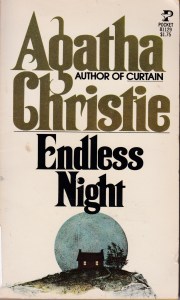
As I mentioned yesterday, on Sunday I reread one of my favorite Agatha Christie novels (although in mentioning favorites, I forgot So Many Steps to Death; her espionage novels were absolutely delightful), Endless Night. 

One of the things I loved the most about Christie is how she wasn’t afraid to try different types of crime fiction; she was probably best known for her two primary private eye series, one with Hercule Poirot and the other with Miss Marple, but she wrote over eighty novels, plays, and collections of short stories. She had a very keen eye for character (she is often criticized for the lack of character development; I never had that sense as a reader–she was able to sum up her characters very quickly and easily, able to use a few brief sentences and paint a vivid picture of who the person was; a skill I wish I had) and psychology; she was also a master of plotting. She knew how to create and manage suspense (the suspense is almost unbearable in And Then There Were None, for example); and she pretty much wrote everything from espionage thrillers to psychological suspense to murder mysteries to serial killers to…you name it; she wrote it.

But Endless Night is one of the most incredibly different things she wrote; and she wrote it very late in her career, publishing it in October of 1967.

endless night

The title comes from William Blake‘s Auguries of Innocence:

Every night and every morn,
Some to misery are born,
Every morn and every night,
Some are born to sweet delight.
Some are born to sweet delight,
Some are born to endless night.

According to some quick Internet research, the book was one of Christie’s own favorites, and received a very warm critical reception.

It’s easy to see why.

This is how the book opens:

In my end is my beginning….that’s a quotation I’ve often heard people say. It sounds all right–but what does it really mean?

Is there ever any particular spot where one can put one’s finger and say: “It all began that day, at such a time and such a place, with such an incident?”

Did my story begin, perhaps, when I noticed the Sale Bill hanging on the wall of the George and Dragon, announcing Sale by Auction of that valuable property, “The Towers,” and giving particulars of the acreage, the miles and furlongs, and the highly idealized portrait of “The Towers” as it might have been perhaps in its prime, anything from eighty to a hundred years ago?

I was doing nothing particular, just strolling along the main street of Kingston Bishop, a place of no importance whatever, killing time. I noticed the Sale Bill. Why? Fate up to its dirty work? Or dealing out its golden handshake of good fortune? You can look at it either way.

Isn’t that a terrific beginning?

(And “in my end is my beginning” is also what Mary Queen of Scots took as her motto during her long captivity at the hands of her cousin, Elizabeth I.)

Endless Night is, for wont of a better descriptor, a Daphne du Maurier novel written by Agatha Christie.

The book is told from the first person point of view of Mike Rodgers, a young man about town who is just kind of drifting from job to job. He winds up at The Towers, on a plot of ground known as Gipsy’s Acre, which was apparently cursed by the gipsies forceably evicted from the plot of ground centuries earlier…and the place has known nothing but tragedy since. There’s also a sharp, blind turn in the road just before the place, where plenty of people have been killed in car accidents. But while looking at the place, Mike encounters a young woman named Ellie…and before long, he and Ellie have embarked on a romance, and have decided to buy the land and build a new house there to spend the rest of their lives on. Mike has no real friends, and a bad relationship with his mother. And as it turns out, Ellie is quite wealthy…and once he is introduced to  her affluent world, things start to go very badly. Should they have listened to the old woman who warned them to stay away from Gipsy’s Acre? Is Mike a reliable narrator?

There’s an enormous twist in the book as well, which completely turns the narrative on its head, and makes you question everything you’ve been led to believe; a twist well-worthy of du Maurier. As they were contemporaries, I wonder if the two women ever met?

I love this book, and think it should be paired with du Maurier’s brilliant My Cousin Rachel, which for some reason was recently filmed again (I may watch the remake when it’s available for free streaming; it’s hard to imagine that it’s better than the original, which starred Olivia de Havilland and a very young Richard Burton). Someone should really write a compare/contract essay/piece of literary criticism about the two books; I kept thinking of My Cousin Rachel during this reread; now I really want to reread My Cousin Rachel.

Last night, I also started reading the latest Rebecca Chance, Killer Affair, and was sucked into it almost immediately; it’s Chance at her absolute best, and can’t wait to read more. I also started the final, definitive line edit of the WIP yesterday; since I always feel like the second half of my books don’t get as much attention from me as the first, I am trying something incredibly new for me: I am starting the edit with the second half of the book.

I hate line editing.

And now, back to the spice mines.


Rock a Little (Go Ahead Lily)

Happy Twelfth Night!

It rained all night, the temperature (as threatened by meteorologists) dropped, and it looks grim and dreary outside today. I got another good night’s sleep last night, and feel rested this morning. I am about to get my second cup of coffee, and cut into our first King Cake of the season. Woo-hoo! I do love me some king cake! Tomorrow I am on a panel about villains at New Orleans Comic Con, which should be a lot of fun; and yesterday I finished editing, and turned in, the next J. M. Redmann Micky Knight novel, The Girl on the Edge of Summer. Now, I have some more things to get done this weekend, and then I am sort of free from the constraints of deadlines; I have to write a piece for the Sisters in Crime newsletter, and I have an essay due by the end of the month for another book. I am also heading to Kentucky at the end of the month. Yikes! Oh, January.

Last night, before watching another episode of the oddly compelling Ray Donovan, I read a Daphne du Maurier short story I hadn’t read before; “Escort,”, from the Don’t Look Now and Other Stories collection. I recently got a copy when I realized that this collection had several stories in it I hadn’t read; her collection Echoes from the Macabre is my usual go-to for her short fiction. The problem has always been, for me–and I could be wrong–but her short story collections seem to all be named for stories that were also in Echoes from the Macabre, and in fact, several of the stories in this collection are also in that one. But there are some stories I’ve not read–which is why I decided to go ahead and get this one.

There is nothing remarkable about the Ravenswing, I can promise you that. She is between six and seven thousand tons, was built in 1926, and belongs to the Condor Line, port of register Hull. You can look her up in Lloyd’s, if you have a mind. There is little to distinguish her from hundreds of other tramp steamers of her particular tonnage. She had sailed that same route and traveled these same waters for the three years I had served in her, and she was on the job some time before that. No doubt she will continue to do so for many years more, and will eventually end her days peacefully on the mud as her predecessor, the old Gullswing, did before her; unless the U-boats get her first.

She has escaped them once, but next time we may not have our escort. Perhaps I had better make it clear, too, that I am myself not a fanciful man. My name is William Blunt, and I have the reputation of living up to it. I never have stood for nonsense of any sort, and have no time for superstition. My father was a Non-conformist minister, and maybe that had something to do with it. I tell you this to prove my reliability, but, for that matter, you can ask anyone in Hull. And now, having introduced myself and my ship, I can get on with my story.

We were homeward bound from a Scandinavian port in the early part of the autumn.

I’ve talked before about how, when I was a kid, I not only was an avid reader of mysteries for kids and novels and history but comic books as well. The EC Comics that Stephen King read and was influenced by when he was a kid were no longer around, but I read DC’s House of Secrets and House of Mystery, and Gold Key comics used to produce Mystery Comics Digest bimonthly; collections of stories from three different comic books they used to produce, and the digests rotated between the three titles–and they also included new stories, too. The three titles were The Twilight Zone, Ripley’s Believe It or Not (which I loved to read in the daily paper, too), and Boris Karloff’s Tales of Mystery. These stories were creepy and had elements of horror in them; there were almost always big surprise twists at the end. I loved these, and read them over and over and over again.

“Escort” reminded me very much of those digests. I also love du Maurier–she’s one of my favorites, as Constant Reader is already aware–and she also specialized in twists in her grim and dark short fiction. This story is set in the early days of World War II, and the captain of the ship falls ill–probably appendicitis–and Blunt has to take over control of the ship. A German u-boat shows up, and they play cat-and-mouse for a while…until a freezing cold fog drops down over the sea, and an escort ship shows up–and that’s when things get strange.

The story is very well done; du Maurier is quite the master at the slow build and the sudden burn, but this isn’t one of her better stories. Don’t get me wrong, it’s a good story–it’s just that stories like “Don’t Look Now” and “The Blue Lenses” and “The Birds” and “Kiss Me Again, Stranger” have set the bar so high that it would be impossible for any writer to consistently match the brilliance of those stories. It is definitely worth the read, and there are other stories in this collection I’ve not yet read, either….which is really lovely.

Huzzah!

And in honor of the story, here’s a sailor:

The Edge of Heaven

The end of the year is nigh.

I have a lot to do (of course, as always) over the next few days. I am already tired, just thinking about it, of course, but hey–such is life. I have to work late tonight again, and really should have made a grocery run this morning but I overslept, so there’s that. There is, of course, still time, if I get my act together and get moving, but right now that doesn’t sound particularly appealing. Heavy sigh.

But–probably better to get it done today than to try over the weekend. Nothing will be open on Sunday because of the holiday, and I can’t imagine that Saturday morning before out lunch at Commander’s Palace would be any better. Possible to do, but still most likely a madhouse.

Although Monday is a paid holiday for me, and apparently Costco will be open. Hmmmm. If I can do the grocery store this morning, and Costco on Monday…

Ah, the best laid plans of mice and men.

Anyway, I feel confident I can get the errands run I need to this weekend around writing and football games….although to be honest, I don’t really care about the bowl games other than LSU’s this year; I may watch some to kill some time or while reading, but other than that–meh.

I am going to read George Pelaconos’ The Way Home next, and then I am going to start trying to get caught up on series I have fallen behind on–I’m looking at you, Ranger series by Ace Atkins, in particular–and of course, January’s goal is to read and write about a short story every day, so I am gathering my short story collections and anthologies close. I don’t want to write about a story I’ve already read and written about (alas, “Don’t Look Now” by Daphne du Maurier will have to be excluded from this as I’ve talked about it ad nauseum; but a reread of “A Rose for Emily” is definitely in order), so the idea is to read stories that are new to me, and then write about them.

And now, I need to get ready for work and mine some spice.

Here’s today’s hunk:

Me and You and a Dog Named Boo

As I continue to muddle my way through this manuscript–honestly, I don’t know sometimes why it’s like pulling teeth and other times it’s just comes right out–I am constantly amazed at how many other ideas I get when I am working on something; ideas that are infinitely more interesting and sound like more fun to write than whatever it is I am actually working on. AND IT HAPPENS EVERY SINGLE TIME. And once I am finished, the creativity and urge to work on something else goes right away.

Surely I can’t be the only writer who experiences this?

AUGH.

Madness.

But as I think about these short stories, I remember probably the two finest collections of short stories ever–Echoes from the Macabre by Daphne du Maurier and Night Shift by Stephen King. I recently bought another copy of Night Shift on ebay, as my copy is in a box somewhere. Both du Maurier and King were short story masters; in fact, when I was a kid I loathed short stories and loathed reading them; this was primarily because I had to read things like “The Minister’s Black Veil” ad nauseum in English classes. I wasn’t lucky enough to be exposed to the truly great stories, like Faulkner’s “A Rose for Emily” and Jackson’s “The Lottery” until I got to college; but even by then the damage was done; that, along with the assigned short stories in writing courses (if I ever have to write an essay on Irwin Shaw’s “The Girls in the Their Summer Dresses” again I cannot be held responsible for what I do) had conspired to create a mentality that I loathed short stories. My experience writing short stories in writing courses in various colleges and universities had also taught me that I wasn’t a good short story writer; any good short stories I might write for a class were good purely by accident because I did not know what I was doing. That still stands true for today; I would rather write a novel than a short story.

But I am digressing, as is my wont.

Reading the du Maurier and King short story collections made me aware of what was possible for a truly gifted author to do with a short story; just as Jackson did with “The Lottery” and Faulkner with “A Rose for Emily.” My own difficulties with writing short stories comes from not, I realize now, having an actual system; I get an idea–usually both a title and a first line; maybe a character–and then I just kind of write with no idea of what’s to come, or what the story is about. This is the issue I had with “The Weeping Nun”; I wanted to write a story to submit to an anthology about Halloween stories, and I had this great title with an amorphous idea for a story, a point of view character, and an opening line: Satan had a great six pack. The problem, as I started writing the story, was realizing that as it came to me it had nothing to do with a weeping nun; but I was determined to somehow force that into the story so I could use the title.

On reflection, it seems perfectly insane and ludicrous now; but I am nothing if not obtuse and I am incredibly stubborn in stupid ways. I liked that title, and damn it, this story was going to fit that title if it fucking killed me.

The end result was the story was never finished, I missed the deadline for submission, and there was just frustration left in the wake of yet another short story failure.

And of course, this week as I struggled with writing the novel, it came to me in a flash: the story I was writing had nothing to do with the story of the weeping nun; I should have simply retitled the story and followed it to its logical conclusion and saved the story of the weeping nun for another time.

Idiocy, really. So simple, but I just couldn’t see it at the time.

And now I want to finish writing the damned story, which I now see as being about the gates of Guinee on Halloween night in the French Quarter.

Heavy heaving sigh.

And now, back to the spice mines.

Here’s a hunk to cheer you up, Constant Reader:

hot-firefighters-with-puppies-calendar-charity-australia-1