Lady Marmalade

He met Marmalade down in old New Or-leenz, strutting her stuff on the street, she said “hello, hey Joe, you want to give it a go?

That classic song by Labelle came out while I was in high school, during the early to mid-1970’s, and there was a lot of prurient young teenager thrill in knowing that the French lyrics translated to “do you wanna have sex with me tonight?” But the song–essentially about a hooker in New Orleans and a man’s experience with her–was an introduction to another side of New Orleans–one you wouldn’t find in the World Book Encyclopedia.

It was very important to me, for a variety of reasons, to make Scotty someone who embraced his sexual orientation and sexuality. I wanted to write someone who LOVED having sex, loved beautiful men, and felt no Puritan-American based shame about enjoying sex. Those kinds of characters were few and far between in gay fiction, let alone in gay crime fiction. After writing the typical miserable cynical bitter gay man with Chanse, I didn’t want to do that again. I wanted Scotty was to be the obverse of Chanse in everything, except their mutual love of New Orleans.

(This was, in part, in response to being briefly dropped by Alyson when I signed the Scotty series with Kensington, being told “two mystery series set in New Orleans would be too alike.” I took that personally, as an insult to my talent, ambition, creativity, and abilities…and I think I proved my point. Once Murder in the Rue Dauphine and Bourbon Street Blues were released–and Rue Dauphine sold super well for them and was nominated for a Lammy–Alyson changed their minds. I’m still mad at myself for not asking for more money.)

But while Scotty was highly sexually active, he never got paid for it. He also never did porn–although I did consider that at one point as an option; I thought a murder mystery built around a porn shoot would be interesting and kind of fun. And of course, in this book he mentions that he and the guys have recorded themselves having sex, and have sexted each other.

Scotty always preferred to keep his status amateur–but he was a go-go boy (stripper, exotic dancer, dick dancer, whatever you prefer to call the guys who dance for dollars in gay bars wearing various kinds of male undergarments), and he was certainly someone who was not averse to having a sexual encounter with a handsome stranger. (There’s a joke about this in Mississippi River Mischief where Frank comments after they’ve met someone, “I’ve been with you for almost twenty years. If you think I can’t tell by now that you’ve recognized someone but you’re not sure from where, which means you’ve probably slept with them, think again”–a paraphrase, but you get the gist; Scotty is often running into men who look vaguely familiar, and that usually does mean he slept with them a long time ago.)

New Orleans, despite it’s rather prim-and-proper high society set (on the surface, anyway), with the Pickwick Club and the Boston Club and the mysterious Mystick Krewes of Rex and Comus and so on, has always been a city of loose morals and freewheeling attitudes towards sex and sexuality. We had a zone where prostitution was legal for three decades or so (Storyville) and I wouldn’t be surprised if there were several bordellos operating within the city limits as we speak. There was the arrest of the Canal Street madam; and of course local author Chris Wiltz wrote The Last Madam, a biography of notorious Norma Wallace–the last well-known madam in the city. (Which I need to reread…) Bourbon Street was known for its strippers and vice for decades; there are still strip clubs on the infamous strip running from Canal downtown to Esplanade–and there are usually men in bikinis or something equally scanty on the bars of the gay clubs down down around the St. Ann/Bourbon queer nexus of the Quarter. When I was starting my deep dive into New Orleans/Quarter history, I wasn’t surprised to find out there were “stag” bars down along the riverfront along the levee; and if someone at one of the fancy houses in Storyville had a predilection for the Greek vice that needed scratching, the madam would send one of her bouncers down there to find someone willing to turn a trick, with a fair share going to the house, of course.

I think that’s fascinating, really; and something I want to explore in a story. I’ve started the story (it’s “The Blues Before Dawn” which I’ve mentioned from time to time) but can’t quite nail down the crime part of it. The set-up is great, though, he typed modestly.

I didn’t intend for Scotty to wind up in what is now known as a throuple–a three way couple, or a relationship of three people–on purpose. I wanted to create the dynamic of two men being interested in him at the same time, and have some fun with that in the first book. I absolutely did, and when I sent Colin away at the end of the first one, that was deliberate. I couldn’t decide who Scotty should wind up with, and I wanted Frank to be really who he logically should end up with–but this bad boy with a mysterious background who was so hot and sexy? I couldn’t NOT bring him back, and so I decided I had three books to wrap up the romantic dilemma. I wasn’t certain what the backstory of the dilemma would be, or how it would turn out, or how it would go–but when I was writing Jackson Square Jazz I found the perfect place and perfect way to bring Colin back. That book ended with them deciding to try a throuple to see how it works out. It was going pretty well until Mardi Gras Mambo–and I tried really hard with that book to not end the romantic story the way it ended in that book…and finally decided, since the series was actually turning out to be popular, that I would finish it by the end of the fourth book.

I’ve also not talked about it in the books or on this blog at all, but….they also have an open relationship. (Someone asked me about this at some point after the last book came out.) Nothing else would work for Scotty–he may not take advantage of the opportunities that pop up now the way he used to, but that’s because he has the freedom to make that choice. If he was forbidden from outside sexual relationships, he would cheat–and he doesn’t want to do that because that’s hurtful and wrong. He never wants to hurt Frank or Colin–but both of them are also away from New Orleans for long periods of time; Colin off doing his international agent stuff, while Frank is on the wrestling tour doing shows and promo events; so they are on their own a lot and temptation is always there–after all, all three of them are gorgeous–so while it is unspoken on the page, it’s an open throuple. And usually, Scotty finds outside sex to be kind of dull, unemotional, and not nearly as much fun as it is with one or both of the guys. That’s a character development arc. I also don’t show Scotty going out to clubs or waking up with hangovers with a stranger in his bed anymore, either. He does still go out–he loves dancing–but the gay bar scene has changed since he was younger and he doesn’t find it to be nearly as much fun as he used to.

Though he won’t say no to a hit of Ecstasy during Carnival or Decadence.

How subtle are the changes in Scotty as he has grown, aged and evolved? I think they are miniscule, but a revisit of the first two books in the series has shown a lot of change and growth over the years for him. He is definitely not that same flighty twenty-nine year old who booked a gig dancing at Southern Decadence all those years ago to make rent and wound up kidnapped by neo-Nazis deep in a swamp–I think he’s a little less flighty and a lot more responsible than he used to be…though he’s not as responsible as most people his age. Turning him into a property owner in the Quarter from a renter–and letting Millie and Velma ride off into the sunset in Florida as retirees–has also made him grow up, as now taking care of the property is his responsibility.

I will always be fond of my Scotty, though, and hope to keep writing him till I can no longer type into a computer or speak into a word-to-text app.
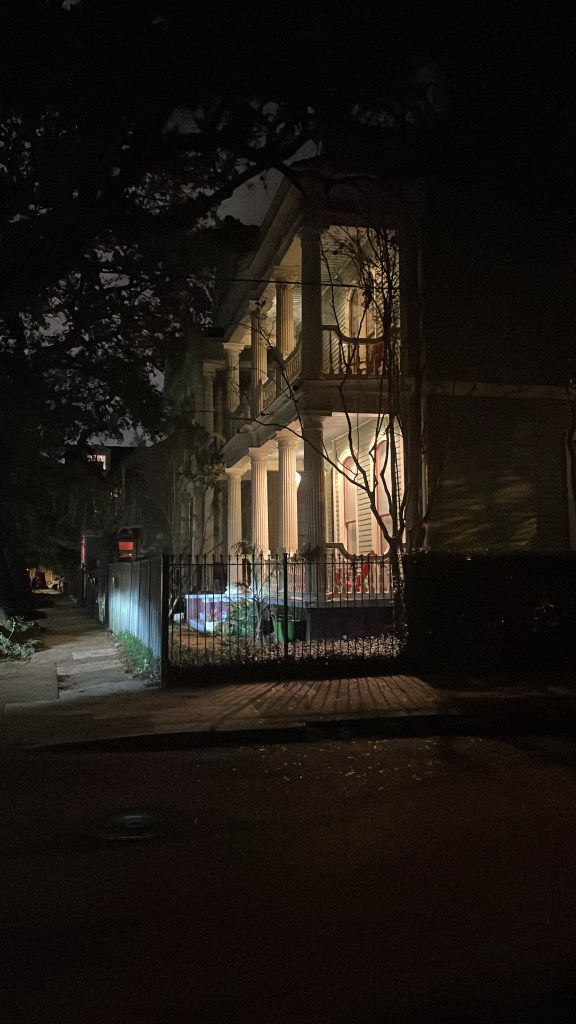

my neighborhood is so beautiful at night, isn’t it?

Today Was a Fairytale

It is Saturday and I am also on vacation for a week. Huzzah!

I have a lot to do, of course, as always, and of course, LSU is playing Arkansas today at eleven–how far the mighty have fallen, to be playing a Western division conference game at eleven in the morning on the SEC Network–so I will undoubtedly watch the game while reading, making notes on things I am working on, and trying to get caught up while not getting terribly saddened by the game and how it turns out.

But of course, as always, the intent behind this vacation is to get caught up on everything, which is no easy chore, believe you me. I need to whip the book into shape and get it rolling again; I need to finish a short story that has to be submitted by January 15th; the Lost Apartment is a disgusting pigsty that desperately needs to be deep-cleaned; and I’d love to be able to finish reading The Hot Rock as well as some other short stories. I also have a goal to relax and get rested, which will also be lovely.

I am sort of looking at the vacation as a kind of reboot, quite frankly; a time to snap out of the writing malaise I’ve been experiencing for the last few months and get back into my writing again. Getting caught up would be absolutely lovely, but as I always tend to be behind on everything…it doesn’t help that Louisiana and New Orleans history is so colorful and fascinating that I will often go down a major wormhole triggered by something I come across looking for something else–I spent several days in the wormhole created by having my curiosity aroused by the Mississippi River forts, for example, and came away from it with no story ideas other than an amorphous Sherlock Holmes story and perhaps something more recent, but again, amorphous and not much else. I spent a couple of days immersed in Cajun and Louisiana folklore, looking for something I could use for the Christmas horror story, only to come up relatively empty-handed. I have the opening for the story, still don’t know what the rest of the plot is, and am not convinced I chose the correct Cajun folk story/monster to use–which is part of the reason I decided to give up on trying to get the story finished by December 1st.

I also have a sink full of dishes and papers and files and books stacked everywhere. Not good, not good at all.

Yesterday Rex–the main krewe that still parades on Fat Tuesday, and whose “king” (Rex) is traditionally considered the King of Carnival, cancelled their ball and also announced that, with no ball and no parade this season, they will not be naming a King and Queen this year. This came as a surprise to me–let’s face it, few krewes are as conservative politically as either Rex or Comus (who chose not to parade once the city passed an ordnance not allowing krewes to discriminate in their memberships) so having Rex cancel its festivities is indicative of the seriousness of the pandemic, really. I know a lot of New Orleanian traditionalists were still holding out hope that parade season would happen, but with Rex making this stand you can be pretty certain that the party’s over for 2021. While this is obviously sad–who isn’t sad that Carnival isn’t going to happen?–it also means that 2022 Carnival will be epic and balls-to-the-wall; I also hate that the last Carnival was the cursed Carnival of 2020. The Historic New Orleans Collection has a great article about the thirteen times parades were cancelled over the 150 years or so we’ve been having Carnival here in New Orleans; naturally, now I am thinking about writing something during a cancelled Carnival of the past.

It’s weird when norms vanish, isn’t it? I would have never dreamed Carnival would ever be cancelled, and yet, here we are.

But will people still turn out in costume on Fat Tuesday? It’s still a holiday, after all, and I can, sadly, see people turning out to drink all day and celebrate.

I meant to read some short stories yesterday, even got started on reading one or two, but after I got home from the gym I wasn’t in the mood and so none of them took with me; I hope to do better with that today. I did make it to the gym last evening, and it was lovely. There’s still some tightness and muscle soreness in my back, but it’s not nearly as bad it was originally, and going to the gym actually made it seem better, to be honest. We watched an episode of The Mandalorian last night–this week’s not being one of the stronger episodes, although the story of the Child progressed a little bit (note to producers: more Giancarlo Esposito, please) and then I fell into a wormhole of Ten Minute History videos on Youtube before retiring for the evening. I do feel very well rested this morning, and not especially groggy; which should bode fairly well for the rest of my day. The lovely thing about this abbreviated and bizarre football season is I am not vested in it other than in watching LSU play; and with the game on early today I should be able to get plenty of things done today (in theory, at least); but seriously, if nothing else, I should be able to make progress on my reading.

And on that note, those dishes aren’t going to clean themselves, alas, so it’s time to mine spice. Have a lovely Saturday, Constant Reader.

I’ve Had The Time of My Life

New Orleans is, of course, more than Mardi Gras; but whenever anyone mentions New Orleans, most people’s minds immediately go there.

It is probably the most famous thing about New Orleans, no matter how hard we try to convince outsiders that there’s more to the city that our annual bacchanal…Mardi Gras is always the default; so much so that the entire season is collectively (and incorrectly) called Mardi Gras; Mardi Gras is merely Fat Tuesday (mardi gras literally translates into fat Tuesday) and the rest of the season is Carnival. No matter how often you try to correct people, it never takes and so I’ve gotten to the point where I no longer correct people. It is what it is.

Likewise, people think of Carnival as a debauched event, and there is some truth to that–women do show their breasts for beads, and I’ve seen guys drop trou as well. However, I can also honestly say I’ve never seen that happen on the actual parade route on St. Charles Avenue; perhaps that happens down on Canal Street during parades, but it doesn’t happen in Uptown. I’ve only witnessed it happen in the Quarter–people on Bourbon Street displaying the required flesh for people up on balconies with a seemingly endless supply of beads, demanding boobs or butts or balls in exchange for a strand of beads. I’ve personally never dropped trou for beads–never will; why on earth would you when they are thrown with such reckless abandon from floats during the parades?

Like most New Orleanians, I had some vague knowledge of the history of Carnival in New Orleans; I knew that the theme song “If Ever I Cease to Love” came about because of a visit from a member of the Russian Romanov royal family in 1872; the Carnival colors of purple, green and gold were also in his honor. I knew that Comus, Momus, Proteus and Rex were the original krewes that paraded; that the flambeaux carriers originally were necessary to light up the parades in the darkness of the night; I also knew that the members of those original krewes–that still exist today, even if some of them no longer parade–were made of the city’s ruling class elites, and the krewes were offshoots of the exclusive Gentlemen’s Clubs in the city–the Boston Club, the Pickwick Club, etc.–that also still exist today.

But I didn’t know a lot about the history; I didn’t know much beyond what I would read in the annual Arthur Hardy’s Parade Guide, which I buy religiously every year. It’s easier, of course, now; there are parade apps that track the parades so you know where they are; whereas before you just had to stand on the route and wait, or (if you are lucky enough, like we are, to live close to the parade rout) listen for a marching band before heading down to the Avenue.

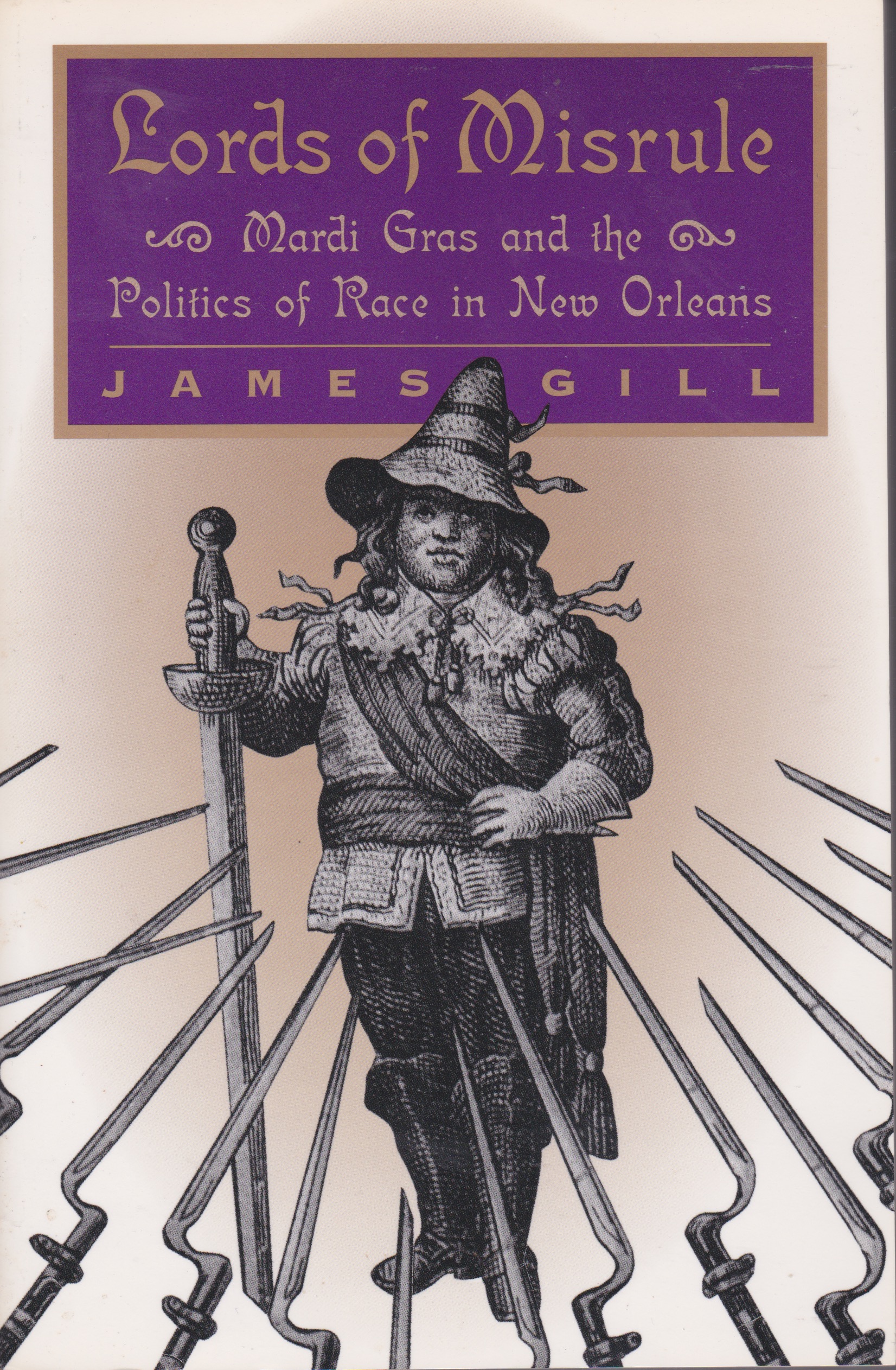
So I decided recently, since I’m reading a lot of New Orleans history, to read James Gill’s Lords of Misrule: Mardi Gras and the Politics of Race in New Orleans.

lords of misrule

The white men in jackets and ties were obviously out of their element. Normally, at this time of day, they would be preparing to leave home or office for a couple of drinks, lunch, and maybe a card game at their clubs. Now, on December 19, 1991, they shifted in their seats, returning hostile glances from a large contingent of black men and women in the packed basement of New Orleans City Hall. The city council was meeting in spartan surroundings while its regular chambers were being renovated, but the physical discomforts were nothing compared to the general psychic unease as everyone waited for the great debate on an ordinance to desegregate Mardi Gras parades and gentlemen’s luncheon clubs.

New Orleans is a Southern city, with all that entails and perhaps even more. There were slaves here before the Louisiana Purchase; both the French and the Spanish brought slaves to New Orleans and Louisiana. New Orleans didn’t hold out long as a Confederate city; it surrendered to the Federal navy fairly early in the war, and with that surrender, the Union plan to control the Mississippi was one step closer to fruition. Racism, Jim Crow, and all the horrible white supremacy that comes with those things were evident here; the Plessy v. Ferguson Supreme Court decision that established the horrific doctrine of “separate but equal” was a case that originated in New Orleans, and had to do with segregated railroad cars. Several years ago Mayor Mitch Landrieu and the city council finally agreed to remove the Confederate statues and other memorials commemorating the city’s racist past; General Lee no longer stands with his back to the North on his plinth in Lee Circle; the statue of General Beauregard outside the entrance to the New Orleans Museum of Art was removed, and the statue of Jefferson Davis on the neutral ground along Jefferson Davis Parkway was also taken down. Perhaps the most egregious memorial–the Battle of Liberty Place memorial–was also removed in the dead of night.

New Orleanians like to pretend that New Orleans doesn’t have that same vein of racism and white supremacy the rest of the South does; but it’s definitely there. It might have more a genteel veneer over it, but it’s definitely there. Orleans Parish is probably the most progressive parish in the entire state–but that’s also an incredibly low bar to set. The vast majority of people I know were in favor of the removal of the memorials, and whenever it came up on a local news website, the comments against the removal were almost inevitably from non-New Orleanians, and usually ginned up the standard Louisiana complaints about New Orleans: out of control crime, poverty, crumbling infrastructure. But all of those things were also true when the city was segregated and operating under Jim Crow; anyone who reads New Orleans history knows that the city was always a hotbed of crime and sin and debauchery.

Lords of Misrule opens with the attempt by the city council in 1992 to desegregate the krewes; my first-ever attendance at Carnival was a mere three years later, and people were still talking about it. The result was three old-line krewes (Comus, Momus, and Proteus) decided to stop parading rather than desegregate (there is a krewe now parading under the name of Proteus again; I don’t know if it is actually the same, original Krewe of Proteus or a newer krewe who took the name). Opponents of the ordinance claimed it would kill Carnival, which is now one of the primary economic engines of the city; nearly thirty years later we can attest that didn’t happen. Modern Carnival attendees don’t now about those krewes and they aren’t missed. But Gill uses this battle at the city council as a jumping-off place to examine the history of the racial politics in the city, and throughout, he uses Carnival–and how racist events in the city, such as the Battle of Liberty Place–to illustrate and illuminate that history.

It’s an enjoyable read, a little eye-opening in places, but a good read, and he also does an excellent job of exploring how Comus was not only  Confederate, but later, if not directly tied to, then definitely sympathetic to the Klan and the cause of white supremacy. Some of these civic leaders who would be, or had been, King of Comus or King of Rex also were leaders of the rebellion, the Klan, and so forth.

And it isn’t until the final chapters that any bias on the part of Gill becomes even remotely obvious; I got the distinct impression in the final chapters that Gill opposed the desegregation of the krewes–but he never comes out and says that; the final chapters simply read that way to me. I could be wrong.

But I do recommend it. It’s a good, interesting read, and sheds some important light on forgotten parts of New Orleans history.