Sunday morning and I am up early again after another lovely night’s sleep. Sparky is feeling feisty this morning after his breakfast–I noticed yesterday how clawed up my right knee is, since that’s the leg he always attacks and tries to climb while I am working on my desktop–so I have a lap blanket to cushion the claws a little bit. It’s my desk chair; he feels very territorial about sleeping in my desk chair after I go to work in the mornings during the week day and I am actually messing with his normal daily routine. Sigh. But I have work to get done today, around reading and cleaning, so he’s going to have to go sleep on the couch.
Yesterday was pleasant. I felt good in the morning after I got up, and did some cleaning. I read some more of Moonraker (astonishing how different the books are from the films) and started The Get Off, which has one of the best openings I’ve come across in books for quite some time–which is saying a lot, because I’ve read some pretty fantastic books lately–and am looking forward to reading some more of it today. I do need to get some writing done today. I wrote a lot yesterday, which was kind of fun, getting back into the swing of things. I wrote a very lengthy letter yesterday, which I will mail tomorrow, and then I worked in my journal for hours, brainstorming and figuring out how to fix things I am working on and what needs to be done. This morning, after reading and getting cleaned up, I’m going to get a story revised and then dive back into the book some more. Deadlines are looming, and the festivals are next weekend (AIEEEE!!!) and I still haven’t figured out a lot of that stuff out yet. Heavy sigh. I hope it’s a calm day at the office this week that doesn’t wear me out too much so I can get all this heavy lifting done.
We also watched the LSU Gymnastics team power to a second consecutive SEC championship meet in a row, which was very exciting. It was a close meet, but LSU broke 198.00 yet again, and the top three teams (Oklahoma and Florida being the other two) didn’t really have their best meet, either. And now it’s on to regionals and nationals. It’s funny how ever since that bitch on the Oklahoma team flooded social media last year with clips of LSU’s gymnasts and claiming they were being over-scored…Oklahoma hasn’t beaten LSU once. Karma is absolutely a bitch, and frankly, I’ve hated their team for its poor sportsmanship ever since–and their bitch of a coach could have stopped that skank from publicly being a piece of shit any time she wanted to, but she didn’t, and she’s theoretically the grown adult in the room, so the Oklahoma athletic department put their stamp of approval on that gymnast’s trashiness. So, fuck you now and forever, Oklahoma.
We’ve been watching Paradise on Hulu, which is nothing like I was expecting it to be. All I knew going in was that it starred Sterling K. Brown playing an agent on the President’s security detail…but the show is very clever and has lots of twists and surprises…as well as Julianne Nicholson, who is becoming one of my favorite actresses, in a stunning performance as a tech billionaire with delusions of grandeur (sound familiar?); we have two more episodes to go, and we’re really enjoying it a lot. Highly recommended, and a lovely distraction from the country’s acquiescence to authoritarianism.
I hate to break it to everyone, but it’s already here. Undesirables are being shipped to prison camps in another country. Companies and universities are giving up their freedoms and bending the knee to an illegal presidency and an even more illegal regime. We were doomed when Merrick Garland slow-walked everything, the Supreme Court colluded on immunity1, and it was very clear that it was the intent of the Biden administration to not go after the criminal syndicate that preceded him in office, which also belied their own claims on the 2024 campaign trail–and they wonder why the Democratic Milquetoast Party’s approval ratings are in the toilet? They rolled over and let this happen to us all. And after spending an entire election season warning us about the rise of fascism, suddenly it’s here and their position is “oh, well, we have to work with them”–don’t ever ask me for a fucking dime again. From now on, I only am donating to specific candidates, after being betrayed by so many once they were in office (looking at you, Schumer and the Asinine Nine); why is it important to elect rollovers like John Fetterman or Schumer or Gillibrand? If they’re going to vote with Republicans against the best interests of their own constituents and country, why not just let the Republicans just have the seat in the first place? And the complacency of the Democratic base has a lot to do with that. I’d still like to see an audit of Kyrsten Sinema’s professional and personal accounts.
But by all means, let’s just surrender the country. Fuck off now and forever, Chuck Schumer. We already live in a dystopia, can we at least count on you to not make it worse? Oh, silly me, your rich donors mean more to you than your base, how could I forget? I certainly never thought I’d see the day when NEW YORK’s senators would fuck over the entire party.
And on that cheery note, I am heading into the spice mines. Have a lovely day, Constant Reader, and I’ll shout at you later, okay?
I suspect there were things discussed privately, or that the Supreme Court had decided in the past out of the public eye, about immunity that we are not privy because STATE SECRETS. This ruling also ensured Bush II would never be charged for his administration’s war crimes in Iraq and Afghanistan. I also believe that when we targeted and assassinated Yamamoto during World War II crossed a line.Yes, it was war…but a targeted assassination approved by the White House? I’m sure it was not either the first or the last crime authorized by the executive branch. ↩︎
Remote Friday! I slept decently last night, which was a lovely thing. Sparky cuddled with me this morning when he got hungry, which was very sweet–I’d rather wake up to a cuddling, purring kitty than to an alarm any day. I’ve always believed alarms were unnatural, forcing you to wake from sleep before you’re ready or you’ve had enough. But that’s all part and parcel of the tyranny of capitalism we’re all subjected to most of our lives, and we’re all about to be (or already been) sacrificed on the altar of Ayn Rand acolytes who only read The Fountainhead or Atlas Shrugged, and not her actual philosophy. (Whenever someone mentions her admiringly, I always ask if they’ve read her essay collection The Virtue of Selfishness and the answer is always no…so I stop listening to anything they say and see no point in arguing with them from a place of better knowledge;1 and the true believers are just another branch of the MAGA family tree of cruelty and bigotry.) Must get up, must make money to spend money to keep the economy going…and round and round it goes.
I was very tired when I got home from work last night and sadly, didn’t get much of anything done. I came home, fed and played with Sparky, and then collapsed into my easy chair with a tired body and worn out brain. Thursdays really are my least favorite day at the office. Paul got home later than I would have liked, but I have to say this year I’ve seen more of him than I usually do during my Festival widowhood, so in a way I’m kind of glad the building collapsed? He’s going to be gone most of today, too, once he gets up, and I am going to be doing my remote work and writing and doing chores and getting the house as in order as I can manage. That always makes me feel better; I always find a messy apartment to be kind of…unsettling and oppressive, which has everything to do with fears of being a hoarder. I’m letting go of my need to never get rid of a book under any circumstance, but that comes from the reality of limited space options. I’ve also cut back on my buying books all the time, and limiting myself to new books from friends, or their recommendations. That has definitely helped financially, too. (But I will never donate my kids’ series books, ever.)
I also want to get some reading done this weekend. I want to get further into my revisit of Moonraker, and I have already moved Christa Faust’s The Get Off to the on-deck position of the TBR list. I’ve been waiting for this book for fourteen years! I love Christa’s voice and her style of writing, as well as how fierce she is, and boy, does that ever come across in the Angel Dare trilogy. Angel is an unusual heroine, and I do think the series will become noir classics to shelve alongside James M. Cain, Patricia Highsmith, and Cornell Woolrich2. I’d love to see them filmed, to be honest, and what a great role she’d be for an ambitious actress.
I did try to write some last night to little or no avail. I really need to get back into that saddle again and get things going. Deadlines loom overhead, and the Festivals are next weekend, and I am going to be super busy during both–I have several things I have to do, and I have all kinds of friends coming into town to speak at one or both. It’s going to be so exhausting, I am already kind of dreading how tired I’ll be. Not to mention commuting to the Quarter and back so we don’t have to board Sparky…and all that walking. Yes, I am going to be completely exhausted…but at least nothing I am doing is in the morning, thank you God, so I can at least sleep in some.
And on that note, I am heading into the spice mines. Have a lovely Friday, Constant Reader, and I’ll check back in with you either later today or tomorrow morning. We shall see, shan’t we?
I read Ayn Rand in my twenties–I read her short novel Anthem in high school–and studied her philosophy, which required reading her non-fiction. I saw the fallacy in her “objectivism”, the flaw that unspools the entire thing, almost immediately, which gave me the knowledge to know she–and everything she believed, was patently predicated on a lack of understanding of human nature and behavior, and most of her acolytes embraced only the parts that confirmed their own biases while ignoring the rest. Check out her writings on religion sometime, and ask yourself how Paul Ryan and others–anyone, really–could be a “devout Christian” and an objectivist, when she wrote and believed that religion was ignorant superstition and unworthy of an intellectual. ↩︎
Note to self: revisit Cain, and read more in the Woolrich and Highsmith canons. ↩︎
They were everywhere when I was growing up—movies and television shows—and my father has been a lifelong fan, so whenever there was a Western on TV, our set was tuned to it. Gunsmoke, Bonanza, The Rifleman—you name it, we watched it. Looking back, my dislike of Westerns was rooted in several things: toxic masculinity, racist depictions of indigenous peoples, and how entertainment in this genre was primarily used to create a mythological portrait of the settling (colonizing) of this continent and make it seem as though Europeans were doing the right thing (even using religion) even though they really weren’t. I never saw the natives as villains, and I didn’t like how easily Westerns picked up the trope of heroic white people and savage natives. Even as a child I could see it was all bullshit and I didn’t buy into it. I was about eleven or twelve when indigenous people occupied the massacre site at Wounded Knee, bringing attention to those false narratives and trying to change what was then culturally-accepted racist viewpoints on the indigenous Americans.
Look at the words used for the indigenous people–“savages”, “redskins”, “braves”, etc.; all dehumanizing and differentiating; “they are not like us so have no rights or privileges and we need to kill them all” was pretty much the US government’s policy to the natives.
Many sports teams still perpetuate this—how many teams still used these offensive names until recently? How many still do? And how upset do people get when those names are changed?
Anyway, I also mentioned in passing on another post that I’d like to explore Western tropes and why I’ve never been terribly interested in them as a genre. When I was in Kentucky the last time visiting Dad some movie channel was having a John Wayne film festival, which kind of made my heart sink. I’ve never really been much of a John Wayne fan (although I do love both True Grit and Rooster Cogburn) and generally avoid his films. The first movie was Hondo, with Geraldine Page (of all people; I wonder what she thought of the experience), and you know, I actually enjoyed it…and it made me think maybe I should revisit John Wayne and check out some of his other, better films. But Christa Faust, who is one of my favorite people in this community, commented she’d love to hear my thoughts on Westerns and their tropes.
She also turned me on to this:
If you aren’t aware of Christa Faust and her work by now, you really should be ashamed of yourself.
Redemption is an amazing Western graphic novel she wrote, and I very happily downloaded it as soon as she let me know of its existence. It also made me recognize and understand my own comics-fandom to a degree, too, and I may need to reevaluate that and explore it. I had thought about doing a Pride post about comic books and super-heroes, but it might need to be a longer form personal essay. Anyway, I don’t read enough graphic novels. I’d known that Christa had done scripts for comics before, but it never occurred to me that I should read them as well as be supportive of my friends who create this way. It is just another form of writing, really.
Christa is one of my favorite writers, and Money Shot remains to this day one of my favorite American noir novels. She’s also one of my favorite people; I love just sitting around shooting the shit with her.
And what she does with Redemption is absolute feminist magic.
You see, the thing about Western tropes is they can often be adapted to other genres–including literary (Lonesome Dove is my father’s favorite novel)–and the first Star Wars movie (I will never call it anything other than Star Wars) borrowed heavily from Westerns, as does The Mandalorian. You can see the influence of Westerns on pop culture almost everywhere you look, really (and really, Western tropes are often influenced by medieval tales of lone knights and paladin, which in turn were influenced by Greek mythology), and Redemption isn’t a classic Western set in the 1800’s; this Old West is the result of some kind of apocalyptic happening, with the end result that the town of Redemption has walled itself off from the rest of the world (for their own safety) and is being run by your typical right-wing doom-and-gloom Christian type, who uses God and the Bible for control rather than for inspiration. The town’s doctor, who is not only a Latina woman but a fierce feminist, has been tried and convicted for providing an abortion to a woman whose child died in the womb and was endangering her life.
She has also been sentenced to death.
If you are seeing parallels between this and our modern world, well, I am pretty fucking sure that’s entirely intentional.
The doctor’s daughter’s only hope to save her mother is to find a legendary gunslinger called the Butcher–who had a past with the doctor when they were young. No one is even sure if the Butcher is real, or if she’s merely a legend.
And in the character of the Butcher, Faust sets Westerns on their ear by taking the typical closed-mouth gunslinger (think Clint Eastwood in all those movies about the Man with No Name) and made her a woman, but without stripping any of the gender expectations for men in Westerns. She’s old, she’s tired, and she’s done with bullshit–but she can still outdraw and outshoot any and every man she runs up against.
The art by Mike Deodato is also incredible.
Highly recommended; and again, check out her other work if you’re not familiar with it. You can thank me later.
Labor Day Monday, and time to readjust from “Greg Herren Author” back to my everyday life here in New Orleans. There’s really nothing like your own bed–but the bed I had at the Marriott Marquis in San Diego was probably the most comfortable bed I’ve had in a hotel to date. I had trouble sleeping the whole time I was there, but the bed was so comfortable that I always slept some and always managed to feel, if not completely rested, but at least recharged. But oh what a lovely time it was!
I flew home yesterday from San Diego, where I’ve been since Wednesday. My apologies for being lax in posting while I was away, and I hope you didn’t miss me too much, Constant Reader. But it was also nice being in a bubble for several days practically cut off from the outside world. I didn’t write a single email since Wednesday morning; I only deleted junk. I didn’t write anything, nor did I read anything once I’d checked into the hotel. But what a marvelous time it turned out to be. I love going to Bouchercon–it’s a marvelous escape from the everyday and being around writers (so many writers!) and readers (so many readers!) and it’s just so much fun. There are so many marvelous people in this business that I so rarely get to see in person, and I never have the opportunity to spend time with everyone that I would like to.
There’s also this weird thing about Bouchercons. You can go the entire time without seeing some of your friends who are there; and you never seem to bump into them. Last year in Minneapolis I hardly ever saw Christa Faust, and even then only in passing or from across a very crowded room. This year I bumped into her almost every time I turned around, and it was an absolute delight because I adore Christa. You also get to make new acquaintances and discover new writers, too. I love debut authors! It’s always amazing to find new authors and make new friends, see old friends–and yet there were so many people I only saw fleetingly in passing, or didn’t see at all. But it was incredibly lovely, really. I resisted temptation in the book room (some of the collectible booksellers had some old editions of the kids’ series–including the super-rare ones no one’s heard of–but I knew if I bought any books I’d have to pay to have them shipped home, and so that extra step was enough to trigger my laziness (and miserliness–I can be extravagant to a fault when I really shouldn’t be) to step in and say, no, you don’t need more copies for your collection even if you can replace some damaged ones with ones that look pretty new for a reasonable price. And I don’t regret not buying those books, either. (I will probably get the ones by new acquaintances, though.) I also had four tickets to get free books in the book room, so I picked up Death by Bubble Tea by Jennifer J. Chow; Her Last Affair by John Searles (who I interviewed for Lambda Book Report back when his first novel came out, and that leads to a great story I will save for another time); The Quarry Girls by Jess Lourey (whom I adore); and one other that I can’t remember, and I can’t seem to find it this morning. Oh, well. Mindy Carlson, who was on the panel I moderated, gave me a copy of her debut, Her Dying Day (which has the best ever opening!) when I ran into her in the lobby on my way to the airport. I can’t wait to read it!
I finished reading Kelly J. Ford’s marvelous The Hunt on the flight home to Dallas yesterday, and then moved on to Laura Lippman’s Prom Mom, both of which are superb. I am almost finished with the Lippman, and when I am finished with this I am going to my chair so I can finish it.
I am pretty much taking the day off from everything and resting. I had planned on going to the grocery store–I still might; it depends on how I feel later–but I am going to relax today. I did get home last night in time to watch LSU embarrass itself on national television last night, but it’s okay. It’s nice to have any expectations for the season gone after the first game, and now I can watch the national title race with idle curiosity while watching LSU get through it’s season with no expectations from them. I was very concerned that they were being over-hyped (everyone seemed to forget that after the big win over Alabama last year, we barely beat Arkansas and lost to Texas A&M before being embarrassed in the SEC title game by Georgia), but this is yet another example of when being right isn’t what you want and brings absolutely no satisfaction–Cassandra was hardly smug as Troy burned around her, after all. I am exhausted, despite the fantastic night’s sleep I got last night, so I think resting up is indeed the way to go for today. We have shows to catch up on, after all, and maybe I’ll even splurge on a movie.
It was a wonderful time. I love my friends in the crime fiction community, and I love that I am sort of known in it now more than I was? I had several people come up and ask about my books, or tell me how fun I am to watch on panels, but I am also beginning to think that I need to be maybe a bit more professional when talking about my own work on panels. Something to ponder as I move into the adulthood of my career (it turned twenty-one this year, after all, which is staggering). I am inspired, reinvigorated, and ready to prove myself worthy to be a part of the community again. I want to get back to my writing and dig into it and keep going and do really good work. Reading Kelly and Laura’s books are inspiring because they remind me to work harder, do better, dig deeper, and aspire for greatness more. I have broken down the barrier that was keeping me from reading novels, or at least was making me unable to focus, and now I hunger to read more. Once I finish Laura’s book I am moving on to S. A. Cosby’s new one, with Alison Gaylin’s marvelous new take on Robert Parker’s Sunny Randall series. (I will never stop marveling that I am friends with, or at least know, my writing heroes.)
And definite shout-outs to all the people who won Anthonys this year, and were nominated. It’s surreal to me to see how many nominees are friends; and it’s absolutely lovely to see that. Only a few winners weren’t friends–and how can you not be happy for friends to get recognition? I adore Catriona McPherson and S. J. Rozan; how delighted was I to lose to writers whose work I’ve admired for years and how thrilling to be in the same category with them? I don’t know Nancy Springer, the other to whom I lost, but I love Enola Holmes. And Kellye Garrett and Wanda Morris are not only incredible writers but wonderful women I am very proud to know. I love Barb Goffman, who has always been so kind and lovely to me ever since the first time I met her. I don’t know Martin Edwards, but from all accounts he is a very kind and lovely and generous person, and I share the TOC of School of Hard Knox with him. The Debut winner, Nita Prose, wasn’t there and I don’t know her, but I do have her book The Maid, and I hope to read it before the end of the year.
So no, I didn’t win any of the Anthonys I was nominated for. What a fucking honor for a gay man to be nominated for three (mainstream, MAINSTREAM not queer-specific) Anthony Awards in the same year for three different books, for anyone, really. I think the only other person to ever be up for three in the same year is S. A. Cosby (and what amazing company to be in, right?); others have been up for two in the same year before (as I was last year; this year Catriona McPherson was a double nominee). I have been nominated for seven Anthonys in total now, and so what if I have lost six times in a row? Awards are lovely, but I honestly don’t mind losing. I love to act like a bitter loser because, well, it’s funny to me. I did start realizing sometime during the pandemic that my “bitter loser” shtick might be insensitive–some people would kill to lose six times; some are never nominated once–and maybe the “bitter loser” shtick doesn’t play as well now as it used to? I don’t know, but it’s such a thrill for me to be nominated, and retrospectively, I’ve had a pretty amazing run: fifteen nominations from Lambda Literary nominations, seven-time Anthony nominee, and once each for the Lefty, the Agatha, the Macavity, and the Shirley Jackson. That’s pretty fucking amazing, and maybe I should finally recognize that maybe, just maybe, I’m pretty damned good at this writing thing? I do need to be better about the other aspects of the business–marketing and promotion and so forth–and since my brain doesn’t juggle as well as it used to, I need to start getting focused and figuring some things out. The rest of this year is going to be taken up mostly with dealing with medical issues (I get my new hearing aids tomorrow!) and I don’t know how much I am going to be able to do or what I can and can’t do; and everything is kind of up in the air now for the rest of the year.
That would have triggered my anxiety before, but I am at peace with it. My decision to override the anxiety and remain calm while traveling worked in both directions, and it was lovely to not get worked up or upset or irritated about anything. I managed to even get my bag from baggage claim, the shuttle to the parking lot, and then drive home without losing my cool–I didn’t even swear at a single driver–and I kind of want to keep that level of calm and cool going forward. I did experience some anxiety before I moderated the Humor and Homicide panel yesterday; I was brought in–not at the last minute, but far too late for me to get copies of the panelists’ books and read them to prepare–late but my word! What a group of amazing professionals I was blessed to moderate! You need to read their books; they are talented and funny and marvelous and I was totally blown away by them–and three of them were debut authors! There was J. D. O’Brien, whose debut novelZig Zag, about a marijuana dispensary employee who plans to rob her employer, only for Westlake-like hijinks to ensue; the delightful Mindy Carlson, whose debut novel I already mentioned; the always wonderful Wendall Thomas, a seasoned pro whose latest, Cheap Trills, sounds incredible and I can’t wait to read; the witty and charming Jo Perry, who has a marvelous series from the point of view of a dead man and whose latest, Cure, sounds great; and Lina Chern, whose debut novel Play the Fool is about a tarot card reader trying to solve her best friend’s murder and sounds amazing. I had them read their book’s opening few sentences, and once I heard them, I knew it was going to be a breeze. It was wonderful! What a great break for me to get to moderate this panel and find even more great books to read. I could have talked to them about their books for hours. Afterwards, I realized I hadn’t even used half of the questions I had–always the sign of a great panel!
Speaking in public has always been difficult for me and always ramps up the anxiety (which I always thought was just stage fright). But now that I know what it is, I can sort of control it. I can’t control the adrenaline spike and what comes with it–the shaking hands, the talking too fast, the shakiness of my brain, the upset of my stomach–but I can control the mental part and not allow the anxiety to take over. It was very strange knowing I can’t control the physical response to the chemical imbalance but I can control the mental/emotional response, so instead of freaking the way I usually do before going on–I focused on making sure pre-panel that they were all comfortable, that I wanted them to talk themselves up with the goal of selling a book to everyone in the room, and basically, asked questions and got out of the way and let them shine like the stars they are–and did they ever! Especially when you remember I hadn’t sent them questions in advance to prepare; they each were speaking extemporaneously, which is impressive as hell. The nervous energy I handled by walking around briskly before the panel and talking to each of my panelists individually and staying hydrated. Yes, I drank water, limited myself to one cappuccino per day, drank iced tea for lunch instead of Coke, and tried very hard to remember to slow down and get over the FOMO I always feel. I did have some cocktails every night, but never enough to get more than a bit tipsy and paced myself more.
And now, I am going to head back to my chair and finish reading the new Lippman and maybe start reading the new Cosby. I have laundry to do, a dishwasher to empty, and basically, I am just going to relax as much as humanly possible today. I should probably make at least a minor grocery run; maybe not. But what a marvelous, marvelous time I had.
One of the things I’ve greatly enjoyed over the last few years has been the sea change in how publishing views works by non-white and non-straight authors; the push for more diverse voices in the publishing community has already borne wonderful fruit. I’ve been saying for years that the world of crime fiction was in danger of getting stale again, much as it did in the late 1970’s and early 1980’s; particularly the private eye novel. The arrival of Sara Paretsky, Sue Grafton, and Marcia Muller on the scene shook things up and shook things out; the private eye novel got a much-needed shot in the arm of adrenaline with these three women and the others their work inspired; I strongly believe the move toward diversity is going to bear fruit in much the same manner–and it already has, frankly; the works of diverse writers like S. A. Cosby, Kellye Garrett, Rachel Howzell Hall, Alex Segura, Tracy Clark, Cheryl Head, and so many others have joined the great pioneers like Walter Mosley and the wonderful Barbara Neely to open up new perspectives on crime and crime fiction; our society and world; and again, this was desperately needed–and is necessary every so often, for our genre to refresh and expand and become more inclusive. We’re also seeing more queer books being sent out into the world from the big houses in New York, which is also incredibly exciting (another shout out to Yes Daddy By Jonathan Parks-Ramage and A Beautiful Crime by Christopher Bollen).
It’s a very exciting time to be a fan of crime fiction.
Noir has always been one of my favorite sub-genres of crime fiction, and I always enjoy reading modern takes on it. I want to write more noir, quite frankly; Chlorine would be the first of at least four I want to write, if not more (for now, I have ideas for four of them, with Chlorine being the most full formed). I always enjoy modern takes on noir–Laura Lippman’s Sunburn was quite marvelous, as was Christa Faust’s Money Shot and Choke Hold)–and of course, S. A. Cosby is a master of rural Southern noir; both Blacktop Wasteland and Razorblade Tears are destined to be considered classics, I think.
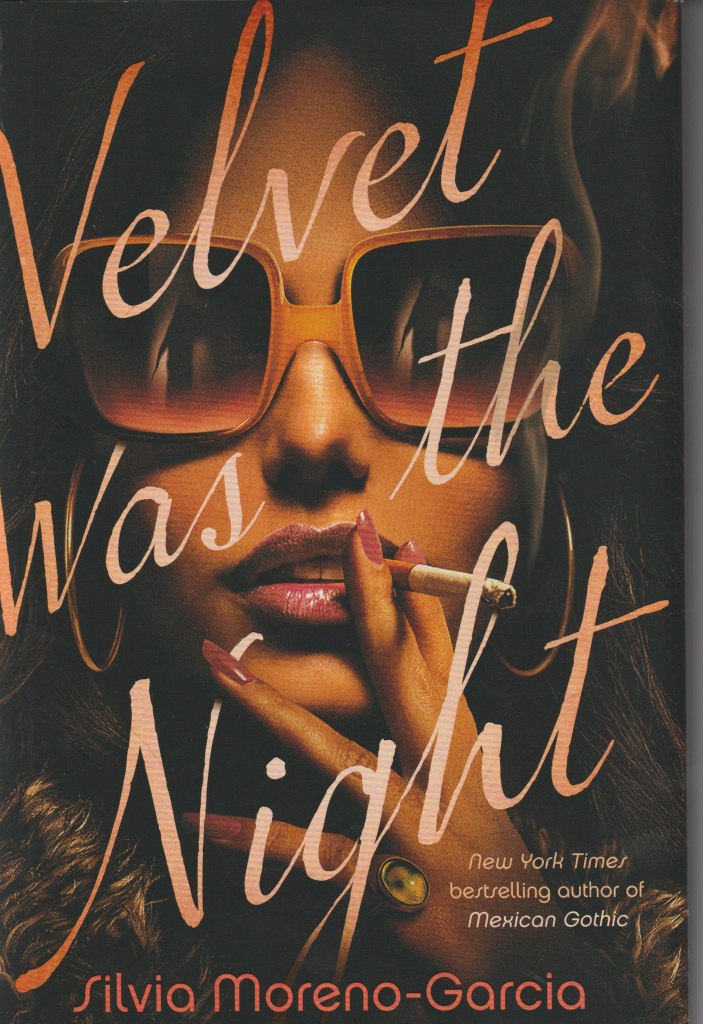
So, I was very curious to read Silvia Moreno-Garcia’s take on modern noir, Velvet Was the Night. It took me a very long time to finish–which is not indicative of the quality of the book, I hasten to add–because after I read so much during the post-Ida power outage, I kind of broke my brain and thus haven’t been able to really focus as much on reading as I would like; yesterday after the LSU game I sat down and finished it with Georgia-Kentucky on as background noise.
And what a fun ride it was.
He didn’t like beating people.
El Elvis realized this was ironic considering his line of work. Imagine that: a thug who wanted to hold his punches. Then again, life is full of such ironies. Consider Ritchie Valens, who was afraid of flying and died the first time he set foot on an airplane. Damn shame that, and the other dudes who died, Buddy Holly and “The Big Bopper” Richardson; they weren’t half bad either. Or there was that playwright Aeschylus. He was afraid of being killed inside his house, and then he steps outside and wham, an eagle tosses a tortoise at him, cracking his head open. Murdered, right there in the stupidest possible way.
Often life doesn’t make sense, and if Elvis had a motto it was that: life’s a mess.That’s probably why he loved music and factoids. They helped him construct a more organized world. When he wasn’t listening to his records, he was poring over the dictionary, trying to memorize a new word, or plowing through one of those almanacs full of stats.
No, sir. Elvis wasn’t like some of the perverts he worked with, who got excited smashing a dude’s kidneys. He would have been happy solving crosswords and sipping coffee like their boss, El Mago, and maybe one day he would be an accomplished man of that sort, but for now there was work to be done, and this time Elvis was actually eager to beat a few motherfuckers up.
He hadn’t developed a sudden taste for blood and cracking bones, no, but El Güero had been at him again.
The recent rise of Silvia Moreno-Garcia has been meteoric, although I am sure to her it has seemed anything but. I read her terrific vampire novel, Certain Dark Things, a while back, loved it, and have been following her career ever since as she has turned out novels at a terrific rate–Gods of Jade and Shadow, Untamed Shore, Mexican Gothic–all of which have been critically acclaimed and sold very well; I love that she bounces from genre to genre–horror to fantasy to crime; even bouncing around in the sub-categories of the crime genre. This is only my second read of her work–I have them all, of course–and had been meaning to get around to her take on noir with a Mexican flourish for quite some time. (I am really sorry I broke my brain with all the reading I did after the power went out; I greatly enjoyed this book, but it was so hard for me to focus for some reason…but am glad I sat down yesterday with the book, determined to finish it at last.)
One of the things that strikes me about Moreno-Garcia’s work is that I am seeing Mexico, a place I greatly love, through a fresh new perspective; like all Yanquis, I always view Mexico through the prism of a tourist. I’ve always wanted to write about Mexico, and have several short stories in the files that are set there (I did write one erotica story as Todd Gregory set in Acapulco; from the perspective of a tourist, of course: “Oh, What A Friend I Have in Jesus”)…but reading Moreno-Garcia makes me aware of how scant my knowledge of our Southern neighbor is–all of the counties south of the Rio Grande, frankly–which is a stinging indictment of our education system. (Don’t even get me started on the concept of Latin America vs. “America”) I know very little of Mexican history after the Spanish conquest, other than the Mexican War and the French empire set up under a Hapsburg by Napoleon III during our civil war. I know very little history of any of the countries that make up the rest of the American continents, really–and isn’t that more than a little bit disgraceful? I also know very little about their cultures, their politics, and what goes on there; a quick glance through the news also will show very little information or news being reported about those non-United States/Canada American countries, which is really a shame.
Velvet Was the Night is set un 1971, a particularly politically rife period in Mexico. The US was terribly concerned about communism being spread by the Soviets in what has always been considered the American soft underbelly–I mean, look at our reaction to Cuba–and there’s no question that CIA operatives and money were working to subvert Communism while supporting borderline Fascist governments because that was preferable to Washington than another potential Soviet satellite state in our hemisphere. The vast paranoia of that time–which really lasted from 1945-1990, really–cannot be underestimated or understated. By rooting her story in actual events of 1971–the crackdown of the Mexican government on dissidents–Moreno-Garcia slyly gives us a taste of how American foreign policy of the time affected everyone in Mexico, as well as a history lesson. (One of the great modern deceptions of our society is this idea that we always act benevolently as a nation; we’re doing this for your own good.) The book has two point of view characters; one, depicted in the opening above, is “Elvis”, a very young man who works as a thug, basically, for an oppressive group of anti-Communists that try to infiltrate dissident groups and haunt protests in order to make them turn violent, so the military can intervene on behalf of the “people.” Elvis grew up very poor and sometimes imagines what his life would be like if he were able to pursue his primary interests–educating himself and music. He doesn’t know what his future holds but is vaguely aware the path he is on–violence and more violence–will not end well. Over the course of the book he begins to question the values he’s been taught to believe in his gang, and begins to aspire to get out of it.
The other main character is Maite, a legal secretary barely getting by on her low salary and barely able to afford food. Her car has been in the shop unclaimed because she cannot afford the mechanics’ bill. She leads a lonely and solitary life, has a very vivid imagination and fantasy world she prefers to inhabit, colored strongly by her love of romance comic books and the music she likes to listen to. Maite’s lovely neighbor, Leonora, asks her to feed her cat while she is away, and when she agreed, Maite unknowingly enters the world of political struggle and upheaval. The riot depicted in the first chapter, that Elvis helps engineer? A friend of Leonora’s has taken pictures that prove that the riot was started by government forces, and those two rolls of film are the McGuffin everyone in the book is after–except poor innocent Maite, who, like any main character in a great Hitchcock film, becomes involved in something life threatening by simply agreeing to feed a neighbor’s cat–something she resents agreeing to do. When Leonora doesn’t come back, Maite starts looking for her–primarily motivated by the fact she can’t afford to keep feeding the car, and Leonora promised her money for feeding it–money she needs to get her car back. Motivated by her own poverty, Maite finds herself getting involved more and more in this clandestine world, and her own life is in danger soon.
The true strength of the book lies in the careful characterizations of both Elvis and Maite; two desperate people trapped by poverty in lives they want to escape, and the parallel journeys they both follow that lead their paths to cross; and the richness of the reality of what life in Mexico City was like during the turbulent time when the book is set. Moreno-Garcia shows us, as she did in Certain Dark Things, what the reality of life is like in one of the world’s largest cities, the reality the tourists rarely, if ever, get a chance to see. And while the hopelessness of both their situations seem unresolvable at times, the pacing is strong and the story construction so tight, and you the readers finds yourself rooting for them both to get out safely.
I really loved this book, and am sorry my inability to focus forced me to take so long to finish reading it. It’s extraordinary, and I recommend it highly.