Crocodile Rock

Oh, Louisiana.

My beautiful, beautiful state. Louisiana is basically a lush, fertile state chock full of important natural resources, and also sports the nickname “Sportsmen’s Paradise,” because outdoor sports–hunting, fishing, etc.–are abundant here. Lots of hunting, lots of fishing, that sort of thing.

But Louisiana also is known for corruption, being backwards in many ways, and some truly bizarre politics/politicians. It’s easy to say that Louisianans have a very cynical view of politics and politicians–no one is really surprised when one of our elected officials is caught doing something criminal or morally questionable; the basic presumption is that they’re all crooks and liars unless proven otherwise. We can never forget that one gubernatorial election featured bumper stickers and campaign slogans that read Vote for the crook, it’s important–when Governor Edwards, convicted for taking bribes in office, was running again after serving time and his opponent was notorious racist and former Klan Grand Wizard David Duke.

And for the record, that election was in the early 1990’s–not that long ago.

As I said yesterday, I watched a four hour documentary on Hulu this past week called Murder in the Bayou, about what is called the “Jeff Davis 8”–eight women murdered over a period of less than three years in and around the Jefferson Davis Parish village of Jennings. The women all  had issues with drugs, and also came from really poor backgrounds. The documentary was interesting, and seemed geared to the idea that there was a serial killer operating in the parish–and for some reason, the cops simply couldn’t track said killer down, and eventually the killings stopped.

I also remembered that there was a book about the murders, with the same title, by New Orleans journalist Ethan Brown, and I had a copy. So, after I finished watching the documentary Friday afternoon, I got the book down from the shelves and looked to see if there were any photographs included. There weren’t–just the flyer with the reward posted, with photos of all the victims on it. I started reading…
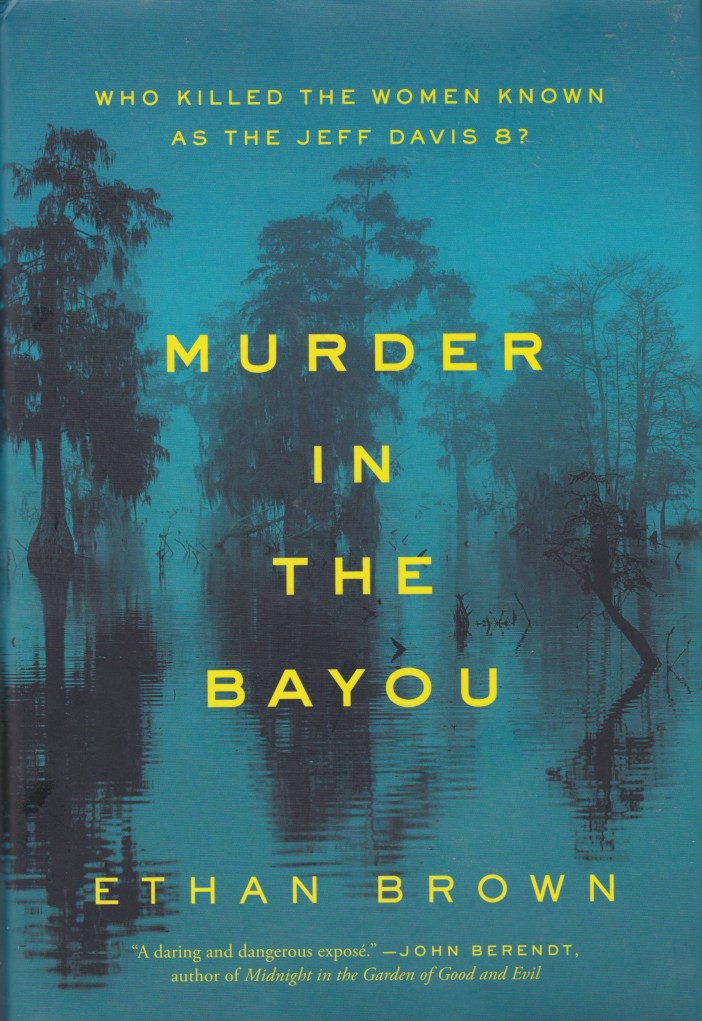
murder in the bayou

On May 20, 2005, Jerry Jackson, a soft-spoken slim African-American retiree with a short salt-and-pepper Afro, prepared to cast a fishing line from a hulking bridge over the Grand Marais Canal on the outskirts of Jennings in southwest Louisiana. Jackson peered down at the muddy rush below, the corroded, cylindrical rain pipes along the canal belching water, the collapsed pedestrian bridge far out in the distance. As he prepped his fishing line, Jackson imagined the catch that day, white perch, a small bass with a strong spine that’s so abundant in Louisiana it’s the state’s official freshwater fish. In low-lying southwest Louisiana, where rain is constantly siphoned to prevent flooding, drainage canals are as common as the perch. These canals provide sustenance for poor Louisianans for whom fishing is both a generations-old tradition and a day-to-day necessity. For hobbyists such as Jackson, who made the approximately ten-mile trip to Jennings from his cramped trailer on a dead-end street in nearby Welsh, drainage canal democratize fishing. Expensive shrimp boats and fishing equipment aren’t necessary–all one needs to do is drop a line into the water.

As Jackson peered deeper into the Grand Marais Canal, he spied the outline of a human body. “It had come up on the news that someone had stole some mannequins,” Jackson told me, “so I thought that one of the mannequins ended up in the water somehow.” Jackson focused his eyes on the figure. “I saw flies, and mannequins don’t attract flies.”

It didn’t take me long to get into the book to realize there was information, crucial information, about the victims in the book that wasn’t included in the documentary; in fact, the documentary left a lot of important information out. Yes, the women all had addiction issues, but they also were sex workers–turning to sex work to either get drugs, or to get the money to buy drugs. The police didn’t cooperate much with Mr. Brown, and the sister of one of the victims played a very prominent role in the documentary; she was only mentioned by name once in the book. Brown also shared the information that many of the victims were witnesses to other crimes, and theorized they were all killed to silence them–and that it wasn’t a serial killer after all. Brown also isn’t convinced completely that the police were so inept and incompetent to handle these kinds of investigations (something that came up a lot in the documentary), but that the parish police were actually corrupt, involved in the drug trade, and connecting all the dots also led to a peripheral involvement by a powerful politician. Naturally, the police and the politician disagree with Mr. Brown’s theories and conclusions…but he also includes, in the book, other crimes in the parish that may or may not have been connected to the murders, as well as corruption within the police department; things that were not in the documentary.

One of the things that struck me, while watching and again when reading the book, is how tragic the cycle of poverty is in these small towns, not just in Louisiana, but across the country. The class divide–marked in Jennings by literally railroad tracks that separate the good part of town from the bad–is truly staggering; I would imagine it’s much the same in big cities only not as obvious. The poor and uneducated people in places like Jennings are trapped in a terrible cycle of poverty that they cannot seem to break, which is truly sad, and the disruptive nature of the families they were born into doesn’t help much, either. And once someone starts spiraling down into drug addiction, there’s nowhere to turn to for help getting off the drugs…and there’s no money for rehab, which is incredibly expensive.

I can’t imagine how horrible it would be to stuck like that, with no hope for the future.

The book is very well written, and it’s not terribly long; I read it in one day, and it’s a terrific read. I do recommend it, and I also recommend watching the documentary as well. I’m curious about why they chose to leave some stuff out of the documentary that’s in the book–perhaps it has something to do with both using the same title but not adapting the book or using it as source material, or something along those lines–but it’s very interesting to see the two very different takes on the murders.

And yes, learning more about these murders did, in fact, give me an idea for another Chanse novel; the first idea I’ve had for a Chanse novel since I wrote Murder in the Arts District. I can easily see fictionalizing this story, with Chanse as the investigating private eye…or someone else, really; it doesn’t have to be Chanse, and the issues at play here–the disposability of drug addicted sex workers, class distinction, and corruption in the parish power structure–are things I would love to explore in a novel.

Like I don’t have anything else to write already, right?

And now back to the spice mines.

Fooled Around and Fell in Love

It’s Sunday morning in New Orleans and I am already awake and swilling coffee. It looks kind of gray outside my windows this morning. The sun is trying to come out from behind the cloud cover so I don’t think today is going to be one of those rainy days like yesterday, but it’s kind of nice. The humidity has returned–Friday was miserable–and it’s only May. The true dog days are yet to be upon us. Heavy heaving sigh.

Yesterday I was moving stuff around, trying to lessen the appearance of clutter as well as to figure out where to put all the extra paper towels (thank you, Costco!) and put the things I was moving into places that I would remember when I discovered a copy of the first anthology I ever published a short story in, released way back in August of 2000: Men for All Seasons, edited by Jesse Grant, and from Alyson Books. It’s an erotic story, of course; my first two published short stories were erotica an d I don’t think I published a story that wasn’t erotica until “Smalltown Boy” in Rebel Yell 2, several years later. It was also interesting to look at the table of contents and see that my original by-line for fiction was Gregory Herren, not Greg; I do think I switched to Greg for the second story that was published that same month in Men magazine. Going through the list of contributors, I was struck by how many of those writers are no longer writing–or if they are, they aren’t using their “erotica” pen names anymore.

Back in the day, if you worked really hard you could make a lovely little income writing gay erotica. I was paid $300 for the story in Men; I published a second story there a few years later for the same pay. I think I got $75 for the story in Men for All Seasons. I started writing erotica primarily as a lark; Alyson’s publicist advised me to start writing short fiction for their anthologies, primarily for the publication credits and the money, as well as to make my name better known and more familiar to the Alyson editorial staff. He was right; Alyson wound up buying my first novel Murder in the Rue Dauphine, and I stayed with Alyson for the first five Chanse books, as well as several erotica anthologies I edited for them. I always called myself “an accidental pornographer” because it wasn’t anything I’d ever wanted to do, but the money was nice and the books actually did very well. But now…now there’s no market for actual gay erotica. Anthologies don’t sell and so no one is doing them anymore; the only market for erotica is novels, and reality is most of those are written now by straight women for other straight women, and that’s not the kind of erotica I write. (This is not to say straight women cannot write gay erotica geared toward gay men; in my editing days I worked with a lot of straight women who wrote horny, nasty, raunchy men on men erotica and you’d never know the author was a woman.) But the women who like to read the m/m stuff don’t like the erotica I write, and so I don’t really write it anymore.  I don’t miss it, to be honest–there are only so many ways to write about male on male sex originally, only so many words–and I even at one time wrote a column for the Erotica Writers Association on how to write good porn. I think my favorite column title was “Sometimes A Cock Is Just A Cock.”

I didn’t do much writing yesterday–actual physical writing–but I did do a lot of thinking and rehashing and going over my notes for the WIP. I doubt very seriously I will get as caught up as I had wanted to get this weekend, but you know, that’s just how it goes sometimes. Today is May the 5th, and I am going to dig into Chapter Six again in just a moment, with the hopes that Chapters 7, 8 and 9 will fall into place as I go…and then maybe I can start with Chapter Ten. I got so far off track with this WIP that I don’t really remember the story I was trying to tell in the first place, which is terrible–my memory, once so incredibly dependable I didn’t really need to take notes, in now completely unreliable. Part of the reason I decided to go back and redo the chapters I’d already written was to get myself immersed back into the story, get a feel for the characters, and maybe find the flaws and mistakes and holes in the plot. I’ve managed some of that, of course, which makes it all worthwhile, and I did find the outline for Chapter Ten in my journal (which I’d completely forgotten I’d written down), so yes, not actually spending time at the keyboard yesterday while actually simply reviewing notes and rereading things was a pretty smart thing to do.

Going through the current and previous journal also reminded me of some short story ideas I’d had that had somehow slipped, unbidden, from my memory. I also managed to page through The Gulf by Jack E. Davis yesterday, and I believe it will be a rich source of ideas and materials for me to write another book–my spring break murders novel, Where the Boys Die–and many others. Nonfiction is a great source of material for fiction, in case you were wondering.

And now I am going to sign off with this entry as I have another, Game of Thrones specific one I started yesterday that I would like to finish this morning.

170856_177996562235912_122584814443754_340422_5816097_o

Love Machine

Ah, Monday of the week that ends with the tenting and the Weekend o’Festivals. Just thinking about getting through this week and this weekend makes me tired. Very tired.

We started moving perishables and other things that could be poisoned by the termite gas over to the carriage house yesterday; even as we did so, I kept remembering and finding more things that need to go over there. I’ve never experienced termite genocide before, that oh-so-uniquely New Orleans experience that so many others have before multiple times. It’s got me thinking about the possibility of murder by termite tent, of course–although I am pretty certain I’ve read a book where that happened, I think it was by Elaine Viets.

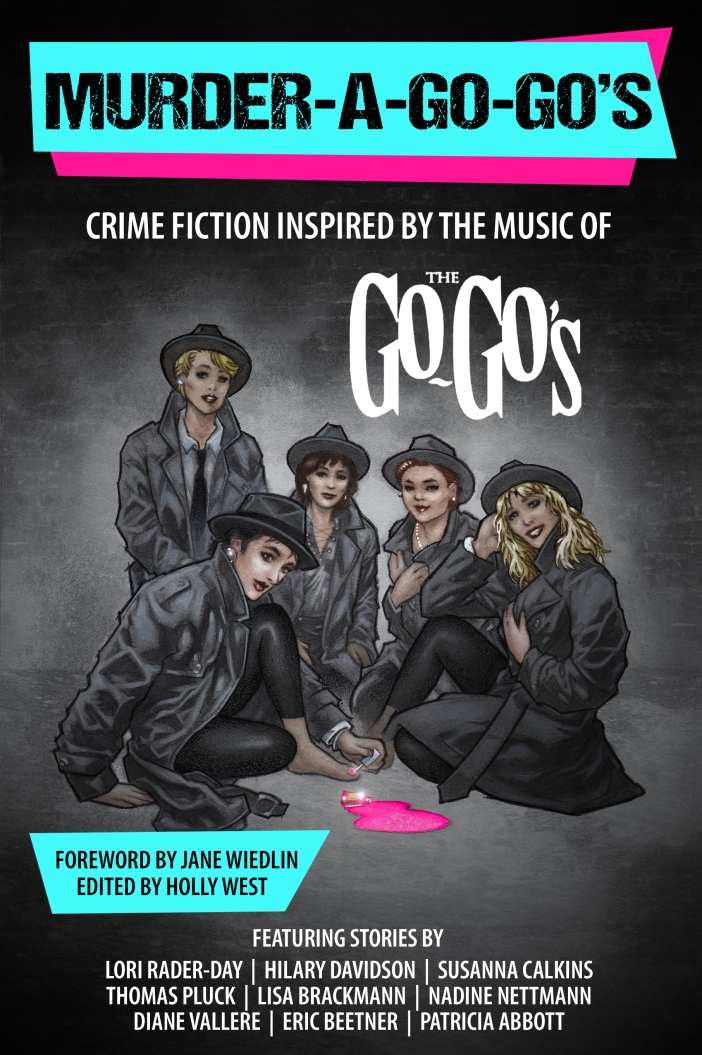
Murder-a-Go-Go’s officially releases today as well, so those who preordered it should be getting it delivered to your electronic reading devices and those who ordered hard-copies should be getting them soon. Huzzah! I love book birthdays; my own for Survivor’s Guilt and Other Stories is soon to come; April 10th, officially. Order, order, order! And don’t forget, the first ever Chanse MacLeod short story is in this book!

I reread my story for Murder-a-Go-Go’s again yesterday, primarily because another idea came to me yesterday, which I shared on social media: Someone really needs to write a spring break noir called WHERE THE BOYS DIE and I would read the hell out of that. I do think that’s a terrific idea; is there any better setting for a noir than a small beach town taken over by tens of thousands of partying college students? (I also had another idea for a book, based on an actual brutal murder that took place over spring break several decades ago; hat tip to Scott Heim for reminding me of that murder) I had always wanted to do one over the course of Southern Decadence weekend as well; I still might do that one. Anyway, I’m digressing. So, on my post about Where the Boys Die some suggested I write it, others that it sounded like an anthology, and then Jessica Laine said, you already wrote this story for MURDER-A-GO-GO’S, and I loved your story. 

The thing about being a writer is that all-too-often you don’t remember things about your work once it’s finished. “This Town,” my story for Murder-a-Go-Go’s, is one of my favorite stories that I’ve ever written, to be honest; I think it’s also one of my best. But, when I read Kristopher Zgorski’s lovely review and he singled out my story as one of many for individual praise, and then seeing Jessica’s lovely comment, I decided I should probably reread the story since my recollection of what I actually wrote was so vague…and there it was. Constant Reader, it’s good. I then pulled up my story “Neighborhood Alert,” which is going to be published in Mystery Tribune, and it, too, is good. This was revelatory for me; as I may have mentioned, another story of mine was recently rejected by Alfred Hitchcock’s Mystery Magazine, and that had, of course, put me into a bit of a tailspin as far as my writing of short stories was concerned…astonishing at how easy it is to have one’s confidence in one’s own work shattered, isn’t it?

And that also got me to thinking about the second Chanse short story, “Once a Tiger,” that has tragically been stalled for so long. Short stories are actually more intimate than novels; in that you have much less space to develop a story and less room for characters so it has to be scaled back some. “Once a Tiger” is struggling because, quite simply, there are too many characters in it; how does one investigate a death at a fraternity house on a college campus when there would have to be well over a hundred brothers and pledges? That was where I struggled with the story; even the police would have trouble sorting all of this out, so imagine the trouble Chanse would have with it, working alone as he does. I still want to write a murder mystery set at Chanse’s LSU fraternity, where Chanse has to come back and solve the crime, but I just don’t–at the moment–see how that can be done as a short story. Maybe now that I’ve said that it will come to me–just like the other day, how to weave the two plots for the next Scotty book came to me from out of nowhere.

I love when that happens.

And now back to the spice mines.

51807918_2082001481887309_3231561375222333440_o

This Town

As I have mentioned before, I kind of invited myself to contribute to this anthology. It’s probably the single most brazen thing I’ve ever done as a writer. I’m not sure how it happened, exactly; I just saw it on Twitter or something and shamelessly contacted Holly West, who–rather than saying who the fuck are you? HELL FUCKING NO, was quite gracious and said, “By all means! I have a spot for you!”

The songs I got to choose from were three of my favorites, but I eventually decided on “This Town,” after reviewing the lyrics:

We all know the chosen toys 
Of catty girls and pretty boys 
Make up that face 
Jump in the race 
Life’s a kick in this town 
Life’s a kick in this town
This town is our town 
It is so glamorous 
Bet you’d live here if you could 
And be one of us
Change the lines that were said before 
We’re all dreamers – we’re all whores 
Discarded stars 
Like worn out cars 
Litter the streets of this town 
Litter the streets of this town
This town is our town 
It is so glamorous 
Bet you’d live here if you could 
And be one of us


 “We’re all dreamers–we’re all whores”–that was the line that sold me; this was the song I was going to use.

But despite the fact that was the line that convinced me, these lines:

Bet you’d live here if you could 
And be one of us

were the ones that actually inspired my story.

cover-west-murder-go-gos-frontOur IDs were fake, but no one seemed to care. Even when a burly bouncer asked to see them, his bare meaty arms adorned with tattoos, his bored eyes just flicked over the lami- nate before waving us inside. Celia was right about that, like she was right about every- thing. She could always find someone with coke to share or sell, or who was happy to share their blunt with us. She was a golden girl, the kind I used to think only existed in books or movies, the girl that’s too perfect to exist, the one every other girl wants to be friends with, wants to be. The one all the guys notice first, their eyes wide open and their jaws gone slack.


She always had the trendiest new make-up, the first to try out a daring new look we were too cowardly to try but quick to copy, always the first, the one everyone else imitat- ed. She seemed to glow from inside, drawing everyone’s eyes to her effortlessly, and she somehow managed to always look perfect, even when she was drunk, even after dancing for hours when our make-up ran down our cheeks and perspiration dampened our arm- pits. Her skirts were just the tiniest bit shorter than everyone else’s, her tops seemed to fit her in a way they didn’t fit anyone else, her hair thicker and shinier and bouncier. She pulled in guys like night insects to a white light, caught up in her magic. They only no- ticed the rest of us once she’d turned her attention elsewhere. We didn’t mind taking sec- ond place because it seemed like the natural order of things. She always knew the right thing to say—whether kind or insulting—and we all gravitated to her. She was our pledge class president, organized, efficient, determined we be the best pledge class our Omega Psi chapter had ever seen. Even the sisters seemed to be a little in awe of her, grateful she’d picked Omega Psi out of all the offers she’d had—every sorority had offered her a bid, I’d overheard one sister telling another at Monday night dinner, her voice awed as she went on to say that had never happened in the history of the Greek system at Tulane.

And she made us all feel special, whispering “Sisters” to us as we hooked our pinkie fingers and whispered the word back to her, committing to a lifelong bond with her.

She was Celia, and we were better for knowing her, special for being her sisters, like she’d selected us to be pledges and not the actives.

She somehow even knew the best places to catch the parades at our first Mardi Gras and wasn’t from New Orleans.

Haven’t we all known a girl like Celia, the one who somehow always knows what the next thing is, who always wears new styles and fashions before anyone else, who always seems to know where the best parties are, where to find the cute guys, the one everyone is drawn to, who draws the eye, who is the center of attention?

I was in a fraternity in college, and another trope that pops up regularly in my fiction is college Greeks–fraternities and sororities. Chanse was an alum of an LSU fraternity (I have an in-progress short story where Chanse deals with the current day members of his old fraternity after a suspicious death on Big Brother Night, “Once a Tiger”), and of course there are the Todd Gregory fraternity novels. Sororities fascinated me back then, and they still do today; they were a lot stricter than their male counterparts back when I was in college, and still seemed stuck, rules and tradition-wise, in the 1950’s.

Anyway, one day during Carnival last year I was standing under the balcony in front of the praline shop during a Saturday afternoon parade–Iris, I think it was–when a gaggle of sorority girls passed by in front of me. The clear leader of the pack was a beautiful young woman the others were clearly trying to please and impress; the alpha to their betas. They all paused right next to me so the leader could light a cigarette. As she put her cigarette in her purse three men of varying ages immediately stepped up to light her cigarette for her–one was in his fifties, one was slightly older than the girls, and another who might have been in his thirties–and I remembered another golden girl from a sorority back when I was in college…and I wondered what it would be like to be, not the alpha girl, but one of the betas, caught up in her thrall, and what you might be willing to do  for your alpha. Is it peer pressure, is it desire to please, what precisely is it that keeps you in thrall and makes you do things against your nature?

And that night, I started writing “This Town.”

The great irony, of course, was that after I’d written the story and Holly graciously agreed to use it in her anthology, I was reading William J. Mann’s Edgar-winning Tinseltown and realized that “this town” has a specific connotation, one that makes the song itself make even greater sense: “this town” is how people in Los Angeles refer to show business, i.e. “you’ll never eat lunch in this town again.” I’d even know that, from years of reading biographies and memoirs and histories of Hollywood and the studio system, but…my mind and my memory is a sieve these days.

But I’m very proud of my story, and I hope that you will like it, too, when you get a chance to read it.

Sailing

Yesterday wasn’t pleasant. Nothing in particular, I was just in a mood for most of the day; and it was very easy to get me irritated. It rained most of the morning and afternoon–which ordinarily is something I enjoy–but it just seemed to place a damper, a gray filter of some sort, to the overall feeling of the day.

It was very strange, really. A low energy day when I’d slept well and wasn’t tired; Tuesday was the same. Being low energy for me usually means I am also very tired, and so not being tired while having low energy was unusual for me…and I didn’t like it in the least. This morning I feel better–more energy, even if still sleepy–so we’ll see how today goes. It’s much colder this morning than it was yesterday–I didn’t even take a coat yesterday with me; but it’s thirty-nine degrees in here this morning, which is pretty fucking awful.

I was also thinking about Monsters of New Orleans yesterday, my planned short story collection for which I would have to write mostly new stories (I do have a few on hand I could use), and the idea for the collection was, of course, triggered by reading Empire of Sin and realizing how many blank spots there were in my knowledge of New Orleans history, which also turned around and triggered the thought that I need to read more about the city’s history and that evolved into ideas and thoughts and plans. I also have another collection I am working on, Once a Tiger and Other Stories, which will have my second Chanse MacLeod short story in it (the title story), and a bunch of others that have been published (or were submitted to other markets) since Survivor’s Guilt and Other Stories was pulled together. One of the things on my to-do list for this week was checking out the stories I have on hand, make some tweaks, and hopefully get them submitted somewhere by the end of the month.

Sigh. Plans, plans, plans. And yet I never can seem to want to get any of this stuff actually done.

Why work when you can procrastinate? Which is my motto, and needs to be cross-stitched onto a sampler I can hang in my kitchen.

But I am making a project list, so I can be more aware of what I need to do and when it needs to be done and all of that; lists are my thing and so there you have it.

I read some more of Caleb Roehrig’s Last Seen Leaving last night, which I am enjoying; it’s a very different kind of y/a voice than anything I’ve read before, which is both refreshing and fun.

And now back to the spice mines this morning. Have a lovely Thursday, everyone.

17621904_1306426352738759_889410002924164138_o

Shining Star

Well, good morning, Thursday, how do you do? I’m a bit giddy, as I always am after working thirty-two hours in three days. I am in the home stretch of the week with my short days, and a three day weekend! Huzzah! Huzzah!

I can’t wait to sleep in. I also love days when I don’t have to go outside at all, other than perhaps walking to the gym or Walgreens or taking out the garbage. And as the Scotty work is going so well–I have only chapters one through five left to go over again, and then I can start inputting the changes and making the necessary corrections, and I need to finish rewriting the opening and I need to write the afterward–it also serves as a boon to my mood. I am really itching to be done with this, and I am so glad I took my time with this manuscript. I think it’s going to be one of the better Scottys, if I pull off everything I’m trying to do, and I have to say, it’s lovely to feel ambitious with a Scotty book. I think that was why the Chanse series felt like it was running down to me; I didn’t really feel particularly ambitious for the series and the character anymore. It’s been nice writing short stories about Chanse; “My Brother’s Keeper” in Survivor’s Guilt and Other Stories is my first Chanse short story and it’s also my first-ever private eye short story. I’m feeling kind of excited about writing private eye stories–I wrote one for another anthology (not a Chanse, alas) and I really want to get back to the other Chanse story I started, “Once a Tiger.” I never thought I’d be able to write private eye stories, and now I feel confident enough to try writing them. I am feeling ambitious with my short story writing, and that’s also a really good feeling. I think I am getting better at it, and am starting to understand them better, if that makes any sense. I also spent some time over the last few days rereading some of my stories critically–“The Problem with Autofill” and “The Snow Globe”–and I think I know how to fix them. I am going to do the same with “Moves in the Field” and “Burning Crosses” over the next couple of days.

I’ve reached the point in my reread of Pet Sematary where the book starts to take off with its story; Louis is home alone at Thanksgiving while the family visits Rachel’s wealthy parents in Chicago (some back story of the bad blood between Louis and her parents is also established here), and of course, Ellie’s beloved cat Church is killed by a passing car on the road. Naturally, Louis doesn’t know how he’s going to deal with both Rachel (who has a very well-established death phobia) and his daughter, who is sure to be devastated and heartbroken. Father figure from across the road Jud, however, comes to his rescue, and later that evening, takes Louis and Church beyond the deadfall (which the ghost of Victor Pascow already warned him against crossing) and the pet sematary and into the woods and the swamp beyond, to the Micmac burying ground…and of course, Church comes back. Different, but back.

As I read this section of the book (of course, Ellie comes home and knows Church is different–so different she really doesn’t want anything to do with him; echoing Jud’s comment “sometimes dead is better”) I began to remember some of the issues I had with the book on first read. Namely, almost every step of the way the book and story has the problem that is probably best encapsulated as why would you do this? Like in horror movies, the group being hunted by the killer always splits up, or the girls always wear heels before running in the forest, etc. Louis is incredibly passive when it comes to the Micmac burying ground visit with the cat’s corpse; never once does he ever stop to question what he’s doing or to ask Jud why they are going so deep in the forest, or why he isn’t simply burying the cat in the regular pet cemetery. And when Church comes back…I don’t know; he seems to take the resurrection of the cat much easier than you’d think a doctor would. And of course when he asks Jud, after Church returns, if anyone’s ever buried a human up there…well, you just know at that point that someone is inevitably going to be buried up there; it’s simply a matter of who, and what’s going to happen when that person returns. I know if, for example, my own cat returned from the dead I’d freak out a whole lot more than he did.

But I am enjoying the book a lot more this time around; it reads very quickly and easily, and the Creed family are immensely likable.

I didn’t watch another episode of Titans last night, instead getting sucked into the Australian Open, which will undoubtedly happen more and more as the tournament goes on. (But I am looking forward to watching one when I get home; it’s an early day for me and I do have some cleaning to do, but I am definitely penciling in both more reading time and time to watch another episode.)

Tomorrow morning i have to get up early to take my car in for routine servicing, and then in to work. It’s also another early day for me–only four hours–and hopefully tomorrow evening when I get home I can finish the cleaning for the weekend so I can work on writing and editing all weekend as well as finishing my reread of Pet Sematary. My next read is going to be a Diversity Project read; I’m going to read my library book, Caleb Roerig’s Last Seen Leaving,  a queer y/a title, and after that, probably something by an author of color. I’m also going to work on rereading Stephen King novels this year, methinks–that’s a lot of reading projects, isn’t it–and I also have some Stephen Kings on hand that I’ve not read…which is something I intend to take care of this year as well.

And on that note, I am heading back into the spice mines for the rest of the morning. Have a lovely Thursday, Constant Reader.

1077486_10151792762268923_369388472_o

Remember the Time

Friday morning! I get to go into work late because I am, as always, passing out condom packs tonight in the Quarter for Southern Decadence; when we finish, I am officially on vacation all I ever wanted until I return to the office on September 11 (gulp). Huzzah! Huzzah! Part of that time will be, of course, spent in St. Petersburg at Bouchercon. (huzzah! huzzah!) I am still trying to get my Bouchercon homework finished; I am nearly finished with James Ziskin’s delightful Cast the First Stone, and hopefully will be able to finish Thomas Pluck’s Bad Boy Boogie before our panel next Friday. (If I can’t, I really need to turn in my book nerd card.) I am also hoping to take Madeline Miller’s Circe with me on the trip to read.

I don’t want to give the impression that Cast the First Stone isn’t as good as it is by taking so long to read it; I’ve been in a late summer/dog days of August malaise that has had me having a lot of trouble getting anything done; the house is a mess (worse than usual) and I’ve gotten nowhere on the Scotty book and I’ve done very little writing of consequence at all this month. I’m trying very hard not to beat myself up over this; it is what it is, and it’s not a reflection on anything I do or my career. August, particularly late August, is always hideous when it comes to trying to get anything done; the heat and humidity this particular year has been particularly hideous, and it really sucks the life and energy right out of you. I am taking the manuscript for the Scotty with me to St. Pete; and I am hoping I’ll be able to carve out time to reread and make notes and so forth over the course of the weekend.

I’m also trying to figure out the rest of the story for “The Blues before Dawn.” I am also wondering whether or not this is more of a novel rather than a short story. I can’t make up my mind about my main character, or a time period to set the story in. I fucking hate when that happens. But it also means I need to think about the story some more, which is also not such a bad thing; as it’s a historical I’ll need to do some more research–I’ve been realizing lately how skimpy my knowledge of New Orleans and Louisiana history (with a few exceptions) actually is.

Another mental challenge for this is my decision, made over the course of the summer, to think about creating a new series. The Chanse series is pretty much over; after I decided to stop with Murder in the Arts District I wasn’t sure I was, in fact, finished with the character and series, but as more time passes the less I am interested in writing another novel about him. That might change, but I am now more convinced than ever that ending the series was the right thing to do. I have, however, written a Chanse short story and started another (I’ve still not finished “Once a Tiger”), and feel relatively certain Chanse will live on in short stories from time to time. The endless struggle and utter lack of motivation I have in finishing this Scotty book is also kind of a tell that maybe it’s time to wind this series down as well–a much harder decision, as I love Scotty much more than I ever cared about Chanse. But in the meantime, I’ve been thinking about writing yet another series. I had thought about spinning Jerry Channing, the writer, who first appeared in The Orion Mask and then again in Garden District Gothic his own series; as a true crime writer who often follows and writes about true crime for magazines, and is always looking for a subject for his next book, he seemed perfect as the center of another series. But the character’s back story was problematic, and I realized his background, in some ways, might be far too similar (and thus derivative) to Scotty’s. Then again, so what if Scotty and Jerry are both formerly personal trainers? if that and being gay is all they have in common…I do have an idea for a Jerry novel that might work; maybe I should write that and see if a series might work.

But “The Blues Before Dawn” also has grown in my mind as a possible start for a series, and maybe it should be a novel rather than a story (this, by the way, happens to me all the time). I think writing a historical crime series set in New Orleans might be an interesting idea; there are only two in existence that I am aware of–Barbara Hambly’s brilliant Benjamin January series (which is antebellum and opens with A Free Man of Color), and David Fulmer’s Valentin St. Cyr Storyville series, which opens with Chasing the Devil’s Tail. (Don’t @ me; I am sure there are others I can’t think of, even now I am thinking James Sallis’ Lew Griffin series, the first of which is called The Long-Legged Fly, is historical.) But the other day I came across an interesting article about Algernon Badger, who was chief of police in New Orleans from about 1870-1876, as well as Jean Baptiste Jourdain, who was the highest ranking mixed race police detective in 1870, and in charge of the Mollie Digby kidnapping investigation.  There is so much rich history in New Orleans that I don’t know, have barely scratched the surface of; one of the many reasons I roll my eyes when people refer to me as “a New Orleans expert.” The concept of a high ranking police detective after the Civil War and during Reconstruction in New Orleans fascinates me; and I kind of like the idea of writing about the Prohibition era here as well.

I think I need to have a long chat with my friend, historian Pat Brady.

I also got a rejection yesterday for a short story; and was enormously pleased that it didn’t spend me into the usual downward spiral of depression. Obviously, I am disappointed my story won’t be used, but it was just so lovely to actually get a notification that they aren’t using my story that it just rolled off my back. (It was also a lovely note, which included some thoughts on the story; ironically, what they thought would have made the story better was something that I had personally thought when reviewing and revising; but I didn’t trust my judgment and didn’t make those crucial changes. You’d think after all this time I would have learned to trust my judgment!)

And now, I am going to go curl up in my easy chair and try to finish James Ziskin’s delightful Cast the First Stone.

37974616_1901683620125872_4497797199568044032_n

Baby-Baby-Baby

John D. MacDonald is one of my favorite authors. Period.

I first read MacDonald when I was about thirteen: The Dreadful Lemon Sky. I didn’t care too much for it on my first read; I was coming off reading Agatha Christie and Ellery Queen and Erle Stanley Gardner and Charlotte Armstrong, and was deep into my Victoria Holt/Phyllis Whitney phase, so I was confused–this isn’t a mystery at all, I remember thinking as I read it…and ironically, it was this enormous disappointment that led to me moving away from reading mystery/crime novels for a very long time.

When I was about sixteen, I bought a couple of ratty old MacDonald paperbacks for a dime each at a flea market: Murder in the Wind, The Crossroads, and The Drowner. These were three of his stand-alones from his pulp days, before he started writing the Travis McGee series, and I loved all three of them. This was my first experience with pulp fiction/noir; it was shortly after this that I went on my James M. Cain kick, and slowly came to an appreciation of the less-traditional style  of  crime novel. Years later, when Grafton, Muller and Paretsky brought me back into reading crime, I remembered how much I’d enjoyed those pulpy MacDonalds and decided to give Travis McGee another try. I bought another copy of The Dreadful Lemon Sky, and this time, the character caught on with me–and soon I was tearing through the entire series. The earlier MacDonald novels had all mostly gone out of print, but he periodically was still writing stand-alones; still dark and twisty and noir and pulpy, but these novels had more heft–Condominium, One More Sunday, Barrier Island–and I think those later three don’t get the credit they deserve.

In the last few years I’ve been acquiring used copies of those old MacDonald pulp stand-alones–and while they are dated, they are still compelling reads. And yes, as I have said before, Chanse MacLeod owes a lot to Travis McGee.

So, you can IMAGINE my thrill that the MacDonald Estate allowed me to reprint one of his stories in Florida Happens.

image-2_med_hr

From his website: This website is devoted to John D. MacDonald, author of 78 books, including the famous Travis McGee series.  JDM is well-known in mystery fiction writing, especially for his books with Florida as a setting.  Most of the current Florida mystery writers acknowledge JDM’s impact on their writing.

Born In Sharon, Pa., MacDonald , as a young boy, wished he had been born a writer, believing that they were a separate “race,” marked from birth.  But two years of  writing 10 to 12 hours a day, 6 to 7 days a week, in 1945 and 1946, convinced him otherwise.

By the time he died he had published 78 books, with more than 75 million copies in print.

He married Dorothy Prentiss in a secret ceremony in 1937 in Pennsylvania  and a public wedding was held in Poland, N.Y.  in 1938.

He graduated from Syracuse University with a degree in business in 1939 and then went to Harvard to work on an MBA. His son, Maynard, was born that year.

He worked at several menial jobs after earning his MBA in 1939.

MacDonald then served in the Army beginning in 1940 at the Rochester N.Y Ordnance station.  He was sent to  India in late 1943, and was accepted in the OSS in late 1944 . He  was sent  to Ceylon  where he was the Commander of Detachment 404.  He was not a spy, however, but served in the Ordnance areas.

He wrote nearly 450 short stories, and published his first novel ,The Brass Cupcake, in 1950 (complete bibliography here) He continues to earn praise from millions of readers and lasting respect from fellow authors. He was given the Grandmaster Award in 1972 by the Mystery Writers of America; the Ben Franklin Award (1955);and was Guest of Honor at Bouchercon in 1983. Numerous other awards and Honorary Doctorates were given to him as well.

Perhaps the greatest testament to his writing, now decades  after his death in 1986, is that his books continue to sell, movies continue to be planned, and the internet continues to serve as a place to discuss his work and related matters.  See the Facebook Busted Flush group.

quote-integrity-is-not-a_med_hr

The story is “Hangover.”

He dreamed that he had dropped something, lost something of value in the furnace, and he lay on his side trying to look down at an angle through a little hole, look beyond the flame down into the dark guts of the furnace for what he had lost. But the flame kept pulsing through the hole with a brightness that hurt his eyes, with a heat that parched his face, pulsing with an intermittent husky rasping sound.

With his awakening, the dream became painfully explicable—the pulsing roar was his own harsh breathing, the parched feeling was a consuming thirst, the brightness was transmuted into pain intensely localized behind his eyes. When he opened his eyes, a long slant of early morning sun dazzled him, and he shut his eyes quickly again.

This was a morning time of awareness of discomfort so acute that he had no thought for anything beyond the appraisal of the body and its functions. Though he was dimly aware of psychic discomforts that might later exceed the anguish of the flesh, the immediacy of bodily pain localized his attentions. Even without the horizontal brightness of the sun, he would have known it was early. Long sleep would have muffled the beat of the taxed heart to a softened, sedate, and comfortable rhythm. But it was early and the heart knocked sharply with a violence and in a cadence almost hysterical, so that no matter how he turned his head, he could feel it, a tack hammer chipping away at his mortality.

His thirst was monstrous, undiminished by the random nausea that teased at the back of his throat. His hands and feet were cool, yet where his thighs touched he was sweaty. His body felt clotted, and he knew that he had perspired heavily during the evening, an oily perspiration that left an unpleasant residue when it dried. The pain behind his eyes was a slow bulging and shrinking, in contrapuntal rhythm to the clatter of his heart.

He sat on the edge of the bed, head bowed, eyes squeezed shut, cool trembling fingers resting on his bare knees. He felt weak, nauseated, and acutely depressed.

This was the great joke. This was a hangover. Thing of sly wink, of rueful guffaw. This was death in the morning.

Great, terrific writing.

And now I can say I edited an anthology with John D. MacDonald as a contributor.

I may never stop being thrilled.

Typical Male

The male gaze.

Per Wikipedia (which isn’t always accurate):  In feminist theory, the male gaze is the act of depicting women and the world, in the visual arts and literature, from a masculine, heterosexual perspective that presents and represents women as sexual objects for the pleasure of the male viewer.

Or, as Laura Lippman likes to quip about crime fiction written by men: A beautiful woman is dead and a man feels bad about it.

Lippman is joking, sort of; much of male-centered crime fiction can be boiled down to that sentence. The sexualization of women in crime fiction, particularly in hard-boiled fiction or noir, has been a thing since the early pulp days; classic English crime fiction, like that written by Agatha Christie and Dorothy L. Sayers and their other contemporaries, probably didn’t sexualize their women characters…although I do seem to recall that Arlene Marshall in Christie’s Evil Under the Sun was not only sexualized, but also highly misunderstood; it isn’t until Poirot solves the crime at the end of the book that we finally begin to understand Arlene as something other than a sex object who devours men like a praying mantis; the Christie version of a femme fatale being softened, as it were, in the final reel.

It is surprising to read books published in prior decades with their attitudes towards women–sometimes my jaw literally drops at how writers used to describe women, reducing them to their sexuality and their sex appeal; older, or less attractive, women, are written about in an almost contemptuous manner. This still pops up from time to time in modern fiction, but it’s not nearly as common as it used to be.

I was sitting at a literary luncheon, for example, while the speaker was talking about his admiration for John D. MacDonald–an admiration I share–and in particular, about MacDonald’s Travis McGee series. I was nodding and smiling when a female author friend leaned over and whispered to me, “I wonder if he’ll mention McGee’s magic wand.”

I was startled at first, and then I stifled a laugh–it wasn’t the appropriate time in the talk to laugh–but the more I thought about it, the more I realized she was right. One of the major things about Travis McGee, and the novels written about him, was how he ‘sexually healed’ the damaged women he was assisting during the course of the book; even his friend and cohort often referred to him as a ‘knight-errant coming to the rescue of the lady.’ It never really dawned on me, when I was reading the books–either the first time or any of the successive times I’ve reread them–that he was actually fucking them back to good emotional and mental and physical health; I always thought, since it usually involved them going sailing on his houseboat and fishing and doing the mindless, physical work while relaxing and getting tan and enjoying life away from the worries and problems of the world and day-to-day life.

I missed the bit about the magic wand because I’m gay and it never crossed my mind.

Which is doubly ironic, considering how much MacDonald and McGee influenced my Chanse MacLeod character and the series I wrote about him; but despite the influence in the creation of the character/series, my series was dramatically different from MacDonald’s.

Being a gay crime writer, while limiting in many ways, is incredibly freeing in others. I fully acknowledge that my books are firmly centered in the gay male gaze; that when I write either Chanse or Scotty, I often devolve in description of male characters the way male writers used to/sometimes still do write about women; their looks, their sex appeal, their fuck-ability factor. Sometimes I wonder if that’s what people mean when they talk about my books being all about sex; because Chanse and Scotty view men as sexual beings and that is something readers aren’t accustomed to seeing?

Perhaps.

Something to ponder.

Today’s short story is “Born of Man and Woman” by Richard Matheson, from  The Best of Richard Matheson collection:

X–This day when it had light mother called me retch. You retch she said. I saw in her eyes the anger. I wonder what it is a retch.

This day it had water falling from upstairs. It fell all around. I saw that. The ground of the back I watched from the little window. The ground it sucked up the water like thirsty lips. It drank too much and it got sick and runny brown. I didn’t like it.

Mother is a pretty I know. In my bed place with cold walls around I have paper things that was behind the furnace. It says on it SCREENSTARS. I see in the pictures faces like of mother and father. Father says they are pretty. Once he said it.

And also mother he said. Mother so pretty and me decent enough. Look at you he said and didn’t have the nice face. I touched his arm and said it it alright father. He shook and pulled away where I couldnt reach. Today mother let me off the chain a little so I could look out the little window. Thats how I saw the water falling from upstairs.

Richard Matheson isn’t as well known as he should be; he is a giant in the horror community and deservedly so, but he should also be highly acclaimed as one of the great writers of any genre from the twentieth century. His novels were filmed frequently–so even if you don’t think you know his work, you do. SOme of the films based on his novels include The Incredible Shrinking Man, Legend of Hell House, I Am Legend (The Omega Man), Somewhere in Time, Stir of Echoes, What Dreams May Come, and countless others. His short stories were often adapted for episodes of Twilight Zone or Night Gallery–probably the most famous being “Nightmare at 50,000 Feet.” Just a creative genius.

This story is chilling, absolutely chilling. We never really know much about the poor young man (or woman) chained in the basement of this family’s home; other than he was born of their union and something went terribly wrong. He is treated terribly and not educated well and they feed him, but they also are so repulsed and horrified by him that they beat and abuse him and keep him chained against the wall…but as the story progresses his pathetic need for love and company turns.

And it’s hard to feel any sympathy for the rest of his family…who are about to become his victims.

And now, back to the spice mines.

33984489_1851989305095304_8619000950679404544_n

I Can’t Wait

So, yesterday I signed the contract to publish my short story collection, Survivor’s Guilt and Other Stories: Tales of Mystery and Suspense, with Bold Strokes Books for an April 2019 release date–which means it should be available at Saints & Sinners/ Tennessee Williams Literary Festival in late March.

I am inordinately excited about this, you have no idea, Constant Reader! It’s the first book contract I’ve signed since 2015, for one thing–everything came out in 2016 or early 2017, so yeah, it’s been a hot minute–but I am also excited because it’s a short story collection and it isn’t erotica.

In 2004 Starbooks collected my wrestling stories into a short-lived collection called Wanna Wrestle?, that went out of print very quickly for various reasons, none of which had to do with actual sales; it’s a rarity and few copies exist out there in the wild. Bold Strokes also did a collection of my Todd Gregory erotic stories, Promises in Every Star and Other Stories, a few years back as well. But I’ve always wanted to do a collection of non-erotic short stories, but never thought I would ever have enough stories, enough material, to actually do so.

But I also had no way of knowing I would also lapse into a short story writing mania the way I have  this year. I mean, I can’t believe how much short story writing I’ve been doing this year.

But, also in fairness, only four of the stories in this collection are new.

Here’s the table of contents:

Survivor’s Guilt (originally published in Blood on the Bayou, which won the Anthony Award for Best Anthony and the story was nominated for a Macavity Award)

The Email Always Pings Twice (originally published in Ellery Queen’s Mystery Magazine)

Keeper of the Flame (originally published in Mystery Week magazine)

A Streetcar Named Death (originally published in the anthology I Never Thought I’d See You Again, edited by Lou Aronica)

An Arrow for Sebastian (originally published in the anthology Cast of Characters, edited by Lou Aronica)

Housecleaning (originally published in Sunshine Noir, edited by Annamaria Alfieri and Michael Stanley)

Acts of Contrition (originally published in Ellery Queen’s Mystery Magazine)

Lightning Bugs in a Jar

Spin Cycle (originally published in Men of the Mean Streets, co-edited by me and J. M. Redmann)

Cold Beer No Flies (originally published in Florida Happens, coming in September)

Annunciation Shotgun (originally published in New Orleans Noir)

Quiet Desperation (originally published as a Kindle single)

The Weight of a Feather

My Brother’s Keeper

Don’t Look Down

Smalltown Boy (originally published in Rebel Yell 2, edited by Jay Quinn)

So, only four of the stories, (five, if you count “Quiet Desperation,” which was a Kindle single) are original. And technically, “Cold Beer No Flies” is a new story; but by the time the collection comes out next year Florida Happens will also be out, rendering it no longer a new story.

But even more exciting? “My Brother’s Keeper” is the first Chanse MacLeod short story ever, and now that I’ve written one, it doesn’t scare me anymore. I’ve already started another, “Once a Tiger,” and who knows? Maybe I will write more. I don’t think I’ll ever write another Chanse novel, but short stories? Why not? Writing private eye short stories is challenging; more of a challenge than just the usual crime story I write, and so I see writing more private eye stories as an opportunity to grow further as a writer, and get better at what I actually do.

The great irony is that my short story writing mania of this year actually has provided me with almost enough stories for a second collection, all unpublished stories, and I have about another dozen or so in some form or stage of being written. Freaking crazy.

Oh, and you know that messy Chapter Fourteen of the Scotty book? Was so fucking easy to fix it’s not even fucking funny. It literally required the deletion of about 200 words and the addition of 120 or so back, and it’s fucking fixed. Blam. Problem solved; the same problem I might add, I’ve been avoiding for like  three weeks.

Because, you know, avoidance. My go-to.

Heavy heaving sigh.

Here’s the opening paragraph of “Don’t Look Down,” aka the Italy story:

Jase shifted the Fiat’s engine into a lower gear as he started up the steep hill. He hadn’t driven a standard transmission since college, but he did remember hills required downshifting. As the Fiat started climbing he passed two handsome, tanned men on mountain bikes, sturdy thighs straining against their brightly colored Lycra casing. According to the directions, he would be in Panzano when he reached the top of the hill.  There was a parking lot off to the left and just beyond that he could see a stone wall. The hill—or mountain, he wasn’t sure which—dropped off into a valley to the right, vineyards and olive trees spreading out to the next sloping hill.  A low stone wall hugged the right side of the road nearer the crest of the hill, with barely enough space for pedestrians or mountain bikes. All the roads had been incredibly narrow since he’d left the highway, with many sharp blind curves as the road weaved in and out and around and along mountains.  At one point an enormous bus coming the other way had almost forced him onto the shoulder, missing the black rental car by inches. He glanced up at the directions tucked into the sun visor. At the crest of the hill there would be another sharp, almost ninety-degree turn to the left, and to his right would be the triangular town center of Panzano-in-Chianti. To get to the hotel, because of the narrow one-way streets, he’d have to circle around the  triangular town square to get to the little hotel. 

33865992_1851225275171707_8088228887944757248_n