It was chilly yesterday morning when I left the Lost Apartment for the office; I actually thought about going back in for a light jacket, but decided eventually to simply tough it out because I suspected (correctly) that the once the day got going it would get hot out. I was tired yesterday–fatigued, more than anything else–but the day was relatively calm at the office which was a lovely respite from the shit show of the earlier days of the week at the office; yesterday, however, we had several amusing intercom system mishaps. A code was called seven times…for a floor we don’t have. Another time the intercom system got turned on and a conversation between three women was broadcast through the entire building. Needless to say, our entire department was in hysterics.
Kind of a silly day around the office really.
But I was very tired when I got off work again yesterday, which comes mostly from stress at at the office. Yesterday was much better than the previous days, but those two days kind of wore me down for the entire week. I did manage to work on a short story I want to revise and submit to an anthology next week, and once I did go to bed, I slept extremely well and feel rested this morning, which is awesome. I don’t think today at work will be terribly stressful, but you never know. I haven’t yet checked the news about Milton and what’s happened to Florida overnight–mainly because I’m almost afraid to; just as I’m a bit worried to check the hurricane center for new developments occurring. The season doesn’t officially end until December 1 (!!!) and there have been years where we’ve had hurricanes through November. Yay.
After my brain finally became too tired to do anything last night, I just spent the rest of the evening before going to be watching hurricane coverage. I lived in Tampa for about four years or so, back in the 90s before cell phones and before everyone had the Internet; a simpler time if you will. I’ve only been back once, and I could hardly recognize it from when I lived there before (I did fly into the airport two other times, one for Bouchercon in St. Petersburg and the other when we went to that tennis resort just north of the city), it’s changed so much. That’s partly why I don’t write about Tampa; I have fictional places in Florida I write about because it’s how I remember things. I should probably go back to Tampa once more to research how the city is laid out and other things, get a feel for it–or I could just keep writing about fictional cities that are based on real places. Muscles is a Florida book, should I ever finish it, and there are several other ideas I have for Florida books. Will I ever have the time or opportunity to write them? I still delude myself that this I will.
I am glad, however, that bad as it was–Milton wasn’t as bad as he could have been. But I am sure those who’ve lost their homes probably aren’t feeling grateful for anything this morning other than being still alive. Trust me, I know the feeling. It’s sometimes hard to believe that Katrina was over nineteen years ago. I don’t know what we do if we dealt with another one of those here; we’re both kind of old to go through the rebuilding thing again, so we maintain a sense of denial about Louisiana’s hurricane vulnerability. I also kind of feel in some way–the superstitions left over from the primordial ooze brain deep inside–that writing about a hurricane hitting New Orleans will cause one, because I am just THAT powerful. There was a lot of that after Katrina in the first few days, until I realized how incredibly narcissistic that is. Yes, Greg, your city was destroyed because you were writing about a hurricane at the time; everyone else is at your mercy. Talk about a God complex.
And tomorrow I’ll be working at home before I leave for Alabama. I may stop by the office on my way out of town; but we shall see. And on that note, I am going to head into the spice mines. Have a great Thursday, everyone, and I shall chat with you tomorrow morning.
I always say my first identity is reader; I was a voracious reader long before I realized that loving to read and loving books predestined me to become an author, a teller of tales. Certainly author is my primary, preferred identity; sometimes I worry that my identity is entirely too wrapped up in being an author. But trying not to worry and be anxious about anything and everything in my life is my new mantra.
Anyway, I had the great pleasure of meeting S. A. (Shawn) Cosby at Bouchercon in St. Petersburg. I don’t really remember much of the weekend–I met a lot of people and I drank way too much–but I know I met and liked him enough to get a copy of his debut novel, My Darkest Prayer. I loved the book, and saw in its pages an incredible talent, for character and place and dialogue and language, and when I reviewed it on here I predicted an incredibly bright future for him as a crime writer.
I was right,
Titus woke up five minutes before his alarm went off at 7:00 A. M. and made himself a cup of coffee in the Keurig Darlene had gotten him last Christmas. At the time she’d given it he’d thought it was an expensive gift for a relationship that was barelyfour months old. These days, Titus had to admit it was a damn good gift he was grateful to have.
He’d gotten her a bottle of perfume.
He almost winced thinking back on it If knowing your lover was a competition, Darlene was a gold medalist. Titus didn’t even qualify for the bronze. Over the last ten months he’d forced himself to get exponentially better in the gift-giving department.
Titus sipped his coffee.
His last girlfriend before Darlene has said he was a great boyfriend but was awful at relationships. He didn’t dispute that assessment.
Titus took another sip.
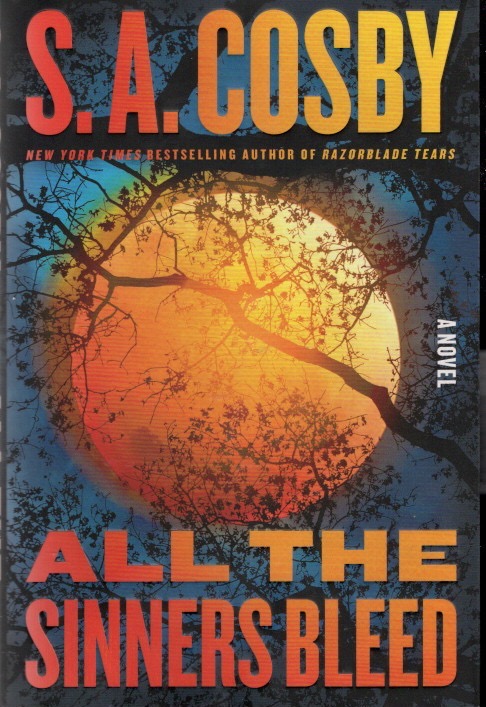
All the Sinners Bleed is Shawn’s fourth novel (as a solo author–he also co-wrote a book with Questlove). In the wake of My Darkest Prayer, he released two novels to extraordinary success and acclaim, Blacktop Wasteland and Razorblade Tears. Both were amazing, and somehow each book is somehow better than the preceding one–which is really saying something; I’d happily retire if I ever reached anything comparable to those two with any two of my own.
But they were just warm-up acts for this incredible new novel.
Something that has always interested me over the years is the integration of American police forces on every level. How do, for example, Black and/or Latinx/Hispanic cops feel when their fellow officers commit racially driven police brutality? How does it feel to be a part of a police force–particularly in the deep South, but also in places like Los Angeles–that has always been historically racist and oppressive to non-whites? For that matter, how does it feel to be a queer police officer?
All the Sinners Bleed takes on that question with our main character, Titus Crown, the recently elected first-ever Black sheriff in a pretty racist little corner of southeastern Virginia. Titus was born and raised there; his father and brother live there, and he returns to his hometown after a stint with the FBI. He ran for sheriff not expecting to win, but to try to break the stranglehold of power always held by money and white supremacy there. (I have another essay or entry to write about small Southern counties/parishes, and how they all too frequently are run like corrupt authoritarian dictatorships with the power being passed down within a few families, sometimes only one. Exhibit A: the Murtaughs in the South Carolina low country.) As the first Black sheriff of Charon County, he has to uphold the law–which he intends to do to the best of his abilities.
The book opens with a shooting at the local high school; this was hard for me to read and part of the reason it took me so long to get into it; I thought this was going to be a school shooting novel and I wasn’t sure if I wanted to read that. But I was wrong; yes, there was a shooting at the school and yes, that shooting was pivotal to the plot, but it wasn’t a mass shooting: a young Black man goes to the school and murders one of the teachers, and on his way out he is shot and killed by the cops when he won’t drop his weapon. Why would Latrell Macdonald shoot Mr. Spearman, a very popular teacher? As Titus starts looking into the strange shooting, he discovers another level of horror going on in Charon County, and once the story gets moving, it’s hard to put the book down.
Over the course of this all-too-short novel, Cosby tackles a lot of issues without either being preachy or over-the-top. Confederate monuments, the Daughters of the Confederacy, racism, white supremacy, the cruelty of poverty, police brutality, and the hard, cruel kind of Christianity practiced in poor, remote rural regions of the South. But the most powerful aspect of the book is how it handles grief; the three Crown men dealing with the loss of wife and mother, a wound that never heals–and the guilt that comes with moving on from such a loss. Cosby had a lot to say in just over three hundred pages; the fact that he said it all, and powerfully, by using character, place and story to get his messages across is testament to his great skil.
And this book is bound to piss off white supremacists. It will make a great Christmas gift for any in your family.
One of the fun things you get to deal with when you’re a queer mystery writer is the diversity panel.
What, you may well ask, is a diversity panel?
It’s what used to happen back in the day when well-meaning non-minority people realized they had to do something with non-white non-straight mystery writers coming to mystery conventions. What better way than to wash your hands of working for diversity by throwing all of the non-white non-straight writers at a conference onto a “diversity panel”?
Back when I was getting started and still was doing touring for book store events, I used to joke that signings/readings always made me feel like a sideshow freak hawking snake oil; the mass signings at events like BEA (Book Expo America) were the worst for this. I always wound up sitting next to someone enormously popular or famous (when they’re done alphabetically, I always expect to be seated next to Charlaine Harris, which is quite humbling. The most humbling of all was sitting next to Sharyn McCrumb at the South Carolina Book Festival. Her line literally went out of the room and into the hallway….ao I just started opening the books for her to make it run more smoothly. Might as well be useful since I was just sitting there doing nothing.)
But that was years before I was ever put on a diversity panel. Ah, the well-meaning diversity panel. Make no mistake, it’s always meant well–the path to hell and all that–but inevitably these panels would devolve into let me teach you nice straight white cisgender people about homophobia/racism/misogyny. The problem was always not the intention, which was good (inclusivity is never a bad thing), but the mentality that you could throw everyone outside the straight white cisgender class onto that type of panel and not worry about actually putting those authors onto other panels wasn’t the best. Conference diversity was the goal, and tossing out a “diversity panel’ to check off that box…yeah, no thanks.
As if having your entire writing career reduced to, in my case, who I fuck isn’t a bit disheartening, to say the least. It also very clearly sends the message that the only benefit any audience would ever get out of listening to me speak would be my ability to teach them about what it’s like to be a GAY writer. Not a mystery writer, not a writer, but a GAY writer. When I taught the character/stereotype class for SinC into Good Writing at New Orleans Bouchercon, I opened with “I don’t get up in the morning and shut off my gay alarm and go down my gay staircase and make myself a gay cup of coffee. I shut off my alarm, go downstairs and make a cup of coffee like everyone else does.”
I’m a gay man, and I write (mostly) about gay men. I’ve written and centered characters who were gay men before, and will probably do so again. My driving passion, though, is to write about my community and people like me. I long ago accepted I’d never get rich doing so, but I write what interests me and the concerns and plights of gay men are usually at the top of that list. I bristled whenever I was assigned to a queer panel or a diversity panel at a mainstream community event, but I also felt obligated to do the work–and I’ve always (wrongly) believed that complaining sounds like ingratitude. (Ah, that Christian brainwashing!) If I do sit on the panel and talk about the history of queer crime fiction, writers from the past who influenced me but are out of print today, and talk about why I write what I write, maybe some hearts and minds can be changed, or at least influenced to do some reflection and processing that can lead to effective change.
But…I can also talk about writing, and inspiration, and plotting and character development and dialogue and the mechanics of novel/story construction. I can talk about suspense and cliff-hangers, and how to keep the reader turning the page. I can talk about setting and place, scene and mood and voice, first person v. third or present v. past tense. I mean, I get it. If you want someone to talk about gay crime writing, you should get a gay crime writer; every writer can speak to those things, but not every writer can talk about being a gay crime writer. But it’s so nice when I can talk about something else, you know?
The diversity panel all too often would also be the only panel we “others” would get assigned to, because clearly the only interesting thing about us and our work was it didn’t center straight white cisgender people. They were always scheduled at terrible times–either super-early in the morning or late in the afternoon; and inevitably, there would be panels scheduled against packed with superstars everyone wants to hear. If having your work and career distilled down into simply being about you fuck is disheartening, imagine being assigned to a panel at 4 in the afternoon on Friday to talk about how who you fuck makes you different from the majority of authors to the six or seven people who show up for it (if you were lucky).
If signings or readings made me feel like a sideshow freak hawking snake oil, diversity panels tend to make me feel like some exotic creature behind glass in a zoo somewhere. (There is, however, a defense for these panels, in that they do make marginalized writers easier to find for marginalized readers, but that’s an argument for another day.) I made the conscious decision to start refusing to do them quite a while ago, probably after the St. Petersburg Bouchercon. I did agree to do one at Bouchercon in Toronto, and I only agreed to do that one because Kristopher Zgorski was moderating and he pulled the panel together.
But I will say this: the diversity panel in Toronto was very well attended, and I met not only some writers and readers that were new to me, but those folks have become friends in the time since. I was pleasantly surprised that we had a full room; which I took as an incredible sign because it wasn’t an all-encompassing diversity panel but restricted to queer people, and that many people showed up. (I suspect a lot of that had to do with Kristopher’s blog readership more than any of us who were actually on the panel.) I believe the panel was–and forgive me if my faulty memory leaves someone out–Owen Laukkanen, Stephanie Gayle, John Copenhaver, Jessie Chandler, and me. It was great. We had an amazing conversation, I got to meet Stephanie and John for the first time, and it’s always fun hanging with Owen and Jessie. Kristopher asked great questions. When it was over, I was pleasantly surprised. The audience was receptive and also asked great questions.
When I was helping do the program for Dallas Bouchercon, the local committee really wanted a diversity panel. I agreed to put one together on two conditions: 1, that I would be the moderator so could control the topics under discussion* and 2. it would not be the only panel the participants would be assigned to. I made sure that was the case since I was helping write the program, and knowing I had the power to ensure that happened was the only reason I agreed to organize it. I also asked everyone who was on the Dallas panel if they minded being on the panel, and guaranteed them another panel while asking. I also assured them refusing the diversity panel would not affect any decisions about other panels, either–because you have to worry about that, too! I called it “Not a Diversity Panel” and I had planned on not talking about any of us being writers from the perspective of being marginalized, but at most, how being “on the margins” impacted how, what, and who we chose to write about.
Ironically, I wound up not going to Dallas after all; an inner ear infection kept me in New Orleans.
Diversity panels have come a long way from what they used to be, but that danger is still there. I would urge conference programmers to think long and hard before deciding to put together a diversity panel, and why you think it’s necessary to have one. If you do decide that it’s something needed for the program, remember that the authors on it should have a chance to be on a panel where they can be an author, not just a diverse author. Diversity issues and concerns should be discussed, and diversity panels are often the place for those conversations that are so important and necessary to happen. But they can easily can go down the path to the dark side, very easily, in which the panelists are made to feel like zoo animals being poked, prodded, and observed. It’s great that people will show up in droves to these panels now–but that’s why sensitivity and a moderator who has experience with marginalization is essential, to bar a repeat of that horrible diversity panel where a well-respected and lauded editor, about three quarters of the way through the panel where a very great discussion was being had decided to opine, But it has to be about the writing! The writing has to be good!
Because of course diversity is pushing bad work forward? Because work from non-white non-straight writers usually doesn’t measure up? I was horrified, and lost any respect I had for the editor along with any desire to ever work with said editor.
I will forever feel ashamed for not calling out that comment in the moment, but I was so stunned and shocked I didn’t know what to say.
And now it’s Tuesday again, huzzah! One day down, four to go.
Don’t mind me–I’m just over here wishing my life away.
The Saints managed to eke out a win last night, and it wasn’t pretty, frankly; 30-27 in overtime over the Chargers. I actually went to bed when the game went into overtime; I had to get up early and I really couldn’t justify staying up any later and risking being tired all day today, with so much that needs to get done. I was very tired and drained when I got home from work last night, to be honest; but after sitting in my easy chair for a little while and cuddling with Scooter, I put the dishes away and did another load; took a shower to wash the day off me and did a load of laundry, and basically took some time to clean and organize the kitchen with the end result that I came downstairs this morning to a clean kitchen, a dishwasher filled with newly washed and clean dishes, and feeling pretty awake and not tired. I also set out my clothes for today last night, and packed today’s lunch last night as well. I may have been too mentally tired to read or write anything last night, but overall, it was a much smarter way to spend the evening than i usually do on a day when I had to get up at six.
We’ll see if I can continue to be that smart tonight, shall we?
Highly unlikely, given my past history, but we shall see.
One never knows.
I emailed the essay off for another round of edits yesterday, and hopefully today will have time to start working on the edits for my story “The Snow Globe.” I have a shit ton of other things I need to get to–odds and ends, here and there, now and then–I am very behind on everything, as always, and trying to get caught up. But my email inbox is getting emptied, slowly but surely, and that’s always a good thing.
Over this past weekend, I was paging through my journal from two years or so ago or whenever St. Petersburg Bouchercon was; there are notes in there from St. Petersburg, so I know that’s when the journal was from (Dana Cameron and I stood around in the lobby near the hospitality suite, talking about a Nancy Drew spoof that someone needs to write called Escape from Canyon Ranch, and we literally laughed until we were in tears; I wrote some of it down in my journal, and rereading those notes reminded me of the good times I used to have when I could travel and go to conferences), and it was quite illuminating. I realized, while looking through it, that I really need to go back through old journals; there may be notes and ideas scribbled down that have completely escaped my mind, and some of it might be good, usable stuff. (My last two have pages with notes on Bury Me in Shadows marked by post-it notes; but there were also notes in this particular journal as well.) One of the lovely things about journals is the memories they can spark, and of course, there’s also the notes on works in progress or ideas that can spark even more inspiration…which is also lovely.
I’ve been reading Gore Vidal’s Lincoln, bit by bit; Vidal’s work is very well written but it’s not compulsive reading–it’s rather easy to put it down and walk away from it for a few days or so–but for some reason on Sunday I picked up my copy of Edna Ferber’s A Peculiar Treasure, which is a kind of memoir about her writing life (do people even remember Ferber today? She was kind of a big deal in her time, was a member of the Algonquin Round Table, and wrote a lot of successful novels and plays, including Giant, Show Boat, Cimarron, So Big, and many others), and it’s interesting to view her style of memoir-writing; slightly whimsical and self-deprecating while somehow at the same time kind of boastful? I was interested to see that she had a connection to Emporia, Kansas; she began as a journalist and was friends with Emporia’s most famous son, William Allen White, and visited there often; he was, in fact, the person who gave her the idea to write Cimarron. Ferber has always interested me–she never married, for example, which of course always made me wonder about her sexuality (as one always does with historical figures who died unwed) but I’ve never really been able to find out much about her, which is why I bought this used copy of her memoir, to see if there were any hints in it. She’s very good at deflection, and from the bits and pieces I’ve been able to read over the years since getting the book, she never really talks much about her personal life at all, other than in a whimsical, almost magic realism way, and mostly focuses on her professional life once you get past her childhood–but there are no stories about dates or crushes or teen heartbreaks or anything like that, alas.
And now, on that note, I am heading back into the spice mines. Have a lovely Tuesday, everyone.


 Queer and Loathing in America