You Must Love Me

Many years ago, at a Bouchercon in the far distant past, I was lucky enough to be assigned to a panel with several strangers. It was Raleigh, and I don’t remember what the panel was about–other than none of us on the panel actually wrote what the topic was about–but it ably helmed by Katrina Niidas Holm. That was the weekend where I was lucky enough to meet both her and her husband, Chris. Also on the panel were Liz Milliron, Lou Berney, and Lori Roy. I always intend to read my co-panelist’s work before panels, so I can talk to them intelligently about their books–but it’s not near as pressing as it is when I moderate, and this was one of those years where I was busy and simply didn’t have the time. The panel was marvelous. I had the best time, and I loved everyone on the panel. I have since gone on to read their work and have become a besotted fan of all three of them, really.

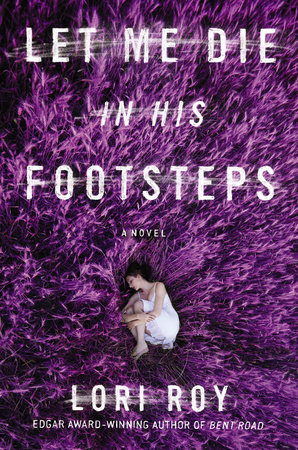
My first Lori Roy novel was Bent Road, which won her (deservedly) the Edgar for Best First Novel. I absolutely loved it, and made sure I got the next two as well. (At the Edgars following the Raleigh Bouchercon, both Lou and Lori won Edgars; her second, also making her one of the few authors to win Edgars for Best First and Best Novel.) I’ve read everything she’s published since then, but have never gotten to the second novel (an Edgar Best Novel finalist) or Let Me Die in His Footsteps, her second nomination for Best Novel and her second Edgar win. I don’t remember why I decided to finally read Let Me Die in His Footsteps, but I am very glad I did.

It’s really quite marvelous.
Annie Holleran hears him before she sees him. Even over the drone of the cicadas, she knows it’s Ryce Fulkerson, and he’s pedaling this way. That’s his bike, all right, creaking and whining. He’ll have turned off the main road and will be standing straight up as he uses all his weight, bobbing side to side, to pump those pedals and force that bike up and over the hill. In a few moments, he’ll reach the top where the ground levels out, and that front tire of his will be wobbling and groaning and drawing a crooked line in the soft, dry dirt.

Theyre singing in the trees again today, those cicadas. A week ago, they clawed their way out of the ground, seventeen years’ worth of them, and now their skins hang from the oaks, hardened husks with tiny claws and tiny, round heads. One critter calls out to another and then another until their pulsing songs made Annie press both hands over her ears, tuck her head between her knees, and cry out for them to stop. Stop it now. All these many days, there’s been something in the air, a spark, a crackle, something that’s felt a terrible lot like trouble coming, and it’s much like the weight of those cicadas, thousands upon thousands of them crying out to one another.

Annie has known all morning Ryce would be coming. It’s why she’s been sitting on this step and waiting on him for near an hour. She oftentimes knows a thing is coming before it has come. It’s part of the curse–or blessing, if Grandma is to be believed–of having the know-how.

Let Me Die in His Footsteps is set in rural Kentucky, with a dual timeline–the present in the book is 1952; the past is 1936. Both timelines feature two sisters, one normal and the other with the “know-how.” In the present, Annie is the sister with the know-how while her sister Caroline is normal and pretty and sweet and pretty much beloved. The 1936 section focuses on Caroline’s mother, Sarah, and her sister with the know-how, Juna. It is soon made clear in the present day that something terrible happened back in 1936, something whose repercussions are still being felt to this present day of 1952. Annie isn’t Caroline’s sister, but rather her cousin; Sarah is Caroline’s mother while Juna was Annie’s. Juna also had a bad reputation around the county, having played a pivotal role in the 1936 tragedy. The book opens with Annie reaching her ascension; the halfway mark between sixteen and seventeen, when she is supposed to look down into a well at midnight, where she will see the face of the man she is going to marry. Annie sneaks out of the house late at night to go next door and peer down into the Baine family well; there’s trouble and tension between the two neighboring families…dating back to 1936. All the Baine sons are long gone; the only one left is old Mrs. Baine, who sits out on her porch with a shotgun in case of her worthless sons try to come home. Caroline follows Annie and sees someone in the well; Annie sees no one. But after the look into the well, they discovered Mrs. Baine’s dead body in the yard…and all the secrets and lies from 1936 start to not only unravel but impact 1952.

We’re never really sure what the “know-how” is, or if it’s just an old wives’ tale, a superstition. The rural south in both 1936 and 1952 were dramatically different than modern times; the rural areas weren’t as exposed to television or films or the newspapers, really and the old ways still held sway. I can remember being told about someone with the sight that everyone was supposed to stay away from in rural Alabama when I was a kid; those kinds of superstitions and beliefs still exist in some of these more backward rural areas. But one thing I truly appreciate about Roy–who often writes about poor rural Southern people–is that her writing isn’t what I call “poverty porn”; her characters are very real and this just happens to be their situation. The Hollerans have a lavender farm, having eschewed tobacco in the recent past after Grandpa Holleran died from lung cancer. Lavender infuses the novel almost from the very first page. I love the smell of lavender, although I would imagine fields and drying houses filled with it might be a lot. The story plays out in a slow burn, terrific build to the end, and all kinds of secrets from the past must be dealt with in order for the present-day characters to get on with their lives.

Roy is such a good writer that it almost takes my breath away. She uses a distant third person point of view, one in which we don’t really get inside her character’s heads that much, so the reader has a kind of distant remove from the characters, but it really works. Her work reminds me of Faulkner without the racism, and of other great Southern writers. Her novels are very smart, with a lot of depth and emotional honesty that resonates with the reader, compelling us to keep reading.

Highly recommended; Let Me Die in His Footsteps clearly deserved to win the Edgar for Best Novel.

Hopefully there will be a new Lori Roy soon, because all I have left of her canon is her second novel, Until She Comes Home, which was also an Edgar finalist.

I’ll Remember

Monday morning and I got home from Malice Domestic yesterday afternoon after a rather odd but interesting time at the airport–more on that later. I was very tired–exhausted would not be hyperbole–but also very glad I was home. I had a lovely, wonderful, splendid time; the only regrets I have are that there were times when I was tired and had to go rest in my room for a while and take a break rather than spend that time catching up with old friends while getting to know the new ones. I had trouble sleeping the entire trip, which was unfortunate; even going two days without having any Coke didn’t do the trick (and once it didn’t work, why continue depriving myself?). But what a marvelous, friendly event Malice Domestic turned out to be this year! I also got to thank some people in person for their kindnesses over the last year which was also lovely. I read Ellen Byron’s marvelous Wined and Died in New Orleans on the trip up, so didn’t mind the flight delay or the rush hour traffic my cab from the airport was unfortunately timed to cross paths with. But because of the delay I went for a long time without eating–nothing from my yogurt before I left for the airport until about eight o’clock that evening–so my blood sugar dropped and I never really caught up on it over the course of the weekend. That and the no sleep resulted in a very tired Gregalicious who arrived at the Lost Apartment much later than scheduled–which was yet another life lesson.

On my way to the airport in a Lyft (wonderful, friendly driver named Tyrone who got a 25% tip), just as he dropped me off Southwest texted me of a half hour delay on my flight. No worries–I got to the airport about two hours before the flight, so…an extra half hour, no big deal. Of course, it’s Washington National…small, cramped, overcrowded, and not many options for food once you’re past security. And then it seem like every half hour there was another text with another hour delay. Tired and uncomfortable, I started getting annoyed. But as the delays continued to pile up–along with gate changes, which meant moving and trying to find another place to sit–I moved from irritation to acceptance to amusement, along with a lot of empathy for the airline employees. While they never said what the problem was, I’d assumed it was weather–but now this morning, I am beginning to think it was a mechanical issue. The last text I got extending the delay to make it another two and a half hours after the airport was followed shortly thereafter by another text changing the gate and now moving the flight up from its previous 3:45 departure (originally scheduled for 12:45) to 2:00 pm, which clearly meant they’d exchanged an aircraft and crew for the original one I was supposed to be on. So, that was cool, and the flight was two-thirds empty, so I got an entire row to myself just as I did on the way up to DC. I also hadn’t eaten, and there was nowhere to eat during the delay other than a pizza place (and I wasn’t in the mood for pizza) so was starving by the time I retrieved my bag and car and headed for home. I stopped and got Paul and I dinner–I knew there wouldn’t be anything in the Lost Apartment to eat–and then came home, exhausted and happy to be back home. I love conferences; I love seeing my people and my friends and making new ones and discovering new books and writers to enjoy. My Agatha nominees panel was marvelous, and excellently moderated by Alan Orloff. I was fun being on a panel with Elizabeth Bunce again (and her Myrtle series is marvelous; check it out) and Frances Schoonmaker was an absolute delight. We also somehow all three wound up wearing red and black to the banquet, which was a delightful surprise. I got to sit next to Valona Jones (aka Maggie Toussaint) at the table–she’s lovely– as was everyone else at my table. Didn’t win–so, as per my post the other day, it now seems real to me, and I got my nominees’ certificate which I am going to proudly hang somewhere in the my office space. But there’s also no disgrace in losing to Nancy Springer and Enola Holmes, either. I got to talk about my book, which was nice-when you’re as prolific as I am, sometimes conferences fall in such a way that I’ve had two out since the last conference, so sometimes I don’t get to talk about a book that I’ve written anywhere publicly other than here and social media. I also loved the questions Alan asked us on the panel; I’m thinking I may answer them at length on here because they were that great kind of question that you could literally spend an hour talking about instead of just the limited time we had for the panel. (I was also thinking I should maybe talk more about the book again? I don’t know. It was lovely. I had a lot of people tell me they’d read it and even more telling me it was a great title…so maybe I should talk about it some more? I don’t know.) I got to sit next to Mariah Fredericks at the signing, so I got to meet and talk to her a bit and she’s delightful (her latest, The Lindbergh Nanny, sounds amazing). I am glad I got to spend some time with friends, too–there was lots of laughter, which was wonderful–and I never got over-served, which was also a first for me at a mystery conference! Maybe that was why I couldn’t sleep? Nah, definitely not that. I also got to talk about being banned for the first time in years; for one thing, it’s hard to believe it happened eighteen years ago and now everyone is dealing with the shit I dealt with back then, too….so it occurs to me that in light of the return of the banning, I should probably write about it again from the perspective of how things are now. I also was thinking I should write about how much I love Elizabeth Peters/Barbara Michaels after going to the appreciation panel; she helped found Malice, which always puts Malice into a special place in my heart already because I loved her work.

Anyway, I got home while it was still light out, unloaded my suitcase into the washing machine and got that started; put my dress clothes in a pile to take to the dry cleaner’s; and then spent the evening relaxing with Paul and Scooter while we watched Ghosted (the new Chris Evans/Ana de Armas action/adventure rom-com which was actually kind of cute and fun–the two stars are likable and charming and have good chemistry) and then more episodes of The Watchful Eye, which is quite strange and oddly entertaining. We’ll probably finish off the series tonight. I do have a lot to do today–I took the day off, and am very glad I did, as I was exhausted and OMG, I slept so good; there’s nothing like your own bed, seriously–and then we’ll need to find something new, although I think there are some shows we watch dropping new seasons this month. I have to get the mail, pick up a prescription, gas up the car, have a doctor’s appointment, need to get groceries, and have a ZOOM meeting tonight. I also have to dig back into the book; I am so horribly behind on this revision it’s not even funny. ANd it’s May already. Jesus. I also started reading Lori Roy’s marvelous Edgar winning Let Me Die in His Footsteps from 2015; Constant Reader, it is quite wonderful and I honestly can’t wait to finish reading it. Lori Roy is one of my favorite current authors, and doesn’t get nearly the attention she should. (She’s also one of those rare authors who hit the ultimate dual–Edgars for Best First Novel and later for Best Novel.) The kitchen is a mess, as always, but I’m glad I spent some time before the trip trying to get that shit caught up because it isn’t nearly as bad as it could be (and was).

And now I have a day to get caught up on life after being in my author bubble for a few days to ease my reentry into my regular life. I won’t get to be AUTHOR again until Bouchercon in San Diego. But that’s okay, you know. I like the balance of the two different parts of my life, and there’s nothing like working in an STI clinic to keep you not only humble but grounded in the real world.

And on that note, I am heading into the spice mines. Have a lovely day, Constant Reader, and thanks again to everyone at Malice Domestic for a simply marvelous weekend.

Always

I always learned from reading–which is probably why I was so bad at math, now that I think about it.

And while I’ve certainly read more than my fair share from reading non-fiction (history and biographies), I’ve also learned a lot from fiction (while admitting as an adult that some of what I’ve learned from reading fiction should be viewed with a much more critical eye)–the so-called “travelogue” books in the kids’ series, like Nancy Drew’s The Clue in the Crossword Cipher or the Hardy Boys’ The Mystery at Devil’s Paw was often how I learned obscure facts that frequently come in handy when watching Jeopardy or playing Trivial Pursuit (example: The Clue in the Crossword Cipher was where I learned that the Inca language is called quechua, and I also learned about the Nasca Lines and Macchu Picchu from that book). I love reading books that, through the course of the story, expose me to information about a culture or a society or country that I don’t know much about–I’ve generally heard of it, but don’t have any other knowledge and let’s face it, there’s only so much time in every day and it’s hard enough to keep the plates spinning as is–which is why I love fiction that tells me an entertaining story while at the same time teaching me something.

Julia Dahl’s debut novel, Invisible City, is one of those.

I was in Chinatown when they called me about the body in Brooklyn.

“They just pulled a woman out of a scrap pile in Gowanus,” says Mike, my editor.

“Lovely,” I say. “So I’m off the school?” I’ve spent the past two days pacing in front of a middle school, trying to get publishable quotes from preteens or their parents about the brothel the cops busted in the back of an Internet café around the corner.

“You’re off,” says Mike.

The rest of the press is on the scene when I arrive at the gas station across from the scrap yard. Pete Calloway from the Ledger is baring his crooked teeth at the NYPD’s Deputy Commissioner of Public Information, or as reporters call him, DCPI. DCPI is six inches taller and seventy pounds heavier than Pete. It’s barely twenty degrees out and Pete’s got his hoodie up, his shoulders hunched against the cold, but DCPI is hatless, scarfless, gloveless, coatless. His uniform jacket collar is pulled up, two inches of starched wool-blend against the icy wind.

“We’re hearing she was found without clothes,” says Pete. “Can you confirm that?”

Again, I am late to the Julia Dahl party. This book was an Edgar finalist for Best First Novel, and any number of my colleagues and friends in the mystery/crime community have raved to me about Dahl’s strong gift for writing. Invisible City was the final selection for me to take with me on last week’s trip, and it was a wonderful companion for me on my three and a half hour flight from Boston back to New Orleans. I was so deeply engrossed in the novel that–other than being interrupted by the flight staff to give me a bag of pretzels and a can of Pepsi, and then to collect my garbage–the plane could have caught fire for all I knew or cared; I just wanted to get to the bottom of the murder of the naked woman whose body discovery kicks off this well-written and very fast-paced mystery story.

Our main character here is Rebekah Roberts, and what a gift to the crime world she is! Well rounded, fully developed, and absolutely real, Rebekah is one of the most fascinating and complex series characters I’ve come across in quite a while. Dahl, like all great writers, lets us see Rebekah in all of her glory–with all of her flaws, her personality issues, her raw emotion–and while sometimes she might seem to an outsider as a bit brash or even much as I hate to say it, bitchy–Rebekah’s rawness and vulnerability makes her someone you not only enjoy spending time with as a reader, but you hate to stop spending time with her at the end. She’s fairly young, recently out of the University of Central Florida, and now living in New York trying to make ends meet (as well as build a journalism career) while working as a stringer for a tabloid paper in the big city. She’s not making a lot of money, and her small circle of friends are also terrifically rounded out as fully dimensional characters–and I hope, as the series progresses, we get to know them even better.

The case obviously begins with Rebekah going to cover the discovery of a nude woman’s body at a scrap yard in the dead of winter. But…the scrapyard is owned by Hasidic Jews, and the body is quickly taken away by a Hasidic funeral parlor rather than the medical examiner’s office, which strikes Rebekah as not only strange but not legal.

And this is where Dahl’s genius as a creator kicks in: Rebekah’s mother was Hasidic, questioned her faith, met Rebekah’s father and ran away with him. They were never married, but she gave birth to Rebekah, but the pull of her faith and her old life proved far too strong for her, and so she abandoned father and baby when Rebekah was six months old. She grew up without a mother, her father slowly changing the story of what happened to her mother as he deemed she was old enough and mature enough to handle the truth–from dead to gone to abandoned–and this, naturally, has caused some deep emotional issues for Rebekah to deal with. She hates her mother while longing to meet her and confront her–and gobbles anti-anxiety medication on the regular as she begins digging into the murder of this unfortunate Hasidic wife and mother, having to confront her own conflicted feelings about being not only half-Hasidic herself, but her own issues with that faith and way of life which she feels robbed her of her mother.

Dahl also does a magnificent job of exploring the Hasidic way of life–how alien it appears to the very much modern Rebekah, who cannot grasp why anyone in the modern day would choose such an archaic, ancient way of life, but as Rebekah learns more about why the Hasidim choose to live the way they do, my own understanding grew. The way she brings these Hasidic characters to life, refusing to simply turn them into stereotypical, one dimensional freaks and humanizing them instead, is a gift to her readers. I may not be able to comprehend living that kind of life, but I came away from this book with an understanding and empathy for them; why they self-isolate and remove themselves from the goyim in a way I don’t think I could have without Dahl unlocking that world in such a compassionate, empathetic manner.

And it’s a corker of a mystery too. I couldn’t put it down, and I am very excited to continue reading more in the series. Rebekah is an amazing heroine, destined to be ranked up there with the other great female crime series characters, and I look forward to watching Dahl continue to grow and flex her muscles as a writer–which are already, from this debut, clearly well-trained already.

Read this book. You can thank me later.

I’m Only Me When I’m With You

Operation Scooter is going well so far. He doesn’t run away when we get out the syringe, he’s eating the wet food–although he’s not eating enough, I don’t think–and we’ve successfully convinced him his tartar control dry food (which is what he used to eat) are treats. We’ve also noticed behavior change in him since we started the insulin; he seems more alert, more active, and his fur is softer and sleeker than it was. He’s also more affectionate than he has been for a while–he’s never been much of a “hey let’s play” cat; he just wants to cuddle and purr. He also doesn’t seem to be drinking as much water as he was–that was when we noticed the change; he was drinking more water and his litter box became insane to deal with–and so I’m pretty happy about the whole situation now. It doesn’t phase me anymore to get the syringe ready or give him the shot. We’re hoping he’ll do so well with the change in diet and with the insulin now that he won’t need the shots anymore in a few months.

I’m so glad this is going so well. As I mentioned before, we’re very close to the ten year anniversary of when we lost Skittle and Scooter rescued us, and losing him around this time would have been rough. It’s going to be whenever it does happen, regardless, but I’m delighted we are going to be able to enjoy Scooter cuddles for a while longer.

The weather–and daylight–have definitely changed around here now; last night it dipped into the sixties (I could tell; I slept deeply and well, and my bed was so warm and comfortable this morning I didn’t want to get out of it). I feel very rested this morning. Yes, I certainly could have stayed in bed for longer than I was able to, but the summer weather has definitely broken and we are now in our beautiful, marvelous, gorgeous fall. (It’s very dark outside my windows this morning)

I finished reading Patrick Ness’ Release last night, and it was quite marvelous. I am looking forward to putting my thoughts together about it into a blog entry–it definitely made me think, and rethink, a lot of what I knew, or thought I knew, about writing for the young adult market. I think next up on my reading is going to be John Vercher’s Three Fifths, which was an Edgar finalist for Best First Novel this past spring, and I’ve heard a lot of truly terrific things about it. I also got two Kindle books for a ridiculously low sale price–John Ball’s In the Heat of the Night (which the Oscar winning film was based on, and I think it won an Edgar Award) and V. M. Burns’ The Plot Is Murder, which looks absolutely delightful. I should really read more of the books on my iPad book apps, shouldn’t I? There are quite a few of them, and I keep acquiring more, and since I’m not traveling at all….

I also managed to get a lot of my email cleared out yesterday, which was not only productive but felt amazing. I don’t feel sleepy-tired today, either, which means I should have yet another productive day. Yay! I had a lovely day at the office yesterday–all of my clients kept their appointments, and that’s really my favorite part of my day job, helping people–even if it’s just in the small way that I can through my work. I enjoy those interactions with my clients; and I miss seeing clients every day. I’m not sure when or if I will ever be back to full time counseling, but I really do hope it’s sooner rather than later.

Paul didn’t get home until late last night, after I had already gone to bed–he’s working on grants and proposals–and I have to admit, I was plenty tired when I got home from work yesterday, which was why I read my book rather than doing any cleaning or writing or revising. Hopefully, he will be home at his usual time tonight–I just let music videos stream endlessly on Youtube on the big television while I read, and thought about Bury Me in Shadows some more. I pitched both it and the Kansas book to my publisher yesterday–biting the bullet and realizing the stress of a deadline is what I need to finish pushing through them and getting them both finished–so hopefully they will agree to take both books and I can get the contracts signed and the deadlines set relatively soon. I’ve still not heard back on the Secret Project, but I still have hope an offer might come through; although the longer it takes the less confidence I have that one will be forthcoming.

Worst case scenario: it’s turned down and I use the plot for another Scotty book. Worse things have happened.

And on that note, tis back to the spice mines with me. Have a lovely Tuesday, Constant Reader.