Heart to Heart

Gah, it’s Wednesday and the week is half over and I’ve not scratched many items off my to-do list. Heavy heaving sigh. Although the weather seems to have turned here and it’s been lovely the last few days. I worked in the storage unit for about an hour yesterday; got a few more book donation boxes together and threw some things away, which was progress of a sort. The primary problem, however, is discovering that almost everything in there appears to be cases of copies of my own books, or my kids’ series–the Hardy Boys, Nancy Drew, etc.–that I will never get rid of; so I think my next move is to swap out boxes of books in the attic (or decoratively hidden around the apartment), books that I want to keep (copies of books written by friends, etc.) for the cases of my own books; it only makes sense to have easier access to them in order to donate for charity auctions or for book events where they don’t have copies of my books or aren’t able to get copies of my books. Or to sell myself. I do think from time to time I should resell my used books and make some money off them, but it also seems like an incredible pain in the ass and I barely have time to keep up with everything I need to get done, let alone adding another chore.

We’ll see.

I am one step closer to sending out the query letters. With the assistance of some amazing friends, I think I had a damned good query letter put together that just needs a tweak here and there, and has also helped me figure out what tweaking, oddly enough, needs to be done in the manuscript itself. So, the goal is to send out a wave of query emails by the end of the week, work on Scotty, finish the final revision of a short story to get sent out there, and make those manuscript tweaks.

I also put another book in the donation pile this week that didn’t pass the fifty page test, and am about to start reading R. L. Stine’s The Lost Girl. I read a lot of Stein and Christopher Pike novels in the early 1990’s–which helped inspire me to write the drafts that became Sorceress, Sara, and Sleeping Angel–so I am interested to see some of his newer work. I met him, not only at the Edgars one year, but at Stokercon in Vegas, and he is a lovely, very nice man. My original thought with those y/a’s was to link them all together at some point, the way he’d linked the Fear Street novels together, and in a way, all of my young adult novels are sort of linked together–Sara is set in a small town in Kansas; that town is where Laura, the main character in Sorceress is from; the town in California Laura moves to is where Sleeping Angel is set; and Scotty’s parents in Lake Thirteen are from the small town in Alabama where my main character in Dark Tide is from…and the town where Scotty lives now, in the suburbs of Chicago, was where Glenn in Sara moved to Kansas from. All connected. I sometimes forget that my young adult books all are in the same world and are all connected…

And on that note, I’m not going to finish my to-do list by sitting here thinking about getting things done.

Today’s Hump Day Hunk is actor Aaron-Taylor Johnson.

 IMG_1671


All Right

It’s gloomy this morning, and my heart is heavy upon waking to the news from Las Vegas. Yay, Monday.

I have a lot to get done this week, as ever. Bouchercon and our trip to Toronto looms on the horizon; I went to work on the stuff in the storage attic over the laundry room this weekend. Cleaning out the storage spaces, of course, is an exercise in letting go; I donated three boxes of books last week and will probably donate that many more this week.

I want to get at least three more chapters on the Scotty book done this week; I also want to revise a short story one final team before sending it out into the world; and I am going to get the WIP whipped into final shape so I can start sending that out to agents. It should work, as long as I don’t get sidetracked or distracted or lazy. Tonight when I get home from work I am going to make pho, for the first time; I’ve found a ‘quick” recipe that should only take about forty minutes to make.

I started reading another book yesterday that didn’t pass the first fifty page test; into the donate pile it went, and I started reading another, The Girl Next Door by Jack Ketchum. I’ve never read Ketchum, but I’ve know who he is for years. I met him at Stokercon in Las Vegas; and since he was one of the guests of honor, I arranged for his travel and so forth. What an absolutely charming man! I bought my copy of this book that weekend, but never ran into him again after I’d bought it. It’s quite excellent so far.

And on that note, tis off to the spice mines with me for the rest of the day.

Here’s a hunk to slide you into the week.

ed467dbea523fb9e7d271c2b364acb56


I Won’t Hold You Back

Being from, not only the South but also from Alabama, I am very particular about Southern fiction, and fiction set in Alabama (there is more of it than you might think; there is certainly much more of it than To Kill a Mockingbird). Robert McCammon has written some exceptional Southern horror fiction set in Alabama; I absolutely loved Boy’s Life, while I have yet to read Gone South (which is in the TBR pile). He actually  set a book in the part of Alabama I am from; it was a good book, but it bore no more actual resemblance to that county than anything other book set in the rural South; it was as though he simply put up a map of Alabama and stuck in a pin in it, said “okay this is where it will be set” and worked from there. But it was a good book that I enjoyed; it had some interesting things to say about religion–particularly the rural Southern version of it. I myself want to write about Alabama more; I feel–I don’t know–connected somehow when I write about Alabama in a greater way than I do when I am writing about New Orleans, and that’s saying something. Mostly I’ve written short stories, the majority of which have never been published; only two have seen print, “Smalltown Boy” and “Son of a Preacher Man.”

I remember Michael McDowell from the 1980’s, when the horror boom was at its highest crest; I never read his work but I was aware of it. I remember reading the back covers of his Blackwater books and not being particularly interested in them; there was just something about them, and their Alabama setting, that somehow didn’t ring right to me; I don’t remember what or why, but I do remember picking them up several times in the bookstore, looking them over, and putting them back.

In recent years, McDowell has enjoyed a renaissance of sorts; he was a gay man who died from AIDS-related complications in 1999. I wasn’t aware that he was part of the writing team who published a gay mystery series under the name Nathan Aldyne until sometime in the last few years, and I’d been meaning to get around to finally read one of his horror novels, the reissue of The Elementals (which included an introduction by my friend, the novelist Michael Rowe–whose novels Enter, Night and Wild Fell are quite extraordinary)–which again is set in Alabama, only this time Mobile and the lower panhandle of Alabama that sits on either side of Mobile Bay (the same area, in fact, where I set my novel Dark Tide, only my novel was set on the other side of the bay). My friend Katrina Niidas Holm recently asked me to read the book so we could discuss it drunkenly over cocktails at Bouchercon in Toronto later this month; this morning I sat down and read it through. (It’s not very long; 218 pages in total.)

the elementals

In the middle of a desolate Wednesday afternoon in the last sweltering days of May, a handful of mourners were gathered in the church dedicated to St. Jude Thaddeus in Mobile, Alabama. The air conditioning in the small sanctuary sometimes covered the noise of traffic at the intersection outside, but it occasionally did not, and the strident honking of an automobile horn ould sound above the organ music like a mutilated stop. The space was dim, damply cool, and stank of refrigerated flowers. Two dozen enormous and very expensive arrangements had been set in converging lines behind the altar. A massive blanket of silver roses lay draped across the light-blue casket, and there were petals scattered over the white satin interior. In the coffin was the body of a woman no more than fifty-five. Her features were squarish and set; the lines that ran from the corners of her mouth to her jaw were deep-plowed. Marian Savage had not been overtaken happily.

In the pew to the left of the coffin sat Dauphin Savage, the corpse’s surviving son. He wore a dark blue suit that fit tightly over last season’s frame, and a black silk band was fastened to his arm rather in imitation of a tourniquet. On his right, in a black dress and a black veil. was his wife Leigh. Leigh lifted her chin to catch sight of her dead mother-in-law’s profile in the blue coffin. Dauphin and Leigh would inherit almost everything.

Big Barbara McCray–Leigh’s mother and the corpse’s best friend–sat in the pew directly behind and wept audibly. Her black silk dress whined against the polished oaken pew as she twisted in her grief. Beside her, rolling his eyes in exasperation at his mother’s carrying-on, was Luker McCray. Luker’s opinion of the dead woman was that he had never seen her to better advantage than in her coffin. Next to Luker was his daughter, India, a girl of thirteen who had not known the dead woman in life. India interested herself in the church’s ornamental hangings, with an eye toward reproducing them in a needlepoint border.

On the other side of the central aisle sat the corpse’s only daughter, a nun. Sister Mary-Scot did not weep, but now and then the others heard the faint clack of her rosary beads against the wooden pew. Several pews behind the nun sat Odessa Red, a thin, grim black woman who had been three decades in the dead woman’s employ. Odessa wore a tiny blue velvet hat with a single feather dyed in India ink.

Before the funeral began, Big Barbara McCray had poked her daughter, and demanded of her why there was no printed order of service. Leigh shrugged. “Dauphin said do it that way. Less trouble for everybody so I didn’t say anything.”

This is an auspicious beginning to a novel that straddles the line between Southern Gothic and horror; but in using the word horror I am thinking of the quiet kind of horror, the kind Shirley Jackson wrote; this isn’t the kind where blood splatters and body parts go flying or you can hear the knife slicing through flesh and bone. This is the kind of horror that creeps up on you slowly, building in intensity and suspense until you are flipping the pages anxiously to find out what happens next.

McDowell introduces all of his characters in those few short sentences; Dauphin and his wife, Leigh; her mother Big Barbara; her brother Luker and her niece, India. Odessa also has a part to play in this story, and the only other character who doesn’t appear in this opening is Big Barbara’s estranged husband, Lawton. Lawton, like Mary-Scot, only plays a very small part in this tale, and so the reader doesn’t need to meet him until later.

(I do want to talk about character names here; the Savage family all have names that have something to do with Mary Queen of Scots; the deceased is Marian, her long dead husband Bothwell; Mary-Scot is as plain a reference as can be, whereas her two brothers were Mary Stuart’s husbands: Dauphin–her first husband was Dauphin Francois, later King Francois I of France–and the deceased elder brother, Darnley; the romantic Queen’s second husband was Lord Darnley. Marian’s –of Mary–deceased husband Bothwell bore the name of the Scottish Queen’s third husband, the Earl of Bothwell. These Savage men died in reverse order of the Queen’s husband’s though; Bothwell first followed by Darnley,  and of course, as the only one living, Dauphin will die last. Also, there’s never any explanation for why Big Barbara is called Big Barbara; usually in Southern families the reason you would call someone “Big” is because there is a “Little;” there is no Little Barbara in this story, and I’m not sure where Luker came from as a name, either. I wondered if it was a colloquial pronunciation; names and words that end in an uh sound turn into ‘er’ in Alabama; Beulah being pronounced Beuler, for example, so I wondered if his name was Luka…)

The McCrays and the Savages are families bound by decades of friendship and now marriage; they have three identical houses on a southern spit of land in the lower, western side of the Alabama panhandle in a place called Beldame; Beldame is very remote, bounded by the Gulf on one side and a lagoon on the other; during high tide the gulf flows through a channel into the lagoon and turns Beldame into an island. There are no phones there nor power lines; electricity is provided by a generator and there is no air conditioning. Oh, how I remember those Alabama summers without air conditioning! One of the three houses is being lost to a drifting sand dune and is abandoned…and as the days pass, the reader begins to realize there’s something not right about that dune…or about that house.

The book reminded me some of Douglas Clegg’s brilliant Neverland; that sense of those sticky hot summers in the South, visiting a place you’re not familiar with and is kind of foreign (the primary POV once the story moves to Beldame is India, who has never been there before); those afternoons where the heat and humidity make even breathing exhausting, the white sugary sand and the glare from it, lying in a shaded hammock just hoping for a breeze–the sudden rains and drops in temperature, where eighty degrees seems cold after days of it being over a hundred…the sense of place is very strong in this book, and Beldame is, like Hill House, what Stephen King called in his brilliant treatise on the genre Danse Macabre, ‘the bad place.”

I really enjoyed this book. A lot. And it has made me think about writing about Alabama again; this entire year I’ve been thinking that, and now feel like it’s a sign that maybe I should.

And now back to the spice mines.

Wanna Be Startin’ Something

Well, I finished the tragic mess that is currently known as Chapter Seven’s first draft yesterday. And it is a mess; this is easily one of the sloppiest first drafts of a novel I’ve ever written. In fact, I feel so bad about how shitty it is I may even go back and rewrite the entire first half once I finish Chapter Ten. This book is so bad, I can’t even believe how badly I can write a Scotty novel. Oh, well, that’s what rewrites and revisions and future drafts are for.

I also finished rereading It yesterday. Wow, you are undoubtedly saying, that’s a lot of reading. But truth be told, much like the Losers Club when they return to Derry twenty-seven years later, the more I read the more I remembered. And yes, I skimmed some sections, and skipped some entirely. It’s a perfectly fine novel, and I would recommend it..but there are problematic sections, and yes, I do feel like I’m committing treason by saying anything negative about Stephen King and his work, because he is my writing idol, and he has been since I was a teenager. What works in this book works extremely well; no one writes about the lives of children, how they relate to other children, and what it’s like to be a loser as a child (or feel like one) the way he does. I identify with every one of those kids, I feel for them, I desperately want them to succeed and have great lives and live happily ever after. Their return as adults doesn’t work quite as well as the parts that are set in the past; the characters are still richly defined, and their relationships still work–but I still didn’t like the resolution of the story, either when they were kids or when they were adults; I didn’t like the way the book ended (but for the life of me, I couldn’t write such a book nor could I think of a way to end such a book), and it reminded me a lot of Floating Dragon by Peter Straub in many ways (or vice versa; I think I read the King first and then the Straub originally and was struck by the similarities; I do love both books and think of them fondly). I’m not sorry I took the time to reread It and reacquaint myself with Derry and the Losers Club; there are some genuinely good scares in the book, and it’s one of the best books about a small city I’ve read–King really does a great job of depicting life in these smallish towns/cities and how the social dynamics work in them, whether it’s Derry, Castle Rock, or Jerusalem’s Lot. (That was one of the best parts of Needful Things for me; how the town dynamics worked and how the characters and their lives and their petty foibles and feuds all were entwined so intricately together.)

One of the other interesting things I found in rereading It was there was an LSU connection in it; in the town Ben has moved to and currently lives in there was a local kid who was a star athlete and went to LSU, only to party too hard and flunk out, and wound up coming back to the small town as an alcoholic. The town is Hemingford Home, where of course Miss Abigail lived in The Stand; also in that same book when Nick Andros is jumped, one of the assailants was wearing his fraternity ring from LSU–he was the sheriff’s brother-in-law, and he partied too hard and flunked out of LSU as well. Methinks Mr. King knows someone who went to LSU and flunked out for partying too hard. Those are the only two references to LSU in King’s work that I know of; would that Rocky Wood was alive so I could email and ask him.

Maybe someday I’ll get to ask Mr. King.

And of course, It is very reminiscent of the novella “The Body.” which is probably my favorite work of King’s, if pressed to name a favorite–the Losers Club, like the smaller group of friends in “The Body”, has the fat kid, the kid whose brother died and parents haven’t gotten over it, the poor kid (only switched from male to female in It), and the kid who gets beaten up a lot because of his smart mouth.

And there’s also the writer character–King often throws a writer in his work (Ben in ‘salem’s Lot, Jack in The Shining), but this was the first book where he really went all-in on  writer character with Bill Denbrough–and of course, his next novel was Misery, which of course took the writer character, and the dangers of fame, to a whole new level.

But yeah, the gang bang scene has a whole different vibe about in 2017. It didn’t phase me thirty-one years ago, but now it’s just kind of…icky.

As I said, I’m not sorry I reread it; most of it still stands up, and I still think it’s a terrific, if flawed, novel.

Today I need to get this kitchen in order, and I want to work some more on both the WIP and the new Scotty, maybe even a short story. Next up for my reading is Michael MacDowell’s The Elementals.

And now, back to the spice mines. Here’s a hunk to get your week off to a nice start.

17523549_1306428822738512_2755094986544804343_n

Family Man

So, last night I started my reread of Stephen King’s It. The book is slightly over 1100 pages long; and was the second novel King published that I never reread after the initial read (the other being Pet Sematary, which I think I will reread at some point now; I really disliked the book, but I think it was more because of its subject matter than anything King did, if that makes sense?). I sat down with it in my easy chair, and before I knew it the evening had passed and I was well past page two hundred. King is always compulsively readable; I can’t think of a single King novel where I just thought, meh and was able to put it down and walk away from it without regret. Likewise, I was so enmeshed in the story last night that when Paul wanted to watch some of our shows (How to Get Away with Murder, Will and Grace) I was a little annoyed to put the book down. I have no doubts that i will be able to get the entire thing reread in a matter of days; it’s simply a matter of finding the time to read.

Over the years since I first read It, I’ve seen some negative commentary on the book; I myself can distinctly remember not being overly thrilled with the ending, and being more than a little disappointed, which was a first with a King novel for me. The criticisms I’ve seen leveled at the book have included its length (I thought about that while reading last night, and frankly couldn’t imagine being King’s editor, trying to decide what to cut and what to leave behind), which I suppose can be justified in some ways; 1100 is awfully long. But as I was reading, I couldn’t imagine what needed to be cut from the book. King brings Derry vividly to life, and almost every word, every sentence, used to create his characters seems absolutely necessary. One of the things I’ve always loved about King was his realistic-seeming characters; whether it’s Stan Uris’ wife with her bitter recollection of not being allowed into the after-prom party at the country club because she and her date were Jewish, or Eddie Kasprack’s realization that in his overweight and needy and clingy wife, he has actually married his mother; and so on. No other writer I can recall has ever captured childhood, or written about children and the way their minds work, the way King has; the children he creates take me back to memories, long buried and forgotten, about my own childhood and its insecurities and its terrors–like Ben Hanscom when I was a kid I loved the library and lost myself in books, and was never lonely because I never really knew what it was like to have friends or a gang of friends. I always had books, you see, and I could see myself in some way in each and all of his characters as children.

Another one of the criticisms I’ve seen leveled at It has to do with the gay-bashing murder of Adrian Mellon in the second chapter of the book; it’s this murder that brings the cycle of death back to Derry; just as the the first chapter’s depiction of how Georgie Denbrough dies, chasing his paper boat down the gutter triggers the cycle of death in 1958. I’ve seen criticism of the Adrian Mellon death as proof that King is homophobic, or criticism that the depiction of Adrian and his lover, Don Hagarty, was homophobic. Rereading it last night, I never once got that sense. The book was originally published in 1986, at the height of the AIDS epidemic and the societal terror/homophobia that was triggered by the epidemic; some thirty years later it is easy to forget, or downplay what a truly terrifying time that was. And here was King, one of the biggest selling and most read authors of our time, putting in a vicious homophobic attack at the start of one of his biggest and most ambitious novels to date. Was his depiction of Adrian and Don, with their lipstick and tight pants and glittery eye shadow, indeed homophobic?

No, I didn’t think so in 1986 and I don’t think so in 2017.

Maybe Adrian and Don weren’t the most masculine gay men King could have chosen to write about, but the thing that we, in our more ‘enlightened’ times, tend to forget was that back in the day, back when the community was primarily focused on not dying and getting medical research into treating and preventing HIV/AIDS, the big butch straight-acting gay men were deep in the closet and desperately terrified that anyone might find out their truth. The effeminate gay men, ones who embraced who they were and wore make-up and flashy clothing and might have minced and pranced around a bit, flaunting their homosexuality–they were out because they didn’t have a choice. They weren’t straight-acting, the societal definition of masculine; they couldn’t hide their sexuality if they wanted to. Even if they remained closeted, everyone thought they were gay and treated them accordingly anyway, so they came out and got in everyone’s face.

And sometimes, getting in people’s faces, being so defiant about who they were, got them killed, as was the case with Adrian Mellon in Chapter Two of It.

King doesn’t show this hate crime as two fags getting what they deserved, either, by the way; he makes both Adrian and Don sympathetic, making the point that no one deserves to be beaten, attacked, or killed for simply being who they are. This was a radical statement to come from a straight white man whose books always shot up to Number One on the bestseller lists and had become a cultural phenomenon. Even the cops, who themselves were homophobic, made it clear that they maybe didn’t like gays but felt they should be left alone. King even talks about the small gay community in Derry, that it exists. He shows the death of Adrian as a tragedy, what happened to him as undeserved, wrong and terrible. He also shows, in a scene where Don shows Adrian, who has fallen in love with the small city and wants to stay there, the homophobic graffiti on the bridge where he ultimately dies–and the horrible words made this reader recoil, in horror and revulsion, at the inhuman sentiments expressed there with spray paint; the way the scene plays out only the most homophobic monster, without any feelings or heart, could possibly read any of it and think, well, that fag got what he deserved or agree with the sentiments spray painted on the bridge.

I’m sure there are others who can find this scene homophobic; I remember reading it back in my closeted days and having my decision to stay closeted confirmed; this is what happens to out gay men. I don’t think that was King’s intent; I believe King was trying, in his way, to show the oppression and abuse that gay men in 1986 were subjected to, something you didn’t find very often in mainstream novels of the time or even in mainstream novels of today.

He showed homophobia in all of its ugliness, and it still resonates today, thirty-one years later.

I have to go to the grocery store this morning, and I have a lot of cleaning and writing to do. So here’s a hunk to get your Saturday going, as I head back into the spice mines.

17309042_10158389426205290_7953415716721709226_n

The Other Guy

Thursday!

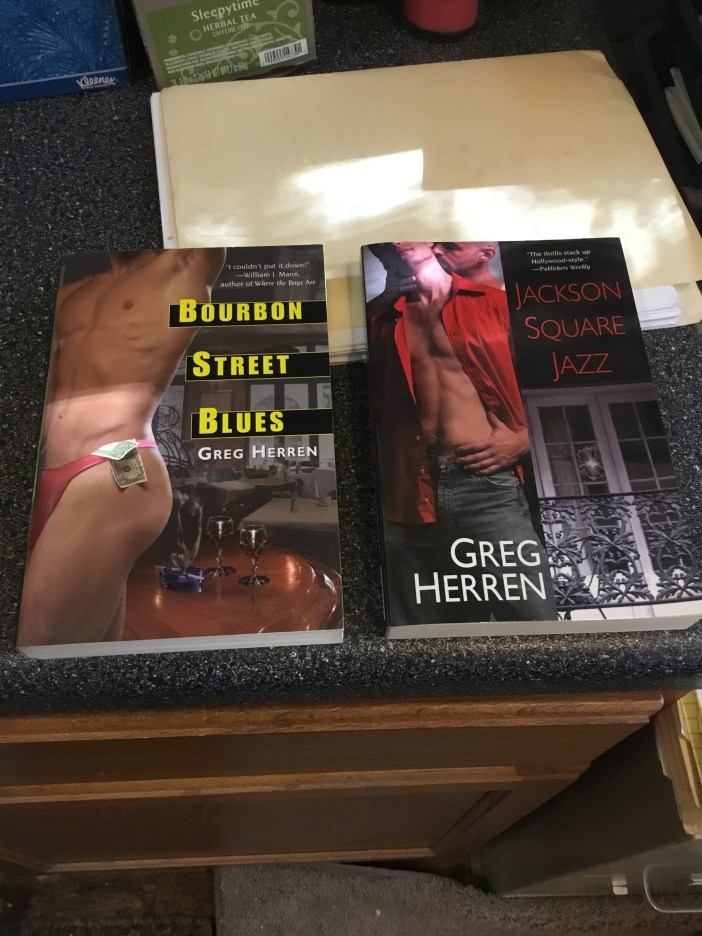
I survived the long day yesterday somehow, slept beautifully last night, and am wide awake and raring to go this morning. Hurray! I am still reading Background to Danger by Eric Ambler, which is another one of those “uh oh, what did I get myself into?” style espionage stories, and am enjoying it tremendously. I also made more progress on the new Scotty yesterday morning–having my usual this sucks doubts as well–and it looks like I am finally going to be getting the ebooks for Bourbon Street Blues and Jackson Square Jazz under way; with an eye to hopefully having them available after the first of the year.

Right? It certainly has taken me long enough.

I also want to get a short story revised and out into the markets over the course of this weekend. We shall see how that goes.

I hope to finish reading the Ambler either today or tomorrow, and then dive into The Elementals by Michael MacDowell. Toronto Bouchercon looms on the horizon; and I need to start thinking about getting ready for that.

Also, speaking of the first two Scottys, I am donating a signed copy of the first two–unavailable in any form other than second-hand sellers or ebay–since 2010 to a fundraiser for disaster relief being organized by Murder by the Book in Houston. So…this is a good chance to see where the Scotty series began, before the ebooks/POD versions become available.

IMG_1808

We’re very excited to announce that Murder By The Book will be organizing and hosting BOOK LOVERS CARE, a collectible book auction benefitting natural disaster relief. The book-loving community is a generous one and we’re hoping this news gets spread far and wide. Authors, readers, collectors – we’re looking at you!

We are currently soliciting donations of signed/collectible books and book-related items to be auctioned off online. While Murder By The Book specializes in crime fiction, we are looking for books of all genres.

* 90% of the money raised will go to Direct Relief, a highly-rated charity providing worldwide relief, specifically to areas affected by Hurricane Harvey, Hurricane Irma, Hurricane Maria, and the Mexico City earthquake.

* 10% of the money raised will go to the BINC Foundation – the Book Industry Charitable Foundation, providing aid to booksellers in time of crisis.

* Please mail all donations to the following:

Murder By The Book
Attn: Book Lovers Care 
2342 Bissonnet St.
Houston, TX 77005

* We will be accepting donations through the end of October, with the hope of the auction occurring in November – just in time for holiday gift-giving!

* While any donation of a book is a good deed, we are specifically looking for signed first editions, limited editions, unique book swag, and unique items that would bring excitement to an auction because of their value and rarity. We are not looking for used paperbacks. If you’re looking to donate them, we suggest Operation Paperback.

* For any specific questions or media inquiries regarding this, please contact us at the following email address: bookloverscare@gmail.com

And now back to the spice mines.

Promises, Promises

Hello, Wednesday! I’ve  been sleeping incredibly well since having to get up so early for the NO/AIDS Walk on Sunday; I’ve also added some more vitamins to my daily regimen that are supposed to help with creating melatonin naturally in my body, and have started drinking tart cherry juice, which is also supposed to assist in that. Has this change in routine had something to do with it? Perhaps. I am also trying to not look at any kind of electronic screen (other than the television) for half an hour before bed. I do feel very relaxed and rested this morning; which is lovely, since I have a very long day on deck.

I meant to take the Ambler novel with me last night to read between clients, but forgot it like a moron. I did work some more on Chapter Six yesterday, and even finished the draft of it, but it’s really terrible. But the framework is there to make it better; and that’s what rewrites are for. I also got started on Chapter Seven, so I may be on track to get this next Scotty book finished by the end of October, which was my hope (the draft, that is). I am, as always, behind on everything–I was so close to being ahead….but then the sleep issues started again last week and BAM! My energy and creativity were knocked flat and here I am, behind on everything again. Hurray.

I need to finish reading the Ambler by this weekend, since I’ve decided to  make October a horror-only reading month. I am going to start my reread of It this weekend, and I am also going to start reading The Elementals by Michael MacDowell, because I promised Katrina Holm I’d read it before Toronto Bouchercon. I also want to get my reread and re-evaluation of The Haunting of Hill House done before Toronto; and I have an enormous stack of horror that I want to get read this month. November I’m going to get back to my eclectic reading patterns, and then, of course, January is going to be Short Story Month again, where I read a short story every day for discussion. I’ve found even more short story collections scattered throughout my book collection, which is incredibly exciting.

All right, I am heading back into the spice mines. Here’s a Hump Day Hunk for your viewing pleasure:

16836462_1277495445631850_375592218010177997_o

Come Dancing

Tuesday!

Being off yesterday was kind of nice. I started a project I’ve been meaning to start all year (it was one of my goals set on the first of the year) and went to my storage unit. The goal is to clean a lot out of it, as well as get some more copies of my books out to replenish the supply in the Lost Apartment. I was actually worried that the boxes of my books were in the absolute back, but they weren’t. I was able to assemble three boxes of books to donate, found the copies of my own books I needed (hello, Bourbon Street Blues and Jackson Square Jazz!) and now that I’ve actually done it–it’s not as intimidating as I thought it would be. I’ve also always kept my papers–manuscript drafts, notes, etc–in manuscript boxes or small boxes that approximate a manuscript box; those don’t end up stacking well and you can only imagine how many of those there are. I’ve decided that the smart thing to do is get rid of those small, collapsing, not-so-sturdy boxes and assemble file boxes, and move the papers in there, labelling the new boxes appropriately. That way they’ll stack better, and will most likely create more room. And when I am moving all that stuff around, I can drag out other boxes of stored books to donate. So, yes, I am feeling inordinately proud of myself.

I started reading Eric Ambler’s Background to Danger, which I believe may be his first novel. It’s really quite good; Mr. Ambler certainly knew how to turn a phrase: One sunny morning in July, Mr. Joseph Bhaltergren’s blue Rolls-Royce oozed silently away from the pavement in Berkeley Square, slid across Piccadilly into St. James’, and sped softly eastward towards the City of London.

I so wish I’d written that sentence. While it’s ostensibly about the car and the drive into London, it also tells you everything you need to know about the passenger. That’s pretty masterful.

After taking the weekend off (from writing) I managed to get back to work. I intend to get the reread of the WIP finished over this week, and then the adjustments to the manuscript that need to be made done this weekend, as well as writing the query letter. I also hope to get some of the new Scotty written this week; Chapter Six is sucking big time.

Ah, well. I don’t have to go into the office until later today, so I should be able to get some work on it finished. We are greatly enjoying Harlan Coben’s The Five on Netflix; we’re about four or five episodes in, so about halfway finished. I have an excessively long day tomorrow, but that’s cool.

All right, I’ve got things to do this morning.

Here’s a Tuesday morning hunk for you:

17156321_1286974531350608_1822764787196576938_n


Don’t Let It End

I rested well last night; I am not tired this morning. Yesterday was physical exhaustion, complete and total with mental exhaustion thrown in for good measure; but I rested well. I won’t say I slept well, because I can remember being aware a lot while I was in bed, but this morning my muscles aren’t fatigued and my mind is alert and sharp, which it wasn’t yesterday.

I started reading Linda Joffe Hull’s Eternally 21 yesterday, and got about halfway through. It’s quite charming; the voice of the main character–Maddie–is delightful, and Hull manages to pull off the how does a wife and mother get involved in a murder investigation with aplomb. I don’t know how to describe or categorize the book as far as the crime fiction category goes; whether this would be considered a cozy or a traditional mystery. Maddie is enormously likable; the set-up for the book/series is that she and her husband Frank have had an enormous financial setback; he’s a television financial broadcaster, and he was defrauded, and lost all their money, in a Ponzi scheme. Obviously, if that news got out he’d probably lose his job–who would listen to a financial advisor who lost all his own money–so they are trying to keep up appearances. She’s started a website/blog about how to save money shopping, couponing and so forth, under the name “Mrs. Frugalicious”, which is starting to take off–she also has to keep that a secret because, again, why did the financial advisor’s wife have to start saving money and being more frugal when she used to be extravagant? As the story continues, you start to realize that Maddie is the glue that really holds the family together; Frank would undoubtedly be much worse off without her as his wife; and the cool competence and efficiency she’s developed to run her household also translate to being a successful Coupon Queen; and the skills she’s sharpened saving money actually come in handy for solving a crime.  It’s very charming, and it’s also quite funny; Hull’s got a slightly twisted sense of humor that really works in the book.

I have to work today and tomorrow; tomorrow is the NO/AIDS Walk, which means getting up ridiculously early. But I have Monday off, which is lovely, and my house is an absolute disaster area. I simply haven’t had the energy this week to try to keep up with it; I am going to try to get it into some semblance of order this morning before I head down to the office. Sigh. I also want to get some writing done this weekend; I want to spend Monday rereading and making notes on the now line-edited WIP.

Okay, back to the spice mines. Here’s a Saturday hunk, Tom Hiddleston.

IMG_2773


She’s a Beauty

I always find the process other writers use fascinating; I remember back in the day when I used to read books about writing (never, ever read The Art of Fiction by Robert Gardner unless you’re actually reading it for its unintentional hilarity and incredible pomposity; stick with Stephen King’s On Writing, which actually imparts wisdom born of experience, and some damned good advice) and was interested in all the different components of writing, and how different the advice was; it wasn’t until I actually began to write seriously that I realized that the best thing you can get from another’s writer’s process is to simply try the various methods as a starting point; a way to find your own way into what works for you.

That’s what I tell workshops I teach; I’ve taught many over the years and I’ve also worked with/edited many writers at the start of their careers. What works for, say, Sue Grafton–which enormously productive and successful for her–might not work for you. I have been asked any number of times what my process is; but it’s really not that simple.

You see, just as I have creative ADD whenever I’m working on something, I don’t always use the same process. Kristi Belcamino, a friend and fellow writer, asked me yesterday in a comment about my process; so here it is.

I wrote the first Chanse novel, Murder in the Rue Dauphine, (working title: Tricks) without an outline. I knew what the crime was, I knew who the killer was, and I thought I knew how to get from Point A (Chanse being hired) to Point B (unmasking the killer). After writing an enormously lengthy first draft, I realized that I’d actually gotten it very wrong; I got to Point B all right, but around Chapter Ten the book went off course and veered crazily along like a drunk driver trying to drive in a straight line and failing miserably. Even the unmasking of the killer didn’t work; I had to basically throw out the second half of the book and start it over. Starting over the second half then meant that the first half didn’t really fit with the new second half, so I had to go back and redo the entire first half of the novel. It was a long, painful process, and I thought to myself, there’s got to be a better way to do this.

So, when I started writing the second Chanse novel Murder in the Rue St. Ann (working title: Murder in the Rue Royal, changed because of the alliteration which annoyed my editor) I outlined the whole thing, from beginning to end. By doing this, I was able to see–hey, the story is getting derailed here–and could fix it before I wasted time writing a lot of material I wasn’t going to be able to use and would have to throw it and rewrite. I thought this was a much easier way to do it, frankly, and it made more sense. I was able to catch errors in the plot and fix them before I actually sat down to write the manuscript, if that makes sense. I did this, and it worked. But while this was the first novel I wrote after getting my first novel signed, it wasn’t my second novel to get published. That was Bourbon Street Blues, when I introduced a new character, Scotty Bradley.

Bourbon Street Blues was only intended to be a stand-alone, not the start of a series that has lasted now for fifteen years and eight novels (I am writing the eighth now). I pitched the idea to a different publisher instead of my original publisher, and got a two-book contract for a series. As I said, it was intended to be a stand alone, but I figured I’d deal with the series concept when it was time to do that. Having had some success with an outline, I tried something a little bit different this time. My outline for Rue St. Ann was basically a paragraph for each chapter breaking down what happens in the chapter; for Bourbon Street Blues I decided to make the outline a little more detailed; it also made sense to me that hey, if the book has to be this many words long, figure out how many chapters its going to take, divide that number by the word count, and then every chapter has to be that long, give or take. Making every chapter about the same length will also subconsciously give the reader a structure to the story without realizing what I’ve done.

The difference between this and what I’d done with the Chanse books was I started writing this longer, more detailed outline with no idea of how it was going to end, or what was going to happen. But it worked, and successive drafts was just filling in more details, etc. so that I then had a finished draft and then went back over it to tighten language, deepen character, etc. This free-wheeling style of writing seemed to work for Scotty; it was kind of who he was as a person, and so all future Scotty books were done this way; a short first draft, each successive draft making the book longer and then a final polish. Sometimes I get stuck when I’m writing Scotty and don’t know where to go next; then I go back and revise the earlier chapters and get an idea of how to go from there. Sometimes I have to outline the next five chapters, and as I struggle with that outline the answers come to me. (I am also terrified this is going to not work someday.)

So, when I start with the Chanse books I know how I am going to end the book, and have to fill in, with an outline, how to get from Point A to Point B. With Scotty I write a short first draft that’s kind of an extensive outline to get me through when I have no idea what the story is going to be or how it’s going to end. I find with Scotty I go back and revise earlier chapters a lot before it’s finished, so I am always worried later chapters don’t get as much attention as the earlier ones.

My stand-alones–the y/s and so forth–are kind of a combination; it depends on the book. If I know how it starts and I know how it ends, I do an outline to get me from beginning to end. If I don’t know how it ends, and simply have the opening premise, I do a long outline, let it come to me as I do it, and then go back and see if it works, fix what doesn’t (or at least try to), and do it over and over. I usually end up doing three drafts total, maybe four; and then do a quick polish of the final draft before turning it in.

The current WIP, that I keep talking about? I didn’t know how it was going to end, and just started writing. I knew the characters, I knew what the premise was, and basically, I was adapting a story I came up with years ago, using the characters and so forth I’d already created, only using it with a different story and a different theme. I still like the original idea I had, and I may be able to eventually turn that into telling the story I’d originally wanted to tell..but I really like this story I am telling now. I wrote the first draft in less than six weeks, total; I started writing two years ago in June and finished it in early July. I let a friend whose opinion I deeply respect read it, and she gave me some amazing notes. I went through and made some changes–the original draft was over a hundred thousand words, without a final chapter–and then I printed the whole thing out and did the line edit I’ve been bitching about for so long. But in doing all of this, I figured out how to tell the story I wanted, how to get the message I want across, and now know what changes have to be made to the manuscript for this final draft. But when I was writing the first draft, I had a goal to meet every day: three thousand words every day. Sometimes I met it, sometimes I went over it, sometimes I didn’t come close. But writing the book was very organic; it literally came to  me as I wrote it. And this weekend I am going to spend some time reading this leaner draft and figuring out where to put the things I need to add to it, and then write the final chapter. The goal was to start submitting it to agents on October 1; I think I’m going to make it.

Incidentally, this current Scotty? I started outlining the next five chapters…but by the time I finished the second chapter of this outline I knew what Chapter Six needed, and so I started writing it.

Sigh. Does that make sense?

I also try to write something every day–my goal for every day is to write 2500 words minimum, on something. On good days I can get that done in two hours; on bad days it can take me, off and on, all day; on the worst days I don’t do anything. But it’s something I try to maintain; whether it’s the manuscript I am working on, or a short story in progress, an essay; I try to write something every day. I have about ten short stories in progress right now, and ideas for many many more. I don’t use the same process with short stories; they are much harder for me because often I know the set-up and have the idea for the beginning, and sometimes when I don’t know the ending it comes to me while I am writing it and I am able to finish a first draft. Other times I get stuck and it gets put aside for awhile. Sometimes I come back to them, sometimes I never do. Right now, I have the following short stories in progress: “The Gates of Guinee,” “Fireflies,” “A Holler Full of Kudzu,” “The Brady Kid,” “The Rosary of Broken Promises,” “For All Tomorrow’s Lies,” “This Thing of Darkness,” “Circumstance,” “The Weight of a Feather,” “The Terrortorium,” “Quiet Desperation,” “Never Kiss a Stranger,” “Passin’ Time,” “Closing Time,” “The White Knuckler,” “The Ditch,” and “The Weeping Nun.” I hope to finish them all someday; maybe some of them will never be finished. I also have several other book ideas I want to write at some point; one is a horror novel with no title, and I have some (what I think) are terrific ideas for some. I also have an idea for another Scotty book.

Damn, just thinking about all this made me really tired.

Here’s a Throwback Thursday hunk for you, Constant Reader:

21751584_10212982889823550_4735446225636510593_n