Footsteps

I wound up deciding to take yesterday off from the world–computer, social media, you name it–because for whatever reason my desktop was acting wonky yesterday morning and eventually I grew so irritated I decided to run my errands. When I got home from that further irritation–nothing like people not only not wearing masks in public but not maintaining social distance as well–and I just wanted to scream at everyone: “do you want us to be on lockdown through September? What the fuck is wrong with you?”

But then I remember–this is New Orleans and nobody follows rules here; or at least, they ignore them when they’re inconvenient. It’s sadly part of the charm here, and now that it’s something important…I see how dangerous that can be. But it was nevertheless more fuel for my irritation, and by the time I got home my computer was still wonky so I decided to say fuck it and take the day away from the computer and social media. It was kind of nice–I fell into a Youtube hole of history videos (I am really glad to be studying history again; as I’ve said before, I kind of wish I’d majored in History in college–but would have never been able to narrow down a field of majority interest). I spent most of the afternoon moving and rearranging books and filing and cleaning while this Youtube videos played on continually; I learned some more about the Byzantine empire, the plague, and the Hapsburgs–who are so fascinating to me. Let other wars, you, happy Austria, marry.  Someday I’d still like to do a book about the powerful women of the sixteenth century; and many of those important women were Hapsburgs.

One of the things I’ve found interesting is how writers are engaging with their lockdown situation and their social media. Lists are popping up everywhere; and as I daydreamed yesterday while doing my chores and so forth, I started thinking about my own lists–rather than ten albums or books or movies that shaped me, I wanted to come up with more specifics: My Ten Favorite Agatha Christie novels, my favorite romantic suspense novels, my favorite crime novels by women, and so on. The reboot of Perry Mason, coming this summer from HBO (it looks worth a look, frankly; although I imagine there are any number of Mason purists who will naturally hate it; there always are), might be worth taking a look at some Perry Mason novels–I feel the books don’t get nearly as much attention as the TV series based on them; and the books don’t get talked about nearly enough, either. Talk about puzzles–Erle Stanley Gardner was a master of crime plotting, and red herrings, and confusing the reader; I don’t think I ever correctly solved a Perry Mason case until Perry revealed their identity, dramatically, in the court room (which is, of course, where that trope originated); and I do have a couple of them lying around on the shelves in the laundry room–The Case of the Calendar Girl and The Case of the Crying Swallow–so perhaps, as part of the Reread Project, I should revisit them both.

I also spent some time thinking about The Plot Against America–which is directly related to our finishing Ryan Murphy’s Hollywood last night on Netflix. Both are alternate histories, but one of the things about Hollywood is that it was an alternate history that was actually appealing; usually, alternate histories inevitably paint an uglier reality than the one that actually happened (although it’s hard to imagine a more dystopian alternate history for the present day than the actuality); Hollywood didn’t do that. Instead, it showed how horribly racist, homophobic, and misogynist the country was, and how Hollywood reflected that…and then gave us a lovely alternate history where a Hollywood studio saw its duty to change those things and open up society in the late 1940’s. It’s quite marvelous, actually; I kept waiting for reality to break over them, but it never did. It’s very well done, and it’s shot in the style of Hollywood films of the time, right up to the obligatory happy Hollywood ending. And of course, the boys were beautiful. The Plot Against America, on the other hand, was completely horrifying because it was so easy to imagine that we as a country could have gone that way. I don’t know how the novel ends–I never finished it; I have said before that I am not a fan of Roth and I never got past the first chapter of this one–but I thought the way the show ended was perfect, even if it was terrifying at the same time; it was more of an indictment of the United States (as I said to Paul, “this show is terrifying because it could so easily have gone this way here”) and humanity than anything else.  Hollywood also could be seen as an indictment of the way things used to be–its message seemed to be this could have all changed so much earlier if anyone in Hollywood had the courage to make these changes–and that is just as damning as The Plot Against America.

Today I am going to write and edit and revise and get things done. I think I am always teetering on the edge on Saturdays anyway; still leftover tired and so forth from the week, and then having to deal with the general public on top of that is always draining and rough on my moods. Computer issues on top only heightens the aggravation, and being already on the razor’s edge doesn’t make it any easier. I kind of have a mess here in the kitchen that needs to be handled–I deliberately avoided my desk yesterday, so there’s sorting and filing that needs to be done around here as well–but this morning, after I finish this, I am going to abjure to my easy chair and read for a bit. I want to get further into Mysterious Skin, and then I am most likely going to move on to another Mary Stewart reread, either Thunder on the Right (which I don’t remember at all) or Madam Will You Talk?, which I have some memory of; and there are also short stories I’d like to sink my teeth into. I haven’t touched the most recent Lawrence Block anthology, which looks terrific and has some amazing contributors. I want to get my story “Night Follows Night” revised today and possibly submitted somewhere; I’d also love to get some revisions done on “This Thing of Darkness” and “Never Kiss a Stranger.”

And of course, the Secret Project. I really need to get back to work on the Secret Project.

So, yes, I have my work cut out for me today. I also should spend some time drafting the replies to the massive amounts of emails I’ve accumulated over the last day or so. And then I feel like I can face Monday with a clear conscience.

Have a lovely Sunday, Constant Reader. I plan to.

IMG_0822

Forever in Love

Saturday.

I do love the weekends, even the ones when I have over a gazillion things to do.

So, I submitted a story to McSweeney’s. They did an open call for queer stories, and I am a queer writer of queer stories, and I just happened to have a dark little story that just needed to be polished a little bit, which I did yesterday morning and I sent it in. That’s three short stories I have out on spec right now, and my fingers are crossed. All three are kind of long shots, in a way, but nothing ventured, nothing gained, right? I’m hoping to work on the Secret Project this weekend and get it under control, tweak another story to send out on Monday morning, and maybe–just maybe–finish one of these stories of which I don’t have a first draft available to tweak/edit/revise. Which one, I’m not quite sure, but it’s also been a hot minute since I’ve worked on any of the novellas in progress…perhaps this weekend I should give a look to either “Festival of the Redeemer” or “Never Kiss a Stranger.” I kind of want to finish “Condos, for Sale or Rent”; it’s a pandemic story, after all, and it would be interesting to get one of  those written and sent out somewhere….although it could very quickly become dated.

Hell, I started writing it three weeks ago (I think) and it’s probably already dated.

We started watching the new Ryan Murphy Netflix show Hollywood last night, which is essentially about the film industry’s (and by extension, society’s) treatment of minorities and gays during the post-war period when television was rising and the studio system was collapsing. This is the same period I will be writing about in Chlorine, so naturally the show was of interest to me: the fabled Sunday pool parties at George Cukor’s with the gorgeous young men who wanted to be movie stars and if it meant the casting couch so be it; Scotty and the fabled gas station of prostitution; fictional characters mixed in with real ones; Henry Willson and his abusive and predatory agenting methods towards beautiful young men (and Rock Hudson, who is a character in this and very well cast); and the horrors of the LAPD vice squad and how a career could be ruined by an ill-timed arrest or visit to the nelly house (gay bar); and how relationships, actual relationships between men that were more than just sex, weren’t seen as possible (Billy Haines to the contrary). It’s the perfect background for a noir novel, quite frankly, and I also, while watching the first three episodes, came up with the one missing component to my plot for Chlorine–the stakes for my main character, which means now the book is completely possible. The show itself is very well done, the acting superb, and the period setting perfectly done (interesting that the last show we watched, The Plot Against America, was also a period piece and also very well done). I do recommend it; the cast is incredibly pretty, both men and women, and it’s very fun seeing Jim Parsons playing monstrous Henry Willson.

I slept very well last night–the weather was stunningly beautiful yesterday, a gorgeous and incredibly unseasonal cool day, without humidity–and got home from work not only not feeling tired, but fairly energetic. I spent some time once I got home in my easy chair with a purring kitty in my lap, rereading stories that I want to work on and some of the partials that need to become complete, before we tuned into Hollywood. Today, I need to make a brief grocery run, stop and pick up the mail, and run by the bank to deposit a royalty check–always a pleasant feeling, quite frankly–and then I am coming home to probably spend most of the day alternating between cleaning, reading Mysterious Skin (it’s not only haunting but compulsively readable), and doing some writing, as well as some organizing. As I said yesterday, I’d like to get more stories out for submission–it always comes in waves like this–but there are four more markets out there I don’t have something submitted to, and I spent a little time on Submittable looking for markets and found a few more with deadlines later this month that I ‘m going to consider looking at. I also need to finish the Secret Project this week as well; always so much to do.

And that’s not even looking at the emails that are piled up in my inbox. Heavy heaving sigh. But I can spend some time, here and there, today and tomorrow answering emails and saving the drafts to send on Monday morning; I refuse to send emails (except in emergency cases) on the weekends because that simply breeds more emails. And since I’m feeling energized this morning, I kind of want to take on things that need to be taken on, if you know what I mean.

And on that note, I am heading back into the spice mines. You have a lovely day, Constant Reader, and I might check back in on you later today–stranger things have happened–or else I will just talk to you tomorrow.

IMG_0814 a

Building a Wall

Friday! Friday! Friday!

HUZZAH!

I also submitted my story “The Affair of the Purloined Rentboy” off to the editor yesterday morning; it was quite a lovely thing to do, and now of course I intend, as I always do, to forget all about it and get on with my life. I spent part of last evening revising another story to submit today–I doubt very seriously it’ll get taken, but nothing ventured, nothing gained–and am looking forward to getting on with some other things this weekend. I need to get some serious work done on the Secret Project, which I haven’t touched since before the pandemic, and God willing and the creek don’t rise, I’d like to get that finished this weekend, along with the revision of my story “Night Follows Night.” Ideally, I’d love to have a story in the submission process with the four publications I aim for–Ellery Queen’s Mystery Magazine, Alfred Hitchcock’s Mystery Magazine, Mystery Weekly, and Mystery Tribune–at all times. I just am not sure that I have enough completed stories to keep that going; but if I can get “Night Follows Night” revised this weekend, and then I can move on to another story next week, and so on…by the end of May I’ll have something at each publication, and who knows? Perhaps I might get lucky.

I also need to get back to Bury Me in Shadows at some point; now that I know how to revise the damned thing and make the story work, I’ve been itching to get my hands back on it. I think I may even start rereading the manuscript as it is this weekend; making some notes so I don’t forget all the things I need to do to make it work.

The Edgars were presented on-line yesterday, announced on Twitter, and it went very well–congratulations to everyone, from the judges to the finalists to the winners, for all their hard work–and I realized last night, looking through my mentions, wow, I actually had fun on Twitter yesterday! How fucking crazy is that? Pretty crazy, indeed; but it was an exciting mix of writers and books and styles, and I am really sorry we didn’t have the opportunity to celebrate everyone and everything in person. I hate that people didn’t get their chance to be celebrated at a really nice black-tie event, and obviously, nothing we can do on-line could replicate the excitement of the night, with the champagne and being with everyone…but it was still really nice.

Now if only I can find the time to get today’s story finished and polished and turned in by this evening, that would be terrific.

We finished watching The Plot Against America last night with a two episode binge, and it’s really quite well done and quite disturbing; there were several times throughout the series where it crossed my mind that hmm, this is really making me uncomfortable, maybe we should stop watching–but that was the entire point of the show, and the book, to begin with; to see the parallels today and be made to feel uncomfortable. Chernobyl was very much the same way, and sometimes that’s the role of art and entertainment; to make the viewer uncomfortable with accurate reflection of inhumanity and how it becomes possible–how easily it becomes possible.

No one wants to believe how easy it is for people to go to the dark side, or at the very least, to be complicit.

And I am looking forward to this weekend. I really am. Yes, I need to run to the grocery store and yes, the weekend is rarely, if ever, long enough; but I am very happy that I made it through yet another week and managed to get a lot done.

Sometimes that’s all you can hope for, really.

IMG_0743

Break 4 Love

Thursday morning.

I slept rather well last night, even if I did keep waking up periodically throughout the night. I’m not sleepy or tired–at least not thus far,  but it’s still early, Today I have to turn in my Sherlock story, which means going over it one more time today and formatting it properly; it shouldn’t be terribly difficult. Am I nervous? Of course I am; it’s always nerve-wracking when you submit a story that outside of your comfort zone. I also learned yesterday at some point that McSweeney’s is taking submissions for a “queer” issue; I have a couple of stories that might work to submit there–with a little tweaking–so hopefully I will have the wherewithal to deal with doing both of those today.

We watched another episode of The Plot Against America last night, and it’s very well done, and creepy on so many levels. I’ve not seen much about the show in the zeitgeist, but it’s really quite worth watching.

I was tired last night when I finished my work-at-home work (well, it’s not finished, just finished for the day), and so it was another evening of scrolling through Youtube and falling into Youtube wormholes of lists and so forth–and old music videos–before Paul got home and I made dinner, then we talked for a while before watching an episode of the show. Such an exciting life I lead! I literally sometimes  wonder why I bother making myself write these entries every day.  But I am looking forward to this weekend at long last, and my email inbox has already gotten out of control and depressing to look at; my goal for this morning between screening people is to try to get it as cleaned out as possible. Not every email requires an answer, after all, and getting into the trap of answering every email is a fool’s game.

I’ve been extremely scattered again this week, what with all these new story beginnings and ideas I’ve been having. Creative ADHD is certainly the worst, and there are times when I simply can’t reign it in, no matter how hard I try. It’s also sort of frustrating because I know I’m never going to get all these stories written, no matter how hard I work on it; it’s just that some of the titles are almost too good to pass up, you know? I really think “Procession of the Penitents” is a great title; and the idea behind it is also equally good; an assistant ADA, new to her job, sitting second chair to the ADA in charge of sex crimes prosecutions, and the case is a gang-rape at a fraternity party. Then again, it might be too much story for a short story–I’m not certain I can get all the story into six thousand words or less; which sometimes is the problem with my ideas. Before I used to always think in terms of novels–oh this would make a great novel–knowing full well I’ll never get a chance to write every novel I want to write. When I started the Short Story Project two or three years ago, the entire point of it was to retrain my brain into thinking in terms of short stories with the new ideas; it’s worked in that regard, and only in some cases have I come to understand that it’s too much for a short story; but now at least I am thinking in terms of longer stories being novellas. There’s another one I’d love to write–novella or novel–centering Venus Casanova and her last case before she retires from the NOPD; it’s a great idea but then again we have the issue of “should a white gay man write about a black woman?” I mean, sure I can, but will it be authentic? Should I be sucking the air out of the room and taking a publishing slot away from a woman (or man) of color? Probably not, and being a minority myself (although, as I always say, I hit the jackpot by being a cisgender white male; gay is my only crime) doesn’t necessarily make it okay.

The Edgars are being announced today on Twitter at 11 am EDT; you might want to follow @EdgarAwards so you won’t miss a single announcement. Pretty cool. Ordinarily, about now I’d be waking up at the Grand Hyatt in another hour or two, getting some coffee, and getting ready to face the day of the Edgar banquet. I haven’t been in years–I think 2015 was my last attendance–and while I was dreading getting up on stage to speak in front of that glittering room of publishing literati, I’d rather be doing that right now than slurping down coffee and preparing to go to another day of work screening people for symptoms before letting them into our respective buildings. (I work at one building in the morning before switching to the other in the afternoon.)

But such is pandemic life. None of us saw this coming, and back in January when I assumed the role of Executive Vice President of Mystery Writers of America, I certainly had no clue that I’d be presiding over the cancellation of the banquet (first time ever) and symposium (first time ever). Yay for making history?

Heavy heaving sigh.

Yesterday was also payday, but since the first isn’t until tomorrow I don’t have to start paying bills until then–so I am leaving things be, so as to maintain the illusion I have money in the bank for yet another day.

And on that note, hello spice mines! Time to put on my mining helmet and head on back in. Have a lovely Edgar Thursday, Constant Reader!

IMG_0753

The Former Enfant Terrible

I don’t know that I would consider myself a former enfant terrible; I’m not entirely sure I am not currently one, given the actual definition of the term. In French it means unruly child, and I don’t know that I was one of those or not, but the current Webster definition (that of a person whose unconventional or controversial behavior or ideas shock, embarrass, or annoy others)–that I can actually see. I’m certainly annoying; I can be embarrassing; and I am pretty sure I’ve said or done things other people might consider, or see, as shocking. I mean, just being gay shocks some people.

If I could choose which of those three verbs I would pick, if I could only be one: most definitely, without question, annoying.

I am sure there are many who would agree that I have already succeeded on that score. (shrugs) It happens.

Well, we’ve made it to Wednesday somehow, and that’s an accomplishment of which we can be terribly proud. Making it through any day these days is an accomplishment, really; I know that everyone else is as sick of the phrase the new normal as I am (it certainly begs the question of what is normal); and I’m not certain this is a ‘new normal’ anyway; the real new normal is what comes after all of this, and that’s the part I’m kind of worried about, to be honest. What will the new world, arising from the ashes of the COVID-19 pandemic like the phoenix of lore, look like? We had already established that there is a certain percentage of the population who aren’t civic-minded, don’t care about anyone outside of their immediate circle of selfishness, and believe that if they’re unhappy no one else should be; appallingly awful as they are, at least they’re setting example for everyone else of who not to be–although others–a much smaller amount, to be sure–see their wretched behavior and jump on the bandwagon of selfishness and hatred. We’ve always had those people in this country; they were Tories during the revolution; pro-slavery; America First while the Nazis ravaged Europe and began slaughtering undesirables; and so forth.

We started watching David Simon’s new HBO mini-series, The Plot Against America, based on the novel of the same name by Philip Roth. I’m not going to argue the merits of Philip Roth as a writer; he won every conceivable writing award during his lengthy career, and whenever I’ve dabbled into his canon, I’ve not really come away terribly impressed. At the direction of my friend Laura, I read When She Was Good, and I had read another one of his earlier novels already, Letting Go; I wasn’t really impressed terribly by either–I’ve never really understood, or gotten, novels about the sexual messes straight people get themselves into because of their warped sense of everything about themselves, let alone the American puritan ethic about sex and sexuality; I tried reading The Plot Against America because it was a topic that interested me: what if Nazi sympathizer and anti-Semite Charles Lindbergh had been elected president in 1940, rather than Roosevelt winning his unprecedented third term? I gave up about a chapter into it–as I often say about literary novels (looking at you, Jonathan Franzen), why would I read a novel about characters the author clearly doesn’t like? I”m not interested in people debating me about the genius of Philip Roth; I don’t get it, and that’s fine. I’ll give him another try–probably after I finish watching this show, I’ll probably give The Plot Against America another try, It came out around the same time I read Sinclair Lewis’ disturbing, if flawed, It Can’t Happen Here, which was chilling in its depiction of how easily Fascism could rise, and become perfectly acceptable, in this country (I sometimes wonder what Lewis, a brilliant social critic and writer, would think of these modern times in which we find ourselves), which is something I’ve chewed over a few times myself, and have considered writing about at some point. I saw the possibilities of where we are right now back in the 1980’s, during the height of the HIV/AIDS pandemic, as people died and no one cared because it was “the right people” who were doing the dying. That was what first inspired my alternate American history novel idea–one that still is bubbling in the back of my mind, the rise of the American dystopia, and the concurrent horrors that would come in its wake.

I do think that the times in which we currently live will be referred to by future historians as “the Oligarchy” or “the Oligarch Age,” as opposed to the truly falsely named “Gilded Age,” when workers were as disposable as animals and the capitalistic monsters rose to wealth and power in ways unforeseeable to the original founders.

I’m still reading Mysterious Skin (or rather, rereading it) and I’m very interested to find that I don’t remember as much of it as I had originally thought. It brings back to me a lot of memories of Kansas, and while I was never a child there, I can imagine what it would have been like. There’s a dark sensibility to this story, and the writing, that I’m really enjoying; I’ve always believed Scott Heim could write amazing noir stories, and kind of wish he would. I just haven’t been able to focus as clearly on reading as I would like lately; primarily because I’ve been writing again, and apparently, I can either focus on writing or focus on reading, but not both at the same time. It’s a very vivid depiction of being an outsider as a child–for both of its main male characters–and that is certainly something I can relate to, even now; although I never truly felt like an outsider until we moved to suburbia. After that, I spent the next twenty-three years feeling like I didn’t belong, in either my world or any world, for that matter. Heim really gets that across, and far better than I did in Sara.

The weather outside is frightful. Last night as we watched another episode of The Plot Against America, a massive thunderstorm rolled in, and it continued to rain throughout the night–and even this morning, this storm system (or another one, who knows? Not a meteorologist) is still raging outside my windows. Right now the rain has stopped, but when I first woke up it was coming down pretty intensely. It appears that is our forecast for the rest of the day as well, so it’s good, gloomy day for working from home. Ah, there was another blast of lightning, and thunder immediately behind. Yikes! Glad I am not going out there into that mess, quite frankly.

And of all things–because of course I don’t have enough works in progress–I started writing some new short stories last night–“In the Shadow of a Tomb,” “Procession of the Penitent,” “Dimestore Cowboy,” “The Plague Doctor” and “The Arrow in the Cardinal’s Cap”–mostly openings and an idea of the story, and who knows whether anything will ever come out of any of them, really, but it’s nice to be productive again, even if it’s scattered and all over the place. But I am going to try to spend this weekend sending stories out for submission again; it’s a really nice feeling to have stories out in the world, even if they don’t get taken.

And on that note, back to work. Have a lovely Wednesday, Constant Reader!

IMG_0808

Birthday Boy

Today is Paul’s birthday, and while he generally prefers to be left out of my blog and social media posts, it bears mentioning. I’m not really sure what one can do for a pandemic shelter-in-place birthday, but I’ll probably stop at the grocery store and get cupcakes or something. We’ve also reached the point in our relationship–25 years this summer–where we really don’t bother with gifts much anymore, for either birthdays or Christmas or anniversaries; we generally don’t need anything much, as we always just go ahead and buy what we want or need when we want or need it, which makes it incredibly difficult when it comes to buying gifts for each other. I’ve always taken pride in how thoughtful my gifts are, but Paul always got me better gifts than I got him, almost from day one, so it’s also kind of nice to no longer feel that competitive impulse and stress anymore.

And yes, gifts can turn into competition, thank you very much. Anything can, if you have a competitive personality. It’s something I personally don’t like about myself, so I try not to indulge myself by giving into that particularly unattractive aspect of my personality anymore.

I’m also seeing a lot of quarantine-themed ebooks being released–primarily, the social media promotional posts about them–and I have to give credit where it’s due. Mid-March was basically when places started going on lockdown, and here we are, a mere six weeks later, seeing books inspired by the situation out there for the reading public. I guess we’re going to find out relatively soon if there’s an audience for these types of books and who that audience might be–leave it to romance to be the first genre to truly dig deeply into it. I myself started writing a quarantine noir story a few weeks ago–triggered by the realization that the construction site two lots over from my house was considered “essential” by the city–and of course, over the weekend I roughly sketched out the start of another Scotty book, set during the quarantine; which also begs the question of timing and so forth. If I start writing the book now–and were able to completely commit to it–the earliest I could conceivably have a strong first draft done would be by July, possibly mid-June; assuming I wouldn’t be able to stick to a schedule of writing a chapter a day. But even if I managed to get the entire thing written and polished and turned in to my publisher, and they rushed it through the process, the earliest it would be available to readers would be by December, and that’s really pushing it. And who knows where we might even be by then? It could already be over by then, or we could still be in the midst of it, and IMAGINE how sick everyone will be of the quarantine by then if we’re still in it. I know no one wants to think about the length of this thing, but it’s entirely possible we could still be dealing with it at Christmas.

And seriously, perish that fucking thought, right?

Nobody wants a pandemic Christmas.

I did manage to get the vast majority of my emails handled yesterday–I took the day off from the day job; I would have been working from home anyway, and yes, well aware I could have pretended to be working but I am not wired that way–and spent some serious time wading into them and answering the ones I’d been hoping might go away at some point; I also filed some of them away that didn’t require a response and deleted still others that were of no consequence. It was actually kind of lovely, and if I can manage, from hereon out, to stay on top of them, perhaps they will not build up to such a disgraceful and out of control number again. I shudder to even look this morning, to be perfectly honest. But I got both stories edited and revised, huzzah, and I even submitted one already; the Sherlock story will be sent in most likely on the day it’s actually due, or this Wednesday. I’m actually relatively pleased with it, to be honest. Is it a real Sherlock story? Perhaps, perhaps not. As I always say, I am not the best judge, and when it comes to Sherlock, what I don’t know would fill the Library of Congress and there would still be things left over.

And now I only have a few odds and ends to get finished–the Secret Project, for one, and I’d like to get some of these other stories out into the wild before I dive back into writing (or trying to write) my book. Madness, right?

Right.

And now, off to the spice mines. Have a lovely Tuesday, Constant Reader.

IMG_0809

For Your Own Good

As Monday rolls around again–huzzah?–and we’re in the last week of April. These last two months have certainly lasted forever, haven’t they? Christ the Lord.

I did something really strange yesterday morning; or rather, more strange than my usual, which is pretty strange. I started writing another Scotty book. It may come to nothing, but ever since the title Quarter Quarantine Quadrille popped into my head a couple of weeks ago, my mind has toyed with the thought over and over again. And since the intro to every Scotty book opens with an homage to the opening of a truly famous classic novel (Rebecca, The Haunting of Hill House, Lolita, Peyton Place, to name but a few) the thought crossed my mind that I could do an homage to “The Masque of the Red Death”, so I looked it up on-line and cut and pasted the first two paragraphs into a word document, and started playing with it a bit. I’ll probably look at the openings of other pandemic-related fictions, like Death in Venice or The Plague before finally deciding on which one to actually use–or even if a Scotty quarantine book is something the world wants or needs–but the actual opening of the first chapter came to me on Saturday night, while we watched that dreadful Chris Hemsworth as a mercenary movie: as I watched a fight scene where Hemsworth’s character took on basically a team of soldiers by himself and killed them all in less than two minutes, Paul said, “I wonder how long this script was? Two pages of dialogue, maybe?” and I thought to myself, this is probably what a Colin novel would have to look like, and from there I leapt to Scotty, Frank and Taylor sitting around during quarantine, watching a movie like this, and Taylor saying, idly, “This is what Colin actually does when he’s not here, isn’t it?” and then forces the questions I’ve been asking myself over the last few books–especially in the last one–about morality and ethics and how do Scotty and Frank and the family look past what Colin’s source of income is? And since I signaled at the end of the last book that Colin was on his way home…and it did come up, during the book, that being involved with Colin makes them targets…that maybe, just maybe, it was time to deal with that in a Scotty book. So I wrote the first few paragraphs of a first chapter, where exactly that happens: they are watching an action/adventure movie when Taylor makes the observation, and the awkward conversation that ensues from it.

It might be a false start and a dead end–Lord knows I already have enough on my plate without trying to write another Scotty book on top of it–but…stranger things have happened.

I also reviewed my Sherlock Holmes story, which was actually much better than I ever dared dream; revising it and making it stronger will not actually be the odious chore I feared it might. On the other hand, I cannot be certain that the editor will feel much the same way about the story as I do, so it must be honed and refined and polished till it gleams in the light of day. (Ironically, I couldn’t remember the end….) But I did a much  better job than I thought I had–yes, I am my own worst critic, this is absolutely true–and this pleases me to no end. The story itself works, and just needs a little bit of tweaking the language and an added sentence here, a subtracted sentence there…yes, I am very pleased with it. Once I get it in shape, off it goes–and I think my other one that’s due this week only needs a tweak here and there as well.

HUZZAH!

Always good news.

We also watched Hustlers–didn’t care too much for it; sorry, felt like it could have been much better–and then the first episode of the Penny Dreadful spin-off, City of Angels, set in Los Angeles in 1938, and I liked it. A lot. It has a very noir sensibility, crossed over with some supernatural/horror elements, and it addresses not only race but Nazi infiltration into Los Angeles in that year–and pulls no punches. Draw your own conclusions, but I thought it was terrific, and look forward to watching the rest of the season. Nathan Lane is very well cast as a hardboiled LA homicide detective, and you can never go wrong with Natalie Dormer. I then watched–while Paul got ready for the week–watched a historical mini-series on Starz called Maximilian and Marie de Bourgogne, I think a multi-language production? Sometimes it sounded like French, sometimes like German, sometimes like something in between; perhaps Flemish? Anyway, it’s quite well-produced and this royal couple never gets the attention they quite deserve, given their marriage resulted in nearly five hundred years of wars between France and Germany (through its many iterations, from Holy Roman Empire to Austrian Empire to German Empire). The fifteenth century is an interesting time; one of blood feuds between branches of both the royal families of England (the Wars of the Roses) and the French Valois (the Orleans and Burgundy branches, respectively; ending with the Burgundy branch being absorbed into the House of Habsburg…so yeah), and a tighter unifying of the Holy Roman Empire into a hereditary throne for the Habsburgs. It was also the century in which Spain was freed of Moorish occupation and unified into Spain again–and once again, the Habsburgs wound up getting involved there and absorbing another throne. I’d known about the series for quite some time, and was glad to see it finally available to stream on one of my (too many) services. Yay, HISTORY!!!

I woke up feeling tired this morning, so I decided to make today another vacation day, stay home and get some things done around the house. I may venture out to the grocery store, but then again, I may not; those trips always seem to exhaust me, and why push it if I don’t have to? I have to be jealously guard my health these days, and my energy–bearing in mind the subconscious depression and angst can also be wearing down my body fairly regularly; another post-Katrina lesson–sometimes you’re not even aware of the depression bogging you down until it actually does. I spent the weekend pretty much in a complete state of exhaustion; it was very odd, and limiting in what I was able to work on and get done. Don’t get me wrong, I am delighted I reread all these in-progress short stories that have been languishing in my “edit” folder for so long–so much so that I actually got ideas on how to fix and rewrite and revise them all; there may be a massive flurry of submissions coming to the few publications out there that take crime stories–but the lack of energy I experienced for the majority of the weekend wasn’t very helpful, really.

And it seems to have carried over into today as well. Yay? Not really.

But I have about a million emails to reply to, several more to initiate, and then I’ going to probably head first into the spice mines, where I need to stay for most of the day. Since I am taking a vacation day, I need to make it worthwhile.

And so, on that note, I am heading back into the spice mines. Have a lovely and productive Monday, Constant Reader. I know I hope to.

IMG_0806

The Letter

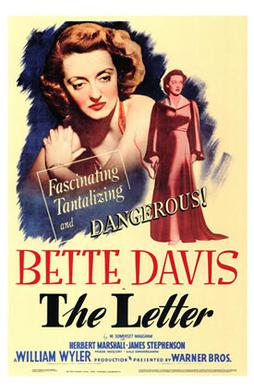
It sometimes catches me off-guard when it turns out a favorite movie was adapted from a short story or novel. Many of my favorite writers had their books turned into film more frequently than I think (or knew, or remembered); and more films were based on books and short stories than people remember or think. I knew, for example, that Now Voyager was a novel before a film; so were Stella Dallas, Flamingo Road, Laura, Whatever Happened to Baby Jane, and so forth. I also know W. Somerset Maugham had written Of Human Bondage (the film of which made Bette Davis a star) and the short story “Rain” (filmed with first Gloria Swanson and remade with Joan Crawford). I’d never read Maugham, but I know of his work; it was only recently, however, that I discovered that one of my favorite Bette Davis films, The Letter, was a Maugham short story he himself adapted into a play. Leslie Crosbie is one of Davis’ best performances, opening on a Malaysian rubber plantation with the sound of gunshots, as a man staggers down the front steps of a bungalow-style plantation house, with Bette Davis grimly following, gun in hand, and when he collapses onto the ground, she stands over him and fires four more bullets into his prone body at her feet. It’s an incredible opening, and a remarkable scene for Davis to play. The determination, the anger, the you so deserve worse than this look on her face–yes, she earned an Oscar nomination for that scene alone.

And once I knew (or was reminded; I may have known at one time it was a Maugham story and simply forgotten), I had to read the story.

The_Letter_poster

Outside on the quay the sun beat fiercely. A stream of motors, lorries and buses, private cars and hirelings, sped up and down the crowded thoroughfare, and every chauffeur blew his horn; rickshaws threaded their nimble path amid the throng, and the panting coolies found breath to yell at one another; coolies, carrying heavy bales, sidled along with their quick jog-trot and shouted to the passer-by to make way; itinerant vendors proclaimed their wares. Singapore is the meeting-place of a hundred peoples; and men of all colours, black Tamils, yellow Chinks, brown Malays, Armenians, Jews and Bengalis, called to one another in raucous tones. But inside the office of Messrs. Ripley, Joyce and Naylor it was pleasantly cool; it was dark after the dusty glitter of the street and agreeably quiet after its unceasing din. Mr. Joyce sat in his private room, at the table, with an electric fan turned full on him. He was leaning back, his elbows on the arms of the chair, with the tips of the outstretched fingers of one hand resting neatly against the tips of the outstretched fingers of the other. His gaze rested on the battered volumes of the Law Reports which stood on a long shelf in front of him. On the top of a cupboard were square boxes of japanned tin, on which were painted the names of various clients.

There was a knock at the door.

“Come in.”

A Chinese clerk, very neat in his white ducks, opened it.

“Mr. Crosbie is here, sir.”

He spoke beautiful English, accenting each word with precision, and Mr. Joyce had often wondered at the extent of his vocabulary. Ong Chi Seng was a Cantonese, and he had studied law at Gray’s Inn. He was spending a year or two with Messrs. Ripley, Joyce and Naylor in order to prepare himself for practice on his own account. He was industrious, obliging, and of exemplary character.

“Show him in,” said Mr. Joyce.

He rose to shake hands with his visitor and asked him to sit down. The light fell on him as he did so. The face of Mr. Joyce remained in shadow. He was by nature a silent man, and now he looked at Robert Crosbie for quite a minute without speaking. Crosbie was a big fellow, well over six feet high, with broad shoulders, and muscular. He was a rubber-planter, hard with the constant exercise of walking over the estate, and with the tennis which was his relaxation when the day’s work was over. He was deeply sunburned. His hairy hands, his feet in clumsy boots were enormous, and Mr. Joyce found himself thinking that a blow of that great fist would easily kill the fragile Tamil. But there was no fierceness in his blue eyes; they were confiding and gentle; and his face, with its big, undistinguished features, was open, frank and honest. But at this moment it bore a look of deep distress. It was drawn and haggard.

“You look as though you hadn’t had much sleep the last night or two,” said Mr. Joyce.

“I haven’t.”

Mr. Joyce noticed now the old felt hat, with its broad double brim, which Crosbie had placed on the table; and then his eyes travelled to the khaki shorts he wore, showing his red hairy thighs, the tennis shirt open at the neck, without a tie, and the dirty khaki jacket with the ends of the sleeves turned up. He looked as though he had just come in from a long tramp among the rubber trees. Mr. Joyce gave a slight frown.

“You must pull yourself together, you know. You must keep your head.”

“Oh, I’m all right.”

“Have you seen your wife to-day?”

“No, I’m to see her this afternoon. You know, it is a damned shame that they should have arrested her.”

“I think they had to do that,” Mr. Joyce answered in his level, soft tone.

“I should have thought they’d have let her out on bail.”

“It’s a very serious charge.”

“It is damnable. She did what any decent woman would do in her place. Only, nine women out of ten wouldn’t have the pluck. Leslie’s the best woman in the world. She wouldn’t hurt a fly. Why, hang it all, man, I’ve been married to her for twelve years, do you think I don’t know her? God, if I’d got hold of the man I’d have wrung his neck, I’d have killed him without a moment’s hesitation. So would you.”

“My dear fellow, everybody’s on your side. No one has a good word to say for Hammond. We’re going to get her off. I don’t suppose either the assessors or the judge will go into court without having already made up their minds to bring in a verdict of not guilty.”

As you may have noted, Constant Reader, this story was written during a time when casual racism was not only accepted but was par for the course. Maugham wrote during the first half of the twentieth century primarily; “The Letter” was certainly set during the time of decline for the worldwide British Empire (“the sun never sets on the British empire”); an empire that was built on the backs of its enslaved and conquered peoples, and justified its abuses and colonialism and exploitation with the typical white supremacy. The Empire didn’t survive the second World War–the Japanese in particular shattered the Empire’s Asiatic pretensions–but all the worst of British racism and classism and misogyny is there on display in this story (this sentence: Singapore is the meeting-place of a hundred peoples; and men of all colours, black Tamils, yellow Chinks, brown Malays, Armenians, Jews and Bengalis, called to one another in raucous tones–in particular), and really is terribly dated in that regard. The story is also problematic in that it also upholds the standard misogynist trope that a woman will easily and without qualm accuse a man of rape to cover up her own crimes. So, it’s easy to see how such a story could spring from the mind of a gay man in that time period; my gay brothers can make the worst misogynists, I’m ashamed to say, and written during a period when misogyny was so incredibly rampant…yes, I can see it.

The story is vastly different from the film. The film obviously centers Bette Davis; it’s one of her finer performances, and the character of Leslie Crosbie; the story itself is entirely told from the perspective of her attorney, Mr. Joyce. But the bottom line of the story and film are the same: Leslie Crosbie murdered Geoff Hammond; the question is why? Mrs. Crosbie’s story is that he showed up at her door late at night and tried to rape her, and she killed him in self-defense, protecting her honor. The only problem is that she fired four more bullets into his corpse when he was already dead, from close range; this doesn’t sound like self-defense. Mrs. Crosbie herself claims she doesn’t remember any of that; and given that she’s a white woman, her story is she was defending her honor against a rapist, and the victim had taken up with a Chinese woman and was no longer received by honorable people (oh, the racism!), Mr. Joyce has no doubt that Mrs. Crosbie will neither hang nor go to jail; popular opinion in the ruling class is heavily on her side. But it turns out there’s a letter in existence, in her handwriting; begging Geoff Hammond to come see her at her home while her husband was away. Leslie explains this away quickly; in the hubbub of the shooting and its aftermath, she’d quite forgotten she’d invited him over to help her buy a gun as a gift for her husband, and once she hadn’t told the police, and remembered, she couldn’t tell them without making herself look bad. The Chinese woman Hammond was sleeping with has the letter; and wants money for it. Mr. Joyce explains to Mr. Crosbie…who comes up with the money, and then bitterly says to Me. Joyce: “the reason I was away was because I had gone to buy myself a new gun.”

Leslie had lied about her reasons for inviting Hammond over; what else has she lied about? But once the letter has been destroyed, and the jury sets her free–Mr. Joyce asks her one more question–and Leslie explains her truth: she’d been having an affair for years with Hammond, but the Chinese woman–whom he had loved when he was younger–had come back to his life and he no longer wanted anything to do with Leslie. Leslie was furious–bad enough to be thrown over, but for a Chinese woman? She deliberately invited him over that night; he told her he hated her and wanted nothing to do with him, and to her–this justified not only killing him, but her desire to get away with murdering her lover…and, because of racism and misogyny and class, she does.

It was an interesting–if dated–read, and while I winced away from the horrific racism (much worse than the misogyny of how courts always treated upper crust white ladies with such gentility, allowing them to get away with their crimes, and even cheering lustily their acquittals), I’m glad I read the story. I’ll probably read more of Maugham–I’d read Of Human Bondage when I was a teenager and hated it; I should probably reread it through the lens of Waugham’s homosexuality and how that main character’s relationship with toxic Mildred was undoubtedly shaped by his own denial of his sexuality; I’d probably enjoy that more now–and most definitely want to read “Rain”, to see how Sadie Thompson fares in her creator’s words, as well as to see how misogynistic Maugham was in creating her…it seems to me, in the works of his I’ve read, that his female characters were a lot darker and definitely more noir, than I might have thought before.

It might be interesting to retell “The Letter” entirely from Leslie’s point of view. Hmm, now there’s a thought.

Confidential

Here we are, Sunday, and I don’t feel nearly as tired as I did yesterday. Friday and Saturday were days of exhaustion, really; nothing quite makes me feel so old as having to spend most of Saturday on my fainting couch (easy chair) because I have so little energy I can’t really get much of anything done. Oh, I got the laundry finished, and I did a load of dishes, but other than that….yeah, most of the time was spent in the easy chair. We watched Parasite last night on Hulu (it’s streaming free there) and was quite impressed and moved by it; it definitely was not like anything I’ve ever seen before, and that’s saying something, given how most films are merely rehashes of other films, as evidenced by Extraction, the Netflix original film we watched directly after, starring Chris Hemsworth as a mercenary hired to kidnap back an Indian drug lord’s son from the enemy Indian drug lord who’d kidnapped him. That was essentially the plot, and the movie was mostly explosions, guns being fired, and physical fighting scenes (at one point, it occurred to me that I could open a Scotty book with Scotty, Frank and Taylor watching a similar type film, and Taylor idly saying, “This is what Colin does, isn’t it?”–which opens up a huge can of worms.); entertaining mildly, but not a satisfying film-watching experience. It was apparently based on a graphic novel…but let’s just say it was no Watchmen, and leave it at that.

I didn’t write much of anything yesterday because I was so tired, and I tried to read, but my brain couldn’t handle continuing to read a novel, and Scott Heim’s Mysterious Skin deserves better focus from its readers, so I moved on to some short stories. I read W. Somerset Maugham’s “The Letter” (more on that in its own entry) and started reading his “Rain” before my mind derailed again and I had to set the iPad down. I also reread some of my own short stories, that are in some sort of progress–remember how I said the other day that I had nineteen in some stage of completion? There’s actually more than that, if I am being completely honest with myself (which I also knew) and some of the ones I didn’t count–“The Trouble with Autofill,” “Night Follows Night,” “The Enchantress,” “Moves in the Field”, “A Holler Full of Kudzu,” “Once a Tiger,” “Please Die Soon”, “Burning Crosses”–are actually closer to completion than I originally thought; some of them are actually better than I remembered; and letting them sit for so long…rereading them now I was able to see for myself what else the stories needed; the necessary tweaks to get them done and ready to go.

Sometimes you need distance.

Today I have to revise the Sherlock story again, as well as the one I am submitting to a blind-read anthology. They’ve both sat, like the others, for quite some time (at least a week) since I last looked them over, and so I am hopeful that, just as yesterday, rereading the two stories today will help me see what they are missing, so I can get them in order to send them out. April is nearly over, and I need to get these finished, as well as get back to work on the Secret Project; the sooner that is finished the better, quite frankly, and I need to get these things finished and out of my hair; or at least not have them hanging over my head anymore.

Surprisingly, I’m feeling better these days about myself as a writer. I’m not sure what that’s all about, to be honest, but it’s kind of nice. The problem is finding the time and energy to devote and commit to it. Working a basic 9-5 schedule these days is highly unusual and taking more than a little while for me to get used to, if I am being completely honest, and I think the early rising every morning is what is making me so worn out by the end of the week–and sometimes it feels like i need an extra day to recover sometimes. But it is what it is, you know, and the sooner I get adapted to this new reality the better off I’ll be. It isn’t easy, after a lifetime of mostly never working 9-5, to get used to working 9-5. (Cue Dolly Parton’s classic, should have won an Oscar, song.)

I’m behind on everything, I might as well add, not just my writing and not just my reading. My email inbox is overflowing with matters needing my attention; I simply haven’t had the energy or strength over the last two days to even face them, and that must needs be remedied today (I always answer emails as drafts over the weekend, preparatory to send them all on Monday mornings; my first rule of emails is never answer on the weekends because emails beget emails). I knocked off the box of index cards I use as an address book (it’s very twentieth century, and I really need to move everything from it to the spreadsheet address book I created years ago) and those need to be sorted and put away somewhere safe that I won’t knock them over again. I need to do the floors, both kitchen and living room. The sink is again full of dishes. I need to clean stuff out of the refrigerator that is no longer edible–the noodles from over a week ago; the Swedish meatballs from last weekend–and I also need to figure out how to stretch my upcoming paycheck to last another two weeks.

And I have to write today. I want to spend some time with my new story “The Flagellants,” and at least get the ideas about the opening in there and written down. I want to write some more on “Festival of the Redeemer” and “Never Kiss a Stranger.” I want to read some more, since I clearly can focus this morning; I think after I finish writing this and my entry about Maugham’s “The Letter” I may go ahead and do some stretching and then get cleaned up; that always seems to help with motivation and energy. I think this week I have to do some ZOOM things for promotion; I’ll need to check the calendar so I don’t miss out–which has tragically happened before, and will undoubtedly happen again. I suppose there are worse things….it’s really a wonder I have any career at all, quite frankly.

And yet, here I am, some thirty or so novels and some fifty or so short stories into it. Plugging along like some blunderer who doesn’t know what he’s doing so he happily keeps going, writing books and selling stories and getting more publication credits as he goes with little or no direction. I used to  have a plan; I used to make plans–and then everything got so completely derailed during the Time of Troubles that I no longer look ahead, think ahead, plan ahead–what’s that saying? Man plans and the gods laugh?

The Laughter of the Gods would make a great title for my memoirs, should I ever write them. It’s actually a pretty great title, and I should make use of it. *makes note*

I also, of all things, have an idea for a period mystery short story, set in the Roman Jubilee of 1350–that Barbara Tuchman providing me with more ideas all the time. I’d had an idea about writing a crime series set in the fourteenth century and in Italy, following the last years of life of English soldier for hire Sir John Hawkwood, who retired to Italy and died in Florence–but I don’t think he was there in 1350, when someone attempted to murder the Papal Legate and he got an arrow through his cap–this made me think of a story called “The Arrow in the Cardinal’s Cap”, in which the Papal Legate hires Hawkwood to find out who committed this borderline sacrilegious assault on, basically, the Papacy. There is but scant mention in Tuchman’s A Distant Mirror of the incident, and so more research would clearly be needed–I’m not even sure Hawkwood was in Italy at the time, but of course I could fictionalize the character as well, if need be–but I like the idea of writing a period story. I’ve only done a few of those, and while they may be historicals now, they were set during a period I was actually alive and lived through; “The Weight of a Feather” is probably the first and only story I’ve published set during a time I hadn’t been born yet.

So…maybe a trial balloon with a historical story? Why not? I do love history.

And on that note, I’d better head back into the spice mines.


IMG_0474

The Calm Before the Storm

Alfred Hitchcock was a great film director, and was responsible for some of the best movies ever made, from Rebecca through Notorious through North by Northwest to Vertigo to Strangers on a Train to The Birds to Psycho; the list of great Hitchcock films goes on and on and on and has been studied by film academics and written about; you certainly cannot forget Truffaut/Hitchcock, either. Lost in the discussions of his abilities as a filmmaker (and how he was somewhat abusive to his leading ladies) is his contributions to the culture in other ways. Alfred Hitchcock Presents ran for years; an anthology show like The Outer Limits or The Twilight Zone, he presented bizarre stories (often based on short fiction; perhaps the most famous episode of all was based on a Roald Dahl short story in which a wife kills her husband with a frozen leg of lamb, which she then cooks and serves to the investigating police officers) on a weekly basis and the show ran for a long time. (It’s available to stream now, and I keep meaning to dive back into the show.

But Hitchcock also was a master, before it was a thing, of licensing his name out for use; his name meant something as a master director of film suspense, and in addition to the television series there were also anthologies, also published under the aegis of Alfred Hitchcock Presents–my grandmother used to buy and read them; so did my parents–and even today one of the best short story markets for crime is Alfred Hitchcock’s Mystery Magazine. There were anthologies for adults, anthologies for teens and anthologies for kids.

And there was also The Three Investigators.

3 investigators 1

Bob Andrews parked his bike outside his home in Rocky Beach and entered the house. As he closed the door, his mother called to him from the kitchen.

“Robert? Is that you?”

“Yes, Mom.” He went to the kitchen door. His mother, brown-haired and slender, was making doughnuts.

“How was the library?” she asked.

“It was okay,” Bob told her. After all, there was never any excitement at the library. He worked there part time, sorting returned books and helping with the filing and cataloguing.

“Your friend Jupiter called.” His mother went on rolling out the dough on the board. “He left a message for you.”

“A message?” Bob yelled with sudden excitement. “What was it?”

“I wrote it down. I’ll get it out of my pocket as soon as I finish with this dough.”

“Can’t you remember what he said? He may need me!”

“I could remember an ordinary message,” his other answered, “but Jupiter doesn’t leave ordinary messages. It was something fantastic.”

“Jupiter likes unusual words,” Bob said, controlling his impatience. “He’s read an awful lot of books and sometimes he’s a little hard to understand.”

“Not just sometimes!” his mother retorted. “He’s a very unusual boy. My goodness, how he found my engagement ring, I’ll never know.”

She was referring to the time the previous fall when she had lost her diamond ring. Jupiter Jones had come to the house and requested her to tell him every move she had made the day the ring was lost. Then he had gone out to the pantry, reached up, and picked the ring from behind a row of bottle tomato pickles. Bob’s mother had taken it off and put it there while she was sterilizing the jars.

“I can’t imagine,” Mrs. Andrews said, “how he guessed where that ring was!”

“He didn’t guess, he figured it out,” Bob explained. “That’s how his mind works…Mom, can’t you get the message now?”

“In one minute,” his mother said, giving the dough another flattening roll. “Incidentally, what on earth was that story on the front of yesterday’s paper about Jupiter’s winning the use of a Rolls-Royce sedan for thirty days?”

And that is how The Three Investigators series (technically, in the beginning  “ALFRED HITCHCOCK and the Three Investigators”) began. While it’s not as smooth, per se, as the opening of the Trixie Belden series in The Secret of the Mansion, this is also a dramatically different series, and will always have a place in my heart as one of the best series for kids–if not the best–ever published. It never reached the same heights of popularity as Nancy Drew or the Hardy Boys; which was a shame, because it was a much better series than either of those. For one thing, the Three Investigators actually considered themselves to be professional detectives; Nancy and the Hardys, amongst with most of the others, were strictly amateurs (although in the Kathryn Kenny books, “the Belden-Wheeler Detective Agency” became kind of a running gag or thing; it was what Trixie and Honey decided they wanted to be when they grew up; and frankly, I’ve always kind of wanted to see a Trixie-as-an-adult hard-boiled series). And while this opening is a little longish about getting to the point, it eventually does; Bob is a highly excitable young man who works at the library, and this is also our first look at Jupiter Jones, and one of the best things about the series is Jupiter; he is the central character and there would be no Three Investigators without him–and he is one of the most remarkable, and original, characters in kids’ mystery series fiction.

I always thought of Rocky Beach as a sort of stand-on for Long Beach in this series; this is where the boys live, and it’s just south of Los Angeles and a drive to Hollywood. This is where the three boys who make up the titular team of the series live; the third investigator, whom we have yet to meet in this opening, is Pete Crenshaw. And that bit about the contest and the Rolls-Royce? It’s very important. Access to a vehicle, and someone to drive them around, is an integral part of the creation of this investigative agency; they can’t always count on getting rides or paying for cabs or only involving themselves in cases they can investigate on bikes; this is the impetus Jupiter has been looking for to open the agency. Jupiter’s message to Bob is impenetrable to his mother; but it makes perfect sense to Bob–and therein lies another one of the great charms of this series: Jupiter lives with his uncle Titus and aunt Mathilda; the couple own and operate the Jones Salvage Yard, a sprawling junkyard where they repurpose other’s people things, or fix them. Jupiter himself is quite adept at wiring and repairing things; just one, as we the readers will find out, of his many skills. Hidden deep within the salvage yard is the wreck of a mobile home, which the boys use as “headquarters”; over the years Jupiter has managed to hide the mobile home behind piles of junk. The yard is also surrounded by an enormous, tall wooden fence, and Uncle Titus has encouraged local artists to paint murals on the fence. With the help of Bob and Pete, Jupiter has created “secret entrances” into the salvage yard, with tunnels through the piled up junk; that way the boys can come and go as they please without having to use the main entrance. They also have a covered workshop in another area hidden from view; Jupiter’s message to Bob is simply Red gate rover, come over come over, the presses are rolling. Bob knows this means,  come to headquarters, use red gate Rover, and we’re printing our business cards. 

“Red Gate Rover” means use the entrance through the fence that is a mural of a team of firefighters fighting an enormous blaze; there’s a dog watching them, and the knothole in the dog’s eye will spring the hidden gate open. And sure enough, once he gets there, the printing press is rolling and Jupiter presents him with a card, that reads:

THE THREE INVESTIGATORS

We Investigate Anything

? ? ?

–and also has their names. Jupiter is, naturally, the first investigator with Pete as second; Bob is Records & Research, since he works in the library and is their best writer; it is his job to write up their cases. As such, and with an understanding that all cases also need to be introduced as well as get sufficient publicity for their agency to get clients, Jupiter has decided on two things: to ask Alfred Hitchcock to introduce their cases, and offer to help find him a truly haunted house, as he is looking for one for his next film. Using the Rolls-Royce, driven by a very proper British chauffeur named Worthington, Jupiter and Pete call on Mr. Hitchcock at the studio. (The Rolls-Royce, by the way, has every luxurious amenity available to a limousine in that time; and is gold-plated, which sticks out. It was originally commissioned by a Saudi oil millionaire.) They bluff their way in–partly because Jupiter pretends to be Hitchcock’s nephew, even arranging his face to imitate his expressions and voice and patterns of speech–but Hitchcock isn’t that interested in introducing their cases, but has no worries about them looking for a haunted house for him. (While they are calling on Hitchcock, Bob has gone to the library to research something–Jupiter writes the words Terror Castle on the back of one of their business cards and offered no explanation.) But when Jupiter does his impression of “Hitchcock as a 13 year old”, Hitchcock is offended and promises to introduce the first case as long as Jupiter will never do the impression again (and, it is to be noted, the introduction and afterward, as supposedly written by Hitchcock, is clearly done so grudgingly; this was a genius touch by author Robert Arthur–and over the course of the series Hitchcock not only grows fond of the boys but starts sending clients their way).

The thing I loved perhaps the most about this series (outside of the wonderful titles for the books) was they actually were investigators. They actually solved the mysteries they were investigating–well, Jupiter did, mostly–through observation and interpretation of data. Jupiter was, in many ways, kind of a young Sherlock–and he often referred to Holmes. Another thing that was very clever about the series is that the stories were rarely, if ever, told from Jupiter’s point of view; Bob and Pete were always the point-of-view characters, representing the reader, who also couldn’t figure out what was going on. Since it mattered for suspense and storytelling to not know what Jupiter was thinking, Bob and Pete stood in for the reader, confused by the cryptic things Jupiter said–or casually observing Jupiter noticing something that didn’t make sense.

Another thing that, in my opinion, makes the series stronger than others is it is made, very plain, from the very beginning that fat-shaming is a bad thing. Jupiter is described as stocky or husky; he deeply resents being called fat, and whenever someone cruelly makes such an observation, both Pete and Bob always get angry and jump to his defense (Jupiter was also a child star, playing Baby Fatso in a Little Rascals type television show; his being a fat child made him the butt of the jokes in the show and he DESPISES being laughed at)–compare that to how Bess is frequently mocked for being hungry and chubby in the Nancy Drew books, or the depiction of the Hardy Boys’ supposed best friend Chet Morton as an always-hungry, overweight comic relief and foil they always laugh at–yeah, not cool, Stratemeyer Syndicate, not cool at all.

The first Three Investigators story I read was The Mystery of the Moaning Cave. We were in Alabama one summer, and staying with a cousin of my mother’s who had a son my age who also loved to read, and loved mysteries. He had a stack of library books, and I picked up my very first Hardy Boys read, The Mystery of Cabin Island, out of the stack. I was two chapters in when he finished reading his book (The Mystery of the Moaning Cave) and asked me to swap books with him. I was enjoying the Hardy Boys, but the cover of the Three Investigators book he was offering me was tantalizing, plus that title! How could a cave moan? I started reading, and was soon swept up in the story–which remains, to this day, one of my favorites in the series. It reminded me of another book I greatly loved as a child, The Mystery of the Haunted Mine, but the problem was my library didn’t have any of these books, and I could never find more of them anywhere. In junior high a friend of mine was a fan of the series, which led me to reread The Mystery of the Moaning Cave, which I loved all over again, and then its predecessor, The Mystery of the Screaming Clock, which was also amazing. I eventually discovered, on a birthday trip to Toys R Us, an entire shelf of the books; I got five–The Secret of Terror Castle, The Mystery of the Whispering Mummy, The Secret of Skeleton Island, The Mystery of the Laughing Shadow, and The Mystery of the  Coughing Dragon. 

I honestly don’t recall how I was able to collect the rest of the series, or where I got them or what order in which I read them, but I did eventually read the entire series. Later, the series moved on to other authors other than Robert Arthur and the quality became more hit-and-miss, but even the worst Three Investigators case was better than the best books in other series. I still love the Three Investigators, and occasionally will take one down to reread it, again marveling at how well constructed the books are; how tight the plots and how strong the characterizations. I also loved how something small and simple, like the search for an escaped parrot (The Mystery of the Stuttering Parrot) would lead to a massively complicated and interesting case about a massive art theft, or the search for a missing cat with mismatched eyes turned into The Mystery of the Whispering Mummy, or a near car crash led them to a small European principality and international espionage in The Mystery of the Silver Spider. Their cases inevitably started small, but eventually grew into something major; like they grabbed onto a loose, seemingly unimportant thread that unraveled a much larger case.

One thing that always amused me was how adults rarely, if ever, took them seriously. Jupiter’s aunt and uncle, and the parents of Pete and Bob, always looked at their “firm” as a “little mystery-solving club”. Inevitably the adults who pooh-poohed their abilities had to eat their words. I also loved that Jupiter wasn’t athletic but was smart. I identified with that a lot more than I did with the Hardy Boys, who were literally good at everything they tried.

The death of Alfred Hitchcock was an enormous blow, and the publisher–Random House, I believe–introduced a mystery writer for a while to replace Hitchcock, but the quality was already starting to decline, and eventually even the fictitious mystery writer, Robert Sylvester, was replaced by another fictitious entity; but the book in which the switch was made didn’t avoid the truth of Hitchcock’s death, and they actually handled it very well.

And some of the earlier books are seriously dated now; The Secret of Terror Castle centered on the home of a silent film horror star whose career was derailed by his speaking voice when talkies came; obviously, that would have happened around ninety years ago now, so there wouldn’t be any contemporaries still alive. Likewise, The Mystery of the Screaming Clock centered on someone who was a sound effects expert for radio suspense shows–which would, at best, have been seventy years ago now.

I’ve never believed this series was as popular as it deserved to be, nor did it get the attention it truly deserved. The books have been out of print for awhile now–maybe you can get used copies, there may even be ebooks now, I don’t know–but they should still be available. I would love to write one of these, to be honest.

They were the shit, y’all.