This Love

Today’s working from home adventure will be interrupted by a trip to the office for a working lunch! I love when we get paid to do work and get fed at the same time. One of the drug companies is doing a brief training for us, and they are treating us to lunch from Mona’s on Frenchmen. I miss Mona’s; when I worked all those years at the office on Frenchmen Street I used to treat myself to Mona’s periodically–their gyro plate was my go-to, always, and I’ve been missing my gyros, so you can imagine my delight when I learned about this training.

Huzzah, indeed!

Free lunch is always a plus.

I also have errands to do at some point, and I probably should go to the gym this evening. I plan to be super-productive today–I am going to watch The Stunt Man while I am making condom packs this afternoon as well–and of course, there are any number of household chores that need to be completed. Ugh, so much cleaning and picking up to do around here, as well as writing to do. I made a pretty decent start on Chapter 17 last night, so hopefully tonight I can get through it and Chapter 18; and with a strong push this weekend I can almost get all the way through the rest of the book, which would be amazing and would put me way ahead of schedule. So, that’s the goal for this weekend, at any rate. I also want to finish The Spy Who Came in From the COld, because I got a very advance copy of the next Alison Gaylin novel, The Collective, which I cannot wait to dive into.

If I can get the book finished this weekend, I can then spend next week working on short stories before diving back into the book’s final pass, and I might even be able to get it turned in early. I am also looking forward to getting the final cover design–which I fucking love–at any minute. I approved the final proof of it yesterday, and so it should be arriving in my inbox at any time. I am also feeling a lot more confident about the book itself, which is always a good thing; this final revision, I think, is helping to really pull it all together.

We tried watching His Dark Materials last night. I’ve never read the books, but that doesn’t mean I can’t watch and enjoy the show (I’ve still only read the first book in A Song of Fire and Ice, but that didn’t stop me from enjoying Game of Thrones both before and after I read the book), but there was too much going on that I didn’t understand and thus made it much harder to follow. Paul fell asleep–which should give you an indication of his level of enthrallment–and so I think we’re going to take a pass on it. We also started watching the new Hulu adaptation of The Hardy Boys (if you will recall, I was highly amused that the kids’ series fan pages were in a major uproar about the show and the changes made to it from the books, and I will agree, those changes are substantial enough to make you wonder why they bothered calling it The Hardy Boys–but would a show called something else get any traction?), which I liked just fine, even if it was a lot darker than anything ever seen in the books. I mean, their mother is murdered in the very first episode–the Hardy Boys, at least in the original series, never dealt with anything so dark and scary as a murder–and instead of the Hardys having always lived in Bayport, they live in “the city” and move to “Bridgeport” during the premiere. They’ve also turned Biff Hooper into a girl (I don’t have a problem with this) and overall, it’s not bad and we’ll probably continue watching. (I will, at any rate; Paul may not) I also want to give the CW series adaptation of Nancy Drew another shot; I actually liked the premiere, but never went back to it from there.

And seriously, there is such a book in these rabid fans and their reaction to changes to their sacred texts.

I also would like, at some point in 2021, to start pulling together my own kids’ series. It has been something I’ve wanted to do since I was a kid, and lately I’ve been feeling that gravitational pull to writing a kids’ series again. Oh, I know I have two books scheduled for deadlines already and that I need to dive into Chlorine once I get these both out of the way–and there’s probably another Scotty book out there I should write (at least the one)–but as I have mentioned more and more lately, I am becoming much more conscious of running out of time; when I was in my forties, it seemed like there was all the time in the world to write everything I wanted to write. Now that I am approaching sixty like a bullet, and more ideas come to me all the fucking time, I am becoming highly aware of the finite amount of time I have and that I am not going to be able to write everything I want to write. It’s a shame–I really have too many good ideas that will probably go to waste–but you know, that’s kind of how life works.

And on that note, tis off to the spice mines with me. Happy Thursday, everyone.

Mean

When I was a child and lived on the south side of Chicago, elementary school was dismissed every day at 3:15 pm. It took about ten minutes for my sister and I to walk the block home, meaning we usually could just catch the last minutes and closing credits of Dark Shadows every day. This was disappointing, of course, because we loved the show and tried to keep up with it; the older woman down the street with whom our mother left us every morning on her way to catch the bus for her shift spooling wire at an electronics factory in Cicero and fed us both breakfast and lunch also watched, and would tell us the following morning what was going on in Collinwood (she also got us to watch One Life to Live and General Hospital with her; but we weren’t as veste in Llanview and Port Charles as we were with the haunted Collins family).

But at three thirty every day one of the affiliate networks in Chicago showed reruns of old movies, and we generally watched the movie–we weren’t allowed outside unless our mother was home–and she usually got home around four. My grandmother had already given me a taste for old movies and mysteries, so watching the afternoon movie wasn’t a hardship for me, and it kept my sister and I quiet while Mom made dinner and did whatever housewifely and motherly chores she had to take care of before Dad came home.

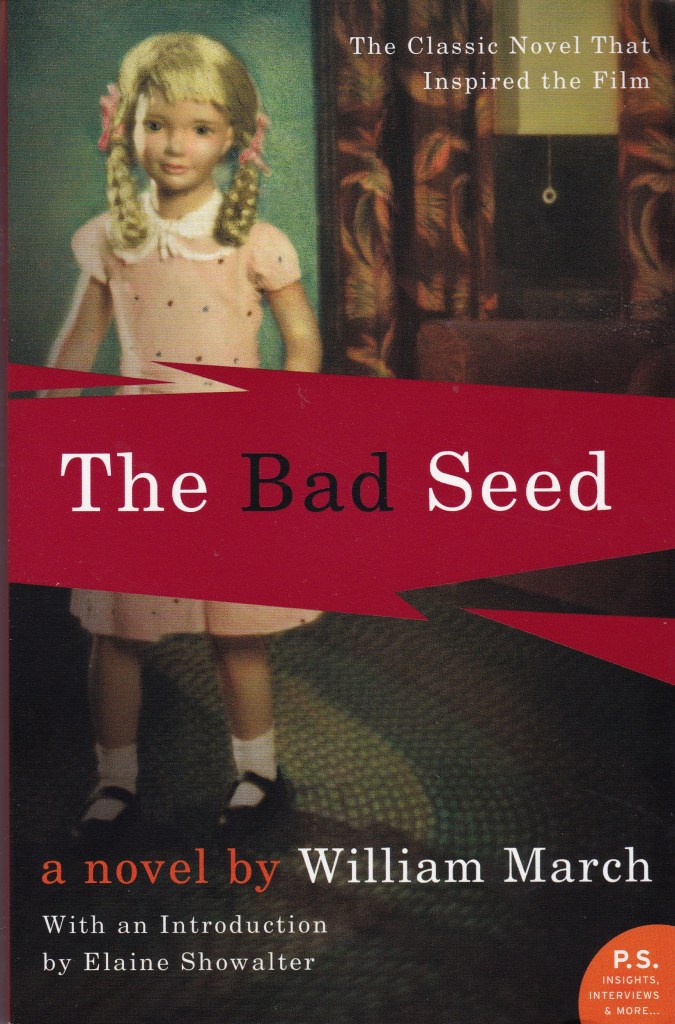
It was watching those afternoon movies where I first encountered The Bad Seed.

Later that summer, when Mrs Penmark looked back and remembered, when she was caught up in despair so deep that she knew there was no way out, no solution whatever for the circumstances that encompassed her, it seemed to her that June seventh, the day of the Fern Grammar School picnic, was the day of her last happiness, for never since then had she known contentment or felt peace.

The picnic was an annual, traditional affair held on the beach, an among the oaks, of Benedict, the old Fern summer place at Pelican Bay. It was here that the impeccable Fern sisters had been born and had lived through their languid, eventless summers. They had refused to sell the old place, and had kept it up faithfully as a gesture of love even when necessity made them turn their town house into a school for the children of their friends. The picnic was always held on the first Saturday of June since the eldest of the three sisters, Miss Octavia, was convinced, despite the occasions on which it had rained that particular day, and the picnic had to be held inside, after all, that the first Saturday of June was invariably a fine one.

If The Bad Seed has lost its ability to shock and horrify, it’s because in the decades since it was published (and adapted into both a play and film) the notion of a child being a killer has gone from being shocking to the general public to one that is kind of accepted; children do kill, and despite all the societal push towards sentimentality toward children. Rhoda is a sociopath, if not a psychopath; her inability to feel remorse or empathy or any other kind of human emotion is chilling to read about–she’s a stone cold killer, and clearly, she thinks nothing of killing to get something she wants: whether it’s the penmanship medal from her school, or a nice trinket promised to her, and then to shut up the janitor who sees through her and threatens to expose her; there’s a progression there. First she kills on impulse to get something she wants, then she coldly and calculatedly kills to protect herself. Rhoda is maturing as a killer, which is very chilling for the reader. The book is told entirely from the point of view of Rhoda’s mother, Christine–who is very slowly coming to realize, time after time, that her child is a monster, despite the innocence of childhood and everything we are taught to think, sentimentally, about children.

Psychology was starting to come into its own in the United States during the 1950’s, and you can see how crime writers took to psychology in that decade: The Bad Seed asks the question of nature v. nurture (although its answer is that it’s nature, genetic, and cannot be helped–and there’s some truth to that. I’m not entirely sure that sociopathy or psychopathy is learned behavior; are these cold-blooded killers born that way or are they creations of their environment? The solution Mrs. Penmark comes up with and executes in the novel is dramatically different from the film–the film had to abide by the Production Code, whereas novels had no such restrictions on them–and I believe the book’s ending actually works better than the film’s.

One thing that the book does brilliantly is depict the emotional turmoil and distress of the mother, slowly beginning to suspect and find proof that her child, that she loves so dearly, is actually a monster.

I first read this book when I was a teenager; I’d already seen the movie when I discovered the book on the shelves at the library, and so I checked it out and read it. I enjoyed it tremendously at the time–and it also had me watching other teens and young children for signs of sociopathy for a few years–and so thought it might be worth a revisit. It was, most definitely; it’s a bit dated, and of course the notion of a killer child isn’t quite so shocking as it was back during the Eisenhower administration–we’ve seen too many real life examples of this, and of course the trope of the killer child has been used, over and over again, in crime fiction and in films, so it’s not the brace of cold water in the face that it once was (kind of like how Beast in View by Margaret Millar was groundbreaking in its time–its still a great read–but what Millar did in that novel has been copied and imitated so much that it’s almost a cliche; one has to read these books with those sort of things in mind). Agatha Christie also used the trope of the sociopathic child (although in a quick google search it turns out Christie’s sociopathic child killer predated The Bad Seed; honestly, Christie did everything first).

It was a very pleasant reread, and as always, it’s interesting to visit (or revisit) books that were considered shocking in their time, only to have them turn out to be fairly tame–I’m looking at you, both Peyton Place and Valley of the Dolls–as well as to see how far the crime fiction genre has progressed. (I still consider Peyton Place to have a place in crime fiction, even though most people don’t. And while the crimes in the book may not be the driving point of the story, those crimes do impact everyone in the town in some way….there’s another essay to be written, probably after I reread the book at some point. It’s been awhile since I’ve revisited both Peyton Place and Valley of the Dolls….perhaps that can be my Christmas present to myself.

Seven

Saturday morning and it’s rather chilly in the Lost Apartment . The sun is shining and there aren’t many clouds in the sky–I see plenty of blue up there at the moment–and I haven’t checked the weather yet. All right, I just looked and it’s currently forty-nine, with a high of fifty-three predicted for the day. Sounds like the kind of day when one just wants to stay indoors all day and under a blanket, does it not? I have a lot to get done this morning–the sink is full of dirty dishes; more than will fit in the dishwasher, so I am going to have to do two loads–and of course, there’s filing to do and organizing to be done; notes to be read on the work-in-progress as well as chapters to be revised; and I’d like to be able to read some more of The Bad Seed, if not finish reading it today. LSU is playing Alabama tonight, and it’s not going to be pretty, but at least it won’t be disappointing. It’s very weird, there’s always a minor hope, even in bad years, that we might beat them, but not this one. I love my Tigers and I’ll tune in–but I am under no illusions that they’ll pull off a major upset here. Our only hope is a sustained three and a half hour miracle, really; but this entire football season has been such a wash anyway–I really think it should have been skipped, which is what I’ve thought all along–yet here we are.

I do occasionally think that LSU having one of the greatest football teams and seasons of all time last year somehow broke the world, and if LSU having a shitty season is what it takes to reset everything, I can live with that sacrifice.

Yesterday was a good day. I had to swing by the office because I had run out of lube for the condom packs–I brought home flavored–so I had to swing by there to pick up regular lube tubes–and then after returning home, I made condom packs while watching Logan’s Run, yesterday’s entry into the Cynical 70’s Film Festival. I had never before seen it; I, of course, remember what it’s plot was–a world where everyone dies at thirty; the title character is about to turn thirty and he runs. Well, turns out that was a vast over-simplification; Logan, played by a stunningly beautiful young Michael York (I’ve waxed euphoric over his beauty before; I had a major crush on him throughout the 1970’s; have continued to appreciate his work as I got older; and he came to the Williams Festival one year, so I not only got to meet him but was delighted to find he was very charming), is a “sandman”–in the future, after over–population and depletion of resources and so forth, society collapsed and a utopian human city was built under a dome, and all humans devote themselves merely to pleasure, and when they turn thirty, they are renewed; in a ritual, everyone gathers to watch them sacrifice themselves, to be reborn–someone has to die in order for someone to be reborn. The “sandmen” are those who hunt down the ones who decide they want to live and run for their lives. When caught, they are killed and are dead forever–no chance of being reborn. Logan actually has about four years left before he turns thirty, but he is given the job to search for Sanctuary–a place all the runners try to get to safely–and the controlling computer also speeds up his life, turning the life clock in his hand all the way up to almost time for him to die. Jenny Agutter plays the love interest who can help him get to Sanctuary; they run, and it becomes very weird once they escape. The special effects are pretty bad–the movie was pre-Star Wars–and so are the sets and costume designs. It does, I decided, fit into the film festival because the film itself is kind of cynical; it basically took American youth obsession and created a world based entirely in youth; and it’s interesting they chose thirty as the end point of life–after all, the youth movement of the 1960’s always said “never trust anyone over thirty.” As I watched, I couldn’t help but think of all the possibilities they couldn’t explore in a two hour film–and thought, you know, this show could easily rebooted as a mini-series that could go into all of those explorations–the collapse of society, who built and created this new world, who actually is in power in this utopian paradise, how did they get the initial buy-in necessary–and so on and so forth. And with our country growing evermore obsessed with youth and beauty–yeah, this could be really good. Logan would be a good role for someone like Nick Jonas or Alexander Dreymon or any number of beautiful young actors in the business today.

The lovely thing about HBO MAX is they are continually adding more and more films to their TCM app–you can only imagine my delight to see the delightful Peter O’Toole film The Stunt Man was recently added; The Ruling Class is already there. I am a huge Peter O’Toole fan–the fact the man never won a competitive Oscar despite giving career-defining performance in those two films, along with My Favorite Year, The Lion in Winter, Becket, and Lawrence of Arabia never ceases to amaze me. Both The Stunt Man and The Ruling Class certainly fit into my Cynical 70’s Film Festival–they have also added the original The Omega Man and Soylent Green, both of which I intend to watch despite the fact both star Charlton Heston, the king of over-acting. But…both definitely belong in the Festival, and I really wish they would add Serpico.

I also would like to watch Cruising again–to see it from a present day perspective.

The Mandalorian continues to delight as well, and our favorite raunchy junior high puberty comedy, Big Mouth, also came back yesterday.

And on that note, I am heading into the spice mines. Have a lovely Saturday, Constant Reader.

Style

Friday morning, and I had an absolutely lovely night’s sleep, thank you for asking. It’s the final day of the work week, the weekend looms, and as always, I have a million and a half things to get done before Monday. I somehow managed to fall behind on the writing again–by the time I was finished with my work-at-home duties yesterday I was exhausted again–and as such, didn’t write another word. So I need to get my writing going again today, knowing I am at least two chapters behind that need to be caught up, and yes–NO PRESSURE THAT AT ALL, is there?

I have some copy edits for an essay that dropped into my inbox this morning, which shouldn’t be too terrible an issue to deal with over the course of the weekend–then again, I’ve not really looked at them, either, so it could be absolutely horrifying once I open the document–but again, I don’t see that I won’t be able to get caught up on everything that must be done this weekend. What I really need to do is make a to-do list; I’ve been meaning to all week and yet somehow have not managed to get around to it yet. Gah. But that’s the kind of week this has been; 2020, after dragging all fucking year, seems to have now speeded up time now that it’s coming to a close, continuing to prove itself to be a shit-bag of a year.

Given how much optimism we all had for 2020 and what we ended up receiving, I am a bit afraid of 2021, to be completely honest.

I did manage to get some things done yesterday, and I managed to watch Superman whilst making condom packs yesterday; the 1978 version with Christopher Reeve. I hadn’t seen the movie in years–I saw it originally in the theater and then watched again when it was on HBO in the early 1980’s–and wasn’t really prepared for the impact it would still have, many years later, on a rewatch. As I watched, my nimble hands breaking off condoms in groups of four and shoving them into little plastic bags, along with a packet of lube and instructions on how to properly use them, I found myself catapulted backwards in time and remembering the time period. The movie’s slogan was You will believe a man can fly and you also have to remember the late 1970’s was when films–and special effects–were changed forever after Star Wars and Close Encounters of the Third Kind. Superman was the acme of super-heroes; perhaps the most famous, the most loved, and possibly the very first comic-book hero with superpowers, and bringing him to the big screen with a huge budget and special effects to make it look like he actually had powers was a huge deal. It was a huge hit, set the stage for several sequels, and showed Hollywood that comic book heroes were big-ticket items–it can easily be argued that there would be no MCU, no Arrowverse on television, and no Batman movies had there never been Superman first. The first sequel was also a huge hit, but the franchise began to run out of steam with the third, and the fourth was misbegotten from the very beginning.

On this rewatch, Christopher Reeve was even more perfect than I remembered, and Margot Kidder, whom I always believed was miscast, actually fit the role much better than she had in my memories. But what made the movie work–just as how the Patty Jenkins Wonder Woman worked–was how Reeve, at that point a complete unknown whose biggest role had been on the soap Love of Life, fit the role like a hand in a glove. He looked the part, had the right body for the part, and he just was Clark and Superman–and the physical differences between the two different characters–entirely dependent on how Reeve held himself, stood, and his posture–I could see how you wouldn’t see one as the other. Obviously, there were some flaws–how on earth did Lois Lane afford a penthouse with that glorious view and patio deck on a reporter’s salary? How did reversing the Earth’s spinning turn back time so he could save Lois–and didn’t turning the clock back change a lot of other things as well? DC was still in its Golden Age–the Crisis on Infinite Earths reboot was still some years in the future–and so this film fits into that comic book era; they were trying to update the comics and giving their characters more of modern flare and new costumes for the most part at this time, before realizing their universe was so convoluted and confusing they needed to start over. This was the period when Wonder Woman had gotten rid of her powers; when Supergirl was poisoned, which led to her powers becoming unreliable and actually coming and going beyond her control; when two more Green Lanterns turned up on earth in addition to the original; and Green Arrow going more in a Batman-like grim direction.

But it was an uplfiting movie, putting a clear-cut hero on the screen, and it is to Reeve’s credit that he made Superman’s integrity, code of ethics, and kind concern for all humanity from a two-dimensionality to a fully fleshed out, completely believable character that you root for. The John Williams score was excellent, and it really was perfectly cast–I apologize to Margot Kidder for hating her performance for all these years. It was also interesting to see the New York of the 1970’s (passing off as Metropolis), and remembering the way the culture saw the city in that decade (the Cynical 70’s Film Festival has also done a really good job of this); in some ways the perception of New York hasn’t really changed much since then, but it isn’t the same city today that it was back then. It was, I think, in the latter half of the 1970’s that Hollywood began to turn away from the cynicism of the decade and began making movies with happy endings or that were more uplifting in general–Star Wars, Superman, Rocky–the melding of those polarities in film deeply influenced the films of the 1980’s.

And on that note, I am heading back into the spice mines. Have a lovely day, Constant Reader.

Love Story

Thursday morning, and I am working from home today. I have some errands that simply must be run this morning–fortunately I only have to work a half-day today–so once I get this posted and get my own act together, it’s off to the errands so I can come home and do data entry/make condom packs. I think I am going to rewatch the Christopher Reeve Superman–it’s a 1970’s movie, after all, and I don’t know yet if it will deserve a place in the Cynical 70’s Film Festival; I don’t think so, but I think it could be a fun reread while working with my hands.

I was very tired when I got home from work yesterday–so tired that I skipped the gym (!) and didn’t work on the book. Tonight when I finish my condom packing I am going to have to get back to the book, and figure if I can get two chapters done in one day I’ll be back on schedule. LSU’s lamb-to-the-slaughter game against Alabama isn’t until Saturday evening, so I should be able to get several chapters finished during the day that day, and maybe even more. Who knows? There’s a plethora of possibilities.

I slept late this morning–I did wake up at six, again at seven, and finally at eight. I feel much better: very rested, relaxed, my muscles feel good, and my back also doesn’t hurt at all. This is, needless to say, quite lovely, and while it is cold this morning, the cold is nowhere near as bitter as it was the last few mornings, so I can handle it. I haven’t even put on a cap to keep my head warm, which is a lovely thing. It’s very gray outside–the sky is covered with clouds, so it’s kind of grayish-gloomy; like winter mornings I remember from my childhood in the Midwest. I ordered electric blankets the other day–a friend on Facebook suggested it when I was complaining about the cold, and had one of those wow it never ever occurred to me to get electric blankets moments when I truly wonder about my intelligence and intellectual capacity. But in fairness to me, I don’t think I’ve ever owned an electric blanket, and we certainly didn’t have any when I was growing up….but thinking about it this morning, what a difference that could have made that bitterly cold winter I spent in Minneapolis twenty five years ago….

I am still reading both The Bad Seed by William March and Lincoln by Gore Vidal; obviously I was too tired last night to make any headway on either. Paul and I did watch an episode of something that might turn into a guilty pleasure for us….Cajun Justice, about the sheriff of Plaquemines Parish. Louisiana was an enormously popular location for reality television shows back in the day–remember Duck Dynasty?–and since one of my co-workers is moving to Plaquemines Parish (Houma, specifically) she was the one who found this single season reality show…when she mentioned it to me the other day–when we first talked about her move down there, and it’s been a couple of weeks; it was around the time I was looking up Cajun/Louisiana folklore for a potential Christmas horror story, which is when I was finding all those wonderful bayou supernatural legends, like le feu follet and the lutin…which I was able to look up in Gumbo Ya-Ya. The show is kind of, I don’t know, offensive in some ways, as it depicts Cajuns and their culture as an exotic thing; lots of talk about voodoo and black magic and so forth. (This is part of the problem I had with writing about Cajuns and the supernatural; I’m afraid I’ll give in to the stereotypes rather than depict the culture and the people authentically.) I mean, I do want to write short stories illustrating Cajun culture and their interesting folklore and legends (Monsters of Louisiana), but I also want to do it correctly. Gumbo Ya-Ya is an excellent source material, a great starting place, but I am also very aware that its authors were also steeped in the white supremacy and racism of the time in which they wrote and compiled the book, which also makes it harder to decipher what is real and what isn’t.

All right, I’ve got dishes to put away and laundry to fold before I hit the errand trail, so have a happy Thursday, Constant Reader, and I’ll check in with you later.

Welcome to New York

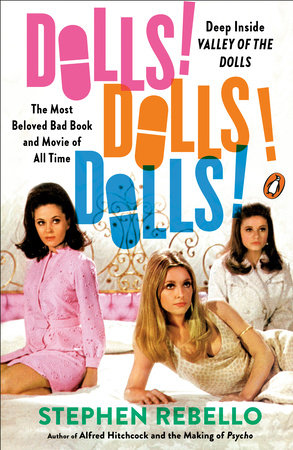
I love Valley of the Dolls.

I love Valley of the Dolls unequivocally. I’ve loved it since the first time I read the book, and every time I’ve reread it since that first time. I’ve watched the movie a dozen times–even if the first time I just stared, mouth agape, not believing what I was seeing–and I watched the televised mini-series remake in the 1980’s, and interesting casting choices aside, found it interesting. (There’s really a terrific article, essay, or book about all those glamorous, soapy mini-series that literally defined the 1980’s waiting to be written…)

When I was younger I was also really into the whole Hollywood thing; movie stars, Hollywood history, scandals, celebrity culture. I read a lot of biographies and memoirs of old Hollywood, watched tons of old movies (still do, in fact) and while I never really considered writing any Hollywood histories or star biographies, it was more of a hobby than anything else; just another one of my many interests. I love these books that talk about how movies get/got made (Sam Staggs has done some of these with some magnificent films–he’s covered All About Eve, Sunset Boulevard, A Streetcar Named Desire, and Imitation of Life), and so when I discovered there was one about the making of Valley of the Dolls, how could I resist? (And at some point, I would love to write a book of essays about what people consider trashy books, called Guilty Pleasures.)

The book is quite a fun read. It opens with a history of Jacqueline Susann’s life–she was, indeed, fascinating on her own–and her marriage; how she came to write her first book, Every Night, Josephine!; and how she had always wanted to be a star of some sort, and finally decided she would become a famous author, and started writing Valley of the Dolls. She succeeded far beyond her wildest dreams; the book sold a ridiculous amount of books and made everyone involved a fortune, so inevitably of course it was made into a film. (Again, another wormhole from reading the book–how fantastic would Liza Minnelli have been in a production of Mame in the 80’s or 90’s?)

Much as I love the film, the story of 20th Century Fox and the feuding father-son Zanucks for control of the studio in the 1960’s would also make a fucking fantastic book–as well as examining the studio’s films during the period; everything from disasters like Cleopatra and Dr. Dolittle to The Sound of Music, as the studio went from near bankruptcy to rolling in cash to bankruptcy again.

And I do love the film, even though it is flawed, not well done, and not well-written. For me, the strength of the book is the relationships between the women–particularly Jennifer, Anne, and Neely–and really, the book really is about how difficult it is to be a woman in show business. Helen Lawson is the cautionary tale of the star-monster, and Neely’s story is about how one become a star-monster. The character of Neely is a masterstroke, really; the sweet uneducated young talent whom everyone takes advantage of because of her naivete, who then grows into yet another Helen Lawson-like monster. This makes her betrayal of Anne in the final third of the book more meaningful and powerful; the elimination of the closeness of the women from the film robs it of its emotional heart. Having the movie end on a hopeful note was a mistake, if an understandable one; the sad ending of the novel, with Anne caring less and less about Lyon’s infidelities and gradually becoming addicted, like Neely and Jennifer before her, to the dolls to get through the day. I also thought them cutting all the stuff about Anne’s “fiancee” and his father Gino being chased after by Helen–as well as Anne and Helen’s weird friendship–also undercut the emotional impact of the story; the falling out between the two of them was also integral to the plot.

But I do enjoy the movie, even as I appreciate how badly it’s done. (in the book, Rebello at one point refers to its popularity as a camp classic, playing to audiences who shout out the lines with the characters, and says that it’s kind of ‘the gay Rocky Horror Picture Show’–which begs the question, um, what do you think Rocky Horror is?

If you’re a fan of the movie and/or the book, you will probably enjoy reading this book. I highly recommend it; it’s quite gossipy and fun, and it’s always interesting to see how the sausage gets made.

And Valley of the Dolls frankly needs a mini-series remake that is more true to the book. Have fun would it be to see someone like Patti LuPone take on the role of Helen Lawson? Songs by Stephen Sondheim? Margot Robbie as Anne? Lady Gaga as Neely? Peter Skarsgaard as Lyon? Darren Criss as Tony Polar? Natalie Dormer as Jennifer?

Ah, one can but dream.

Lover

And now it’s the day after the holiday, where Americans ignore all sanity and safety precautions and slam into stores long before sun-up for bargains and to get their Christmas shopping finished. I don’t know if this is actually happening this year or not–I flatly refuse to participate in the nonsense of greedy consumerism (the antithesis of the holiday they intend to celebrate) known as Black Friday; for years, this was the day I drove home to New Orleans from Kentucky. In these pandemic times, I have not bothered to find out what the retailers are planning or planned in terms of safety and so forth; there was no need for me to know, frankly, and at some point today I’ll go to some news sites and see the horrors that transpired for myself.

No thank you.

I finished reading The Hot Rock yesterday, which I enjoyed very much, and then moved on to Night of Camp David, by Fletcher Knebel, which is also interesting. Knebel–I don’t know if anyone else remembers him, but he used to write political thrillers back in the 60’s and 70’s (probably the best known work of his would be Seven Days in May, primarily because it was also made into a film, and the subject–the US and the USSR on the brink of nuclear war–was timely and always in the back of everyone’s mind, right up until the day the USSR collapsed). I’ve never been a big fan of political thrillers, to be honest–political fiction has never really interested me too much, primarily because the reality is too much like fiction as it is, and for another, so much world building to do, even if you simply take the US government and political system as it is and simply graft your story and characters onto it–even if you use the actual history as the history of your new world. Paul and I avoided The West Wing for years for this very reason–why get vested in a fictional world of American politics when the real world is right there in front of you all the time–but we discovered it one day when Bravo used to do the marathons all the time, and went back and watched it from the beginning, and it remains one of our favorite shows of all time.

So, it’s entirely possible I would thoroughly enjoy political thrillers after all–I’ve certainly enjoyed, or at least never minded, when thrillers (like those of Robert Ludlum) brushed up against reality or created their own fictional American political world.

Like I don’t have enough to read already, right?

I was reminded of Knebel and his work back sometime during the past four years, as some website (maybe Crime Reads?) did a piece on this particular book, which had returned to print, and focused on a president who was losing his sanity, and the only person who really was aware is the first term, junior senator from Iowa, whom the president has taken a liking to, and keeps inviting to Camp David for late night conversations where the president tells him his insane, Fascistic intentions for his second term. (Yeah, can’t imagine what triggered the publisher to bring this back into print, can you?) I had never read Knebel back in the day, but reading this piece made me curious, not only about this book but about Knebel in general. The Cynical 70’s Film Festival has also reminded me of the deeply cynical political fictions of the time (I really want to read The Manchurian Candidate)–so many thrillers set in or around politics back in the day–and, of course, conspiracy theories flourished. (The true heyday of the JFK conspiracy theories was clearly the 1970’s.)

All in all, yesterday was a highly enjoyable, relaxing day; today will be more of the same. Sure, I did some cleaning–I cleaned out two of my kitchen cabinets, reorganizing them to make them more functional–and of course i made a turkey roast in the slow cooker, which was quite marvelous. We finished watching season one of Mystery Road, which was quite good, and then moved on to the first three episodes of the HBO MAX series, The Flight Attendant, which was based on a Chris Bohjalian novel, and stars Kaley Cuoco of The Big Bang Theory in the lead. Cuoco is tremendously appealing and quite talented. Working the first class cabin on a flight to Bangkok, she becomes involved with one of her passengers, played by Michiel Huisman, and agrees to go to dinner with him in Bangkok. She blacks out during the evening–she’s an alcoholic and in severe denial about it–and wakes up next to his bloody, dead body (his throat was cut) and has absolutely zero memory of the evening before. It’s an interesting mystery, and as I said, Cuoco is terrific in the lead, and is surrounded by a terrific cast.

There really aren’t enough books–particularly crime thrillers–built around flight crews, frankly. I kept thinking about that last night as I watched; I have a short story in progress about a gay flight attendant called “The White Knuckler”, which I’ve never finished, and it also reminded me of how much I love the Vicki Barr Stewardess mystery series for kids.

So, what’s on the agenda for today? At some point I need to get to the gym, and of course the kitchen is in ruins. I am probably going to clean up the mess in the kitchen this morning, then move onto my easy chair to read some more, and then I am going to write all afternoon before going to the gym. Since we watched all the episodes of The Flight Attendant that are currently available–there won’t be a new one again until Thursday–we’re going to need to find something else to watch tonight to entertain us. Which can sometimes prove challenging, but there are worse things.

Have a lovely day, Constant Reader.

Treacherous

Tuesday morning, and. the second day of paid vacation leave. Yesterday was a pretty good day, all in all–I didn’t get nearly as much done as I would have liked; but I did get some things done and progress was made. I also went to the gym, which was lovely; I actually identified which exercise I was doing that was causing my back to be sore–and frankly, it was one I didn’t like to do–so I eliminated it and substituted another one. My back is still a little sore today, but nothing like it was before and in fact, last night it didn’t hurt at all. So, again–progress.

“The Rosary of Broken Promises” now sits at a solid three thousand words, and in all honesty, I am just vomiting up on the page and will worry about cleaning it all up later. It’s going well–definitely will require revision and rework; as I said, I’m just kind of feeling my way through the story and figuring out who my main character is (and resisting the urge, which is constant, to turn it into the opening of another stand alone novel) and why he is who he is; the story, ostensibly a poor family’s Christmas story, has already taken a much darker turn than I’d originally intended. But it fits, it works, it makes the story darker and richer and more personal than what I was originally thinking when I sat down to write it. It’s definitely not right for that anthology call that inspired me to be writing a Christmas story to begin with, and seriously, I am not sure where it might be right for (always a problem with writing short stories–figuring out where to sell them) but I. like the story a lot and, as always, my worst case scenario would be another short story collection of my own.

And being creative, actually writing, is fun.

We finished watching Le Manti last night. I won’t spoil the ending for anyone, but I was very disappointed with the incredibly lazy way the writers came up with for who the copycat killer actually was; it was a stereotype thing which has been already debunked, discredited, and is incredibly harmful. Then again, it was a French show and I don’t know how things work in France when it comes to things like this. It was quite a shame, because this laziness was unexpected, given the care they had taken with the story, the characters, and their past histories–and their current relationships. It’s a shame, because overall I enjoyed the show until that point and would happily recommend it, but now I feel like I can’t. Maybe they thought they were being edgy; I don’t know, but it was still terribly disappointing, especially in 2020.

Today I have some more errands to run–Paul wants to go to Costco (I knew he would become an addict the first time I took him there) and I have a prescription to pick up, and there’s a way to do all of this (and a few others) in a nice timely and efficient manner, which is always lovely. I don’t have to go to the gym today since I went yesterday, so other than that excursion, I’ll be home for most of the day, so there’s no reason I can’t write, read, and clean all day.

Other than utter laziness, of course.

I think tonight we’re going to watch that Sarah Paulson Hulu film, Run, which is another take on the Gypsy Blanchard thing–the mom who has Munchhausen’s by proxy and is making her child ill–but it’s done like a horror film rather than a drama, which is an interesting twist that I like an awful lot–although the concept of chronically sick children turning out to have been made ill by a psychotic caregiver is slowly turning into a stereotype.

And on that note, tis time to get back into the spice mines. Have a lovely day, Constant Reader.

Big Star

Sunday morning, and all is well–as well as it can be, at any rate–in the Lost Apartment. The Saints play the hated Falcons today at noon, with Taysom Hill–he of the sparkling blue eyes, the shredded muscular body, and the big warm infectious smile–getting the start as quarterback in place of Drew Brees, who is injured with broken ribs.

LSU eked out a win yesterday over Arkansas by partially blocking a field goal attempt in the closing minutes, 27-24, but with the only games left being Mississippi (it really requires effort not to say Ole Miss), Texas A&M, and Florida left to play, and a possible rescheduling of the Alabama game (still to be determined), means a losing season is still hanging in the balance. Alabama and Florida are both ranked in the Top Five, and none of those remaining games are going to be easy. They could easily go 0-4; 4-0 is unlikely; 2-2 is possibly the best we can hope for, which would leave the Tigers 5-5 on the season. The officiating in the game yesterday was absolutely terrible–not biased; the calls both for and against LSU were constantly questionable (some of the things that weren’t overturned were astonishing in retrospect).

I got some things done yesterday–the early game time for the Tigers certainly helped in that regard–did some serious cleaning, which was absolutely necessary, as well as some deep filing, which was enormously helpful. I discovered that, much to my surprise, my novella “Never Kiss a Stranger,” actually began as a short story called “A Streetcar Named St. Charles”–which, obviously, I ditched once I wrote a story called “A Streetcar Named Death”–and what was interesting about finding the original story was that I originally intended for my main character to meet the love interest on the streetcar; I think that’s still going to happen in the new version I am doing, but not quite in the same way (plus, that was also how I started “A Streetcar Named Death'”–a chance encounter on the streetcar, so yeah, changes). Some of what I wrote can still be used, of course, in the newer, improved version I have in progress, but what was truly amazing was how completely I’d forgotten the original.

I also started writing another story that formed, somehow, in my brain as I cleaned and filed yesterday: “The Rosary of Broken Promises.” If you will recall, I had started my story for the Christmas horror anthology, “To Sacrifice a Pawn” (really love that title) and then decided I didn’t have enough time to write it and do a really good job….so of course, yesterday I began to form another idea, drawing from the mists of my brain a similar opening as the “Pawn” story, but with a different tone, mood, and main character, and the newer idea was much darker than the original. I love this new story’s title as well; because of course I don’t have enough work in progress already (eye roll).

My back is still sore–I’m not sure what the hell I’ve done to myself, but I’m also not entirely sure it’s a muscle strain issue. I mean, it easily could be, but I am still going to the gym regularly, and it doesn’t affect the exercises I’m doing, nor does it make any of the exercises impossible. In fact, usually after I work out it doesn’t hurt at all, and it takes a while–usually overnight–for it to come back with full force. Yesterday I was aware of it, wincing periodically, with it getting worse the later in the day it got; this morning it is really miserable. Today I am going to use some heat on it with the heating pad; slather it with Icy Hot, and am going to use the yoga roller on it to try to loosen it up.

And of course, periodically I have those “creative mind” moments like, what if it’s something serious, or you had a mini-stroke or something and don’t know it?

A creative mind is truly a curse sometimes.

We watched a delightful film with Sir Ian McKellan and Dame Helen Mirren yesterday, The Good Liar, which wasn’t anything like I expected it to be; for some reason I had gotten it into my head that it was a comedy, and it was anything but a comedy. It was a very dark story about the sins of the past and swindling–very well written, with some terrific surprises in it and some truly terrific acting; Russell Tovey also was good in a supporting role as Dame Helen’s suspicious grandson–and I am surprised this film didn’t get more attention, particularly from fans of crime fiction. Very twisty, very interesting, and very well done. We then moved on to a French limited series, Le Manti (The Mantis) in which a present day serial killer is copying the crimes of a confessed serial killer who has been in jail for twenty-five years–and the serial killer is a woman. Played creepily by former Bond girl Carole Bouquet (For Your Eyes Only), the Mantis offers to help the police catch the killer, a la The Silence of the Lambs, with only one stipulation: her liaison with the police has to be her son, who is now also a cop. Very twisty, very creepy, very well plotted, we tore through three episodes of it last night. I do recommend it, even if there are some plausibility questions. And how nice to see Carole Bouquet so many years after her Bond girl days, still strikingly beautiful as an older woman, and with much stronger acting chops than in her days scuba diving with Roger Moore in the Greek islands.

And on that note, tis time to get back into the spice mines. Have a lovely Sunday, Constant Reader–will check in on you again tomorrow morning.

How You Get The Girl

Friday morning and all is right in my world–at least so far so good, one would think.

The weather has been truly spectacular here these past few weeks–despite dipping into the “almost too cold for Gregalicious” category after the sun goes down–and I’ve been really enjoying it. LSU is playing tomorrow–although I don’t have very high hopes for the game, since the program is now in turmoil, not only from having a surprisingly bad season but from allegations of sexual assault from players and ensuing cover-ups, which is despicable, frankly–and of course the Drew Brees injury has things looking rather bleak for the Saints as well. Ah, 2020 football season–so much worse than I’d ever thought it could be for fans in Louisiana. Heavy heaving sigh.

I reluctantly came to the conclusion yesterday that I am not going to try to get my story finished for that “monsters of Christmas” anthology. Much as it would be fun to be in the book if accepted, while the pay would certainly be lovely and welcomed, and I also loved the idea of trying to get a story written and publishable (maybe) in such a short period of time–despite all of those things, I really shouldn’t take time away from either the book or the other story already in progress that is developing nicely. It’s not the smartest thing in the world to do, and can I really spare the necessary time to get it done? Probably not, so while I am not crossing it off my to-do list entirely, I am not going to pressure or push myself to get it done.

My back is still sore this morning–but sitting in my easy chair with the heating pad while making condom packs certainly helped dramatically. I’m still not entirely sure what I did at the gym to cause this soreness, and the last time I went to the gym I didn’t feel it getting worse as I went through my workout, so who the hell knows? More heating pad today, and hopefully when I go to the gym later it’ll be okay.

Yesterday I watched two films while making condom packs, and while both fit squarely into the Cynical 70’s Film Festival, the other also crossed over, theoretically, into the Halloween Horror Film Festival–or would have, had it not been so incredibly terrible.

The first was Deliverance, which was an enormous hit on its first release, made Burt Reynolds a bonafide movie star, and has added so much to the common vernacular that people probably quote it without knowing the source material. While I knew the whole “squeal like a pig” thing came from Deliverance, I did NOT know “he’s sure got a pretty mouth” also came from the film. My parents took my sister and I to see it at the drive-in (and in retrospect, what in the name of God were they thinking? That movie is definitely inappropriate for junior high school students), and while I do not recall the other movie that played with it (which might have explained the choice better), I was pleasantly surprised in some ways by Deliverance. For one thing, it’s beautifully shot in the back woods/mountains of Georgia–breathtakingly beautiful. James Dickey wrote the screenplay based on his only novel–he was primarily known as a poet, and was also an alcoholic–and I’ve tried several times to read the book; I have a copy on my shelves somewhere right now. The film definitely fits in that paranoid 1970’s sub-genre of city people discovering how truly terrifying the country can be, despite the entire American mythology of the country and rural communities being the real America (which still rears its ugly head from time to time today). I could write an entire essay debunking that myth, frankly, as I am rather surprised no one has ever written (doesn’t mean someone hasn’t) an essay or a treatise about this entire sub-genre of film and fiction novels.

Deliverance is also an interesting exploration of 1970’s masculinity; the concept of masculinity, and what is traditionally masculine, was already starting to change and shift around the time the book was written and the film made; in its four characters we see the four masculine archetypes of the time, and how they compare/contrast with each other. The basic premise of the story–a river is being dammed to create a lake, and the dam will provide hydroelectric power for Atlanta, while the lake will flood towns and force communities to relocate away from land held in their families for generations, so these four men decide to canoe down the river one last time in a kind of “back to nature” type weekend thing that was becoming more and more popular with city-dwelling men whose city lives were beginning to make them think they were soft. Burt Reynolds, with his rubber zip up sleeveless vest, with the zipper strategically unzipped enough to show off the thick black pelt of hair on his chest, stood in for the masculine ideal; a strong man who, despite living in the city, only truly comes alive when pitting himself against nature in a game of survival; he is also the only member of the party who understands the dangers of the wilderness–the other three men in the party all think of it as a fun lark. He keeps referring to the Ned Beatty character as Chubby–he’s out of shape and not as fit; out of his element in the wilderness and often complaining and unable to meet the physical demands of the trip. Jon Voight, still at the height of his blonde youthful beauty, is prettily masculine–overshadowed by Reynolds’ machismo, but able to rise to the occasion and do what needs to be done. The fourth member of the trip–played by Ronny Cox–is yet another soft city type, definitely out of his element; while not seen as useless as the Ned Beatty type, also not as useful in a crisis as he could have been. The film’s bottom line is ultimately about survival, and who will survive when a fun weekend goes wrong. Deliverance also plays into a lot of the stereotypes about poor rural Southern white people–in fact, I would go so far as to say that Deliverance is responsible for cementing a lot of those stereotypes into the public consciousness. It’s a very good, if slightly bizarre, film; it certainly has to be one of the first films to depict male-on-male rape (and that’s one of the flaws in the film; why on earth did that happen? Why did the two rednecks attack them? Maybe it makes more sense in the book), and one of the reasons I always wanted to read the book was to see if there was more information, more explanation, to make the story work better. But I never have been able to get past the first chapter–Dickey was also one of those hard-drinking macho bullshit Hemingway-type writers, oozing with toxic masculinity, and that really comes through in the first chapter of the book, which is as far as I’ve ever gotten without putting it aside with a wince. But there’s an interesting essay to be written about masculinity and how it is portrayed in the film; reading the book and including it, with a comparison/contrast, could be enlightening.

The second half of my double header was Damien: Omen II, which is now available on Amazon Prime–but wasn’t back when I rewatched The Omen and The Final Conflict, the third part of the trilogy. Damien is just a bad movie, from beginning to end; it opens shortly after the conclusion of the first film, and the archaeologist in the Holy Land, Bugenhagen, telling a friend that Damien Thorn is the anti-Christ, proving it by showing him a newly excavated wall where a medieval monk who was visited by the devil and went mad, painted the images the devil showed him; amongst those images are the anti-Christ at numerous stages of his life–and he looks like Damien Thorn. Bugenhagen also has the ritual daggers that must be used to kill Damien…which is interesting, since he gave them to the Gregory Peck character in the first film, who was trying to use them at the end when he was killed; how did the old man get the daggers back? Was there more than one set? The rest of the movie is about Damien slowly learning who he is, while people continue to die around him, including his cousin/best friend. Damien was taken in by his father’s brother and his second wife, played by William Holden and Lee Grant (and just like in the first film, they are way too old to have thirteen year old sons), and the movie makes no sense, isn’t scary in anyway, and just really comes across as a pale imitation of the first, which wasn’t very good to begin with.

I also read a short story last night, from The Darkling Halls of Ivy, and while I did enjoy reading the story, “Einstein’s Sabbath,” by David Levien, in which a Princeton student after the second world war, one who was on the ship that sent the planes with the atomic bombs to Japan, comes to Professor Einstein’s home to blame him for the use of the bombs, and their creation. It’s an interesting story, but like the Jane Hamilton, not really a crime story per se; which is the only real problem I had with it.

And on that note, I am heading back into the spice mines. Have a lovely Friday, Constant Reader.