Walking on the Moon

 When I wrote the introduction to Night Shadows: Queer Horror, I talked about the similarities between crime fiction and horror, as a means to explain how two crime writers (myself and the incomparable J. M. Redmann) found ourselves editing a horror anthology. Make no mistake; there are a lot of similarities between the two genres. Both, for example, are concerned with death and to no less a degree justice; there’s almost always a mystery involved in a horror novel–primarily as the main characters try to figure out what is going on and what they can do about it, but still. So-called slasher films/novels are really just the horror equivalent of serial killer stories; The Silence of the Lambs notably was both crime and horror. I’ve always been interested in both, although I lean more to the crime side, since I really don’t have the imagination or creativity to write horror (or much of it, anyway; and everything I do write that is horror is undoubtedly horribly derivative).

The book I just finished reading, Dan Chaon’s Ill Will, manages to blur the line between horror and dark crime fiction as well. It is, in fact, one of the creepiest and darkest things I’ve ever read; definitely in the top ten, at the very least.

ill will

Sometimes in the first days of November the body of the young man who had disappeared sank to the bottom of the river. Facedown, bumping lightly against the muddy bed below the flowing water, the body was probably carried for several miles–frowning with gentle surprise, arms held a little away from his sides, legs stiff. The underwater plants ran their fronds along the feathered headdress the boy was wearing, across the boy’s forehead and war-paint stripes and lips, down across the fringed buckskin shirt and wolf-tooth necklace, across loincloth and deerskin leggings, tracing the feet in their moccasins. The fish and other scavengers were most asleep during this period. The body bumped against rocks and branches, scraped along gravel, but it was mostly preserved. In April, when the two freshman college girls saw the boy’s face under the thin layer of ice among the reeds and cattails at the edge of the old skating pond, they at first imagined the corpse was a discarded mannequin or a plastic Halloween mask. They were collecting pond-water specimens for their biology course, and both of them were feeling scientific rather than superstitious, and one of the girls reached down and touched the face’s cheek with the eraser tip of her pencil.

During this same period of months, November through April, Dustin Tillman had been drifting along his own trajectory. He was forty-one years old, married with two teenage sons, a psychologist with a small practice and formerly, he sometimes told people, some occasional forays into forensics. His life, he thought, was a collection of the usual stuff: driving to and from work, listening to the radio, checking and answering his steadily accumulating email, shopping at the supermarket, and watching select highly regarded news on television and reading a few books that had been well received and helping the boys with their homework, details that were–he was increasingly aware–units of measurement by which he was parceling out his life.

When his cousin Kate called him, later that week after the body was found, he was already feeling a lot of vague anxiety. He was having a hard time about his upcoming birthday, which, he realized, seemed like a very bourgeois and mundane thing to worry about. He had recently quit smoking, so there was that, too. Without nicotine, his brain seemed murky with circling, unfocused dread, and the world itself appeared somehow more unfriendly–emanating, he couldn’t help but think, a soft glow of ill will.

The book is about, ultimately, damage: how violent crime and trauma affects people, and how that damage can be passed along to the next generation.

When Dustin was a child, his parents, along with his aunt and uncle (two brothers married two sisters) were murdered while the kids slept outside the house in a camper, the night before they were all due to leave for Yellowstone. The blame fell on Dustin’s older, adopted brother, Rusty–in no small part to Dustin’s testimony and that of his older cousin, Kate–who claimed to have resurfaced memories of Rusty forcing them to participate in Satanic rituals (this was actually a big thing in the 1980’s), and Rusty was convicted and went to jail. Recently, DNA evidence over-turned Rusty’s conviction, and he was released. Dustin’s wife has recently died of cancer, and his youngest son Aaron is using heroin while pretending to go to college. And one of Dustin’s patients, a former cop, is convinced that young college boys are being kidnapped and ritualistically drowned by a cult of some sort, and wants Dustin to help him look into it. All of these disparate threads weave in and out of each other; interconnected yet causing more alienation for this complex and completely dysfunctional family as the book careens along to its ultimate denouement, a downward spiral of hopelessness and tragedy.

The writing is spectacular, and Chaon also plays with form and even typesetting to get the feel of the novel across to the reader; this can seem intrusive and distracting at times, but as you continue to read, this style creates an irresistible mood and drive to continue reading; as the Tillmans’ past, present, and future all seem to converge in on their lives and each other, it becomes almost hypnotic.

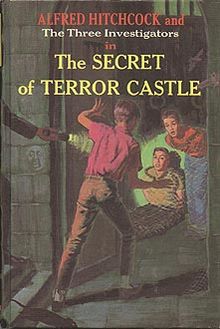
There’s also a shout out to The Three Investigators in the text, which I also loved.

This book is amazing. It reminded somewhat of Lou Berney’s The Long and Faraway Gone, which was sublime and one of the best novels I’ve read over the past few years. I highly recommend this…and can’t wait to read more of Chaon’s work.


1, 2, 3, Red Light

Friday morning in the midst of an unusual cold spell for New Orleans. It’s the second weekend of Jazz Fest, and the high today–and yesterday– was merely seventy one degrees. It’s in the frigid low sixties right now; but it’s going to be sunny and clear and lovely all day; no rain in the forecast for the weekend. I have some appointments tomorrow, but am going to stop for groceries on my way home from work tonight so I don’t have to deal with that tomorrow. I’d like to make some further progress on the WIP tomorrow, as well; hope to do so today, too.

As I have said lately, I’ve been thinking a lot about Alabama, primarily due to events I’ve done in that state this year (the first time I’ve ever done anything there). I have written short stories (full disclosure: only two have been published) set in Alabama, and only one book set there. Many years ago, I thought about doing a whole series of books set in Alabama, and all connected (what can I say? I was reading Faulkner) in one way or the other. I created a fictional town and county (thank you, Mr. Faulkner) and families and connections and the whole ball of wax, but never wrote any of them, of course. (I was always big on the ideas phase, not so much on the writing phase.) The town was Corinth, Alabama, and the county had the same name. Recently, as I’ve been doing research into Alabama history (when I’m between clients at work), those ideas have come back to me. Taylor, Frank’s nephew in the Scotty series, is from Corinth; Frank’s mother was from there and that’s the Sobieski connection to Alabama. My favorite short story of all the ones I’ve published, “Small Town Boy,” is also set there, and of course, when I started writing Dark Tide, my main character, Ricky Hackworth, was from Corinth–and somehow related to characters in the short story; we never know what the main character’s name is in the story, but the story focuses on his relationship with a Hackworth whose mother has just shot his father–“those trashy Hackworths.”

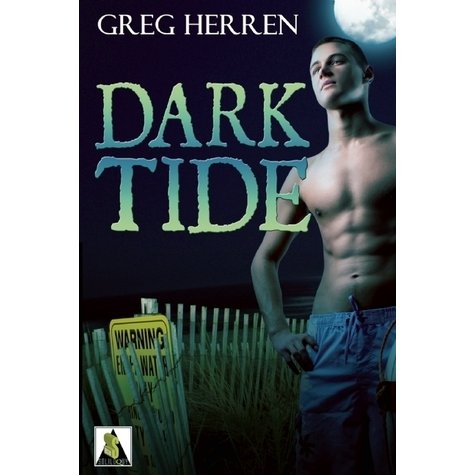
Dark Tide is one of my personal favorites of my books, and I think it’s partly because it was a return to Corinth. The book wasn’t set there–Ricky leaves Corinth for a summer job on the Gulf Coast of Alabama as a lifeguard–but Ricky was from there, and I was able to draw on the rich background I’d created for the town in my twenties as backstory for the book. I also tried to do something with the writing style that I’d never done before, which was mimic the pacing of swimming strokes with the pacing of the book. I don’t know if I succeeded, but I know some of the best work I’ve done is contained inside the pages of that book–there’s one particularly creepy scene where Ricky is swimming in the bay and he has this feeling that there are carnivorous mermen down in the depths of the bay beneath him as he swims, and then imagines it as he strokes through the calm morning waters. I also really liked the character of Ricky; he’s grown up relatively poor and motherless (the reader never knows what happened to his mother), and thinks back to how he is treated by the richer kids, how he is picked on for his suspected sexuality, how deeply closeted he is, and how he met, at a swimming camp his father could barely afford to send him to at the University of Alabama, he met and fell in love with someone who basically changed his life and helped him see that he wasn’t a freak. I loved the character of Ricky, and Dark Tide also is one of few novels I ever wrote that has a big twist that flips the story completely–there are hints, of course, I would never cheat–and I am very proud that I pulled it off.

The book was originally conceptualized and titled as Mermaid Inn. When I was a kid, I used to read comic books voraciously; I sometimes wonder how I found the money to buy as many comic books and kids’ series books as I did (I tend to suspect, now that I am in my fifties, that I was a great deal more spoiled as a child then I thought I was). DC Comics used to publish two comics that were more horror/mystery related than super hero oriented; House of Secrets and House of Mystery. EC Comics, which deeply influenced Stephen King, was no longer around by the time I was reading comics, so these two comics–with secret and mystery in their titles, which is what drew me in to them–were the first horror I read, and I loved how the stories always had a big twist at the end (and come to think of it, that’s the way I write horror, which is probably why I don’t sell any horror short stories). There was one issue that was completely devoted to a story called “Bloody Mermaids,” and I remember it to this day. It was an interesting tale; a scholar who was fascinated by the legend of the mermaid was determined to find one and thus prove they were real. He comes to an old inn along the seashore where mermaids have supposedly been sited over the years, only is horrified to discover that rather than beautiful and kind sea creatures, the ones who inhabit the sea at this place were monsters who feasted on human flesh and blood, and only come out at night; kind of like sea vampires. At the very end he finally finds one, he is horrified by the truth of what she is, and she knocks him out and is ready to drink his blood when the sun starts to rise and she has to flee back to the safety of the water. And the narrator–both comics had them–said something along the lines of ‘be careful what you wish for, the reality of what you seek may be something you don’t want to see.’ The story always fascinated me, and it inspired me to create a story of my own.

dark tide


The engine of my pickup truck made a weird coughing noise just as I came around a cruve in the highway on the Alabama Gulf Coast and I saw Mermaid Inn for the first time.

My heart sank.

That’s not good, I thought, gritting my teeth. I looked down at the control panel. None of the dummy lights had come on. I still had about a half tank of gas. I switched off the air conditioning and the stereo. I turned into the long sloping parking lot of the Inn, pulling into the first parking spot. I listened to the engine. Nothing odd. It was now running smooth like it had the entire drive down. I shut the car off and kept listening. There was nothing but the tick of the engine as it started cooling.

Maybe I just imagined it.

Hope springs eternal.

I took a deep breath while sitting there, listening closely to make sure.

The last thing I needed was to spend money on getting the stupid old truck fixed. Maybe it just needed a tune-up. I couldn’t remember the last time it had one.

Once Ricky arrives at the Inn and gets settled, he finds out the lifeguard from the summer before disappeared, and the longer he stays, the more he realizes that things in Mermaid Inn–and the nearby town of Latona–are not what they seem.

And now, back to the spice mines.

Light My Fire

Nancy Drew is eighty-seven, can you believe it?

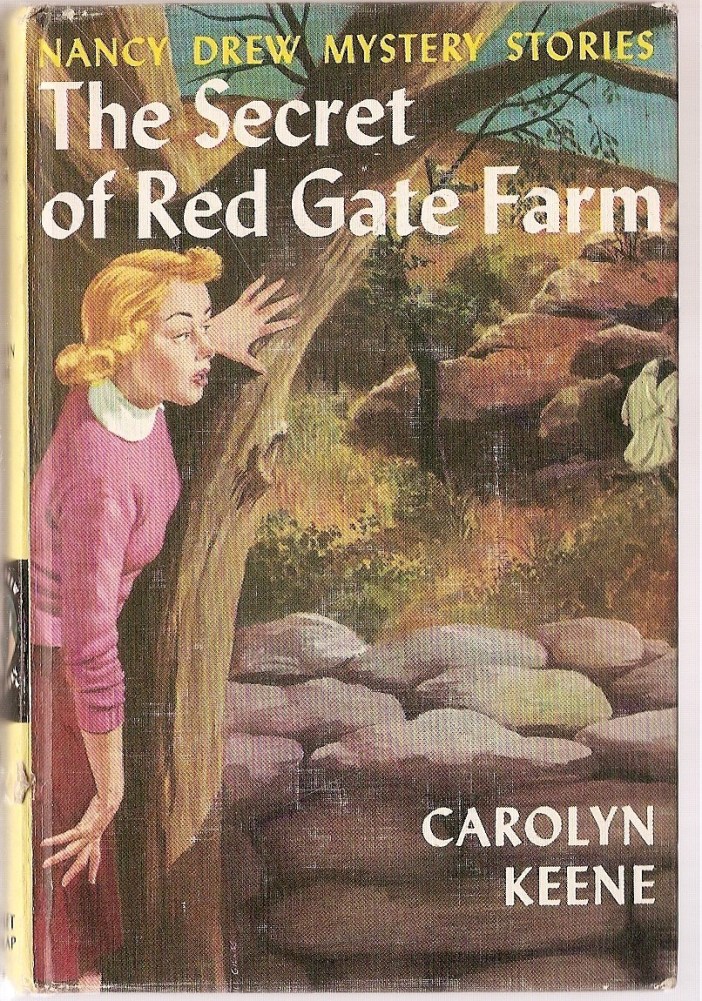
secret of red gate farm

I first discovered Nancy Drew when I was in the fourth grade, at Eli Whitney Elementary School in Chicago. I was already reading every mystery I could get my hands on, either through the school library, the public library, or what my parents would let me order through the Scholastic Book Club, but I didn’t discover Nancy Drew–or the other series for kids–until the fourth grade. My teacher, Mrs. Pirog, had a big wooden table in the back of the room with discarded books from her own kids spread out on it. One day I noticed the above book, and decided to take it home and read it. I loved it! Nancy and her pals Bess and George helped some poor girl and her grandmother, about to lose Red Gate Farm to the mortgage, while also unmasking a ring of counterfeiters. There were two other volumes back on the table–The Mystery at Lilac Inn and The Haunted Showboat–and I was hooked. At the Woolworth’s where I usually spent my allowance, I acquired The Secret of the Old Clock, The Hidden Staircase, and The Bungalow Mystery. (On the book table was also a Dana Girls mystery, The Secret of the Old Well, but we’re going to focus on Nancy Drew for now.)

I became obsessed with reading and collecting the entire series. I still collect them, of course, even if my collection is in storage because I don’t have the room to display them in the Lost Apartment. My obsession (I guess this was probably the first example of my OCD-lite coming to light) was driven even further by my parents’ forbidding me to read them; you see, I was a boy and these were books for girls. I started collecting and reading the boys’ series, and buying Nancy Drew, and the other series for girls, on the sly; I would get, say, five Hardy Boys books and slip two Nancy Drews into the stack, and then would bury the Nancy Drews at the bottom of the book bag beneath the Hardy Boys, and pull out one of the Hardy Boys to read in the car on the way home. (I was undoubtedly not fooling my mother, who had to notice that the yellow-spined Nancy Drew collection was mysteriously growing, albeit at a slower pace than the Hardy Boys.)

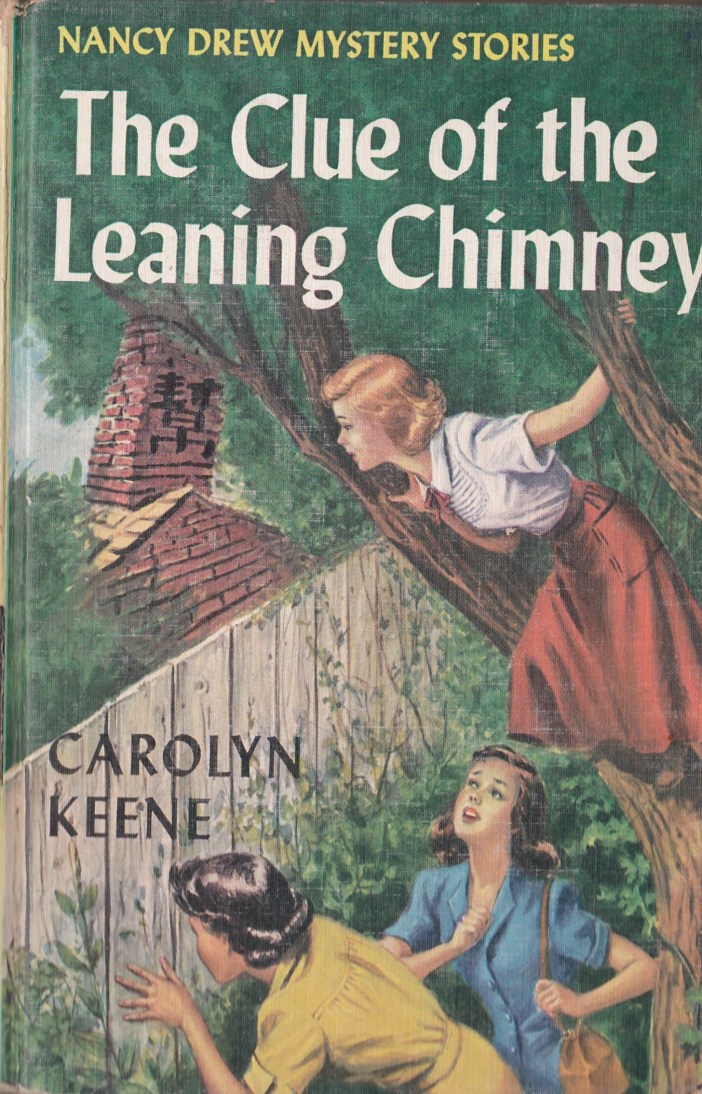
nancy drew leaning chimney

This was also an early example of my stubbornness, and the streak of “if you want me to not do something, the worst thing you can do is tell me so.”

Hard to believe something as innocuous as Nancy Drew mysteries could be considered contraband, isn’t it? My sister helped out sometimes, too, when she felt like it, by buying them for me. They couldn’t very well tell her she couldn’t have them.

Ghostwriting a Nancy Drew mystery as Carolyn Keene is on my bucket-list, I might add.

While I can’t credit Nancy Drew for my lifelong love of mysteries and my desire to become a mystery writer, she was a big assist, and my first introduction to mystery series. I read almost all of the Grosset & Dunlap series (Nancy, the Hardy Boys, Dana Girls, Judy Bolton, Ken Holt, Rick Brant, Biff Brewster, Cherry Ames, Vicki Barr), as well as the Trixie Belden books and The Three Investigators (which was probably my favorite, along with Ken Holt), and have kept all of my copies all these years. In my early twenties I started finishing the sets, haunting used bookstores for used copies, since many of the off-brand series were no longer in print. After Hurricane Katrina I discovered eBay, and started finishing the sets. Once I had all of the Nancy Drew and Hardy Boys series completed, I went back and started recollecting the series–there were  original texts and revised texts, and my completed sets were combinations of the two. Now I want a complete set of revised texts and one of original texts. I also belong to collectors’ groups on Facebook, and there’s a store in Savannah, Books by the Bay, that specializes in the kids’ series that I am DYING to visit (and will undoubtedly drop a ton of cash at if I ever get there).

So, happy birthday, Nancy. Thanks for all the great memories!