Bridge over Troubled Water

Looks like we made it, Constant Reader; through another week of trials and tribulations and who knows what all, quite frankly. I woke up at six, but stayed in bed until just before eight, and feel obscenely well-rested, not tired at all; maybe a bit of a sleep hangover, but other than that, in tip-top shape for this lovely weekend. There’s condensation all over the windows around my workspace this morning; I suspect it rained over night and the air out there is probably warm and thick with water. It’s also not cold inside, which is a tip-off that it’s probably a lovely day outside. Paul is going to go into the office at some point today; I intend to go run some errands later as well as get some serious writing done. Conference championship football games are on television all day, but I really don’t care who wins any of them, if I’m going to be completely honest. The kitchen seems scattered and messy today, so does the living room, and of course, Paul is leaving for his winter visit to his family on this coming Wednesday, so I will have almost a full week of alone time.

I am, for December 1, disgustingly behind on everything; from Bury Me in Satin, stalled at Chapter Six, to finishing touches on both the Scotty book and the short story collection. I also need to proof read Jackson Square Jazz at some point so that can finally be available as an ebook; it never seems to end, does it? But I did somehow manage to tear through my to-do list this past week (other than anything writing/editing related that was on it) and I think now, finally, the day job is finally going to settle into a kind of routine schedule. I also picked up Bibliomysteries Volume I, edited by Otto Penzler, at the library yesterday, so I have a wealth of short stories to read. (I also still have all the volumes of anthologies and single author collections I was reading earlier in the year on the mantel in the living room; I should probably get back to those at some point as well.) I am probably going to keep The Short Story Project rolling into the new year; I do love short stories, and I keep finding more unread collections on my bookshelves.

I got some books in the mail yesterday; the two most recent Donna Andrews Meg Langslows, Toucan Keep a Secret and Lark! The Herald Angels Sing (which I wish I could read over the Christmas holidays; I love reading Donna’s Christmas books during the season but I doubt I’ll have time to read Toucan first; and yes, I have to read them in order DON’T JUDGE ME); two novels by Joan Didion, Democracy and The Last Thing He Wanted; two books by Robert Tallant, one fiction (The Voodoo Queen, an undoubtedly error-riddled and racist biographical novel about Marie Laveau) and one nonfiction (Ready to Hang: Seven Famous New Orleans Murders); the next volume of George R. R. Martin’s A Song of Fire and Ice, A Clash of Kings; and Hester Young’s follow-up to The Gates of Evangeline, The Shimmering Road. 

So, yes, my plate is rather full this weekend–but I shall also have plenty to do while Paul is gone. I am also thinking about buying the third and final season of Versailles on iTunes to watch. I will probably make an enormous list of all the things I want to get done while Paul is in Illinois and wind up doing none of them.

Heavy heaving sigh.

I also need to figure out his Christmas presents while he’s gone, so I can get them and have them all wrapped before he gets home.

And so now, ’tis back to the spice mines with me. Have a lovely day, Constant Reader.

IMG_4424

Show and Tell

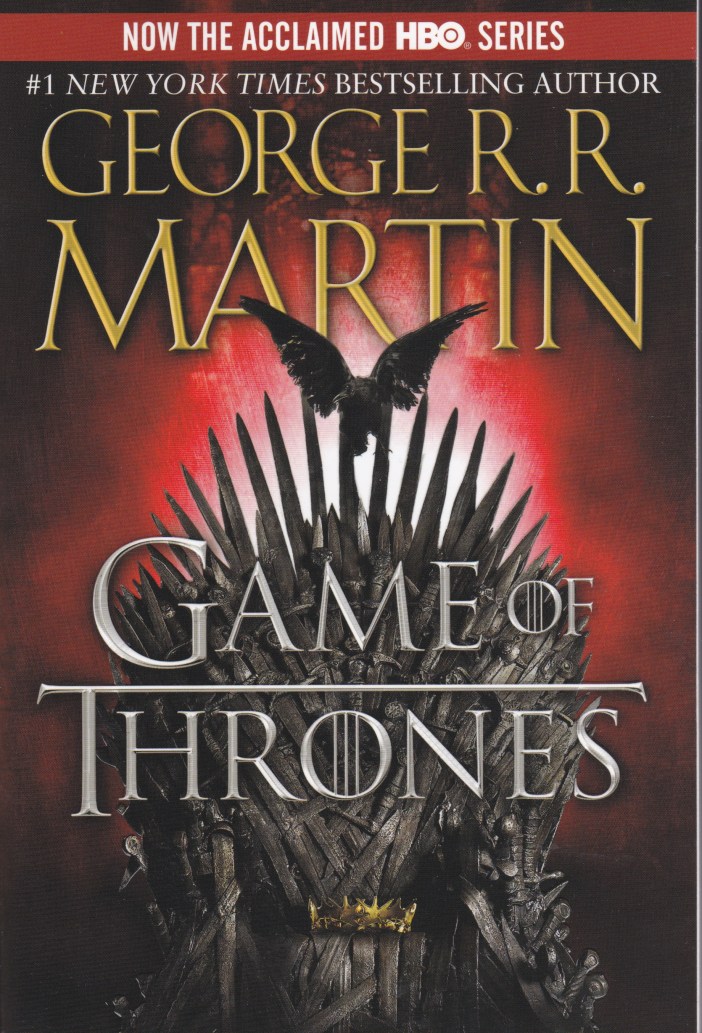
So, audiobooks and A Game of Thrones.

I am, of course, a huge fan of the HBO program Game of Thrones, based on George R. R. Martin’s epic fantasy series A Song of Fire and Ice. 

As I explained to Paul when we started watching, “It’s like medieval history, only with magic and zombies and dragons.” The first season was incredible–I had not read the books–and I remember thinking, in the season finale, as Dany walked out of the smoking ashes of Khal Drogo’s funeral pyre with baby dragons perched on her, my god, this entire season was simply set-up, before we get to the main story.

Little did I know what we were in for–although I liked, with the execution of Ned Stark, whom it seemed was the main character, the reality that anyone can die at any time–which of course increases the dramatic tension; if any character can die at any time, the stakes are much higher–and Paul and I have thrilled to the ups and downs and highs and lows. The show has done a wonderful job of weaving his story as well as forcing us, as viewers, to understand that, ultimately, life isn’t fair and good doesn’t always win over evil in the end.

I had been resistant to reading the books, primarily because they aren’t all written and published; I despise having to wait for the next book in a series, particularly when it’s very possible that by the time that book has come out you’ve lost the thread of the story and forgotten who is who with the characters (I’m looking at you, Stephen King and The Dark Tower); this epic series, though, is a bit different precisely because there’s a television show, which would make the remembering easier. But still…I hate waiting for another book. I did order a paperback set of the series books currently available, but when I saw how long they were and realized the time commitment that would be involved, I just didn’t think I could do it.

Flash forward to week before last, and my decision to give listening to Audiobooks a try on long car trips. As I may have mentioned before,  the concept of Audiobooks wasn’t something I was terribly keen on; I’ve always hated being read to, and I also had no idea how long audiobooks were and how long it would take to listen. But I did think, “I bet A Game of Thrones would be long enough to last the entire drive” and I set about looking for an audio book I could download. Nothing from the Public Library, and so finally, after trying out some other options, I finally went with the thirty-day free membership to Audible and downloaded A Game of Thrones…only to see that the recording lasted just over thirty-three hours. I also knew that if I really got into the story, I wouldn’t want to wait three days to finish listening, so I decided to go ahead and take my physical copy of the book with me, so I could finish reading it.

Which I did, in a lot less than the over twenty-one hours that was left on the Audiobook.

a game of thrones.jpeg

“We should start back,” Garen urged as the woods began to grow dark around them. “The wildlings are dead.”

“Do the dead frighteb you?” Ser Waymar Royce asked with just the hint of a smile.

Garen did not rise to the bait. He was an old man, past fifty, and he had seen the lordlings come and go. “Dead is dead,” he said. “We have no business with the dead.”

“Are they dead?” Royce asked softly. “What proof have we?”

“Will saw them,” Gared said. “If he says they are dead, that’s proof enough for me.”

Will had known they would drag him into the quarrel sooner or later. He wished it had been later rather than sooner. “My mother told me that dead men sing no songs,” he put in.

If you can remember back that far, the very first episode of the TV series opened with this exact scene; members of the Night’s Watch, in a frozen cold forest north of the wall, investigating…only to encounter the horror that is coming. The story then switches to the epic power struggle in the seven kingdoms of Westeros, primarily the set-up of the bad blood between two of the major houses: Stark and Lannister. The Starks are of course set up as the good guys; the Lannisters, with their deceit and money and incest, the bad. As I listened–and later, read–I found myself getting very caught up in the story, even though I knew most of it already; the book is more layered and obviously has more backstory and information than the television series. Also, as I read along, I was reminded of my original comment to Paul: its medieval history with magic and zombies and dragons.

I’ve always loved history; I’ve read a lot of historical fiction and I’ve read a lot of history. I mentioned before Maurice Druon’s The Accursed Kings series, recently reissued and marketed as the “inspiration for Game of Thrones!” , with introductions by Martin himself. (I took my new copy of The Iron King with me on the trip, and started reading it after I finished the Bibliomysteries Volume 2 and A Game of Thrones.) I’ve always wanted to write my own history, with countries and lords and ladies and so forth all invented in my fevered brain; primarily because I wanted to change the way some histories ended. (What if the Babington Plot succeeded and Elizabeth I was assassinated?, for one example) This is kind of what A Song of Fire and Ice is; and I am of course the perfect audience for this.

I’ve not read much fantasy fiction. I’ve read The Lord of the Rings, of course (who hasn’t, really?), and I read the first few books of the The Shannara Chronicles many years ago; I’ve also read a few volumes of David Eddings’ The Belgariad, and of course McCaffrey’s The Dragonriders of Pern (hello, Showtime? This series would be perfect for a television show). One of the common themes of all of these series, along with Martin’s, is a lesson we never heed: those who do not learn from history are doomed to repeat it. In each of these series, there was an enormous and great threat from the past that everyone has forgotten or dismisses as “legends”; but the threat is very real, the stories are true, and in the present day, the threat is reemerging and everyone has to remember how to fight it.

Another theme of A Song of Fire and Ice is also history, and politically, related: people will always put short term gain ahead of long term success; instant gratification, apparently, being far far more satisfying that careful and strategic planning; selfishness often leads to doom.

I am really looking forward to reading more of A Song of Fire and Ice.

I Can’t Make You Love Me

GEAUX SAINTS!

So, it’s another chilly Sunday here in the Lost Apartment. It’s sixty degrees now outside, but it dipped into the forties overnight, so it’s going to take awhile for the Lost Apartment to recover–if it ever does. Today I need to pack up for the trip tomorrow morning. I’m not taking the MacBook Air with me, so I am not entirely sure how I’ll be able to crosspost the blog–should I write any entries–to Facebook and other social media because cutting and pasting on the iPad confuses me.

Don’t judge me.

The LSU game last night was a romp; never in doubt from the first snap, and ending with a 42-10 score. It was 28-3 at half-time and was never in doubt. As such, there was very little-to-no tension on my part, so I was able to sit in my easy chair like a millennial, scrolling through apps on my phone while also taking some time to read. I stopped by the Latter Library yesterday to pick up another book I’d reserved (Chariots of the Gods? by Erich von Daniken–more about that later) and also renewed Bibliomysteries Volume 2 for another week. I am taking both books with me to Kentucky, and am also taking A Game of Thrones by George R. R. Martin; I think it’s time I got started writing A Song of Ice and Fire, now that the end of the television series is in sight with this past week’s announcement that the final season will begin airing in April.

I took yesterday as my day off for the weekend; I didn’t clean anything, nor did I organize or file or edit or write. I was basically just a lazy slug, sitting in my easy chair and flipping between football games while reading. I’m still rereading ‘salem’s Lot but have now reached the end game, the final section of the book called “The Empty Village,” and the tracking down of the vampires concluding with Ben and Mark running away to Mexico while Ben writes his book isn’t as interesting to me as the opening of the book; as I said when I discussed the reread initially, I am more interested in how King depicts the town more than anything else, which was the impetus for the reread. And how much do I love this sentence, which opens section 2, “The Emperor of Ice Cream”:

The town knew darkness.

It’s very Shirley Jackson-esque, and the passage that follows is perhaps my favorite part of the entire book.

I also think I am going to give The Shining  a reread; The Shining is, for most fans, critics and readers, King’s best work. I couldn’t get into it when I first bought the paperback, with the boy’s head with a blank face drawn on a shiny silver cover. I picked it up again a few years later and tore through it in one sitting; but as creepy and horrifying as it was, and how nasty the Overlook Hotel was…it was one of the few I never reread completely. I’ve picked it up and started it again, flipped through it and read sections, but I’ve never read it from beginning to end. I think the complexity of Jack Torrance as a character cut a little too close to home for me, but now that I have over fifty books out there with my name (or a pseudonym) on the spine…I don’t have to be too stressed about the failed author character being too close to home for me anymore.

At least one can hope so.

Tomorrow is the dreaded twelve hour car ride through Mississippi, Alabama, a bit of Georgia, and the Smoky Mountains of Tennessee. I need to go get the mail before I leave town and possibly stop by the bank, so I am going to be getting a later start than I would have perhaps wished, but a twelve-hour drive is a twelve-hour drive no matter when you get started, and I am most likely going to shower and go straight to bed when I arrive in Kentucky. I am still trying to figure out what digital book to download and listen to in the car–who says you can’t teach an old dog new tricks?–but none of A Song of Fire and Ice are available as audiobooks from the library, and the library’s app isn’t as intuitive as I would like (translated: I’m too old to figure out the easiest way to use it). I wanted to start Charles Todd’s brilliant series set during the end of the first world war, but the first book isn’t available from my library (BASTARDS!!!!) and so I have to choose something else. I’ll spend some time on there today–maybe on the library’s website, which is easier for a Luddite like me–and perhaps the second Louise Penny Inspector Gamache novel might do the trick.

Or maybe The Shining. Ooooooh.

Most of today is also going to be spent on odds and ends. I may get some writing work done, or I may not. I think after the Saints game we are going to watch either Love, Simon or Call Me By Your Name; both are available for free streaming on one or another services I pay for now. I also am assuming I’ll finish watching Knightfall while I am in Kentucky, as my parents both go to bed early every night.

And yesterday I also managed to read “The Gospel of Sheba” by Lyndsay Faye, from Bibliomysteries Volume Two, edited by Otto Penzler:

Letter sent from Mrs. Colette Lomax to Mr. A. Davenport Lomax, September 3rd, 1902.

My only darling,

You cannot comprehend the level of incompetence to which I was subjected today.

You know full well I never demand a private dressing room when stationary, as the very notion implies a callous disrespect for the sensitivities of other artists. However, it cannot pass my notice when I am engaged in a second class chamber en route from Reims to Strasbourg. The porter assured me that private cars were simply not available on so small a railway line as our company was forced to book–and yet, I feel justified in suspecting the managers have hoaxed their “rising star” once again. The reek of soup from the dining car’s proximity alone would depress my spirits, even were my ankles not confined one atop the other in a padlock-like fashion.

I do so loathe krautsuppe. Hell, I assure you, my love, simmers with the aroma of softening cabbage.

Lyndsay Faye has twice been nominated for the Edgar Award for Best Novel (for The Gods of Gotham, which I adored, and for Jane Steele, which is still in my ever-growing and enormous TBR pile), and she is also a delight to know in addition to her enormous gift for writing. Lyndsay is an enormous Sherlock Holmes fan (Sherlockian?), and even her first novel, Dust and Shadow, was a Holmes tale; she recently published an entire collection of Holmes short stories. “The Gospel of Sheba” is sort of a Holmes story; both he and Watson do appear in the story, but it’s primarily told from the point of view of a sub-librarian, Mr. Lomax; he is married to a professional singer who at the time of the story is currently on a tour–her presence in the story is either through her husband’s point of view or epistolary; we get to see occasional letters from her. Her husband’s point of view is seen through diary entries where he talks about the mystery of the Gospel of Sheba, a grimoire a member of a private men’s club with an interest in the supernatural has discovered and that makes anyone who reads it ill. One of the things I love the most about Faye is she writes in the formal style of the nineteenth century, but it always reads as organic and never forced. There’s never a sense from the reader of Oh I see what you’re doing here or from her as the author of see how clever I am? She’s somehow modernized that formal style, breathed fresh life into it, and uses it to help set the mood and the time and the setting. You can almost hear the hiss of gas in the lamps, and see the flickering gaslight. This is a terrific story, and reminds me of why I loved The Gods of Gotham so much, and also reminded me I need to dive back into her backlist.

And on that note, ’tis back to the spice mines with me.

IMG_4349

Bennie and the Jets

What a lovely weekend this past one was, seriously; the Abomination in College Station aside, and even that was more of a seriously? than anything else.

I got back to New Orleans around seven pm on Friday night; there’s a time zone change going and coming, but it always seems like because of that I make better time coming home than going. It’s a mental thing, obviously; same amount of time, same amount of miles (slightly less than 1500 round trip), and yet…it seems to go so much faster. I always think–and I know this makes literally no sense–that since I am driving south and going from a higher elevation to a lower one, that it’s all downhill.

I said it didn’t make sense.

I also somehow managed to wrestle with some ideas and projects-in-progress while I was gone; whether those solutions to the problems will work (or if the problem is a real problem in the first place) remains to be seen.

But Saturday morning I had coffee with my friend Pat, preparatory to my Costco run; it was actually a most productive meeting. She helped me with some great info for a short story I am writing, and she also gave me some tips on how to do my New Orleans research (and also thought Monsters of New Orleans was a great idea). The Costco trip wasn’t as bad as one might have thought the Saturday after Thanksgiving; I assume everyone burned out on shopping on Black Friday. But Costco is never an ordeal, even when it’s crowded; which really says a lot about their management philosophy and how well they treat their employees. Everyone is always so nice and friendly and polite; compare that to the staff at, let’s just say Wal-mart, and you see what I mean.

This actually set the mood for a rather lovely weekend. I relaxed and recovered from the trip, while getting caught up on things around the house–grocery shopping, cleaning, laundry, etc. It was quite lovely. I actually finished reading End of Watch during the Abomination in College Station, and one benefit of spending time at my mother’s house? I really think my house needs a deep thorough cleaning and reorganization; i.e. my kitchen could be more efficiently set up. I also need to clean out kitchen and bathroom drawers, and as for my TBR pile–well, if I have had it for more than two years and haven’t read it, time to donate it. And if, later, I decide I want to read it…well, I guess I can buy it again if I want to read it that badly. (I’m talking big, but I know once I start going through the books I am my book-hoarding tendencies are going to re-emerge.)

I know myself all too well.

I also read  “The Book of the Lion” by Thomas Perry,  from Bibliomysteries Volume Two, edited by Otto Penzler:

Dominic Hallkyn played back the voicemail on his telephone while he took off his sport coat and hung it up to dry in the laundry room. The smell of rain on tweed was one that he knew some people might say was his smell, the smell of an English professor. The coats–tweed or finer-spun wool in the winter and seersucker or summer-weight fabrics in the late spring or early fall–were his work uniform, no different from a mechanic’s coveralls. He wore them to repel the skepticism of the young.

The first couple of calls were routine: a girl in his undergraduate medieval lit course has been sick, so could she please hand in her paper tomorrow? Of course. He had plenty of others to deaden his soul until that one arrived. Meg Stanley, the Department Chair, wanted him to serve on a Ph.D. oral exam committee. Unfortunately, he would. Reading the frantically scribbled preliminary exam and then asking probing questions in the oral would be torment to him and the student, both of them joined in a ritual of distaste and humiliation, all of it designed to punish them both for their love of literature, but it was part of his job.

Thomas Perry is another luminary of the crime fiction world whose work I’ve neither tasted nor sampled until now. One of the lovely things about anthologies, such as this, is that you can get a taste of an author’s work, a feel for their writing style, without the commitment to reading an actual full-length novel, and you can then decide whether you wish to add the author to your must-read list. “The Book of the Lion,” a tale of academic/rare book intrigue, certainly got Perry added to my list of authors to explore. In this story, our stuffy professor Hallkyn receives a mysterious phone call from a man who claims to have discovered a rare copy of an even rarer work; Geoffrey Chaucer’s “The Book of the Lion,” a romantic history of Richard Couer-de-Lion that has been lost to the ages. The value of such a book, of course, would be in the eight figures at the very least; it’s worth to literary scholarship perhaps even higher. It’s a sort of historical treasure hunt story–this reminds me of William Martin’s Harvard Yard, which involved the search for Love’s Labour’s Found, a long-lost Shakespearean play–and also had several delightful twists.

So, yes, Mr. Perry has been added to my list.

IMG_4389

The Streak

Yesterday was, for the most part, a great day (do NOT mention the travesty/joke that was the LSU game last night; that entire officiating crew, including the booth, should be fired with extreme prejudice. I am not one to blame officiating for losses, but LSU won the game three times and they kept giving A&M just one more chance. Fuck. Off. It’s very hard to not begin–after so much of this the entire season, and not just against LSU–as corruption from the SEC office on down. Greg Sankey needs to resign. NOW.). I got up early and started trying to play catch-up (I was unplugged for most of the week) and then had coffee with my friend Pat, who is a noted historian and a terrific person. I was picking her brains about New Orleans research and she also had an experience I wanted to know about as background for a short story I am writing (“Please Die Soon,” if you must know), and we wound up spending almost three hours chatting, and she also gave me some more ideas for Monsters of New Orleans, which was a lot of fun. We met at the PJ’s on Maple Street in a part of Uptown I’m not sure what to call (Uptown? University? Riverbend?) but it was quite nice to see a part of New Orleans I rarely go to–and discover things–like there’s a lovely breakfast place next door to PJ’s, along with a Christian Science Reading Room (who knew?) and a Starbucks across the street (“Caffeine Alley,” I joked). So after we were finished, I went over to the Starbucks and got some espresso beans for the house, and an insulated travel mug. From there it was about a ten minute drive to Costco, and then back home. I finished reading End of Watch, did the laundry, cleaned and organized the kitchen, and started organizing and doing things in the living room while football games played in the background.

One thing about staying with my family–my mother makes Joan Crawford look like a filthy hoarding slob–was all I can see is how dirty the Lost Apartment is, and how irrationally and inefficiently organized it is. So, yeah…I’m working on that, and probably will today as well.

I need to start digging through all the emails that piled up while I was gone, and I also need to pay bills and update my checkbook. Heavy sigh. But I’ve slept well since coming home, which is lovely, and today I have to make a grocery run, which I will do later this morning.

One thing about driving across country is one is reminded precisely how beautiful this country actually is, or how incredibly vast. New Orleans to Kentucky is over seven hundred miles and takes about twelve hours to drive; and that’s not even close to being halfway across the country. As I drive through Mississippi, Alabama, a small piece of northwest Georgia and through Tennessee–particularly Tennessee–I cannot help but marvel at how beautiful it is; the Smoky Mountains of Tennessee between Chattanooga and Knoxville in particular at this time of year as the leaves are turning. Every time I drive through there I wish I had more time, so I could stop at Scenic Lookout points and take photographs so I can share the amazing beauty with you, Constant Reader.

On the other hand, one cannot help but notice the Confederate flags mounted on the front license plate frames of pick-up trucks and BMW’s and Hondas. This always saddens me when I see it; this clinging to a horrible past and ignoring what that flag actually means to most Americans. Its use, to me, is basically saying fuck you, slavery was a good thing to everyone who sees it, and rather defiantly, at that. As I drove home on Friday, after seeing a proliferation of these on the highway between Fort Payne and Birmingham, an idea for an essay came to me (“Song of the South”) about the “heritage not hate” mentality, and developed that thought even further after talking to Paul about the trip when I got home.

I have so much to write, and so very little time to do it in. Heavy sigh. Sometimes it feels to me that time is nothing more than sand held in my cupped hand on a windy morning at the beach; the grains slipping out of the palm and through the fingers as I desperately try to cling to it.

Heavy sigh. I also want to write up A Game of Thrones and End of Watch.

But I did read short stories while I was gone, and next up is “Mystery, Inc.” by Joyce Carol Oates, from Bibliomysteries Volume Two, edited by Otto Penzler.

I am very excited! For at last, after several false starts, I have chosen the perfect setting for my bibliomystery.

It is Mystery, Inc., a beautiful old bookstore in Seabrook, New Hampshire, a town of less than two thousand year-round residents overlooking the Atlantic Ocean between New Castle and Portsmouth.

For those of you who have never visited this legendary bookstore, one of the gems of New England, it is located in the historic High Street district of Seabrook, above the harbor, in a block of elegantly renovated brownstones originally built in 1888. Here are the offices of an architect, an attorney-at-law, a dental surgeon; here are shops and boutiques–leather goods, handcrafted silver jewelry, the Tartan Shop, Ralph Lauren, Esquire Bootery. At 19 High Street a weathered old sign in black and gilt creaks in the wind above the sidewalk:

MYSTERY, INC. BOOKSELLERS

NEW & ANTIQUARIAN BOOKS

MAPS, GLOBES, ART

SINCE 1912

As you can clearly see, Constant Reader, Mr. Penzler only recruits the upper echelon of crime writers for his Bibliomysteries, and few literary names have as much luster as the highly-acclaimed Joyce Carol Oates. Again, Ms. Oates is an enormously prolific and gifted writer; I’ve barely scratched the surface of the Oates canon but her work often leaves me awestruck and inspired and more than a little humbled.

“Mystery Inc.” is another one of her toothsome tales of darkness; the main character in this story owns several mystery bookstores in New England and has decided that this lovely bookstore in a small town on the New Hampshire coast is the next one he wants to acquire. The loving descriptions of the store, the artwork and rare books for sale make it sound, in Oates’ delightful prose, like a place I’d certainly wish to visit and somewhere you would have to pry me out of with a crowbar. The main character covets the store, and rarely have I ever read such a story of covetousness I could identify with so completely. But the main character not only wants the store, but has a dark plan for acquiring it. And, as always in an Oates story, things in the store might not be what they seem on their surface; the store has a dark, ugly history which the present owner shares…terrific story, absolutely top tier.

And now, back to the spice mines.

IMG_4386

We Got a Love Thang

Vacation, all I ever wanted…vacation have to get away!

But in fairness, I dread being in the car for nearly twenty-four hours over the course of five days.

Shudder.

And there’s so much to do before I leave.

I fixed our front door last night. Paul’s key got stuck in the front door lock and wouldn’t come out. I just shrugged and said I’ll just take the deadbolt apart, fetched a screwdriver, and did precisely that. I not only got the key out of the lock but I also reassembled the deadbolt, fixing what had gone wrong with its mechanism. Once I was finished, I was a little amused; I certainly never would have dreamed I’d ever be that handy. I wish I were handier; I wish I knew how to change the oil in my car and how to rewire things. I am, in fact, very uneducated about how my current car works, and I’ve had it for almost two years. I really do need to read the manual.

I am thinking about working on Bury Me in Satin today, after I run my errands and before the LSU game this evening. I also think the last two chapters have been incredibly difficult because I am having to make it up as I go. I have this amorphous idea of a story, but am not entirely sure I know how I am going to tell it; hence the problems I’ve had with the last two chapters. What I need to do is some planning; some brainstorming on the characters and who they are and what they want, and perhaps even some plotting and outlining. I also wonder if I am simply, in reaction to having such a hard time writing the last two chapters, coming up with excuses for not actually doing any writing (“well, there’s really no point in even trying to write anything since I don’t know this and this and this”) which could in reality be some kind of self-sabotage crossed with Imposter Syndrome with perhaps just a pinch of my tendency to procrastination and shameless laziness.

And, just for fun, there’s the distinct possibility that all of it is true.

This is why writers drink.

I slept incredibly deeply and well. I stayed up later than I’d wanted to because I chose to wash the bed linens last night, rather than today, and the dryer struggled with the blankets–it does this sometimes, with no rhyme or reason to it–and finally rolled into bed just past twelve last night. I got up at nine this morning; it really makes a significant difference to wake up organically, rather than be untimely ripped from the arms of sleep by the brutality of an alarm.

I started watching a series on Netflix called Knightfall last night–well, I’d started it one night in the last week when Paul was late getting home, and it’s interesting. I don’t care about the historical inaccuracies; whenever I watch historical fiction I generally do unless it’s so glaring it cannot be ignored. It’s about the last of the Knights Templar, and borrows somewhat from The DaVinci Code, which of course borrowed heavily from Holy Grail Holy Blood, which was a rather lengthy non-fiction tome built around a conspiracy theory (the authors went on to write two more books, following the same theme; their primary source was later revealed to be a liar). I read Holy Grail Holy Blood back in the 1980’s, when it was newly in paperback; I read it again in the 1990’s, primarily because I was interested in the sections on the Cathar heresy in the south of France and the Albigensian Crusade that wiped them out. Thus, the ‘big reveal’ in The DaVinci Code  wasn’t really a big reveal to me; as soon as it became clear that the plot had to do with the Knights Templar and Priory of Sion, I knew what it was.

Anyway, I digress.

Knightfall is about the Knights Templar, and is set in France during the reign of Philip IV, the Fair (which meant handsome and had nothing to do with justice). Now, I know Philip IV, conniving with Pope Clement, eradicated and wiped out the Templars; but Clement’s predecessor Boniface is in this–and he is working with the Templars. The basic plot of the story (thus far) is that the Templars once had possession of the Holy Grail in the Levantine city of Acre; but as they escaped the city before the armies of the Arabs, the ship it was on sank. Fast forward a few years, and something is going on within and without the Templar order; we found out last night that the actual Grail isn’t at the bottom of the harbor at Acre but somehow made it to France.

This is actually a deeply fascinating period in French history; Philip IV, who is not particularly well known (we as Americans are not particularly knowledgeable about French history; which is to be expected as former colonies of the British, and French histories/biographies written in English by either British or American historians are few and far between–unless they are about Louis XIV, the French Revolution, or Napoleon), reigned over a particularly turbulent era in French history. The eradication of the Templars–to whom he owed an obscene amount of money–was part of a carefully laid plan he executed with the assistance of Pope Clement, who was basically a tool of the French throne. Philip had come into conflict with Pope Boniface, had taken him prisoner, and basically forced Clement down the throat of the cardinals. The Papal court was then moved from Rome to Avignon in the south of France (the Papal period known as the Babylonian Captivity), and Clement appointed enough French cardinals to outnumber the rest, ensuring the popes would continue to be French and would stay in Avignon. (This eventually led to the great schism, with two different popes–at times, there were more than two–competing for power and the obedience of kings and their subjects, excommunicating anyone who followed a different pope, and degrading the Catholic Church–which eventually led to the Protestant reformation….so yes, Philip the Fair was actually the father of the reformation), and the Templars were rounded up, convicted of heresy in trumped up trials, and burned at the stake. The last Grand Master, Jacques de Moray, was convicted of heresy and burned. The King, the Pope, and the King’s great minister were present when the Grand Master issued a curse from the flames, calling them all to account for their crimes before God within a year. (Whether this actually happened or not is up for debate.) But within a year, all three men were dead. Philip’s three sons all died without sons, following each other on the throne successively; when the last one died, his daugher’s son, Edward III of England, claimed the French throne through his mother as the closest male heir to Philip IV and his sons; the nobility gave the crown to a cousin who became Philip VI, and thus the Hundred Years War began.

The fourteenth century is fascinating. An excellent history of it is Barbara Tuchman’s A Distant Mirror. French novelist Maurice Druon wrote an entire series of fictional books about the dying out of the main line of the French royal house, the destruction of the Templars, and all the scandals that plagued the children of Philip IV, beginning with The Iron King; new editions have been published in English due to the popularity of Game of Thrones, and the books have introductions by George R. R. Martin–because he read them and they helped inspire Game of Thrones. I read this series of books–The Iron King, The Strangled Queen, The Poisoned Crown, The Royal Succession, The She-Wolf of France, The Lily and the Lion, and The King Without a Kingdom–collectively known as The Accursed Kings, when I was a teen. Druon opens the series with the breaking up of the Knights Templar and Moray’s curse…and then proceeds to show how the curse worked on France and its royalty for decades.

Anyway, I am enjoying Knightfall. It’s a truly fun romp, and the main character is played by the very handsomely bearded Tom Cullen. It’s apparently a History Channel show, and has been renewed for a second season.

I also found a French show, Maximilian and Marie de Bourgogne, which looks very promising; about the marriage between Maximilian of Austria and Mary of Burgundy in the late fifteen century; a marriage that was, frankly, the root cause of every major European war from 1476 to 1914. It is in French, which means subtitles, but I am slowly but surely getting over my aversion to subtitles as my hearing gets worse–I tend to turn on the subtitles on even English language movies and television shows because I can’t understand what they’re saying; particularly if it’s British made. It might be something interesting to watch and explore while I am in Kentucky next week.

And on that note, tis back to the spice mines. Have a lovely Saturday, everyone.

IMG_4347

I Will Remember You

Yesterday was Veteran’s Day; which originally was called Armistice Day. The day began as a remembrance of what was then considered, and called, the Great War. There had never been any war prior that was so awful, so horrific, so bloody. It changed the face of the world…empires crumbled and new nations rose from the ashes of the old. But the peace treaty that ended it was short-sighted and vengeful.

World War I was a horrific experience. “The war to end all wars” was what it was called; in the United States it was sold to Americans as “making (sic) the world safe for democracy”–despite being allied with the despotic autocracy of the Romanov empire in Russia. It was a most hideous war, one that left both the winners and the losers heartily sick of the waste of war and its pointlessness…yet merely served as a prelude to the much more horrific second world war; its conclusion set the stage for the rise of the Fascists in Italy and Germany, and the utter collapse of the German empire around the world, as well as the utter exhaustion and weakness of the surviving empires of the French and the British, set the stage for the rise of Imperial Japan in the Pacific and Asia…this rise ultimately led Imperial Japan into conflict with the United States. So, the “peace” of the first world war planted and fertilized the seeds for the second.

The flower of Europe’s youth died in this war,  in the trenches, in the mud and the wet and the cold. PTSD was first recognized after this war in soldiers who came home; only it was called shell shock back then. The boys who went off to this war came home as men forever changed by what they’d seen and experienced and borne witness to. It was a new kind of war, one presaged by the American Civil War and the Franco-Prussian War. It would take yet another war for humanity to begin to rethink war.

And of course, the existence of nuclear weapons also had a lot to do with that critical rethinking.

I abhor war because I’ve studied it; for me, supporting the troops has always, for me, meant not putting them in unnecessary danger. Wars might sometimes be necessary, but they are, above and beyond all else, waste. Waste of lives, waste of money, waste of resources, all in the service of what is far-too-often an unclear, amorphous goal or purpose. I value the lives of our military, and not only the sacrifice of those serving but of their families, and I don’t think their lives and limbs should be placed in jeopardy without being absolutely certain there is no other alternative, and if they are to be place in such jeopardy, it should be for clearly defined, well understood objectives. I also believe they deserve everything we can, as a country, can do for them after their service. Our VA Hospitals should be the best in the world. No veteran should be homeless or unable to get the help they need to get back on their feet. No service family should be on food stamps, or go hungry, or worry about how to pay their bills or feed and clothe their children.

It’s the absolute least we can do for them.

Happy Veterans’ Day, and thank you for your sacrifice and service.

The Saints won big! Huzzah! GEAUX SAINTS! That was a lot of fun to watch, and I must say, the Saints are looking pretty amazing this year.

I also read “The Compendium of Srem” by F. Paul Wilson, from Bibliomysteries Volume 2, edited by Otto Penzler, for the Short Story Project.

Tomas de Torquemada opened his eyes in the dark.

Was that…?

Yes. Someone knocking on his door.

“Who is it?”

“Brother Adelard, good Prior. I must speak to you.” Even if he had not said his name, Tomas would have recognized the French accent. He glanced up at his open window. Stars filled the sky with no hint of dawn.

“It is late. Can it not wait until morning?”

“I fear not.”

“Come then.”

With great effort, Tomas struggled to bring his eighty-year-old body to a sitting position as Brother Adelard entered the tiny room. He carried a candle and a cloth-wrapped bundle. He set both next to the Vulgate Bible on the rickety desk in the corner.

I’ve not read F. Paul Wilson before; I know of him, of course, and have always meant to get around to reading him…but you know how it is, Constant Reader: too many books and authors, not enough time.

But “The Compendium of Srem” is a terrific story; about a mysterious book that comes to the attention of Torquemada and the Inquisition in Avila. Wilson provides just enough background for the story to place it firmly in its time period: Spain under Ferdinand and Isabella, during the time after the reconquest and after Columbus sailed; when they were purifying the country of heresy (Moors and Jews). This story shows how simple it can actually be to write historical fiction–just a dib and a dab lightly dropped into the story, to place it in a context of time and place, without over-embellishing or over-explaining (the dreaded info dump); which of course has put ideas into my head. I greatly enjoyed reading this story, and look forward to reading more of Wilson.

IMG_4343

Real Love

Thursday morning feeling fine. How’s about you and your’n?

I wrote another chapter of Bury Me in Satin last night, and it’s….rough. But it’s a first draft, and usually I use the first draft as more of an extended outline rather than anything else; to get the story out, get a feel for the characters, and work out subplots and whether they work or not. The story, which has swirled amorphously in my mind for years now, is starting to emerge from those shadows and take shape, which is kind of cool (even after however many books it is I’ve written, this still amazes me every time it happens).

The day job move continues apace; yesterday I worked at the main office, helping to pack up stuff and clear things out–as with any move, it’s startling to see how much has accumulated over the years, and stuff that needed to be either shredded or thrown away years ago somehow just got put in a box and filed away somewhere. We all do this, I know; there’s nothing like moving to force you to purge.

I managed to borrow a copy of Alecia Long’s The Great Southern Babylon from my friend Susan yesterday, and I am really looking forward to reading it. I can’t believe, as I have said many times recently, how little actual New Orleans history I’ve read; the only actual history I’ve read is the delightful Frenchmen Desire Goodchildren, John Churchill Chase’s brilliant history of the city, told through how the streets were named; and given the unique and strange street names we have here, it makes for a fun read. I highly recommend it; I may even need to take another read through its pages at some point. One of the most interesting things–to me at any rate–is how little mention there is of queer New Orleans history in so many of these books. It’s hinted at obliquely, or in passing–veiled references to “sodomy shows” and the occasional side reference to male prostitutes in Storyville in Empire of Sin–and even looking through the indexes of some of these books you find no mention of sodomy, homosexuality, or any of the other key secret words you would expect to find–which means my research is going to be difficult if not nigh impossible. But the best news about this is I have so many friends and connections in the city with research–I have a lot of friends at the Historic New Orleans Collection; I have friends who are local historians; and of course there are enormous archives at the UNO library, the public library, and at Tulane.

The only question is when will I have the time to do this research?

Time for me is always the question. And while I self-deprecate and self-lacerate a lot about my laziness, the truth is I just don’t have a lot of spare time–and I can’t work non-stop. You have to be able to recharge, relax, and rest, otherwise the work you do isn’t going to be much good.

But once the day-job move is over and I settle into yet another new weekly schedule and adapt, I think I’ll be able to get things going. And I am really looking forward to spending more time in the library.

IMG_2552

I Wanna Love You

Ah, it’s Tuesday, an Election Day in the republic, and I certainly hope everyone is voting today. We kind of take that for granted–the right to vote–and it’s more than a little bit on the shameful side, all due respect.

I’ve also not worked on Bury Me in Satin since Sunday; Monday was a bit of a crazy day, but I am hoping that tonight I can get back into the book.

On the other hand, I am so anxious about this election I don’t know if I can sufficiently focus or not. Heavy sigh. But then again, going deep into the manuscript might also be just the ticket to keep my mind off everything; it’s going to be a late night and I don’t know how much of it I can take. So there’s also that. I hate that every election now is so stressful, and there’s so much urgency!

I voted, of course, as I always do; I’ve voted in every election since I turned eighteen. I vote in midterms. I vote in local elections. I vote in all national elections. Hell, I’ve worked on campaigns and I’ve knocked on doors and I’ve donated money. There wasn’t a lot of terribly important things on our Louisiana ballot today; some ballot initiatives–one of which was incredibly important; requiring a unanimous verdict in criminal trials; the old law, requiring merely a majority, is a horrific Jim Crow holdover which was put into place precisely to send people of color to prison; I very proudly voted to require verdicts to be unanimous. Our local House rep was, of course, up for reelection; there were some judgeships on the ballot, and of course, secretary of state. I walked over to the International School on Camp Street and voted; the ladies who always work the elections told me this was the busiest election with the highest turnout that they can remember. I found that interesting,  particularly because there was so little on our ballots.

I finished reading Empire of Sin this weekend during the Saints game; I really enjoyed it, and I’ve now requested an inter-library loan of Alecia Long’s The Great Southern Babylon. We have a copy of it somewhere; she and Paula are friends, and she has been at the Tennessee William Festival numerous times. I also started reading Herbert Asbury’s The French Quarter, while I wait for the Latter Library to get the Long book in. One of the things I love most about New Orleans history is that the city has always been rough-and-tumble; so many of the original settlers the French sent over were criminals and/or shady people. It was actually kind of interesting to read how, in Empire of Sin for example, even back then–the 1890’s through the 1920’s–the locals shook their heads and lamented the crime rate in the city, and the corruption/incompetence at City Hall.

Some things never change.

But I got the contract for Royal Street Reveillon today in the e-mailbox; signed that sucker and sent it back. So a release date will be forthcoming shortly, and sooner rather than later there will be a cover reveal. (I also played around with potential Scotty titles for the next book in the series; came up with some really good ones, but am not sure what the plot should be…Scotty went to Jesuit High School, which has been roiled in some sex abuse scandals lately; along with, of course, the Archdiocese of New Orleans…it’s something I’ve always wanted to write about, but I don’t know if Scotty is the vessel for such a story. I am also thinking about something voodoo-ish; but then I think well, yeah, there’s SOME woo-woo in the series but for the most part the series is fairly reality based so would that even work? There’s also the whole Jean Lafitte thing I’ve always wanted to do. Heavy heaving sigh. It never ends…and I really need to focus on the book I’m writing, don’t I?)

FOCUS.

And now, back to the spice mines.

44420180_1958933654400868_3210799391644319744_n

Keep on Walkin’

I’ve never really thought I could write personal essays (or non-fiction, for that matter). They never held much appeal to me, as either a reader or as a writer.

A lot of this has to do with my checkered educational history; for someone who aspired to be a writer, it now amazes me how many college professors desperately tried to stomp that aspiration out of me–yet at the same time, it enormously pleases me that I proved them all WRONG. When I first started college, the week before my seventeenth birthday, my basic English Comp class required us to spend the first day writing an essay, predicated around the question you are going to spend the rest of your life on a deserted island, what three people and three things would you take with you, and why? I don’t remember what I wrote; I know one of the people was Stephen King so he could keep writing books to entertain me. But the end result of that essay was me being moved from Basic Comp to Honors English. This was not only a surprise but exciting; whomever that professor was, he recognized my ability! 

Honors English, however, turned out to be a horrific nightmare…as did all of my experiences with the English department of that particular college. My new professor–whom I shall never forget, like I shall never forget my first creative writing professor at that benighted plague of a university–was, quite frankly, a moron. There were only twelve of us in the class; she advised us on the very first day that she never gave A’s because that left no room for improvement. I was not an Honors student, so this didn’t phase me, but it caused a lot of discomfort in my extremely-driven-by-GPA classmates. And she stuck to that; none of us ever got an A on any of our essays or papers, and she certainly didn’t teach us anything. My essays were shredded by her on a regular basis; she also liked to proclaim that we would never get so honest an opinion on our writing as we got from her, and even as a naive teenager, I sensed that she took malicious pleasure in being as nasty as she could with our work. We never got anything productive or useful from her; no editorial guidance whatsoever; just nasty condescending commentary in red ink on our papers. That, coupled with a kinder yet equally unhelpful professor in the second semester of Honors English Comp, convinced me that I would never be able to write non-fiction; that writing essays and personal essays were a skill set I neither possessed, nor could learn.

Thanks for that, bitches.

And when you factor in the creative writing professor the next semester who told me I’d never publish…well, you can see why I became absolutely disinterested in college and it just became something else I had to endure and get through.

So, as I grew older and evolved and continued reading and pursuing from time to time my desire to write, I avoided nonfiction and essays. I was never going to write them, I wasn’t any good at them, so why bother? This negative perception continued throughout my life until a friend told me, several years ago, that you write a personal essay on your blog every day. I’d even written and published some, yet I still had that wall up in my mind: I’m not smart enough. I’m not clever enough. Anything I have to say has already been said better by someone else. Anything point I’d try to make would get the response “well, duh, LOSER.”

I started reading Joan Didion last year, beginning with her book Miami, and suddenly, began to see essays in an entirely new light.

This is a book about books. To try that again, it is a book about my fatal flaw: that I insist on learning everything from books. I find myself wanting to apologize for my book’s title, which, in addition to embarrassingly taking part in a ubiquitous publishing trend by including the word girls, seems to evince a lurid and cutesy complicity in the very brutality it critiques. If I can say one lame thing in my defense, it is that I wanted to call this book Dead Girls from the moment I realized I was writing it, in the spring of 2014 I wrote an essay on the finale of the first season of True Detective, trying to parse a category of TV I identified as the Dead Girl Show, with Twin Peaks as this genre’s first and still most notable example. People seemed to like that essay, so I understood that Dead Girls was something I could hitch my wagon to.

So begins Alice Bolin’s Dead Girls: Essays on Surviving an American Obsession. To be honest, while I greatly enjoyed reading this book, I didn’t find that most of the essays were, in fact, about ‘surviving an American obsession’; I thought this was going to be a lengthy look at how the trope of dead girls runs through, and is repeatedly used, over and over, in all aspects of crime fiction; be it a television show, novels, or films. Bolin instead extrapolates her theme to encompass society as a whole, and I’m not entirely sure she succeeds.

Didion, on the other hand, opens this way:

This book is called Slouching Towards Bethlehem because for several years now certain lines from the Yeats poem which appears two pages back have reverberated in my inner ear as if they were surgically implanted there. The widening gyre, the falcon which does not hear the falconer, the gaze blank and pitiless as the sun; those have been my points of reference, the only images against which much of what I was seeing and hearing and thinking seemed to make any pattern. “Slouching Towards Bethlehem” is also the title of one piece in the book, and that piece, which derived from some time spent in the Haight-Ashbury district of San Francisco, was for me the more imperative of all these pieces to write and the only one that made me despondent after it was printed. It was the first time I had dealt directly and flatly with the evidence of atomization, the proof that things fall apart: I went to San Francisco because I had not been able to work in some months, had been paralyzed by the conviction that writing was an irrelevant act, that the world as I had understood it no longer existed. If I was to work again at all, it would be necessary for me to come to terms with disorder. That was why the piece was so important to me. And after it was printed I saw that, however directly and flatly I thought I had said it, I had failed to get through to many of the people who read and even liked the piece, failed to suggest that I was talking about something more general than a handful of children wearing mandalas on their foreheads. Disc jockeys telephoned my house and wanted to discuss (on the air) the incidence of “filth” in the Haight-Ashbury, and acquaintances congratulated me on finishing the piece “just in time,” because “the whole fad’s dead now, fini, kaput.” I suppose almost everyone who writes is afflicted some of the time by the suspicion that nobody out there is listening, but it seemed to me then (perhaps because the piece was important to me) that I had never gotten a feedback so universally beside the point.

It seems unfair to critique Bolin negatively simply because the book went in a different direction than I thought it would; but I ultimately was disappointed in her collection primarily because I was looking for, I don’t know, a feminist point of view about the misogyny in crime fiction, both written and filmed. That was, actually, my primary carp about her book. I enjoyed it otherwise; Bolin has a dry wit and she wrote about a lot of things from a perspective I hadn’t considered–that of the young millennial female trying to make it in an increasingly hostile world with very little opportunity for young writers to make a living. She also critiques Didion harshly; harsher then perhaps I might have, although I do periodically take some issue with the lens through which Didion sees the world and writes about it–that of a very privileged white woman, whose inability to recognize her own privilege sometimes colors her observations.

Slouching Towards Bethlehem is the third non-fiction book of Didion’s I’ve read over the last two years; the others being Miami and After Henry. I also read her novel A Book of Common Prayer, which, while bizarre, was also terribly interesting and exceptionally written. Regardless of what one might think of Didion’s privilege and how it might color her lens, the woman is an exceptionally skilled writer. Her sentences are flawlessly constructed, and the rhythm manages to convey an almost world-weariness, a sense of being jaded by what people do. The two books are actually good to read together, because they seem to focus on the same thing, even though written decades apart. Bolin uses the trope of the dead girl to launch into her consideration of a world where young people are disillusioned by the lack of opportunity, where intelligence and talent perhaps do not provide a means of making a living anymore, and how the misogyny of society, as depicted through the dead girl trope, helps stack the deck against young women. Didion’s book looks at the beginning of that erosion, the decay of the mythology of the American dream. Her observations of Haight-Ashbury during the days of the hippies and the flower children, and conversations with the young people who flocked there, is an interesting contrast to the world Bolin is writing about: those young people were disaffected by the box of the American dream, felt trapped by the opportunity their parents were pushing them towards; they didn’t want the white picket fence and the 2.3 children and the dog and the split-level house in the suburbs and the long commute into the city for a 9 to 5 existence. They rejected the American Dream; Bolin’s generation wishes it were even an option to reject.

Were I teaching Freshmen English Comp, these two books would be my required texts for my students. Both books made me think; both books inspired me to write myself and gave me ideas; both writers have depth and perception and skill. I got more than I was expecting from Bolin’s book; I got precisely what I thought I would from Didion’s.

I highly recommend both.