You Are My Sunshine

Ah, Phyllis A. Whitney.

I first discovered Mrs. Whitney’s work at the Tomen Branch of the Chicago Public Library, where it stood on the corner of Pulaski and 27th Street. My mother used to leave my sister and I at the library while she grocery shopped (not always; we could only go to the library and check out books when we were returning the ones we’d checked out the last time, so about every other Saturday; I can only imagine the relief she felt when she saw us go through the library doors on those Saturdays to be free of her kids for a while) at the Jewel/Osco kitty corner across the street. The book–The Secret of the Tiger’s Eye–was a lot of fun; I was just discovering the joys of mysteries through the Scholastic Book Club at school, and was also discovering the Hardy Boys, Nancy Drew, and the other series for kids, and it was educational. Set in Cape Town,  I learned a lot about apartheid and the structural and systemic racism in South Africa. Bonita (I think that was her name) had to come spend the summer there with her aunt, and soon became involved in a mystery involving her dead cousin. It was great fun, and soon I was either buying her books from the book club or checking them out from the public library or the school library: The Mystery of the Hidden Hand (Greece), The Mystery of the Golden Horn (Istanbul), and so forth. Her books was also kind of travelogues, where she managed to also educate her young readers about the places where there were set, and the history there, as well. Mrs. Whitney had been a librarian, and so she knew her research, she took her writing–and her audience–seriously, and she won two Edgar Awards for best mystery for juveniles.

When I was eleven or twelve–not sure which–my parents let me join the Mystery Guild, and after I got the initial shipment of books, the first catalogue with a selection was a novel called Listen for the Whisperer, by Phyllis A. Whitney–whose juvenile mysteries I was still reading. I read the description, and its story–about a film star and a murder twenty years in the past–intrigued me; I was just starting my Hollywood fascination, and this seemed right up my alley. My mother gave me permission; I ordered it, and I never looked back with Phyllis A. Whitney.
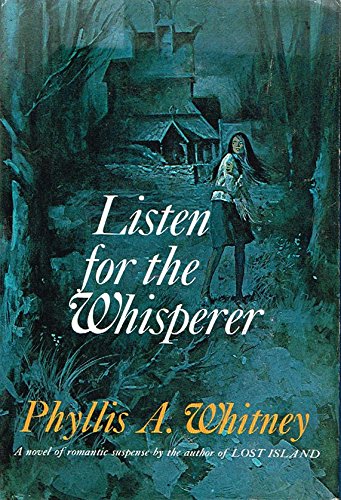
listen for the whisperer

I sat in the darkened theater with my hands clasped tensely in my lap and my eyes fixed unblinking upon the screen. The man beside me touched my arm and I pulled away from him, not wanting anything to break the spell of the scene that was moving, inexorably to its climax.

“Let up, Leigh,” Dick whispered. “This is pure corn, even if Laura Worth did win an Oscar nomination for it years ago.”

Twenty years ago. I knew. But I would not listen to him. I shut him out and watched the screen. I knew the scene by heart, but the impact was always the same. My ambivalence was always the same. I was fascinated by every move the woman on the screen made, yet at the same time I detested her utterly. No one had a better right to detest her.

In the role of Helen Bradley in the movie adaptation of my father’s novel, The Whisperer, Laura Worth was coming down that famous Victorian staircase that had been almost a character in the book. Not only I, but the entire audience sensed her fear. Terror seemed to emanate from her as she descended the stairs, one hand clinging to the banister, the other held to her throat in dread. She was a woman going to meet death–and knowing it. The audience knew it, too. Sure of the outcome, sure she would finally escape, they still felt the fright she meant to convey. Even Dick was silent, watching as she reached the foot of the stairs.

The black and white screen managed to reproduce the eeriness of gaslight; even the furnishings seemed to suggest the gray flicker that was the very color of terror. Helen Bradley knew that she lived in this house with a husband who intended to kill her. She knew that no one would believe her accusation if she made it, and that there was no escape from what was going to happen–very soon. Yet she must go down those stairs, cross the hall and enter the parlor where he waited for her. The background music was hushed, suitably tense and anticipatory. You forgot this was Laura Worth, the actress. You became Helen Bradley.

Pretty great opening there, isn’t it? Mrs. Whitney established who the center of the novel is: an actress named Laura Worth, and as the opening scene progresses, Dick asks Leigh, “Wasn’t there some scandal that hurt the picture and cost her the Oscar?”

And that is the central mystery at the heart of the novel: the murder of director Cass Alroy during the filming of The Whisperer, some twenty years or so earlier. Ms. Worth had a habit of sleeping in her dressing room during filming; in order to feel closer to the part and to the process of filming. She’d been feuding with her director since filming started; there were rumors of a love affair gone bad between them. One night while she was staying in her dressing room, she had a crash and went out to see what made the noise; a younger co-star who also happened to be a huge fan of hers, Rita Bond, was also there, and they discovered the dead body of Cass Alroy, hit over the head and killed by someone unknown. The feud stories cast suspicion on Laura; after the filming was complete she gave up her career, left Hollywood, and returned to her home country, Norway–she was half-Norwegian–and became a recluse.

Leigh Hollins, the main character, is Laura’s daughter. Laura had an affair with Leigh’s father during the filming of another of his books, but she wasn’t interested in either marriage or being a mother; so she gave up the child to Leigh’s father, who later married someone else who raised Leigh as her own. Leigh has never known her birth mother, and that has always been a bone of contention and discontent in her life. Now, watching the film again, as a young journalist who often writes profiles of film stars and with her father dead, Leigh decides to go to Norway and make contact with her birth-mother after all these years. But what she finds when she gets to Norway is that the secrets from the past–and the mystery of who killed Cass Alroy–is still very current and swirling around her mother’s household. Leigh also finds herself not only in danger, but some romance as she tries to build a relationship with her mother and get to the truth about what happened so many years ago on the set of The Whisperer–and almost everyone in the household is a suspect, then and now.

It’s a terrific book, if a little dated; one of my primary problems with Whitney’s heroines is they weren’t nearly as strong as I would have liked, and another trope she repeatedly used (although not in this particular novel) was good girl (her heroine) vs. “bad girl” (the villainess); the bad girl in the story inevitably was sexually promiscuous, mean-spirited, and often married to the man the heroine was in live with, and made him miserable (Lost Island, Columbella, The Turquoise Mask, among many others). Another recurrent theme in Whitney’s work was family drama/tension; her heroines also often had to return to somewhere they’d fled and avoided to try to repair a family relationship: in this book, the heroine and her birth mother; in Silverhill, she is returning her mother’s body to the family she was estranged from; in The Turquoise Mask she is going to meet her mother’s family and try to get to the truth of her mother’s death when she was a little girl; in Lost Island she is returning to get to know the son she gave up to her cousin and the son’s father, whom her cousin married (Lost Island was always one of my favorites; I may have to revisit it as well).

Whitney’s books are mostly available as ebooks now; some are still in paperback print–but I think the majority of her children’s books are unavailable. She won two Edgars for Best Juvenile Mystery, and was named a Grand Master by Mystery Writers of America in the 1980’s. As I said, some of her books probably seem a little dated now, but she was an incredibly prolific writer, the books are still engaging, and I think she isn’t remembered as much as perhaps she should be.

Go Rest High on that Mountain

Saturday morning in New Orleans, and all is well. I slept really well last night–the deep dead sleep I love so much, because it’s so revitalizing–and can’t help but notice that I’ve been enjoying that kind of sleep a lot more since I started back to the gym. Coincidence? I think not.

Yesterday, I’m not going to lie, started out pretty fucking shitty. I got up feeling terrific. Well rested, ready to get out and kick some ass this weekend; as evidenced by yesterday morning’s blog entry. I went to the gym, had a tough workout–the motivation was there, but missing Wednesday had put my body out of sync with the weight-lifting, which made it more of a struggle than it should have been–then I came home. I started doing the laundry (I do the bed linens every Friday), made myself a protein shake, started getting the dishes taken care of, and then sat down at my desk to check my emails and social media. My twitter feed was filled with homophobic micro-aggressions from people who should, actually know better; as I read through I felt my anger and gorge rise. I was just about to send a PM to a friend (who definitely should know better) when Scooter jumped up onto my desk and knocked over my protein shake….all over my desk, my keyboard, my checkbook, my wallet, the research books I’ve been using for a writing project, my lap, and various file folders.

I was not pleased.

That took about half an hour to get cleaned up (thanks again, Scooter) and by the time I was finished I was already behind schedule for getting to work and running errands. I have a tire with low air, so I stopped at a convenient gas station (there is literally only one that’s convenient, and even it is out of the way) and of course, it was filled with morons. WHY WOULD YOU TAKE THE BACK PUMP INSTEAD OF PULLING TO THE FORWARD ONE?

I suspect her name was Karen.

The gas station turned out to be an exercise in aggravation and frustration, so I decided to say fuck it and do it over the weekend sometime. Then I got stuck behind a garbage truck, and when finally–after driving all the way uptown behind this idiot going 14 miles per hour–I got stuck behind a street cleaner on Jefferson on my way to Claiborne. We’ll just pretend there were no idiots on their cell phones on I-10 because I just can’t with people who think a phone call is more important than their life and the lives of everyone else on the highway.

Seriously, days like yesterday make me long for the next meteor and extinction event.

By the time I finally got home from work,  I was essentially done-in and exhausted. I later attributed it to the lack of a protein shake–I mean, the protein shakes I generally have after working out are enormous and have a lot of protein in them; because it spilled I had to have one of those prepackaged ones, which only had about half the protein in it that I usually rebuild with after a good workout–so note to self: should there ever be a repeat of the Protein Shake Incident, drink two of the pre-packaged ones, or you will suffer later.

So, it’s a gorgeous and sunny day outside; it’s a bit chilly here in the Lost Apartment, but that probably means it’s warmer outside. I have to walk over to the Home Depot (I need to get file folders and a new little notebook to replace my check register; yes, I still balance my checkbook, and yes, I still write everything I spend down), and the Lost Apartment  needs cleaning. I am way behind on my emails again (what else is new) and I have some things I need to get taken care of today; I want to finish reading my Ali Brandon novel this weekend, and I also want to pick out my next Reread Project read. I decided that since it’s Leap Day I shall also spend the day working on the numerous in-progress short stories I have; I am also going to try to get the Secret Project planned out and back on track again today, so I can launch myself full force into it again tomorrow. I also want to try to use today (and my new file folders) to get better organized. One of the worst things about Carnival is you literally just try to tread water with everything and you inevitably get scattered, disorganized and behind…and then it’s so hard to get everything back under control yet again once it’s over. I may not get much writing done today–certainly I know I won’t get as much done as I would like to get done–but the most important thing is to ensure that I am organized, know what I need to get done, and that way I can start organizing tasks and start getting them done.

I also got a shit ton of books in the mail this week; some definite treasures, some from authors I’m not familiar with, and once again, I weep at the idea of all the books I will never have the time to read. I am perhaps most excited about Alabama Noir, from the Akashic noir series; edited by Don Noble, it has stories from some of my favorite writers (Ace Atkins, Carolyn Haines, and Suzanne Hudson, among others) and of course, it’s ALABAMA, which I still feel such a strong pull towards, despite having never lived there and knowing deep in my bones and my soul that New Orleans is my home. Do other people feel that way about the states where they were born, where their parents and family are from? Or is it just a Southern thing? One of the reasons I started writing Bury Me in Shadows was because I wanted to write about Alabama, and the complexity of my feelings for the state. I’ve done some Alabama short stories, and I’ve set one book in Alabama–Dark Tide, which was mostly set down in the Gulf beach area–but I’ve always wanted to write more about Alabama. I think the reason Bury Me in Shadows has been so difficult to write for me is because I’m really not sure what the state is like now; and yes, of course it’s fiction, but I also don’t want to indulge in stereotyping and I want to be able to write honestly. I don’t have the time or the money to drive up there, look around, and get a better sense of place than my memories–plus, the part of the state I’m from isn’t the most friendly for people like me–but you never know. All it would really take is a long weekend and a cheap motel somewhere.

And on that note I just heard the dryer click off, so perhaps it’s time for me to get going on everything.

Have a lovely Saturday/Leap Day, Constant Reader!

1621981_10152213121411473_280855996_n

Walking the Floor Over You

I have always loved to read, and have always encouraged other people to read. It’s one of the great pleasures of my life, for as long as I can remember. Once I learned how to read, I never stopped reading. I will probably never stop reading. There are fewer non-sexual pleasures in life as satisfying as reading a good book.

As I’ve mentioned before, my grandmother got me really started into watching old movies–both horror and crime–and also encouraged me to read. She was the one who got me started reading Mary Stewart, by giving me her copy of The Ivy Tree; my friend Felicia in high school reminded me of Stewart and so I started reading more of her work. (I still have not read all of Mary Stewart’s work–that “I don’t ever want to run out of something new to read by Mary Stewart” thing I do) And while I enjoyed all of them, I enjoyed some more than others. For example, i remember reading The Moon-spinners, but not really enjoying it very much, frankly. I never revisited the book…but now that I am doing the Reread Project, I decided to give it another read.

0449027953

It was the egret, flying out of the lemon grove, that started it. I won’t pretend I saw it straight away as the conventional herald of adventure, the white stag of the fairytale, which, bounding from the enchanted thicket, entices the prince away from his followers and loses him in the forest where danger threatens with the dusk. But, when the big white bird flew suddenly up among the glossy leaves and the lemon flowers, and wheeled into the mountain, I followed it. What else is there to do, when such a thing happens on a brilliant April noonday at the foot of the White Mountains of Crete; when the road is hot and dusty, but the gorge is green, and full of the sound of water, and the white wings, flying ahead, flicker in and out of the deep shadow, and the air is full of the scent of lemon blossom?

The car from Heraklion had set me down where the track for Agios Georgios leaves the road. I got out, adjusted on my shoulder the big bag of embroidered canvas that did duty as a haversack, then turned to thank the American couple for the lift.

“It was a pleasure, honey.” Mrs. Studebaker peered, rather anxiously, out of the car window. “But are you sure you’re all right? I don’t like putting you down on the hill like this, in the middle of nowhere. You’re sure you’re in the right place? What does that sign post say?”

The above pictured cover was the one I originally read; the reread was of a more recent edition. When I was younger, I was fascinated by ancient history: Egypt, Greece, and Rome, to be exact; Greek or Roman or Egyptian ruins on the cover of a book, especially if it was a suspense novel, drew me to the book like moth to flame. (That was what originally drew me to read Phyllis A. Whitney’s Mystery of the Hidden Hand, which I now believe–my memory lies, remember–was the first Whitney I read, because it was set in Greece) I had also remembered seeing a film version of The Moon-spinners, broken up over two weeks’ episodes of The Wonderful World of Disney, which starred Hayley Mills. I don’t remember much of the film now, but I do remember thinking it was vastly different from the book when I read it the first time. It’s not on Disney Plus (neither is Johnny Tremain or Now You See Him Now You Don’t, which has annoyed me regularly since I signed up for the service), and I’m not about to spend even three dollars on renting it on Amazon Prime–although I was tempted enough to look it up to see if it can actually be viewed anywhere.

Anyway.

I enjoyed the book much more greatly this time. I’m not certain why, precisely, I didn’t like it as much as Stewart’s other books at the time, but sometimes that’s just the way it is. The Moon-spinners focuses on Nicola Ferris, an adventurous young Englishwoman in her early twenties. She works at the British Embassy in Athens; her parents died when she was a teenager and she went to live with her aunt Frances, who is a leading botanist. Frances is also single and terribly independent, like most women in Stewart novels; Nicola admires and loves her aunt greatly and emulates her. Her aunt is taking a yacht voyage with friends around Greece and the islands; Nicola decides to take a vacation, meet up with Frances on Crete–a friend, a travel writer, has recommended a very remote village with a small hotel to them–and Nicola has the great good fortune, while on Crete, to meet an American couple (the above mentioned Studebakers) who are driving around Crete and offer her a lift to Agios Georgios, putting her there a day earlier than expected. (This sentence, describing the Studebakers,  They were both lavish with that warm, extroverted, and slightly overwhelming kindliness which seems a specifically American virtue–is a terrific example of Stewart’s exceptional skill as a writer; in that one sentence she tells you exactly who the Studebakers are.) The Studebakers aren’t terribly keen on letting her off in the middle of nowhere, to lug her suitcases and such over a dusty mountain trail to a village where she isn’t expected until tomorrow and where she will know no one; fortunately her work at the embassy has given her a passable knowledge of speaking Greek.  Nicola insists she’s fine and thanks them for their kindness, and starts trudging along the dusty path.

All of Stewart’s heroines are strong, capable, intelligent young woman who can take care of themselves; and courageous. It is while walking on the path that Nicola’s Greek adventure takes off–she stops at a pond to get a drink of water, and in the reflection of the water she sees a man’s face, watching her. Your average run-of-the-mill heroine would scream and run off or be terrified; Nicola is merely startled and curious. This is how she comes across Lambis, the Greek boatman, and young Mark Langley, who has been shot and needs medical attention. Nicola immediately makes Mark’s problems her own. Lambis, as it turns out, had put in his boat in a nearby bay so that Mark and his younger brother Colin could go exploring and look at the ruins of an old church, originally a shrine to a Greek god but converted during the days of the old Eastern Empire into a Byzantine church. As they are walking back to the boat they come across of small group of people arguing over a recently dead body. Mark is shot and left for dead; Colin is taken. And so, now of course, Nicola wants to help rescue Colin and help Mark–she isn’t, after all, expected for another day, and of course, the killers/kidnappers must be from the small town of Agios Georgios.

Stewart is, as always, an exceptionally talented writer. Her descriptions are simple yet poetic; she vividly brings the town, the mountains, the sea, everything to life so well you can easily imagine yourself there. And courageous Nicola, now possessed of dangerous knowledge that could get her killed, has to navigate the village while trying to help Mark find Colin, with no idea of who she can trust and where she can turn to help.

Nicola is a terrific heroine, and I can see why Stewart was so popular with women and teenaged girls; she wrote smart, no-nonsense, capable young women who were courageous and fearless and could pretty much handle anything. The suspense is, at times, unbearable.

There is an element of romance to the story as well; Nicola begins to have feelings for Mark, but it’s practically an afterthought, and it feels almost like it was inserted into the story. There’s absolutely no need for the two of them to develop feelings for each other; other than the psychological closeness that comes from a shared danger (one of the things I loved the most about the sequel to Romancing the Stone, The Jewel of the Nile, is that it showed that happy couples who bond over adventures don’t necessarily wind up living happily ever after; I’ve often wondered about the couples from these types of novels), and this is one of the reasons I no longer really consider Stewart a romantic suspense writer; the romances in her books often feel that way–something inserted into the story later to appease either her agent or editor–and they are completely unnecessary to the story; if anything, the romance develop organically because of what else is going on in the story; the suspense/mystery aspect is the most important part.

And Stewart consistently wrote some of the best openings in crime fiction.

Highly recommended; I will probably reread it again someday.

Mama He’s Crazy

Believe it or not, back before the Internet and social media, it was possible for a book to go viral; to become so popular and so talked about it would sell a gazillion copies and establish the author–usually–as a long-time bestseller. To this day, I don’t know how I became aware of the viral books of the 1970’s (titles like Coma by Robin Cook; Jonathon Livingston Seagull by Richard Back; Jaws by Peter Benchley; The Other by Thomas Tryon; The Exorcist by William Peter Blatty; and The Godfather by Mario Puzo, among others), yet I did become very aware of them, and read most of them (true confession: I never read Jonathon Livingston Seagull, despite being a number one fiction bestseller for two consecutive years).

Mary Higgins Clark’s Where Are The Children? was a viral sensation when it was first published in 1975; I read it in paperback, and distinctly remember plucking it off the wire rack in the Emporia Safeway. I started reading it in the car as my mom drove us back home to Americus–the little town seven miles or so northwest of Emporia, where we lived; population less than a thousand, and the only time I’ve ever lived in such a small town–and couldn’t stop reading. I helped her bring the groceries in, went to my bedroom, and piled the pillows up and went back to reading.

where are the children

He could feel the chill coming through the cracks around the windowpanes. Clumsily he got up and lumbered over to the window. Reaching for one of the thick towels he kept handy, he stuffed it around the rotting frame.

The incoming draft made a soft, hissing sound in the towel, a sound that vaguely pleased him. He looked out at the mist-filled sky and studied the whitecaps churning in the water. From this side of the house it was often possible to see Provincetown, on the opposite side of Cape Cod Bay.

He hated the Cape. He hated the bleakness of it on a November day like this; the stark grayness of the water; the stolid people who didn’t say much but studied you with their eyes. He had hated it the one summer he’d been here–waves of tourists sprawling on the beaches; climbing up the steep embankment to this house; gawking in the downstairs windows, cupping their hands over their eyes to peer inside.

He hated the large FOR SALE sign that Ray Eldredge has posted on the front and back of the big house and the fact that now Ray and the woman who worked for him had begun bringing people in to see the house. Last month it has been only a matter of luck that he’d come along as they’d started through; only lyck that hed gotten to the top floor before they had and been able to put away the telescope.

Time was running out. Somebody would buy this house and he wouldn’t be able to rent it again. That was why he’d sent the article to the paper. He wanted to still be here to enjoy seeing her exposed for what she was in front of these people…now, when she must have started to feel safe.

I bought another copy of Where Are The Children? in 2014; my original copy lost years ago to one of many moves, intending to go back and rereading it at some point. The importance of Mary Higgins Clark, not just to women crime writers but to the genre in general, cannot ever be overstated. Clark was the bridge between the domestic suspense masters of the past–Margaret Millar, Charlotte Armstrong, Dorothy B. Hughes, among many others–and the next generation of women crime writers that dawned in the 1980’s, as well as to the modern domestic suspense writers–women like Alison Gaylin, Lori Rader-Day,  Catriona McPherson, and Wendy Corsi Staub, among many others–and her example–of grace, generosity, kindness, and assistance–is one other writers should emulate.

We could all use more Mary Higgins Clarks in the world.

Anyway, because of this importance, I thought I should reread her first as an homage to her importance; I’d recently met her, in passing, and was shocked when I ran into her again a year later that she remembered my name and the short conversation we’d had as I’d helped her onto the escalator at the Grand Hyatt in New York; I, of course, remembered every word and that glowing smile she’d given me. There was little doubt in my mind she wouldn’t remember me; how many thousands of people had passed briefly through her life? But she was sharp as a tack, and remembered me. “Greg! I was hoping you’d be here if I needed help with the escalator again,” she said, holding our her hand to me with that thousand-watt smile of hers. Then she winked, “I’ll be looking for you later. How did that book you were writing turn out?” When I told her I’d worked out the problem (yes, as I helped her onto the escalator and chatted briefly, I somehow managed to tell her that one of the many reasons I admired her was her dedication to working hard, and asked if she ever got stuck–because I was stuck on my WIP. She laughed and said, “Work through it. That’s the only way.” She was right.) and the book was coming out that very month, she replied, “I look forward to reading it.”

I seriously doubt that she did, frankly–but it was an incredibly kind and generous thing to say to someone many many rungs on the ladder beneath her, if we can even be said to be on the same ladder.

Her recent death obviously saddened many, me amongst them. So I decided to memorialize her by rereading her first and most famous bestseller, Where Are The Children? 

And really, it was past time, wasn’t it?

Upon finishing my reread, I would say that Clark was most like Charlotte Armstrong, of the women who came before her; she wrote about, like Armstrong, normal every day women who were simply minding their own business when something evil came across their path, and they had to dig deep inside and discover their own strength to overcome it.

In Where Are The Children?, Clark came up with a devilishly clever plot about one of the worst things that could ever happen to a woman: the loss of her children. Nancy Harmon, now Nancy Eldredge, married one of her college professors and had two children by him, only to have them snatched away and murdered. Their bodies were found washed ashore, their heads taped inside plastic bags; dead before they went into the water. Nancy was tried for their murders, convicted–and then released on appeal due to a technicality. The disappearance of the prime witness against her made retrying her impractical; so she changed her hair and disappeared from San Francisco to Cape Cod, where she found and married a realtor and had two more children–where no one knows who she is. (This would, of course, be impossible–or incredibly difficult–today; with the Internet and 24 hour news, everyone in the country would recognize her, different hair color or no.) Nancy is still haunted by her past, most of which she has buried in her subconscious–but little does she realize her idyllic new life is about to upended: on the same day the local paper runs an article exposing her past, her two children, Michael and Missy, disappear yet again; and of course, it looks like she has killed yet another set of her children.

But what Clark does is let the reader know immediately that Nancy is not only innocent of killing this set of children, but the first set as well. The book opens, as seen above, with a chapter in the point of view of the villain of the story; she does this consistently throughout the book–we see the events from other points of views, other than just Nancy’s and the villain’s, which also helps the suspense build and keeps the reader turning the page.

Also, it should be noted that the entire timeline of the book is less than one day, and probably not even ten hours; the children disappear around ten in the morning and the climax of the book happens after nightfall. Also, the book takes place during a particularly nasty thunderstorm, which includes hail.

Another excellent way she builds suspense is bringing in minor characters on the periphery of the story, puts a scene in their point of view, and of course it turns out that each one of these minor characters holds another, crucial piece of the puzzle.

Where Are The Children? is a subversive novel in many ways, and it’s easy to see how it became a phenomenon, and why Clark won the hearts of millions of readers. She plays with the tropes of what it means to be a mother; how quickly we blame mothers for anything that happens to their children or how they behave; and how quickly the admiration for motherhood can turn to contempt and scorn–and how easy that turn is made.

It can also be seen as a sequel, of sorts, to those Gothic novels where a child is endangered and the heroine has to act to save the child; this was a well Phyllis A. Whitney and Victoria Holt drew from, many many times. Instead of trying to save the child, in this case this is the aftermath of what happened should the mother (or young governess, whomever the heroine was) not have succeeded the first time in saving the children–but has a chance at redemption by finding and saving the second set of children.

It reminded me somewhat of Charlotte Armstrong’s Mischief, which is also long overdue for a revisit.

And now, back to the spice mines.

He’ll Have to Go

Saturday morning, and I slept in until nearly eight thirty! Living large here, I have to say.

Yesterday was one of those days; the temperature dropped, as you may recall, and once again when turning on the heat Thursday night, it didn’t really come on–it did, but it never truly got warm in the Lost Apartment, either upstairs or down. So, I wound up having to stay home from work to wait for the HVAC guys, who actually arrived dutifully when they said they would (this is so rare as to merit mention), and worked on it for a while. They did eventually leave, and I went to the gym and ran my errands.  I don’t know if the heat is actually fixed or not; we didn’t need it last night anywhere other than the kitchen, and I have a space heater for in there (it never warms up in the kitchen, ever) but I did manage to get a lot of cleaning and organizing done. I also managed to start watching the film of The Talented Mr. Ripley on the iPad yesterday at the gym (the Anthony Minghella version) and it veers away from the book’s narrative much more than I ever had supposed; the character of Meredith (played by Cate Blanchett) doesn’t exist in the book, nor does the entire subplot about Dickie’s affair with the village girl in Mongibello. But the one thing I will say about this film–and the thirty or so minutes of it I watched–Matt Damon is exceptionally great in the role of Tom; far more so than Jude Law as Dickie (he was nominated for an Oscar; the film made him a star), and this just might be one of Damon’s best performances.

Paul, I believe, is off to the office later today, and has plans with friends to go watch Krewe de Vieux tonight; I intend to stay home and work on the Secret Project, get my taxes together and sent off to the accountant, and emails to answer. There’s also organizing and filing to do, and I need to do the floors; I always leave the floors for Saturday vacuuming. Paul’s absence also gives me no excuse for not reading and writing for most of the day; around the cleaning, at any rate–and I am actually looking forward to getting a lot of both done today.

I’m still reading Tracy Clark’s Broken Places, which is really good, and in fact, once I finish writing this I am most likely going to  head over to the easy chair and spend a few hours with it this morning before moving on to the Secret Project. I am also really enjoying Jason Berry’s City of a Million Dreams, which I am not very far into, but I feel confident in recommending just based on the introduction and part of the first chapter. I’ve not read Berry before–he’s local, and has written quite a few books, including taking the Archdiocese to task for covering up the sexual abuse of children–but I am impressed enough to start adding his canon to my TBR list. We started watching Avenue 5, which was much funnier than I thought it would be–and Hugh Laurie is terrific as the captain; the entire cast is actually quite good. We’re probably going to also start watching The Outsider on HBO, which presents a conundrum for me; I generally like to read the book while I am watching the TV series based on it (I did this with Big Little Lies, and found it to be incredibly enjoyable; I’ve not read the King yet, but once I am done with the Clark, I am definitely going to pull The Outsider down from the shelf and give it a go)., but I guess pulling down The Outsider and moving it up to the top of the TBR list won’t hurt anyone or anything.

Parades also start this coming Friday on the St. Charles Avenue route; the challenge is going to be continuing to write and go to the gym around my job and the parades; parade watching is always a blast–it will probably never get old for me–but it’s also exhausting and keeps me up later at night than I probably need to be awake, given how early I will have to get up the following mornings.

It’s also lovely to wake up and sit at my desk and glance around and see clean, clear counters and a sink that is primarily empty of dirty dishes. There’s a load in the dishwasher that needs to be put away, and a load of laundry in the dryer that also neede to be fluffed and folded, but like I said, other than that and the floors (and these stacks of file folders and scribbled notes scattered around my desk), there’s no cleaning to be done this morning. My muscles are tired this morning from the gym yesterday, but I’m not sore, and I feel more stretched than I usually do, which also actually feels good–I may just stretch out a bit a little later; I’d forgotten how good it feels to have stretched muscles as opposed to tight ones.

So, that’s the plan for today, at any rate. I’m going to go pour yet another cup of coffee, take my book and repair to the easy chair; after that, it’s back to the desk to do some writing and answer some emails (I never actually send them until Monday morning; emails beget emails, and I’d rather not wake up Monday morning at the crack of dawn with an insane amount of emails to answer; it’s too, too daunting to deal with on a twelve hour day).

I was also thinking the other day–thanks to a post by someone on Facebook–about books that should be paired together, like a good wine and some good cheese; how reading the two back-to-back can enhance the reading pleasure of both. Michael Koryta’s The Prophet (which is one of my favorite books), for example, pairs beautifully with Megan Abbott’s Dare Me (and you need to be watching the television adaptation of Dare Me); Alafair Burke recommends pairing Scott Turow’s Presumed Innocent with Gillian Flynn’s Gone Girl, and there was one more I can’t quite remember, but it was also quite brilliant. (I also think pairing Stephen King’s Carrie and Christine together enhances the pleasure of reading each even more.)

I was also thinking about “event” books; Gone Girl was probably the most recent “event” book–a book that sold a gazillion copies and everyone was talking about. There have always been “event books”, which in the pre-Internet, pre-social media days was harder to have happen, and yet it did, all the time. Two such books from the 70’s include Thomas Tryon’s The Other and Peter Benchley’s Jaws; the fame of Jaws was spread even further by an event film based on it that has almost entirely eclipsed the book. Robin Cook’s Coma was another one of these; I intend to include The Other in my Reread Project this year, but rather than Jaws I am going to reread Benchley’s second novel, The Deep, and Cook’s second novel, Sphinx–which was Cook’s only non-medical thriller thriller.

And on that note, I am going to repair to the easy chair with my coffee and Tracy Clark. Have a lovely Saturday, Constant Reader; I certainly intend to.

1209113_10151802572687778_2028718899_n

I’d Better Off (In a Pine Box)

I love Patricia Highsmith, and one of the great joys of the last twenty years or so in my reading life has been slowly working my way through her canon.

Is there anything more fun and exciting than discovering a new writer whose work you enjoy? I think not! And it’s always fun to start working your way through their canon. I’m not even remotely close to being finished reading Highsmith; I’ve been enjoying my occasional forays into her work, and if you’ve not read her short stories….well, you’re really missing out. Her short stories are just as quirky and dark and pessimistic as her novels; although I’m really not so certain that I should use the pessimistic label with Highsmith. From everything I’ve read about her, she was a terribly unpleasant person with a cynical world view and a not particularly high opinion of her fellow human beings; although I think I can honestly say right there with you, Patricia! most of the time. Highsmith’s dark, cynical view of the world and her fellow human beings is partly what makes her books so terrific, so amazing, so suspenseful and so entertaining. I think the first of hers that I read was Strangers on a Train, which was a Hitchcock film I’d always loved; imagine my surprise to discover that it was based on a novel (as so many old films were; not many people knew, for example, that Whatever Happened to Baby Jane? was also a novel first, and it’s actually quite a good novel, at that). The book was amazing (and I should probably reread it as well), and I became aware of The Talented Mr. Ripley when the Anthony Minghella film version, starring Matt Damon, Jude Law, and Gwyneth Paltrow, was released. The same author as Strangers on a Train?

I was so in. I actually read the book before I saw the film–which I think we rented, or watched when it made its way to HBO–which I also really enjoyed; Matt Damon did a great job as Ripley. But as more time went by my memories of the novel became supplanted by memories of the film–and as I knew there were differences between the two, I always meant to get back to the book but never did. I also never read the other books in the so-called Ripleyad; I never saw any point. I thought the first novel stood perfectly well on its own with its self-contained story and I worried that reading the others might spoil the first. There are five novels about Tom Ripley in total; written over the course of twenty six years, from 1955 to 1991. (There’s a lovely but expensive boxed set of them available; I may treat myself to that for my birthday, but whether I do or not remains to be seen.)

Over the past few years (probably a decade, I literally have no concept of time anymore) I’ve read some other Highsmith novels; The Blunderer and The Cry of the Owl, neither of which are as well known as the Ripley books or Strangers on a Train, which is a pity; both are truly fantastic–I particularly love the way she flips the narrative in The Cry of the Owl and turns it into something completely different from what the reader is expecting at the beginning; it’s absolutely genius, and mandatory reading for anyone who wants to write suspense novels, frankly.

But I wanted to reread Ripley, and possibly even go on to the other four books in the Ripley series, primarily because I am now rereading some of these older works with an eye to how male sexuality is presented; Ripley  was published during the highly repressive 1950’s, which was a horrible decade in which to have an alternate sexuality as well as to write about them; often they were coded. (I also want to reread Strangers on a Train for that same reason) When the Minghella film was released, there was a lot of talk about Ripley’s sexuality and its possible repression; there’s probably a similarity there between it and A Separate Peace; books in which I recognized something when I read them about male relationships, friendship, and intimacy that resonated with me. And I also realized, as I said earlier, that my memories of the book had become blurred by my memories of the film–which I also want to watch again; I can never forget that image of Matt Damon’s so-pale-it-almost-glowed skin on the beach in his yellow bikini when he awkwardly meets the Jude Law/Gwyneth Paltrow portrayed characters, and I wanted to reread that scene again in particular, to see how Highsmith handled it.

the talented mr. ripley

Tom glanced behind him and saw the man coming out of the Green Cage, heading his way. Tom walked faster. There was no doubt the man was after him. Tom had noticed him five minutes ago, eying him carefully from a table, as if he weren’t quite sure, but almost. He had looked sure enough for Tom to down his drink in a hurry, pay and get out.

At the corner Tom leaned forward and trotted across Fifth Avenue. There was Raoul’s. Should he take a chance and go in for another drink? Tempt fate and all that? Or should he beat it over to Park Avenue and try losing him a few dark doorways? He went into Raoul’s.

Automatically, as he strolled to an empty space at the bar,  he looked around to see if there was anyone he knew. There was the big man with the red hair, whose name he always forgot, sitting at a table with a blonde girl. The red-haired man waved a hand, and Tom’s hand went up limply in response. He slid one leg over a stool and faced the door challengingly, yet with a flagrant casualness.

“Gin and tonic, please,” he said to the barman.

The book opens differently than the Minghella film; which immediately changes the dynamic of who Tom Ripley is. In the film, Dickie Greenleaf’s spots Tom performing at a high society party with a music combo; he’s wearing a jacket that identifies him as an Ivy League alum–so Mr. Greenleaf, seeing that he’s about the same age as his son, thinks Tom might know Dickie and be amenable to an expenses-paid trip to Italy to retrieve him; only later do we learn he’d borrowed the jacket and probably doesn’t know Dickie at all.

As you can see from the above, Highsmith opens with suspense. Someone is following Tom, and it’s making him nervous–why? And why would someone be following him? We soon find out that he’s nervous because he’s been pulling a tax scam; he’s been calling random people, pretending he’s from the IRS and telling them they need to send more money because they didn’t pay enough taxes; it’s just for fun, as the checks aren’t made it out to him and he can do nothing with them. This is our first anticipation, as readers, that Our Hero may not exactly be your traditional-style suspense hero. But it’s only Mr. Greenleaf, not a treasury agent, and Mr. Greenleaf explains his situation to Tom–wanting Dickie to come home, as his mother is dying of leukemia and Dickie needs to get it together, give up his Bohemian life as a painter in Italy and come back to the US to take up his rightful place in the family business.

Soon Tom is on his way to Italy, funded by the Greenleafs, and tasked with bringing the recalcitrant heir home. He does find Dickie on the beach in Mongibello, and has to somehow make his acquaintance–and he doesn’t have a swimsuit:

He hadn’t brought a bathing suit with him, and he’d certainly have to have one here. Tom went into one of the little shops near the post office that had shirts and bathing shorts in its tiny front window, and after trying on several pairs of shorts that did not fit him, or at least not adequately enough to serve as a bathing suit, he bought a black-and-yellow thing hardly bigger than a G-string.

ripley

In the film, the awkwardness of the scene–and Tom in the bathing suit (which, in this case, is a lot more than a G-string; but then again, Tom has buried a lot of shame deep inside himself, and not just about his sexuality) he is clearly uncomfortable wearing, as well as the pasty whiteness of his skin amongst all the tan bodies on the beach, instantly induces sympathy for him–and in the book, it’s much the same. Highsmith takes us into Tom’s mind, in a tight third person point of view, so that we know what he is thinking and what he is feeling–but Highsmith is such a master writer, so good at making we the reader identify with Tom…that we soon forget that she is also dropping little hints along the way about just who he is. He is often refreshingly honest–he is very quick to tell people that he is good at forgery (he is) and mimicking other people (again, he is) and freely admits to many not quite moral talents; the great irony is that Tom has learned that you can quite often tell the absolute truth to people and they won’t believe you. He’s charming in his way, because he has learned that to get what he wants out of life, he has to be. Soon he is quite obsessive about Dickie–and disliking Marge, to the point of hating her for never letting him be alone with Dickie.

And this exchange:

“Marge and I are fine,” Dickie snapped in a way that shut Tom out from them. “Another thing I want to say, but clearly,” he said, looking at Tom, “I’m not queer. I don’t know if you have the idea that I am or not.”

“Queer?” Tom smiled faintly. “I never thought you were queer.”

Dickie started to say something else, and didn’t. He straightened up, the rubs showing in his dark chest. “Well, Marge thinks you are.”

Ah, some self-loathing a teenaged Greg can certainly identify with. Deny, deny, deny.

I loved the book even more than I did on the first read, and perhaps there’s a much longer, more in-depth piece I could write about this book (I certainly tagged a lot of pages as I read), but I am now interested in reading the rest of the Ripleyad; to see how Tom comes out–he certainly wound up ahead of the game at the end of The Talented Mr. Ripley, having lied, forged, stolen, and killed his way to get there.

And I do want to watch the film again–it’s on Netflix. Maybe something to watch while on the treadmill at the gym? Perhaps.

You Don’t Love Me Anymore

Sunday morning, and with no Saints game today I have no excuse not to get a lot done today. It’s chilly this morning and gray outside; we still have rain in the forecast but it’s calm and quiet out there right now; perhaps the calm before the storm? Ugh, such a tired cliche–but it’s fine with me.

Yesterday I got a lot of chores done–very little writing, but the chores were necessary and of course, being the Master Procrastinator that I am; I have to have a clean apartment–or at least one that’s been straightened up some–in order to have a clear conscience enough to get work done. I now have no excuses to not get everything done that I need to get done today–but we’ll see how that goes; there’s always something.

I read another Holmes story yesterday–“The Musgrave Ritual”–which I couldn’t remember the plot of, other than remembering that it was one of my favorite Holmes stories. Like “The Gloria Scott“, it’s a “let me tell you a story” story; I really don’t remember the Holmes stories being like this, of course, but it’s something to think about as I prepare to write my own pastiche. It’s a style of writing/story-telling I’m not so certain I want to try, but then again–the entire point of me writing a Holmes story is to push myself as a writer and get better overall, so perhaps…perhaps I should try it that way and see how it goes. Anyway, as I reread it, I remembered why I liked it so much; it’s a treasure hunt story, and I absolutely love treasure hunts. At least two Scotty books–Jackson Square Jazz and Vieux Carre Voodoo, are treasure hunts.

I also rewatched the original film version of Shirley Jackson’s The Haunting of Hill House, 1963’s The Haunting, directed by multiple Oscar winner Robert Wise, and starring Julie Harris as Nell. I saw this movie long before I even knew there was a book, let alone read it; my grandmother loved old black and white movies, and she especially loved crime and horror–probably where I get it from, and she also introduced me to the novels of Mary Stewart, Victoria Holt, Ellery Queen, and Erle Stanley Gardner. I was very young and the film absolutely terrified me–to this day, even remembering the scene with the door expanding and contracting unsettles me. I was, of course, quite delighted as a teenager to discover it was actually a novel (I had read Richard Matheson’s Hell House, with it’s similarities to The Haunting, year earlier and wondered if he’d gotten the idea for the book from the movie), and it quickly became one of my favorite novels of all time; in fact, I believe it was Stephen King who introduced me to the novel, because the opening paragraph was an epigram to ‘salem’s Lot. But I hadn’t watched the film in years; I’d watched the horrible 1999 remake, and of course the Netflix series loosely based on the book (I do recommend the series, it’s fantastic, once you get back the fact that it’s not a faithful adaptation but kind of fan-fiction; it didn’t even have to be Hill House for the story to work, but that’s a subject for a different blog. I do recommend it, though). Julie Harris is perfectly cast as Nell, and Claire Bloom does an excellent job as Theo. There are differences between the book and the film; why they changed Dr. Montague’s name to Dr. Markway is a mystery, and the later third of the film, after his wife arrives, is vastly different from the later third of the novel, and her character is completely changed; the young man who escorts her to Hill House is also excised from the movie. But the way the film is shot–the use of light and shadow, the up angles of the camera, and the ever-so creepy claustrophobia of the enclosed house–is absolutely terrifying, and you never see what is actually haunting the house. That was the singular brilliance of the book, and Wise kept that for his film (the execrable 1999 remake went completely over the top with CGI effects and so forth; ruining the necessary intimacy of the story). I still think of it as one of the scariest movies I’ve ever seen, and on a rewatch–the way you hear Nell’s thoughts, whispered, while Julie Harris’ eyes dart around–adds to the intimacy. I think that interior intimacy is a large factor in why the book is so fantastic, and why both book and original film work so well. The Netflix series does show the ghosts of Hill House, but it’s also done in a very subtle, unsettling way, which is why I think I liked it so much.

I also was thinking about rewatching Anthony Minghella’s film adaptation of The Talented Mr. Ripley, but decided to hold off until I finish the reread of the book–which I am still in the midst of–I want to finish it before my trip this week, because I want to take two different books with me to read.

I did finish my reread of Kirkland Revels by Victoria Holt, which was much better than I remembered, with it’s haunted monastery and ghostly monk haunting the big manor house. It’s also a terrific novel about paranoia and gaslighting; the ultimate evil scheme behind everything hinges on the heroine of the story being eventually committed to an insane asylum, and hopefully miscarrying her child, or it being born dead as a result of the confinement. Holt novels often hinged on the possibility of insanity being genetic–if the mother is insane, her child most likely will be as well–and this horror, which was probably very real in the nineteenth century, makes this book terribly unsettling. The main character, Catherine, is very strong-willed and intelligent, but she marries a man without meeting any of his family, moves into the family estate (Kirkland Revels), and then he dies in a fall from a balcony, and she returns to her father’s house; only to have to return to Kirkland Revels when she discovers she is pregnant. The combination of vulnerable and pregnant heroine being gaslit into believing she is insane was pretty unsettling to me when I originally read the novel; which is probably why it’s one of the few Holts I never took down from the shelf on a rainy afternoon and reread. Rereading it, thought, makes me appreciate the mastery apparent in Holt’s writing. She never again wrote another novel with a pregnant heroine–while some of her later novels did involve pregnancies and/or motherhood (On the Night of the Seventh Moon, The House of a Thousand Lanterns) the mystery, and the plot against the heroine, never occurred during the pregnancy. Romantic suspense, and its twin sister, domestic suspense, were a kind of “women’s noir,” in that the stories always focused on what were seen as the biggest fears for women–marrying the wrong man, danger to her child, not being able to trust your husband–were the recurring thread through all of them.

I also did manage to get some work done on the new project yesterday, which was lovely and my goal for the day. Not as much as I would like–I wouldn’t be me if I didn’t fail to achieve everything in a day that I wanted to–but enough to be satisfactory. I also came up with an idea for another Scotty, one that takes place down in the bayou–Cajun Country Cavaille–but whether I’ll write it or not remains to be seen. But I’d like to address the loss of the Louisiana wetlands at some point in print, and writing about a (probably fictional) version of Lafourche and Terrebonne parishes is probably the best way to do that; I just don’t have a murder mystery to hang the story on. My interest in the Scotty (and possible resurrection of the Chanse) series is expanding outward from New Orleans to the rest of Louisiana; I’ve come to realize that not only do I love New Orleans but I also love Louisiana, frustrating and irritating as that love can be sometimes. Louisiana is so beautiful…I also want to write about the Atchafalaya basin sometime, too, and of course let’s not forget the infamous Bayou Corne sinkhole no one talks about anymore…and of course there’s Cancer Alley along the river between Baton Rouge and New Orleans, which is also begging to be written about.

And on that note, perhaps it’s time for me to head back into the spice mines. Have a lovely Sunday, Constant Reader.

warrior-2-678x381

He Can Put His Shoes Under My Bed Anytime

As Constant Reader might remember–or if you don’t, here’s the reminder–I’ve been tasked with writing a Sherlock Holmes short story. Being quite mercenary–I rarely turn down opportunities to make money–I of course said yes; I am not a Sherlockian by any means, but it was precisely this lack of knowledge regarding perhaps the greatest private detective in the history of crime fiction (along with the offer of payment) that also was part of my inspiration to respond to the querying email with a most enthusiastic yes, of course I would love to; for there is also nothing such as the combination of payment AND a challenge to my writing skill and ability that I will welcome most gratefully.

Which, of course, was immediately followed by what the fuck were you thinking?

Now, I read most of the Holmes stories when I was in junior high, and they never really took with me. I enjoyed them, don’t get me wrong, but I never became what I call a “Sherlockian”; an enormous fan who devours any and all Holmes-related materials, whether they were written by Doyle himself, or the pastiches/homages, or any of the scholarship. I’ve watched some of the films, yes, and enjoyed both Sherlock and Elementary, even though we gradually lost interest in the latter and stopped watching. I also read the Nicholas Meyer “new cases” published in the 1970’s, The Seven Per Cent Solution and The West End Horror (I believe he’s published yet another one, as well). And a few years ago I bought the definitive annotated Holmes two volume set on eBay. So I figured I could reread some of the original stories, ask some of my friends who are deep into Sherlockiana to help if I needed it (both said yes, because writers are often very kind and generous people–side-eye at Romance Writers of America), and then I remembered a story I meant to read for last year’s Short Story Project, “The Case of Colonel Warburton’s Madness,” by Lyndsay Faye, which was a Sherlock Holmes story originally published in an anthology called Sherlock Holmes in America, and reprinted in The Best American Mystery Stories 2010, edited by Lee Child. I got the book down from the shelves yesterday and started reading.

My friend Mr. Sherlock Holmes, while possessed of one of the most vigorous minds of our generation, and while capable of displaying tremendous feats of physical activity when the situation required it, could nevertheless remain in his armchair perfectly motionless longer than any human being I had ever encountered.  This skill passed entirely unnoticed by its owner. I do not believe he held any intentions to impress me so, nor do I think the exercise was, for him, a strenuous one. Still I maintain the belief that when a man has held the same pose for a period exceeding three hours, and when that man is undoubtedly awake, that same man has accomplished an unnatural feat.

I turned away from my task of organizing a set of old journals that lead-grey afternoon to observe Holmes perched with one-leg curled beneath him, firelight burnishing the edges of his dressing gown as he sat with his head in his hand, a long-abandoned book on the carpet. It was with a view to ascertain that my friend was still alive that I went so far against my habits as to interrupt his reverie.

Isn’t that a wonderful start? And very Doyle-ish, yet uniquely Lyndsay Faye’s style. Lyndsay is a dear friend–and one of the people who agreed to advise me on my story–and we’ve known each other for years. I first saw her at the first Edgar banquet I attended; she was a finalist for Best Novel for The Gods of Gotham, which was fantastic and you should read it–and again more recently for her novel Jane Steele. We later were both on a judging panel for the Edgar for Best Short Story and became friends; I later recruited her for the Mystery Writers of America board of directors, and we’ve been buds ever since.

The story is truly fantastic, and as I read it–it’s a reminiscent story, in which Watson recounts an old story to Holmes from his days traveling in the United States, and this story is set in San Francisco. Colonel Warburton was a war veteran of both the Mexican War and the Civil War who’d made a fortune and built himself a mansion in San Francisco. But now in his latter years he fears he is losing his mind, having flashbacks to his war days, and Watson never really quite figured out what was going on in the Warburton mansion–but in relating his story and observations, he delivers the missing piece to solve the puzzle to Holmes’ brilliant deductive mind.

And thus, I realized that my fears–ever-present, of course–of imposter syndrome and so forth, which had been swirling around in my head about writing this story, began to disappear. I also grabbed one of the annotated volumes and started reading another Holmes story–and the idea that I had, “The Affair of the Purloined Rentboy”, began to take even better shape in my head…and I decided that today, as part of my writing, I would attempt to start writing the story. Which is very exciting, I might add.

Yesterday was a most productive day here in the Lost Apartment. I got a really good night’s sleep Froday night, and woke up aflame to get shit done yesterday. I cleaned, I organized, I filed, I did laundry, I cleaned the floors, I did the dishes and I read and I wrote and I did all kinds of things that made me feel quite accomplished by the time I plopped down in my easy chair to relax for the evening and watch television. Paul had gone into the office for the afternoon, and went out for the evening with friends, so I was pretty much alone all day yesterday and was able to accomplish a lot–not having an LSU football game to get stressed over was a big part of my getting so much done. The Saints are playing Minnesota today in the play-offs; I’m debating whether I should watch with my full attention, or stay here in the kitchen writing, checking in on the score periodically. I should, of course, stay in here writing. I need to get further along with Bury Me in Shadows, of course, and of course there’s the Sherlock story, and some website writing I agreed to do by a week from Monday.

So, on that note, I need to head back into the spice mines. I didn’t sleep as deeply last night as I did on Friday night, but it’s okay; I’m neither tired, nor exhausted; I actually feel rested if not completely awake this morning. Perhaps once I finish my second cup of coffee, and sort through my emails, I’ll be more awake.

So, it is off to the spice mines with me now, Constant Reader. Have a lovely Sunday!

53063626_2500889266606528_4900311205152817152_n

Every Time Two Fools Collide

So I finally went back to work on the book last night when I got home from the office. Huzzah! I was beginning to think I never would work on the damned thing again, but maybe there is something to this “arbitrary date chosen by Julius Caesar to start the new year” thing, after all. I started writing two new short stories, I got back to work on the book–pretty amazing, I have to say, especially taking into consideration that I’ve been such a fucking slug about writing for quite some time now.

Huzzah for the end of that nonsense!

Whether it actually means something remains to be seen, of course, but at least I also started the next chapter as well. It felt good to be writing again, and it felt really good to be making this manuscript better. It’s been so long since I last worked on it that I am going to have to go back to my notes and review them again; but that’s fine. At least I have the notes, you know, and that puts me ahead in a way–look, I’ll take these little victories where I can, thank you very much.

It does seem as though the RWA mess has calmed somewhat on Twitter, and what the future holds for the organization remains to be seen; it’s always sad to see an organization tear itself apart in this way, especially when the real root cause of the whole mess is racism. Sorry, Nice White Ladies, but we’re not going back to the 1950’s–the people of color aren’t going back to the back of the bus and the queers aren’t going back into the closet. And inevitably, there’s going to be issues any independent audit turns up; aren’t there always? I can only theorize the paid staff’s been colluding with the people masterminding this insidious leadership coup, and there are probably irregularities that will turn up in their books once the inevitable independent audit shows up. There’s something terribly rotten at the core of that organization, and it’s just a matter of time before it gets dragged out into the light and exposed.

I am still reading Richard Campanella’s Bourbon Street, and I’ve now reached the period of time–the 1950’s through the 1960’s–where the street truly earned its name and reputation as a strip for sinning. As always, ideas are flooding through my mind for new stories and perhaps a new series; I think the story I originally started writing a while back, “The Blues Before Dawn”, might actually work better as a short (70k-ish) novel set in the late 1950’s/early 1960’s rather than the WWI/Storyville era I was thinking about setting it…and also makes me wonder about my Sherlock Holmes story; perhaps moving it to a more modern era might be better? But I must get these other two manuscripts finished before I really even start thinking about other novels–and let’s face it, Chlorine needs to be the next novel I write anyway. I wrote a first draft of the first chapter a few months back, and it turned out better than I’d thought it might; and last night, as we watched John Mulaney stand-up comic specials on Netflix, the second chapter came to me, almost fully formed. It’s lovely when that sort of thing actually happens, you know–it’s so organic and I love it, it makes me feel like a real writer when it does–and it doesn’t really seem to happen all that often.

Although I probably should be spending all this time researching for Chlorine while I finish writing these other two books, shouldn’t I?

I don’t have a timetable for finishing Bury Me in Shadows or the final revision of the Kansas book, either. I probably should set one–although I’ve been doing that for the last year and it never seems to motivate me to get the work done.

OH! I also realized the other day when I was listing my favorite reads of 2019 I forgot two: The Better Sister by Alafair Burke and The Nickel Boys by Colson Whitehead. Both are frigging fantastic, and you need to read them sooner rather later. Get on it. Don’t make me come over there, because I will.

Tonight after work is the office holiday party, so I’ll be stopping there on my way home from work and probably then proceeding to Rouses so I won’t have to leave the house all weekend. Fingers crossed, at any rate.

I also have some errands to run on my way into the office today. It rained last night–everything is slick and shiny and dripping outside my windows this morning–and I suspect the temperature went south overnight as well; it’s very cold in the Lost Apartment this morning. I always forget how bipolar the weather in southeastern Louisiana is in the winter–it was warm and muggy yesterday. I stand corrected–it’s 62 with a high of 71 forecast for the day, so it’s clearly just cold here inside. Sigh, New Orleans.

I’m still rereading both The Talented Mr. Ripley and Kirkland Revels  as well; once I finish those rereads (and blogs) I’ll go on to my annual reread of Rebecca, I think, and then it’ll be time to read some new things from my TBR pile. The new Elizabeth Little ARC has been taunting me from the top of the TBR pile since I received it (read me, read me, come on and read me, you bitch!), and I was actually thinking about taking it with me as one of my “to reads” for the trip to New York; there will be lots of airport/airplane time involved, after all, and there’s no better time to read then when you’re traveling.

And on that note, I have some laundry to fold before I get ready for work. Have a lovely day, Constant Reader!

adam hagenbuch

Someone Loves You Honey

The second day of the New Year, and I didn’t want to get out of bed this morning. I went to bed relatively late, but still. I stayed up watching Georgia and Baylor play in the Sugar Bowl; yesterday was pretty much a waste as I spent the day in my easy chair watching bowl games while rereading both The Talented Mr. Ripley and Kirkland Revels. I also started writing two new short stories yesterday.

One is a Venus Casanova story–I’ve actually got another started as well, in the files–called “Falling Bullets,” inspired by the stupidity of people who fire guns into the air at the stroke of midnight on New Year’s Eve, either not knowing (or not caring) that the bullets aren’t fired into outer space, and that gravity will eventually bring them back down, possibly causing property damage or injuring, even potentially killing, another human being. I’d never heard of this before I moved to New Orleans; as we prepared to go out for the first time ever on New Year’s Eve while living here, there was a news report warning about falling bullets–and Paul and I looked at each other in completely stunned disbelief. As the years passed, and we were reminded, year after year, about the danger–including billboards along the highway that read Falling bullets kill–it just became one of those weird New Orleans things that just became part of the fabric here–the river might rise, a tropical storm might come, someone will be killed on New Year’s Eve by a falling bullet. I was reminded of this–it seems as though after Hurricane Katrina the  city-wide effort to convince people not to fire guns into the air abated somewhat, and I forgot all about it–recently when an article came across my Facebook feed….and it occurred to me that “Falling Bullets” would make a great title for a short story, and the story would have to be about someone who deliberately killed someone else but tried to make it look like a ‘falling bullet.’ The logistics of this are currently escaping me–how one would even try to pull this off–but that’s what the thinking process of writing is all about; figuring this shit out.

The other story is probably something I will never publish–or if I even try to get it published, will take a very long time and will take many, many intense revisions because the subject matter is, frankly, flammable. But the more I think about it the more I want to write it, which again is terrifying. It isn’t easy taking on big ugly subjects, but this one? It kind of wants to be written and so I am probably going to give it an attempt, even if it ends up never seeing the light of day.

I’m planning on getting back to work on Bury Me in Shadows this weekend; I’ve taken long enough of a break from it for it to start to seem like I’ve never seen any of it before, and that’s not really what I was going for, to be honest. This morning, despite being groggy, I feel as though something has clicked and my lethargy is no longer a thing anymore? Perhaps the malaise has passed? Perhaps spending the last two days really not doing much of anything and not stressing about anything was precisely what the doctor had ordered, you know? I feel very rested, sort of energized, and kind of ready to get back to it. It’s also one of the reasons why I despise these completely arbitrary calendar dates–as the year runs down, it becomes ever so much easier to simply say oh, I’ll never get this done before the new year so it may as well wait for then.

Yeah, not exactly productive, you know?

I’m also enjoying both of my rereads. One of the most interesting things about Highsmith’s Ripley is she never talks about his appearance; he’s a complete cipher to the reader. We don’t really ever learn much about his past, other than his parents died and he was raised by an aunt he despises in Boston and eventually ran away from her to New York, where he’s sort of living by his wits–and by his wits, my takeaway is that he is “depending on the kindness of strangers” while running little scams, taking a job here and there before quitting or being fired; and his sociopathic lack of concern for anyone he  encounters is a lot more clear to me on this reread. And yet Highsmith, who writes in what I would best describe as a distant style, manage to engage the reader with Tom–who you start rooting for. He is very clever, and he’s always, surprisingly, refreshingly honest with everyone; he tells, for example, both Dickie and Marge almost immediately upon meeting them that he can mimic voices and forge signatures, along with any number of little, not particularly legal, things he can do. Tom is very quickly fascinated with Dickie, whom he is being paid to convince to return to the United States; his enormous dislike of Marge, almost on start, is a foreshadowing of the future happenings in the small Italian coastal village of Mongibello.

The reread of Kirkland Revels is also quite enjoyable. Victoria Holt was possibly the preeminent author of Gothic novels in the second half of the twentieth century; she not only wrote terrific mysteries with romance (or romances sprinkled with mystery), she also wrote in the style of the classic nineteenth century Gothic writers; her debt to Jane Eyre and the Brontes is apparent on every page. It’s a very distinct, almost too proper style, but it works and it draws the reader into the feel of the story, as well as making one care about her heroine. Kirkland Revels is, if I recall correctly (and there’s no guarantee that such will be true), perhaps her spookiest of all  her novels; Kirkland Revels is a haunted house, and the ruins of the old abandoned abbey near the house are also haunted. I read the book once when I was younger; I read all of Holt’s novels when I was in my teens, and continued reading them into my early twenties–but the quality of the later novels began to slip as my own reading tastes grew more sophisticated, and I don’t think Holt would be as popular were she publishing today. Many of her books take a hundred or so pages before the story actually gets started; often she spends the first hundred or so pages of the book setting up the character’s back story, beginning with her childhood. I also reread Holt novels–I often reread favorites when I was younger and had more free time–but this is one I never reread, and it was only recently that I began to understand why Kirkland Revels wasn’t one of my favorites back then: it was because Catherine, the heroine, is pregnant throughout the course of the main part of the novel, and that added an additional layer of anxiety to the gaslighting she was experiencing. It is sadly all too easy to understand why no one believed her–they simply dismissed it as her pregnancy playing tricks on her mind–and that also made me uncomfortable. I also remembered Catherine as a wimpy heroine; she is not. Victoria Holt’s characters often needed to be rescued, once the killer revealed his or herself to her, and then left them to die somewhere. But these women weren’t pushovers, nor were they wimps; and even as I sit her writing this, I realize that that is a perception that was created in the years since  I read the books; the fact they always needed to be rescued somehow negated their own strength and their not-so-willing-to-give-in-to-societal-expectations attitudes.

So, hurray for me for doing these rereads!

And on that note, tis back to the spice mines.

524568_10151614701576714_2011628574_n