How Can You Expect To Be Taken Seriously?

Monday and here we are, getting ready to stare down yet another week.

We watched more of Little Fires Everywhere last night, and it really is extremely well done. It really is an interesting look at race and privilege and power; all while using tropes that were staples of soap operas. As the show amps up and starts racing along to its climax, the basis of the majority of the drama of the show is a custody struggle over an adopted baby–a storyline so stale for soap operas that I don’t know that the few left even use it anymore. But with strong writing, excellent production values, and an enormously talented cast, this stale trope not only works in this instance, but works very well. I am curious, though, as to why the book is set in 1997 rather than the present; the reason behind it isn’t apparent, and it feels incredibly current; although the music at school dances and so forth is rather jarring, and it takes a moment to remember that the story is set over twenty years ago. I don’t even notice the lack of smart phones and social media. I’m just sorry that I didn’t get a copy of the book to read along while I watch, which was such a terrific experience with Big Little Lies. 

And Reese Witherspoon certainly has a type of woman that she regularly plays, doesn’t she? Super Karen?

I finished a dreadful first draft of “Falling Bullets” last night, and it is dreadful. Fortunately there are other drafts to be done, and corrections and edits that can be made to it, but at this point I’m just happy I finished a draft–it’s been awhile since I’ve finished something I’ve started. At first I was rather nonplussed because about 1500 of the 2000 words I’d already written–mostly the stuff I’d written Friday evening–didn’t really work anymore; but I went back to the beginning and started tweaking things, and was even able to tweak enough of the 1500 problematic words to save most of them. So, while I am not pleased with the draft and its condition, I am pleased that it is finished, at around 4600 words.

I also finished reading Thunder on the Right yesterday, and had a lovely time with it. I do think it is one of the lesser Mary Stewart novels–but a lesser Mary Stewart is better than  a lesser writer’s best, so there’s also that.

I have decided to take today off from work; I am not feeling as great as I should, and literally cannot face another day of data entry and condom packing. Fortunately I have enough vacation time accrued for me to take yet another day off–although I really need to start letting the time build up again, for when this is all finally over and done with, so I can take an actual vacation, which is something I am going to be in seriously need of–and so am going to stay home, finish some odds and ends, and then get ready to face the rest of the week. I also have to work early tomorrow morning, so will have to get to bed early this evening; and I think we’re going to maybe start slowly opening the STI clinic next week. I am of two minds about this–I am certain we can do it safely, but at the same time I worry whether clients will be willing to come in to get their screenings done. I miss my old life, quite frankly, and like everyone else, long to get back to it. But unlike everyone else, I don’t see the old normal coming back. This situation has changed so much about our lives and how we do things, and in many cases, things that were considered “impossible” before have now been shown to be possible. I can’t imagine, for example, that the expensive old version of the book tour will return now that we have seen it can be done relatively inexpensively virtually. I easily can see publicists cutting expenses at publishers by arranging on-line interviews and readings and Q&A’s and book club meetings rather than spending money for an author to travel. And for authors who can’t foot the cost of their own tours, well–here’s an inexpensive alternative that may actually work.

Next up for the Reread Project is an old favorite of mine by Barbara Michaels, House of Many Shadows. Dr. Barbara Mertz wrote, of course, wonderful mysteries as Elizabeth Peters (if you’ve never read the Amelia Peabody series, you really, really  need to), and wrote suspense novels that may or may not have a supernatural bent to them–Ammie Come Home is, obviously, by far and away my favorite of these–as Barbara Michaels. I rediscovered the Michaels novels in the late 1970’s/early 1980’s, and became just as addicted to them as I would to the Elizabeth Peters novels later that decade; House of Many Shadows is one of my favorites of the Michaels novels; The Crying Child is another. The rest are also good without question, but to my mind those three are head-and-shoulders above the others. The Michaels novels also have great, great titles: Wait for What Will Come, Be Buried in the Rain, The Dark on the Other Side, and Witch, to name only a few. And, if I am being complete honest, Bury Me in Shadows was inspired by the Michaels novels; as was Lake Thirteen.

And the humor in the Scotty books probably owes more than a little to the influence of the Elizabeth Peters novels.

I also gave up on rereading Katherine Anne Porter’s long short story about the Spanish flu, “Pale Horse Pale Rider.” I can certainly understand why critics and literary enthusiasts shit themselves over Porter’s writing, but it just doesn’t work for me. I don’t care about her characters or what happens to them, and Porter is definitely one of those authors who–to me–loves the sound of her own voice; what could be said in a sentence or two turns into rambling pages and pages in which she basically says the same thing, over and over again. And she never wastes any time on making the reader care about her characters, or even getting to know them well. I thought, when I first read her Collected Stories years ago and found them to be tedious and boring (as I was rereading “Pale Horse Pale Rider” I could actually hear a Lit professor enthusing about her works in my head), and I thought I’d give them another chance, thinking perhaps I had matured enough as a reader to enjoy them now; that it was my own immaturity as a reader and lover of the written word that kept me from enjoying them in the first place.

I am pleased to report I am wrong, and that I find Porter’s work as constipated and dull as I did the first time, and there’s nothing wrong with not liking her work. I still dislike The Great Gatsby, even after reading it three times, after all; let the literary snobs come for me. I don’t care. Scoff at me all you like, I will never like or admire Porter.

And on that note, I think I’ll go lay back down for a bit. Have a lovely Monday.

IMG_1024

DJ Culture

Ah, Kansas.

I only spent five and a half years there, and yet somehow, it more shaped my psyche and who I am than the years as a child in Chicago or the four and a half years in its suburbs; even more so than the eight years spent in California. I’m not entirely sure why precisely that is, but it’s true. I think perhaps it’s because it was there I really and truly started writing, and started seriously thinking that my both life and career were going to be about writing. By the time we took the 1:30 a.m. train out of Emporia for California, my identity as a writer was firmly fixed in my head; when I stepped off the train into the California sunshine, I knew I was going to be a writer someday, somehow, some way.

And when I lived there, in Kansas, I wasn’t really aware of other Kansas writers. (I also wasn’t aware of other gay people there, either.) Now, of course, I know Sara Paretsky is a Kansan, along with Nancy Pickard and Kay Kendall and Lori Roy; I don’t know if Scott Phillips is a native, but he writes about Kansas. Alafair Burke grew up in Wichita.

And of course, there’s Scott Heim.

I recently read a novella by Scott, “Loam”, which was really good, and it put me to thinking about Mysterious Skin, the first of three novels he published, and alas, the only one that I’v actually read. I read it back in the late 1990’s, methinks, when I was scrabbling around trying to get caught up on gay lit and read as much of it as I could. I also saw the film (I’ll watch anything with Joseph Gordon-Leavitt in it, quite frankly), and while I have met him and spent a little time with him, and we follow each other on both Facebook and Twitter, I don’t know that I would safe in referring to him as a friend, I do consider him an acquaintance of whom I am very fond. He’s quite witty on social media, and I admire his skill as a writer…so I thought I should take a reread whirl with Mysterious Skin. 

I also wanted to read it as a dark crime novel, borderline noir; I was certain the story would hold up, but since Mystery Writers of America classifies it’s definition of a mystery as writing about the commission, solving, and/or aftermath of a crime….while it can be a stretch, Mysterious Skin kind of fits into that broad definition. Laura Lippman thinks we need to stop claiming literary works, like Crime and Punishment and Sanctuary as crime novels; but I honestly believe Sanctuary absolutely and positively is a masterwork of literary noir; the line between “Southern Gothic” and “crime fiction” is relatively tiny and there is a lot of crossover. Some of Flannery O’Connor’s work, definitely Southern Gothic, crosses over that fine line between literary fiction and crime.

I am not defining literary works, or works from other fields, as crime fiction to try to elevate crime fiction; it doesn’t need elevating to get respect, which was Laura’s point. Crime fiction deserves respect because it is good, and those who dismiss sneeringly as genre need to remember that literary fiction is just as much a genre as anything else.

As Nevada Barr said, “It’s either mystery or romance or just plain boring.”

6132sc9ejNL

The summer I was eight years old, five hours disappeared from my life. I can’t explain.  I remember this: first, sitting on the bench during my Little League team’s 7 P.M. game, and second, waking in the crawl space of my house near midnight. Whatever happened during that empty expanse of time remains a blur.

When I came to, I opened my eyes to darkness. I sat with my legs pushed to my chest, my arms wrapped around them, my head sandwiched between my knees. My hands were clasped so tightly they hurt. I unfolded slowly, like a butterfly from its cocoon.

I brushed a sleeve over my glasses, and my eyes adjusted. To my right, I saw diagonal slits of light from a small door. Zillions of dust motes fluttered through the rays. The light stretched ribbons across a cement floor to illuminate my sneaker’s rubber toe. The room around me seemed to shrink, cramped with shadows, its ceiling less than three feet tall. A network of rusty popes lined a paint-spattered wall. Cobwebs clogged their upper corners.

My thoughts clarified. I was sitting in the crawl space of our house, that murky crevice beneath the porch. I wore my Little League uniform and cap, my Rawlings glove on my left hand. My stomach ached. The skin on both wrists was rubbed raw. When I breathed, I felt flakes of dried blood inside my nose.

Like some of the best crime novels, Mysterious Skin is about survivors of a trauma, and the different ways people react to suffering through trauma. It actually isn’t a stretch to call it a crime or mystery novel; the central story is trying to determine what happened to Brian Lackey when he was seven years old and lost five hours of time. Brian at first becomes obsessed with UFO’s and alien encounters, as those are the only places he can find where other people also lost time; so he becomes convinced that he was kidnapped by a UFO and experimented on; all the evidence, such as it is, certainly points to that. The other boy, Neil, had a sexual relationship with his Little League coach, which he believed was consensual and that Coach loved him; as he grows up he becomes a hustler, tricking with johns cruising a park in Hutchinson (all these small cities in Kansas have/had gay cruising places; Emporia even had one) and eventually moving away to New York, where he continues hustling. Neil’s trauma is actually even unknown to him; he’s convinced himself that he was special and that Coach loved him; their sexual relationship wasn’t perverse or perverted or anything wrong, but rather based in love and consent; his own memories are very clouded, and as a young adult hustler he finds himself drawn to older men, much like Coach was.

It’s very definitely a literary novel, make no mistake, but it is, at heart, a novel about a crime and the trauma that comes from that crime and its aftermath; which fits the definition of “mystery” that comes from Mystery Writers of America. I doubt very seriously the panel of judges for the Best First Novel Edgar the year this was released would have picked it as a finalist (which it deserved to be); the subject matter is hard enough for people to deal with, let alone the sexuality of Neil, who is essentially a teen hustler, getting paid by older men for sex.

Beautifully written with a sparsity of language that Megan Abbott or James M. Cain or Shirley Jackson would embrace; Heim chooses words carefully to evoke powerful images and emotions and realities in as few words as possible, and while some might think the ending a bit of a cheat, leaving the door open to many possibilities–I feel like he found the absolute perfect place to end his novel: Neil coming to realize that what he experienced with Coach wasn’t love (something he has been adamantly refusing to understand since it happened–that whole I’m different than the others thing so many children feel under those circumstances–I’ve known any number of gay men who had relationships with adults when they were very young and didn’t realize it wasn’t love until they aged out of their Lolita-like relationships) and Brian finally piercing through the veil his mind has hidden the truth from all these years because it was too much for him to handle…until he could handle it.

Mysterious Skin is also an incredibly powerful depiction of what it’s like to be grow up working class in a sparsely populated state like Kansas–the worries about money, the beater cars you keep coaxing more life out of, that college might not be an option, and there aren’t that many good jobs to be had–and what it’s like to grow up queer under those circumstances. At one point in the book Heim says something incredibly smart and true–about how the stuff that is hip and cool on the coasts takes about three years to get to the center of the country; which is something I learned very quickly when I moved to California and all of my clothes were dated and wrong and out of style.

This is a truly terrific book, and I encourage you to read it, if you haven’t already.

Electricity

Good morning, Tuesday, how it’s going with you, Constant Reader, on this lovely early May morning?

I sent out another story yesterday–why, yes, I am on a roll, kind of, thank you for asking. I could also easily go 0 for 4, which is certainly more likely than 4 for 4 (I know, I know, self-deprecation there, and yes, it’s a very hard habit to break but I am working on it).

Last night I managed to work througb some of my my computer frustrations. Apparently, at some point in the last few months or so, there was yet another Mohave update–I remember when it happened, and I didn’t install it, it somehow just happened–that rendered my flash drive unreadable or unworkable with Mac computers. Fortunately I have that shitty little PC laptop, which can still read it. So I then had to download a Cloud for PC app, which needed a Windows update to work, and–long story short, I found a backup to the flash drive from November backed up in the Cloud, and I honestly don’t think I worked on anything on the flash drive that wasn’t backed up to the Cloud already, so it was simply a matter of moving the working files from the back-up folder in the Cloud to the active area. An enormous pain in the ass, but there you have it–and I now have the files I need accessible. At some point I’ll be able to get that PC Cloud app working and save yet another back-up, but until then I am able to work with what I have, thank you.

Today is another early morning for me, but truth to be told, I’m pretty much starting to adapt to these mornings and they aren’t nearly as painful as they used to be. I’m actually getting rather used to this sort of 9 to 5 thing, which I never expected to ever happen in a million years. Last night I was home shortly after five, and had some time thus to work on these computer issues. And since it was May 4th, and Rise of Skywalker was newly available to stream last night on Disney, I decided to watch it again–more critically this time than when I saw it in the theater, and yeah. I enjoyed it on the big screen—I always enjoy Star Wars on the big screen, as a general rule, but when I was rewatching it, it seemed disjointed, poorly written and planned, and kind of all over the place. So, all those people who were so critical of it? Yeah, they were probably right, but this sequel trilogy didn’t “ruin my childhood” or anything; it was just disappointing on a rewatch. I’ll probably have some more thoughts about the whole thing later.

I also finished reading Scott Heim’s Mysterious Skin last night, and it really is quite a wonderful book. Reading it as a crime novel was an interesting take, and I think I can quite solidly back up my theory that it is, in fact, while a very literary book to be sure, a crime novel. It certainly is structured and written kind of like one, and the mood and tone of the book is very dreamlike yet terrifying, like Megan Abbott’s The End of Everything, which I think is a good companion book for Mysterious Skin. There will, of course, be a blog entry devoted to the book; I’m still gathering my thoughts about it and trying to order them in some way. Afterwards, I tried to find my copy of We Disappear, but couldn’t put my hands on it–even though I am absolutely positive I located it the moment I started rereading Mysterious Skin…it’ll turn up, I’m sure.

I also started rereading Mary Stewart’s Thunder on the Right, which has some rather razor-sharp wit going on in the very beginning, which immediately (to me) added to its charm, and drew me in already. I also remember Thunder on the Right as being a “lesser” Stewart novel–kind of like The Moon-spinners and This Rough Magic, both of which I loved on the reread.

Tonight we’ll probably go back to watching Defending Jacob; I was already watching Skywalker when Paul got home, and he just fell asleep while watching that–he also pointed out that he doesn’t remember watching it in the theater at all; which is really not a sign of a movie that resonated with the viewers, really–so tonight it’ll be back to Defending Jacob. Apple is really putting a lot of cash into their streaming service, a and there are certainly a lot of impressive names being put to work on their shows, so who knows? I also need to sign into my CBS app so we can start watching their All Access Star Trek shows, as well as the reboot of The Twilight Zone from Jordan Peele.

There’s really so much good stuff to watch–and that’s only the stuff I know about. We’ve stumbled onto so many good shows over the years that we’d not heard about, and of course, season 3 of Killing Eve is also up now.

And on that note, tis time to get ready for the spice mines. Have a most lovely Tuesday, Constant Reader, and I’ll talk to you later.

IMG_0858 copy

Footsteps

I wound up deciding to take yesterday off from the world–computer, social media, you name it–because for whatever reason my desktop was acting wonky yesterday morning and eventually I grew so irritated I decided to run my errands. When I got home from that further irritation–nothing like people not only not wearing masks in public but not maintaining social distance as well–and I just wanted to scream at everyone: “do you want us to be on lockdown through September? What the fuck is wrong with you?”

But then I remember–this is New Orleans and nobody follows rules here; or at least, they ignore them when they’re inconvenient. It’s sadly part of the charm here, and now that it’s something important…I see how dangerous that can be. But it was nevertheless more fuel for my irritation, and by the time I got home my computer was still wonky so I decided to say fuck it and take the day away from the computer and social media. It was kind of nice–I fell into a Youtube hole of history videos (I am really glad to be studying history again; as I’ve said before, I kind of wish I’d majored in History in college–but would have never been able to narrow down a field of majority interest). I spent most of the afternoon moving and rearranging books and filing and cleaning while this Youtube videos played on continually; I learned some more about the Byzantine empire, the plague, and the Hapsburgs–who are so fascinating to me. Let other wars, you, happy Austria, marry.  Someday I’d still like to do a book about the powerful women of the sixteenth century; and many of those important women were Hapsburgs.

One of the things I’ve found interesting is how writers are engaging with their lockdown situation and their social media. Lists are popping up everywhere; and as I daydreamed yesterday while doing my chores and so forth, I started thinking about my own lists–rather than ten albums or books or movies that shaped me, I wanted to come up with more specifics: My Ten Favorite Agatha Christie novels, my favorite romantic suspense novels, my favorite crime novels by women, and so on. The reboot of Perry Mason, coming this summer from HBO (it looks worth a look, frankly; although I imagine there are any number of Mason purists who will naturally hate it; there always are), might be worth taking a look at some Perry Mason novels–I feel the books don’t get nearly as much attention as the TV series based on them; and the books don’t get talked about nearly enough, either. Talk about puzzles–Erle Stanley Gardner was a master of crime plotting, and red herrings, and confusing the reader; I don’t think I ever correctly solved a Perry Mason case until Perry revealed their identity, dramatically, in the court room (which is, of course, where that trope originated); and I do have a couple of them lying around on the shelves in the laundry room–The Case of the Calendar Girl and The Case of the Crying Swallow–so perhaps, as part of the Reread Project, I should revisit them both.

I also spent some time thinking about The Plot Against America–which is directly related to our finishing Ryan Murphy’s Hollywood last night on Netflix. Both are alternate histories, but one of the things about Hollywood is that it was an alternate history that was actually appealing; usually, alternate histories inevitably paint an uglier reality than the one that actually happened (although it’s hard to imagine a more dystopian alternate history for the present day than the actuality); Hollywood didn’t do that. Instead, it showed how horribly racist, homophobic, and misogynist the country was, and how Hollywood reflected that…and then gave us a lovely alternate history where a Hollywood studio saw its duty to change those things and open up society in the late 1940’s. It’s quite marvelous, actually; I kept waiting for reality to break over them, but it never did. It’s very well done, and it’s shot in the style of Hollywood films of the time, right up to the obligatory happy Hollywood ending. And of course, the boys were beautiful. The Plot Against America, on the other hand, was completely horrifying because it was so easy to imagine that we as a country could have gone that way. I don’t know how the novel ends–I never finished it; I have said before that I am not a fan of Roth and I never got past the first chapter of this one–but I thought the way the show ended was perfect, even if it was terrifying at the same time; it was more of an indictment of the United States (as I said to Paul, “this show is terrifying because it could so easily have gone this way here”) and humanity than anything else.  Hollywood also could be seen as an indictment of the way things used to be–its message seemed to be this could have all changed so much earlier if anyone in Hollywood had the courage to make these changes–and that is just as damning as The Plot Against America.

Today I am going to write and edit and revise and get things done. I think I am always teetering on the edge on Saturdays anyway; still leftover tired and so forth from the week, and then having to deal with the general public on top of that is always draining and rough on my moods. Computer issues on top only heightens the aggravation, and being already on the razor’s edge doesn’t make it any easier. I kind of have a mess here in the kitchen that needs to be handled–I deliberately avoided my desk yesterday, so there’s sorting and filing that needs to be done around here as well–but this morning, after I finish this, I am going to abjure to my easy chair and read for a bit. I want to get further into Mysterious Skin, and then I am most likely going to move on to another Mary Stewart reread, either Thunder on the Right (which I don’t remember at all) or Madam Will You Talk?, which I have some memory of; and there are also short stories I’d like to sink my teeth into. I haven’t touched the most recent Lawrence Block anthology, which looks terrific and has some amazing contributors. I want to get my story “Night Follows Night” revised today and possibly submitted somewhere; I’d also love to get some revisions done on “This Thing of Darkness” and “Never Kiss a Stranger.”

And of course, the Secret Project. I really need to get back to work on the Secret Project.

So, yes, I have my work cut out for me today. I also should spend some time drafting the replies to the massive amounts of emails I’ve accumulated over the last day or so. And then I feel like I can face Monday with a clear conscience.

Have a lovely Sunday, Constant Reader. I plan to.

IMG_0822

The Former Enfant Terrible

I don’t know that I would consider myself a former enfant terrible; I’m not entirely sure I am not currently one, given the actual definition of the term. In French it means unruly child, and I don’t know that I was one of those or not, but the current Webster definition (that of a person whose unconventional or controversial behavior or ideas shock, embarrass, or annoy others)–that I can actually see. I’m certainly annoying; I can be embarrassing; and I am pretty sure I’ve said or done things other people might consider, or see, as shocking. I mean, just being gay shocks some people.

If I could choose which of those three verbs I would pick, if I could only be one: most definitely, without question, annoying.

I am sure there are many who would agree that I have already succeeded on that score. (shrugs) It happens.

Well, we’ve made it to Wednesday somehow, and that’s an accomplishment of which we can be terribly proud. Making it through any day these days is an accomplishment, really; I know that everyone else is as sick of the phrase the new normal as I am (it certainly begs the question of what is normal); and I’m not certain this is a ‘new normal’ anyway; the real new normal is what comes after all of this, and that’s the part I’m kind of worried about, to be honest. What will the new world, arising from the ashes of the COVID-19 pandemic like the phoenix of lore, look like? We had already established that there is a certain percentage of the population who aren’t civic-minded, don’t care about anyone outside of their immediate circle of selfishness, and believe that if they’re unhappy no one else should be; appallingly awful as they are, at least they’re setting example for everyone else of who not to be–although others–a much smaller amount, to be sure–see their wretched behavior and jump on the bandwagon of selfishness and hatred. We’ve always had those people in this country; they were Tories during the revolution; pro-slavery; America First while the Nazis ravaged Europe and began slaughtering undesirables; and so forth.

We started watching David Simon’s new HBO mini-series, The Plot Against America, based on the novel of the same name by Philip Roth. I’m not going to argue the merits of Philip Roth as a writer; he won every conceivable writing award during his lengthy career, and whenever I’ve dabbled into his canon, I’ve not really come away terribly impressed. At the direction of my friend Laura, I read When She Was Good, and I had read another one of his earlier novels already, Letting Go; I wasn’t really impressed terribly by either–I’ve never really understood, or gotten, novels about the sexual messes straight people get themselves into because of their warped sense of everything about themselves, let alone the American puritan ethic about sex and sexuality; I tried reading The Plot Against America because it was a topic that interested me: what if Nazi sympathizer and anti-Semite Charles Lindbergh had been elected president in 1940, rather than Roosevelt winning his unprecedented third term? I gave up about a chapter into it–as I often say about literary novels (looking at you, Jonathan Franzen), why would I read a novel about characters the author clearly doesn’t like? I”m not interested in people debating me about the genius of Philip Roth; I don’t get it, and that’s fine. I’ll give him another try–probably after I finish watching this show, I’ll probably give The Plot Against America another try, It came out around the same time I read Sinclair Lewis’ disturbing, if flawed, It Can’t Happen Here, which was chilling in its depiction of how easily Fascism could rise, and become perfectly acceptable, in this country (I sometimes wonder what Lewis, a brilliant social critic and writer, would think of these modern times in which we find ourselves), which is something I’ve chewed over a few times myself, and have considered writing about at some point. I saw the possibilities of where we are right now back in the 1980’s, during the height of the HIV/AIDS pandemic, as people died and no one cared because it was “the right people” who were doing the dying. That was what first inspired my alternate American history novel idea–one that still is bubbling in the back of my mind, the rise of the American dystopia, and the concurrent horrors that would come in its wake.

I do think that the times in which we currently live will be referred to by future historians as “the Oligarchy” or “the Oligarch Age,” as opposed to the truly falsely named “Gilded Age,” when workers were as disposable as animals and the capitalistic monsters rose to wealth and power in ways unforeseeable to the original founders.

I’m still reading Mysterious Skin (or rather, rereading it) and I’m very interested to find that I don’t remember as much of it as I had originally thought. It brings back to me a lot of memories of Kansas, and while I was never a child there, I can imagine what it would have been like. There’s a dark sensibility to this story, and the writing, that I’m really enjoying; I’ve always believed Scott Heim could write amazing noir stories, and kind of wish he would. I just haven’t been able to focus as clearly on reading as I would like lately; primarily because I’ve been writing again, and apparently, I can either focus on writing or focus on reading, but not both at the same time. It’s a very vivid depiction of being an outsider as a child–for both of its main male characters–and that is certainly something I can relate to, even now; although I never truly felt like an outsider until we moved to suburbia. After that, I spent the next twenty-three years feeling like I didn’t belong, in either my world or any world, for that matter. Heim really gets that across, and far better than I did in Sara.

The weather outside is frightful. Last night as we watched another episode of The Plot Against America, a massive thunderstorm rolled in, and it continued to rain throughout the night–and even this morning, this storm system (or another one, who knows? Not a meteorologist) is still raging outside my windows. Right now the rain has stopped, but when I first woke up it was coming down pretty intensely. It appears that is our forecast for the rest of the day as well, so it’s good, gloomy day for working from home. Ah, there was another blast of lightning, and thunder immediately behind. Yikes! Glad I am not going out there into that mess, quite frankly.

And of all things–because of course I don’t have enough works in progress–I started writing some new short stories last night–“In the Shadow of a Tomb,” “Procession of the Penitent,” “Dimestore Cowboy,” “The Plague Doctor” and “The Arrow in the Cardinal’s Cap”–mostly openings and an idea of the story, and who knows whether anything will ever come out of any of them, really, but it’s nice to be productive again, even if it’s scattered and all over the place. But I am going to try to spend this weekend sending stories out for submission again; it’s a really nice feeling to have stories out in the world, even if they don’t get taken.

And on that note, back to work. Have a lovely Wednesday, Constant Reader!

IMG_0808

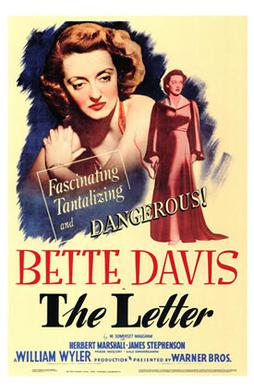
The Letter

It sometimes catches me off-guard when it turns out a favorite movie was adapted from a short story or novel. Many of my favorite writers had their books turned into film more frequently than I think (or knew, or remembered); and more films were based on books and short stories than people remember or think. I knew, for example, that Now Voyager was a novel before a film; so were Stella Dallas, Flamingo Road, Laura, Whatever Happened to Baby Jane, and so forth. I also know W. Somerset Maugham had written Of Human Bondage (the film of which made Bette Davis a star) and the short story “Rain” (filmed with first Gloria Swanson and remade with Joan Crawford). I’d never read Maugham, but I know of his work; it was only recently, however, that I discovered that one of my favorite Bette Davis films, The Letter, was a Maugham short story he himself adapted into a play. Leslie Crosbie is one of Davis’ best performances, opening on a Malaysian rubber plantation with the sound of gunshots, as a man staggers down the front steps of a bungalow-style plantation house, with Bette Davis grimly following, gun in hand, and when he collapses onto the ground, she stands over him and fires four more bullets into his prone body at her feet. It’s an incredible opening, and a remarkable scene for Davis to play. The determination, the anger, the you so deserve worse than this look on her face–yes, she earned an Oscar nomination for that scene alone.

And once I knew (or was reminded; I may have known at one time it was a Maugham story and simply forgotten), I had to read the story.

The_Letter_poster

Outside on the quay the sun beat fiercely. A stream of motors, lorries and buses, private cars and hirelings, sped up and down the crowded thoroughfare, and every chauffeur blew his horn; rickshaws threaded their nimble path amid the throng, and the panting coolies found breath to yell at one another; coolies, carrying heavy bales, sidled along with their quick jog-trot and shouted to the passer-by to make way; itinerant vendors proclaimed their wares. Singapore is the meeting-place of a hundred peoples; and men of all colours, black Tamils, yellow Chinks, brown Malays, Armenians, Jews and Bengalis, called to one another in raucous tones. But inside the office of Messrs. Ripley, Joyce and Naylor it was pleasantly cool; it was dark after the dusty glitter of the street and agreeably quiet after its unceasing din. Mr. Joyce sat in his private room, at the table, with an electric fan turned full on him. He was leaning back, his elbows on the arms of the chair, with the tips of the outstretched fingers of one hand resting neatly against the tips of the outstretched fingers of the other. His gaze rested on the battered volumes of the Law Reports which stood on a long shelf in front of him. On the top of a cupboard were square boxes of japanned tin, on which were painted the names of various clients.

There was a knock at the door.

“Come in.”

A Chinese clerk, very neat in his white ducks, opened it.

“Mr. Crosbie is here, sir.”

He spoke beautiful English, accenting each word with precision, and Mr. Joyce had often wondered at the extent of his vocabulary. Ong Chi Seng was a Cantonese, and he had studied law at Gray’s Inn. He was spending a year or two with Messrs. Ripley, Joyce and Naylor in order to prepare himself for practice on his own account. He was industrious, obliging, and of exemplary character.

“Show him in,” said Mr. Joyce.

He rose to shake hands with his visitor and asked him to sit down. The light fell on him as he did so. The face of Mr. Joyce remained in shadow. He was by nature a silent man, and now he looked at Robert Crosbie for quite a minute without speaking. Crosbie was a big fellow, well over six feet high, with broad shoulders, and muscular. He was a rubber-planter, hard with the constant exercise of walking over the estate, and with the tennis which was his relaxation when the day’s work was over. He was deeply sunburned. His hairy hands, his feet in clumsy boots were enormous, and Mr. Joyce found himself thinking that a blow of that great fist would easily kill the fragile Tamil. But there was no fierceness in his blue eyes; they were confiding and gentle; and his face, with its big, undistinguished features, was open, frank and honest. But at this moment it bore a look of deep distress. It was drawn and haggard.

“You look as though you hadn’t had much sleep the last night or two,” said Mr. Joyce.

“I haven’t.”

Mr. Joyce noticed now the old felt hat, with its broad double brim, which Crosbie had placed on the table; and then his eyes travelled to the khaki shorts he wore, showing his red hairy thighs, the tennis shirt open at the neck, without a tie, and the dirty khaki jacket with the ends of the sleeves turned up. He looked as though he had just come in from a long tramp among the rubber trees. Mr. Joyce gave a slight frown.

“You must pull yourself together, you know. You must keep your head.”

“Oh, I’m all right.”

“Have you seen your wife to-day?”

“No, I’m to see her this afternoon. You know, it is a damned shame that they should have arrested her.”

“I think they had to do that,” Mr. Joyce answered in his level, soft tone.

“I should have thought they’d have let her out on bail.”

“It’s a very serious charge.”

“It is damnable. She did what any decent woman would do in her place. Only, nine women out of ten wouldn’t have the pluck. Leslie’s the best woman in the world. She wouldn’t hurt a fly. Why, hang it all, man, I’ve been married to her for twelve years, do you think I don’t know her? God, if I’d got hold of the man I’d have wrung his neck, I’d have killed him without a moment’s hesitation. So would you.”

“My dear fellow, everybody’s on your side. No one has a good word to say for Hammond. We’re going to get her off. I don’t suppose either the assessors or the judge will go into court without having already made up their minds to bring in a verdict of not guilty.”

As you may have noted, Constant Reader, this story was written during a time when casual racism was not only accepted but was par for the course. Maugham wrote during the first half of the twentieth century primarily; “The Letter” was certainly set during the time of decline for the worldwide British Empire (“the sun never sets on the British empire”); an empire that was built on the backs of its enslaved and conquered peoples, and justified its abuses and colonialism and exploitation with the typical white supremacy. The Empire didn’t survive the second World War–the Japanese in particular shattered the Empire’s Asiatic pretensions–but all the worst of British racism and classism and misogyny is there on display in this story (this sentence: Singapore is the meeting-place of a hundred peoples; and men of all colours, black Tamils, yellow Chinks, brown Malays, Armenians, Jews and Bengalis, called to one another in raucous tones–in particular), and really is terribly dated in that regard. The story is also problematic in that it also upholds the standard misogynist trope that a woman will easily and without qualm accuse a man of rape to cover up her own crimes. So, it’s easy to see how such a story could spring from the mind of a gay man in that time period; my gay brothers can make the worst misogynists, I’m ashamed to say, and written during a period when misogyny was so incredibly rampant…yes, I can see it.

The story is vastly different from the film. The film obviously centers Bette Davis; it’s one of her finer performances, and the character of Leslie Crosbie; the story itself is entirely told from the perspective of her attorney, Mr. Joyce. But the bottom line of the story and film are the same: Leslie Crosbie murdered Geoff Hammond; the question is why? Mrs. Crosbie’s story is that he showed up at her door late at night and tried to rape her, and she killed him in self-defense, protecting her honor. The only problem is that she fired four more bullets into his corpse when he was already dead, from close range; this doesn’t sound like self-defense. Mrs. Crosbie herself claims she doesn’t remember any of that; and given that she’s a white woman, her story is she was defending her honor against a rapist, and the victim had taken up with a Chinese woman and was no longer received by honorable people (oh, the racism!), Mr. Joyce has no doubt that Mrs. Crosbie will neither hang nor go to jail; popular opinion in the ruling class is heavily on her side. But it turns out there’s a letter in existence, in her handwriting; begging Geoff Hammond to come see her at her home while her husband was away. Leslie explains this away quickly; in the hubbub of the shooting and its aftermath, she’d quite forgotten she’d invited him over to help her buy a gun as a gift for her husband, and once she hadn’t told the police, and remembered, she couldn’t tell them without making herself look bad. The Chinese woman Hammond was sleeping with has the letter; and wants money for it. Mr. Joyce explains to Mr. Crosbie…who comes up with the money, and then bitterly says to Me. Joyce: “the reason I was away was because I had gone to buy myself a new gun.”

Leslie had lied about her reasons for inviting Hammond over; what else has she lied about? But once the letter has been destroyed, and the jury sets her free–Mr. Joyce asks her one more question–and Leslie explains her truth: she’d been having an affair for years with Hammond, but the Chinese woman–whom he had loved when he was younger–had come back to his life and he no longer wanted anything to do with Leslie. Leslie was furious–bad enough to be thrown over, but for a Chinese woman? She deliberately invited him over that night; he told her he hated her and wanted nothing to do with him, and to her–this justified not only killing him, but her desire to get away with murdering her lover…and, because of racism and misogyny and class, she does.

It was an interesting–if dated–read, and while I winced away from the horrific racism (much worse than the misogyny of how courts always treated upper crust white ladies with such gentility, allowing them to get away with their crimes, and even cheering lustily their acquittals), I’m glad I read the story. I’ll probably read more of Maugham–I’d read Of Human Bondage when I was a teenager and hated it; I should probably reread it through the lens of Waugham’s homosexuality and how that main character’s relationship with toxic Mildred was undoubtedly shaped by his own denial of his sexuality; I’d probably enjoy that more now–and most definitely want to read “Rain”, to see how Sadie Thompson fares in her creator’s words, as well as to see how misogynistic Maugham was in creating her…it seems to me, in the works of his I’ve read, that his female characters were a lot darker and definitely more noir, than I might have thought before.

It might be interesting to retell “The Letter” entirely from Leslie’s point of view. Hmm, now there’s a thought.

The Calm Before the Storm

Alfred Hitchcock was a great film director, and was responsible for some of the best movies ever made, from Rebecca through Notorious through North by Northwest to Vertigo to Strangers on a Train to The Birds to Psycho; the list of great Hitchcock films goes on and on and on and has been studied by film academics and written about; you certainly cannot forget Truffaut/Hitchcock, either. Lost in the discussions of his abilities as a filmmaker (and how he was somewhat abusive to his leading ladies) is his contributions to the culture in other ways. Alfred Hitchcock Presents ran for years; an anthology show like The Outer Limits or The Twilight Zone, he presented bizarre stories (often based on short fiction; perhaps the most famous episode of all was based on a Roald Dahl short story in which a wife kills her husband with a frozen leg of lamb, which she then cooks and serves to the investigating police officers) on a weekly basis and the show ran for a long time. (It’s available to stream now, and I keep meaning to dive back into the show.

But Hitchcock also was a master, before it was a thing, of licensing his name out for use; his name meant something as a master director of film suspense, and in addition to the television series there were also anthologies, also published under the aegis of Alfred Hitchcock Presents–my grandmother used to buy and read them; so did my parents–and even today one of the best short story markets for crime is Alfred Hitchcock’s Mystery Magazine. There were anthologies for adults, anthologies for teens and anthologies for kids.

And there was also The Three Investigators.

3 investigators 1

Bob Andrews parked his bike outside his home in Rocky Beach and entered the house. As he closed the door, his mother called to him from the kitchen.

“Robert? Is that you?”

“Yes, Mom.” He went to the kitchen door. His mother, brown-haired and slender, was making doughnuts.

“How was the library?” she asked.

“It was okay,” Bob told her. After all, there was never any excitement at the library. He worked there part time, sorting returned books and helping with the filing and cataloguing.

“Your friend Jupiter called.” His mother went on rolling out the dough on the board. “He left a message for you.”

“A message?” Bob yelled with sudden excitement. “What was it?”

“I wrote it down. I’ll get it out of my pocket as soon as I finish with this dough.”

“Can’t you remember what he said? He may need me!”

“I could remember an ordinary message,” his other answered, “but Jupiter doesn’t leave ordinary messages. It was something fantastic.”

“Jupiter likes unusual words,” Bob said, controlling his impatience. “He’s read an awful lot of books and sometimes he’s a little hard to understand.”

“Not just sometimes!” his mother retorted. “He’s a very unusual boy. My goodness, how he found my engagement ring, I’ll never know.”

She was referring to the time the previous fall when she had lost her diamond ring. Jupiter Jones had come to the house and requested her to tell him every move she had made the day the ring was lost. Then he had gone out to the pantry, reached up, and picked the ring from behind a row of bottle tomato pickles. Bob’s mother had taken it off and put it there while she was sterilizing the jars.

“I can’t imagine,” Mrs. Andrews said, “how he guessed where that ring was!”

“He didn’t guess, he figured it out,” Bob explained. “That’s how his mind works…Mom, can’t you get the message now?”

“In one minute,” his mother said, giving the dough another flattening roll. “Incidentally, what on earth was that story on the front of yesterday’s paper about Jupiter’s winning the use of a Rolls-Royce sedan for thirty days?”

And that is how The Three Investigators series (technically, in the beginning  “ALFRED HITCHCOCK and the Three Investigators”) began. While it’s not as smooth, per se, as the opening of the Trixie Belden series in The Secret of the Mansion, this is also a dramatically different series, and will always have a place in my heart as one of the best series for kids–if not the best–ever published. It never reached the same heights of popularity as Nancy Drew or the Hardy Boys; which was a shame, because it was a much better series than either of those. For one thing, the Three Investigators actually considered themselves to be professional detectives; Nancy and the Hardys, amongst with most of the others, were strictly amateurs (although in the Kathryn Kenny books, “the Belden-Wheeler Detective Agency” became kind of a running gag or thing; it was what Trixie and Honey decided they wanted to be when they grew up; and frankly, I’ve always kind of wanted to see a Trixie-as-an-adult hard-boiled series). And while this opening is a little longish about getting to the point, it eventually does; Bob is a highly excitable young man who works at the library, and this is also our first look at Jupiter Jones, and one of the best things about the series is Jupiter; he is the central character and there would be no Three Investigators without him–and he is one of the most remarkable, and original, characters in kids’ mystery series fiction.

I always thought of Rocky Beach as a sort of stand-on for Long Beach in this series; this is where the boys live, and it’s just south of Los Angeles and a drive to Hollywood. This is where the three boys who make up the titular team of the series live; the third investigator, whom we have yet to meet in this opening, is Pete Crenshaw. And that bit about the contest and the Rolls-Royce? It’s very important. Access to a vehicle, and someone to drive them around, is an integral part of the creation of this investigative agency; they can’t always count on getting rides or paying for cabs or only involving themselves in cases they can investigate on bikes; this is the impetus Jupiter has been looking for to open the agency. Jupiter’s message to Bob is impenetrable to his mother; but it makes perfect sense to Bob–and therein lies another one of the great charms of this series: Jupiter lives with his uncle Titus and aunt Mathilda; the couple own and operate the Jones Salvage Yard, a sprawling junkyard where they repurpose other’s people things, or fix them. Jupiter himself is quite adept at wiring and repairing things; just one, as we the readers will find out, of his many skills. Hidden deep within the salvage yard is the wreck of a mobile home, which the boys use as “headquarters”; over the years Jupiter has managed to hide the mobile home behind piles of junk. The yard is also surrounded by an enormous, tall wooden fence, and Uncle Titus has encouraged local artists to paint murals on the fence. With the help of Bob and Pete, Jupiter has created “secret entrances” into the salvage yard, with tunnels through the piled up junk; that way the boys can come and go as they please without having to use the main entrance. They also have a covered workshop in another area hidden from view; Jupiter’s message to Bob is simply Red gate rover, come over come over, the presses are rolling. Bob knows this means,  come to headquarters, use red gate Rover, and we’re printing our business cards. 

“Red Gate Rover” means use the entrance through the fence that is a mural of a team of firefighters fighting an enormous blaze; there’s a dog watching them, and the knothole in the dog’s eye will spring the hidden gate open. And sure enough, once he gets there, the printing press is rolling and Jupiter presents him with a card, that reads:

THE THREE INVESTIGATORS

We Investigate Anything

? ? ?

–and also has their names. Jupiter is, naturally, the first investigator with Pete as second; Bob is Records & Research, since he works in the library and is their best writer; it is his job to write up their cases. As such, and with an understanding that all cases also need to be introduced as well as get sufficient publicity for their agency to get clients, Jupiter has decided on two things: to ask Alfred Hitchcock to introduce their cases, and offer to help find him a truly haunted house, as he is looking for one for his next film. Using the Rolls-Royce, driven by a very proper British chauffeur named Worthington, Jupiter and Pete call on Mr. Hitchcock at the studio. (The Rolls-Royce, by the way, has every luxurious amenity available to a limousine in that time; and is gold-plated, which sticks out. It was originally commissioned by a Saudi oil millionaire.) They bluff their way in–partly because Jupiter pretends to be Hitchcock’s nephew, even arranging his face to imitate his expressions and voice and patterns of speech–but Hitchcock isn’t that interested in introducing their cases, but has no worries about them looking for a haunted house for him. (While they are calling on Hitchcock, Bob has gone to the library to research something–Jupiter writes the words Terror Castle on the back of one of their business cards and offered no explanation.) But when Jupiter does his impression of “Hitchcock as a 13 year old”, Hitchcock is offended and promises to introduce the first case as long as Jupiter will never do the impression again (and, it is to be noted, the introduction and afterward, as supposedly written by Hitchcock, is clearly done so grudgingly; this was a genius touch by author Robert Arthur–and over the course of the series Hitchcock not only grows fond of the boys but starts sending clients their way).

The thing I loved perhaps the most about this series (outside of the wonderful titles for the books) was they actually were investigators. They actually solved the mysteries they were investigating–well, Jupiter did, mostly–through observation and interpretation of data. Jupiter was, in many ways, kind of a young Sherlock–and he often referred to Holmes. Another thing that was very clever about the series is that the stories were rarely, if ever, told from Jupiter’s point of view; Bob and Pete were always the point-of-view characters, representing the reader, who also couldn’t figure out what was going on. Since it mattered for suspense and storytelling to not know what Jupiter was thinking, Bob and Pete stood in for the reader, confused by the cryptic things Jupiter said–or casually observing Jupiter noticing something that didn’t make sense.

Another thing that, in my opinion, makes the series stronger than others is it is made, very plain, from the very beginning that fat-shaming is a bad thing. Jupiter is described as stocky or husky; he deeply resents being called fat, and whenever someone cruelly makes such an observation, both Pete and Bob always get angry and jump to his defense (Jupiter was also a child star, playing Baby Fatso in a Little Rascals type television show; his being a fat child made him the butt of the jokes in the show and he DESPISES being laughed at)–compare that to how Bess is frequently mocked for being hungry and chubby in the Nancy Drew books, or the depiction of the Hardy Boys’ supposed best friend Chet Morton as an always-hungry, overweight comic relief and foil they always laugh at–yeah, not cool, Stratemeyer Syndicate, not cool at all.

The first Three Investigators story I read was The Mystery of the Moaning Cave. We were in Alabama one summer, and staying with a cousin of my mother’s who had a son my age who also loved to read, and loved mysteries. He had a stack of library books, and I picked up my very first Hardy Boys read, The Mystery of Cabin Island, out of the stack. I was two chapters in when he finished reading his book (The Mystery of the Moaning Cave) and asked me to swap books with him. I was enjoying the Hardy Boys, but the cover of the Three Investigators book he was offering me was tantalizing, plus that title! How could a cave moan? I started reading, and was soon swept up in the story–which remains, to this day, one of my favorites in the series. It reminded me of another book I greatly loved as a child, The Mystery of the Haunted Mine, but the problem was my library didn’t have any of these books, and I could never find more of them anywhere. In junior high a friend of mine was a fan of the series, which led me to reread The Mystery of the Moaning Cave, which I loved all over again, and then its predecessor, The Mystery of the Screaming Clock, which was also amazing. I eventually discovered, on a birthday trip to Toys R Us, an entire shelf of the books; I got five–The Secret of Terror Castle, The Mystery of the Whispering Mummy, The Secret of Skeleton Island, The Mystery of the Laughing Shadow, and The Mystery of the  Coughing Dragon. 

I honestly don’t recall how I was able to collect the rest of the series, or where I got them or what order in which I read them, but I did eventually read the entire series. Later, the series moved on to other authors other than Robert Arthur and the quality became more hit-and-miss, but even the worst Three Investigators case was better than the best books in other series. I still love the Three Investigators, and occasionally will take one down to reread it, again marveling at how well constructed the books are; how tight the plots and how strong the characterizations. I also loved how something small and simple, like the search for an escaped parrot (The Mystery of the Stuttering Parrot) would lead to a massively complicated and interesting case about a massive art theft, or the search for a missing cat with mismatched eyes turned into The Mystery of the Whispering Mummy, or a near car crash led them to a small European principality and international espionage in The Mystery of the Silver Spider. Their cases inevitably started small, but eventually grew into something major; like they grabbed onto a loose, seemingly unimportant thread that unraveled a much larger case.

One thing that always amused me was how adults rarely, if ever, took them seriously. Jupiter’s aunt and uncle, and the parents of Pete and Bob, always looked at their “firm” as a “little mystery-solving club”. Inevitably the adults who pooh-poohed their abilities had to eat their words. I also loved that Jupiter wasn’t athletic but was smart. I identified with that a lot more than I did with the Hardy Boys, who were literally good at everything they tried.

The death of Alfred Hitchcock was an enormous blow, and the publisher–Random House, I believe–introduced a mystery writer for a while to replace Hitchcock, but the quality was already starting to decline, and eventually even the fictitious mystery writer, Robert Sylvester, was replaced by another fictitious entity; but the book in which the switch was made didn’t avoid the truth of Hitchcock’s death, and they actually handled it very well.

And some of the earlier books are seriously dated now; The Secret of Terror Castle centered on the home of a silent film horror star whose career was derailed by his speaking voice when talkies came; obviously, that would have happened around ninety years ago now, so there wouldn’t be any contemporaries still alive. Likewise, The Mystery of the Screaming Clock centered on someone who was a sound effects expert for radio suspense shows–which would, at best, have been seventy years ago now.

I’ve never believed this series was as popular as it deserved to be, nor did it get the attention it truly deserved. The books have been out of print for awhile now–maybe you can get used copies, there may even be ebooks now, I don’t know–but they should still be available. I would love to write one of these, to be honest.

They were the shit, y’all.

Closer to Heaven

Yesterday was Friday, and I was tired.

Really, really tired.

I slept for ten hours last night and woke up still exhausted this morning–bleary-eyed and bone-tired. It makes me a bit nervous, as the last time I was able to sleep so much, or do deeply, only to still be tired, was when I was sick this last time, and whatever that was, I sure as hell don’t want to see it return again. I just feel what we used to say down south–“bone tired”. (Hmm, that’s not a bad title.) So, while I have things to do today–we need to swing by the Cat Practice to get Scooter another bag of food, for one, and I definitely need to do some writing and cleaning and organizing around here, if I have the energy–and in a worst case scenario, I can always simply curl up with some books or short stories. I did manage to do some reorganizing/rearranging of the books last night–out Netflix app on the Apple TV is all fucked up; I’m probably going to have to delete and download it again, which is an enormous pain in the ass. Our wireless was also running ridiculously  slow the last few days, so I rebooted the cable box and the wireless router yesterday, which signed me out of everything fucking thing and I just was too tired to deal with that shit last night. We wound up watching an incredibly bad gay movie on Amazon Prime–I won’t name it out of respect for the effort, time and money that went into it, plus I don’t like dumping on gay creators–during which both Paul and I dozed off here and there, before it was over and I finally retired to bed. I was also too tired last night to focus on doing any reading–which was definitely a lost opportunity, and one that I deeply regret. I’d like to finish reading Scott Heim’s Mysterious Skin this weekend; it’s really quite wonderful, and I’d like to move on to his We Disappear once I finish it. I’ve also got a lot of short stories to read–not the least of which is W. Somerset Maugham’s “The Letter,” and I simply love that it’s the source material for one of my favorite Bette Davis movies, of the same name–and there’s another one, by Mark Twain, about an incident that happened at the court of Charles VI in France (I stumbled on this story somehow; the true story it’s based on is detailed in Tuchman’s A Distant Mirror, which is starting to seem like a really great inspiration for me, almost Biblical in its inspiration). Plus I have, as I noticed last night as I reorganized the books, The Collected Stories of Flannery O’Connor and the latest Lawrence Block anthology–Mr. Block does some seriously excellent anthologies, for the record–and so there’s all kinds of good reading on hand should I have the mental acuity to focus on some reading today.

It’s also not a bad idea to read the stories I am currently readying for submission by the end of the month. Perhaps I should spend the day in my easy chair with print outs of stories and perhaps spend some time with some of my favorite short story writers. It’s also not a bad idea to revisit Bury Me in Shadows, which I have decided to completely overhaul–the problem is the main character’s age, but because I envisioned it originally as being about a teenager, I was stubbornly clinging to that idea, and it actually works better if I advance his age to having just graduated Pre-Law from college and readying to attend law school in the fall; this having a free place to live in the summer and a paying job that is relatively easy makes more sense for the character to agree to what he’s doing; plus it eliminates the entire what is his mother thinking in letting him do this? It will also require me to do some other tweaking (not that kind of tweaking, those days are long in my past, thank you very much), but I also think it’ll be stronger and a better story for it.

Which is always a plus.

I would like to do some work this weekend on other stories that are currently hanging in stasis right now, not the least of which is my pandemic story, “The Flagellants.” I’m not certain why that story is nagging at me; I don’t know what it’s going to be or how its going to end; so I guess it’s one of those stories that will reveal itself to me as I write it, which is madness, really.

Recently someone–I think Gabino Iglesias? I could be wrong–tweeted asking writers to stop talking about how much they hate writing, and his tweets really resonated with me. I don’t hate writing, but it would be easy to assume that I do from reading what I post, tweet and blog about writing. I do love writing; I love everything about it, even the frustrations and irritations–which I usually have to express to get out of my system. Publishing is an entire different subject than writing; I reserve the right to always be able to bitch about the publishing industry and its quirks and utter seeming ridiculousness whenever I please, along with the right to complain about being frustrated with the writing process at any time. But I want to make it very clear that I love writing and that’s why I do it. I love writing what I write, even though I am well aware (and if I wasn’t, have been told enough times by my heterosexual colleagues) that there’s not really any money in writing gay crime stories. But I like writing gay crime stories; I like writing gay characters, and I also feel like the full potential for gay crime stories has yet to be tapped. But I’ve dabbled with heterosexual narratives in my short stories, and if I am ever going to write a novel about straight people–or centering the straight point of view–the short stories are an excellent way to practice.

And…every new story I finish writing puts me that much closer to a second collection of stories, which is very exciting to me. I was originally calling the second collection Once a Tiger and Other Stories, but I am thinking about changing it to This Town and Other Stories, primarily because “This Town” is a better story than “Once a Tiger” and secondly, I like the symbolism of “this town” referring to New Orleans–even though that’s not what the Go-Go’s were referring to in their song of the same title, which was the inspiration for my story. (My original collection began as Annunciation Shotgun and Other Stories before metamorphosing into Survivor’s Guilt and Other Stories.)

I also started writing a blog entry about my love of The Three Investigators, which will probably go up at some point over this weekend; depends, I suppose, on when I finish it. And there’s a shit ton of emails that need my attention in my inbox as well; but I just can’t face that yet today. Maybe later on, after I get some things done, I can spend some time answering emails (as drafts to send on Monday) as well as writing some that I need to send.

But I just heard the dryer stop, which means I need to go fold some clothes and add another load to the dryer, and my coffee cup is also empty and in dire need of refilling; my stomach is growling as well, so it’s probably time for me to push away from the desk, get more coffee, fold some clothes and then have some Honey-nut Cheerios–which has been my pandemic breakfast of choice these days.

It also looks like a beautiful day outside. Have a lovely Saturday, Constant Reader!

IMG_0473

Casting a Shadow

And it’s Friday again! Cue the dancing horses.

I have a lot that I want to get done this weekend. I need to get those stories pulled together, and I want to get started on finishing off the Secret Project. Stupidly, I also started writing another short story yesterday, “The Flagellants,” which I am not really sure what it’s going to be about, or how to even finish the stupid thing. (An\d because I am twelve years old, sometimes when I think the title quickly it sounds like flatulence, which is a joke I may make in the story because I am twelve years old.) And yes, I got the idea from the bubonic plague chapter in Barbara Tuchman’s A Distant Mirror; during the fourteenth century’s bubonic plague outbreak, the church was already in disrepute and many felt that the plague was God’s judgment on a sinful mankind, so there were some religious cults that sprang up; the flagellants movement was one of these, and it was enormously popular and spread throughout central Europe, primarily Germany. These penitents would march through town and flagellate themselves with whips and cat o’nine tails and knotted ropes, trying to take on the sins of all mankind.

Naturally, I found this interesting, and I really liked “The Flagellants” as a title, and we’re kind of in the midst of a pandemic…granted, we’re not that far into it as of yet, but we’ve already seen ridiculous behavior in the name of Jesus–so far, nothing I’m aware of from other faiths–but I began to think about it some more and wondered, what if this becomes more lethal and lasts longer than anyone is even considering now? The second wave of the Spanish influenza pandemic of 1918-1919 was much worse than the first, and in the wake of the Great War (aka World War I) and said pandemic there was a huge religious revival in the US during the 20’s–we tend to only think of that decade as flappers and bathtub gin, but that wasn’t all that was going on during that decade (it was also the decade that inspired Sinclair Lewis to write Elmer Gantry, and the decade of Aimee Semple McPherson)…and the old “what if” questions started running through my head, and I remembered the religious fanatics who always protest at Mardi Gras and Southern Decadence…and yeah, that’s kind of how stories get born. I’m not sure where this story is going to go or what it’s going to become–it’s kind of fun and different than anything I’ve written before–and I’m not entirely sure it’s going to end up as a crime story, which makes it even more fun.

I slept really long and well last night, and didn’t want to get up this morning, which was lovely–and a long time coming. It’s been a while since I’ve had such a great night’s sleep, and it was absolutely wonderful. I feel rested and ready to go mine some spice this morning.

As expected, Joey Burrow was the Number One draft pick last night, taken by the Cincinnati Bengals–and I said to Paul, “it’s going to be weird rooting for the Bengals now”–one of the many reasons I don’t get so far into the NFL is it is impossible for me to not root for former LSU players and their new teams to do well; and I really can’t devote more time to the NFL than I already give to the Saints. But after last night, I feel it’s pretty safe to say the Saints are Louisiana’s favorite team, and now the Bengals are our second favorite. I also never pay attention to the NFL draft, but I did last night because I wanted to see how the LSU players would do in it. Five players in the first round, I believe–Joey Burrow, K’Lavon Chaisson, Patrick Queen,  Justin Jefferson, and Clyde Edwards-Helaire (which is a record, I believe, for LSU and one short of the overall record)–and now I need to go read the Advocate to see how the rest of the team did, and where they wound up.

Obviously, I will always love this 2019 team and everyone on it. It’s kind of hard not to, after the dream season they just gifted us with–and it’s going to be a very hard act to follow; every LSU team going forward is going to be compared to this one.

This weekend, I hope to get some more writing done. I didn’t get hardly anything written this week (after having such a great writing weekend last weekend), but I do need to finish revising and polishing these stories that are due, and maybe even work some more on some of these ones that are in progress–I may just keep writing “The Flagellants” and see where it goes, just letting it develop as it goes–and I need to start getting some other stuff prepared to get back to work on. I also want to do some reading this weekend; I’ve really fallen behind on that, and I want to make reading more of a priority; it certainly is a better thing to do with my time than falling into Youtube rabbit holes.

And now back to the spice mines.

IMG_0247

Who’s That Girl

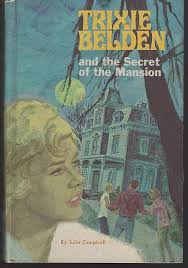
Ah, Trixie Belden.

Not as well known or as beloved as Nancy Drew, I always kind of preferred Trixie to Nancy; and not just because she was kind of an underdog in comparison. No other kids’ series was/is as popular as Nancy Drew; even the Hardy Boys can’t compare to Nancy’s popularity.

But…I liked Trixie more than I liked Nancy. Sometimes Nancy seemed insufferable; and in all fairness to Nancy, that was more a result of the “new” Nancy that resulted from the revisions of the original texts, beginning in 1959, and this “new” Nancy appeared in the newer books as they were released as well. This Nancy was too perfect; she was good at everything, she was nice and polite, she was such a goody-two-shoes I was amazed Bess and George could stand her–although they weren’t much better. The Nancy of the original texts had more of a personality; she was a goody-two-shoes, to be sure, but she also had a lot of self-confidence and self-assurance, and she was a good person who enjoyed helping people. But when the books were revised–and this new Nancy became the Nancy of record for all new books, going forward–they basically took all of her personality away and left a one-dimensional cardboard cutout. I didn’t give up on the series, by any means, but..new Nancy was someone I wouldn’t have liked in real life.

Trixie Belden, on the other hand…seemed like a real person, or at least she did at first. Like Nancy, there was a definite turning point in her behavior in the series which happened when the original writer–Julie Campbell–stepped aside and was replaced by a bunch of ghostwriters using the pen name Kathryn Kenny. (Julie Campbell, by the way, also wrote some of the Cherry Ames ad Vicki Barr series, using the name Julie Tatham.) Trixie lost her temper, was fidgety, was a tomboy with no use for girly things, and hated doing her chores–to the point where sometimes she hurried through them so quickly she kind of did a shitty job. But she was at heart a nice kid, and regularly felt bad when she had misbehaved and tried to make up for it after the fact. She also sometimes blurted things out that hurt other people’s feelings–immediately feeling horrible about it–and these were all things, aspects of her personality, that made her relatable–as opposed to perfect paragon of virtue Nancy Drew, who was so emotionless she might as well have been a Stepford wife.

images

“Oh, Moms,” Trixie moaned, running her hands through her short, sandy curls. “I’ll just die if I don’t have a horse.”

Mrs. Belden looked up from the row of tomato plants she was transplanting in the fenced-in vegetable garden.

“Trixie,” she said, trying to look stern, “if you died as many times as you thought you were going to, you’d have to be a cat with nine lives to be with us for one day.”

“I don’t care!” Tears of indignation welled up in Trixie’s round blue eyes. She scooped up a fat little worm, watched it wriggle in the palm of her hand for a minute, then gently let it go. “With Brian and Mart at camp this summer, I’ll die of boredom. I mean it, Moms.”

Mrs. Belden sighed. “You declared you’d suffer the same fate if we didn’t buy you a bike three years ago. Remember?” She stood up, frowning in the glare of the hot July sun. “Now, listen, Trixie, once and for all. If you want to buy a horse like the one you fell in love with at the horse show yesterday, you will have to earn the money yourself. You know perfectly well the only reason your brothers could go to camp is because they are working as junior counselors.”

Crabapple Farm, Trixie reflected, was really a grand place to live, and she had always had a lot of fun there, but she did wish there was another girl in the neighborhood. The big estate, known as the Manor House, which bounded the Belden property on the west had been vacant ever since Trixie could remember. There were no other homes nearby except the crumbling mansion on the eastern hill, where queer old Mr. Frayne lived.

The three estates faced a quiet country road two miles from the village of Sleepyside that nestled among the rolling hills on the east bank of the Hudson River. Trixie’s father worked in the bank in Sleepyside, and Trixie and her brothers went to the village school. She had many friends in Sleepyside, but she rarely saw them except when school was in session. Now that her brothers, Brian and Mart, had gone to camp, there was nobody but her little brother, Bobby, to play with.

Trixie impatiently kicked a hole in the dust of the path with her shoe.

“It’s not fair. You wouldn’t let me try for a job as a waitress or anything. Maybe I could have gone, too.”

“You’re only thirteen,” her mother said patiently. “Next year we might consider something of the sort. Dad and I are really sorry, dear,” she added  gently, “that we couldn’t afford to send you to camp this year.”

Trixie suddenly felt ashamed of herself, and she impulsively threw her arms around her mother. “Oh, I know, Moms, and I’m a pest to nag at you. I won’t any more, I promise.”

As I said, I greatly enjoyed the Trixie Belden series when I was a kid, and while some of the later volumes were also quite good, it was also very clear that the first six–the Julie Campbell written ones–were clearly written by someone other than those who continued the series, and were also vastly superior in terms of character, plot, setting and the writing, frankly. Just this opening of the first book in the series, The Secret of the Mansion, was quite excellent; look at everything that is set up in those first paragraphs and in the dialogue between mother and daughter: you can tell there’s deep affection there; we establish that Trixie has three brothers, two of whom are spending the summer working as junior counselors at camp; Trixie is prone to being overly dramatic; her father works at the bank and her mother likes to garden and grow her own vegetables; they live near a small town on the east bank of the Hudson River; they only have two other homes nearby–the empty Manor House and across to the road from that one is the Mansion, where a creepy old man lives (I doubt the author was using the word queer in the modern sense here; more likely the old definition, “odd.”).

That’s a lot of background and character work, yet it feels organic and not in the least like the bane of all writers, the infamous “info dump.” Soon, Trixie’s mom agrees to pay Trixie five dollars a week with help around the house and garden and sometimes watching her six year old brother, Bobby, and that way she can save money to buy her horse. Shortly after this, Trixie notices moving trucks arriving at the Manor House–her mother has forgotten to tell her that the wealthy Wheelers have bought the place and are moving in–and they have horses. Trixie grabs Bobby and they take off to meet the new neighbors, where she meets her soon-to-be best friend, Honey, who is sickly and ridiculously well-mannered and pale, along with some of the other staff–including Miss Trask, Honey’s governess, and Regan the groom.

The Secret of the Mansion was probably one of the best first novels of a kids’ series ever published. Not only did it introduce us to the Belden family, it did so slowly–we wouldn’t meet the other two members of the family until the third book, when Mart and Brian returned from camp in The Gatehouse Mystery–and we also met the boy who would become the other important tentpole of the series: red-headed Jim Frayne, crazy old Mr. Frayne’s grand-nephew, whose mother had died leaving him at the mercy of a horrible and abusive stepfather, Jonesy. Jim ran away and came to find his great-uncle, only to find out that he’d been hospitalized and in a coma. There was also some depth to the stories, as well–poor old Mr. Frayne’s wife had been bitten by a copperhead snake, he was rushing her to the hospital and their car broke down, and she died waiting for him to get help; the old man went mad with grief, left the car where it was broken down and would never allow another car on his property. The house also began to crumble and get in pretty bad shape–he supposedly had a lot of money, most of which most people assumed was hidden in his messy mansion (old Mr. Frayne was a hoarder). Trixie and Honey are trying to help Jim–Trixie is sure there is money secreted in the house–and eventually, Jonesy shows up after Mr. Frayne dies in the hospital, and Jim runs away again–leaving a note for Trixie and Honey. The old house also catches fire in the night and burns to the ground the night Jim runs away–there’s a lot of action and excitement in the book, including Trixie saving her brother’s life when  he, too, is bitten by a copperhead–and again, character development, as Honey becomes more and more outdoorsy and healthy and more like Trixie, and the two girls become more bonded in their friendship. The book also sets up the sequel, The Red Trailer Mystery, (which was actually the first book in the series I read)–in which the girls and Miss Trask hit the road to go looking for Jim–who actually inherited the small fortune Mr. Frayne had left behind, safely invested. They do find him–and solve another mystery–and it turned out that Jim’s long-deceased father was a college friend of Honey’s father, so the Wheelers adopt Jim, writing a lovely end to the story of the runaway red-headed boy with nothing.

As I mentioned earlier, there was a noticeable shift in tone, continuity, and who Trixie was as a character with the switch in authors, from one author writing under her own name (I believe her name was actually Julie Tatham Campbell, or the other way around). The last two books she wrote, Mystery off Glen Road and Mystery in Arizona, were kind of light on the mystery and stronger on the development of the characters and their friendships/relationships with each other. With the invention of “Kathryn Kenny” as a pseudonym to make other authors,  the books became more heavy on the mysteries and the new authors didn’t care so much about continuity or the established history of the characters: Trixie became more “girly” than tomboy-ish, for one thing, and they started playing up the “boyfriend/girlfriend” dynamic between, not only Trixie and Jim, but Honey and Brian Belden, as well as Mart with Diana Lynch (who was first mentioned in The Red Trailer Mystery, and joined their club, the Bob-Whites of the Glen, after being the central focus of The Mysterious Visitor). They added yet another member to their group, Dan Mangan, Regan’s nephew, in The Black Jacket Mystery–although the core group of five appeared in every book, Diana and Dan often got left out of their future adventures, begging the question of why were they added into the group in the first place? Some of the later books were good, fun mysteries–The Marshland Mystery, The Mystery of Cobbett’s Island, Mystery of the Emeralds, The Mystery of the Missing Heiress–but that core strength from the characterizations in the initial six books was missing from the rest, and as the series continued beyond those first sixteen (a long period of time passed before “Kathryn Kenny” started writing again) the stories and characters grew weaker, which was a shame.

The series gradually evolved from a “how to start a mystery series for kids” primer to “how to ruin a mystery series for kids” primer, which is a shame. I’d match those first four volumes against the first four volumes of any other kids’ mystery series and Trixie would, almost without exception, win, hands down. She was never as popular as Nancy Drew–no one was–but I always thought Trixie and her friends, having fun and adventures in the Hudson valley north of New York City and in the lower Catskills, would have made a fun television series for kids.

I’ll always have a soft spot for Trixie….and The Secret of the Mansion remains one of the best mysteries for kids ever published.