Too Late for Goodbyes

Well, we made it to Friday, didn’t we? I do feel sometimes as though wishing for the weekend, or counting the days until payday, is kind of wishing my life away. (My mother used to tell me that when I was younger, and it’s one of those things I’ve never forgotten. Whether or not that’s a good thing, I’m not sure. Most of my mother’s sayings are like that; my favorite being always expect the worst and you’ll never be disappointed. I’m never sure if that means lower your expectations to avoid disappointment, or if it means the opposite–if you always think the worst is going to happen you’ll make it happen? So confusing. But most of these came from her incredibly pragmatic mother, so I tend to think the former rather than the latter in this case.)

I wrote close to three thousand words yesterday; and yet felt disappointed with my output. Two thirds of them were my short story “Burning Crosses,” which I am enjoying but again am struggling to write and the rest were on the next chapter of the Scotty book, which I actually enjoyed writing. I am hoping to get both this story and maybe two chapters of the Scotty finished this weekend; I want to do some cleaning as well (quelle surprise) and I want to finish reading my Bryan Camp novel so I can blog about it before the release next week. It’s really good, and you NEED to preorder it. Seriously.

I’ve gone back to streaming The Shannara Chronicles, and have seriously gotten sucked into the show. I’ve now watched the first episode of Season Two, and am liking the direction it’s taking. I don’t remember the books; I only read the first two–The Sword of Shannara and The Elfstones of Shannara–and I think the show was culled from the second book on. Paul’s back home now, so it’s going to be tricky watching shows he’s not watching; the Festivals are over and he won’t be home late anymore or working on the weekends.

For the Short Story Project, I offer the following two stories:

First up is “Orange is for Anguish, Blue for Insanity” by David Morrell,  from Lawrence Block’s Alive in Shape and Color.

Van Dorn’s work was controversial, of course. The scandal his paintings caused among Parisian artists in the late 1800s provided the stuff of legend. Disdaining conventions, thrusting beyond accepted theories, Van Dorn seized upon the essentials of his craft to which he’d devoted his soul. Color, design, and texture. With those principles in mind, he created portraits and landscapes so different, so innovative, that their subjects seemed merely an excuse for Van Dorn to put paint upon canvas. His brilliant colors, applied in passionate splotches and swirls, often so thick that they projected an eighth of an inch from the canvas in the manner of a bas-relief, so dominated the viewer’s perception that the person or scene depicted seemed secondary to technique.

Impressionism, the prevailing avant-garde theory of the late 1800s, imitated the eye’s tendency to perceive the edges of peripheral objects as blurs. Van Dorn went one step further and so emphasized the lack of distinction among objects that they seemed to melt together, to merge into an interconnected, pantheistic universe of color. The branches of a Van Dorn tree became ectoplasmic tentacles, thrusting toward the sky and the grass, just as tentacles from the sky and the grass thrust toward the tree, all melding together in a radiant swirl. He seemed to address himself not to the illusions of light but to  reality itself, or at least his theory of it. The tree is the sky, his technique asserted. The grass is the tree, and the sky is grass. All is one.

David Morrell is a long time best selling author, and I’ve met him several times; he’s an incredibly nice man. He’ll always be known as the author of First Blood–he calls himself “Rambo’s Father,” but he’s enjoyed a lot of success throughout his career. This story is one of my favorites from this collection, and perhaps one of the top five new stories I’ve read for the Short Story Project. It’s fan-fucking-tastic; a story about art and obsession and madness and genius; I could devote an entire entry to simply unpacking and deconstructing the themes and symbols and metaphors in this fucking brilliant story. Alive in Shape and Color is a fantastic collection, frankly, that if you like short stories you should definitely read; but this story is so good I would tell you this book is worth the cover price in order to read this story alone. I fricking loved it. LOVED it.

Next up was “The Preacher Collects,” By Gail Levin, from Lawrence Block’s In Sunlight and In Shadow:

They call me “Reverend Sanborn.” I was born Arthayet R. Sanborn, Jr., in Manchester, New Hampshire, sone of Arthayer and Annie Quimby Sanborn. I graduated from Gordon College, a good Christian school in Wenham, Massachusetts, and in Woonsocket, Rhode Island, before I went to Nyack, New York, where I led the First Baptist Church, located on North Broadway. My job came with the security of a home, just next to the church, where I lived with my wife, Ruth, and our four children.

Before long I met at church our neighbor and long-time parishioner, Marion Louise Hopper. An aging spinster, she lived alone in her family’s old house next door to the church. She liked to boast that her younger brother, and only sibling, was a famous artist, named Edward. Edward Hopper, however, appeared to want as little as possible to do with Nyack and his sister.

I didn’t care for this story as much as some others, but it’s well written. It’s about a minister who basically robs Edward Hopper’s work from his sister, who still lives in the family home, but we never really get a sense of why he does this, his justifications for it, and it just moves from this to that to there to this to that to there; it was kind of emotionally flat for me. Of course, I also read this right after the Morrell story in the other collection, and it may very well be that affected my perception of this story. I’ll give it another go at some point, which would be only fair.

And now, back to the spice mines.

1e3769b75af0e60ee6016d9974644998

Freedom

Thursday. I don’t have to go in until later today, which is nice; it gives me the morning to slowly wake up and get going. I didn’t sleep well last night for some reason so I am going to be really tired this evening; which is fine, I suppose. Maybe I’ll sleep well tonight, who knows? Paul came home just as I was getting ready to go to bed, which was nice. Normality, such as it is, has returned to the Lost Apartment. I started reading William J. Mann’s Tinseltown: Murder, Morphine, and Madness at the Dawn of Hollywood. It won the Edgar several years ago for Best Fact Crime, and I’ve been wanting to read it for years. I’ve know Bill for years–I was also there at the Edgars the night he won–and have always enjoyed his work.

I started writing that short story “Burning Crosses” yesterday, and am trying really hard to not allow fear to stop me from working on it. I think it could be a really good story, but…it’s also potentially a dangerous one to try to tell. but I can’t let fear of reaction stop me from working on something. That’s just not a good thing, you know?

51AFYZxNRhL._SX304_BO1,204,203,200_

“Everyone in Venice is acting,” Count Girolamo Marcello told me. “Everyone plays a role, and the role changes. The key to understanding Venetians is rhythim–the rhythm of the lagoon, the rhythm of the water, the tides, the waves…”

I had been walking along Calle della Mandola when I ran into Count Marcello. He was a member of an old Venetian family and was considered an authority on the history, the social structure, and especially the subtleties of Venice. As we were both heading in the same direction, I joined him.

“The rhythm in Venice is like breathing,” he said. “High water, high pressure: tense. Low water, low pressure: relaxed. Venetians are not at all attuned to the rhythm of the wheel. That is for other places, places with motor vehicles. Ours is the rhythm of the Adriatic. The rhythm of the sea. In Venice the rhythm flows along with the tide, and the tide changes every six hours.”

Count Marcello inhaled deeply. “How do you see a bridge?”

“Pardon me?” I asked. “A bridge?”

“Do you see a bridge as an obstacle–as just another set of steps tp climb to get from one side of a canal to the other? We Venetians do not see bridges as obstacles. To us bridges are transitions. We go over them very slowly. They are part of the rhythm. They are the links between two parts of a theater, like changes in scenery, or like the progression from Act One of a play to Act Two. Our role changes as we go over a bridge. We cross from one reality…to another reality. From one street….to another street. From one setting…to another setting.”

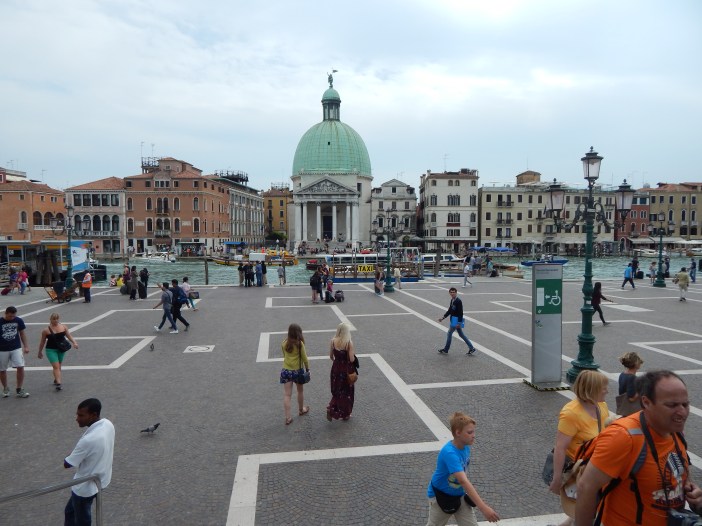
I love Venice. We spent a mere twenty-four hours there on our trip to Italy several years ago, taking the train from the magnificent station in Florence through the Italian countryside north and then across the lagoon to the Venetian station. I walked ahead of Paul through that Italian station, unable to wait to catch my first glimpse of the city from the top of the stairs rising from the piazza and vaporetto station on the Grand Canal.

DSCN6269

I was enchanted from that first glimpse.

I’d always wanted to visit Venice–ever since reading Daphne du Maurier’s brilliant story “Don’t Look Now” and seeing the film version, which is incredible–and also Anne Rice’s Cry to Heaven. Seeing Venice, even if was only for twenty-four hours, was wonderful. We were also incredibly lucky because Venice wasn’t crowded; apparently that’s become a huge problem (goo.gl/ePMQjT). It was even a problem when Berendt was writing The City of Falling Angels.

The title comes from a sign Berendt saw one day while strolling around Venice, near an old church that was crumbling and in need of restoration: BEWARE OF FALLING ANGELS. Apparently, the statues of angels on the sides of the church and along the rooftop had become loose with the rotting of the masonry, and one had fallen, almost hitting a pedestrian. The book reminded me so much of Venice, and why the city had enchanted me during my all-too-brief visit. I want to write about Venice; I’ve been toying with a story for years, and as I am just now starting to write my Panzano story, maybe I will soon write the Venice story.

Anyway, Berendt is best-known, of course, for his book about Savannah: Midnight in the Garden of Good and Evil, which I read decades ago when it was new. I enjoyed it; it was an examination of the quirks and curiosities of the city, built around the lens of a murder committed by a member of Savannah society. The City of Falling Angels is the same type of book, only viewed around the lens, not of a murder, but the burning of the Fenice Opera House. It did turn out to be a crime; two men were convicted of arson, but Berendt uses the fire, the investigations, and the subsequent trial, to view Venice; and along the way he takes a look at the quirks, eccentricities, and curiosities of a place that, like Savannah, is quaint and historic and beautiful–yet also very small. A lot of the things he talks about in the book–the concerns of locals that Venice is no longer for the Venetians, that the city is losing its neighborhoods to tourism; that poorer and middle class Venetians are being pushed out in the name of tourism–are concerns that we locals now have about New Orleans, so that made the book even more interesting to me. When we were there, we stayed overnight at a wonderful little family run hotel just off the Rialto Bridge and on one of the side canals; the Hotel San Salvador. We, too, had a lengthy conversation with two of the young women working there–members of the ownership family–who told us the same thing: Venice is no longer for the Venetians. Their family can no longer afford to live in the city, despite owning a hotel there; they live on the mainland and commute into the city. Most of the city’s apartments are being bought up by foreigners who then rent them out to visitors, so it is also affecting business for establishments like the Hotel San Salvador. I loved the hotel, it was charming and quaint and cozy; I loved the second floor lounge overlooking the canal below, and the family who owned and operated it were so nice, friendly, and charming. If and when we return, we will undoubtedly stay there again.

I’ve met John Berendt exactly once; he was very nice, and I liked him. I like his books, too. My character, Jerry Channing, who appears in both The Orion Mask and Garden District Gothic, and whom I’ve considered spinning off into his own series, is based on him only in that he writes the same kinds of books and articles Berendt does; kind of a cross between Berendt and Dominick Dunne. (I still might spin Jerry off; a lot of my short stories, which have first-person narrators who are never identified, are told in what I imagine Jerry’s voice to be) In fact, Jerry’s biggest success is a book called Garden District Gothic (very meta of me), which is about the quirks and curiosities and eccentricities of New Orleans, viewed through the lens of a society murder in the Garden District. The Scotty novel that bears the same title is an investigation into that case twenty-five years later, in fact (again, very meta of me).

16903185_10210905674210634_792277906514866377_o

Anyway,  I highly recommend The City of Falling Angels. I think I enjoyed it a lot more because I’d been to Venice, but it definitely made me want to go back. It’s very well-written, and a lot of fun to read.

And now back to the spice mines.


Walking on Sunshine

Wednesday. I found my missing copy of The City of Lost Fortunes, which ironically was in my backpack the entire time in a pocket I didn’t check because I wouldn’t have put it in there. Yes, sometimes I wonder about what’s left of my sanity.

Paul returns sometime today; he never tells me his itinerary when he travels, so unless I absolutely pin him down and make him tell me, or forward the itinerary to me, I have no clue when he gets home. It’s usually late in the evening–he is one of those who, no matter how many times I tell him to never do this–always takes the last flight of the day. Rule Number One of traveling is never to take the last flight of the day because disruptions in service can trap you overnight somewhere. And since visiting his family always requires a connection somewhere, it happens almost every single time.

I also finished reading The City of Falling Angels last night; John Berendt’s tome about Venice, and enjoyed it very thoroughly. I have some thoughts about the book, and Venice in general, but I am going to let them percolate for a day or so before talking about them on here.

Yesterday I worked some more on “Don’t Look Down”–again, it is like pulling teeth–and started another short story. I shouldn’t have started writing another story, in all honesty, but “Burning Crosses” has been a story I’ve wanted to write for a really long time, and it starting taking form in my head yesterday so I just kind of dove in headfirst. I also started “Feast of the Redeemer,” my Venice story, which I blame entirely on John Berendt. Today I don’t know what I’m going to write, but I think I am going to start trying to outline the rest of the Scotty book. It may not actually be actual writing,  but it counts as work.

I read two more short stories. First up: “The Daemon Lover” by Shirley Jackson, from The Lottery and Other Stories:

She had not slept well; from one-thirty, when Jamie left and she went lingeringly to bed, until seven, when she at last allowed herself to get up and make coffee, she had slept fitfully, stirring awake to open her eyes and look into the half-darkness, remembering over and over, slipping again into a feverish dream. She spent almost an hour over her coffee–they were to have a real breakfast on the way–and then, unless she wanted to dress early, had nothing to do. She washed her coffee cup and made the bed, looking carefully over the clothes she planned to wear, worried unnecessarily, at the window, over whether it would be a fine day. She sat down to read, thought she might write a letter to her sister instead, and began, in her finest handwriting, “Dearest Anne, by the time you get this I will be married. Doesn’t it sound funny? I can hardly believe it myself, but when I tell you how it happened, you’ll see it’s even stranger than that…”

Sitting, pen in hand, she hesitated over what to say next, read the lines already written, and tore up the letter. She went to the window and saw that it was undeniably a fine day. It occurred to her that perhaps she ought not to wear the blue silk dress; it was too plain, almost severe, and she wanted to be soft, feminine. Anxiously she pulled through the dresses in the closet, and hesitated over a print she had worn the summer before; it was too young for her, and it had a ruffled neck, and it was very early in the year for a print dress, but still…

This story, which is sad and tragic and, like so many Shirley Jackson stories, a real mystery where it’s left up to the reader to interpret what is really is about, is terrific. It resonated with me because I am one of those people who is too excited and restless to sleep the night before something I am looking forward to; and I can never wait until it’s time on that day, having to make myself busy doing things and keeping myself occupied and then, when the appointed time arrives…yeah. One of my neuroses is being stood up; having someone make a date with me for anything, something I am excited about doing, and then never hearing from the person. With this story, we are never entirely sure if this is something she imagined or it was only in her head or if it was real, and this makes it all the more poignant and sad and heartbreaking. There was something of Raymond Carver in this story; in its ordinariness and sadness and poignancy; but Jackson was far superior to Carver–although this story made me want to read something of his again.

Next was “Ampurdan” by Warren Moore, from Lawrence Block’s Alive in Shape and Color.

Alan Bowling was walking again. The golden light of the Colorado autumn played across the rusts and browns of the ground beneath him. Behind him, the city. The air was cool here, away from the shops, the school, the fringes of the city of Ampurdan.

Alan didn’t know why the city–pfft, city. Don’t put on airs; at most, a town, really–was named Ampurdan. He had read that the word was an old name for a place in Spain now called Emporda. He himself privately called it “Ampersand,” a place between two other places, connecting them by force of…by force of what? How did an ampersand connect things, other than by force of will and in the mind of the person connecting them? The and of the ampersand the conjunction, was between whatever two things the speaker, the thinker, chose to conjoin. And since in Alan’s life, the only conjunctions he saw were the compounding of day upin day, there seemed to be little sense of a period to this place, to this life. Merely a string of days becoming ellipsis, until one day each inhabitant reached an end of words.

“Ampurdan” is a perfectly fine story, and similar to the Jackson in its depiction of sadness, loneliness, and poignant in telling the story of lonely Alan Bowling, who goes through his life missing opportunities to be happy through no fault of his own. He knew love once and it wasn’t returned; he was also the kind of person who only loves once. There’s also a bitter horror at the center of the story, but rather than being horrified by what Bowling did, we are sympathetic and understanding because Moore does such an amazing job of painting the picture of who Alan is, what drives him, that aching sadness and loneliness at the core of his being. This isn’t one of my favorite stories in this collection, but it’s certainly a strong story, and an indication of how terrific the entire collection is, honestly.

And now, back to the spice mines with me,

milo ventigmilglio

No More Lonely Nights

Paul returns tomorrow night, so I will return to my usual status as second best to Scooter. I have to say I’ve enjoyed his neediness more than usual this past week, as he cuddles with me in the bed and sleeps in my lap while I read or watch television.

I didn’t get nearly as much done this weekend as I had hoped or wanted to; I did reread the first ten chapters of the Scotty book and got some edits on it done–it does need a lot more work to be smooth–and I am trying to figure out how much I want to have happen here in the second half of the book. I may end up writing it a lot longer than it needs to be–surgically removing the bits that aren’t necessary afterwards. I worked some more on “Don’t Look Down,” which took up the majority of my writing time this weekend, and remained just as difficult and painful to write as I remembered it being. It’s going to be a long story–I am not worried about its length, as it is going into my short story collection rather than being sent out into the open market (gay main character, after all, makes it basically un-publishable).

I also started writing out ideas for three more stories: “Burning Crosses,” “Feast of the Redeemer”, and “Cross Roads.” Not sure if anything will come out of any of them, but there they are.

Today I need to get some things done that are due, and then I can focus on getting back to work on the other writing.

I am drawing to the end of The City of Falling Angels by John Berendt, and really enjoying it; in fact, I am enjoying it more than I enjoyed Midnight in the Garden of Good and Evil, to be honest. Venice is ultimately more interesting than Savannah, sorry; at least to me. (Don’t get me wrong, I’d love to visit Savannah–but if I had to choose between the two Venice would always win.)

I also read a shit ton of short stories this weekend, and sadly, finished reading both Lawrence Block’s wonderful anthologies, In Sunlight and In Shadow and Alive in Shape and Color. I do hope he’s doing another one this year, because they are quite marvelous.

So, for today’s edition of The Short Story Project, I do have a story up from In Sunlight or In Shadow, Joe R. Lansdale’s “The Projectionist”:

There’s some that think I got it easy on the job, but they don’t know there’s more to it than plugging in the projector. You got to be there at the right time to change reels, and you got to have it set so it’s seamless, so none of the movie gets stuttered, you know. You don’t do that right, well, you can cause a reel to flap and there goes the movie right at the good part, or it can get hung up and the bulb will burn it. Then everyone down there starts yelling. and that’s not good for business, and it’s not good for you, the boss hears about it, and with the racket they make when the picture flubs, he hears all right.

I ain’t had that kind of thing happen to me much, two or three times on the flapping, once I got a burn on a film, but it was messed up when we got it. Was packed in wrong and got a twist in it I couldn’t see when I pulled it out. That wasn’t my fault. Even the boss could see that.

Still, you got to watch it.

This is a marvelous story, about a mentally challenged young man who grew up in an incredibly abusive household and never graduated from high school. He’s gotten a job, through a mentor, as the projectionist at a local movie theater. The job makes him incredibly happy, and the voice! Lansdale has nailed the character’s voice so poignantly and beautifully, you can’t help but care about him and his undoubtedly doomed relationship with the beautiful usherette. The conflict in the story comes when two hoods attempt to shake down the theater owner for protection money, and how the staff, how our main character, tries to deal with that situation. A truly great story. Lansdale is a terrific writer, just terrific, and this short story, as well as the one in Alive in Shape and Color, are both so strong that I really want to start tracking down all of his short stories. A quick Google search shows that there are, in fact, quite a few. How lovely!

And then, I turned to “The Lottery” by Shirley Jackson, from The Lottery and Other Stories.

The morning of June 27th was clear and sunny, with the fresh warmth of a full-summer day; the flowers were blossoming profusely and the grass was richly green. The people of the village began to gather in the square, between the post-office and the bank, around ten o’clock; in some towns there were so many people that the lottery took two days and had to be started on June 26th, but in this village, where there were only about three hundred people, the whole lottery took less than two hours, so it could begin at ten o’clock in the morning and still be through in time to allow the villagers to get home for noon dinner.

The children assembled first, of course. School was recently over for the summer, and the feeling of liberty sat uneasily on most of them; they tended to gather together quietly for a while before they burst into boisterous play, and their talk was still of the classroom and the teacher, of books and reprimands. Bobby Martin had already stuffed his pockets full of stones, and the other boys soon followed his example, selecting the smoothest and roundest stones; Bobby and Harry Jones and Dickie Delacroix–the villagers pronounced this name “Dellacroy”–eventually made a great pile of stones in one corner of the square and guarded it against the raids of the other boys. The girls stood aside, talking among themselves, looking over their shoulders at the boys, and the very small children rolled in the dust or clung to the hands of their older brothers and sisters.

“The Lottery” is probably one of the most famous–if not the most famous. American short story of the twentieth century. It was, in fact, quite a shock when I realized, paging through my copy of The Lottery and Other Stories, that I had in fact actually never read the most famous short story written by one of my favorite writers; we did the play in Acting class when I was in high school, and I have seen the short film based on it. But I had never actually read the story itself. I don’t have to get into what the story is about–who doesn’t know what the story is about–but wow, what an exceptional piece of writing. Jackson, as always, just writes about something terrible in a matter-of-fact, nondescript way, like what she is writing about is nothing extraordinary; these lotteries have always happened and will always happen and she’s just recording one of them. I would be willing to go so far as to say (and bear in mind I am not an expert) that this story firmly established New England as the best setting for horror in this country; Jackson’s influence from this story is clearly evident in everything of Stephen King’s,  some of Peter Straub’s work, and most definitely in Thomas Tryon’s. Even knowing what the story was about didn’t lessen it’s chill, and that has everything to do with the authorial voice, and how powerful it is.

Whew.

And now, on to the spice mines.

IMG_1182

Be Near Me

It’s a gray Monday, and I have a lot to do today before I return to work tomorrow. Yesterday was a complete waste of a day; I did manage to reread the first half of the first draft of the Scotty novel and spent some time reading/editing “Don’t Look Down”; not really sure how it needs to be fixed but am going to try to get that taken care of today. I need to run an errand at some point, and I must go to the gym today. But I need to get past the schedule I always am stubbornly stuck with; I’ve always done errands/gym around elevenish/noon; which is insane. There’s no required schedule as such; I can do errands or go to the gym at any time I please. So, yes, I am going to  work my way through things this morning, and try not to waste my time with social media, the way I always do.

It really is a time suck.

I’m not sure why I had such low energy yesterday; whether it was the gloom or the cold or whatever; but I had intended to go to the gym yesterday and run the errands. Instead I found myself listless and drained of all energy; I had to force myself to make lunch yesterday afternoon. I spent most of the day lying in bed reading–although I did managed to muster the energy to come downstairs and watch The Ritual on Netflix around eight o’clock last night. I feel better today so obviously the low-energy was something my body insisted on; it’s just been a long time since I’ve had such a day where I couldn’t force myself to do anything. I usually just brush all that aside and make myself do things. It didn’t work yesterday, alas.

I suppose the best thing to do is just accept that it was something my body needed and be done with it.

I also read some some short stories yesterday. First up was  “Taking Care of Business,” by Craig Ferguson, In Sunlight or in Shadow

The Reverend Jefferson T. Adams, beloved and respected minister of this parish for over fifty years, pulled deeply on the long fragile Jamaican-style reefer and held the smoke deep in his lungs. There was no sensation of getting high anymore, or indeed panic or paranoia or any of the other unpleasantness. No sensation at all really but he enjoyed the ritual.

He listened to the music from outside the church. It was too nice a day to go inside. Cold and still with a high milky cataract of cloud diffusing the sunlight enough to flatter the landscape, softening the edges and blanching out the imperfections like an old actor’s headshot.

The sea was guilty and quiet, like it had just eaten.

This is a poignant and sad story, about a minister who is dying from cancer and smoking medical marijuana with an old friend every day as his life fades away from him. The two old men talk about things, reveal secrets to each other they’ve kept hidden away from the world their entire lives, and finally, as every story about death must, it ends with the death of the reverend, but it’s not sad, it’s kind of poignant and beautiful. Craig Ferguson is an actor/comedian/writer; he was on The Drew Carey Show and later hosted The Late Show (or something like that); I was pleased to see he is also quite talented as a writer.

Next up was “Guilt-Edged Blonde” by Ross Macdonald, from The Archer Files.

A man was waiting for me at the gate at the edge of the runway. He didn’t look like the man I’d expected to meet. He wore a stained tan windbreaker, baggy slacks, a hat as squashed and dubious as his face. He must have been forty years old, to judge by the gray in his hair and the lines around his eyes. His eyes were dark and evasive, moving here and there as if to avoid getting hurt. He had been hurt often and badly, I guessed.

“You Archer?”

I’d taken a long break from reading Macdonald’s short stories; while I appreciate and quite like his hard-boiled style, sometimes though it becomes a bit much to deal with, and in the short stories, that is particularly obvious and somehow more difficult to deal with. I do love the way the stories twist and turn and become something far different than they start as; this story has Archer hired as a bodyguard, only to arrive to meet with his client who’s already been murdered, and a blonde woman is seen fleeing the scene. The client had basically been a mob accountant and stole money from them; and was worried they were going to come after him. However, the story has nothing to do with how it’s set up, and it’s quite a twisty and strange tale. This is one of the stronger Archer short stories, but…again, a little of that hardbitten, hard-boiled, macho straight man sensibility goes a long way in my book; so it’ll probably be a while before I return to The Archer Files. I don’t to make it sound like I don’t like Macdonald and these stories…I do. Reading a Macdonald novel is a bit different. Most of the Archer novels are short and they move so quickly you’re so wrapped up in the story–and the focus is on the story more so than the style; the short stories, oddly enough, because they are short the style is more apparent than in the novels. I’m not entirely sure if that makes sense, but I think it does, even if I can’t seem to put it into words properly.

tumblr_p2iqqx41tz1sh6rbgo1_540

Would I Lie To You?

Is it sad that I will read a themed anthology, and then will think up a short story based on that theme that I would have written had I been asked?

I find myself doing this a lot lately; I think it has a lot to do with the Short Story Project and reading themed anthologies. As I read the terrific stories, I start wondering what would I have written for this had I been asked and then my mind starts to wander a little bit, which is both irritating and distracting. Yesterday I went looking for Edward Hopper paintings, and found two that would have worked as story inspirations. One day last week I found an image of my favorite Salvador Dali painting on-line, and grabbed it to my desktop so I could look at it and wonder what kind of story it would inspire within me. And obviously, Jim Fusilli’s Crime Plus Music made me wonder what song would inspire me to write a crime/music story, and of course, thought of a Stevie Nicks/Fleetwood Mac song, and then scribbled down a potential title and some thoughts on the story.

Because I don’t have anything else to write, obviously.

I did get some things done yesterday; I cleaned the kitchen and get caught up on laundry. I must have left my copy of Bryan Camp’s The City of Lost Fortunes at the office, as I could put my hands on it anywhere, which was really annoying as I had intended to finish reading it this weekend; I can’t find it, so I must have taken it out of my backpack at the office on Thursday and walked out at the end of the day without putting it back. At least, I hope that’s what happened to it. I’d really hate the have to wait until I buy the hardcover before I can finish reading it. But in lieu of that, I read a shit ton of short stories yesterday, getting very caught up on the Short Story Project. I will probably get even further on that today, since I don’t have my novel to read. Today I need to write and edit, finish cleaning the living room, and get everything ready for tomorrow; the final day of my three day weekend, and I need to definitely make progress, else I will spend most the week berating myself until the next weekend rolls around. Paul will return home on Wednesday. If I can simply stick to what I need to do, and check things off the list, I can go to work on Tuesday feeling terribly accomplished.

It’s very cold this morning; it rained most of the day yesterday, so today we have the predictable temperature drop. It’s really making me want to just curl up in the easy chair with a book–which is fine, I can do that, as long as it’s the manuscript or one of the short stories or all of the above.

Must. Stay. Focused.

I did watch a couple of movies yesterday; the original 1973 film version of Jesus Christ Superstar (I didn’t remember what a fucking hot daddy Caiaphas was) and Legion, a horror film that came and went many years ago; the Syfy series Legion, which I started watching and never finished, was a sequel of sorts to it. I never finished watching because it was difficult to find, or when I remembered to try the episodes weren’t available anymore, and having not seen the film, I was a bit lost. Now that I’ve watched the film, which I kind of liked, I am looking forward to starting the TV show over again.

All right, I need to get some things done around here. So here are two short stories I read yesterday:

First up is “Shaderoc the Soul Shaker” by Gary Phillips,  from Crime Plus Music, edited by Jim Fusilli.

On for the days when he could snort him a line of flake while some groupie was down on her knees, her head buried between his spread leather-clad legs, pleasuring him like he was a visiting pharaoh. Goddamn, that time in his room backstage at the Forum…the two big-titty blondes. Sheeet, the top of his head damn near blew off that night as they sexed him up, down, and sideways.

Churchill “Church” Gibson shook his head, regretfully cycling away from the glorious past into the stone-cold reality of now. He glared at the screen of his laptop as if it were an adversary. He put aside his coffee and tapped the keyboard and the music app replayed his most troubling tack through external speakers. The green audio readout traveling from left to right as the music filled his compact home studio space.

This is a terrific story. Gary Phillips is one of those crime writers who should be much more successful than he is; he wrote a story for Blood on the Bayou that was fantastic and this one–about a formerly successful, hard-living musician whose career has waned but has a chance to get back on top by writing the soundtrack to a film but is having a terrible time creating anything decent, is terrific. As a writer, I can certainly understand that feeling of why can’t I do this anymore and it used to be easy to do this. But as he works, he starts seeing people from his past, who talk to him and remind him of what he used to be capable of, and as he creates he remembers past times and past crimes…it’s absolutely fantastic.

Next up, also from Jim Fusilli’s Crime Plus Music, was “The Long Black Veil” by Val McDermid.

Jess turned fourteen today. With every passing year, she looks more like her mother. And it pierces me to the heart. When I stopped by her room this evening, I asked if her birthday awakened memories of her mother. She shook her head, leaning forward so her long blond hair curtained her face, cutting us off from each other. “Ruth, you’re the one I think of when people say ‘mother’ to me,” she mumbled.

She couldn’t have known that her words opened an even deeper wound inside me and I was careful to keep my heart’s response hidden from my face. Even after ten years, I’ve never stopped being careful. “She was a good woman, your mother,” I managed to say without my voice shaking.

Jess raised her head to meet my eyes then swiftly dropped it again, taking refuge behind the hair. “She killed my father,” she said mutinously. “Where exactly does ‘good’ come into it?”

This is a haunting story about love and family, friendship and class, all set in a small town somewhere which is never specifically named. McDermid, an enormously successful and award-winning crime writer (you should read her if you haven’t; start with A Place of Execution and The Mermaids Singing), manages to tell this story from two different point of views, and so captures small town America perfectly that it is almost eerie. It’s a terrific story, heartbreaking and tragic in its very simplicity. I don’t think I’ve read a McDermid short story before, but this is a great example of why her work is so popular.

And on that note, it’s back to the spice mines with me.

20139726_1483071895137171_270669942309726059_n

Voices Carry

FRIDAY! Huzzah! MY short day of the work week, and I also took this Monday off because I have things to get done. So, I am on the verge of a three-day weekend, and desperately looking forward to it. I’ve been having a great week of getting things done, frankly–I’ve been killing it on the Scotty book, and hope to be half-way finished the first draft today–getting so ridiculously close it’s not even funny–and I have a lot of cleaning to do around the house as well. I want to finish reading Bryan Camp’s The City of Lost Fortunes this weekend, and I also want to get some final revisions done on some short stories. I have errands to run, places to go, people to meet, things to do….

But Paul is also gone for the weekend, so outside of Scooter’s neediness, I will get a lot done out of, if nothing else, a sense of utter boredom.

I started watching this week’s broadcast of Jesus Christ Superstar last night, and actually was liking it before it was time for me to go read in bed–I got all the way up to the Last Supper, and was actually amazed at how quickly it went past. I have some thoughts about this musical/concert/whatever you want to call  it–particularly about how scandalous it was back when it originally debuted, and how appalled Christians were by it, but it will have to wait until I am actually finished watching it.

I am also thoroughly enjoying The City of Falling Angels; it makes me want to write about Venice, which I fell in love with during our brief twenty-fours there several years ago. Paul wasn’t as crazy for Venice as I was; so getting back there isn’t going to be as easy as I would like, but I do want to return there and spend more time there, especially now that I’ve read more history of the city and know what to look for. Interestingly enough, as I was reading the book last night I thought, you know, I think we actually walked by the Fenice Opera House while we were there, and I just looked on Google Maps and sure enough, we had. (I just knew it was the opera house at the time; I didn’t realize it was the opera house, and that John Berendt had built his entire book about Venice around the fire in 1996 that destroyed it.)

And now I cannot stop thinking about writing the Venice story I’ve been thinking about ever since we visited, “Festival of the Redeemer.”

Heavy sigh.

I’ve also fallen a bit behind on my short story reading–between reading the Bryan Camp novel and all the writing I’ve been doing, I’ve simply not found the time to read stories, so I’ll have to devote some time to that this weekend. I read one last night, but I am not ready to talk about it just yet; as a very stubborn creature of habit, since I don’t have a second one to talk about this morning I can’t seem to bring myself to write about just the one. It’s a good one, though–Gary Phillips is the author, and he’s fantastic–and I am hoping to read some more Shirley Jackson as well as get deeper into Crime Plus Music, which is where the Phillips story is from.

I’ve done quite a bit of Scotty writing this week, which pleases me to no end. I am goingto carve out some time this weekend to read/revise/make notes on the first ten chapters, which will help me envision what is going to happen in the final ten. I have an idea, but I am not sure if it’s a direction I want to take…ugh, this Scotty book has been so difficult.

Ah, well, best to get back to it.

IMG_1096


Glory Days

God, there’s nothing more depressing than paying the bills, is there?

Yesterday was a good writing day; I should be able to finish off Chapter Nine today, which is absolutely lovely. If I can get Chapter Ten done by the weekend–which I should be able to do, no problem–then I’ll be halfway finished with the first draft. Huzzah! All downhill from there, too. Although there’s an awful lot to cram into the last ten chapters…I may have to plan that out a little better. Heavy sigh. But I can also work on outlining it, to have a general idea of what direction I’m going in, which will be enormously helpful. I don’t ever stick to the outlines–ever–but it helps give me a general idea of what direction to go in.

I was also going over an editor’s note on one of my short stories, which were absolutely lovely, in all honesty. I want to get that done over this weekend–I’ve taken Monday as a vacation day, so I have a three day weekend this weekend, the intent to get as much cleaning and writing and editing done as I possibly can; Paul left yesterday morning to visit family for a week, and hey, why not use the time as effectively as possible?

I also read some more of The City of Falling Angels last night; I am really enjoying John Berendt’s views on Venice, and also kept thinking, wow, I’d love to take an apartment in Venice for a couple of months, how awesome would that be?

I intend to finish Bryan Camp’s debut novel this weekend as well, since it’s pub date is coming up, so I can get a review posted on here.

It never ends, really.

I read some short stories, too! First up was “Nighthawks” by Michael Connelly, from Lawrence Block’s seminal In Sunlight or in Shadow:

Bosch didn’t know how people in this place could stand it. It felt like the wind off the lake was freezing his eyeballs in their sockets. He had come totally unprepared for the surveillance. He had layers on but his top layer was an L. A. trench coat with a thin zip-in liner that wouldn’t keep a Siberian husky warm in the Chicago winter. Bosch wasn’t a man who gave much credit to cliches but he found himself thinking: I’m too old for this.

The subject of his surveillance had come down Wabash and turned east toward Michigan and the park. Bosch knew where she was going because she had headed this way on her lunch break at the bookstore the day before as well. When she got to the museum she showed her member pass and was quickly admitted entrance. Bosch had to wait in line to buy a day pass. But he wasn’t worried about losing her. He knew where she would be. He didn’t bother to check his coat because he was cold to the bone, and he didn’t expect to be in the museum much more than an hour–the girl would have to get back to the bookstore.

I’ve not read a lot of Connelly, but I remember meeting him many years ago at the Virginia Book Festival and liking him a lot. I read the first Bosch novel sometime in the last seven or eight years and greatly enjoyed it; I’ve not watched the Amazon series but probably will at some point. There are just so many Connelly novels to get caught up on, it just overwhelms me to even consider reading them all. But this is a Bosch short story, and a good one. In this story, Bosch has retired (or quit) the police force and has become a private eye; which is cool. The story is terrific; he was hired to find a Hollywood bigshot’s daughter, he finds her–and then finds out why she disappeared in the first place…and then faces a moral dilemma. Truly a terrific story!

The next story was “The Incident of 10 November” by Jeffery Deaver, also from In Sunlight or in Shadow:

December 2, 1954

General Mikhail Tasarich, First Deputy Chairman of the Council of Ministers of the Union of Soviet Socialist Republics

Kremlin Senate, Moscow

Comrade General Tasarich:

I, Colonel Mikhail Sergeyivich Sidorov, of recent attached to the GRU, Directorate for Military Intelligence, am writing this report regarding the incident of 10 November, fof this year, and the death associated therewith.

I am way behind on my Deaver reading as well; I greatly enjoyed the Lincoln Rhyme series, but as I said, I fell behind and now am SO far behind on him that I despair of ever catching up; same with Lee Child. This is the second story of Deaver’s I’ve read that has dealt with the Cold War Soviet Union, from the point of  view of one of their agents; the other was in the MWA anthology Ice Cold. I don’t know if this is an interest of Deaver’s, or if one story begot the other, or if he’s written novels around this subject, but my interest was piqued. It’s a great story, flows really well, and has to do with a German scientist who was absorbed into the Soviet Union after the end of the Great Patriotic War…and I really enjoyed.

Now, I best get back to the spice mines.

28467762_1815115152116053_4842812587806162278_n

Run to You

Yesterday I wrote 2700 words, which was lovely. Two more chapters and I will be at the midway point of the first draft of the Scotty book! Huzzah! I do feel like most of those words were crap, but I advanced the plot, I advanced the story, and we’re percolating right along, which was truly, well and indeed, lovely. I hope to reach the midway point of the book by the weekend, which is when I am hoping to finish revising “Don’t Look Down” and “My Brother’s Keeper,” and maybe even “The Problem with Autofill.” Huzzah! I love that I am working again, and I am trying to keep my confidence in my work up. It’s so easy to get distracted, it’s fucking easy to hit that downward spiral, and I WILL NOT HAVE THAT THIS YEAR.

Ain’t gonna happen, bitches.

I finished reading Jon Ronson’s So You’ve Been Publicly Shamed this week, and I really enjoyed it. It really made me think about a lot of things, not the least of which are the on-line social media lynch mobs. I mean, there are so many truly terrible people on Twitter, trolls and bots and so forth, that it’s easy to forget that some of the people we see posting vile things, or things we totally disagree with, are people, just like we are; even though we may not agree with anything they do. I know it surprises people that I have conservative friends, but I do; and as long as they aren’t nasty and trollish, I like having them around on my social media. They do sometimes help me see things in ways that I’ve never thought about before, that may not ever have occurred to me, and I do appreciate that insight. The fact that I can see their posts and comments means that they haven’t blocked me; they may have hidden me–and to be fair, the shirtless men that get me banned all-too-frequently on Facebook might be a bit much for my conservative friends–but I also never see them saying anything homophobic or anything that makes me think they buy into the homophobic bullshit that is so frequent on their side of the spectrum; whether knowing me has anything to do with that, I don’t know. I’d like to think so, at any rate.

My next non-fiction is John Berendt’s The City of Fallen Angels. I’d forgotten I even had the book, to be honest; I was rearranging and reorganizing bookshelves the other day and there it was. VENICE!!! How could I resist? So, it’s on the nightstand for my before-I-go-to-sleep reading. I’m also itching to get back to Bryan Camp’s The City of Lost Fortunes. Seriously, pre-order the hell out of this one. You won’t be sorry.

I also read some short stories. First up is “The Misfits” by Naomi Rand, from Crime Plus Music, edited by Jim Fusilli:

Where would you have been without me, go on, tell me that why don’t you, you ungrateful bitch. I made you.

That was his parting shot to me. Johnny O believed that until the minute he cast his eyes upon you, you didn’t actually exist. My ex-manager thought I was some piece of clay he breathed that lousy cigarette breath into to coax to life.

I believed otherwise. My version is that when we met, I  had already been alive and well and living in Calabasas for seventeen years. I, Julie Weston, was a senior at Calabasas High. I’d already been accepted to my first choice school, UCLA. And why not? I had a 4.0 average. Plus, I was captain of the girl’s swimteam, lynchpin of the debate team, and to top it off, I was dating the boy most likely to be crowned prom king. So really I did exist before. Not only did I exist, I was well on my way to making my doting parents proud. But you be the judge.

I fucking loved this story; it was amazing. A chance encounter in Tower Records, and Julie joins an all-girl band called the Misfits, which begins a quick rise to stardom in the late 1970’s. It kind of reminded me of the true story about the Runaways–the all girl rock band which launched Joan Jett and Lita Ford–and some of the horrible allegations that have come out in recent years about their manager, how the girls were manipulated and/or sexually/emotionally/physically abused; I couldn’t get that out of my head as I read the story. It’s absolutely terrific, with a great ending. I have to say, I am loving reading my way through Crime Plus Music.

Next was “Rooms by the Sea” by Nicholas Christopher, from In Sunlight or in Shadow and editor Lawrence Block:

There were two doors into this house. The first, in a small unfurnished room, opened directly onto the sea. It could only be entered from the water. When it was left wide open on a sunny day, the light slanting into the room illuminated half of the near wall on a diagonal. As the sun descended to the horizon, the wall could be read like a sundial: its illuminated half shrinking until the entire wall had darkened.

The second door, in a foyer on the other side of the house, opened onto a rough path that wound through a forest and ended in an obscure park at the city limits. The fountain in that park, centered by stone mermaids that spout water, had been dry for months. The buildings that lines the city streets were red and brown. The sun ate into their brick, sending up puffs of dust. At dusk their blue windows turned amber. On the fire escapes women were smoking and reading, gazing up occasionally at the river of bruised clouds that flowed to the sea. One of them, a redhead, was reading a slim memoir entitled Rooms by the Sea, written a century ago. The author, Claudine Rementeria, was married to a Basque shipping magnate who had immigrated to America. She herself was Basque, and shortly before her untimely death at thirty, she wrote the book in her native language, Euskera, in order to please her husband. Aside from a small private printing at the time–of which only a few copies have survived–her book hadn’t been translated and published in English until recently. The redhead, Carmen Ronson, the thirty-year-old great-granddaughter of Claudine Rementeria, owned both the English translation and one of the extant Euskera copies.

This story read more as a fable; a literary story rather than a crime story, with a haunting tone to it;  Christopher did a great job creating a mood that carried through the whole story with the rhythm of the words. It’s more of a magical realism story; a fable, if you will, relating the Basques back to Atlantis and…it’s hard to describe. It’s quite good.

And now, back to the spice mines.

29594408_10211616758243041_8636825159989588484_n

All Through the Night

Well, I finished an incredibly difficult chapter of the Scotty book last night, and can now move on to the rest of the story. I despise transitional chapters, and this one was particularly painfully hard; it’s why I initially set the manuscript aside to begin with all those weeks ago. But now I am full on into the investigation, and things can really start happening now; the red herrings and the incredible confusion. This book is going to probably wind up having a plot as convulated and confusing as Mardi Gras Mambo was, and I do consider that to be, in fact, a very good thing. I am feeling very ambitious as I return to tackling this manuscript, and it’s been quite a while since I have felt that way.

And, now that I reflect on it, to not feel ambitious as one embarks on a search for a possible agent is quite possibly the stupidest mentality one can have for such a thing; if for no other reason that one is already defeated in spirit. It is so easy to give up, it is so incredibly easy to be defeated in spirit as one pursues a career in writing, that one has to grasp onto ambition with both hands and squeeze the very life out of it. I’m not sure when or where or why I allowed my ambition to fall to the wayside, but not only was it gone but I didn’t miss it. Which is a very strange thing to admit to; but ultimately not surprising. Ambition is one of those traits I was raised to believe was unseemly, unpleasant, and unattractive. I still struggle, to this day, with taking pride in achievements; to accepting compliments without prevaricating or being self-deprecatory in response. Sometimes I hear myself responding to a compliment and hear a tiny, desperate voice wailing from deep within the recesses of my own mind, just accept the fucking compliment.

And how many times has this self-doubt, this insecurity, this self-defeating mentality stopped me from reaching for something I wanted? Stopped me from attempting to write something outside of my comfort zone, something I want desperately to try? Far too many times, I have to admit, much as it pains me to do so.

Confidence is such a funny thing, isn’t it? Even the word–which I use to mean belief in yourself–had another meaning; con comes from confidence… a con man is a confidence man; likewise,  a con artist is a confidence artist.

So is confidence, self-confidence, the art of deluding yourself, conning yourself into a belief that you have more value than you actually do, perhaps?

Although I must say, wrestling that chapter into submission–no matter how bad the writing may be, no matter how bad the chapter might be–has certainly made me feel a lot more confidence in myself; because of course there was the fear that I’d never be able to get this chapter done, that the book would stall out, that I would fail.

But I did it. I worked through it, and I already know how the next chapter is going to go.

And that’s a good thing.

I also read some short stories. First up is “Serial Benefactor” by Jon L. Breen, from Manhattan Mayhem, a Mystery Writers of America anthology edited by Mary Higgins Clark.

To start with, I’m a centenarian, Sebastian Grady by name, and still fully marbled. My current address is Plantain Point, a retirement home on the California coast with a lot of residents from the entertainment world. To give you an idea, the president of our association is called the Top Banana, though most of the vaudevillians have died off.

As you can imagine, I’ve seen many younger generations come of age, and the current lot don’t seem too anxious to make the transition to adulthood. Don’t ask me if I blame them.

Evan is my favorite great-granddaughter.

This story is very clever, and I enjoyed it very much. It concerns a series of murders back in the post-war era; with all the victims being associated with the theater in some way, and all being pains in the ass to everyone who’s ever had to deal with them. There is a conversation at a cocktail/dinner party, and shortly thereafter people start dying. Clues are planted in the newspaper–lines from songs from musicals–and the killer is never caught. Sebastian poses the story to his great-granddaughter Evan to see if she can figure out the clues and how they relate to the murder victims. Sebastian has his own theory about the murders…and while we never are certain who the killer is, we do get a pretty good idea. And there’s a LOVELY twist at the end.

Next up was  “The Blackbird” by Peter Robinson, from Crime Plus Music, edited by Jim Fusilli:

It ended with a head floating down the river. Or is that where it began? You could never be certain with the Blackbird. I should know. I’ve known him for years, and I was with him until the end. Well, almost.

His real name was Tony Foster, and once, quite early in our relationship, I asked him how he had acquired his nickname. Tony drew on his cigarette in that way of his, cupping it in his palm like a soldier in the trenches, as if he believed it would be bad luck to let anyone see the glow. He turned his blue eyes towards me, a hint of a smile lighting them for a moment, then he looked away and told me it came about when he was a teenager growing up in a rundown council estate in the mid-sixties.

This isn’t necessarily a crime story, although there is a crime in it; the crime is how the story ends, but the story isn’t about the commission of the crime or the solving of the crime, but I suppose it is sort of about how the crime effects the narrator of the story. It’s really a sad, bleak tale that leaves the reader full of melancholy when it’s finished; it’s beautifully written and terribly sad. Well done, Mr. Robinson, well done.

IMG_1095