(She’s a) Very Lovely Woman

Saturday morning and it looks kind of gray outside the windows this morning as I look out at the world blearily and drink my first cup of coffee. I slept very well last night–which is always welcome–but woke up feeling a bit groggy this morning. I am sure the caffeine will work–it generally does–but as I glance around at the chaos of my office/kitchen my inclination is to pour the coffee out and go back to bed and sleep the rest of the day away, hoping magical elves or something else will show up whilst I sleep to finish organizing and arranging this mess into something resembling workable order. On the other hand, I don’t think that’s going to happen, so I am going to need to wake up, buckle up, and put my nose to the proverbial grindstone. I’ve got to contain this mess–and do it properly, no more sweeping things under proverbial rugs to get mess out of sight–and I’ve got to work on the book today and I need to run some errands. I also have to go to the gym today, so I will most likely follow football championship games today by periodically looking on-line to check scores only. Paul is going into his office this afternoon to do some work as well, and I need to update my to-do list and…yes, it’s a very busy day for a Gregalicious.

I finished reading Murder Most Fowl by Donna Andrews last night–charming, as always, delightful and witty and funny–and decided, since I was talking about how much I preferred Miss Marple to Hercule Poirot the other day, that I should revisit one of the Marple stories. I have a hardcover copy of A Caribbean Mystery–I don’t recall where it came from–but it has some sentimental value for me in that it was the first Marple novel of Christie’s I had read all those many moons ago when I was a child, holing up in my room on Saturdays with a book and a bag of Bar-B-Q Fritos. (My first Poirot was actually Halloween Party, which I also have a hardcover copy of and again, do not recall where I got it or how long I have had it; I read most Christies in paperbacks purchased at the Bolingbrook Zayre’s off their wire paperback racks) In those first few pages of the book, it spelled out exactly what I loved about the Marple stories–about how living in a small village actually exposes one to almost every kind of human behavior there is in a smaller ecosystem, and the great irony that the smallness and rural aspects of the small community are all too frequently seen as provincial and inexperienced in the world (why Grace Metalious’ Peyton Place was so shocking when it was originally published some seventy years ago; that placid, idyllic on the surface looking village/small town/rural community has a lot more going on than one would think at first glance). This is an excellent set-up, really, for the story Christie is writing about this fictional resort on a fictional West Indies island; her nephew, the successful novelist Raymond West, has paid for this trip for her to get some sun and recover from an illness…and when she originally protested about the expense and “who will watch out for my home in St. Mary Mead”–this response (which I hadn’t remembered) hit me right between the eyes:

Raymond had dealt with everything. A friend who was writing a book wanted a quiet place in the country. “He’ll look after the house all right. He’s very house proud. He’s a queer. I mean–“

He had paused, slightly embarrassed–but surely even dear old Aunt Jane had must have heard of queers.

Now, what is one to make of that? It was a jolt, certainly. It put me in mind of something I came across on Twitter the other day, written by Wil Wheaton, in which he had answered at a con somewhere a question regarding the current debate of “can you separate the art from the artist?” This is something I’ve pondered about quite a bit–most recently, the feeling of guilt I experienced in rewatching Chinatown, knowing now what I–we all–know about Roman Polanski. I enjoyed Chinatown every time I’ve seen it, and I was now watching–rewatching–through a different lens than I had before; I was watching in terms of my own Cynical 70’s Film Festival, to see how a 70’s film that actually harkened back to old-style crime/hard-boiled/noir styles, but with a more modern (at the time) sensibility fit into that 70’s cynicism and darkness about humanity and human behavior. But the discomfort kept popping up, particularly because Polanski himself appears in the film…and I eventually decided not to rewatch another favorite, Rosemary’s Baby, because of it.

I am not going to consign Agatha Christie to the trash heap of history; she was an extraordinary writer, and one of the most influential in the field in which I myself write. Nor do I think a simple throwaway line or two in a book originally published in 1964 is enough to dismiss Christie and her canon as homophobic and never revisit her work. In fact, given the time period in which the book was written, I am surprised the two sentences weren’t, frankly, much worse. Reading the sentences didn’t offend or outrage me; it was just a surprise, primarily because I didn’t remember them at all in a book I’ve read multiple times over the years–and I think when this hardcover came into my possession (I won’t swear to it, but I think I got it during one of my many eBay buying frenzies after Hurricane Katrina, when I felt it necessary to get copies of books with some sentimental value to me) I did actually read it again because I didn’t remember the plot–and this either went right past me or I noticed and didn’t think much of it.

Revisiting this book and viewing it through a modern lens is going to be interesting. And like I said, the reference could easily have been worse–but seeing queer used in this way reminds me of how it used to be used. The younger generations are reclaiming the word, and I myself have been advocating for it as a generic term for the non-straight community for eons…but I also can see why there are people of my generation/the one before me/the one after me who object to its use and why.

But I would a thousand times rather see the word queer used in an Agatha Christie novel than faggot. And I also remember the sympathetic depiction of a lesbian couple in my favorite Marple, A Murder is Announced.

Interesting thoughts on a Saturday morning. The sun has come out now and it’s not quite so gray outside; the second cup of coffee is certainly hitting the spot right now and the grogginess is beginning to leave from not only my head but from my body. I still don’t want to straighten up this mess, but there’s no choice, really, and I want to get some good work on the book done today and tomorrow. I need to go to the gym either today or tomorrow as well; perhaps later this afternoon once I get some writing/cleaning/organizing completed. I cannot be completely lazy this weekend, much as I would like to be; I have to get things done, and the more things I get done now the fewer things I will have to do later this month (I am not, for example, going to want to write on Christmas). But once a procrastinator, always a procrastinator.

And now it occurs to me that perhaps I am procrastinating here, so I am going to bring this to a close. Have a lovely Saturday, Constant Reader, and will talk to you soon.

One for One

FRIDAY!!!!

Yesterday was a good day. I slept extremely well, got up, answered some emails and printed some things out that I needed to sign and scan and send back, data entered, and then made condom packs. Once I was finished with my work-at-home duties for the day, I went to the gym. Yes, that’s right–one more time for those in the back: I went to the gym again. It was a lovely late afternoon–early December is so lovely here, Constant Reader, you have no idea–and so the walk was nice. People out walking their dogs, dogs running around having a good time in Coliseum Square, a nice coolness…it’s so lovely here once the blast furnace of the summer is over.

I also wrote for a bit–not one of my better writing days, alas–and so took a break and read Donna Andrews’ Murder Most Fowl for a while until it was time for us to watch last night’s batch of episodes of Gossip Girl. The last three episodes of the reboot–although I suppose it’s really more of a sequel series than a reboot–have dropped, but last night’s was rather lame; the season is sputtering its way to the finish line, which is a shame, since it started so well with guns blazing–and we’ve come to the conclusion that we much prefer the OG. We saw the first two episodes of Season 2, and are all in once again; despite the fact that the season one finale was such a disappointment. New characters, new romances for the characters, and lots of new drama, which is wonderful. I still can’t believe we didn’t ever tune in when it was originally airing.

Today is another work-at-home day, mostly data entry but with some condom-packing perhaps later. Yesterday’s condom-packing movie was another entry in the Cynical 70’s Film Festival, and I decided to check out Shaft, the original from 1971 starring Richard Roundtree–who was sexy as fuck. I’ve never seen the original Shaft movies; there were three of them in total (Shaft’s Big Score, Shaft in Africa) released in the 1970’s, and while it’s terribly dated now, it still holds up as entertainment. And one cannot really dismiss its importance as a film, given the time in which it was produced. Here we have, in 1971, six years after the Voting Rights Act and other important civil rights legislation, a complex Black private eye as the hero of a crime film; it is a mere four years after the Oscar-winning In the Heat of the Night, with Sidney Poitier as a Philadelphia police detective solving a strange murder in rural Mississippi and having to deal with the horrific racism of the region. The film was a huge hit at the time, and it’s famous “Theme from Shaft” by Isaac Hayes won the Oscar and was a huge hit record; I believe the entire soundtrack also sold extremely well. The character of John Shaft was created by a white writer named Ernest Tidyman–no #ownvoices there–who also co-wrote the screenplay (he also wrote the screenplay for that same year’s The French Connection–he was definitely having a good year); and published a number of novels featuring the character. Just as Virgil Tibbs and In the Heat of the Night were created by a white writer named John Ball–the novel the film was based on in that particular case was problematic–so was John Shaft; but in looking up Tidyman, I also saw that he received an Image Award from the NAACP. The plot of the movie is pretty straightforward; the Mafia is trying to muscle in on a Black mobster in Harlem, so they kidnap his daughter, so he hires Shaft to find and rescue her. The NYPD is concerned about a possible mob war between to the two rival syndicates, and also is pressuring Shaft to give up what he knows and get involved. It was very much a film of its time; I always love seeing movies film on location in New York during that time, when the city was much grimier than it is now, and its success may have been integral in the development of what came to be known as the “Blaxploitation” film in the 1970’s–when studios realized there was a big audience for films about the Black experience in America, with strong Black lead characters, giving rise to the careers of Black stars like Pam Grier, for one–and some of Chester Himes’ novels were given the Hollywood treatment. Are there any books, I wonder, about this period? Why did they stop making these movies? (They must have stopped making money, which is usually the reason Hollywood stops making any kind of film) I must make a note to do some research.

I also worked on cleaning and organizing last night, so there’s some finishing up to do here in the kitchen/office. I also had to answer some questions regarding the proofs of my story “The Snow Globe” (which will be in the upcoming anthology Murder is Magic, co-edited by Donna Andrews, Barb Goffman, and Marcia Talley), which was nice; I was very glad that story finally found a home somewhere. It was originally, of all things, a Halloween story that morphed into a Christmas story–I’ll write more about it when the book comes out–but the opening line came to me one Halloween night as I stood on the balcony of the Parade watching all the costumes down below on Bourbon Street, when someone dressed as Satan came out of Oz. The costume was totally slutty-gay; a guy with a phenomenal body wearing red boots, a red bikini covered in sequins, horns, and red body paint. Wow, I thought, Satan has a great six-pack, and laughed, because I realized it was a terrific opening line for something–short story or a book or something–and pulled out my phone and texted it to myself so I wouldn’t forget. It sat in a folder called Satan costume for many years…until I realized I could turn it into “Santa” and turn it into a Christmas horror story. And the rest, as they say, is history.

All right, it’s time for me to get back to data entry. Have a lovely Friday, Constant Reader, and will check in with you again tomorrow.

Some of Shelly’s Blues

Thursday, and Gregalicious is working at home today. Huzzah? Huzzah! I do like working at home; it always has been best for me to work in isolation; my attention span is such that being around co-workers inevitably means distraction and lower productivity than I would prefer. This is especially true when I am doing data entry; it’s much easier to make mistakes and get distracted when others are around and talking, even if they aren’t talking to me. The printer/copier/scanner (business sized) is right behind where I sit at my cubicle, so every time someone prints something or needs to copy something I see them approaching out of the corner of my eye and they are right behind me as they go about their business. It’s a bit awkward to not acknowledge them or for them not to say anything to me, so when we used to operate at full capacity with everyone in the office I generally had a short conversation with everyone who was printing or scanning or copying…which, as I mentioned, is distracting when you are doing data entry and trying not to lose your place and be accurate. I’ve also gotten really used to there not being anyone else in the office since I myself went back to working a few days in the office every week in July 2020. Even now, we are still not at full capacity and not everyone has returned to the office yet–certainly not all at the same time, the way it used to be–and it’s going to be incredibly weird when we get to the point where we are all back in the office again.

Incredibly weird.

So for now I will continue to enjoy my working at home days, doing data entry and then when my eyes get bleary or start crossing, moving back to my easy chair so I can watch a movie or a television show Paul doesn’t watch while I make condom packs (seriously, if I got paid by the pack I’d probably make a lot more money than I actually do).

I felt great all day yesterday; a holdover from going to the gym Tuesday night, no doubt, and I was in a really good mood as well. I got a lot done yesterday–I realized, yesterday when writing my blog (and discussed it here) that I hadn’t really gotten a feel yet for my main character’s voice, and that was part of the reason why I’ve been struggling with the manuscript. So last night I started writing a biography of her, trying to get inside her head, to understand her point of view and how she feels about the world and how she sees it; I was making her a little more namby-pamby, I think, than I wanted her to be. I want her to be strong and capable, but also a bit unsure of herself; I want her to be feeling a bit of dissatisfaction with her life, not so much because she’s made bad choices but because in a lot of cases in her life she didn’t really get to choose her own path. She fell in love and married very young, had twin sons, and then she was raising her sons while working on renovating the old house she and her husband had bought, so the house was her job outside of wife and mother; her husband died suddenly and she went on raising the twins by herself. Now they are off at college and she has reached a point in her life where she isn’t quite forty yet, but doesn’t know what she wants to do with the rest of her life; she kind of thinks she made the easiest choices along the way. It probably also doesn’t help that her two best friends are successful professional women. I want this to be a good mystery series, of course, but I also want to show her journey from a place of what do I do with the rest of my life to having a clear purpose with goals and ambitions and dreams.

And writing her biography helped me with developing the character, so here’s hoping writing the book will become a bit easier now? One can always dream…

And you know what? After I finished the biography, and sat down to revise Chapter 4–I started to feel like I knew her, and what she would say, and how she would react. I feel like she really came to life, both on the page and in my head, in this chapter, and I powered all the way through it, which felt really great. Maybe it was a holdover of the endorphins from going to the gym Tuesday night; I don’t know. But I feel much better about the book and everything else this morning–tonight I will get going on Chapter 5–and I think I can make a very strong push now to get it finished on time.

I also finished reading Donna Andrews’ The Gift of the Magpie last night, which was terrific and fun and the perfect thing to read during Christmas season; she really is masterful at writing about Christmas, and her community of Caerphilly, Virginia, is always delightful to revisit. I enjoyed the visit so much that I started reading the next in the series, Murder Most Fowl, within minutes of finishing the earlier volume–I have others to read, of course, but this wonderful binge-read of Andrews in an attempt to get caught up on the series (only two left, inclusive of Murder Most Fowl), and the next one is another Christmas one…so, yeah. I’ll probably keep going with Andrews until I am all caught up.

We also finished the first season of the original Gossip Girl last night, staying up later than we’d intended to once we realized how close we were to the end of that first season–and the season finale was interesting; they pretty much had gotten everyone to a happy place, so naturally they had to dynamite everything to set up the next season, but I was more than a little disappointed with how they did it. I am not as intrigued to continue watching as I might have been–but it has been a really fun ride, and even the “villain” characters have wound up being a lot of fun to watch–with the exception of psycho Georgina, and Paul and I kept saying (spoiler) “oh for fuck’s sake, Serena, sic Blair on her. What’s the point of having an evil bitch best friend if you don’t take advantage of her skills?”–which she finally did, and it was ever so satisfying.

I just felt like they could have done a better job with the season one cliffhanger situation.

I guess the Saints are playing again tonight–they also played last Thursday–which means this weekend is another major-Louisiana-football-team-free weekend, which should amp up my own productivity. Today I am going to be working here at home, obviously, and then I am going to the gym, and then I want to get some more work on the book done. I made a new to-do list yesterday, and have to say I am very pleased with how well I’ve been doing lately, getting things done; one can never underestimate the motivating power of a to-do list.

And on that note, it’s time to head into the spice mines. Have a lovely day, Constant Reader, and I’ll talk to you later.

Silver Threads and Golden Needles

If you’ve been sensing a theme in my recent reading, Constant Reader, you are correct. I have been reading a lot of traditional mysteries lately–cozies, if you prefer–and there are any number of reasons why. One, I want to read more broadly across the genre; two, I actually enjoy them, a lot; and three, well, yes, I am writing one. I am only sorry that it took #3 in that sentence to really dig into one of my favorite sub-genres of crime fiction again, since I am having the best time since I started digging them out of the TBR pile and reading them. They are called cozies for a reason; they are generally warm stories about incredibly kind and likable people who wind up getting involved in murders–usually through no doing of their own–and through their own shrewd observations of behavior and brains, inevitably wind up finding the killer’s identity before the police do.

I know I am an anomaly when it comes to this, but I always preferred Agatha Christie’s Miss Marple to Poirot. I loved that the elderly, always under-estimated by everyone spinster from the little village, simply by watching and observing human nature in the microcosm of her village–and her theory about human nature, “people who are similar often behave similarly”, is kind of spot-on. I loved how the suspects in a case would remind her of someone she knew from the village in the past, and her observations were inevitably correct. A traditional mystery is one where there’s no violence or bloodshed on the page (mild, if there is–like a punch in the nose or something like that when trying to evade the killer, etc.), no sex, not much cursing, and so forth. I tend to think of them as stories that take place in the world we’d rather live in, rather than the actual real world we do live in.

Stephen King, in his seminal treatise on horror, Dance Macabre, described horror novels as examples of the conflict between the philosophical concepts of the Dionysian and Apollonian; in which the Apollonian signifies the status quo–peace, order, reason and balance–while the intrusion of the murder/crime into that Apollonian ideal sends the community reeling into the Dionysian: disorder, tragedy, emotional illogic. The solving of the crime brings the community back into balance and returns it to the Apollonian ideal, so the amateur sleuth in these books are agents of reason. And since one of the major precepts of the traditional/cozy mystery is that sense of community–see Donna Andrews’ Meg Langslow series–it is the duty of the amateur sleuth to return the community to the sense of peace, order and serenity that ruled before the Dionysian influence disrupted all of that.

But Mary Feliz’ first Maggie McDonald mystery kind of turns that theory on its ear.

“Awesome! I bet it has bats!” My fourteen-year-old son, David, exploded from the car and mounted the steps of the old house three at a time. He peered through the grubby porch windows.

“Is it haunted?” Brian, my twelve-year-old, leaned into my side as we stood in the front yard. I eyed the dust motes cavorting in a light beam that had escaped the shrubs and overgrown trees surrounding the 100-year-old California Craftsman house. I put a reassuring hand on Brian’s mop of curly hair. “I doubt it, honey.” I hoped it was true.

I swallowed hard and watched my husband, Max, ease his long legs out of the Prius. Like my minivan, Max’ car was overloaded. We’d packed both cars with everything too fragile to transport in the moving van. In among the breakables, our two kids, one golden retriever and two cats, we’d tucked picnic food, cleaning supplies, and sleeping bags.

Today was Thursday. The plan was simple. The movers would arrive tomorrow. Since Monday was Labor Dat, we’d have four days to get settled. The kids would start school on Tuesday, and Max would begin his first full day at the new job the same day. I was giving myself a month to focus solely on house and gamily. After that, I was determined to restart my career as a professional organizer.

Anyone who has ever moved to a new city and started over can relate to the opening chapter of this book. I myself have moved countless times to new communities–from Chicago to the suburbs to Kansas to California to Houston to Tampa to Houston to Tampa to Minneapolis to New Orleans to Washington and back to New Orleans finally. There’s something exciting about starting over in a new place–but there’s also that little thought in the back of your head, what if you were better off where you were before? It can be both scary and intimidating to move–especially when you have children, as Maggie does. Her family was happily living in Stockton when her husband’s aunt died, leaving them the property where he grew up and remembered fondly. They visited the property while the estate was in probate, and Maggie, too, fell in love with the big old beautiful house, and agreed to give up her own business–she’s an organizer, the person you hire when you can’t organize yourself and you need help–and move to Orchard View in Silicon Valley to this big beautiful house where her husband grew up…and right away, her worst fears are coming true. The house somehow has become incredibly run down, with broken windows and dirty inside; there’s a horrible smell coming from the basement, and the power doesn’t work. It doesn’t even look like the same house…and then they find the dead body of the caretaker in the basement.

So the house is soon crawling with cops, and Maggie wants to go back home to Stockton with the kids and wash her hands of the whole mess.

Who could blame her?

But the cops are actually friendly–even if the first neighbor she meets is kind of a dick–and helpful, introducing to people around the town who can help get the house back together and under control, so she and her family can get settled in. The principal of her kids’ school is a problem–as is the recurring acts of vandalism at the house. And then Max’s job sends him off to Bangalore, leaving Maggie to deal with everything on her own. The vandalism amps up, and before she knows it she is stumbling over yet another dead body. Who is killing people who have a connection to Maggie’s family? Is the vandalism connected to the murders, or is it something else entirely? Is one of her new friends and acquaintances actually the culprit?

It’s a fun read, and I appreciated the different spin on the community aspect of a traditional mystery. Having Maggie and her family (her boys are terrific, too) resettling into a new place means that, like the reader, she has no history with either Orchard View or the people who live there; we meet them and get to know them as she does. As Maggie grows more comfortable in her new home, so do we the readers–and that was a pretty big risk to take for the author, and I respect Feliz for taking that risk. It was actually kind of cool to see her establishing those relationships and creating a history with the characters, as opposed to having to dip into a lot of backstory, which is also hard to do with aplomb and without losing reader interest.

I am looking forward to reading more of this series!

When Will I Be Loved

Good morning, Tuesday.

I slept very well last night–but at the same time, wasn’t terribly tired yesterday nor did I ever run out of steam. When I got home I worked on the book for a while, then gave in to Scooter’s whining demands that I sit in my easy chair and read so he could sleep in my lap. I started reading Donna Andrews’ The Gift of the Magpie–it’s marvelous, as I expected, and before I knew it I was halfway through by the time Paul got home and we settled in for a few episodes of the original Gossip GIrl–it’s weird how vested we’ve become in this show, but it’s quite fun. I also managed to get a lot done yesterday–the Sisyphean task of email turning out to be quite Sisyphean–I managed to get a lot of it cleaned out only to have more come in once I sent out mine, but I think I simply need to accept the fact that it’s an on-going process and stop punishing myself for not ever getting the inbox emptied out.

I am, after all, trying to be less hard on myself these days.

And it looks as though the coaching carousel at LSU is finally over; it looks like they will be hiring Brian Kelly away from Notre Dame. I wasn’t really sure how I felt about it at first–he has been successful everywhere he’s coached, going back to his days at Grand Valley State in Michigan–but he’s a completely different style of coach than what we are used to down here, as they endlessly say on television, “on the bayou.” (For the record, the entire state isn’t a bayou, and while there are a lot of them, most of the population doesn’t actually live on one.) But the more I thought about it, the more sense it made; he’s an odd fit, to be sure, but he’s always been a good coach and we really need that here. Our last three coaches have all won national titles, and in every instance the hire was questionable–none of them (Nick Saban, Les Miles, Ed Orgeron) had really made names for themselves before coming here, but all three were able to succeed (at varying levels) in Baton Rouge. In fact, when Nick Saban was originally hired, LSU was coming off a losing season, hadn’t won the SEC title in over a decade, and hadn’t won a national title in over forty years. (LSU has won three in the twenty-one years since he was hired; not quite Alabama level success, but I don’t think any other team has won more than two in that same time period.) So, I am willing to give him my support (for what it’s worth, and that’s practically nothing) and see how it all plays out.

I am going to try to make it to the gym again tonight. It’s been over a month since the my last time there, so I am going to have to start with the one set this week, two next, and so forth again. I’ll have another trip next month, but as long as I am consistently going before and after I won’t have to restart the training program again–and the hotel in New York has a lovely fitness facility I can use (although I tend to never work out when I travel, which is part of my problem, and working out would undoubtedly help with the sleep issue as well when I travel). I know there’s a new variant floating around out there that will eventually make it’s way over to the United States (omicron) but I am hopeful it’s not going to cause another shutdown or highly restrict gatherings in public and so forth.

And today is the last day of hurricane season, thank you baby Jesus. It’s actually been quite a year, really, now that we are about to enter the final month of it and I look back. January seems like a million years ago, doesn’t it? We had a category 5 hurricane here, a rough summer, no Carnival, a freeze on Fat Tuesday (when we didn’t have heat; I don’t ever want to be that cold again) and I actually made it up to Kentucky twice this past year. I also read a shit ton, watched a lot of movies, and finished writing two books–my short story output wasn’t what I would have liked it to have been, and I never finished the first draft of Chlorine either, but I did make some progress on the novellas I’d been developing, and once this book I am currently writing is finished I am going to go full steam on several of the projects-in-progress I have in the works; and I really do want to write a Scotty book this year. I know the plot, I know the story, and I know what I want to do with it, it’s just a matter of sitting down over the course of a weekend or something and pulling the varied thoughts and plots together into a coherent whole I can sit down and write.

I also rediscovered my love of writing this year–I mean, at least I started remembering how much I love doing it rather than viewing it as “just one more thing I have to do”, which was kind of the mentality I’d been facing it with over the last few years, which wasn’t particularly bright and definitely the wrong way to look at it.

So, as shitty as a year it may have been overall in the macro sense of life and the world in general, it wasn’t a completely bad year for me. And isn’t it better to always look at the positives?

And on that note, I am heading into the spice mines. Have a lovely Tuesday, Constant Reader.

It’s So Easy

I honestly don’t know how I used to survive long drives without audiobooks.

I used to worry about listening to audiobooks on those long drives, primarily out of worry that I would get so absorbed in what I was listening to that I would lose track of what I was doing (when one is easily distracted–hello, ADHD! how’s the wife and kids?–one tends to avoid things that might be distracting) and that isn’t good when you are hurtling along a highway at speeds between sixty and eighty miles-per-hour. This is why I have massively long playlists on my phone (both in iTunes and Spotify); they were created so I would have music to entertain me on these lengthy drives. But while music can make the time pass more quickly, audiobooks make it seem to fly past. It doesn’t distract me to listen to a book being read (I’ve always hated being read to, another reason I avoided them for as long as I have); if anything, sometimes I miss things in the book when I am having to pay attention to something on the road (like construction or heavy traffic) but have found I don’t lose the thread of what I am listening to; my subconscious is still listening and and so I don’t lose my place–which does happen with an actual book, and I have to sometimes go back and reread parts when I get lost.

But…never happens when I am reading Donna Andrews.

“I think they’re plotting to bump off Terence today,” Michael said.

“Bump him off?” I echoed. “Not for real, I assume.”

“Don’t get your hopes up. Bump off his character. In the Game.”

“I could love with them bumping him off for real,” I said. “Just as long as they pick a time when we both have alibis.”

Michael chuckled. No doubt he thought I was kidding. Of the two dozen actors, musicians, and acrobats my husband had recruited to perform at the Riverton Renaissance Faire, Terence was my least favorite by a mile. He was rude, selfish, greedy, lecherous, and just plain obnoxious. Unfortunately, he was also an intergral part of what we’d come to call “the Game”–the ongoing semi-improvisational entertainment that had become so popular with visitors to the Faire.

“Most Renaissance fairs just replay the story of Henry the Eighth and one or another of his wives,” MIchael had said when he’d explained the idea to my grandmother Cordelia, the Riverton Faire’ss owner and organizer. “Or Queen Elizabeth beheading Essex. What I have in mind is something much more exciting. We have this fictitious kingdom, and all the actors belong to one or another of the factions fighting to control it, and they plot and scheme and duel and seduce and betray each other. And they do it loudly and publicly at regularly intervals all day long, in period costume and elegant Shakespearean prose.”

As I have undoubtedly made very clear on this blog over the years, I love Donna Andrews’ Meg Langslow series. It’s one of my happy places; revisiting Caerphilly (or wherever she has sent the cast of this delightful series) is like watching Ted Lasso or Schitt’s Creek; I know I am going to put the book down with a satisfied smile upon completion, be in a very good mood, and just be happy and content with life in general. That’s a real gift, as a reader, and one I am very grateful to receive. I do worry, however, as I get closer to being caught up with this marvelous series that once I am, that there will be a tinge of sadness when I finish the most recent release, akin to when I get to the end of a season of Ted Lasso–sad that there’s not another one to read, but happy to know that there will inevitably be two dropping within months of each other. (While I can completely understand the stress and hard work involved in producing two such lovely and intricately plotted novels per year–those subplots! All the regular supporting cast! The history of a series going on so long!–I am quite happy that Ms. Andrews has such a dedicated work ethic.)

When I saw this was set at a Renaissance Fair, my heart leapt with joy. Andrews positively excels at writing books set at events and/or conferences (the one set at a fan convention for the fantasy series Meg’s husband starred in is a particular favorite, as is the one set at a Battle of Yorktown reenactment), and the fact that the RenFair is being held at, and hosted by, Meg’s grandmother Cordelia (who first turned up in another favorite, The Good the Bad and the Emus–well, they’re all favorites, really) made it even more joyous for me. I love the relationship between Cordelia and Meg’s grandfather, Dr. Blake–as well as their relationship with their joint son, Meg’s father. The ins-and-outs of a RenFair are of particular interest, particularly since this one has a story running through it, known by participants as ‘The Game’; hired actors playing parts, acting out the struggle over who will succeed Good Queen Cordelia (played by Meg’s grandmother, natch) on the throne of Albion? Costumes and swords, duels and jousting, crafts and mead and underhanded skullduggery!

And the skullduggery doesn’t stop at the Game, either.

The book, as all Andrews novels, is an absolute delight. Her wit makes me laugh out loud–I am sure any number of highway drivers on I-75 or I-59, glancing over at me as we drove along, were curious (or concerned) as I occasionally would burst out laughing as I listened. I resented having to stop for gas or a bathroom break, or to get something to eat–scarfing down food as quickly as I could so I could get back to the car and get the audio going yet again. (I am certain the pleasure of listening to this book had something to do with the trip home being an hour shorter than the trip up) The only complaint I could possibly have with this book (any of hers, really) is that I want more of it, more of the regular cast…I would absolutely read a book about them even if there were no mystery involved at all. But Andrews always delivers a solid mystery to go along with the delightful characters she creates–and she also often slips in some social commentary so slyly and sneakily that unless you’re attuned to looking for it, you might miss it.

The afore-mentioned Terence is the villain of this piece, as one might well expect from that witty opening quoted above. An egomaniacal actor in the grips of a severe case of narcissism, he’s not nearly as witty and talented and attractive as he thinks he is, and his constant practical jokes on other cast members–or attempts to add new subplots to the Game, naturally involving his own character–are looked at askance by the others; fortunately, Meg and her grandmother are quick-witted enough, along with Michael, to improvise on the spot and divert the story back to where it should be.

A particularly funny bit involves Dr. Blake, her grandfather, and why he shows up at the RenFair: a noted ornithologist and environmentalist (with a particular liking for birds of prey), he shows up with a cage of wrens…thinking it’s WrenFest (a throwback to the previous book in the series, which featured OwlFest). They find him a wizard’s costume and staff, and he takes to the role with relish, which leads to even funnier scenes.

But one an early morning owling expedition, our intrepid cast stumbles over a dead body in the woods…but no worries. Meg is on the case, and manages, with wit, style and verve, to untangle the various subplots and motives and machinations of the various suspects to eventually unmask the killer…which leads to a hilarious, if dangerous, confrontation in which she saves the day.

And resolve all the various problems of everyone in the book.

I actually had about five minutes of the book left when I pulled up in front of my house–and despite being incredibly glad and grateful to finally be home after eleven hours in the car…I stayed in the car to finish listening.

I cannot think of any higher praise than that.

That’ll Be The Day

I was never much of a science fiction fan when I was a kid. I think the first science fiction I actually read was Dune (the original trilogy) when I was in high school; the first book was on my English class reading list. I loved Dune; still think of it fondly to this day, although it’s a bit dense and whenever I return to it kind of think the writing is a bit stiff…but it remains a treasured read of mine. Even Star Wars (I will die on the hill of refusing to call Episode IV A New Hope; when I saw it, it was called Star Wars and they didn’t add this abomination of a title until Return of the Jedi was released years later–I still remember my confusion when viewing The Empire Strikes Back and EPISODE V scrawled across the screen…”What the fuck do they mean, EPISODE V?”) didn’t really turn me into much of a science fiction fan; but as more Dune books were released, I would buy them and read them voraciously. I also read the novelizations of the Star Wars movies, but refused to read anything new and not in the films–the bitterness of being burned by Splinter of the Mind’s Eye (in which Luke and Leia were romantic interests….ewwwwww) still stings to this day; and of course when the sequel trilogy started being released all those books stopped being canon, so it was a wise decision on my part.

But Return of the Jedi did inspire me to try to write science fiction. I wrote a short story in which I created an entire universe–the science undoubtedly didn’t make sense–but it was fun to write, and I realized I needed to be better versed in science fiction if I wanted to write it.

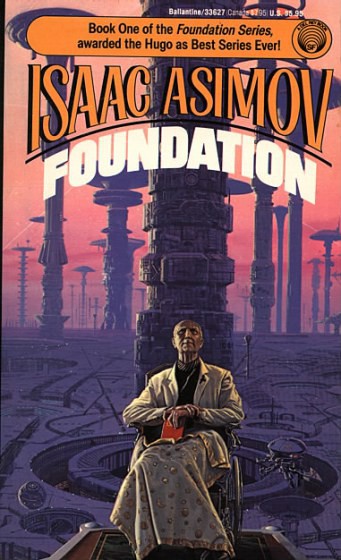
So, I went to the bookstore, asked the clerk “if I wanted to start reading science fiction, where would I start?” She smiled, and retrieved Foundation for me from the science fiction shelves. When she handed it to me, she said, “This book is aptly titled, because it’s basically the foundation for everything published in science fiction ever since.”

And she wasn’t wrong.

His name was Gaal Dornick and he was just a country who had never seen Trantor before. That is, not in real life. He had seen it many times on the hyper-video, and occasionally in tremendous three-dimensional newscasts covering an Imperial Coronation or the opening of a Galactic Council. Even though he had lived all his life on the world of Synnax, which circles a star at the edges of the Blue Drift, he was not cut off from civilization, you see. At that time, no place in the Galaxy was.

There were nearly twenty-five million inhabited planets in the Galaxy then, and not one but owed allegiance to the Empire whose seat was on Trantor. It was the last half-century in which that could be said.

To Gaal, this trip was the undoubted climax of his young, scholarly life. He had been in space before so that the trip, as a voyage and nothing more, meant little to him. To be sure, he had traveled previously only as far as Synnax’s only satellite in order to get the data on the mechanics of meteor driftage which he needed for his dissertation, but space-travel was all one whether one travelled half a million miles, or as many light years.

Having read almost all of the Foundation novels (I didn’t read the prequels that came later; ending with Foundation and Earth), I was very excited to see the Apple TV adaptation–while knowing it would be dramatically different (no doubt) from the books. But it was so different I thought it would be wise to go back and reread (or listen) to the original novel again. (It’s also been a very hot minute since I read them all, and I don’t remember everything I’ve read the way I used to…)

(Side note: I had actually read an Azimov novel in the 1970’s–Murder at the ABA–and still have my original paperback copy, purchased at the News Depot on Commercial Street in Emporia, Kansas. I’ve always wanted to revisit it–because it was very insider-y about the American Booksellers Association annual event–now Book Expo America and in decline–as well as about publishing itself, and I wanted to see how spot-on Azimov was with the book. I remember it fondly, and am also curious as to whether or not it still holds up as a mystery novel.)

There are differences; there are characters in the show that don’t exist in the book, there was no Thespin in the book (Anacreon does, however, play an important part in the book), there’s no Genetic Dynasty running the Empire (in fact, little to nothing in the book about the Empire once the Encyclopedists take off for Terminus), and of course, Azimov wrote about white men–the show is much more diverse as well as gender flips both Gaal and Salvor Hardin. If you’re an Azimov purist, you’ll probably dislike the show, I think; I enjoyed it even as I noticed the significant differences. But listening to the audiobook, I also realized that some of those changes were necessary–what worked in the book and was exceptionally clever probably wouldn’t translate well into a visual medium, but listening and getting refreshed in my memory of what the original work actually was made me appreciate the book all the more. I’d remembered it was incredibly smart and clever, particularly in how everything worked out to solve what came to be called “Seldon crises”–a situation where the Foundation was endangered, both from within and without, but the forces working against it eventually led to a point where only one possible action could be taken, and it was inevitably the right one; which meant they had to have an almost religious-like belief in Seldon and his mathematics (and how much did I love that math was the savior of the galaxy?) and trust that taking no action was the proper course of action. I also loved how the Foundation changed and adapted from its original mission (its true purpose was hidden from them to begin with, because foreknowledge would change things and alter outcomes), and how it even developed a religion around its technology to control inhabitants on other planets.

And, as that bookstore clerk all those years ago at the bookstore in Manchester Center Mall told me, the book–and Azimov, really–influenced every science fiction writer and novel that came in his wake. It truly was a foundational text for science fiction. And it’s also not difficult to see where his own influences came from–his Galactic Empire was very similar to the Roman Empire in decline, and the parallels to the decline of the American empire are almost impossible to miss.

I did enjoy the show–the production values are amazing, and it’s a great story as well, if it does get off to a bit of a slow start (but it picks up)–but I am even more glad that the show drove me to revisit the original novel again. It truly is a superb work.

Love Has No Pride

Well, that LSU game was something else. GEAUX TIGERS!

It’s also a little sad to see the end of the Orgeron era. LSU is the only top-tier college program to win three national championships this century with three different coaches (only Alabama has won more titles than LSU this century), and these past two seasons have been rough. But I always had a liking for Coach O, was happy to see him get the chance to be the head coach, and even happier–to say the least–to see that magnificent 2019 season. And who knows who the next coach will be, or what his tenure will be like? Ah, well. Never a dull moment as a football fan in the state of Louisiana.

I am feeling more rested and well on the way to recovery from my trip. I made some good progress yesterday on the to-do list, and since the Saints aren’t playing today (some could say they didn’t really play Thursday night, either) I have the entire day free to work on things and get caught up and perhaps–just perhaps–even go to the gym. I wound up having football games playing on television yesterday (some seriously great games yesterday, Rivalry Weekend) but the college season is effectively over. I’ll pay attention to the conference title games and to the bowls, of course–yet at the same time I won’t be personally vested in them and it won’t matter if I watch or not. Weekends thus have become free for me, which is a good thing as I have so much to do. This morning I am going to start working my way through the to-do some more, hope to spend some time writing this afternoon, and I want to start reading my next selection from the TBR pile–Donna Andrews’ The Gift of the Magpie. I still want to do some entries on the other books I read over the past week, and there’s still some straightening up to do around here as well. And of course, there’s always about a thousand emails I have to answer at some point. I am going to try to get the emails answered and prepared to be sent tomorrow morning–yay for draft folders–and as always, I have a shit ton of organizing and filing to do. I have some short stories I need to edit, and I have agreed to write another for an anthology that isn’t due until April or so; I know which story-in-progress I am going to use, but I also need to change it’s title, and last night I found the title–from the Edgar Allan Poe poem “Tamerlane”: “Solace in a Dying Hour.”

Great title, methinks.

No rest for a Gregalicious.

The weather looks a bit gray out there this morning, and we are getting ready to swing into what passes for winter in southeastern Louisiana. Yes, I know winter doesn’t officially start until December 21st or so, but that uncertain period down here where it can be 80 degrees one day and 40 the next is beginning. Sometimes the weather shift happens over the course of the day, which makes it even more fun, as you have no clue how to dress for the day. It can be bitterly cold when I leave for work in the morning, and then incredibly warm when I get off work and I’ll have to run the air in the car on the way home from the office. Yay? I also need to start getting my Christmas cards together–I am determined this year to actually mail them out, which also means getting my address book together (no small feat) and then deciding who gets one and who doesn’t. I’m sure there is some kind of etiquette involving Christmas cards that I don’t know, as always I have no clue how to behave in a socially appropriate and acceptable way, but I don’t care. I don’t keep track of who sends me cards and who doesn’t, just as I don’t pay attention to who wishes me happy birthday on social media and who doesn’t–doesn’t life deliver enough blows as is without having to resort to that sort of pettiness? I am also trying to be better about being petty about stuff, too–I’ll let you know how that goes, since petty is my default–and tracking that sort of thing seems a bit much even to me (although I will admit I have done so in the past), and why make yourself crazy or upset or be hurt by such things? There’s a touch of narcissism in that, really–other people really don’t give you that much thought or energy, which actually seems worse to me; when someone hurts your feelings the truth usually it’s usually more thoughtlessness than anything else–most people would never intentionally hurt anyone else’s feelings unless they are an absolute monster–but also trying to figure out other people’s motivations and/or reasons is a fool’s game because you will never really know one way or another and why waste the time, energy, or effort trying to figure it out?

And it’s Christmas season, which is the antithesis of pettiness. Christmas is about forgiving and peace and love and harmony–although humans always have this remarkable ability to forget the true meaning of the season. (Nothing says peace and love and harmony than claiming there’s a “war on Christmas,” for example) Sure, there’s a religious aspect to Christmas, but it’s far more outweighed by the secularization of the holiday, which gets more and more secularized with every passing year.

Heavy thoughts for a Sunday morning, really.

And Christmas is of course followed by Carnival here in New Orleans, and I guess we are having parades this coming year. I’m not entirely sure how I feel about that, but at least parade season is later in the year than usual–Fat Tuesday itself falls on March 1, I believe–and last year’s cancellation meant that Zulu and Rex and the truck parade didn’t roll on a day where the temperature was 20 degrees and the entire city was freezing; I can’t imagine there would have been hordes out there on the parade route in that kind of miserable weather…but then again, one never knows. People do like to catch beads.

I know I wouldn’t have walked out there, or if I did, stayed long. As it was, we had no heat in the Lost Apartment that fateful freezing Mardi Gras day, and I was huddled under layers of clothing and piles of blankets with a space heater blasting hot air at me…and was still cold.

Sigh. And on that note, I am off to the spice mines for the day. Have a lovely day, Constant Reader, and may all your dreams come true.

All I Want for Christmas

I love prolific writers, but keeping up with their canon when you have very little time to spare on actually reading for pleasure can be difficult. I somehow managed to fall years behind on one of my favorite series–the Meg Langslow mysteries by Donna Andrews–right around the time she started producing two books per year (a regular mystery and one centered on Christmas–hello, Hallmark? This series is perfect for you), which made it even harder to catch up. I did manage to read two this past week (well, I listened to one in the car on the way home, which made the drive a delightful experience), and yes, both were marvelous as always.

“Hoo! Woo-hoo HOO!…HOO! Woo-hoo HOO!”

The gray-haired couple standing at the tinsel-decked front desk of the Caerphilly Inn started slightly, and glanced over their shoulders in the direction of the hooting.

“That’s just the ornithologists again, Mr. Ackley.” Sami, the desk clerk, had probably been hired for his soothing voice. “Having their conference here, you know. Owl Fest.”

“They haven’t brought in live owls, have they?” Mrs. Ackley’s face was anxious. “Surely the hotel wouldn’t allow them to do that.”

“Jane’s terrified of birds.” The man put a protective arm around his wife’s shoulder.

“Of course not!” Sami managed to look shocked at the mere suggestion. “That would be completely against the Caerphilly Inn’s policies.”

Which is why we’d been confiscating all the live owls various ornithologists kept bringing into the conference, and taking them a few miles down the road to temporary headquarters at the Caerphilly Zoo. The owls, that is, not the ornithologists–although I’d been tempted. Two screech owls, a barn owl, and a northern saw-whet owl so far.

Christmas is hard to write about, really. My favorite quote from All About Eve isn’t nearly as famous as the ones everyone quotes regularly–“I detest cheap sentiment”–and I’ve tried to keep that quote in the forefront of my mind when I am writing. That isn’t to say that cheap sentiment doesn’t have its place in entertainment; there’s comfort to be found in works that can sometimes be cloyingly sentimental. For me, I define cheap sentiment as unearned; not coming from the honest emotions of the characters based on circumstance and situations and interactions, but rather from homilies: blood is thicker than water, family above all else, etc. I’ve always wanted to write about Christmas, but it’s a minefield when it comes to sentiment. I myself have written short stories about/around Christmas, but they seemed trite, cloying, and cheaply sentimental, with “all’s well that ends well” ending because, well, it’s Christmas. Everything is supposed to work out in the end because it’s Christmas, right? Clarence gets his wings, bullied Rudolph becomes a hero, etc. etc. I tried to avoid that with my own entry into Christmas crime writing, Royal Street Reveillon, and am not entirely certain I succeeded. Yes, the guilty were punished, but like Die Hard, it wouldn’t have to be the holiday season for the story to work. (This is why I fall on the side of “Die Hard is not a Christmas movie” because Christmas wasn’t integral to the story; it could have been Thanksgiving or the middle of the summer and still worked.)

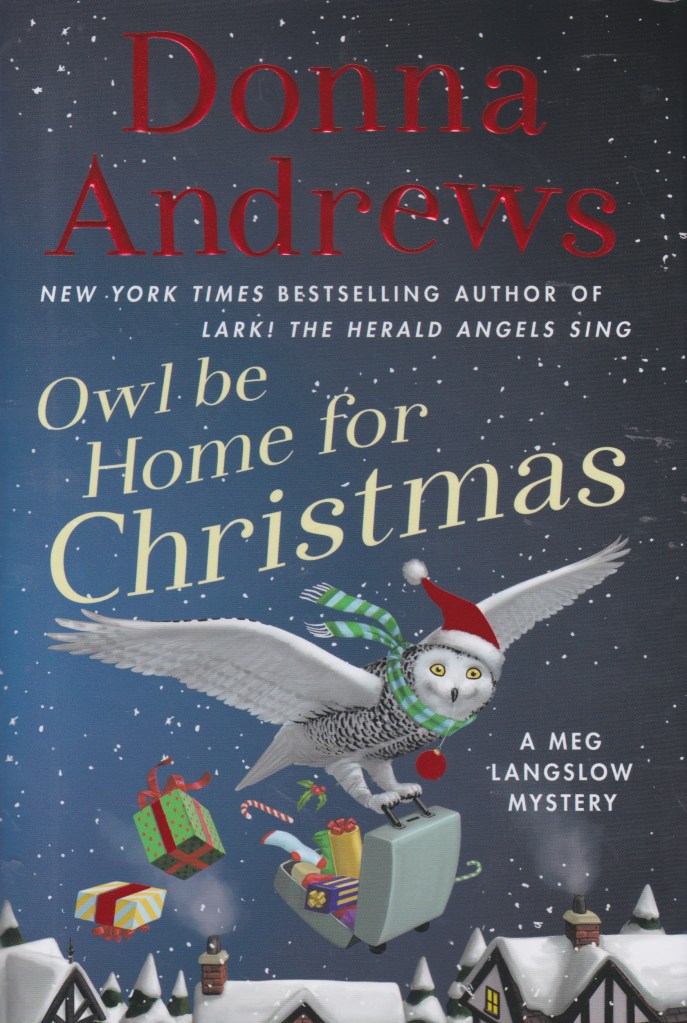
And yet, Donna Andrews manages to write a new Christmas murder mystery that leaves you feeling contented, satisfied, and enormously happy when you close the book after reading the last line–and Owl Be Home from Christmas is yet another gold standard work from the master.

The premise of this one is that Meg’s grandfather, wildlife expert and activist Dr. Blake, is hosting OwlFest at the Caerphilly Inn, and of course, his assistant Nigel is off for the holidays to visit family so the onerous task of keeping the conference running smoothly, and solving problems, falls to Meg, who has moved herself, husband Michael, and their twins (Josh and Jamie*) to one of the guest cottages on the property. Christmas is looming on the horizon, and a polar vortex has descended on Virginia from Canada, creating a blizzard that has everyone trapped at the Inn. In fact, the storm has cancelled flights up and down the eastern seaboard, and Caerphilly is woefully unprepared for a storm of this magnitude, with the city’s two snowplows stranded in snowbanks. Meg, as always, makes the best of every situation, and with the help of the impressively efficient Inn manager, Ekaterina, tries to make the situation of being stranded at the Inn as comfortable and fun for the conference attendees as possible.

Naturally, there are some difficult attendees who Meg would love to righteously smite–and certainly deserve said smiting–and when the obnoxious and well-hated villain of the book, Dr. Frogmore, drops dead at the conference banquet, there’s a plethora of suspects…and with the Inn cut off from civilization by the blizzard, obviously the killer is someone on site.

Meg and her intrepid family and friends now have to find the killer–while still keeping the conference running smoothly and continuing with plans to keep the stranded guests entertained and happy; making the best of a bad situation, which Meg is fantastic at doing.

I loved this book. Andrews has somehow managed to keep a series running for over thirty books without dropping a stitch. While other series tend to run dry (my own Chanse series, for example, and I regularly worry about Scotty doing the same), somehow she manages to keep her enormous supporting cast involved and memorable (I deeply appreciate the three-dimensional lives of the supporting cast, and she is expert at deciding which ones to highlight in each book; Rose Noire is becoming a favorite), and I don’t think there’s a single book in this series where I’ve not laughed out loud multiple times while reading. Caerphilly is a charming place, and every time I go back to visit–even if the cast isn’t in Caerphilly in the book–I always am a bit melancholy when I finish and have to face the real world again.

And she has managed to write all these Christmas books with heart, compassion, and love–and isn’t that what Christmas is really all about?

Masterful. Andrews is a gift the crime fiction community should cherish.

*More Josh and Jamie, please.

Long Way Around

Home.

And exhausted.

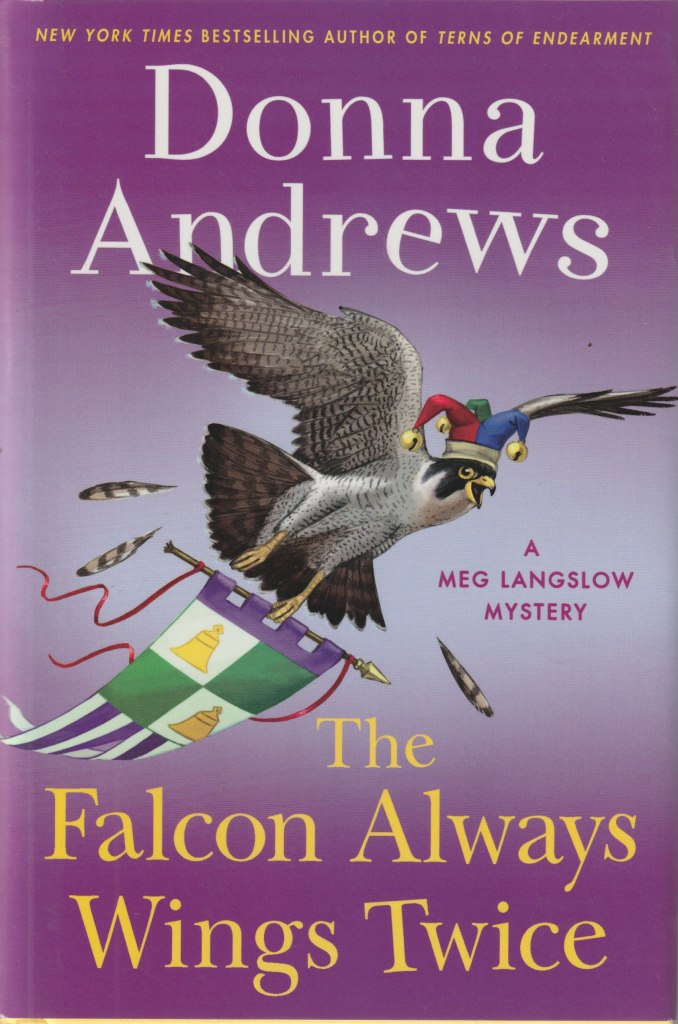
I drove up to Kentucky on Monday; it took me twelve hours to get there. I drove back yesterday; it took eleven hours to get home. I may have been doing 80 most of the way home–hey, the speed limit is 70 and the rule was always ten miles over the limit was cool (except for speed traps)–but every once in a while I would look down and see the needle creeping closer to ninety and would chill out for a while. I listed to Isaac Azimov’s Foundation on the way up, and Donna Andrews’ The Falcon Always Wings Twice on the way home (I had to sit in the car for another few minutes when I pulled up to the house to finish listening to Falcon, which was a delight as are all Donna Andrews novels). I wish I’d know about the magic that is audiobooks before; what a lovely way to while away lengthy drives. I am now almost caught up on the Meg Langslow series; I think there are three more to go. I also managed to read some others this week as well–more on those later–and it was a bit of a whirlwind of a trip. My father and I did some sight-seeing–Civil War battlefields, mostly, as everything else we tried was closed–and I had never known much about Kentucky in the Civil War period, other than the commonwealth didn’t secede despite being a slave state (we learn very little about the Civil War in school, really–mostly Lee and Grant and Virginia, very little about anything else, maybe Sherman’s march to the sea if your teacher was a bit more thorough) and the Kentucky battlefields we visited–Perryville and Richmond–were interesting. My father also told me some more family history; there are relatives who are researching the family history, tracing the family line back to Revolutionary times. I have ancestors who fought in the Revolution, and I am descended from a signer of the Declaration of Independence; Richard Stockton of New Jersey’s daughter married a Herren, and I am descended directly from them. That was interesting to find out–but I imagine if most of us trace our lineage back pretty far we’d find interesting ancestors. (My father made copies of all the records for me; there’s also an ancestor’s will in which he divided up the enslaved people he “owned” amongst his wife and children; which is not a point of pride for me. He enslaved eleven people, per the will, considered “property” to be divided up in his will…he also told me some of the Civil War history of the part of Alabama where we come from; my uncle’s wife had an ancestor who fought on the Union side. There were Unionists and the Alabama Home Guard who fought and committed atrocities against each other–my uncle’s wife’s ancestor had leave from the Union army and come home to visit his wife and children. The Home Guard captured him and skinned him alive…apparently his screams could be heard echoing through the hills. I apparently didn’t go far enough in Bury Me in Shadows…)

But…material for another book, I suppose; and therefore the history of my fictional county (the history of this county is written in blood) can be much more violent and bloody than I originally imagined; which means more secrets, more mysteries, and more spirits trapped on this plane and unable to move on.

There’s also an extremely rare book, long out of print, fiction based in that divided, divisive history, that I am going to try to see if I can get a copy of–I did find it on-line at the University of Alabama Library (eight other libraries, all universities in Alabama have copies); not entirely sure how I would get to borrow it from them, or if I would have to go to Tuscaloosa and read it there. But now that I know about it, I am dying to get my hands on it–I’ve searched for it on-line from used booksellers and eBay and so forth, to no avail.

It was a nice trip, overall. I slept decently every night–the last night was my best night of sleep, which was a good thing because the drive yesterday (it’s eleven hours or so in the car in both directions) is exhausting. The South is so incredibly beautiful–oh, those Smoky Mountains in Tennessee!–and I know people who’ve never been will find this hard to believe, but Birmingham and north Alabama is also breathtakingly beautiful. Those mountains. I do love the mountains, but I don’t think I could ever live in a mountainous area because of that cold weather/snow thing.

And of course now I am very behind on everything. I tried to keep up with deleting junk/sales emails with my phone while I was gone–hundreds per day, thank you Black Friday capitalism–and yet the inbox is still incredibly full with ones I have to answer. The Lost Apartment is a mess, I have errands to run and a grocery list to prepare, bills to pay and a checkbook to balance, filing and cleaning and organizing and of course, writing–I wrote absolutely nothing while I was away, and I have a tight deadline hanging over my head–and a massive to-do list I need to prepare. There’s a lot going on in my life right now, personally and professionally, and I really need to make sure that it’s incredibly thorough, else things will get missed and things will not get covered and that inevitably leads to stress and disaster.

But…my own bed felt lovely last night. I don’t think I slept all that well last night–but I feel a little tired and drained this morning, but I think that’s also due to being exhausted from the drive and feeling disconnected from my own life again. Getting everything together and figuring out everything I need to get done will be an enormous help in that regard. I simply cannot spend today watching college football–it will be okay to have it on in the background, but I can’t sit in my chair all day and waste another day. Fortunately this is the last day of regular season games–conference championship games coming next weekend, with the play-offs later in December, but LSU isn’t really involved in anything after today so I can pretty much follow as a slightly disinterested fan of college football and not care about who wins or who loses or who does what.

And on that note, I am going to start doing some filing and organizing. I gave some blog entries about books I’ve read to do, and I will be here every morning from now on, Constant Reader….and I am also looking forward to the second half of the reboot of Gossip Girl, which dropped on HBO MAX while I was gone. Huzzah!

Have a great day, Constant Reader, and I hope your holiday was lovely.