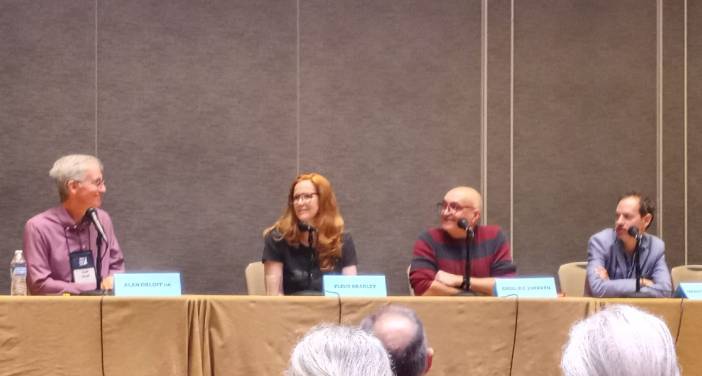
Years ago, there were things you’d never write about in books for teens and pre-teens. Now, though, many more topics are fair game. BUT are there some things you’d never write about? Because of your own feelings, or because you don’t think your audience is ready for it?
On the panel I said I’d never write about cannibalism, but of course ever since then I can’t stop thinking about cannibalism–and that’s entirely on me. I can’t even imagine writing about that.
I’m not going to say there’s anything I won’t write about because I don’t want to limit myself. If I can think of some way to write about something that isn’t pandering or exploitative or offensive, I will. I was recently reading some of my short stories because I am pulling together another collection and one of the stories–I was like, oh yeah, you can’t publish this without a major revision.
I don’t think I would ever write from the perspective of a person of color or a trans-identified individual because while I know I have a very vivid imagination and am capable of empathy, I am also a sixty-two year white cisgender male. I think I could probably do it, with help from a sensitivity reader and my editor, sure; but we need more trans writers and writers of color, not another old white man writing from their perspective. I will include those characters in my work, but not as point of view characters, because we need to make room for those with the lived experience to write those stories. I may not live long enough to see it, but hopefully in about thirty years we’ll have reached the point where exclusion of non-white non-straight non-cisgender writers will no longer be an issue, and what a wonderful world tht will be.
No offense, but none of you is in your target demographic any longer. What challenges does that present and how do you overcome them? How do you ensure that the language your characters speak is reflective of how teens and pre-teens speak today?
How very dare you! I am still a sprightly young man of…um, sixty-two. Point taken. I try to avoid slang and current language because it becomes dated very quickly; akin to how, when I was a child, I saw books and movies and television shows that tried to appeal to the youth market by trying to use current slang and it never turned out well. I mean, once The Brady Bunch kids are saying “groovy” excitedly every other sentence…it kind of killed the word and I never heard it in real life ever again. The time between when a book is written and when it’s released is long enough for current kids’ language to change. My sister’s grandkids are always saying things I don’t understand…but the next year they are speaking a different language, so I don’t try. It’s hard enough keeping up with technology, which also gets dated very rapidly.
What percentage of your readers do you think are adults? Do you consider these crossover readers when writing?
I honestly don’t know, but I wouldn’t be surprised if mine were primarily adults. I don’t set out to write books for kids, really; I write novels where the characters are teenagers. They get marketed as young adult books, which is something I have no control over. I’d like to think both adults and younger readers can enjoy my books that are so classified. If I think about the audience I am writing for when I am writing, it makes the writing more stressful and harder. I trust my editor to make sure I don’t write anything offensive or way off-base or too adult for a young adult audience–which is where my books would be shelved in the library. No one’s complained about mine yet.
Greg, your book tackles multiple contemporary societal problems. How do you balance writing about such tough topics with ensuring that your work is compelling and hits the right mystery/suspense notes?
The objective, for me, when writing about societal problems and issues is to put a human face on them, by making it personal. Societal problems are easily dismissed or ignored when they are simply abstract principles. If my characters are fully rounded, are relatable and seem real to the reader, then the reader will see, through the characters, what it is like to experience and go through these issues; and to develop a sense of empathy, so we aren’t so quick to judge and blame and not try to understand. #shedeservedit was very important to me, because with the Steubenville/St. Marysville rape cases, it made me look back over the course of my own life and remember situations I witnessed or heard about in a completely different light. For example, one of the cheerleaders at a nearby town had an experience similar to what the girls in Steubenville and St. Marysville went through…but in the 1970s, the blame solely went on the girl. When I heard the story she was a willing participant–the story was told to me in hushed whispers by another girl–and all the elements of the modern stories were there: pretty and popular cheerleader; a party with alcohol and football players; the town football team was successful and beloved in the town; and a bitter ex-boyfriend. As the story was told to me, she got drunk and “pulled a train” (a disgusting phrase, really) with five of the football players, including her ex. I was shocked at the time– to think she’d done this willingly, at a party where it was bound to get around (as it obviously did). But now, looking back–how willing was she, really? But that was how things were back then. I’d like to think things are changing, that we are valuing young girls and women as human beings more now…but are we?
Technology changes very rapidly, and teens—and younger children—are often at the forefront of these changes. How do you handle that in your writing?
Like slang, I try to use as little of it as possible. I do realize everyone is addicted to their phones now, and spend most of their lives texting and facetiming and everything else, but while I will use some basic technology–texting, emails, DM’s–I try not to get into the entire app/social media weeds too much because it may change before the book is published and I don’t want to publish a book that’s already dated. I think that if the reader really cares about your characters and the story…they won’t care so much about the slang and tech.
How has your writing evolved since you first got published? If a reader is new to your work, which book would you recommend starting with?
I’d like to think I am a better writer than I was back then. I know I’m a different writer than I was when I started; more life experience, with the concomitant increased empathy, understanding, and sympathy that comes with it. I try to push myself with every new work; it’s the challenge of doing something new and different I really enjoy.
If we’re talking my y/a, I’d started with the first, Sleeping Angel, and go from there. If we’re talking my career in general, I’d say Bourbon Street Blues or Murder in the Rue Dauphine. It’s always good to start at the beginning. If the length of both series is daunting, try either A Streetcar Named Murder or Death Drop (drops October 31!) and then move into the stand alones.
There are a small number of popular writers who spark controversy in their “real” lives. How do you reconcile a great writer with a bad person? Do you read that writer’s work?
Ah, the old “artist vs their work” question. There are writers with enormous talent whose books I’ve loved that social media has exposed as incredibly horrific people with “values” (I have a hard time using that word in reference to such abhorrent beliefs) and I have stopped reading them. I will never have time to read all the books I want to read, and if I’m able to prune my stack by removing racists and homophobes and misogynists and transphobes? Thank you for making my choices easier. I’ve always believed one should be widely read–I used to read nonfiction books about politics and social issues by conservatives because I thought it was important to listen to and evaluate their positions. After we were lied to as a government and a nation to drive popular support for a war we didn’t need to be fighting in order to drive more profits for military suppliers and oil corporations, I no longer needed those perspectives. I don’t need to read excuses and rationalizations for bigotry and prejudice and other indefensible positions for any human being to hold.
The vast majority of my one-star reviews on-line are from conservatives deeply offended by the “politics” of my books. Yes, because a book about gay men by a gay male author is where you should go to get your bigoted world-view validated. If you want that, read Andrew Sullivan. His nonfiction diatribes about social and political issues is some of the best fantasy being published currently.
Who are some of your biggest writing influences?
God, there are so many. I think my y/a is very strongly influenced by Lois Duncan, Christopher Pike, R. L. Stine, Caroline Cooney, and a long forgotten y/a crime writer named Jay Bennett. He won two Edgars for Juvenile, and was nominated a third time. His work is extraordinary; I’ve not read many other writers with that same extremely tight, terse, and taut style. Jay’s books put teenagers in terrible situations where they had to decide what is right and wrong and what to do. They read very quickly, too. I describe him as the y/a James Cain.
As for adults, everyone I read is an influence; even the books or writing styles I don’t care for, because they make me think how would I have done that differently? But definitely John D. Macdonald, James M. Cain, Charlotte Armstrong, Daphne du Maurier, Phyllis A. Whitney, and the old Alfred Hitchcock Presents anthologies, which I am revisiting. The old Three Investigators and Encyclopedia Brown series for kids, too.
Latest trends in Middle Grade and YA fiction?
Diversity, which is fantastic, and hot social issues!
 Queer and Loathing in America