…Ready for It?

Sunday of the holiday weekend and I am feeling pretty good. I am up earlier than I would prefe, but it seems sleeping in later than six is something rare for me now and it’s okay; it gives me more awake time to get things done. I’m getting some reading done every morning when I get up, and yesterday I did do some chores, but tried to mostly relax while processing Victoria’s death. I also read a little bit, and mostly just tried to relax and gather my strength back. I have to run an errand today–a library book is ready for me, and I can swing by Fresh Market on the way home; oh, never mind, the library is closed for the holiday so that will have to wait until Tuesday after work, but I do need to go to Fresh Market anyway, maybe even wash the car while I’m on Louisiana Avenue. But I did get the bathroom and part of the kitchen under control and finished; so the downstairs looks a lot nice than it has since I fell ill, which is a lovely thing. I can finish it today and then work on the living room next, and maybe, just maybe, my house will finally be under control again and presentable and won’t make me groan with despair every time I walk in.

I also watched one of the few Hitchcock films I’ve never seen–mainly because it’s never been available before when I thought about watching: Suspicion, which stars Joan Fontaine (the only performer to win an Oscar for a Hitchcock movie, although she should have won for Rebecca and Anthony Perkins’ failure to be even be nominated for Psycho remains a hate crime) and Cary Grant. It’s based on the Francis Iles novel Before the Fact (of which I have a copy and have been assured it’s better than the film). It did make me think about a theory I have about domestic suspense and Gothics–that they are about women’s fears and therefore women’s noir of a type–and Suspicion is definitely one of those–does her husband–whom she catches in lies all the time and is kind of a bounder–love her or did her marry her for her money? (This is a very common theme in Victoria Holt novels, by the way, which I loved.) Something to write about for another time, methinks. The film itself was okay, and I am now more convinced than ever that Fontaine’s Oscar was a make-up for Rebecca, a far superior film in every way. (It may be time for my annual reread of Rebecca, in fact.)

I also read a bit more into Moonraker, which is fascinating in its casual misogyny, and it’s really hard-boiled attitude; as I said, Fleming’s Bond is so far removed from the Roger Moore/Timothy Dalton/Pierce Brosnan Bond that they may as well be different characters; Connery and Daniel Craig more captured the Fleming feel of the sociopathic killer/spy. The parallels between the villain in the book, Hugo Drax, and Elon Musk are so prescient as to make me wonder whether Fleming could see the future. More on that later, of course.

We finished watching Overcompensating last night, and it’s such a good show. It does an excellent job of depicting how terrifying it is to come out–to anyone and everyone–and how you wind up being a liar for self-preservation; I think all those lies is why I am so triggered by people calling me a liar these days, and I’ve never really seen this depicted in anything queer before–about how you can’t really be a good friend with people you can’t be honest with and have to lie to all the time. It really can’t be explained, but I still have a lot of shame from that time in my life, from when I was overcompensating and making an absolute fool of myself because no one was actually fooled and my true friends were delighted when I came out. The depression and faulty wiring in my brain certainly didn’t help.

And yes, I will always be grateful to those friends who were delighted.

I’m looking forward to relaxing some more today, to be honest. Paul has his trainer this afternoon, and when he gets home I am going to barbecue burgers and cheese dogs. Yes, I know you’re supposed to actually cook out on Memorial Day itself, but I’d rather do it today. I’ve been experiencing hunger a lot more lately than I can recall, and I am snacking on top of it all. I’ve been spending a lot of time looking at Door Dash to have something delivered, and I’ll probably pop that cherry next weekend. I’ve also been missing my mom’s cooking–her chicken and dumplings were sublime, and she made everything from scratch and from memory; her biscuits and gravy were to die for, and somehow she made the best pancakes I’ve ever had anywhere. I am going to make an easy chicken-and-dumplings recipe tomorrow; will definitely report back.

I am getting stronger every day, but I also still tire far too easily and am not even close to being back to 100% yet, which is fine. I just need to be patient–never my strongest suit–and let my body heal itself from the trauma.

And on that note, I am heading into the spice mines. Have a lovely Sunday, Constant Reader, and I may be back later; I hope to get my newsletter done today as well.
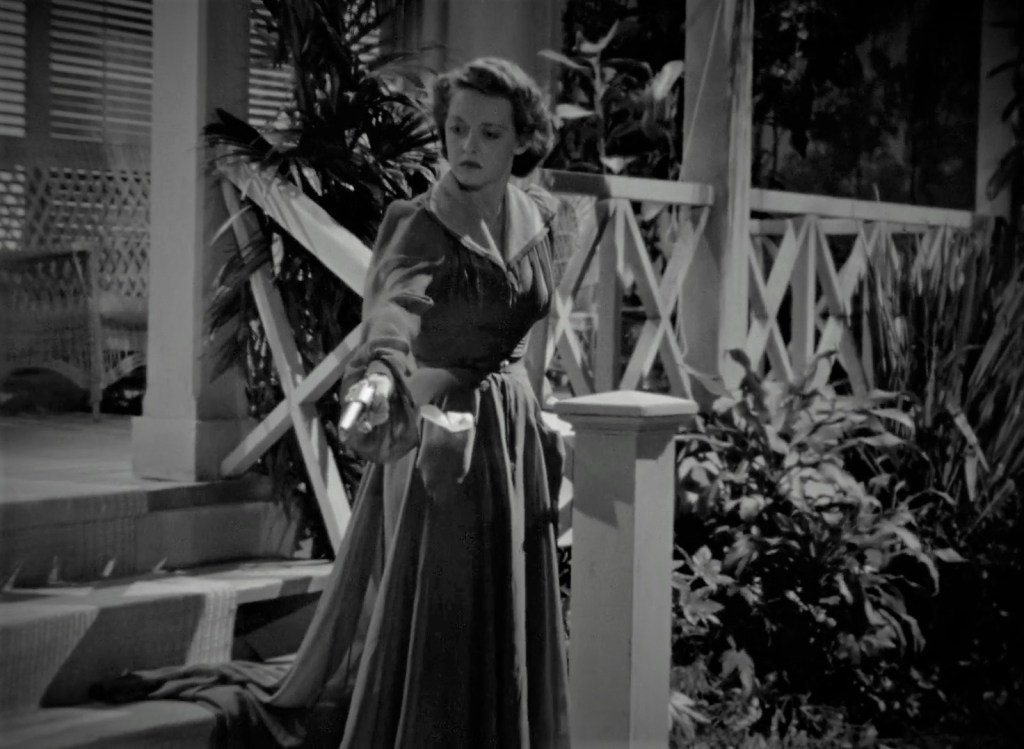
Bette Davis in the opening scene of her Oscar nominated performance in The Letter.

Somebody’s Watching Me

A month or so ago, Ira Levin’s A Kiss Before Dying was one of those “special deals for ebooks,” and I can never pass up a classic for a mere $1.99 (I generally replace my hard copy books with ebooks when they are on sale, so I can donate the real book; but Ira Levin novels will never be donated), which put me in mind of him again (the book is a crime fiction classic), and I started thinking about what is the best part of two of my favorites by him, Rosemary’s Baby and The Stepford Wives, which is the slow build of paranoia until the heroines are completely convinced that everyone is in on it and there’s no one she can trust. This is what I consider “women’s noir,” which is books that depict and explore women’s fears (which is why Gothics were so popular, I think; the wife can never trust the husband and always thinks he is trying to kill her–before the real culprit is exposed and they have their happily ever after. This, to me, mimics what it’s like for a woman when she gets married in real life; she wants to believe in her marriage and love, but how many times has that turned to ashes and dust in reality? Husbands kill wives or cheat on them or leave them; all these marriage fears were tentpoles of Gothics). I was going to revisit both novels–I had some other things I wanted to talk about with The Stepford Wives, and its similarities to Rosemary’s Baby, but I couldn’t find my copy of the latter so went with the former.

Since 2015, the term “gaslighting” has come back into vogue, with small wonder. Gaslighting can make you question your own judgment and your grasp on reality1; something many of us have experienced over the past nearly ten years and it isn’t an enjoyable experience.

Paranoia, combined with not being believed, makes for a fantastic novel that is very difficult to pull off; I can think of any number of films and books that use paranoia as a driving theme for their plots, and I always enjoy them. There really is nothing more frustrating than being being not believed about something that’s happened–or is happening–to you. It can make you crazy, make you question yourself and your own grasp of reality. It’s horrible and cruel in reality, and it’s something everyone can relate to because we have all not been believed at some point in our lives. It’s happened to me enough times (including losing jobs) that it certainly resonates with me. (I have an idea for a gaslighting/paranoia short story that I’ve been wanting to write for some time now.)

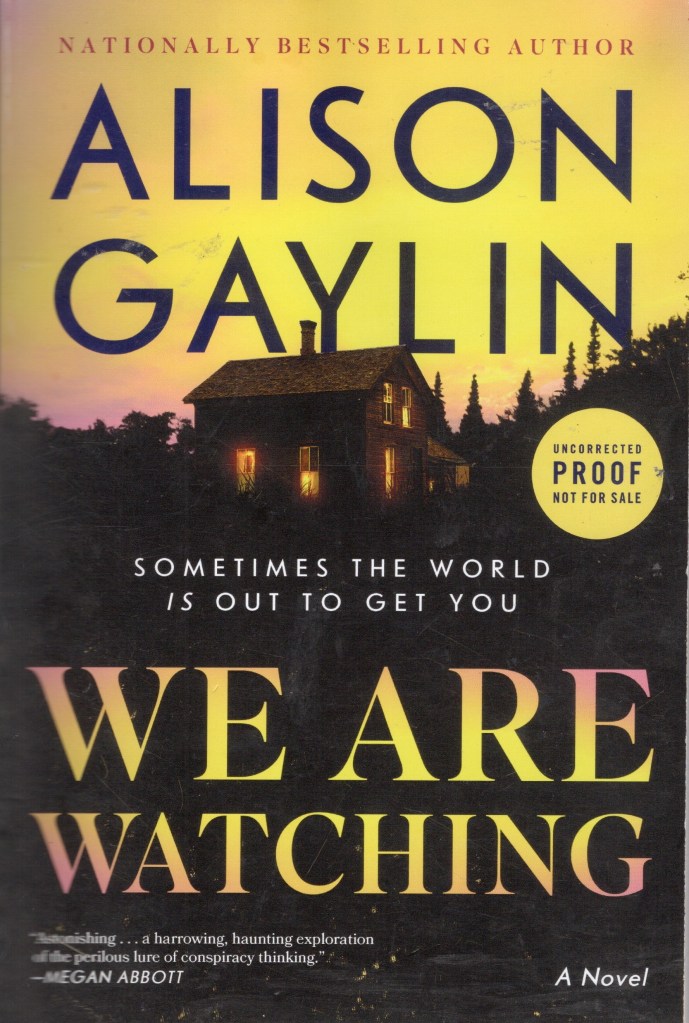
So, needless to say, I greatly enjoyed reading my advance copy of Alison Gaylin’s upcoming January release, We Are Watching.

It’s been the longest day of Meg Russo’s life, and it isn’t even half over. Her stomach gnaws at her, her hands heavy on the steering wheel. But when she glances at the clock on the dashboard, she sees that it’s a little shy of 11:30 a.m., which means that Meg, her husband, Justin, and their daugheter, Lily, have only been on the road for an hour. They’ve got at least three more hours on the thruway, and then they’ll have to contend with the series of veinlike country roads Meg and Justin haven’t traversed since their own college days. If they don’t hit too much traffic, they should be in Ithaca by five, which now feels like some point in a future so distant, Meg is incapable of envisioning it.

Time is strange that, the past eighteen years zooming by in an instant, all of it leading up to a single day that’s already lasted eons. Meg blames the stress of last night, wanting everything to be perfect for their daughter’s send-off, which led to thoughts of Lily’s first visit home for Thanksgiving break, which in turn made Meg think for the millionth time about how cold their house gets in the fall, and how Lily always complains about it. New windows, Meg had thought, lying in bed with her eyes open, envisioning insulated windows to replace those paper-thin sheets of glass, the same windows that were here when she and Justin bought the place twenty years ago–and it was a fixer-upper then. What if Lily came home to new windows? Meg mused, still awake in the wee hours of the morning. Will she have changed by then? Will she have grown too sophisticated to get excited over a warmer house? And so on, until the sky was pink and it was time to wake up and Meg had barely slept at all.

I’ve enjoyed Alison Gaylin’s work since I first read And She Was back in 2012, and have been a fan ever since, gobbling up each new book as she releases them. She has always been a terrific novelist, but what has been amazing to watch is how she pushes herself to do better with each book, tackling bigger themes and creating believable, relatable characters you can’t help but want to root for. We Are Watching may be her best yet, starting as a slow burn but building into an adrenaline boosting rollercoaster of a thriller.

The book opens with Meg and Justin taking their daughter Lily off to college, with all the emotions and fears and sense of loss that comes with a child leaving home and starting to move into their adulthood. Meg is likable, and so is her family. But as they drive a carload of skinheads pulls up alongside of them and start taking pictures. Meg reacts very strongly–so strongly that even I was like take a chill pill, girl!–which eventually leads to a crash that kills Justin, leaving the two women shattered shells of their previous selves. Lily decides to take time off from college and even Meg becomes housebound, despite needing to run her book store in the small Hudson Valley town they live in.

But things slowly begin closing in on both Meg and Lily; who were those skinheads in the other car? Why are truly strange, cult-like people showing up in the store or in town, chanting weird things at them? As Meg’s paranoia and fear grows, it soon becomes apparent that a religious cult is targeting her and her family, but why? But to find the truth, Meg has to not only survive the cult, which seems determined to kill her and her child, but when she has the time, to dig back into her own past to discover the truth–because the truth is the only thing that can set them free.

This book is fantastic, and I couldn’t put it down. It has all the hallmarks of a great Gaylin novel–a compelling and relatable main character doing the best she can in a terrible situation; a twisty plot full of surprises; and the kind of strong writing that makes her sentences and paragraphs sing.

Preorder it now and thank me in January when you finish reading it.

  1. The film this term comes from, Gaslight, is a great movie and Ingrid Bergman is terrific as the wife who isn’t sure if she is losing her mind; she deserved her Oscar and the film still holds up–and a very young Angela Lansbury makes her screen debut in it. ↩︎

If Anyone Falls

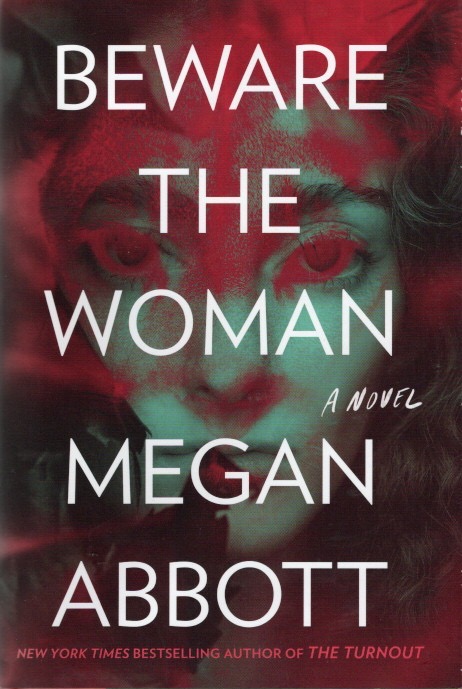
I finished reading the new Megan Abbott novel, Beware the Woman, this morning during a marvelous, raging thunderstorm that filled the gutters and streets of New Orleans with dirty swirling water, cutting the temperature to something bearable for once this summer and cooling the interior of my apartment to the point I needed to put on a sweatshirt and a knit cap on my head. Curled under a blanket with a good book while a thunderstorm rages with a warm cup of coffee on the side table, tendrils of steam rising in curly-cues of white from the creamer-lightened pool of soft brown, is perhaps my happiest of places.

Hell, reading anything new by Megan Abbott is my happiest of places.

My first Megan Abbott novel was Bury Me Deep, which stunned me with its craftsmanship, its voice, its literate choices of words and sentences structures that are short yet lyrical, minimalist strokes painting a broad canvas of human frailty and contradiction, crime and desire that comes from a primal place within, almost inexplicable and unexplainable yet so easily understandable and recognizable. I went on from there to Dare Me and the rest of her all-too-short canon; admiring, loving, respecting and enjoying each book with its magical spell woven by a true master of the literary form, astonishing in its humanity and an exploration of what lengths her characters will go to in order to get the thing (or things) they want, need, desire and hunger for.

Some of the earlier reviews I saw for Beware the Woman painted some parallels between the book and what is perhaps my favorite novel of all time, Rebecca by Daphne du Maurier…which had me intrigued and interested even more than usual.

But more on that later.

“We should go back,” he said suddenly, shaking me out of sleep.

“What?” I whispered, huddled under the thin bedspread at the motor inn, the air conditioner stuck on HI. “What did you say?”

“We should turn around and go back.”

“Go back?” I was trying to see his face in the narrow band of light through the stiff crackling curtains, the gap between every motel curtain ever. “We’re only a few hours away.”

“We should go back and just explain it wasn’t a good time. Not with the baby coming.”

His voice was funny, strained from the AC, the detergent haze of the room.

I propped myself up on my elbows, shaking off the bleary weirdness.

We’d driven all day. In my head, in my chest, we were still driving, the road buzzing beneath us, my feet shaking, cramped, over the gas.

Our main character here is Jacy Ashe, a pregnant wife in her early thirties, married to a neon sign artist, Jed, and working as an elementary school teacher. They are en route when the story opens to the remote upper peninsula of Michigan (primarily known to me from Steve Hamilton’s novels) to visit Jed’s retired doctor father, who lives up there in what used to be the family summer place, with his housekeeper, Mrs. Brandt. This is one of the classic set-ups of one of my favorite subgenres of crime fiction–the Gothic–as well as placing it strongly into another category I love, domestic suspense. This novel has echoes of du Maurier, Phyllis A. Whitney, Dorothy B. Hughes, and Margaret Millar…blended seamlessly together into a classic yet modern novel that updates and reinvigorates both subgenres, bringing them into the modern era and proving they are still just as relevant and important as they have ever been.

(Aside: I do not know where Abbott came up with the name “Jacy,” but it’s one I’ve always liked and wanted to use in my own work since first reading Larry McMurtry’s The Last Picture Show and seeing the Bogdonovich film based on it; I smiled and wondered if that was where Abbott got the unusual name from.)

The Gothic set-up is there, and I can also see the slight echoes from Rebecca: the brooding remote house in the country where tragedy has occurred in the past; the mysterious housekeeper who doesn’t seem to like our heroine very much; the slow-burn of slow revelations of secrets from the past; and the creeping paranoia and potential gaslighting of Jacy…often explained away as her pregnancy hormones or a reaction to the medications after she has a pregnancy complication. One of the strengths of Gothics, for me, is that question of paranoia vs. reality; the gaslighting that is always a hallmark of a Gothic novel. After all, what reason could either Jacy’s father-in-law or husband have for wanting to drive her mad and risking her baby’s health and well-being? She feels her husband slipping away from her and no one seems to believe her…this is probably one of the best depictions of a paranoid pregnant woman in literature since at least Rosemary’s Baby.

Someone once said the Gothic and domestic suspense novels were “women’s noir,” because the danger to them always arose from them being women and doing women’s things; a reaction to the terror of getting married and placing (until very recently) all of your agency into the hands of your husband–and what if you chose poorly?

Abbott takes the best elements of noir and combines them with the foundations of domestic suspense and Gothic to explore what it is like to be a woman, how it is to be a woman, and the trap of societal and cultural expectations for women.

And there’s a reason why the cops always look at the husband first when a woman is killed.

This is a brilliant novel, with many layers to unpack and unravel through its deceptively simple voice and brevity of language. Megan Abbott is a sorceress, a Scheherazade of crime fiction to whom you simply cannot stop listening. Read it, cherish it, love it.

Stay

We did finish watching Castle Rock last week. I’m not really sure what to think of it, but I probably should watch the finale one more time just to be sure. I was playing with my phone–getting text messages–and I may have missed something key.

Either that, or the finale simply made no sense.

Which is, I suppose, a possibility.

I did write yesterday, not nearly as much as I wanted to or would have liked to, but despite all of my best efforts the words simply weren’t coming as quickly or as easily as I would like. I can remember, years ago, putting Madonna or Stevie Nicks or Fleetwood Mac CD’s in the stereo and hitting shuffle, sitting down at the computer and then several hours and thousands of words later realizing there was no music playing anymore and the afternoon was gone. Now, I feel like I am always scrabbling to get some work done between interruptions and distractions. It’s okay–the work is getting done, if at a slower pace than I would prefer–but I do miss those blissful afternoons writing away like a madman.

I’ve been mulling over my y/a about rape culture. As I said yesterday, I had thought (oh, innocence) that in the years that had passed since Steubenville that it wasn’t timely anymore. Yeah, that. It is amazing that at age fifty-seven I can still be so fucking naive about the world in which I live. I read a terrific essay the other day on Vox about how one of the greatest teen rom-coms of the 1980’s, Sixteen Candles, is actually deeply problematic (I’d already recognized its racism years ago), which also sent me into a deep think about other movies aimed at the youth market in the 1980’s and how problematic they are: Revenge of the Nerds, Risky Business, Weird Science, The Breakfast Club, Fast Times at Ridgemont High (less so than the others), Valley Girl, and The Last American Virgin, among many others–and we can’t forget (no matter how hard we try) Porky’s and it slew of even worse sequels. I also started reading Dead Girls by Alice Bolan; which is well written and very interesting. (Every so often I think I would like to write creative non-fiction; I would love to write a critique of the bury your gays trope which would also deal with how gay men are depicted in crime fiction, as well as piece on Gothic romantic suspense novels from the 1950’s through the 1980’s, posited on the premise that these books were noir for women; but then I read something like this book and think, not educated or well read or smart enough.)  I also think there’s a book in a critical reexamination of teen films/books/television programs and how they handled gender roles and sexual assault in the 1980’s.

I am also seriously considering learning how to speak Italian…although French would probably be better for research purposes.

And the Saints won!

And now back to the spice mines.

40406659_292290734896055_5601432137682124800_n