Stand by Your Man

Sunday morning and I’m feeling fine. Yesterday was kind of lovely; I am enjoying this healthy feeling I’m experiencing, and it’s been a while since I’ve not been feeling like shit, so this recovery has been absolutely lovely. Yesterday I managed to be productive yet again–I finished the floors and some odds and ends; there are a few odds and ends that I need to get done today as well–and I got some wonderful reading done; I also managed to get some writing done.

What’s that, you say? Actual writing? Yes, indeed. I wrote about a thousand words on the Sherlock story, give or take; I started writing two new short stories (don’t @ me, I am well aware, but I wanted to get both “Officer Friendly” and “The Pestilence Maiden” started, else I’d forget what they were about or the ideas), and I also did some thinking about all the books and projects that I have in some stage of completion, which was also lovely. It’s nice to slowly be working my way back into my writing again–I was beginning to think I’d never get there, frankly–and yes, it felt really good to be writing again. Today I have to make a run out to get some groceries–my first time leaving the house other than taking out the trash or using the grill–since I got sent home from work over a week ago. I have a mask and gloves, and portable hand sanitizer attached to my key ring. My goal for the morning is to finish this blog, do some other puttering around the house that I need to do before leaving, and then head to the store. When I get back home, I am going to sit down and bang out some more writing, and then at some point I’ll retire to my easy chair to do some more reading.

Now that I’ve actually started to read ebooks, I have to eat a lot of crow. I’ve been resisting reading ebooks for years–I’ve done it, when required, for book award judging, but never really like it and resented having to do it–primarily because I don’t like change, for one thing, and for another, I already spend far too much time looking at screens; the last thing I need to do is read something electronically to relax after staring at a computer screen for a minimum of eight hours a day. My eyes continue to get worse–and it’s a combination of age and blue screen effect, I am fairly certain–and reading electronically was probably not going to help that. But now that I’ve gotten started, I can’t seem to stop. I finished reading This Rough Magic yesterday morning–or was it Friday night? I don’t remember–and yesterday I read a Scott Heim story, “Loam”, and then moved onto another Mary Stewart, Nine Coaches Waiting, which is also fantastic. We watched Zombieland Tap Twice (it was something like that) which was much funnier than I thought it would be, and then the Octavia Spencer horror thriller, Ma–which could have been better, but was perfectly adequate. I do love Ms. Spencer, and wish she would get some better material to showcase her talents more.

I think we’re scheduled to  have shitty weather today, too–rain and so forth–and it looks kind of hazy and sepia-toned out there this morning, and windy–so I should probably get my act together faster this morning and get to the store  so I can not only get it over with, but get back home before the weather turns ugly. Good thing I just looked up the weather–that isn’t going to happen until this afternoon, and I should be able to get there and back before that occurs. It’s also fun to sit at my desk and write during crappy weather, I don’t know why that is, but I like having that tiny barrier of glass between me and the nastiness outside. I’m not sure why that is….but the only thing I like about driving in rain is the coziness of being warm and dry inside my car while only a thin sheet of glass and metal protects me completely from the elements. It’s weird, I know, but everything about me is actually pretty weird; always has been (and for the record, I never became truly happy until I stopped fighting and accepted the weirdness).

I greatly enjoyed Scott Heim’s “Loam”; he’s always been one of the finest writers that our community has produced over the last (gulp) thirty years, and his lack of production has always been a pity and a shame. I read and loved Mysterious Skin years ago, and have always intended to reread it; reading “Loam” got me to find my old copy and place it on the Reread Project pile, which now consists of it, two more Mary Stewart novels (Madam, Will You Talk? and Thunder on the Right), Thomas Tryon’s Harvest Home, Moonraker by Ian Fleming, Sing Me a Death Song by Jay Bennett, Shotgun Opera by Victor Gischler, A Queer Kind of Death by George Baxt, and Harlan Ellison’s collection Strange Wine (I also have Elizabeth Peters’ Crocodile on the Sandbank on deck in my Kindle app).

“Loam” is a long short story about three triplets from the small town of Collingwood, Kansas (is this a nod to Collinwood from Dark Shadows? Perhaps), who are returning for the first time in years, to arrange and attend their father’s funeral. The story begins with the three of them dealing with the rental car arrangements at whatever airport they flew into–I assume Kansas City, which is where I’d fly into if going to visit my part of Kansas–and then slowly, as they make the drive, Heim begins to peel back a trauma the triplets–and the other kids in their first grade class–possibly survived when they were very young; a Satanism scare, in which the teacher and her mentally handicapped son were accused of using (and abusing) the children. This begins to resurface when they stop at a second hand store and find a stack of pictures of their classmates and themselves at that age, possible evidence from the case, which was eventually dismissed as a hoax and a scare–similar to the Satanic scare that happened somewhere else, where the cops basically convinced the children they were abused and to accuse the day care operators of Satanism and abuse–and so we’re never really sure, as are the kids themselves–whether or not it actually happened. It’s very gruesome, and very Gothic, and extremely well written. I recommend it highly; and I wish Scott would write more. I’d never gotten around to his other two novels, In Awe and We Disappear; I’m going to make the time this year, methinks. “Loam” is a Kindle single, part of a group of six stories called “Disorder collection,” whatever that is, and you can get it here for 99 cents. You won’t regret it.

And then I started rereading Nine Coaches Waiting. Again, this is a Mary Stewart novel that I read once, long ago, as I was making my way through the Stewart canon as a teenager; I remember enjoying it, but it didn’t make a strong impression on teenaged me. But as I begin rereading it again yesterday, I could not help but marvel at Stewart’s skill. Nine Coaches Waiting consists of the perfect Gothic romantic suspense set-up; a young orphan girl comes to a huge mansion near the French/Swiss border (she has to fly to Geneva to get there) to be governess to an orphaned young French comte; his estate, Chateau Valmy, is being managed for him by his aunt and uncle; he usually lives with another uncle in Paris, but that uncle, an archaeologist, has been called away for six months to a dig in Greece, and so he has returned to his ancestral home to live with his other uncle. Linda, our twenty-one year old heroine, is half-French and fluent in both languages, but it’s made fairly clear to her during the hiring process that they prefer someone who only speaks English, so that the young Phillippe’s English also will become fluent–as she can only speak to  him in English. Under the cover of that lie Linda comes to Chateau Valmy, and becomes attached to her young charge…while not entirely trusting Phillippe’s aunt and uncle, her employers. What Stewart is doing with this novel is completely subverting the meek governess trope of romantic suspense, that began with Jane Eyre; her employer even mockingly calls her “Miss Jane Eyre” at one point. Victoria Holt went back to the governess well over and over in her novels, from Mistress of Mellyn to The King of the Castle, sticking to, and mirroring, the original trope; I love what Stewart is doing with it, and this is yet another example of what a master writer Mary Stewart actually was.

And on that note, perhaps it’s time for me to get back to the spice mines. Have a lovely Easter Sunday, Constant Reader.

grid-cell-12321-1387651353-4

(They Long to Be) Close to You

Laura Lippman famously said on a panel once that in noir fiction, “dreamers become schemers.” It’s probably the best, and most simple, description of noir that I’ve ever heard; it’s broad enough to include James M. Cain’s Mildred Pierce (the book is different from the film) because Mildred does become a schemer, even though there is no crime in the book. That’s the part of noir that most don’t get; there doesn’t really have to be a crime in the story for it to be noir; although most noir has a crime. The first time I ever tried to write noir (which I love) was when I was asked to write a story for New Orleans Noir; that story, “Annunciation Shotgun,” is one of my favorites of my own work, and I was very pleased with my dark, nasty little story. So, you can imagine my horror when one of the other contributors told me, at a reading for the book, how much she loved my story “because it was so funny.” I hadn’t intended it to be funny, of course, but when it became my turn to read, sure enough, the audience laughed in parts. And I learned a valuable lesson: noir can be funny, too.

This is clearly a lesson the Victor Gischler learned at some point in his writing career because his second novel, The Pistol Poets, is noir but at the same time one of the funniest books I’ve ever read.

51CRGXC6VWL._SX302_BO1,204,203,200_

Moses Duncan was in the barn up to his elbows in the fried engine of his Harley-Davidson when he saw the girl driving too fast down the dirt road to his ranch, her Toyota pickup kicking up dust, the dogs barking. He knew who it was. The girl, one of those college kids. Sexy.

He looked at himself. Wiry arms sticking out of his sleeveless AC/DC T-shirt, greasy jeans. It was freezing in the barn, but he couldn’t work on the bike in a jacket. He hadn’t shaved or bathed in two days. Damn, he hated to look so shitty when the pretty ones came around to make a buy. He pushed back his shaggy dishwater hair, accidentally smearing  grease on one side of his head.

He wiped his hands on a rag, stepped out of the barn just as she parked her truck. Moses squinted at the sky. Clouds rolling in. It was rain soon, sleet maybe if it got cold enough.

As Constant Reader is aware, plot is probably my weakest point when it comes to my own novels. I can do character, dialogue, scene, setting, place, mood–all of that. But when it comes to plot…well, I just can’t seem to wrap my mind around how to intricately construct a plot and weave the strands and characters together. Carl Hiassen is really good at this (and manages to be funny at the same time); Victor Gischler does the same thing. And The Pistol Poets manages to contain the same level of farce as Hiassen, while being truly hardboiled and noir at the same time. There are any number of characters in The Pistol Poets, and many of them are point of view characters, at least briefly; again, very hard to pull off and make work.

The book begins with a college student buying drugs from Moses Duncan; she is having an assignation later on with one of her instructors at Eastern Oklahoma University, a second (maybe even third) rate college in a bumfuck small town, a visiting professor and published poet named Jay Morgan. Jay is the erstwhile hero/anti-hero of the story; having a sort of midlife crisis as he moves around the country at bad colleges as a visiting professor, filling in for tenured professors on sabbatical, drowning in alcohol and an “i-don’t-give-a-shit” attitude. The story also involves Harold Jenks, a two-bit hoodlum in East St. Louis who becomes accidentally involved in the murder of a young college student, heading for the bus station to attend the MFA program at EOU. Harold is sick of the life and decides to take the student’s place, which just happens to be in Jay’s poetry seminar…and the story is off to the races. It’s hard to imagine, given the high amount of violence and high body count, that the book is also funny; it manages to skewer MFA writing programs, poetry, academic writing/literature conferences, department politics, drug dealing, and so, so much more. It’s highly, highly entertaining, and I highly recommend this without any qualms.

And now, back to my edits.

Stay in My Corner

We binged the Netflix series Dear White People last night, and got so involved we couldn’t stop watching; it was one of those shows where you say “oh, just one more won’t hurt” and then it’s over and you’re saying it again and then “well, there’s only ONE left” and then it’s over and you just sit back and think, “wow.” Full realized characters, incredible acting, and the writing? Stellar. Again, it was told from almost everyone’s point of view, so you got to know everyone and their backstories, especially with each other. It was funny, provocative, timely, and diverse. Obviously, my favorite character was the young gay writer, coming to terms with his enormous crush on his hot but straight roommate, trying to figure out who he is while navigating the murky waters of a college campus and institutionalized racism–but no one had an issue with his sexuality. His also gay editor at the independent campus paper got off a line that has me still laughing–and it was repeated by another character in the same episode: “Labels are what keep people in Florida from drinking Windex.”

I finished reading a book yesterday, started a couple more and put them in the donation pile after a couple of chapters, and really was at a loss for what to read next; and finally settled on Victor Gischler’s The Pistol Poets. I did a panel with him years and years ago at the Louisiana Book Festival–really liked him, thought he was smart and funny and engaging–and then read his book Gun Monkeys, which I also enjoyed, and always meant to get more of his books. Sometime last year something reminded me of him, and I finally got some more of them. It has a great opening, and I am looking forward to spending some time with it today, as well as some cleaning, writing, and editing.

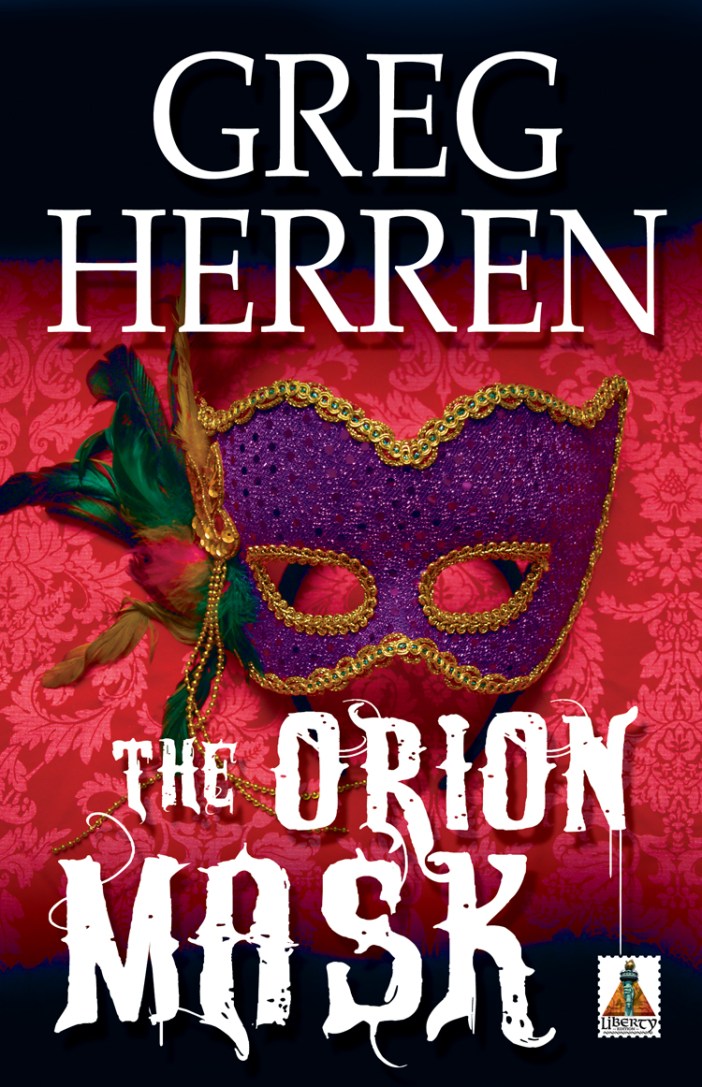
The other day, I wrote about the character of Jerry Manning, who appears in Garden District Gothic, and how much I liked the character. I also used him as a character in The Orion Mask–which I had somehow forgotten–and in fact, Jerry is the catalyst for that entire book. I had already created the character of Jerry for the Paige book I’d intended to write, and I liked him so much I actually introduced him to readers in The Orion Mask.

The Orion Mask 300 DPI

I had the idea for that book a long time ago; I’d always loved the romantic suspense novels of Phyllis A. Whitney, Victoria Holt, and Mary Stewart (although I would argue that she wasn’t a romantic suspense writer, simply marketed as one), and of course, Daphne du Maurier’s Rebecca is one of my favorite novels of all time. One of the reasons I loved that style of book so much is because they were not only mysteries, but there was a Gothic feel to them, stylistically and mood-wise, and I always wanted to write one. (I had already published what is my personal favorite of all my novels, Timothy, and really wanted to go back to that well again.) I originally came up with the idea for The Orion Mask many years ago; when I came to New Orleans for Mardi Gras the first time in 1995, only in all my notes and so forth it was called The Orpheus Mask;  the driving idea was a murder that happened a long time ago, and rare, valuable Mardi Gras masks had something to do with the crime. After moving to New Orleans and becoming more knowledgeable about the city and its history, I realized the Krewe of Orpheus was actually too new–plus, I couldn’t really use an actual Mardi Gras krewe. I still wanted to do the book, though, just wasn’t sure how to make it all work. I also knew it had to take place outside of New Orleans; for the story to work, the majority of the action needed to occur at a mansion in the countryside.

Fortunately, there are plenty of those. I was already using one for Murder in the Arts District, that was based on a sort of hybrid of Houmas House and Oak Alley, and thought, oh, what the hell, I’ll just use the same place for this book, too. It is fiction, after all. I’d created a fictional parish as well–Redemption Parish–for that first book, and had based a small town near the plantation on Breaux Bridge, just off I-10 between Baton Rouge and Lafayette that I’d visited with some friends from out of town years ago, but the town never really appeared in that story, so I could really use it for this book. But I still didn’t know how to connect the masks in…and then we went to Italy, and while we were there we went to Venice, and you cannot escape the Carnival masks or the Murano glass there. As we walked the cobbled alleys of that remarkably beautiful city (I so want to go back), it hit me in a flash: someone from Venice who worked with the glass came to America, to Louisiana, and the plantation not only was a farm but also produced glass, using the same techniques made famous by the Venetians, and they could have produced masks for the Kings of the major krewes of Mardi Gras made from the glass. I invented my own, now-defunct krewe–the Krewe of Orion–and everything fell into place.

My story, of course, which was about a young man whose mother died when he was very young, and who was raised by his father and stepmother, completely disconnected from his mother’s family and only comes to see them as an adult, which starts the story, didn’t really have the right hook I needed to get started. Why would he suddenly, after all these years, finally get in touch with his mother’s family?

And that’s where Jerry came in. Jerry, looking for another true crime to write another one of his books, has discovered the murder/suicide involving my character’s mother. I named the character Heath Brandon, after a friend of mine, by inverting his first and middle names (I’d actually given a character his actual name before we met; it was very odd because his name was so familiar to me when we met, but we’d never met before, and then one day I realized I had actually written a character with that name, but I digress.). I put Heath into another fictional city I’d created for another book, Bay City (based on Tampa), and had him work at the airport at an airline ticket counter (a job I’ve actually had), working for the fictitious airline I created for Murder in the Rue Dauphine and have always used ever since whenever I need an airline.

I sat up in a strange bed, wide awake, my heart pounding.

 Disoriented, I looked around in the gloom, not sure where I was or what had woken me up from my already restless sleep. I shivered. A storm was raging outside as my mind began the process of clearing out the fog. Wind was whipping around the house, rattling the windows and the French doors.  The rain was coming down in a steady stream. As I sat up further in my bed, lightning lit up the room, and I recoiled in horror. The brief flash of illumination had exposed the shadow of someone against the curtains over the French doors. I bit back a scream as I wondered if there was anything within reach in this strange room that I could use as a weapon. My eyes were still seeing spots as thunder shook the house as I remembered there was a table lamp on the night stand next to the bed. As my vision cleared, I could see through the gloom that the doorknob on the French doors was turning. I reached my hand out to the table and fumbled for the switch on the lamp. I found it and clicked it on, filling the room with bright yellow light.

I thought I heard footsteps running away along the gallery.  I threw the covers aside and climbed out of the massive bed. I dashed over to the fireplace on the other side of the bed, grabbed one of the brass pokers, and carried it over to the French doors. I flipped the lock off, turned the knob , and the wind immediately grabbed them out of my hands. They slammed against the walls and swung back. The wind pushed me back a few steps. Curtains moved away from the walls, and the canopy over the bed rippled as I struggled to latch the doors against the walls. Once this was accomplished, I tried to step out onto the gallery. Lightning flashed again as I stepped out onto the wide gallery. I wrapped my arms around me and wished I’d put on at least a T-shirt. The wind was blowing the rain onto the gallery, and the heavy drops were splashing my legs with water as I looked through the gloom in each direction.

I didn’t see anyone.

My heart still pounding, I closed and locked the doors again before heading back to the bed, still holding the poker in my hand. I put the poker into the bed next to me and slid underneath the covers. Maybe it had been a dream, maybe there really hadn’t been someone out there on the gallery trying to get into my room, and it was just my imagination working overtime. There wasn’t anyone out there, you fool, I scolded myself, you’re just a little off balance—but it’s understandable. It isn’t every day you meet a family you didn’t know you had a month ago. I switched the lamp off and pulled the covers back up to my chin, and lay there, staring at the canopy over my head.

It was hard to believe it had only been a month since I first noticed the bald man sitting in the airport lobby, and my entire life changed.

The bald man was Jerry, of course, and he tracked Heath down as he investigated the long ago murder/suicide, and it was Jerry who set the stage for Heath to come back to the family estate, Chambord, and  find the truth about what had happened all those years ago, about his mother and the Orion mask.

Writing the book was a lot of fun, and I’d love to do another, similar style book at some point.

I had thought about giving Jerry his own series, or his own stand-alone book; and when I started making notes I realized something: he had been a personal trainer/stripper (so had Scotty) and he came from a repressive small town and a white trash family (Chanse), and thus was basically repeating myself, which is one of my biggest fears. So I shelved the idea…but it runs through my mind periodically because the idea is a good one. I may have to write it about a different character, though.

Heavy sigh.

And now, back to the spice mines.