The unplanned sequel!
That’s not entirely true, you know. Yes, Bourbon Street Blues was always supposed to be a stand alone (I know you’re tired of the story) and they offered a two book series deal and I took it, thinking I would just figure it out later. Well, I did figure it out later; and when I started writing Bourbon Street Blues I already knew there would be a second book and so I had to set it up in the first as well as plant seeds for the next one after that–if there was going to be another one after that. I didn’t know for sure or not whether there would be a third, so when I was writing the first I kept the personal story as simple as I could in case there wouldn’t be a third and I could wrap it all up with the second if need be. But by the time I finished writing Jackson Square Jazz I was already pretty confident there would be a third (the first had just come out and was doing extremely well) so even if the third still ended up not being contacted, everything wrapped up as nicely as possible at the end of Jackson Square Jazz.
I decided the main mystery plot of the book would have to do with the Cabildo Fire of 1988.
When Paul and I had first moved here, sometime within that first year we saw a documentary on our local PBS station (WYES, for the record, thanks for asking, you there in the back) about the Cabildo Fire. I can only imagine how the city reacted to the news that a fire had broken out in one of our most beautiful buildings and recognizable landmarks–especially given its proximity to the landmark of the city: St. Louis Cathedral, and on its other side, the Presbytere. The documentary focused on the remarkable methods the New Orleans Fire Department went to, not only to fight the fire and prevent its spread to other historic buildings nearby, but to preserve the contents of the inside. The Cabildo is the Louisiana State Museum, and it’s filled with all kinds of artifacts and art documenting the history of New Orleans and the Louisiana territory. They brought fire-fighting boats to the levee, and borrowed more from the Coast Guard. They began hosing down the buildings around the Cabildo so they’d be too wet for the fire to spread.
And firemen were sent inside to remove as much of the contents before they turned the hoses on the Cabildo itself.
They literally lined paintings, framed historic documents, and various other historical artifacts with a variety of values along the fence surrounding Jackson Square, delaying until they had no other choice but to turn the hoses onto the Cabildo.
How easy it would have been to walk off with something priceless in its historic value, I thought, thinking of Robin Cook’s marvelous Sphinx and its opening with the tomb of Tutankhamun being robbed before flashing forward to the present day where a young female Egyptologist happens upon a magnificent statue from antiquity; a golden statue of Pharaoh Seti I. I pictured another young woman, in an antiques shop in the Quarter, happening upon something that looks like an artifact lost during the Cabildo Fire (they saved over 80% of the museum’s contents, by the way), and decided upon the Louisiana Purchase treaty. I could also call the book Louisiana Purchase (which also is the name of the state’s food assistance program; you get a Louisiana Purchase card with an amount loaded onto it every month), and possibly weave something about a food assistance program scandal of some sort woven into it as well. I viewed this as a spin-off stand alone for my character Paige Tourneur from the Chanse series (I had always wanted to write about her), and I thought, you know, the Cabildo Fire and some McGuffin gone missing from the museum would make a great plot for the second Scotty book.
The more I thought about it, the more I liked it.
And, being a dutiful writer, I contacted the administrative offices of the Louisiana State Museum and made an appointment to discuss my book and the fire with Executive Director Jim Sefcik.
And when I met with Jim, I discovered, to my great surprise, that not only had he been working there the day of the fire…it was his first day on the job.
“I was sitting in La Madeleine having coffee and a pastry,” he said (where Stanley is now used to be a La Madeleine; I used to get coffee there all the time during the Williams Festival), “when I heard a fire engine. I looked out the window and saw a firetruck pull up onto the pedestrian mall and stop in front of the Cabildo. As I thought that can’t be good another one pulled up from the other direction and THAT was when I saw the smoke.”
He gave all the credit to the fire chief for how everything was saved–“I just kept saying yes yes, whatever you think is best”–and I remember saying, “Well, at least you got it over with on your first day.”
He laughed, and replied, “Yes, now whenever there’s a crisis of any kind I just think well, at least the Cabildo isn’t on fire and that kind of puts things into perspective.”
He even gave me Polaroid snapshots of the aftermath of the fire; they’d scanned the originals long since to archive them. I just found them again Saturday when I was cleaning out cabinets, you can imagine my delight to stumble over them all these years later.
He also explained to me why the Louisiana Purchase treaty wouldn’t work as the MacGuffin (the original is stored in a vault at the Library of Congress; the display in the Cabildo is a copy and it is multiple pages long) and suggested the Napoleon death mask as a suitable alternative–even telling me a wonderful story about how the one in the Cabildo (there were four or five made) disappeared and then turned up in trash dump about thirty years later.
And he was right. It worked perfectly.
Danger is my middle name.
Okay, so that’s not strictly the truth. My middle name is Scott. But when you’re first name is Milton and you’re last name is Bradley, you’ve got to do something. Yes, that’s right, my name is Milton Bradley, and no, I’m not an heir to the toy empire. My parents, you see, are counter-culturalists who own a combination tobacco/coffee shop in the French Quarter. They both come from old-line New Orleans society families; my mom was a Diderot, of the Garden District Diderots. Mom and Dad fell in love when they were very young and began rebelling against the strict social strata they were born into. The Bradleys blame it all on my mom. The Diderots blame my dad. My name came about because my older brother and sister were given what both families considered to be inappropriate names: Storm and Rain. According to my older brother, Mom and Dad had planned on naming me River Delta Bradley. Both families sat my parents down in a council of war and demanded that I not be named after either a geological feature or a force of nature. After hours of arguing and fighting, Mom finally agreed to give me a family name.
Unfortunately, they weren’t specific. So she named me Milton after her father and Scott, which was her mother’s maiden name. Hence, Milton Scott Bradley.
My older brother, Storm, started calling me Scotty when I was a kid because other kids were making fun of my name. Kids really are monsters, you know. Being named Storm, he understood. My sister Rain started calling herself Rhonda when she was in high school. Our immediate family still calls her Rain, which drives her crazy. But then, that’s the kind of family we are.
So, yeah, danger really isn’t my middle name, but it might as well be. Before Labor Day weekend when I was twenty-nine, my life was pretty tame. I’m an ex-go-go boy; I used to tour with a group called Southern Knights. I retired from the troupe when I was twenty-five, and became a personal trainer/aerobics instructor. The hours were great, the pay was okay for the most part, and I really liked spending a lot of time in the gym. Every once in a while I would fill in dancing on the bar at the Pub, a gay bar on Bourbon Street, when one of their scheduled performers cancelled—if I needed the money. That Labor Day weekend, which is Southern Decadence here in New Orleans, I was looking forward to meeting some hot guys and picking up the rent money dancing on the bar. I certainly wasn’t expecting to be almost killed a couple of times or to have my apartment burn to the ground. I also didn’t expect to wind up as an undercover stripper for the FBI.
It’s a really long story.
The one good thing that came out of that weekend was I met a guy: Frank Sobieski, this mound of masculine, hard muscle with a scar on his cheek, who also happened to be a Fed. They don’t come any butcher than Frank. We hit it off pretty well, and he decided that once his twenty years with the FBI were up, he’d retire and move to New Orleans. I’ve always been a free agent. It’s not that I didn’t want to have a boyfriend, I just never thought I would find one. I enjoyed being single. I mean, young, single and gay in New Orleans is a lot of fun. It doesn’t hurt that people find me attractive, either. I’m about five nine, with wavy blondish hair that’s darker underneath. I wrestled in high school, mainly because the other kids were bullying me because they sensed I was gay. I’ve been working out ever since. Anyone who tells you being in shape doesn’t make a difference in your life is lying. It does.
But I needed a reason for the death mask-MacGuffin to come across Scotty’s path.
So, I turned back to the personal story of Scotty again.
It’s October now, been about five or six weeks since Labor Day and Halloween looms. There’s not been another word from Colin since the end of Bourbon Street Blues and Frank has put in for his retirement while he and Scotty are doing the long-distance thing; Scotty is finding it a bit restraining and having never really wanted or care about being in a relationship, is starting to have second thoughts about giving up his freedom. He has just come back from visiting Frank in DC and that visit has set his teeth on edge and made him even more nervous about Frank moving to New Orleans. David picks him up at the airport, hands him a joint, and Scotty goes on a bender…
…and wakes up with a massive hangover in bed the next morning, realizing to his horror that he is not in bed alone.
How relatable is that? I know I’ve been there more times than I care to remember.
And I realized, the trick is the key linking Scotty to said MacGuffin and the mystery, and as a big figure skating fan I decided to make him a figure skater, in town for Skate America. Scotty doesn’t know he’s a skater until he’s actually at the event and sees him warming up on the ice–and then he gets a note to meet him at his hotel room at the Hotel Aquitaine later that evening, along with the room’s key card–but Scotty shows up only to find a dead man with a knife in his chest.
This one was fun, and having Scotty’s weird ‘psychic’ power allow him to commune with the ghost of a long-dead fireman who knows the answer everyone is looking for was also a lot of fun. (I liked the concept of having Scotty and his mom go down to watch them fight the fire when he was a little boy.)
What a fun book this was to write!
I introduced a very fun Texas millionaire who collects things and doesn’t care how he acquires them (I even brought him back in Baton Rouge Bingo); was able to bring Colin back only to find out he’s not really a cat burglar but actually an international agent-for-hire working for the Blackledge Agency and thus created the “who will he wind up with” romantic triangle; and even had Scotty living in half of David’s shotgun while his home on Decatur Street was being rebuilt (which I had forgotten about until the skim-rereads and changes something with the new book). I also had Scotty get kidnapped again, and this book had the first of his many car accidents. It also contained Scotty’s first trip (in the series) to the West Bank.
One thing I forgot to mention when I was writing about Bourbon Street Blues the other day was how the series (books) were always intended to be insane and over-the-top*; always. The problem I always have with writing this series is stopping myself because something strains credulity and then I have to remind myself, “this series was always intended to be like New Orleans itself: completely unbelievable until experienced personally, and always over the top and ridiculous.”
Which is part of the fun, you know?
*For one example, Bryce Bell, the young skater, lands a quad-axel at Skate America. To put that in the proper perspective, to date no one had landed one competitively, although there’s a young American skater who can land them in practice….eighteen years later.
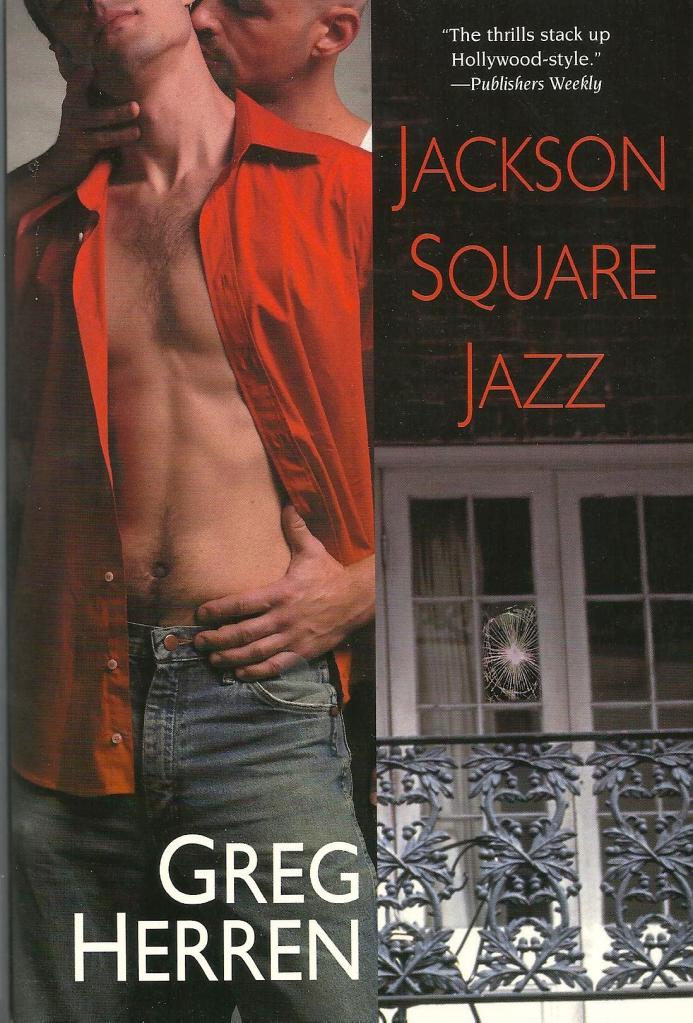
PS: When this book was released, I got asked a lot if I had posed for the cover; the same thing happened with Bourbon Street Blues; I was always apologizing for not being the cover model. With this book, I assumed it was the same thing…but later I realized they weren’t asking about the guy in front with this shirt open but the guy in back kissing his neck. At the time, I had a goatee and shaved head; this guy also has this and he does kind of look like me. What can I say?
 Queer and Loathing in America