This Is Why We Can’t Have Nice Things

It’s Sunday, which means it’s June, so HAPPY PRIDE MONTH, everyone! Woo-hoo! (Cue the bigots and homophobes: why do they get a whole month when the military doesn’t? Sorry you don’t care enough about the actual military, self-styled “patriots,” to know when Military Appreciation Month is–read a fucking book sometime, okay?)

And by the way, assholes, if y’all didn’t come at us with shame all the fucking time, we wouldn’t need Pride in the first place–and remember, the first one was a riot.

My alarm Sparky let me sleep until just after six this morning, which is actually fine. My new sleep patterns had me awake before he started purring and poking at me; I was actually wondering where he was when I woke up, but I wait until he comes to get me up. Yesterday was a lovely, relaxing day for the most part. I finished reading all three of my books (!), which was delightful (enjoyed them all, too) but created a dilemma for me: I wanted to write newsletters about each book, but does anyone really want to get three newsletters from me in one day, especially when it’s Pride Month and I had intended to spend the month writing about being gay in America, and my sordid gay past? That would be four newsletters in one day, were I to do that, so I am on the horns of a dilemma1 this morning. I think I’ll write them all up and save the extras as drafts for later. I do highly recommend Murder Takes a Vacation by Laura Lippman, and I really enjoyed revisiting Moonraker.

And I plan on writing about all the kids’ series I enjoyed as a kid, so the Vicki Barr entry can be saved for later.

I did some chores yesterday, and was actually writing my newsletter about the new Lippman when our power went out yesterday afternoon. Only for an hour, unlike those poor people who went without for over twenty-four hours the weekend before, and I don’t know what caused it–it was a beautiful sunny yet cool day yesterday here in New Orleans–but I used that time to finish the Vicki Barr and barbecue dinner. Ironically, when I brought the hamburgers in when they were finished, the power came back. I watched some of the French Open, we watched this week’s Murderbot, the season finale of Hacks, and then binged some more of The Better Sister, which is superb. We’ll most likely finish that tonight.

I had already decided to bump queer writers and books up the TBR pile for Pride Month2, so my next new-to-me read is going to be Summerhouse, which Kristopher Zgorski recommended on his blog. My next reread will be The Dark on the Other Side by Barbara Michaels, and my next kid’s mystery reread will by The Mystery of the Haunted Mine, which has remained one of my favorite books from when I was a kid, and I got my copy from the Scholastic Book Fair; amazing that I still have it despite all the moves since then, right?

I feel very rested and relaxed this morning. I am still getting stronger (and more mentally back together) every day, which is terrific; My legs still tire easily, but that just means I need to exercise and walk more. I did doze off in my easy chair for about an hour yesterday–getting up early every day does that to me sometimes–but I also got some chores done, and have more to do today if I don’t get lazy. I have to run make some groceries later this morning–better to do it today than on the way home from work tomorrow, right? It’s so much easier to take I-10 home from work, even if the ramp to 90 and the west bank backs up; it’s still easier than navigating through Tremé and the CBD.

I also watched LSU’s baseball game last night against Dallas Baptist before going to bed, certain they would win, and they did; they are in the regional championship today. GEAUX TIGERS!

I’m still feeling good about things overall, too, which is definitely a good thing. I’ve got my to-do list (some things are ready to be scratched off) to work through, as well as these chores to finish up, so I am going to head into the spice mines. Have a great Sunday, Constant Reader, and I’ll be back tomorrow morning–keep an eye out for the newsletter, too!
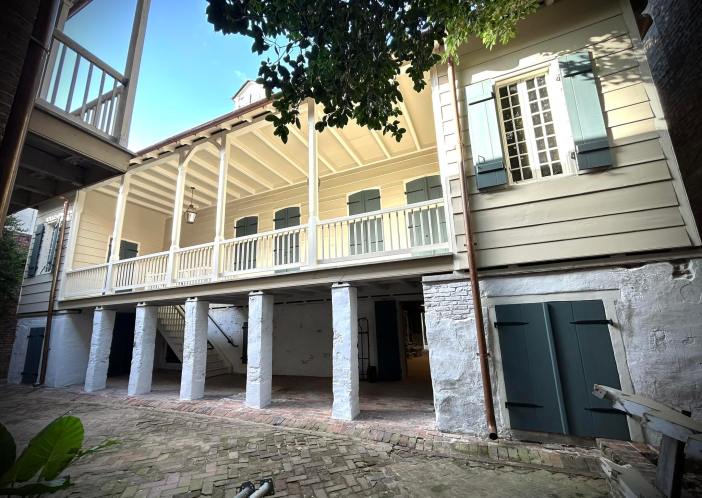
The courtyard of Madame John’s Legacy in the French Quarter
  1. Which also begs the question of what should I make my newsletter thematically in the first place? Do I even need a theme? This is what happens when I stop to think about things, you know, which is why I try not to ever stop to think about things. ↩︎
  2. Making me just as bad as cishet readers, right? “I only read queer books during Pride.” Ah, well, something else for me to deconstruct, right? ↩︎
Please Remember Me

I am often, incorrectly, referred to as a “New Orleans expert.”

Nothing, as I inferred in that sentence, could be further than the truth.

Don’t get me wrong–I absolutely, positively love New Orleans, for many and varied reasons. The short, elevator-pitch answer is always Because I’m not the weird one here. And it’s true; New Orleans is an eccentric city filled with eccentrics. No other city in North America is like it, even remotely; New Orleans is a city that doesn’t abhor strangeness, but rather embraces it. When I came here for my thirty-third birthday in 1994, when I got out of the cab at the intersection of St. Ann and Bourbon that first night, my actual birthday, to go out to the gay bars of the Quarter, I knew I was home. There was no doubt in my mind, no question; just an immediate and instant connection with the city and I knew, not only that I would eventually live here, but that if and when I did all my  dreams would come true.

And that feeling was right. I fell in love with New Orleans, I fell in love in New Orleans, and after I moved here, all of my dreams did, in fact, come true.

So, when I write about New Orleans my deep and abiding love and passion for the city inevitably comes through. But I always kind of smile inwardly to myself when people call me an expert on the city; I am hardly that, and libraries could be filled with what I don’t know about the city. Sure, I do know some things, but an expert? Not even remotely close.

A perfect case in point is Milneburg. What, you may every well ask, is Milneburg? Milneburg was a resort village on the lake shore that many New Orleanians would escape to during the wretched heat of the summer (and I am vastly oversimplifying this); I’ve read about it in history books and so forth. I even thought Murder in Milneburg might make for an interesting historical mystery. I always saw it, though, in my mind’s eye, as close to the parish line between Orleans and Jefferson parishes; closer to Metairie and the causeway. So, you can imagine my shock when I saw a map of Milneburg posted on one of the New Orleans historical Facebook pages I belong to, and realized that I was completely wrong: there was a railroad line from New Orleans to Milneburg (which I knew) that ran along what is now Elysian Fields Avenue. 

So, Milneburg was actually where the University of New Orleans is now located; and the train line continued along east, crossing at the Rigolets.

Some New Orleans expert I am, which is why I decided to start reading more histories of the city over the last few years. It’s been quite an education, and there are still some things I don’t quite grasp–like when the Basin Canal was filled in to become Basin Street, and what relation that had to Storyville and Treme, because the train station also used to be located near Storyville (this was part of the reason why the drive to clean up Storyville and end legal prostitution in New Orleans was successful; the other part was because New Orleans was an embarkation point for the military during World War I and the Pentagon frowned on delivering green military recruits to whorehouses).

So, yeah, some expert I am.

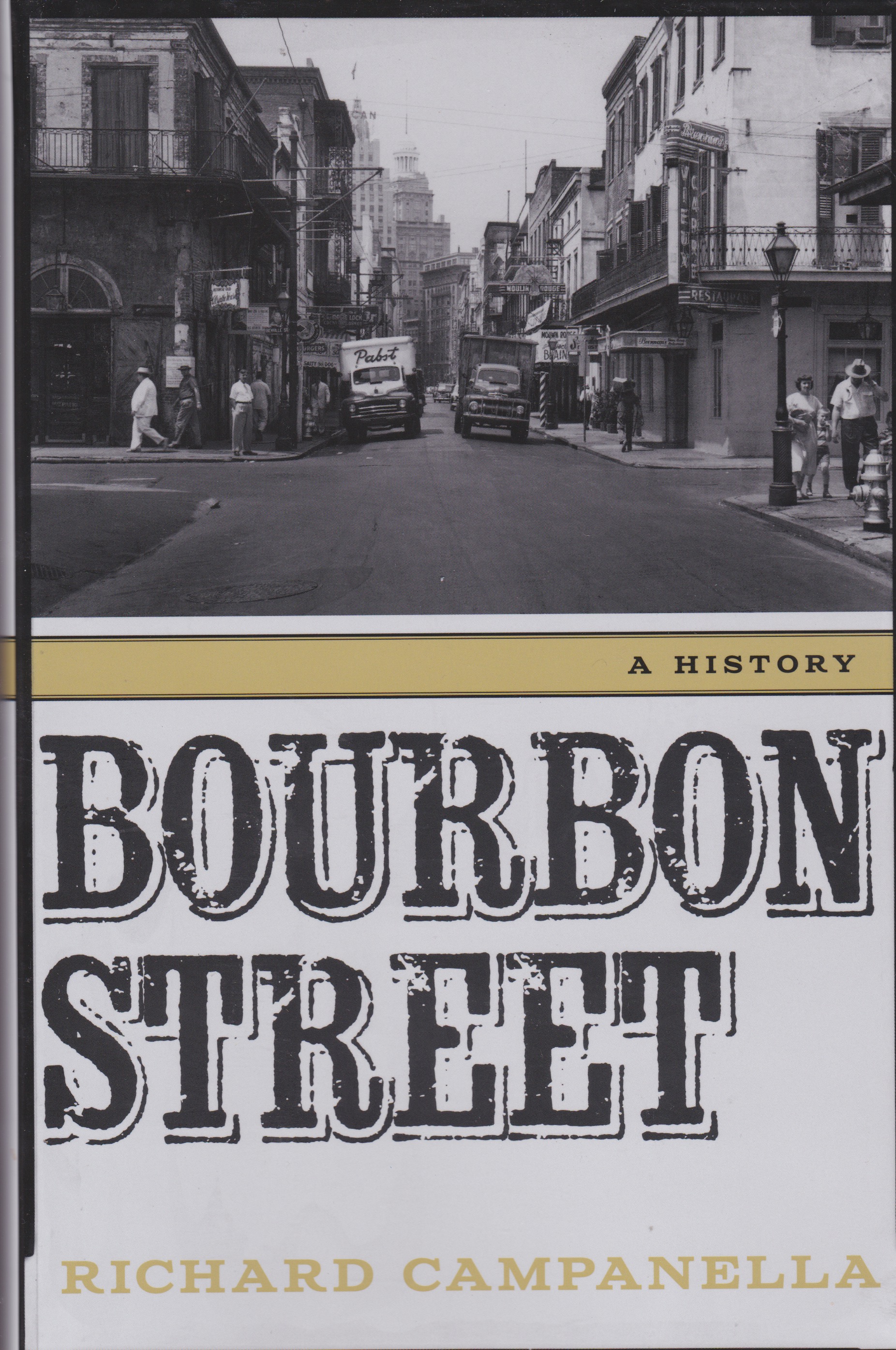
But I really enjoyed Richard Campanella’s Bourbon Street.

bourbon street

There are no straight lines in nature. Nor are there any right angles. Rather, intricate arcs and fractures merge and bifurcate recurrently, like capillaries in a plant leaf or veins in an arm. Nowhere is this sinuous geometry more evident than in deltas, like that of the Mississippi River. Starting eighteen thousand years ago, warming global temperatures melted immense ice sheets across North America. The runoff aggregated to form the lower Mississippi River and flowed southward bearing vast quantities of sediment. The bluffs and terraces that confined the channel to a broad alluvial valley petered out roughly between present-day Lafayette and Baton Rouge in Louisiana, south of which lay the Gulf of Mexico.

Into that sea disembogued the Mississippi, its innumerable tons of alluvium smothering the soft marshes of the Gulf Coast and accumulating upon the hard clays of the sea floor. So voluminous was the Mississippi’s muddy water column that it overpowered the (relatively weak tides and currents of) Gulf of Mexico, thus prograding the deposition farther into the sea. Occasional crevasses in the river’s banks diverted waters to the left or right, creating multiple river mouths and thus multiple depositions. High springtime flow also overtopped the river’s banks and released a think sheet of sediment-laden water sideways, further raising the delta’s elevation.

In this manner, southeastern Louisiana rose from the sea. The process took about 7,200 years, making the Mississippi Delta, as Mark Twain put it, “the youthfulest batch of country that lies around there anywhere.” Young, dynamic, fluid, warm, humid: flora and fauna flourish in such conditions, as evidenced by the verdant vegetation and high productivity of the delta’s ecosystem. Humans, on the other other, view these same conditons as inhospitable, dangerous, even evil, and endeavor to impose rigidity and rectitude upon them, so as to better exploit the delta’s resources.

If New Orleans is known for anything, it’s Bourbon Street. Everyone has heard about Bourbon Street, it seems; just as they’ve heard about Carnival/Mardi Gras, beads, and show us your tits (which locals do NOT do–either yell it or bare them). Campanella’s book traces the history of the famous street, and by extension, the French Quarter itself, from its very beginnings when the French arrived and designed the streets, to its modern day incarnation as a street of endless partying and no little debauchery. It’s very well researched, and Campanella, who I believe teaches at Tulane, is the true expert on the city; I follow his pages on Facebook, and I can’t even begin to tell you how much inspiration and information Bourbon Street  has given me. I’ve put so many page markers in my copy that I’m worried about breaking the spine!

One thing that my reading of New Orleans history has further emphasized to me–and it also really comes through strongly in Campanella’s book–is how New Orleans has always been a city of neighborhoods, and how each neighborhood of the city had (has?) its own unique  sense of itself, and how those who lived in those neighborhoods so strongly identified with them. The evolution of the French Quarter from the original city and seat of its government, to the original French leaving and being replaced by immigrants (as late as the 1960’s the lower quarter was known as ‘little Sicily’ because of all the Italian immigrants and their descendants who lived there), and then evolved again into a different type of neighborhood, with mixed incomes and everything from inexpensive apartments to gradiose condos; and a variety of ethnicities, races, sexualities, and gender identities.

One of the primary concerns modern-day New Orleanians have is the fear of the loss of those neighborhoods; because those neighborhoods were the incubators for all the things that makes New Orleans so special and unique: the music, the art, the literature, and the characters. Short-term rentals are carving up neighborhoods and the rents/property values are currently climbing, with no peak in sight, and people are rightfully concerned about these things.

But one thing I’ve learned from reading these histories, and Campanella’s in particular, is that New Orleans has always changed and evolved, yet has also always managed to keep that unique strangeness that make it New Orleans somehow intact.

If you love New Orleans or find it at all interesting, I cannot recommend Bourbon Street enough to you.