Ode to Billy Joe

Robby Benson. Swoon. I mean, LOOK at him.

Eat your heart out, David Cassidy!

I don’t know when I first became aware of one Mr. Robby Benson, but I do know he was a major crush of mine when I was a teenager–he and Jan-Michael Vincent–and I also think he’s another one of those who definitely helped create a type for me; dark hair and bright blue eyes, and that smile! Jesus Mary and Joseph!

I wasn’t alone in my teen years crushing on Robby; I think most teenaged girls of my generation all had a bit of a crush on him. For one, he was ridiculously beautiful; it kind of should be against the law to look that good. He was also photogenic and telegenic, and I loved his speaking voice. I know my teen years are also when I developed my love of jeans cut Daisy Duke short; and as you can see from the pictures above, Robby’s were cut so short they were basically speedo-sized. Years later, Daisy Dukes were my favorite shorts to wear, because all modesty aside, I’ve always had muscular legs; assets best displayed in shorts cut immodestly short.

But in looking up information on Robby Benson for this post, I realized I had never seen the movie Ode to Billy Joe, which was one of his best-known films. I knew about the movie, of course, but never saw it. It was released the summer we moved to Kansas and it never played in Emporia, and I never saw it on television, either. So, yesterday, I remedied that by watching it on Youtube, which has the entire movie uploaded for free.

The movie itself is simple. Based on the story song by Bobbie Gentry that is probably one of the biggest and best-known hits of all time, it’s ethereal and mysterious and unclear; and the lyrics themselves create an indelible image of a rural Southern lunch and the casual, unknown to anyone speaking, cruelty of the conversation. The narrator had a strong connection to Billy Joe, and his suicide affects her deeply, but nobody really notices. It’s genius in exposing that Southern mentality of “the girls don’t matter”–no one’s noticed that she is connected to him in some way, no one notices that she’s upset, and the way Gentry sings the lyrics is so matter-of-fact yet horrible as she recounts an emotionally troubling experience for herself, and paints such a powerful image of the invisible daughter, left to grieve on her own for the boy she loved, and does she know the reason he jumped? I’ve always liked the song, even if it doesn’t work for me musically (the lyrics don’t match the melody), because it tells so many truths about rural Southern girls that what actually happened isn’t the point–the point is the isolation and loneliness she feels, and the alienation from her own family.

The movie, screenplay and novelization by Herman Raucher of Summer of ’42 fame, fleshed out all those mysteries. It was from the movie and book that turned Ode to Billy Joe into a queer story and a tragedy; it’s also interesting that it wasn’t more of a scandal when the movie was released in 1976; maybe him having had a sexual encounter with another man and committing suicide took the sting and shock of the gay twist; after all, misery and suicide were the only possible outcomes for most queers in movies at the time. Watching the movie, but taking away my own quibbles about its depiction of southern rural life to talk about it as it stands as a queer film, it was really quite revolutionary. First of all, Robby Benson was a full-fledged teen heart throb with photo shoots in every magazine like 16 and Tiger Beat, and having someone who didn’t telegraph gay (or the societal images of what gay looked like then) who was also a heart throb playing the part was putting an acceptable face on a (at the very least) bisexual character. What was also interesting to me about the film was that it was produced by Max Baer (aka Jethro from The Beverly Hillbillies), and the man Bobby Joe had the encounter with was played by James Best, who would go on to greater celebrity and fame as Sheriff Roscoe P. Coltrane on The Dukes of Hazzard later on in the decade. Glynis O’Connor is fine as Billie Lee (seriously, Bobby Joe and Billie Lee? I have an army of relatives from the rural south, and out of all of them there is exactly ONE who has that stereotyped Southern two first names thing), but Benson’s appeal is clearly on display here–and I understand why girls loved him so much: he always played sensitive and vulnerable young men, which girls love.

And he is just stunningly beautiful in this movie.

Benson’s most successful role of all time was, ironically, from voice work: he voiced the Beast in Disney’s Beauty and the Beast.

I also found it interesting the Bobby Joe committed suicide in the Tallahatchee River, which was also where the white supremacists dumped Emmett Till’s body…so that river is kind of hexed, wouldn’t you think?

He also aged incredibly well–Benson is still quite beautiful.

Nothing’s Going to Stop Us Now

Ah, Starsky and Hutch.

As I have been reviewing things that helped confirm to myself as a child that I was a big old homo (for my book The Summer of Lost Boys), I found myself remembering a lot of things, memories from the darkest dusty and cobwebbed chasms of my memory banks.

But as a kid, realizing that I was drawn to men more than women was difficult and weird, and not in the least because I didn’t understand what women saw in men; their sex symbols, to me, left a lot to be desired. I grew up on the cusp of some societal and cultural changes, and not the least of which was the fact that in the 1970s, men finally began being sexualized and held to a kind of male beauty standard that gradually changed that standard–which for a burgeoning young gay boy, was perfect timing. I never understood, for example, what girls saw in teen idols–sure, Bobby Sherman and Davy Jones and David Cassidy were cute…but I didn’t think of them as sexy or sexualized; the Tiger Beat crowd was very into guys who were not sexually threatening–these weren’t guys they wanted to fuck but rather ones they wanted to hold hands with and go on dates to malt shops and movies with, and chastely kiss good night. I never really got the sense that women ever wanted to fuck their sex symbols, either–there was an odd chasteness to women (the old madonna/whore paradigm) in their fandoms. You never heard a woman saying she wanted to fuck Paul Newman or Robert Redford or Burt Reynolds; there was more to it than just sexual energy.

But “Women’s Lib” began taking flight in the 1970s, as did queer rights, and a gradual shift in the paradigm of what is sexy in a man and what isn’t began changing. It was the decade Playgirl launched (more on that later), Jim Palmer began doing underwear ads, and the poster of Mark Spitz and his gold medals wearing a speedo sold like cheap beer on a payday.

And it also began the rise of the himbo shows; the male equivalent of all those jiggle shows with big breasted girls without a bra jumping up and down; those shows were almost guaranteed ratings in the Top Ten. Starksy and Hutch was the first real himbo show that I can remember; David Soul and Paul Michael Glaser were very good looking with great bodies that were very masculine as well–and the show showed them shirtless as much as possible, or in towels, or–you get the idea. They drove a fast car with an odd but distinctive paint job (cars were also stars that decade) and the show also not only was a hit but a part of the zeitgeist, too. I watched every week–as did my sister and almost every girl I knew–but it being a macho cop show, it was okay for men to watch, too.

And if there was an Internet and fan fic, a lot of people would have been writing erotic romances about the two of them.

Their closeness as characters as well as their chemistry, and their willingness to appear half-naked at the drop of a hat certainly made the show popular with gay men–and the stars also didn’t mind playing into the gay interest in the show, as you can see by the picture of them running hand in hand on the beach.

They also did a lot of those kinds of promo photo shoots.

Glaser’s wife later contracted AIDS from a blood tranfusion, and the two of them spent a lot of their time and energy working for AIDS treatment, education, and a cure.

Dark Shadows (Josette’s Theme)

I always forget this when I am asked about major influences on my life, writing, and career–but probably the biggest influence on me was the television soap Dark Shadows.

“My name is Victoria Winters…”

So began the first episode, with young heroine Victoria speaking over some rather spooky music, usually with a background scene of a light in the window at the great house of Collinwood in the fog, or waves crashing against the beach, or the family cemetery, or even the Old House.

Dark Shadows is probably the root or seed from which Bury Me in Shadows was grown from, now that I think about it more. A haunted old house, an even older house in ruins nearby in the woods that was the original family home, ghosts and secrets from the past–oh yes, the framework is absolutely there, and it never even occurred to me.

When my sister and I were kids, we moved to Chicago from Alabama. I was about two years old, give or take; I don’t remember moving up there nor do I remember ever living in Alabama; my sister was two years older. My parents both got jobs–the point of the move was for climbing the economic ladder; they both got really good jobs in factories while my dad finished his degree. But because they both worked (our friends and neighbors all felt sorry for us because our mom had to work; their moms all were housewives), we needed to be watched while they weren’t home. Our landlady recommended a woman down the street–a mother of six whose two youngest were in their last years of high school–and so we started spending our days with Mrs. Harris, who fed us breakfast and lunch, and Mom would pick us up on her way home from the bus stop. When we started school, we went there for breakfast and lunch but came home after school; school let out at 3:15 and Mom was usually home by 3:30. But it was Mrs. Harris–and my grandmother, who worked a night shift–who got me started watching soaps in the first place. One Life to Life and General Hospital sort of held my attention, but it was Dark Shadows I couldn’t wait for. I used to run home from school to try to catch the last five or ten minutes during school; it wasn’t a problem during the summer.

I loved Dark Shadows.

I was crushed when it was canceled.

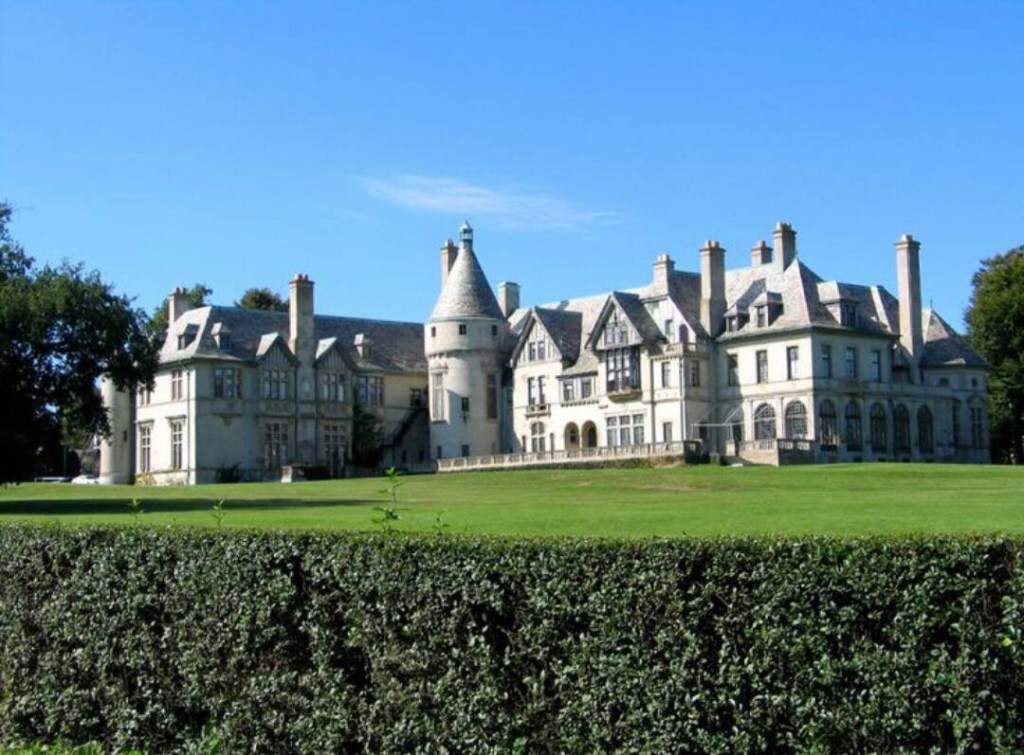
I mean, look at that house!!!!

The show wasn’t canceled, although the ratings were starting to slide a bit in the later years. The truism that Dark Shadows‘ producers and writers discovered is one that practically every other continuing series having to deal with the supernatural and supernatural creatures has had to deal with: how do you keep topping yourself and raising the stakes? True Blood, Supernatural, The Chilling Adventures of Sabrina, and countless others have all run headfirst into that wall. Once you’ve done time travel and vampires and witches and werewolves and Frankenstein and other dimensions, what is left to do? I admire them for pulling the plug rather than getting more and more desperate to get the ratings up and eventually damaging the legacy of the show.

The show was a phenomenon the likes of which had never really been seen before in daytime–and the lesson learned from its success (go for the young audience!) would soon lead to the creation of youth-oriented shows like All My Children and The Young and the Restless–and of course in the mid-1970’s soaps would be forever changed when General Hospital introduced the character of teenager Laura Webber, played by an actual teenager, Genie Francis–and daytime was never the same. But Dark Shadows managed something that other soaps hadn’t–they created teen idols. Jonathan Frid as Barnabas, David Selby as Quentin, and even David Hennessey as David Collins were often on the covers of teen magazines like Tiger Beat and 16. The show even licensed FAN FICTION–a series of books based on the characters from the show, but thanks to all the fun stuff with time travel and parallel dimensions, Dark Shadows was perfect for spin-off books that took place in other Dark Shadows universe; one could even say Dark Shadows was one of the first shows to make use of a multi-verse.

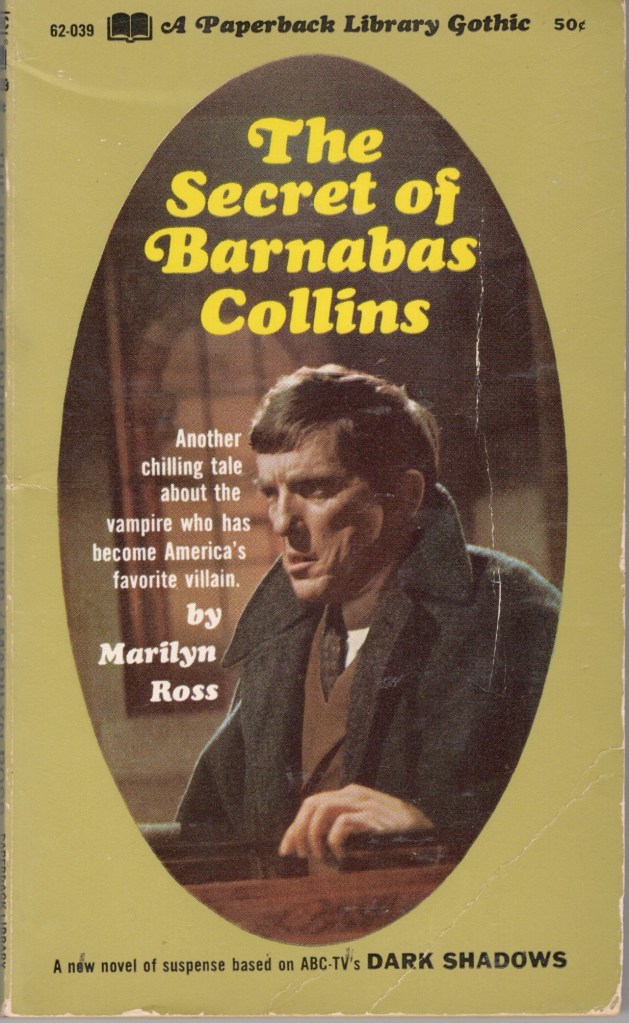
The books were cheap–as you can see in the picture above (a copy sent to me by a friend with whom I bonded over our mutual love of the show) they ran between fifty cents and seventy-five cents a copy; they all had that same gold bordered cover with an oval image of characters from the show, and they were all written by “Marilyn Ross”, which was a pen name for a very prolific Canadian author named  William Edward Daniel Ross; he wrote over three hundred novels during his career, and Marilyn Ross was the name he used for Gothics–and the Dark Shadows books. (He also wrote as Clarissa Ross, and I read some of those novels as well, including The Spectral Mist.) They also weren’t particularly well written, and while they did take place outside the show’s continuity, there were also moments in some of them that didn’t make sense; in one of them, in which Barnabas shows up at Collinwood in the 1910’s, the only son of the family dies in a tragic accident…but if he was the only son, where did the present day Collinses come from? (The earlier books were told from the perspective of Victoria Winters, and in some cases the gimmick was some member of the family was telling Victoria a story about the family history.)

That’s the kind of shit that drives me insane.

But I remember when one of the off-brand television channels in Chicago (not affiliated with a major network) started running repeats of Dark Shadows from the very beginning when we lived in the suburbs in the evenings while the networks ran the evening news–guess what I was watching instead? Yup, Dark Shadows. (I always found it interesting, too, that the young actress who played Victoria Winters originally–Alexandra von Moltke–eventually became infamous as Klaus von Bulow’s mistress Alexandra Isles, who was, in the prosecutor’s theory, the reason Klaus injected Sunny with enough insulin to induce the coma from which she never woke up. But I digress.

I always wanted to write a vampire story similar to that of Barnabas Collins; I have an entire idea for a rural Louisiana version called Bayou Shadows that I’ve tinkered with off and on since the early 1990’s…but then Charlaine Harris started the Sookie Stackhouse series, which was essentially the same thing. I still might write about Bayou Shadows–the town called that has popped up from time to time in my books about New Orleans and Louisiana; most recently in A Streetcar Named Murder, actually–and if people think I’m ripping off Charlaine, so be it.

I’ll know that I’m really ripping off Dark Shadows.

The show also spawned two feature films, Night of Dark Shadows and House of Dark Shadows, each featuring one of the show’s leading men, Jonathan Frid and David Selby, respectively; the first did far better than the second. The show was revived in prime time for a single season in the late 1980’s; I watched it and loved it, of course–even got Paul to watch when it became available on DVD and I rewatched. I wish that show had been given more of a chance, because it was really quite good, and I was curious to see where the story went from that first season. It also had an excellent cast, including Hammer Film star Barbara Steele as Dr. Julia Hoffman. I did watch the Tim Burton film from this century, which had some clever moments but wasn’t quite as good; it went for the silly parody thing The Brady Bunch movies of the 1990’s did, but it didn’t land. The actress who played villainess Angelique in the original series, Lara Parker, has also written some Dark Shadows novels (I have copies but haven’t read them; I really should). Kathryn Leigh Scott, who played the original Maggie Evans on the soap (and in the first film) also has written novels; she was at Long Beach Bouchercon, where I met her and got a signed copy of her book Down and Out in Beverly Heels. She was lovely and couldn’t have been nicer; I really should read that book someday.

I’ve had Dark Shadows on my mind lately because I bonded with Carol Goodman at Bouchercon over our mutual love of Dark Shadows, and the Scotty book still in draft form takes place mostly in a rural parish outside of New Orleans; not the same parish where Bayou Shadows is located, but the next one over.

Sometimes I think it would be fun to reboot the show again, retelling the original story, or picking up from where the television series ended, or even doing a new generation, some forty years later, with David Collins as an adult with children and so forth…Carol and I have joked about coming up with a concept and trying to sell it and be the showrunners…which would be a dream.