Break 4 Love

Thursday morning.

I slept rather well last night, even if I did keep waking up periodically throughout the night. I’m not sleepy or tired–at least not thus far,  but it’s still early, Today I have to turn in my Sherlock story, which means going over it one more time today and formatting it properly; it shouldn’t be terribly difficult. Am I nervous? Of course I am; it’s always nerve-wracking when you submit a story that outside of your comfort zone. I also learned yesterday at some point that McSweeney’s is taking submissions for a “queer” issue; I have a couple of stories that might work to submit there–with a little tweaking–so hopefully I will have the wherewithal to deal with doing both of those today.

We watched another episode of The Plot Against America last night, and it’s very well done, and creepy on so many levels. I’ve not seen much about the show in the zeitgeist, but it’s really quite worth watching.

I was tired last night when I finished my work-at-home work (well, it’s not finished, just finished for the day), and so it was another evening of scrolling through Youtube and falling into Youtube wormholes of lists and so forth–and old music videos–before Paul got home and I made dinner, then we talked for a while before watching an episode of the show. Such an exciting life I lead! I literally sometimes  wonder why I bother making myself write these entries every day.  But I am looking forward to this weekend at long last, and my email inbox has already gotten out of control and depressing to look at; my goal for this morning between screening people is to try to get it as cleaned out as possible. Not every email requires an answer, after all, and getting into the trap of answering every email is a fool’s game.

I’ve been extremely scattered again this week, what with all these new story beginnings and ideas I’ve been having. Creative ADHD is certainly the worst, and there are times when I simply can’t reign it in, no matter how hard I try. It’s also sort of frustrating because I know I’m never going to get all these stories written, no matter how hard I work on it; it’s just that some of the titles are almost too good to pass up, you know? I really think “Procession of the Penitents” is a great title; and the idea behind it is also equally good; an assistant ADA, new to her job, sitting second chair to the ADA in charge of sex crimes prosecutions, and the case is a gang-rape at a fraternity party. Then again, it might be too much story for a short story–I’m not certain I can get all the story into six thousand words or less; which sometimes is the problem with my ideas. Before I used to always think in terms of novels–oh this would make a great novel–knowing full well I’ll never get a chance to write every novel I want to write. When I started the Short Story Project two or three years ago, the entire point of it was to retrain my brain into thinking in terms of short stories with the new ideas; it’s worked in that regard, and only in some cases have I come to understand that it’s too much for a short story; but now at least I am thinking in terms of longer stories being novellas. There’s another one I’d love to write–novella or novel–centering Venus Casanova and her last case before she retires from the NOPD; it’s a great idea but then again we have the issue of “should a white gay man write about a black woman?” I mean, sure I can, but will it be authentic? Should I be sucking the air out of the room and taking a publishing slot away from a woman (or man) of color? Probably not, and being a minority myself (although, as I always say, I hit the jackpot by being a cisgender white male; gay is my only crime) doesn’t necessarily make it okay.

The Edgars are being announced today on Twitter at 11 am EDT; you might want to follow @EdgarAwards so you won’t miss a single announcement. Pretty cool. Ordinarily, about now I’d be waking up at the Grand Hyatt in another hour or two, getting some coffee, and getting ready to face the day of the Edgar banquet. I haven’t been in years–I think 2015 was my last attendance–and while I was dreading getting up on stage to speak in front of that glittering room of publishing literati, I’d rather be doing that right now than slurping down coffee and preparing to go to another day of work screening people for symptoms before letting them into our respective buildings. (I work at one building in the morning before switching to the other in the afternoon.)

But such is pandemic life. None of us saw this coming, and back in January when I assumed the role of Executive Vice President of Mystery Writers of America, I certainly had no clue that I’d be presiding over the cancellation of the banquet (first time ever) and symposium (first time ever). Yay for making history?

Heavy heaving sigh.

Yesterday was also payday, but since the first isn’t until tomorrow I don’t have to start paying bills until then–so I am leaving things be, so as to maintain the illusion I have money in the bank for yet another day.

And on that note, hello spice mines! Time to put on my mining helmet and head on back in. Have a lovely Edgar Thursday, Constant Reader!

IMG_0753

The Letter

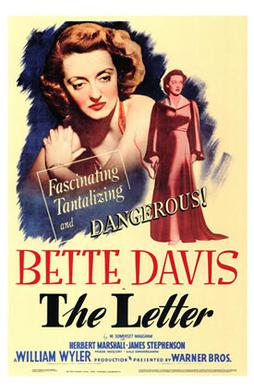
It sometimes catches me off-guard when it turns out a favorite movie was adapted from a short story or novel. Many of my favorite writers had their books turned into film more frequently than I think (or knew, or remembered); and more films were based on books and short stories than people remember or think. I knew, for example, that Now Voyager was a novel before a film; so were Stella Dallas, Flamingo Road, Laura, Whatever Happened to Baby Jane, and so forth. I also know W. Somerset Maugham had written Of Human Bondage (the film of which made Bette Davis a star) and the short story “Rain” (filmed with first Gloria Swanson and remade with Joan Crawford). I’d never read Maugham, but I know of his work; it was only recently, however, that I discovered that one of my favorite Bette Davis films, The Letter, was a Maugham short story he himself adapted into a play. Leslie Crosbie is one of Davis’ best performances, opening on a Malaysian rubber plantation with the sound of gunshots, as a man staggers down the front steps of a bungalow-style plantation house, with Bette Davis grimly following, gun in hand, and when he collapses onto the ground, she stands over him and fires four more bullets into his prone body at her feet. It’s an incredible opening, and a remarkable scene for Davis to play. The determination, the anger, the you so deserve worse than this look on her face–yes, she earned an Oscar nomination for that scene alone.

And once I knew (or was reminded; I may have known at one time it was a Maugham story and simply forgotten), I had to read the story.

The_Letter_poster

Outside on the quay the sun beat fiercely. A stream of motors, lorries and buses, private cars and hirelings, sped up and down the crowded thoroughfare, and every chauffeur blew his horn; rickshaws threaded their nimble path amid the throng, and the panting coolies found breath to yell at one another; coolies, carrying heavy bales, sidled along with their quick jog-trot and shouted to the passer-by to make way; itinerant vendors proclaimed their wares. Singapore is the meeting-place of a hundred peoples; and men of all colours, black Tamils, yellow Chinks, brown Malays, Armenians, Jews and Bengalis, called to one another in raucous tones. But inside the office of Messrs. Ripley, Joyce and Naylor it was pleasantly cool; it was dark after the dusty glitter of the street and agreeably quiet after its unceasing din. Mr. Joyce sat in his private room, at the table, with an electric fan turned full on him. He was leaning back, his elbows on the arms of the chair, with the tips of the outstretched fingers of one hand resting neatly against the tips of the outstretched fingers of the other. His gaze rested on the battered volumes of the Law Reports which stood on a long shelf in front of him. On the top of a cupboard were square boxes of japanned tin, on which were painted the names of various clients.

There was a knock at the door.

“Come in.”

A Chinese clerk, very neat in his white ducks, opened it.

“Mr. Crosbie is here, sir.”

He spoke beautiful English, accenting each word with precision, and Mr. Joyce had often wondered at the extent of his vocabulary. Ong Chi Seng was a Cantonese, and he had studied law at Gray’s Inn. He was spending a year or two with Messrs. Ripley, Joyce and Naylor in order to prepare himself for practice on his own account. He was industrious, obliging, and of exemplary character.

“Show him in,” said Mr. Joyce.

He rose to shake hands with his visitor and asked him to sit down. The light fell on him as he did so. The face of Mr. Joyce remained in shadow. He was by nature a silent man, and now he looked at Robert Crosbie for quite a minute without speaking. Crosbie was a big fellow, well over six feet high, with broad shoulders, and muscular. He was a rubber-planter, hard with the constant exercise of walking over the estate, and with the tennis which was his relaxation when the day’s work was over. He was deeply sunburned. His hairy hands, his feet in clumsy boots were enormous, and Mr. Joyce found himself thinking that a blow of that great fist would easily kill the fragile Tamil. But there was no fierceness in his blue eyes; they were confiding and gentle; and his face, with its big, undistinguished features, was open, frank and honest. But at this moment it bore a look of deep distress. It was drawn and haggard.

“You look as though you hadn’t had much sleep the last night or two,” said Mr. Joyce.

“I haven’t.”

Mr. Joyce noticed now the old felt hat, with its broad double brim, which Crosbie had placed on the table; and then his eyes travelled to the khaki shorts he wore, showing his red hairy thighs, the tennis shirt open at the neck, without a tie, and the dirty khaki jacket with the ends of the sleeves turned up. He looked as though he had just come in from a long tramp among the rubber trees. Mr. Joyce gave a slight frown.

“You must pull yourself together, you know. You must keep your head.”

“Oh, I’m all right.”

“Have you seen your wife to-day?”

“No, I’m to see her this afternoon. You know, it is a damned shame that they should have arrested her.”

“I think they had to do that,” Mr. Joyce answered in his level, soft tone.

“I should have thought they’d have let her out on bail.”

“It’s a very serious charge.”

“It is damnable. She did what any decent woman would do in her place. Only, nine women out of ten wouldn’t have the pluck. Leslie’s the best woman in the world. She wouldn’t hurt a fly. Why, hang it all, man, I’ve been married to her for twelve years, do you think I don’t know her? God, if I’d got hold of the man I’d have wrung his neck, I’d have killed him without a moment’s hesitation. So would you.”

“My dear fellow, everybody’s on your side. No one has a good word to say for Hammond. We’re going to get her off. I don’t suppose either the assessors or the judge will go into court without having already made up their minds to bring in a verdict of not guilty.”

As you may have noted, Constant Reader, this story was written during a time when casual racism was not only accepted but was par for the course. Maugham wrote during the first half of the twentieth century primarily; “The Letter” was certainly set during the time of decline for the worldwide British Empire (“the sun never sets on the British empire”); an empire that was built on the backs of its enslaved and conquered peoples, and justified its abuses and colonialism and exploitation with the typical white supremacy. The Empire didn’t survive the second World War–the Japanese in particular shattered the Empire’s Asiatic pretensions–but all the worst of British racism and classism and misogyny is there on display in this story (this sentence: Singapore is the meeting-place of a hundred peoples; and men of all colours, black Tamils, yellow Chinks, brown Malays, Armenians, Jews and Bengalis, called to one another in raucous tones–in particular), and really is terribly dated in that regard. The story is also problematic in that it also upholds the standard misogynist trope that a woman will easily and without qualm accuse a man of rape to cover up her own crimes. So, it’s easy to see how such a story could spring from the mind of a gay man in that time period; my gay brothers can make the worst misogynists, I’m ashamed to say, and written during a period when misogyny was so incredibly rampant…yes, I can see it.

The story is vastly different from the film. The film obviously centers Bette Davis; it’s one of her finer performances, and the character of Leslie Crosbie; the story itself is entirely told from the perspective of her attorney, Mr. Joyce. But the bottom line of the story and film are the same: Leslie Crosbie murdered Geoff Hammond; the question is why? Mrs. Crosbie’s story is that he showed up at her door late at night and tried to rape her, and she killed him in self-defense, protecting her honor. The only problem is that she fired four more bullets into his corpse when he was already dead, from close range; this doesn’t sound like self-defense. Mrs. Crosbie herself claims she doesn’t remember any of that; and given that she’s a white woman, her story is she was defending her honor against a rapist, and the victim had taken up with a Chinese woman and was no longer received by honorable people (oh, the racism!), Mr. Joyce has no doubt that Mrs. Crosbie will neither hang nor go to jail; popular opinion in the ruling class is heavily on her side. But it turns out there’s a letter in existence, in her handwriting; begging Geoff Hammond to come see her at her home while her husband was away. Leslie explains this away quickly; in the hubbub of the shooting and its aftermath, she’d quite forgotten she’d invited him over to help her buy a gun as a gift for her husband, and once she hadn’t told the police, and remembered, she couldn’t tell them without making herself look bad. The Chinese woman Hammond was sleeping with has the letter; and wants money for it. Mr. Joyce explains to Mr. Crosbie…who comes up with the money, and then bitterly says to Me. Joyce: “the reason I was away was because I had gone to buy myself a new gun.”

Leslie had lied about her reasons for inviting Hammond over; what else has she lied about? But once the letter has been destroyed, and the jury sets her free–Mr. Joyce asks her one more question–and Leslie explains her truth: she’d been having an affair for years with Hammond, but the Chinese woman–whom he had loved when he was younger–had come back to his life and he no longer wanted anything to do with Leslie. Leslie was furious–bad enough to be thrown over, but for a Chinese woman? She deliberately invited him over that night; he told her he hated her and wanted nothing to do with him, and to her–this justified not only killing him, but her desire to get away with murdering her lover…and, because of racism and misogyny and class, she does.

It was an interesting–if dated–read, and while I winced away from the horrific racism (much worse than the misogyny of how courts always treated upper crust white ladies with such gentility, allowing them to get away with their crimes, and even cheering lustily their acquittals), I’m glad I read the story. I’ll probably read more of Maugham–I’d read Of Human Bondage when I was a teenager and hated it; I should probably reread it through the lens of Waugham’s homosexuality and how that main character’s relationship with toxic Mildred was undoubtedly shaped by his own denial of his sexuality; I’d probably enjoy that more now–and most definitely want to read “Rain”, to see how Sadie Thompson fares in her creator’s words, as well as to see how misogynistic Maugham was in creating her…it seems to me, in the works of his I’ve read, that his female characters were a lot darker and definitely more noir, than I might have thought before.

It might be interesting to retell “The Letter” entirely from Leslie’s point of view. Hmm, now there’s a thought.

Confidential

Here we are, Sunday, and I don’t feel nearly as tired as I did yesterday. Friday and Saturday were days of exhaustion, really; nothing quite makes me feel so old as having to spend most of Saturday on my fainting couch (easy chair) because I have so little energy I can’t really get much of anything done. Oh, I got the laundry finished, and I did a load of dishes, but other than that….yeah, most of the time was spent in the easy chair. We watched Parasite last night on Hulu (it’s streaming free there) and was quite impressed and moved by it; it definitely was not like anything I’ve ever seen before, and that’s saying something, given how most films are merely rehashes of other films, as evidenced by Extraction, the Netflix original film we watched directly after, starring Chris Hemsworth as a mercenary hired to kidnap back an Indian drug lord’s son from the enemy Indian drug lord who’d kidnapped him. That was essentially the plot, and the movie was mostly explosions, guns being fired, and physical fighting scenes (at one point, it occurred to me that I could open a Scotty book with Scotty, Frank and Taylor watching a similar type film, and Taylor idly saying, “This is what Colin does, isn’t it?”–which opens up a huge can of worms.); entertaining mildly, but not a satisfying film-watching experience. It was apparently based on a graphic novel…but let’s just say it was no Watchmen, and leave it at that.

I didn’t write much of anything yesterday because I was so tired, and I tried to read, but my brain couldn’t handle continuing to read a novel, and Scott Heim’s Mysterious Skin deserves better focus from its readers, so I moved on to some short stories. I read W. Somerset Maugham’s “The Letter” (more on that in its own entry) and started reading his “Rain” before my mind derailed again and I had to set the iPad down. I also reread some of my own short stories, that are in some sort of progress–remember how I said the other day that I had nineteen in some stage of completion? There’s actually more than that, if I am being completely honest with myself (which I also knew) and some of the ones I didn’t count–“The Trouble with Autofill,” “Night Follows Night,” “The Enchantress,” “Moves in the Field”, “A Holler Full of Kudzu,” “Once a Tiger,” “Please Die Soon”, “Burning Crosses”–are actually closer to completion than I originally thought; some of them are actually better than I remembered; and letting them sit for so long…rereading them now I was able to see for myself what else the stories needed; the necessary tweaks to get them done and ready to go.

Sometimes you need distance.

Today I have to revise the Sherlock story again, as well as the one I am submitting to a blind-read anthology. They’ve both sat, like the others, for quite some time (at least a week) since I last looked them over, and so I am hopeful that, just as yesterday, rereading the two stories today will help me see what they are missing, so I can get them in order to send them out. April is nearly over, and I need to get these finished, as well as get back to work on the Secret Project; the sooner that is finished the better, quite frankly, and I need to get these things finished and out of my hair; or at least not have them hanging over my head anymore.

Surprisingly, I’m feeling better these days about myself as a writer. I’m not sure what that’s all about, to be honest, but it’s kind of nice. The problem is finding the time and energy to devote and commit to it. Working a basic 9-5 schedule these days is highly unusual and taking more than a little while for me to get used to, if I am being completely honest, and I think the early rising every morning is what is making me so worn out by the end of the week–and sometimes it feels like i need an extra day to recover sometimes. But it is what it is, you know, and the sooner I get adapted to this new reality the better off I’ll be. It isn’t easy, after a lifetime of mostly never working 9-5, to get used to working 9-5. (Cue Dolly Parton’s classic, should have won an Oscar, song.)

I’m behind on everything, I might as well add, not just my writing and not just my reading. My email inbox is overflowing with matters needing my attention; I simply haven’t had the energy or strength over the last two days to even face them, and that must needs be remedied today (I always answer emails as drafts over the weekend, preparatory to send them all on Monday mornings; my first rule of emails is never answer on the weekends because emails beget emails). I knocked off the box of index cards I use as an address book (it’s very twentieth century, and I really need to move everything from it to the spreadsheet address book I created years ago) and those need to be sorted and put away somewhere safe that I won’t knock them over again. I need to do the floors, both kitchen and living room. The sink is again full of dishes. I need to clean stuff out of the refrigerator that is no longer edible–the noodles from over a week ago; the Swedish meatballs from last weekend–and I also need to figure out how to stretch my upcoming paycheck to last another two weeks.

And I have to write today. I want to spend some time with my new story “The Flagellants,” and at least get the ideas about the opening in there and written down. I want to write some more on “Festival of the Redeemer” and “Never Kiss a Stranger.” I want to read some more, since I clearly can focus this morning; I think after I finish writing this and my entry about Maugham’s “The Letter” I may go ahead and do some stretching and then get cleaned up; that always seems to help with motivation and energy. I think this week I have to do some ZOOM things for promotion; I’ll need to check the calendar so I don’t miss out–which has tragically happened before, and will undoubtedly happen again. I suppose there are worse things….it’s really a wonder I have any career at all, quite frankly.

And yet, here I am, some thirty or so novels and some fifty or so short stories into it. Plugging along like some blunderer who doesn’t know what he’s doing so he happily keeps going, writing books and selling stories and getting more publication credits as he goes with little or no direction. I used to  have a plan; I used to make plans–and then everything got so completely derailed during the Time of Troubles that I no longer look ahead, think ahead, plan ahead–what’s that saying? Man plans and the gods laugh?

The Laughter of the Gods would make a great title for my memoirs, should I ever write them. It’s actually a pretty great title, and I should make use of it. *makes note*

I also, of all things, have an idea for a period mystery short story, set in the Roman Jubilee of 1350–that Barbara Tuchman providing me with more ideas all the time. I’d had an idea about writing a crime series set in the fourteenth century and in Italy, following the last years of life of English soldier for hire Sir John Hawkwood, who retired to Italy and died in Florence–but I don’t think he was there in 1350, when someone attempted to murder the Papal Legate and he got an arrow through his cap–this made me think of a story called “The Arrow in the Cardinal’s Cap”, in which the Papal Legate hires Hawkwood to find out who committed this borderline sacrilegious assault on, basically, the Papacy. There is but scant mention in Tuchman’s A Distant Mirror of the incident, and so more research would clearly be needed–I’m not even sure Hawkwood was in Italy at the time, but of course I could fictionalize the character as well, if need be–but I like the idea of writing a period story. I’ve only done a few of those, and while they may be historicals now, they were set during a period I was actually alive and lived through; “The Weight of a Feather” is probably the first and only story I’ve published set during a time I hadn’t been born yet.

So…maybe a trial balloon with a historical story? Why not? I do love history.

And on that note, I’d better head back into the spice mines.


IMG_0474

Did You See Me Coming?

And somehow, just like that, we made it to Wednesday again. Well done, Constant Reader; sometimes it feels like we’re just not going to get there.

So, yesterday morning between screenings, I checked out my iCloud drive to just see what precisely I have in progress at the moment (not counting everything else that has been unfinished for years) and the count is: four novels, four novellas, and at least nineteen short stories. (And y’all wonder why I talk about having creative ADHD. Barbara, please.) Then again, should I get all of these things finished by the end of the year, I would absolutely have another short story collection completed (there are already several unpublished, finished stories I have in my “to submit” folders as well, and three that have been sold–two of which are out now–in The Beat of Black Wings and The Faking of the President; so at some point that second collection will be ready to go within the next year or so*) and so it looks as though the dearth of Gregalicious publications will be solved once he gets off his ass and starts finishing things.

Heavy heaving sigh.

One thing I noticed yesterday as I drove to my essential job (yes, my job is considered essential) is that there was a lot more traffic then usual at that time; and then I remembered driving home Friday night after work in heavier traffic than usual as well. Oh no, I thought, I wondered how long it would be before New Orleanians couldn’t stand the isolation anymore and despaired; but there was so little traffic on my way home from work last night that I managed to play one song on my phone through the car speakers as I pulled onto the highway and it was just finishing as I pulled into a parking space across the street from my house (yes, I managed to hit every light as green once I got off the highway too; I LOVE when that happens), so maybe it’s not so bad after all.

These are such strange and new times, and I’m never really certain what to think about them, you know? Or to try to think ahead; this week is about all I can handle right now, thank you very much and good night.  But I’m also a planner, even if the plans and their timing remains somewhat amorphous all the time; it’s just kind of who I am. I’m also aware that if you don’t plan ahead a bit, you tend to get very surprised along the way and that is never, ever a good thing.

Yesterday I discovered, entirely by accident, that one of my favorite old movies–The Letter, starring Bette Davis, had actually been a short story by W. Somerset Maugham first, before he himself adapted it into a play which then became the basis for the two film versions (the more famous Bette Davis version was actually a remake of the Jeanne Engels version from the previous decade), and it was in the public domain, so I downloaded a copy of it to read for the Short Story Project; it’s a long story, clocking in at over 13,000 words, which in today’s world I suppose would make it a novella. I am, of course, rather excited to read the original source material, and I’m not sure I’ve ever read Maugham before–just another one of those great old white male writers I’ve never read; and it occurs to me just now that one of the things I should reread for the Reread Project is Hemingway’s A Farewell to Arms. I’ve never really gotten Hemingway, and certainly didn’t when I was forced to read him in high school–hating the experience so much I never went back to him–but maybe it wouldn’t hurt to give Papa another turn. Perhaps as a more mature adult and reader I can appreciate him more (although my recent reread of The Great Gatsby made me hate the book even more than I already did); but I certainly didn’t mind reading some other Old White Men over the years, like Sinclair Lewis and Theodore Dreiser (I should tackle the massive An American Tragedy sometime; I really liked Sister Carrie when I read it), and I should probably make up one of the greatest gaps in my reading history–The Adventures of Huckleberry Finn, which I’ve never read–but I’ve read a lot of Twain over the years.

It is absolutely insane how many works I have in progress! (I just reread the opening of this entry again) But I do believe that perfectly illustrates my point about my creative ADHD….and there are even more short stories than that, really; those are the ones I’ve worked on at some point over the last few months. And of course, more ideas come to me all the time. Heavy heaving sigh.

And on that note, I need to get ready to face my day. Have a good Wednesday, Constant Reader!

*the third, “The Carriage House”, has been sold to Mystery Tribune, and I’m not sure when it will be released; so stay tuned!

IMG_0695

Always

Kansas.

We moved to Kansas the summer I turned fifteen. It was a bit of culture shock; we’d been living a middle-to-upper middle class suburb of Chicago for about four years then, after spending eight or nine years in a working-class, very blue-collar neighborhood in Chicago, populated primarily with eastern European immigrants, or second, maybe third, generation Americans from central to eastern Europe. All I really knew about Kansas, before moving there, was that it had been a part of the Dust Bowl during the depression; I’d read about “bleeding Kansas” in history books; and of course, tornadoes and The Wizard of Oz (which is a movie I’ve never cared for; I watched it once as a kid and never again). Neither Nancy Drew nor the Hardy Boys ever had an adventure there; nor had any of the other kids’ series or Scholastic Book Club mysteries I’d read. But it was in Kansas that I actually started writing seriously, and began to think about being a writer when I grew up. (It was also in Kansas that I had the bad creative writing professor, and other bad history professors; I actually cannot think of a single decent teacher I had at the university level in Kansas–but then again, I was incredibly miserable when I lived in Kansas and it’s entirely possible that misery bled over into every other aspect of my life.)

I also don’t want to make it seem as though the five or so years I spent there were completely miserable. I did have fun–I was always desperately trying to have fun to distract me from the terror that arose from my sexuality, which was a secret that must be guarded from everyone at all times; it’s laughable to think about it now, but that terror was very real to me then.

It was in Kansas I started writing about teenagers, and while none of that stuff I’d written was publishable–I still have the handwritten novel I started writing there somewhere; the thought of rereading it turns my stomach as I can only imagine how incredibly bad, trite, and cliched it all was–but those characters have lived on and appeared in my actual published work as an adult; primarily I kept the character names and the basis of who they were, fleshing them out and (hopefully) making them three dimensional. Sara is, to date, the only book I’ve published that is set in Kansas; Laura, the main character in Sorceress, is also from Kansas–but the book is set in California. And of course I’ve been playing with the Kansas book now for something like fifteen years–hopefully, that will be finished and done this year.

I love to read about Kansas, and two of my favorite crime writers–Lori Roy and Sara Paretsky–are also from Kansas; Lori’s first novel, Bent Road (it’s brilliant, as is everything she writes) is set in Kansas; Sara, of course, primarily writes about Chicago but wrote a stand alone several years ago called Bleeding Kansas I’ve always wanted to get around to. Nancy Pickard also wrote two stunningly brilliant novels set in Kansas–The Virgin of Small Plains and The Scent of Rain and Lightning; I cannot recommend them enough. One cannot talk about Kansas books, either, without mentioning Truman Capote’s “true crime novel” In Cold Blood, which I like to reread every now and then.

There’s just something noir about Kansas; I don’t know how to describe it, or why it feels that way to me; but there’s just something about the wide open spaces and the wind, that Peyton Place-like feel to the small cities…Emporia (the county seat; we lived about eight miles out of town in an even smaller town called Americus) even had its own full blown scandal where a minister and the church secretary had an affair and murdered their spouses; it was even made into a two-part mini-series filmed on location in Emporia starring Jobeth Williams as the femme fatale. Those small towns, scattered all over the northern part of Lyon County, once thriving and bustling but now barely hand on when I lived there…the abandoned schools, still standing (they’d all been consolidated into one high school in the 1950’s) in the emptying little towns…our consolidated high school, out in the middle of the country with the football field backing up to a pasture; and the explosive boredom for teenagers. I always turn back to Kansas somehow, whenever I am thinking creatively or wanting to write a new short story–so much material, really. Emporia even had a cult; the old Presbyterian College of Emporia had gone bankrupt sometime in the early 1970’s and The Way International had bought the campus, turning it into The Way College of Emporia and I have to tell you, those kids from The Way College were terrifying–and there were lots of stories and urban legends about what went on there on that campus; how much was true I’ll probably never know, but I do know they used to have armed security guards patrolling the edge of campus, and every teenager knew not to ever get cornered anywhere with no possible escape by two or more of those kids….they always traveled in groups, never less than two and rarely more than six, but always in multiples of two. They always looked very clean cut, but you knew them by the nametags they were required to wear, their empty glassy eyes, and the big smiles on their faces.

There’s also the story of the bloody Benders, serial killers who operated an inn and murdered their guests in the nineteenth century before disappearing; I’m sure every nook and cranny of Kansas has some kind of horrible tale of murder hidden away.

And about three or four miles from our high school–you had to turn right when you reached the state road from Americus to get there; if you turned left towards Council Grove you’d pass this place: an abandoned nuclear missile base, that is still there. We used to go there sometimes for kicks–opening the door and listening to the strange sounds from deep inside and water dripping. I had plenty of nightmares about that missile base.

But the only other gay novelist I know from Kansas is Scott Heim (or at least the only one I know of who sometimes writes about Kansas). I read his debut novel Mysterious Skin sometime in the mid to late 1990’s, and was blown away by it (the film is also quite good). Mysterious Skin is set in Kansas, of course, and while it is a literary novel, and a quite good one, for me there were some elements of noir to the story; I have moved it to the The Reread Project pile and hope to get to it again relatively soon, so i can discuss it with more credibility and authority. I’ve not had the opportunity to read his other two novels, In Awe and We Disappear, but I’m adding them to the “need to get a copy” list.

Over this past weekend I read a short story Scott wrote for Amazon; part of something called The Disorder Collection, along with stories from several other authors. You can buy “Loam” here; it’s well worth the ninety-nine cents.

We agreed to share the driving. The early-morning flights had left us feeling run-down, but my sisters said my eyes looked the least bleary, so I should drive first. The clouds had gone gray; it had started to rain. But we could take our time. The afternoon we’d been dreading lay before us in hot, wet highways flanked by sorghum and corn and glistening shocks of wheat. It was late summer, already harvest season, and the fields shuddered in the wind, the grains full and heavy as though fed with blood.

At the rental counter, a cheery, silver-haired clerk had offered us a white sedan, but Louise had disapproved. “A simple compact is fine,” she said, “and no extra options. Just make sure it’s as black as possible. Is ‘funeral black’ a color?” She’d glanced across the desk to Miriam and me, urging us to smile. No one had smiled since we’d met in the arrival lobby with hesitant hugs.

The clerk didn’t seem to grasp Louise’s reference, but when she collected our licenses, she was attentive enough to catch our dates of birth. She turned and yelled, “Girls, come look–triplets!”

It had been years since we’d been subjected to this kind of foolishness. We watched as her pair of coworkers stood from their desks and approached the counter. I could guess what was coming next: we didn’t look anything alike; we had varying shades of brown and blond hair; even our bodies and the ways we dressed, so different. Louise stopped their small talk before it could start, outstretching her hand to silence the room. “Look, our father just died, okay? Let’s sign what we need to sign and get this over with.”

One of the things I love about Heim’s work–and having only read one novel over twenty years ago and now this short story–is that he often writes about the aftereffects, and the aftermath, of traumas and how the victims deal and cope. This is something that interests me; I often think and wonder about how people who’ve dealt with something–my husband is a serial sex offender; my father murdered my mother, my grandfather was a serial killer–they had no control over cope and go on with their lives; I’m actually writing a story dealing with that sort of thing right now (one of the many stories I have in some sort of progress right now; it’s called “He Didn’t Kill Her”), and also those who were directly victimized–how do they deal? How do they cope? How do they go on with their lives after something so traumatic happens to them?

This is why this century’s reboots and sequels to Halloween interest me, because they show how Laurie Strode, years later, was psychologically damaged and who she became; one of the things I loved about the Scream films is they showed how everything that has happened to her has turned Sydney into a different person from who she imagined she’d be before the murders started.

Heim doesn’t write about the peripherally damaged; he writes about those who actually were damaged first-hand. In “Loam”, his triplets are clearly damaged by something that happened to them when they were children; they are returning to bury their father and clearly have not been back to Kansas in years. It isn’t clear what happened to them–it may have just been bad parenting in the beginning–and it isn’t until they stop at a second-hand store (what we used to call “junk shops” when I was a kid) and find some strange and mysterious pictures of their first grade classmates on a table that the memories of the past–and what they went through–begin to come to the fore.

I do wish Scott Heim would write more. This story, sad and dark and mysterious, is everything I love to read.

This: The afternoon we’d been dreading lay before us in hot, wet highways flanked by sorghum and corn and glistening shocks of wheat. It was late summer, already harvest season, and the fields shuddered in the wind, the grains full and heavy as though fed with blood–I wish I’d written that.

Buy it or borrow it if you have Amazon Prime. It’s very well worth the time.

IMG_0112

Your Cheatin’ Heart

I love Harlan Ellison.

So, as you might remember, I recently read two wonderful Harlan Ellison short stories (to be fair, every Ellison short story is wonderful; his lesser efforts are better than most writer’s best), “On the Downhill Side” and the Edgar Award winning “The Whimper of Whipped Dogs,” both included in his collection Deathbird Stories. At one point I had a mass market paperback edition I’d picked up in a bookstore; I literally have no idea where that is–probably lost over the years during a move or something, or it may be on the bookshelves; at this point who knows? But I’ve gathered and collected Ellison collections over the years–recently getting, from eBay, the very same mass market paperback edition of Strange Wine, which was my gateway drug to reading Ellison–and even got the enormous collection The Essential Ellison, which still sits proudly in my bookcase.

The first time I heard of Ellison was when I read Stephen King’s brilliant introduction and evaluation of the horror/speculative fiction genre, Danse Macabre, which reminded me of many great films and books and TV shows I’d loved, and introduced me to still others. Shortly afterward, I was at a friend’s apartment drinking–this was my early twenties–and she had that copy of Strange Wine, and I thought, oh, Harlan Ellison! Stephen King praised him to the skies! I need to read this. I asked if I could borrow it and she gifted me with it (and in all honesty, I thought less of her for not wanting it back, particularly since she raved so much about how good it was), and then I took it home with me that night and the next morning I read the intro and the first story, “Croatoan,” and there was no looking back from that. I devoured the book, learned the term “speculative fiction” (which I much prefer to horror, science fiction, and fantasy; when I worked at Lambda I tried, unsuccessfully, to get that award category title changed to simply Best Speculative Fiction), and also became interested in writing it. This was during the time when I worshipped Stephen King so much that I wanted to become a writer like Stephen King, but wasn’t skilled or trained enough to really write really good speculative fiction–or fiction, really, of any kind. I still write it periodically, and some day when I have the time I’ll work on my short story collection Monsters of New Orleans more (hat tip to Lisa Morton; she suggested I do it years again at World Horror Con in New Orleans); in fact the story I started writing yesterday, “The Pestilence Maiden”, would be for Monsters of New Orleans. I looked for more of Ellison’s works every time I went to a bookstore for about a year after that, to no avail, and eventually Ellison got pushed to the back of my mind.

A few years later, one of the major networks (I want to say CBS) rebooted The Twilight Zone as, I think, maybe a summer replacement series (when that was a thing), and I noticed in the TV Guide one week that one of the two stories in that week’s episode was based on Stephen King’s truly creepy short story “Gramma,” and decided to tune itn. “Gramma’ was the first half hour, and it was totally creepy, just like the story; I stayed turned for the second half, which was called “Paladin of the Lost Hour” and starred Danny Kaye and Tim Reid of WKRP in Cincinnati fame. The story was powerful and beautiful and brilliant, and made me cry. As I watched the credits roll, I saw, to my joy and surprise, that it was based on a Harlan Ellison story and he may have even adapted it into a teleplay. It became a goal of mine to read that story, and so I began haunting used bookstores, looking for Ellison collections. I never, ever regretted reading an Ellison collection, and eventually I did finally find a collection that included “Paladin of the Lost Hour,” which remains to this day one of my favorite short stories.

I was reminded of Ellison recently because of a Twitter thread about short stories; I think perhaps Art Taylor may have started it, looking for short stories to teach in one of his classes (it may have been Facebook); and someone mentioned Ellison’s Edgar Award winning “The Whimper of Whipped Dogs.” (I, of course, suggested “Paladin of the Lost Hour,” which also led to a discussion of The Twilight Zone episode I mentioned earlier, which is actually now on Youtube; you can watch it here. I also didn’t know, until looking up the link, that it was Danny Kaye’s last screen appearance, and he deserved a goddamned Emmy for it; and I’m not even a fan.) I knew I’d recently downloaded, at some point, some Ellison collections to my Kindle app when they were cheap and/or free, so I decided to look to see if I had it. When I opened Deathbird Stories, it was open to “On the Downhill Side,” which turned out to be set in New Orleans; I read it, loved it, and then went to the table of contents, and sure enough, “The Whimper of Whipped Dogs” was in it. (I must have read it before; I am certain I read my paperback copy of Deathbird Stories, but I didn’t remember either story.)

This is how “On the Downhill Side” begins:

I knew she was a virgin because she was able to ruffle the silken mane of my unicorn. Names Lizette, she was a Grecian temple in which no sacrifice had been made. Vestal virgin of New Orleans, found walking without shadow in the thankgod coolness of cockroach crawling Louisiana night. My unicorn whinnied, inclined his head, and she stroked the ivory spiral of his horn.

Much of this took place in what is called the Irish Channel, a strip of street in old New Orleans where the lace curtain micks had settled decades before; now the Irish were gone and the Cubans had taken over the Channel. Now the Cubans were sleeping, recovering from the muggy today that held within its hours the deja vu of muggy yesterday, the deja reve of intolerable tomorrow. Now the crippled bricks of side streets off Magazine had given up their nightly ghosts, and one such phantom had some to me, calling my unicorn to her–thus, clearly, a virgin–and I stood waiting.

Had it been Sutton Place, had it been a Manhattan evening, and had we met, she would have kneeled to pet my dog. And I would have waited. Had it been Puerto Vallarta, had it been 20 36′ N, 105 13’W, and had we met, she would have crouched to run her fingertips over the oil-slick hide of my iguana. And I would have waited. Meeting in streets requires ritual. One must wait and not breathe too loud, if one is to enjoy the congress of the nightly ghosts.

She looked across the fine head of my unicorn and smiled at me. Her eyes were a shade of gray between onyx and miscalculation. “Is it a bit chilly for you?” I asked.

New Orleanians, of course, as I have noted before, are very protective and pedantic about fiction written about the city by people who don’t live here (always said with capital letters: People Not From Here)–this also stands for lazy journalistic features that always, inevitably, get everything incorrect–and in this beautifully written and incredibly poetic opening, there’s an error: the Irish Channel isn’t a strip of street, it’s an actual neighborhood, running alongside the Garden District from Jackson to Louisiana and from Magazine to the river. (I don’t know about the Cubans–I don’t know of any concentrated Cuban immigration to New Orleans, but I know enough not to question it because there’s so much about this magic place that I do not know, which is why I am reading New Orleans history) But the opening of this story is simply gorgeous, and the imagery Ellison uses is absolutely perfect; I particularly like the sentence Vestal virgin of New Orleans, found walking without shadow in the thankgod coolness of cockroach crawling Louisiana night–and wish I had written it.

As I read more of the story, it’s spectral beauty began casting a spell on me; Ellison didn’t try to write about New Orleans like a native or a local; his ghostly spirit with the unicorn, trapped like Lizette in the realm between worlds because of unfinished business, is also new to New Orleans, and sees it as a tourist would; and I realized how wise he was to make this storytelling choice; it makes errors not only acceptable but forgivable (I really can turn into a hellish banshee on this topic) and he also wrote some beautifully evocative lines about the city that I wish I had written:

I despise Bourbon Street. The strip joints, with the pasties over nipples, the smell of need, the dwarfed souls of men attuned only to flesh. The noise.

The Saint Louis Cemetery is ancient. It sighs with shadows and the comfortable bones and their afterimages of deaths that became great merely because those who died went to be interred in Saint Louis Cemetery. The water table lies just eighteen inches below New Orleans–there are no graves in the earth for that reason. Bodies are entombed aboveground in crypts, sepulchers, vaults, mausoleums. The gravestones are all different, no two alike, each one a testament to the stonecutter’s art. Only secondarily testaments to those who like beneath the markers.

It really is a gorgeous story, almost dream-like in its telling, and I absolutely loved it. I then moved on to the Edgar-winning “The Whimper of Whipped Dogs”:

On the night after the day she had stained the louvered window shutters of her new apartment on East 52nd Street, Beth saw a woman slowly and hideously knifed to death in the courtyard of her building. She was one of twenty-six witnesses to the ghoulish scene, and, like them, she did nothing to stop it.

She saw it all, every moment of it, without break and with no impediment to her view. Quite madly, the thought crossed her mind as she watched in horrified fascination, that she had the sort of marvelous line of observation Napoleon had sought when he caused to have constructed at the Comedie-Francaise theaters, a curtained box at the reat, so he could watch the audience as well as the stage. The night was clear, the moon was full, she had just turned off the 11:30 movie on Channel 2 after the second commercial break, realizing she had already seen Robert Taylor in Westward the Women, and had disliked it the first time; and the apartment was quite dark.

The murder of Kitty Genovese, based on my limited knowledge of Harlan Ellison and his work, seemed to weigh pretty heavily on his mind; he wrote this story, clearly influenced by the Genovese murder and the stories that arose around it; I also distinctly remember reading an essay he’d written in which he talked about it–I believe it may have been the introduction to Alone Against Tomorrow, or in one of the mini-essays he wrote about each story collected within its covers; I cannot remember which. But I remember how clearly appalled and horrified he was, not just by the murder, but the way the witnesses did nothing, tried nothing, said nothing, to either stop the murder or to help the hapless victim. As his spirits in “On the Downhill Side” are waiting for their green light to ascend to the spirit plane from this mortal realm, “The Whimper of Whipped Dogs” delves, not into the inhumanity involved in every aspect of the Kitty Genovese murder, but what created that very inhumanity, as Beth, new to New York, begins to see the dark, malevolent spirit that drives New York and sometimes, occasionally, demands blood sacrifice; and as she begins to harden her own shell in order to survive. It’s an extraordinary story, well worthy of the Edgar; although I am surprised it was so honored, as it blurs the boundaries between different genres–and back in the day, Edgar judges tended to be very strict about what was and wasn’t a crime story.

And yes, I will be delving back into Ellison’s short fiction–as a crossover between The Short Story Project and The ReRead Project.

febAnton Antipov4

Fancy

Anyone who follows this blog, or follows me on social media, or has ever heard me on a panel anywhere talking about influences and so forth on me as a writer, knows that I love Daphne du Maurier. My novel Timothy is an homage/pastiche of her greatest success as a writer, Rebecca, a terrific novel I reread every year or so because it’s so multi-layered and so surprising; despite the near-constant rereads for most of my adult life, I can still pick it up and marvel at her mastery and how I can still find things in the book that surprise me; new nuggets of insight that change the entire way the book reads. It’s exceptional, it really is, and part of her incredible gift as a story-teller. I would love to–and definitely need to–reread My Cousin Rachel, which Megan Abbott encouraged me to read several years ago and it, too, blew me away completely; I want to reread it because, like everything du Maurier wrote, it changes when you reread it and I can’t wait to see how My Cousin Rachel reads differently on a second time through.

The opening of Mardi Gras Mambo is also an homage to Rebecca; I opened the book with this sentence: “Last night I dreamed I went to Mardi Gras again” and then the next paragraph also was a pastiche and homage to Rebecca. (Little known fact: almost every Scotty book opens with an homage/pastiche to the opening of a famous novel.)

Du Maurier was a terrific novelist, and there are still novels of hers I’ve not read; as I often say here, I hate knowing that there are no more books by an author I love to read, and since du Maurier is dead…yes, there will be nothing new from her, ever again; and so some books, like The House on the Strand and Rule Britannia and The Scapegoat I will pick up off my shelf, pause, and then put back. What also makes it easier to not finish her canon is the fact that, as I mentioned above, you can always reread her novels and they always seem fresh and new. (I would like, at some point, to also reread Frenchmen’s Creek, Jamaica Inn, and The King’s General.)

Du Maurier was also a short story master.

“Don’t Look Now” is one of my all-time favorite short stories (the Visconti film, starring Donald Sutherland and Julie Christie, is also a masterpiece), and I reread it from time to time. It came up again on a thread by Ed Aymer on Facebook recently, which was all about favorite short stories, and I remembered again how much I love this particular story, and wanted to read it again.

My story “Don’t Look Down” is sort of an homage to this du Maurier tale as well; but I made a very deliberate point of not rereading “Don’t Look Now” while I was writing and revising it because I was not only afraid that I might copy her story but I was also concerned that reading her story and being reminded of how good du Maurier was at writing short stories might intimidate me into not finishing it. This morning I took the book down and reread the story, and now I am kind of furious at myself for not rereading the du Maurier during the writing process of my own story; because as I read the du Maurier I realized oh I could have done such a better job on that story. Inevitable, of course, that I would feel that way, but…

“Don’t look now,”  John said to his wife, “but there a couple of old girls two tables away who are trying to hypnotize me.”

Laura, quick on cue, made an elaborate pretence of yawning, then tilted her head as though searching the skies for a non-existent airplane.

“Right behind you,” he added. “That’s why you can’t turn around at once–it would be much too obvious.”

Laura played the oldest trick in the world and dropped her napkin, then bent to scrabble for it under her feet, sending a shooting glance over her left shoulder as she straightened once again. She sucked in her cheeks, the first tell-tale sign of suppressed hysteria, and lowered her head.

“They’re not old girls at all,” she said. “They’re male twins in drag.”

Her voice broke ominously, the prelude to uncontrolled laughter, and John quickly poured some more Chianti into her glass.

“Pretend to choke,” he said, “then they won’t notice. You know what it is–they’re criminals doing the sights of Europe, changing sex at each stop. Twin sisters here on Torcello. Twin brothers tomorrow in Venice, or even tonight, parading arm-in-arm across the Piazza San Marco. Just a matter of switching clothes and wigs.”

“Jewel thieves or murderers?” asked Laura.

And so du Maurier begins her tale, of mystery and supernatural intrigue and suspense, in one of the most beautiful cities in the world, Venice. It starts out innocently enough; a happily married couple on holiday, having a bit of fun at their lunch. But as the story continues, and John and Laura keep joking about the possible identities of the twin sisters. Finally, Laura decides to follow them into the bathroom to “check on them”, with a joking request that if she doesn’t come back, John is to notify the police. So far so good, and actually incredibly charming. But while Laura is gone, John reminisces on the reason for their trip; their daughter, wearing a bright red coat, had drowned accidentally, and while they still have a healthy son at school, he’s brought Laura here to get away and to help her get over how miserably unhappy she’s been since. This immediately shifts the focus of the story in a way only du Maurier can; a charming domestic scene between a happy couple, only to strip away the artifice and expose the raw nerves and unhappiness below. Laura is gone long enough for John to become concerned; and when she does return, what she tells him, high-spiritedly, is that the blind twin is actually psychic, and could see their daughter seated at the table with them! John’s heart sinks, as he is worried about Laura’s mental health, and he immediately concludes the two sisters are charlatans trying to pull some kind of scam, and he worries about their influence on his emotionally fragile wife. There’s also a great throwaway line here,  that foreshadows the outcome of the story–there’s no such thing as a throwaway line in du Maurier, you must pay attention to everything, because she’s so brilliant at sleight of hand; she does this throughout the story, indicating how we all can become so self-obsessed that we don’t see what is plainly in front of us, and a danger–where Laura off-handedly mentions to John that the blind twin also said that he was also psychic, but wasn’t aware of his own gifts.

The construction of this long story is absolutely marvelous, and even when you know the big twist ending, you really have to look for the way du Maurier set up the big twist, and was setting it up, the entire time; almost from the very beginning, and that’s why, when it comes, once the shock and surprise wears off, you kind of smile to yourself, because she didn’t cheat–she was setting you up the entire time.

I tried doing that with my story “Don’t Look Down”, and obviously, didn’t pull it off as well as du Maurier did in “Don’t Look Now” and in many other stories…which is why she is a master and I merely a Gregalicious.

If you haven’t read this story, you really need to–and I also highly recommend, once you’ve read it, that you watch the film, which is also extraordinary.

augMladen-Vukic5

Amarillo by Morning

So, this morning when I woke up, as my first cup of coffee brewed, I dialed the COVID-19 testing hot-line for staff at the day job and made an appointment to get tested. They scheduled me for 9:20 am; I was called at around eight thirty, which left me with about fifty minutes to wake up, drink some coffee, and pull myself together. Our clinic’s COVID testing set-up is in the parking garage which is the ground floor of our building; staff simply drives into the garage and pulls up to the area where the tents and check-in desk are set up, and the doctor comes out and swabs your nose. Needless to say, as I swilled down coffee and brewed another quick cup to take with me in the car, my nerves were definitely feeling a bit frayed. Saturday was a better day than Friday; yesterday was better than Saturday. So far this morning I seem to feel okay other than fatigue–going up stairs to put on a T-shirt and shorts to drive over to the office made my legs and hips ache a bit; it also triggered a small coughing fit (note: the only time my lungs feel tight is when I cough; other than that I breathe fine and they don’t phase me at all. But when I cough, I feel a tightness in the center of my chest that is pretty severe–but as I said, once the coughing spasm passed, I feel fine) but I got dressed and drove over to the office. It didn’t take long as the streets are pretty empty–there’s some traffic, to be sure, and a pandemic and over-burdened hospitals doesn’t seem to be stopping people from driving like thoughtless assholes–and then I pulled into the garage, got checked in, signed my consent to be tested form, and Dr. Halperin came out and swabbed both nostrils.

And while I can see why the vice-president thought it was invasive–I imagine anything put it any of his orifices would be invasive to him–it really wasn’t that bad. It’s certainly not the worst thing I’ve ever had done to me; I’d certainly rather get my nostrils swabbed like that on a regular basis than have an abscessed tooth ever again, and the worst part of it wasn’t the invasiveness at all. The worst part is the chemical on the swab–it doesn’t quite burn per se, but the closest experience I can think of to it is when you accidentally and deeply inhale mothballs; my eyes watered and it burned a little bit, but not painfully.

In a best case scenario, the test results will be back within 2-4 days–it may be longer, who knows? But I have to go into a strict quarantine until the results do come back, which means not leaving the house or running any errands or doing much of anything. Of course I have gloves and masks, so I can theoretically do some things and leave the house if necessary, but I shouldn’t really take the risk of infecting someone else by going out in public until I know for a certain whether I currently have it, or did have it, or don’t have it at all. I was also a little confused because I’d assumed there would be a blood draw to go with the swab test, but I am also conditioned to thinking about testing for different viruses (HIV, syphilis, and Hep C) so I assumed the testing would also have to involve blood. But then I realized, afterwards as I was driving home, that mucous doesn’t carry the HIV, syphilis or Hep C viruses (virii?); but the COVID-19 virus can be airborne transmitted–which means it must be in the mucous membranes along with the antibodies.

At least that makes testing for it that much easier, so that’s kind of a plus?

I also noticed, this morning, a little bit of PTSD kicking in from the good old HIV/AIDS pandemic days–“oh, look, I need to get tested for a potentially fatal virus and have to wait days to get the results back”–but I quickly tamped that down, shoved the lid closed and firmly padlocked it. I suppose it’s a bit of a surprise that particular version of all the PTSD’s I have locked behind various doors in my brain took so long to try to worm it’s way out, but it did finally show up and I was able to beat it down rather easily.

Thank you, coping mechanisms, developed over several decades of seemingly endless trauma.

I didn’t have to take a nap yesterday, but after we finished watching Miss Fisher and the Crypt of Tears, a lovely stand-alone film follow-up to the wonderful Miss Fisher series from Australia (it was kind of an Indiana Jones-lite adventure, set in Palestine in 1928 and quite fun), I got down my copy of Barbara Tuchman’s A Distant Mirror and opened it up to the chapter about the Black Death. Yes, I recognize that my recent fascination with plagues and epidemics and pandemics is probably morbid, given the current state of affairs in the world, yet my curiosity had always had a bit of morbidity to it and it’s really not surprising that it would take this kind of turn. (And I’m actually kind of glad; I was glad to finally read “Death in Venice” even if it left me a little cold; and it also led me down the path to rereading “The Masque of the Red Death”, and back into my Daphne du Maurier short stories) Realistically, while everyone talks about the Spanish influenza pandemic of a hundred years ago, primarily because it was the most recent pandemic (note to self: reread Katherine Anne Porter’s “Pale Horse Pale Rider”), the worst pandemic in history was clearly the bubonic plague, the Black Death, or, as it was known more simply during the fourteenth century, “the pestilence.”

Here’s how the chapter opens:

In October 1347, two months after the fall of Calais, Genoese trading ships put into the harbor of Messina in Sicily with dead and dying men at the oars. The ships had come from the Black Sea port of Caffa (now Feodosiya) in the Crimea, where the Genoese maintained a trading post. The diseased sailors showed strange black swellings about the size of an egg or an apple in the armpits and groin. The swellings oozed blood and pus and were followed by spreading boils and black blotches on the skin from internal bleeding. The sick suffered severe pain and died quickly within five days of the first symptoms. As the disease spread, other symptoms of continuous fever and spitting of blood appeared instead of the swelling or buboes. The victims coughed and sweated heavily and died even more quickly, within three days or less, sometimes in 24 hours. In both types everything that issued from the body–breath, sweat, blood from the buboes and lungs, bloody urine, and blackened excrement–smelled foul. Depression and despair accompanied the physical symptoms, and before the end “death is seen seared on the face.”

The disease was bubonic plague, present in two forms: one that infected the bloodstream, causing the buboes and internal bleeding, and was spread by contact; and a second, more virulent pneumonic type that infected the lungs and was spread by respiratory infection. The presence of both at once caused the high mortality and speed of contagion. So lethal was the disease that cases were known of persons going to bed well and dying before they woke, of doctors catching the illness at a bedside and dying before the patient. So rapidly did it spread from one to another that to a French physician, Simon de Covino, it seemed as if one sick person “could infect the whole world.” The malignity of the pestilence appeared more terrible because its victims knew no prevention and no remedy.

The chapter is pretty horrific, and it’s hard to imagine what it must have been like to live through in the fourteenth century. It’s impossible to know how many people died because they died so quickly that graveyards overflowed and burial pits had to be dug; people simply dragged the bodies of their dead loved ones to the pits and dumped them there. Estimates were obviously guesses and sometimes exaggerated; one monk’s reported death toll for one particular city, in fact, was more than what its recorded population showed. But it’s not inaccurate to guess that one third of the European population died during the pestilence; towns disappeared, families completely died out. Farms went untended because the farmers and their families died; there were also undoubtedly consequential deaths, not from the plague but because of it; young children whose parents had died starved to death, etc. Naturally they thought it was the end of the world, a punishment from God for sin; and the fourteenth century, which Ms. Tuchman describes as “calamitous”, was certainly ripe for that kind of belief.

One of the interesting things to me about this current pandemic is–and this may entirely be because I am not paying attention and my social media is sort of a bubble; but I cannot believe someone would be saying this about the pandemic and no one i know would notice it and be outraged enough to post about it–where are the evangelicals? Where are all those “end times” preachers and ministers and con artists to prey on the fears of their congregation? Why isn’t anyone pointing out that this could actually be the “rapture” where God is calling his own to him? I have seen that some trashbag minister called this God’s punishment for the gays–but it didn’t gain any traction.

Maybe one of the outcomes of this pandemic will be the ending of that nonsense. I rather doubt it, but you know, hope springs eternal.

I did read for a while yesterday–I got further into Ammie Come Home and I read a short story by Harlan Ellison, “On the Downhill Side”, from his collection Deathbird Stories, which I’d originally read years ago, before I moved to New Orleans, and this story is set in New Orleans. Oddly enough, when I opened the ebook in my Kindle app on the iPad (I was actually looking to see if the collection included his Edgar winning “The Whimper of Whipped Dogs”–it does) it was already opened to that story, so I read it, and as always with Ellison, loved it–and while it certainly is brilliantly written, it was written by someone who didn’t live here. I did love the story; like all of Ellison’s stories, the humanity in it was overwhelming and identifiable and relatable. I’ll probably give it, at some point, its own entry here.

And now I am feeling a bit tired, so I am going to go rest for a bit.

Sexy-Shirtless-Guys-8

Forever and Ever Amen

Yesterday afternoon I got sucker-punched; there I was, having a good day and getting things done and then–WHAM! Right between the eyes–Southwest sent me a reminder email about my scheduled and ticketed trip to New York for the Edgars at the end of April. The 30th, to be exact, but because of the symposium and other duties, I was going to be flying up there on the 28th, hence the reminder email. It didn’t help that the email reminded me that today would have been the closing for TWFest/S&S, and I got teary-eyed and sad and overwhelmed and had to get off the computer and away from the world for a little while.

It was out of the blue–I’ve said this before and it’s my own advice to other people (“remember something unexpected will happen–a tweet, a Facebook post, an email–that will catch you off guard and trigger something internal”) but it’s still rough when it happens, and it did, in fact, derail the rest of my day; there was no writing accomplished yesterday, and I didn’t really do much of anything afterwards, other than binge a few more episodes of Ozark (greatly enjoying this third season; the performances are stellar, particularly Laura Linney and Julia Garner) and then went to bed early. I slept fairly well, and this morning I feel even, but man–was that ever rough yesterday or what?

This week I have to go to work at 8:15 at our other building (campus?) every morning before leaving around noon to head to our other building (campus?) on Elysian Fields for the afternoon shift. Adapting to what is essential a 9-to-5 life isn’t going to be easy for me; it’s something I’ve managed to avoid my entire life until age fifty-eight, although I have to confess (as I said the other day) there really is something to eight hours five days a week. I like getting home earlier than I usually do (around eight), and I just have to  adjust to having those early evenings free. Hurricane season is coming, and so is termite swarm season and the time when stinging caterpillars rain down from the live oak trees like something out of C-level horror film from the 1950’s–usually the second bill on a drive-in double feature; you know the kind of film I mean–and then comes the heat and humidity of the summer. It’s already hotter this year than it usually is at this time of the year; I can only imagine how truly unbearable July and August are going to be this summer. There are but two days left in this hellish March, and then it’s April. (And I do hope nobody is foolish enough to play pranks on April Fool’s Day…)

I’ve decided since my attention span is so limited that it’s time to go back to both the Short Story Project (which I’ve been doing these last few weeks, really) as well as the Reread Project. I had considered rereading Mary Stewart’s This Rough Magic next, since I don’t really remember much of it at all, but have decided to reread one of my all time favorites, and definitely my favorite ghost story of all time, Ammie Come Home by Barbara Michaels. It’s been awhile since I read it, and it was, of course, the first novel by Michaels I read. I had originally watched the Made for TV movie that was based on it (The House That Wouldn’t Die, starring none other than the magnificent Miss Barbara Stanwyck), and then later found it in a volume of Reader’s Digest Condensed Books (remember those?) about a year or so later at my grandmother’s. I eventually bought a used paperback copy when I was either fifteen or sixteen and read the full novel, and it’s been a favorite of mine ever since. (In those days, I preferred her work as Barbara Michaels–it wasn’t until years later that I really got into her novels under the name Elizabeth Peters, and there was no turning back from that moment.)

I have a lot of emails in my inbox to answer–remember, I was in a flurry of responding to emails when I got the reminder from Southwest that derailed my entire day yesterday–as well as to sort and file. I’ve absolutely got to get back on that horse and dive into my emails headfirst today, and I’ve got to generate some others and consolidate all my notes and create an overall to-do list. My primary concern with so many seemingly endless tasks is that I am going to forget something important; I need to get my equilibrium back–hopefully getting used to my next work schedule will be helpful in that regard–and I need to get better organized.

I always seem to be saying that, don’t I?

Hmmmmm.

But the sun is rising and the world is gray outside my windows, and it’s about time for me to head into the spice mines. Stay safe, everyone, and have a lovely day.

Diego_Instore

D-I-V-O-R-C-E

Well, the number of positive cases for COVID-19 in Louisiana has now jumped to 867, with 20 deaths; by my brain calculator that is somewhere between 2 and 3 percent, which isn’t great, but isn’t terrible. As we start amping up our testing here–and I suspect my day job is going to eventually become a testing center–the numbers will only continue to rise, which means an even longer period of self-isolation and this “shelter-at-home” order.

As I said to a friend earlier this morning, I’ve seen New Orleans this empty and quiet before; it’s just weird that a hurricane isn’t involved. I realized yesterday I was sort of expecting there to be an evacuation order eventually in my subconscious, which is where this sense of anxious waiting was coming from. And of course, once I realized my mind had lapsed into “hurricane prep mode”, the anxiousness went away.

I didn’t do much writing yesterday, but I’m fine with it, really. I’m going to try to focus today, and at least finish the revision of one story while hopefully getting to work on another. All of these writing projects, the ones that began before the virus outbreak, seem like they are from a different place and time; almost as though they are someone else’s stories. But that’s okay, really; I am hoping that I’ll be able to start focusing better now that I’ve achieved what passes for mental stability around here. I’ve decided to start reading short stories, picking up the Short Story Project again because my attention span doesn’t seem particularly well-suited to reading longer works of fiction at the current moment. I tried getting back into the book I was reading before all of this started, but unfortunately it had been so long I couldn’t really remember what was going on and who the characters were, so I sadly put it aside. I also am not sure where this came from, but I am going to look for my copy of Thomas Mann’s Death in Venice; although now that I think about it more, I think someone was making a joke about watching the movie. I’ve not read the story but am vaguely familiar with it; I think it takes place during a cholera outbreak in Venice which is why someone mentioned it on Twitter yesterday. I refreshed my vague memory of what Death in Venice is about, and I began to wonder–how much of Daphne du Maurier’s is an homage/pastiche to Death in Venice? I had also been thinking about rereading “Don’t Look Now,” perhaps I should read them back to back to get a grasp on whether there is anything to the thesis. As one of my many projects-in-progress is set in Venice, it cannot hurt to read other works about Venice, and my own story was sort of an homage to “Don’t Look Now” in some ways, so yeah, it can’t hurt.

I also want to get some straightening/organizing done in the living room, which has been let go for far too long. Books are piled up everywhere, I haven’t vacuumed in God knows how long, and every time I sit in my easy chair to watch something on the television, I get a little perturbed looking around at the settled dust and so forth. It’s also time to do another cull of the books; I have books I haven’t read that I’ve forgotten that I own, and if reading short stories again will get me reading muscles flexed and warmed up and ready to go again, it’s not a bad idea to start looking through the stacks to see what I want to read next. Maybe something by Michael Koryta? He’s one of my favorite writers, and I’ve yet to read a book of his that I haven’t thoroughly enjoyed, and then there also my Alafair Burke backlist; some Daphne du Mauriers I’ve not read yet; and so it goes.

Having so many unread books by so many talented authors around the house makes it  hard to decide what to read next–especially when you’re also trying to reread things.

SO, for now, I am going to make myself another cup of coffee, curl up in my easy chair with du Maurier’s “Don’t Look Now,” and once I am finished reading that, I’ll find my copy of Death in Venice and read it before heading back to the computer to finish revising this short story, and then I’m going to try to get everything organized that I need to get organized so I can sail into the week prepared and ready for whatever challenges the pandemic will be sending my way.

Have a lovely Sunday.

antmadam