How Will I Know

Well, somehow I managed to make it to Friday. This wasn’t a great week; sleep issues, mostly, but last night I finally slept well despite some truly strange dreams…which are fading away from me now. That’s fine, but they were seriously weird; I did wake up a few times during the night thinking okay, that was just weird. But as usual, now that I am awake and drinking my coffee, I don’t really remember any of them. I would have loved to stay in bed longer, but I have a meeting this morning at the office. It’s my short day, which is also incredibly lovely, and I am hoping to  have a nice relaxing weekend of catching up on things, including rest.

I managed to get “Fireflies” revised and ready for a read-aloud this weekend; that’s several stories I get to read aloud this weekend, including “Don’t Look Down” and “This Town”. Three stories to read aloud, even if “This Town” is just to check for extraneous words and trim it down a bit, if possible. I also started writing “This Thing of Darkness” yesterday, and it’s coming along swimmingly. I got about 1400 words or so done. I need to get back to the Scotty book this weekend as well; I am going to reread the entire thing before I get back to it, though. I also have to go to the post office as well as do that grocery store thing.

And of course, the apartment is a disaster area.

Heavy heaving sigh.

But I’m pretty jazzed about getting through this day and getting home to start the cleaning, and get to reading Lori Roy’s The Disappearing. She really is quite an extraordinary writer. If you aren’t reading her, you need to be. Seriously.

I am also going to discuss a short story today, which means we are back to the Short Story Project, and might even be able to get another one knocked out tomorrow.

Today’s is “e-Golem” by S. J. Rozan, from the September/October 2017 issue of Ellery Queen’s Mystery Magazine:

Bookstore dust was not the same as other dust. Loew had noticed this before, sweeping out the cluttered aisles of his used-book shop. It settled more gently, but at the same time seemed more weighty, each mote carrying both wisdom and whimsy, erudition and imagination. He shook his head. Loew, he told himself, this is why you’re doomed. WHy you’re barely eking out a living, selling forgotten things no one wants in a store you soon won’t be able to afford.

For most of his life, first working after school in his father’s shop in what was then the Jewish, later the Chinese, and lately the gentry’s Lower East Side, and on through the almost imperceptible transition when the shop became his, Loew had found pleasant this sense of gentle churning. Books no longer needed in one place lodged in the shop until they found a home in another, and customers came periodically to discover what treasures had rolled to the surface. This churning and discovering still went on, he understood, but less tenderly and on the Internet that soul-destroying virtual world where all was about price and little about love. People who bought rare books online did so speculatively, hoping their value would increase. How different from Loew’s customers, who held a book, fingered its pages, inspected its cover, to decide whether this book, this copy, was meant to be theirs. A customer who turned a book down was never a disappointment to Loew. It meant the two didn’t belong together. The customer would find his book, and the book would find its owner. Until it did it had a home here on Loew’s shelves.

S. J. Rozan is one of my favorite crime writers, bar none. This story, which is both clever and slightly sly at the same time, is an example of her work at its best. Loew discovers an old book of mysticism in his store, and half-heartedly tries to create a golem to go after his biggest enemy–Amazon. What happens next is why Rozan is one of the greats of our time in crime fiction; clever twists and turns that one never sees coming. But what really struck me the most about this story is how good she is at voice. Never once does she hit a false note in this story; every word is perfect and fits with the character’s voice. Were I ever to teach a class in crime writing, I’d use this story as an example of how to do voice perfectly.

And now back to the spice mines.

32247206_1671285199636859_5541500018004852736_n

All She Wants to Do is Dance

Hello, Wednesday, how are you this morning? I’m a little out of sorts this fine spring morning in New Orleans; my sleep has been restless this week and thus I am not as rested as I would prefer. The book has turned once again into a slog, but the best thing about the slog is–as I was slogging through Chapter Fourteen yesterday–I had one of those “only when I am writing a Scotty book” moments: when I get bored with what I’m writing so I toss in a plot twist out of nowhere. And it’s a good one too; I can’t believe it never crossed my mind to do this. It also makes sense with what else is going on. I do think this book is going to eventually turn out to be something pretty decent; it’s just getting this slog of a first draft finished. It’s going to be a lot more sloppy than the first drafts usually are; because I am not going back and polishing whenever I get stuck, I am simply forcing myself to keep going.

It also occurred to me yesterday that since it was May 1, I am officially further behind than I’d wanted to be. I wanted to have the first draft finished by now, and obviously, I am still slogging through the middle, with at least another eleven chapters to go. Zounds! Zoinks! Heavy sigh! I also need to finish revising/rewriting some short stories, and need to remember to buy and send a mother’s day card to my mother.

Must. Make. List. Must. CONSULT. List. Regularly.

There’s no point in having a list if you don’t look at it, after all, and avoiding consulting the list for fear its length, and the things still to be crossed off, is not an excuse. It’s simply enabling the procrastination.

So, despite being tired, I am determined to get Chapter Fourteen finished today, and I am going to go back and polish/revise “My Brother’s Keeper.” That is the goal for the day (well, that and paying bills since its payday; avoiding thinking about it because it’s depressing isn’t going to make it go away).

Sad, harsh truths.

What was really funny was yesterday I was looking through real estate listings for a part of New Orleans where one of my characters in the book lived; I’d found a house the day before whilst working on Chapter Thirteen and described it. But the website was still up yesterday, and I looked at it again, and the perfect house for this character was sitting right there, a couple of rows below the one I’d used; one of those ‘faux Tara’ type houses that pretentious nouveau riche southern people like to build and live in; with the wide veranda and, of course, the ever-present, stereotypical COLUMNS. But I wasn’t feeling particularly witty at the time, nor did I want to take the time to revise the entire section, so I simply put in a note in bold, revise this and make it a plantation style house and make lots of snarky Gone with the Wind jokes.

I do love when that happens.

We are also still watching The Terror, which is quite well done. I am always amazed when the credits roll because the episodes go by rather quickly, despite the fact that the story actually moves rather slowly. I did comment last night, after we had watched two episodes, that I couldn’t believe we were only five episodes in, because the show is so complex and layered yet seems so simple on the surface, that it seems we’ve been watching for a long time and should be closer to the end than we actually are. That’s some pretty masterful storytelling, I think. I think I’ll be terribly sorry when this is finished.

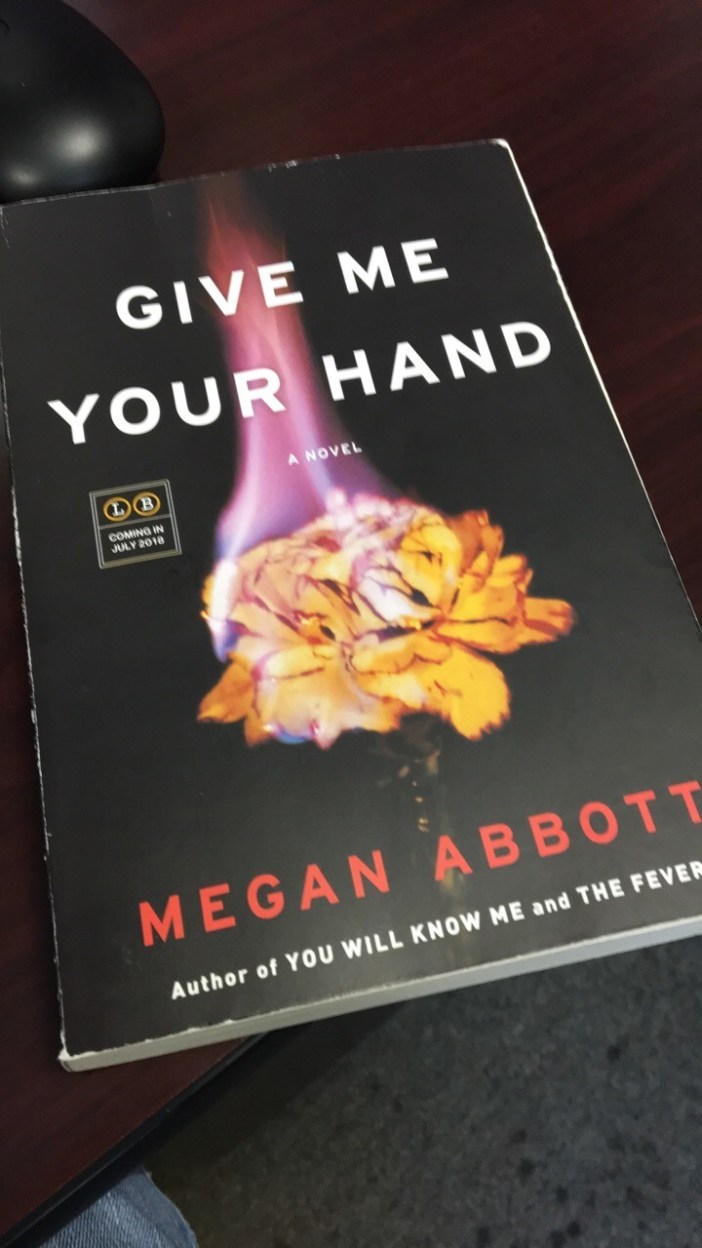
In other exciting news, I got an ARC of Megan Abbott’s forthcoming Give Me Your Hand in today’s mail, which has me thrilled to no end. I love her work; and she somehow manages to surpass herself with each successive novel, which is no easy trick. Now, to find the time to read it. I also have ARCs of Lori Roy’s new novel as well as Alex Segura’s, and I simply have got to find the time to read these books.

give me your hand

I know I’ve not been keeping up with the Short Story Project, but I have read a shit ton of stories already this year! I’ll get back to it, I promise, but I also think I’m going to proceed a little differently than I have been. I’ve been talking about every story I’ve read here, and I don’t think I am going to do that from now on; instead, I am only going to talk about ones that hit it out of the park for me. That may also mean I don’t post about newly read stories every day, but I think I would rather do this than try to find something to say about stories I didn’t care for as much as others; this ends up diluting the Short Story Project, and not allowing me the time nor the opportunity to delve as deeply into the stories I really enjoy.

And now, back to the spice mines. I only managed two thousand words yesterday; and as I said, I am behind. So, must make daily word counts!

I’m on Fire

Friday, and the day and the weekend stretch out before me like an unpainted canvas; blank and full of possibilities. I have a short day at work today, and I slept relatively well last night, so am feeling fairly good this morning. My left shoulder is mysteriously sore, tbough. Not sure what that’s about, but there you have it.

We finished watching Episodes last night, and it ended perfectly; very meta, and very funny. The entire show was kind of meta, really, and I have to give Matt Leblanc credit for not only playing himself, but playing himself as a complete egotistical self-absorbed asshole actor. Not sure what we’re going to watch now that we’ve finished both The Alienist and Episodes, but I have faith in us to find something–although we haven’t had much luck lately in finding something new; although The Alienist was absolutely a lucky find.

My kitchen is a mess this morning, which indicates that I need to get this mess cleaned up, and the sooner the better. Heavy heaving sigh. But….since I don’t have to go into the office until later, perhaps I could spend this morning cleaning the kitchen so I don’t have to do it tomorrow, which makes all the sense you can imagine, you know? I generally try to do some cleaning when I get home on my early day as well, so the weekend is freer to write or edit or do whatever it is that I want to. I need to write this weekend, as I’ve not been doing as much of that lately on the weekends as I need to. I’ve been asked to contribute to an anthology this week; which means I need to either find something I already have in a draft form, or write something entirely new. I don’t know how I feel about writing something entirely new, if I am going to be completely honest. I have the book to catch up on, some other stories that need to be finished so the collection is done, once and for all–primarily work on “My Brother’s Keeper” and “Don’t Look Down”–but there are an awful lot of stories that I have in various stages. I NEED TO REVISE THAT STORY BASED ON EDITORIAL NOTES AS WELL. WHY CAN’T I EVER REMEMBER I NEED TO DO THAT?

Heavy sigh.

Okay, I read a couple more stories for the Short Story Project, and first up was “Thinkers” by Kristine Kathryn Rusch, from Lawrence Block’s Alive in Shape and Color:

1970

Leo’s blood, warm against her cold hands, steamed in the frosty night air. Like hot coffee in a paper cup.

Lisa tried not to giggle, because she knew the giggle would be hysterical. She ran a hand over Leo’s face. He was leaning against the marble edge of the empty pool surrounding the Fountain of the Waters, legs splayed, head pointed toward Wade Lagoon.

Irv was just staring at him, and Helen–God knew where Helen had gotten off to, because Lisa didn’t. Her ears still rang from the explosion, which had been louder than she had expected.

This is a good story, flipping back and forth through time. In 1970, it’s about a group of student revolutionaries, planning to blow up Rodin’s “The Thinker” statue as a blow against the ruling class. The bombing goes awry and one of them is killed, and the viewpoint character, seeing death and destruction in person for this first time, starts rethinking her own radicalism and the ‘revolution.’ In the present day, the viewpoint character is a docent/intern/volunteer, working at the museum to advance herself, and she witnesses eventually a confrontation between a museum volunteer and a museum donor, and it doesn’t make any sense to her…but for the reader, they can see that’s the two women from the group in 1970, and how they, themselves, have gone from counter-culture revolutionaries to the ruling class they once despised. It’s very The Big Chill in some ways, and these theme–youthful radicalism aging into conservatism–has been explored in crime novels/films/television shows, and it’s always interesting, at least for me.

Next was “Gaslight” by Jonathan Santlofer, also from Alive in Shape and Color:

It was true, she hadn’t been feeling well, hadn’t been herself, the headaches, the nausea, the slight vertigo. But she was fine. She’d always been predisposed to colds and flu, periods of time when she didn’t feel quite right, sensitive, her mother used to say, and that was true. It was a virus, that’s all, at least she’d thought so for the first few weeks. But now, after three months, she wasn’t so sure.

“Give it time, Paula, you know how these New York colds can linger, especially in winter,” Gregory, her husband of six months, always so sweet, always trying to reassure her.

But what sort of cold lasted three months?

I loved this story; about a young, wealthy woman married to a struggling artist, who soon begins to suspect her husband might have married her for her money and might just be poisoning her…and what is she going to do about it? This is a classic romantic suspense trope, from the title being borrowed from the film that won Ingrid Bergman an Oscar to the trope which was the plot of almost every Victora Holt novel and was also used by any number of romantic suspense writers back in the day–but Santlofer turns it on its head, and shows how the line between romantic suspense and noir is actually rather blurry. The twists in the story are fantastic and earned, and the way Santlofer builds the suspense is magnificently done. Bravo, sir!

And now, back to the spice mines.

30728171_10155109528711486_2604031885516472320_n

Angel

Wednesday morning.The sun is shining outside, Scooter is on my desk staring outside at the outdoor kitties, and my kitchen is a disaster area. In other words, it’s a typical morning here at the Lost Apartment.

We continue to watch, and be enthralled by, The Alienist. There are only three episodes left, which is disheartening, but all good things must come to an end, and we shall simply have to find something else to watch.

I continue to work on “Don’t Look Down,” which is probably the longest short story I’ve ever written and will undoubtedly wind up either a novelette or a novella or however they determine what those things are. Which is fine; it’s just taking a lot longer to pull together than I thought it would, but I am also working on it piecemeal; a bit here, a bit there, and I am not worrying about language or sentence structure or so forth as I sort of map the story out. I’ve worked my way through the first half again, and now I have to work  my way through the back half, which needs to be strengthened and made more creepy. I also worked on “My Brother’s Keeper” a bit yesterday, filling in a couple of scenes that were missing–again, structural issues being repaired and filled in; I’ll go back over it and make it resonate stronger emotionally in a future draft. I also realized I never got around to doing the edits on a short story I got from the editor; I need to get that done, as well as some website writing I forgot about. My bad! Oops! Must get on that….

So here are some short stories. First up is “Trial by Combat,” by Shirley Jackson,  from The Lottery and Other Stories:

When Emily Johnson came home one evening to her furnished room and found three of her best handkerchiefs missing from the dresser drawer, she was sure who had taken them and what to do. She had lived in the furnished room for about six weeks and for the past two weeks she had been missing small things occasionally. There had been several handkerchiefs gone, and an initial pin which Emily rarely wore and which had come from the five-and-ten. And once she had missed a small bottle of perfume and one of a set of china dogs. Emily had known for some time who was taking the things, but it was only tonight that she had decided what to do. She had hesitated about complaining to the landlady because her losses were trivial and because she had felt certain that sooner or later she would know how to deal with the situation herself. It had seemed logical to her from the beginning that the one person in the rooming-house who was home all day was the most likely suspect, and then, one Sunday morning, coming downstairs from the roof, where she’d been sitting in the sun, Emily had seen someone come out of her room and go down the stairs, and had recognized the visitor. Tonight, she felt, she knew just what to do. She took off her coat and hat, put her packages down, and, while a can of tamales was heating on her electric plate, she went over what she intended to say.

Again, what Shirley Jackson is able to do so beautifully is also what, I think, Raymond Carver tried to do in his stories: the small details and foibles that make up human personalities. Emily’s struggle to get up the nerve to confront the person she thinks is stealing from her, how she goes over it again and again in her head before marching down the stairs–it’s just so utterly human, and real. I wish someone would do a movie like Short Cuts from Jackson’s short stories. She’s better than Carver.

“And Now to God The Father” by Daphne du Maurier, The Doll and The  Lost Short Stories

The Reverend James Holloway, Vicar of St. Swithin’s, Upper Chesham Street, was looking at his profile in the glass. The sight was pleasing to him, so much so that he lingered a considerable time before he laid the mirror back upon the dressing table.

He saw a man of about fifty-five years of age, who looked younger, with a high forehead and magnificent iron-grey hair, that was apt to curl slightly at the temples.

The nose was straight, the mouth narrow and sensitive, and he had been told that his deep-set eyes could be in turn humorous, dangerous, and inspired. He was tall and broad-shouldered; he carried his head a little to one side, and his powerful chin was tilted in the air.

This is another of du Maurier’s lost gems. It isn’t so much a story as a character study, of a particular kind of cleric; one who is more interested in his social position and the invitations he gets than actually doing anything to help unfortunate people, which is supposed to be his calling and his purpose. We see him flit through meetings and flirtations with wealthy and titled women…and then he actually causes harm and damage, trying to clean up a mess created by a profligate earl’s son. Of course he does the wrong thing, because he is the worst kind of cleric. Brilliant character study, absolutely brilliant, with that macabre du Maurier twist.

IMG_1242

Be Near Me

It’s a gray Monday, and I have a lot to do today before I return to work tomorrow. Yesterday was a complete waste of a day; I did manage to reread the first half of the first draft of the Scotty novel and spent some time reading/editing “Don’t Look Down”; not really sure how it needs to be fixed but am going to try to get that taken care of today. I need to run an errand at some point, and I must go to the gym today. But I need to get past the schedule I always am stubbornly stuck with; I’ve always done errands/gym around elevenish/noon; which is insane. There’s no required schedule as such; I can do errands or go to the gym at any time I please. So, yes, I am going to  work my way through things this morning, and try not to waste my time with social media, the way I always do.

It really is a time suck.

I’m not sure why I had such low energy yesterday; whether it was the gloom or the cold or whatever; but I had intended to go to the gym yesterday and run the errands. Instead I found myself listless and drained of all energy; I had to force myself to make lunch yesterday afternoon. I spent most of the day lying in bed reading–although I did managed to muster the energy to come downstairs and watch The Ritual on Netflix around eight o’clock last night. I feel better today so obviously the low-energy was something my body insisted on; it’s just been a long time since I’ve had such a day where I couldn’t force myself to do anything. I usually just brush all that aside and make myself do things. It didn’t work yesterday, alas.

I suppose the best thing to do is just accept that it was something my body needed and be done with it.

I also read some some short stories yesterday. First up was  “Taking Care of Business,” by Craig Ferguson, In Sunlight or in Shadow

The Reverend Jefferson T. Adams, beloved and respected minister of this parish for over fifty years, pulled deeply on the long fragile Jamaican-style reefer and held the smoke deep in his lungs. There was no sensation of getting high anymore, or indeed panic or paranoia or any of the other unpleasantness. No sensation at all really but he enjoyed the ritual.

He listened to the music from outside the church. It was too nice a day to go inside. Cold and still with a high milky cataract of cloud diffusing the sunlight enough to flatter the landscape, softening the edges and blanching out the imperfections like an old actor’s headshot.

The sea was guilty and quiet, like it had just eaten.

This is a poignant and sad story, about a minister who is dying from cancer and smoking medical marijuana with an old friend every day as his life fades away from him. The two old men talk about things, reveal secrets to each other they’ve kept hidden away from the world their entire lives, and finally, as every story about death must, it ends with the death of the reverend, but it’s not sad, it’s kind of poignant and beautiful. Craig Ferguson is an actor/comedian/writer; he was on The Drew Carey Show and later hosted The Late Show (or something like that); I was pleased to see he is also quite talented as a writer.

Next up was “Guilt-Edged Blonde” by Ross Macdonald, from The Archer Files.

A man was waiting for me at the gate at the edge of the runway. He didn’t look like the man I’d expected to meet. He wore a stained tan windbreaker, baggy slacks, a hat as squashed and dubious as his face. He must have been forty years old, to judge by the gray in his hair and the lines around his eyes. His eyes were dark and evasive, moving here and there as if to avoid getting hurt. He had been hurt often and badly, I guessed.

“You Archer?”

I’d taken a long break from reading Macdonald’s short stories; while I appreciate and quite like his hard-boiled style, sometimes though it becomes a bit much to deal with, and in the short stories, that is particularly obvious and somehow more difficult to deal with. I do love the way the stories twist and turn and become something far different than they start as; this story has Archer hired as a bodyguard, only to arrive to meet with his client who’s already been murdered, and a blonde woman is seen fleeing the scene. The client had basically been a mob accountant and stole money from them; and was worried they were going to come after him. However, the story has nothing to do with how it’s set up, and it’s quite a twisty and strange tale. This is one of the stronger Archer short stories, but…again, a little of that hardbitten, hard-boiled, macho straight man sensibility goes a long way in my book; so it’ll probably be a while before I return to The Archer Files. I don’t to make it sound like I don’t like Macdonald and these stories…I do. Reading a Macdonald novel is a bit different. Most of the Archer novels are short and they move so quickly you’re so wrapped up in the story–and the focus is on the story more so than the style; the short stories, oddly enough, because they are short the style is more apparent than in the novels. I’m not entirely sure if that makes sense, but I think it does, even if I can’t seem to put it into words properly.

tumblr_p2iqqx41tz1sh6rbgo1_540

Glory Days

God, there’s nothing more depressing than paying the bills, is there?

Yesterday was a good writing day; I should be able to finish off Chapter Nine today, which is absolutely lovely. If I can get Chapter Ten done by the weekend–which I should be able to do, no problem–then I’ll be halfway finished with the first draft. Huzzah! All downhill from there, too. Although there’s an awful lot to cram into the last ten chapters…I may have to plan that out a little better. Heavy sigh. But I can also work on outlining it, to have a general idea of what direction I’m going in, which will be enormously helpful. I don’t ever stick to the outlines–ever–but it helps give me a general idea of what direction to go in.

I was also going over an editor’s note on one of my short stories, which were absolutely lovely, in all honesty. I want to get that done over this weekend–I’ve taken Monday as a vacation day, so I have a three day weekend this weekend, the intent to get as much cleaning and writing and editing done as I possibly can; Paul left yesterday morning to visit family for a week, and hey, why not use the time as effectively as possible?

I also read some more of The City of Falling Angels last night; I am really enjoying John Berendt’s views on Venice, and also kept thinking, wow, I’d love to take an apartment in Venice for a couple of months, how awesome would that be?

I intend to finish Bryan Camp’s debut novel this weekend as well, since it’s pub date is coming up, so I can get a review posted on here.

It never ends, really.

I read some short stories, too! First up was “Nighthawks” by Michael Connelly, from Lawrence Block’s seminal In Sunlight or in Shadow:

Bosch didn’t know how people in this place could stand it. It felt like the wind off the lake was freezing his eyeballs in their sockets. He had come totally unprepared for the surveillance. He had layers on but his top layer was an L. A. trench coat with a thin zip-in liner that wouldn’t keep a Siberian husky warm in the Chicago winter. Bosch wasn’t a man who gave much credit to cliches but he found himself thinking: I’m too old for this.

The subject of his surveillance had come down Wabash and turned east toward Michigan and the park. Bosch knew where she was going because she had headed this way on her lunch break at the bookstore the day before as well. When she got to the museum she showed her member pass and was quickly admitted entrance. Bosch had to wait in line to buy a day pass. But he wasn’t worried about losing her. He knew where she would be. He didn’t bother to check his coat because he was cold to the bone, and he didn’t expect to be in the museum much more than an hour–the girl would have to get back to the bookstore.

I’ve not read a lot of Connelly, but I remember meeting him many years ago at the Virginia Book Festival and liking him a lot. I read the first Bosch novel sometime in the last seven or eight years and greatly enjoyed it; I’ve not watched the Amazon series but probably will at some point. There are just so many Connelly novels to get caught up on, it just overwhelms me to even consider reading them all. But this is a Bosch short story, and a good one. In this story, Bosch has retired (or quit) the police force and has become a private eye; which is cool. The story is terrific; he was hired to find a Hollywood bigshot’s daughter, he finds her–and then finds out why she disappeared in the first place…and then faces a moral dilemma. Truly a terrific story!

The next story was “The Incident of 10 November” by Jeffery Deaver, also from In Sunlight or in Shadow:

December 2, 1954

General Mikhail Tasarich, First Deputy Chairman of the Council of Ministers of the Union of Soviet Socialist Republics

Kremlin Senate, Moscow

Comrade General Tasarich:

I, Colonel Mikhail Sergeyivich Sidorov, of recent attached to the GRU, Directorate for Military Intelligence, am writing this report regarding the incident of 10 November, fof this year, and the death associated therewith.

I am way behind on my Deaver reading as well; I greatly enjoyed the Lincoln Rhyme series, but as I said, I fell behind and now am SO far behind on him that I despair of ever catching up; same with Lee Child. This is the second story of Deaver’s I’ve read that has dealt with the Cold War Soviet Union, from the point of  view of one of their agents; the other was in the MWA anthology Ice Cold. I don’t know if this is an interest of Deaver’s, or if one story begot the other, or if he’s written novels around this subject, but my interest was piqued. It’s a great story, flows really well, and has to do with a German scientist who was absorbed into the Soviet Union after the end of the Great Patriotic War…and I really enjoyed.

Now, I best get back to the spice mines.

28467762_1815115152116053_4842812587806162278_n

Run to You

Yesterday I wrote 2700 words, which was lovely. Two more chapters and I will be at the midway point of the first draft of the Scotty book! Huzzah! I do feel like most of those words were crap, but I advanced the plot, I advanced the story, and we’re percolating right along, which was truly, well and indeed, lovely. I hope to reach the midway point of the book by the weekend, which is when I am hoping to finish revising “Don’t Look Down” and “My Brother’s Keeper,” and maybe even “The Problem with Autofill.” Huzzah! I love that I am working again, and I am trying to keep my confidence in my work up. It’s so easy to get distracted, it’s fucking easy to hit that downward spiral, and I WILL NOT HAVE THAT THIS YEAR.

Ain’t gonna happen, bitches.

I finished reading Jon Ronson’s So You’ve Been Publicly Shamed this week, and I really enjoyed it. It really made me think about a lot of things, not the least of which are the on-line social media lynch mobs. I mean, there are so many truly terrible people on Twitter, trolls and bots and so forth, that it’s easy to forget that some of the people we see posting vile things, or things we totally disagree with, are people, just like we are; even though we may not agree with anything they do. I know it surprises people that I have conservative friends, but I do; and as long as they aren’t nasty and trollish, I like having them around on my social media. They do sometimes help me see things in ways that I’ve never thought about before, that may not ever have occurred to me, and I do appreciate that insight. The fact that I can see their posts and comments means that they haven’t blocked me; they may have hidden me–and to be fair, the shirtless men that get me banned all-too-frequently on Facebook might be a bit much for my conservative friends–but I also never see them saying anything homophobic or anything that makes me think they buy into the homophobic bullshit that is so frequent on their side of the spectrum; whether knowing me has anything to do with that, I don’t know. I’d like to think so, at any rate.

My next non-fiction is John Berendt’s The City of Fallen Angels. I’d forgotten I even had the book, to be honest; I was rearranging and reorganizing bookshelves the other day and there it was. VENICE!!! How could I resist? So, it’s on the nightstand for my before-I-go-to-sleep reading. I’m also itching to get back to Bryan Camp’s The City of Lost Fortunes. Seriously, pre-order the hell out of this one. You won’t be sorry.

I also read some short stories. First up is “The Misfits” by Naomi Rand, from Crime Plus Music, edited by Jim Fusilli:

Where would you have been without me, go on, tell me that why don’t you, you ungrateful bitch. I made you.

That was his parting shot to me. Johnny O believed that until the minute he cast his eyes upon you, you didn’t actually exist. My ex-manager thought I was some piece of clay he breathed that lousy cigarette breath into to coax to life.

I believed otherwise. My version is that when we met, I  had already been alive and well and living in Calabasas for seventeen years. I, Julie Weston, was a senior at Calabasas High. I’d already been accepted to my first choice school, UCLA. And why not? I had a 4.0 average. Plus, I was captain of the girl’s swimteam, lynchpin of the debate team, and to top it off, I was dating the boy most likely to be crowned prom king. So really I did exist before. Not only did I exist, I was well on my way to making my doting parents proud. But you be the judge.

I fucking loved this story; it was amazing. A chance encounter in Tower Records, and Julie joins an all-girl band called the Misfits, which begins a quick rise to stardom in the late 1970’s. It kind of reminded me of the true story about the Runaways–the all girl rock band which launched Joan Jett and Lita Ford–and some of the horrible allegations that have come out in recent years about their manager, how the girls were manipulated and/or sexually/emotionally/physically abused; I couldn’t get that out of my head as I read the story. It’s absolutely terrific, with a great ending. I have to say, I am loving reading my way through Crime Plus Music.

Next was “Rooms by the Sea” by Nicholas Christopher, from In Sunlight or in Shadow and editor Lawrence Block:

There were two doors into this house. The first, in a small unfurnished room, opened directly onto the sea. It could only be entered from the water. When it was left wide open on a sunny day, the light slanting into the room illuminated half of the near wall on a diagonal. As the sun descended to the horizon, the wall could be read like a sundial: its illuminated half shrinking until the entire wall had darkened.

The second door, in a foyer on the other side of the house, opened onto a rough path that wound through a forest and ended in an obscure park at the city limits. The fountain in that park, centered by stone mermaids that spout water, had been dry for months. The buildings that lines the city streets were red and brown. The sun ate into their brick, sending up puffs of dust. At dusk their blue windows turned amber. On the fire escapes women were smoking and reading, gazing up occasionally at the river of bruised clouds that flowed to the sea. One of them, a redhead, was reading a slim memoir entitled Rooms by the Sea, written a century ago. The author, Claudine Rementeria, was married to a Basque shipping magnate who had immigrated to America. She herself was Basque, and shortly before her untimely death at thirty, she wrote the book in her native language, Euskera, in order to please her husband. Aside from a small private printing at the time–of which only a few copies have survived–her book hadn’t been translated and published in English until recently. The redhead, Carmen Ronson, the thirty-year-old great-granddaughter of Claudine Rementeria, owned both the English translation and one of the extant Euskera copies.

This story read more as a fable; a literary story rather than a crime story, with a haunting tone to it;  Christopher did a great job creating a mood that carried through the whole story with the rhythm of the words. It’s more of a magical realism story; a fable, if you will, relating the Basques back to Atlantis and…it’s hard to describe. It’s quite good.

And now, back to the spice mines.

29594408_10211616758243041_8636825159989588484_n

All Through the Night

Well, I finished an incredibly difficult chapter of the Scotty book last night, and can now move on to the rest of the story. I despise transitional chapters, and this one was particularly painfully hard; it’s why I initially set the manuscript aside to begin with all those weeks ago. But now I am full on into the investigation, and things can really start happening now; the red herrings and the incredible confusion. This book is going to probably wind up having a plot as convulated and confusing as Mardi Gras Mambo was, and I do consider that to be, in fact, a very good thing. I am feeling very ambitious as I return to tackling this manuscript, and it’s been quite a while since I have felt that way.

And, now that I reflect on it, to not feel ambitious as one embarks on a search for a possible agent is quite possibly the stupidest mentality one can have for such a thing; if for no other reason that one is already defeated in spirit. It is so easy to give up, it is so incredibly easy to be defeated in spirit as one pursues a career in writing, that one has to grasp onto ambition with both hands and squeeze the very life out of it. I’m not sure when or where or why I allowed my ambition to fall to the wayside, but not only was it gone but I didn’t miss it. Which is a very strange thing to admit to; but ultimately not surprising. Ambition is one of those traits I was raised to believe was unseemly, unpleasant, and unattractive. I still struggle, to this day, with taking pride in achievements; to accepting compliments without prevaricating or being self-deprecatory in response. Sometimes I hear myself responding to a compliment and hear a tiny, desperate voice wailing from deep within the recesses of my own mind, just accept the fucking compliment.

And how many times has this self-doubt, this insecurity, this self-defeating mentality stopped me from reaching for something I wanted? Stopped me from attempting to write something outside of my comfort zone, something I want desperately to try? Far too many times, I have to admit, much as it pains me to do so.

Confidence is such a funny thing, isn’t it? Even the word–which I use to mean belief in yourself–had another meaning; con comes from confidence…con man is a confidence man; likewise,  a con artist is a confidence artist.

So is confidence, self-confidence, the art of deluding yourself, conning yourself into a belief that you have more value than you actually do, perhaps?

Although I must say, wrestling that chapter into submission–no matter how bad the writing may be, no matter how bad the chapter might be–has certainly made me feel a lot more confidence in myself; because of course there was the fear that I’d never be able to get this chapter done, that the book would stall out, that I would fail.

But I did it. I worked through it, and I already know how the next chapter is going to go.

And that’s a good thing.

I also read some short stories. First up is “Serial Benefactor” by Jon L. Breen, from Manhattan Mayhem, a Mystery Writers of America anthology edited by Mary Higgins Clark.

To start with, I’m a centenarian, Sebastian Grady by name, and still fully marbled. My current address is Plantain Point, a retirement home on the California coast with a lot of residents from the entertainment world. To give you an idea, the president of our association is called the Top Banana, though most of the vaudevillians have died off.

As you can imagine, I’ve seen many younger generations come of age, and the current lot don’t seem too anxious to make the transition to adulthood. Don’t ask me if I blame them.

Evan is my favorite great-granddaughter.

This story is very clever, and I enjoyed it very much. It concerns a series of murders back in the post-war era; with all the victims being associated with the theater in some way, and all being pains in the ass to everyone who’s ever had to deal with them. There is a conversation at a cocktail/dinner party, and shortly thereafter people start dying. Clues are planted in the newspaper–lines from songs from musicals–and the killer is never caught. Sebastian poses the story to his great-granddaughter Evan to see if she can figure out the clues and how they relate to the murder victims. Sebastian has his own theory about the murders…and while we never are certain who the killer is, we do get a pretty good idea. And there’s a LOVELY twist at the end.

Next up was  “The Blackbird” by Peter Robinson, from Crime Plus Music, edited by Jim Fusilli:

It ended with a head floating down the river. Or is that where it began? You could never be certain with the Blackbird. I should know. I’ve known him for years, and I was with him until the end. Well, almost.

His real name was Tony Foster, and once, quite early in our relationship, I asked him how he had acquired his nickname. Tony drew on his cigarette in that way of his, cupping it in his palm like a soldier in the trenches, as if he believed it would be bad luck to let anyone see the glow. He turned his blue eyes towards me, a hint of a smile lighting them for a moment, then he looked away and told me it came about when he was a teenager growing up in a rundown council estate in the mid-sixties.

This isn’t necessarily a crime story, although there is a crime in it; the crime is how the story ends, but the story isn’t about the commission of the crime or the solving of the crime, but I suppose it is sort of about how the crime effects the narrator of the story. It’s really a sad, bleak tale that leaves the reader full of melancholy when it’s finished; it’s beautifully written and terribly sad. Well done, Mr. Robinson, well done.

IMG_1095

Smooth Operator

April Fool’s Eve!

I slept in this morning, after staying up much later than I intended last night. I’d read somewhere that you should stop looking at a screen of any kind–television, computer, phone, iPad–at least half an hour before going to bed to help with sleep, and frankly, I’ll try just about anything that will help in that regard; so I’ve started keeping a non-fiction book on my nightstand, to read for about half an hour every night before attempting sleep. The last two I read were The Black Prince of Florence and Joan Didion’s After Henry; last night I started onJon Ronson’s So You’ve Been Publicly Shamed. I couldn’t stop reading it, of course, and before I knew it, I’d read through the first two people he’d interviewed about their public shamings–Jonah Lehrer and Justine Sacco–and wanted to keep going; but I forced myself to put the book down because it was much later than I wanted to stay up and I was worried about not getting up this morning.

I was right.

It’s kind of interesting to be reading the Ronson book about how public shaming destroyed the lives of two people–one who did something terrible (Lerner) and the other who made a really dumb joke on Twitter that went viral–and Ronson is really a good writer; I actually have some sympathy for the people he is writing about. But this is another, perfect example of why Twitter terrifies and fascinates me at the same time. I can’t imagine how horrible it would be to go viral in such a way on social media, but then again, I try to be very careful with social media. Is that cowardly? Perhaps it is, but i also don’t have time for arguing with people on social media, nor do I have an inclination to do so. I am frequently exposed to different viewpoints on my own social media–but as long as it is couched respectfully and is not in any way nasty or vicious, I like seeing points of view that are different than my own. (Homophobia, misogyny, and racism, however, are always deal-breakers. I never have any sympathy or interest in seeing that point of view.)

As you can tell, I am finding the book to be very interesting.

We also finished watching Season 2 of Santa Clarita Diet, which is hilarious. I highly recommend it. I also got caught up on Krypton and Riverdale yesterday, and did some more writing–not very good writing, mind you; for some reason “Don’t Look Down” is becoming increasingly more and more difficult to write, but I am determined to get that first fucking draft done this weekend. I also want to get some revisions done today. I am going to run some errands and go to the gym in a little bit, and then I am hoping to be able to get home and sit down and just write for the rest of the afternoon, which is going to require me shutting down all social media and closing my web browsers. I think I’ll clean the windows today as well, and maybe do some cleaning…which is the best way to deal with getting stuck on writing.

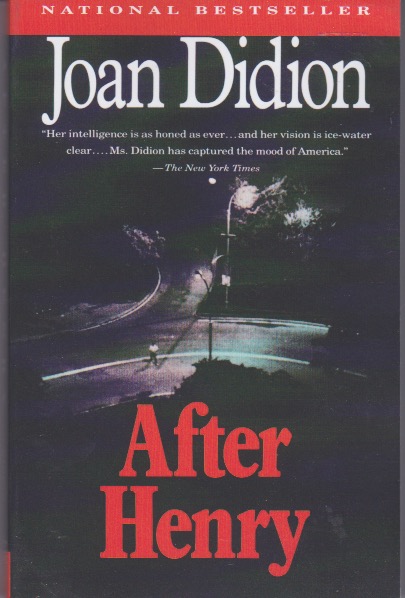
As I said, I finished reading Joan Didion’s After Henry this week.

after henry

It’s a collections of essays she wrote that were published in various places, and tackle various subjects in that amazing style of writing she had; the way she constructs sentences, and puts words and paragraphs together, is so amazing that it’s hard sometimes to drink in what she is actually saying. These essays, about politics in Los Angeles; natural disasters in southern California; the Central Park jogger case in New York; the political conventions in 1988; the Reagan administration and the face it presented to the world; and several others, are pretty amazing and also serve as a kind of time capsule of recent history. I am really looking forward to reading another non-fiction Didion book, and possibly another of her novels.

I had finished reading The Black Prince of Florence before I took up the Didion.

the black prince of florence.jpeg

As Constant Reader is aware, I am fascinated by the Medici family of Florence, who rose from being merchant class to one of the wealthiest banking families in Europe to popes and queens to royalty in their own right. Alessandro de Medici, the little known subject of this biography, was the first Medici to attain royalty on his own; due to the machinations of his uncle, Pope Clement VII (better known to history as the pope who refused Henry VIII’s request for a divorce from Catherine of Aragon), he became Duke of Florence and the republic came to an end. Alessandro was illegitimate, and there is no proof of whom his mother was; his legitimate sister, Catherine, became queen of France. Fletcher does an excellent job of explaining the tumult of the times; how Italy had been riven by a series of wars between different city-states as well as between France and the Holy Roman Empire, both with extensive claims to various places on the peninsula, along with all the machinations in Rome for the papacy. The question of whether Alessandro’s mother was an African slave, or that was simply a slander to discredit him during his lifetime by his enemies, is one that Fletcher takes up; she also explains the differences between modern day views of race as opposed to those of the sixteenth century. I found the book to be endlessly fascinating, and really helped me get a better grasp of just how the Medici family became royalty. Alessandro’s sister Catherine is probably the most famous (notorious?) member of the family; I have numerous biographies of her on my shelves I look forward to reading.

I’ve also read some more short stories for the Short Story Project. First up is”A Poison That Leaves No Trace” by Sue Grafton, from Kinsey and Me:

The woman was waiting for me outside my office when I arrived that morning. She was short and quite plump, wearing jeans in a size I’ve never seen on the rack. Her blouse was tunic length, ostensibly to disguise her considerable rear end. Someone must have told her never to wear horizontal stripes, so the bold red-and-blue bands ran diagonally across her torso with a dizzying effect. Big red canvas tote, matching canvas wedgies. Her face was round, seamless, and smooth, her hair a uniformly dark shade that suggested a rinse. She might have been any age between forty and sixty. “You’re not Kinsey Millhone,” she said as I approached.

“Actually, I am. Would you like to come in?” I unlocked the door and stepped back so she could pass in front of me. She was giving me the once-over, as if my appearance was as remarkable to her as hers was to me.

This story is kind of clever, with a surprise twist at the end that caught me off guard; a woman hires Kinsey to prove that her niece murdered the woman’s sister for the insurance money. It’s fraud, all right, but not what Kinsey was originally led to believe, and the twists and turns are spooled out very cleverly.

The next up was another Sue Grafton tale from Kinsey and Me, “Full Circle.”

The accident seemed to happen in slow motion–one of those stop-action sequences that seem to go on forever though in tryth no mare than a few seconds have elapsed. It was Friday afternoon, rush hour, Santa Teresa traffic moving at a lively pace, my little VW holding its own despite the fact it’s fifteen years out of date. I was feeling good. I’d just wrapped up a case and I had a check in my handbag for four thousand bucks, not bad considering the fact that I’m a female private eye, self-employed, and subject to the feast-or-famine vagaries of any other freelance work.

I glanced to my left as a young woman, driving a white compact, appeared in my driver’s-side mirror. A bright red Porsche was bearing down on her in the fast lane. I adjust my speed, making room for her, sensing that she meant to cut right in front of me. A navy blue pick-up truck was coming up on my right, each of us jockeying for position as the late afternoon sun washed down out of a cloudless California spring sky. I had glanced in my rearview mirror, checking traffic behind me, when I heard a loud popping noise. I snapped my attention back to the road in front of me. The white compact veered abruptly back into the fast lane, clipped the rear of the red Porsche, then hit the center divider and careened directly into my path. I slammed on my brakes, adrenaline shooting through me as I fought to control the VW’s fishtailing rear end.

This story opens with one of the best descriptions of the slow-motion horror of an accident on the highway; how it happens right before your eyes and how you basically have to rely on instinct and automatic reaction to try to avoid the accident because your brain is so busy processing what it’s seeing. The story is worth reading for that alone, but it turns into a case when the mother of the girl driving the compact, Caroline Spurrier, hires Kinsey because it turns out the accident didn’t kill Caroline; she’d been shot. The man driving the truck also has disappeared. From that point on, it’s a great example of a private eye story.

Sigh. I’m going to miss Sue Grafton.

Suddenly

Yesterday I finished revisions on four stories, took a deep breath, and submitted them. Now, we wait. I’m not entirely certain the stories were right for the markets I sent them to, but you know what? Letting them just sit in my computer wasn’t getting them out there. Better to try and fail than not to ever try at all.

As I said yesterday, my confidence in my writing, which, despite all appearances to the contrary has never been strong, was dramatically shaken in the last year; I am only now starting to come out of it, and I am coming back out of it by working. I’ve written well over a hundred thousand words thus far in 2018; most of it short stories, some of it work on a new Scotty novel, still other the manuscript I intend to try to lure the ever elusive agent into my web with; and since sitting down and actually taking stock, I am realizing what I’ve accomplished, and am very proud of myself. The stories I worked on again this week, revising and editing and reading aloud, were quite strong; the two I am struggling with perhaps not as strong–although I do like their titles. Forcing myself to continue working on them is futile at this moment; much as I am loath to put them to the side, I am going to; there is nothing more self-defeating and depressing than trying to force yourself to write something that just isn’t coming. The stories are there, of course; I just haven’t yet worked out how to get them down onto paper yet. I think very often we, as writers, get so bogged down in our stubborn determination to finish something we are working on that we just keep fighting, pounding our head determinedly against an immovable wall–when the smart thing is to take a break from it and work on something else; then come back to the wall with fresh eyes and a rested forehead.

A vanity project that I have always had in the back of my mind was to put together a short story collection of my crime stories. I first had the idea several years ago, but didn’t have enough stories and was going to combine my horror and crime together: the folder and table of contents I created at the time was for Annunciation Shotgun and Other Stories. I’ve never forgotten this vanity project; and even now, when I should be preparing the manuscripts of Bourbon Street Blues and Jackson Square Jazz for their long overdue ebook editions, I go back to the vanity project again and again: well, I’ve published THESE stories since then, maybe I can just go ahead and remove these others that don’t fit as well–take these horror stories out, since my horror is clearly not as strong as my crime fiction. I made another table of contents, just the other day; only now I am calling it Survivor’s Guilt and Other Stories. Whenever I’ve been stuck this past week or so, for want of anything else to do, I’ve started pulling the stories together into a single document to get a word count. The realization the other day of how many stories I’ve done so far this year already, and adding them casually to the table of contents–today it hit me: the manuscript is already publishable length, is over eighty thousand words, without an introduction  and without all of the stories I’ve done so far. I removed all the horror–goodbye, “Crazy in the Night” and “Rougarou” and “The Snow Queen” and “The Troll in the Basement”–and added some more of the newer material. It was astonishing to realize how much there actually was; that I cannot add much more because there simply isn’t room, and that I might have enough for a second volume in a couple of years.

Mind-blowing, really.

Short story collections don’t sell as well as novels, of course; short stories are the bastard stepchildren of publishing, and crime stories even more shunned at the family holiday dinner table. I don’t know if my publisher will want this collection, and I may end up having to self-publish it. Whereas I would have shrank in horror from that possibility a few years ago, it doesn’t matter as much to me now as it did then to have a traditional publisher pull the book together; although I would like another pair of eyes on it, some copy editing, a cover design and packaging done for me. But I am very proud of all of these stories; each one of them means something to me in some way. And if my fears about crime stories with gay characters in them not being acceptable to mainstream short story publications, well, I can always get them seen this way. And I am proud of the new crime stories I’ve written with gay characters in them.

I didn’t write crime stories for the longest time because of that fear; the fear that no matter how high the quality of the story, gay characters would make them unpublishable. The two stories I published in Ellery Queen’s Mystery Magazine, “Acts of Contrition” and “The Email Always Pings Twice,” were mainstream–not a gay character in either story. I did publish two stories in Novelists Inc. anthologies with gay characters, “A Streetcar Named Death” and “An Arrow for Sebastian.” My stories in New Orleans Noir and Sunshine Noir (“Annunciation Shotgun” and “Housecleaning”, respectively) were about gay characters. My story in Blood on the Bayou, nominated for the Macavity Award last year, “Survivor’s Guilt,” wasn’t gay in any way, nor was my story “Keeper of the Flame,” published in Mystery Week. Some of the new stories are gay, some are not. Two that went out today were about gay characters, two of them were not. I was originally not intending to write any crime stories with gay characters this year; it just sort of happened. I think the Chanse story I’ve written–which needs a new title–is pretty decent; but am I limiting my chances of getting the stories into print by writing about gay characters? It’s already a difficult haul finding markets that still take short stories, and the competition is obviously fierce.

And again, as I said yesterday, you never can be certain your story was rejected because you wrote honestly about gay characters. It’s all part and parcel of the insanity of being a gay writer, or a writer who is gay, or whatever the hell label fits on my sash as I walk across the stage at the beauty pageant of publishing.

But I’ve got more than enough stories for a collection now, and I am going to keep playing with the manuscript; what is the proper mix of previously published stories versus new material? Should it all be new material, or should it all be previously published material?

Decisions, decisions.

Therein, indeed, lies the path to madness.

I also read some short stories. First was “Still Life with Teapots and Students”, by Shirley Jackson, from the  Let Me Tell You collection.

Come off it, kids, come off it, Louise Harlowe told herself just under her breath. SHe smiled graciously at her husband, Lionel’s, two best students, noticing with an edge of viciousness that they both held their teacups exactly right, and said lightly, “You’re going to have a pleasant summer, then?”

Joan shrugged perfectly, and Debbi smiled back, as graciously as Louise had smiled, but with more conviction. “It will be about the same as the others, I guess, ” Debbi said. “Sort of dull.”

They’re both too well bred to tell me what they’ll be doing, Louise thought, and asked deliberately, “You’ll be together, of course?”

Jackson is one of my favorites, and while she is mostly known for “The Lottery” and The Haunting of Hill House and macabre, Gothic work, she wrote a lot more than people think and not everything she wrote was macabre. This nasty little tale, in which a professor’s wife has two of his students over for tea–during the course of which she lets the rich little bitches she knows about their affair with her husband, and what’s more, doesn’t care because they are nothing more than something of the moment, is quite rich and layered and textured. From a modern day perspective the wonder is why she doesn’t leave him, as it becomes clear this happens regularly; they politely discuss another faculty wife who wasn’t quite as calm in confronting the student her husband was messing around with, and it’s all very polite and reserved…yet, in this modern era of #metoo and power differentials, the agency both Jackson and the wife in the story give the students–and the contempt and hatred for them the wife feels, but never reveals–makes me wonder. I’m still unpacking this story, several days after reading it; which is how amazing it–and Jackson–are.

And then it was time for “The Doll” by Daphne du Maurier, The Doll: The Lost Short Stories.

I want to know if men realize when they are insane. Sometimes I think my brain cannot hold together, it is filled with too much horror–too great a despair. And there is no one; I  have never been so unutterably alone. Why should it help me to write this?…Vomit forth the poison in my brain.

For I am poisoned, I cannot sleep, I cannot close my eyes without seeing his damned face..

If only it had been a dream, something to laugh over, a festered imagination

It’s easy enough to laugh, who wouldn’t crack their sides and split their tongues with laughing. Let’s laugh till the blood runs from our eyes–there’s fun, if you like. No, it’s the emptiness that hurts, the breaking up of everything inside me.

DuMaurier’s story often have a polite, observational distance and formality to them; much like her novels, even in the first person. This story, of obsession and lust and desire, all of which are thwarted, is not only reminiscent of My Cousin Rachel, but also, as I was reading, made me wonder. We never learn the name of the first person narrator, but the object of his obsession is a woman named Rebecca–you see where my mind was going with that, don’t you? And in some ways, it works as an almost prequel for the novel; the deep obsession and need; the mysterious woman who plays out her cards slowly. What of course doesn’t fit is the doll itself; the woman owns a male doll she has a strange attachment to, a doll our narrator despises, hates, is jealous of; it’s a terrific story of darkness and deep passion and obsession and perhaps, madness….a great example of why I love du Maurier so much.

And now, back to the spice mines.

IMG_2256