Call It What They Want

Thursday morning and my Sparky alarm-cat has me up before six! It’s fine, I was tired and sleepy last night so went to bed around nine, and I slept really well, too. The coffee is hitting the spot this morning, and I’ve already had some breakfast. I am now back up over 190, and my face isn’t gaunt, skeletal and frightening to see in the morning mirror anymore. Tomorrow is of course Remote Friday, and then it’s the weekend, huzzah! I am hoping to finish a newsletter today, too.

I was saddened to hear the news about Edmund White yesterday. It seems like our queer literary icons are all dying now, doesn’t it? Dorothy, Felice, Victoria, and now Ed. I didn’t know Ed very well–well enough to call him Ed, I suppose–but every interaction we ever had was pleasant, and he was always kind to me. I saw a lot of people talking about A Boy’s Own Story yesterday, but my favorite of his works that I’ve read will always be The Farewell Symphony. I fell way behind on his work over the years, but that doesn’t mean I didn’t appreciate him for his talent and what he has done and meant to queer literature over the last fifty or so years. My condolences to his husband, Michael Carroll, and all his friends and family who are grieving.

I also realized last night that we are losing that last generation of gay writers whose careers straddled HIV/AIDS; those that were publishing before, during and after. That’s some history being lost, but most of Ed’s books were autobiographical novels, so that history is still there. As I get older, I am also beginning to understand the drive to write memoirs.a It’s gay history that doesn’t otherwise get recorded, and we need to leave records behind of what it was like to be gay during our lifetimes and the changes, both good and bad, that we’ve witnessed.

I did some chores–not enough, of course–when I got home from work yesterday, but I was pretty tired from the day. I usually have a second person working with me in clinic, but she was out sick yesterday so I did it all by myself. I also stayed on top of my Admin work and was highly efficient, if extremely tired, when it was time to make groceries and come home. I unloaded the dishwasher and finished the laundry (there’s still another load to put in the dishwasher), and we watched another episode of Department Q, which we are really enjoying.

I was worried last night, as I dozed off in my easy chair, that I may have overdone it yesterday and would be worn out this morning, but since I am up earlier than my norm I am going to have to assume that I am not, in fact, worn out. The thing is I have to keep pushing myself to do more and be more active rather than being the slug that I prefer to be; because that first time might exhaust me, but the second time it doesn’t.

In other interesting kids’ series news, Random House is rereleasing the Trixie Belden series with new covers and using old illustrations from previous editions. I don’t know if they are going to do the entire series or not, but so far the first four (The Secret of the Mansion, The Red Trailer Mystery, The Gatehouse Mystery, and The Mysterious Visitor) are out in the wild now. I’m debating whether or not to get the new editions–it’s just more clutter for the house, actually–but it might be fun to revisit them, and I don’t know where my copies are. I always preferred Trixie to Nancy Drew, but Nancy was ubiquitous you were always more likely to find those while Trixies were harder to find. (They were also a lot cheaper–I was getting the ones referred to by collectors as “Whitman uglies” because the covers were bad–I didn’t think so, but I am not a Trixie expert.)

I was too foggy and tired last night to either write or read, so hopefully that will be different tonight.

And on that note, I am heading into the spice mines. Have a lovely day, Constant Reader, and I’ll be back on the morrow.
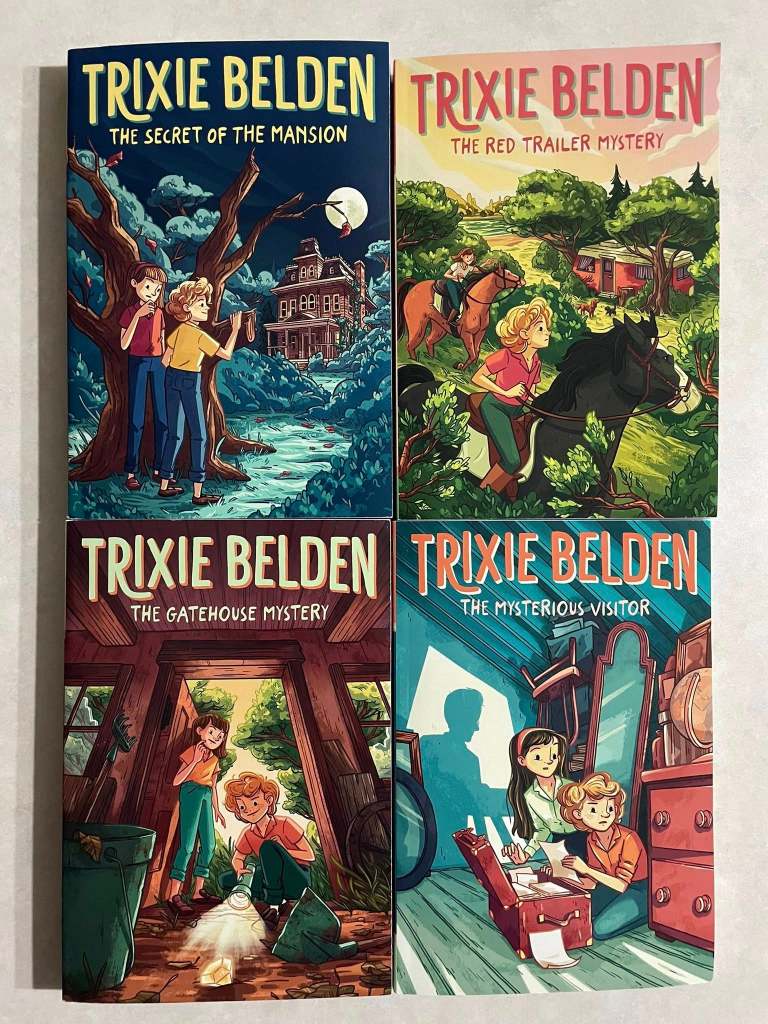
Not sure how I feel about these new covers, but Trixie and Honey look age-appropriate at least!

Roar

Ah, Nancy Drew.

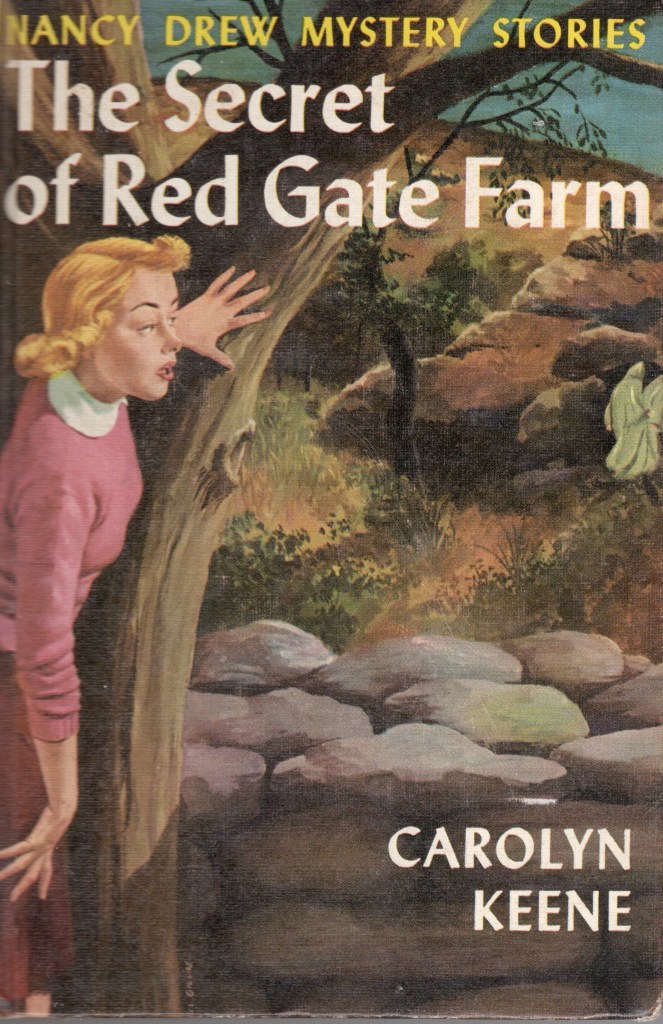
Nancy Drew wasn’t the first kids’ sleuth series I discovered (Trixie Belden’s The Red Trailer Mystery and The Three Investigators’ The Mystery of the Moaning Cave came first), but when I was in the fifth grade, sometime between 1969 and 1970, we had a table of books in the back of the room that had belonged to the (now grown) children of our teacher. I was already reading mysteries checked out from the library or ordered from the Scholastic Book Fair, so when I saw The Secret of Red Gate Farm there on the table, along with the banner NANCY DREW MYSTERY STORIES, I couldn’t pass it up.

And on the back was a listing of all the titles in the series to that point in Nancy Drew history when this copy was printed. This was very exciting for me–a series? Of mysteries? I’d never heard of such a thing, and my life was about to be changed forever.

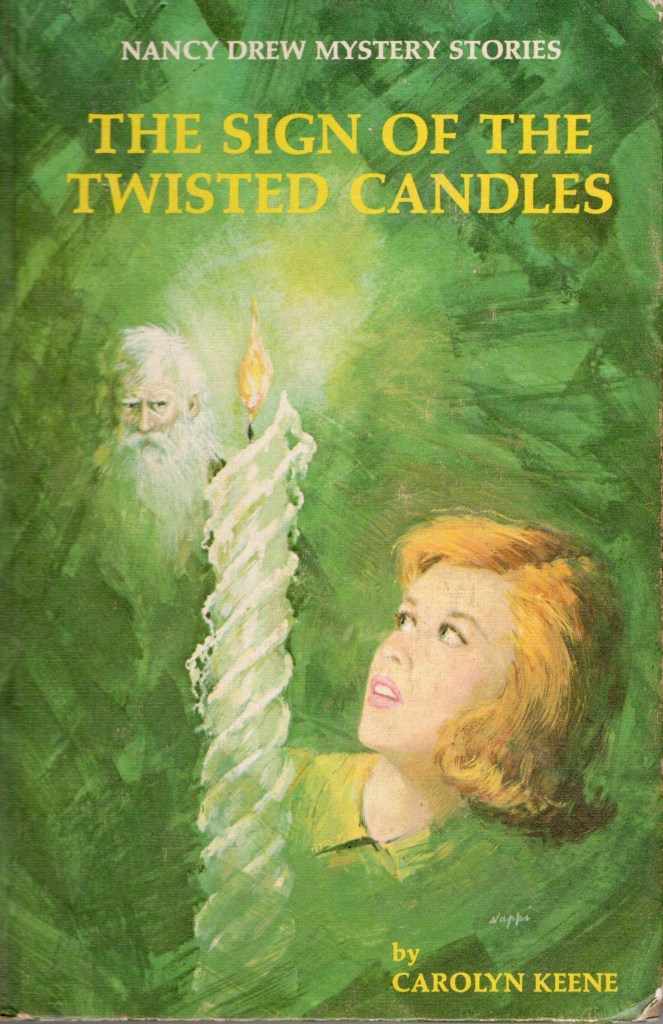
I recently found excellent replacement copies for my collection at the library sale–my copies of Crossword Cipher and Red Gate Farm are seriously dilapidated and wrecked–and I don’t remember if I have a revised text copy of Twisted Candles, so I picked it up, too. I do sometimes wonder if my collecting this books isn’t part of the neuroses I think it it is and part of a tendency to hoard things, especially books.

It probably will not come as a surprise to anyone that it always really bothered me that I didn’t read or acquire the books in order. There were other volumes in the series back on the table, including The Mystery at Lilac Inn, The Hidden Staircase, and The Haunted Showboat. (There was also a Dana Girls, The Secret of the Old Well. I eventually acquired the first and third books, The Secret of the Old Clock and The Bungalow Mystery, from the Woolworth’s on 26th and Pulaski in Chicago.) Nancy Drew was my first real foray into collecting a kids’ series, and of course, my parents were delighted that I moved on to the Hardy Boys without argument as ordered; they never liked me reading books with female heroines, which of course made Nancy Drew even more appealing to me because it was forbidden. (So, of course, I kept reading and acquiring them whenever I could when I wasn’t being supervised. So, yes, I was even in the closet as a Nancy Drew reader,)

But even as the revised texts appealed to me more because the font was better and the books were illustrated, I did notice, even as a kid, that Nancy was a lot more passive than she was in the original texts. Things happened to Nancy in the newer books, and her personality was bland to the point of being beige. It also irritated me that of course this rich lawyer’s daughter didn’t have a job, didn’t go to school, didn’t seem to have any responsibilities whatsoever other than traveling around doing as she pleased and stumbling over mysteries (sometimes the mystery came to Nancy). Her friends all adored her, would do anything she asked, and she was good at everything she tried. As someone who was not good at everything he tried, this annoyed me. Why not give her some flaws? Why make her this super-character who was perfect in every way? As I got older and revisited the original texts more, I could see why aficionados preferred the older versions, despite being dated and rife with racial and racist stereotypes; because Nancy wasn’t perfect in her original incarnation. She was a bit arrogant, definitely classist, and very headstrong to the point of being willful. She was also absolutely fearless, and had very deep convictions about right and wrong, and how wrongs must always be righted. She was fascinating but realistic. She’s aware of her privilege–even as she uses it as needed–but tries to use it to help others less fortunate, which is kind of admirable. The original text Nancy was the kind of character a girl between the ages and nine and thirteen would find aspirational, would want to be like, a role model of sorts presented at a young and formative age that they, too, could be smart and independent and liked as themselves, rather than as someone’s daughter or girlfriend or wife.

Even as a kid, I was drawn to strong, independent female characters. That has never changed.

Most of my collection of Nancy Drew mysteries–and all the other kids’ series I collect–are currently in boxes in my storage attic. There just isn’t room to have them out on display (which makes me crazy, but it’s either that or the copies of my own books, and my vanity trumps not displaying the books every time), because I do have copies of every Nancy Drew except for maybe one or two, and there are some revised editions I don’t have. Shortly after I got to the age where I could actually buy them with my own money, the editions changed; they went from the old flat matte covers to what aficionados and collectors call “the flashlight editions”, because there’s a flashlight as the logo on the spine (rather than the little black box with Nancy in profile) and they went to a glossy cover; also on the cover where NANCY DREW MYSTERY STORIES was changed to a banner across the top in yellow (the Hardy Boys’ banner was blue), and I didn’t like the new glossy covers or the flashlight editions or the banner…plus, I wasn’t going to start over and collect them all in this new format; this was when I started looking for them at yard sales, second hand stores, and flea markets (before the Internet and ebay).

I’ve also noticed how rabid the fans for both Nancy Drew and the Hardy Boys can be. I belong to several Facebook groups for fans and collectors, and those people can get worked up really easily–and of course, it always has something to do with bigotry and change. They hated the new Nancy Drew series because (gasp, the horror!) Ned was Black and even greater horror, she has sex. There was a lot of pearl-clutching over this, as there was about the new Hardy Boys series, in which Joe was made much younger, their mother was killed off, and there were a lot of supernatural elements to both (I never finished the Nancy Drew show, but not out of distaste; I always appreciate new interpretations and find the changes made interesting. I never finished because I forgot about it, in all honesty)–again, pearl clutching–but every so often it amuses me to think about writing a book built around this fandom. But it would of course have to be a fictional series, but it could be really, really funny.

And I think the Hardy Boys may now be in the public domain? I don’t know how that works, but I’d love to be able to write my own. I’ve always wanted to, and if I could actually use the original characters…how fun would that be? I’ve also always hoped to get a gig ghostwriting for either series…I suppose it’s not impossible, but I’m not sure they are still releasing new titles in either series. There have also been spin-off series, too–but I’ve never read outside the original canon. Once they stopped being published in hardcover, I don’t care about collecting the paperbacks or reading them, either.

But Nancy was important in the formation of my interests in reading and what I write, and maybe she wasn’t my favorite series of them all, but I have an appreciation for her and the books still to this day.

My goal is to write an entry on every series I collect–I think I’ve already done The Three Investigators–but so what if I have? My blog, my entries!

Next up, I will probably read the original text of the Hardy Boys’ The Mark on the Door, which I picked up in a tweed edition sans dust-jacket at the library sale.

Until then, hang in there.

Spooky

I’ve decided to launch a new reading project for this year: one in which I tackle rereading middle-grade mysteries. I am not going to limit myself to merely the series books I loved (although they will play a big role in the project), but will also include other mysteries I have, either in one of my reading apps or an actual hard copy, that do not belong to the series. My childhood memories aren’t as clear as I would perhaps like; then again, that period of my life was around fifty years ago, so it would be more of a miracle if I did have stronger memories.

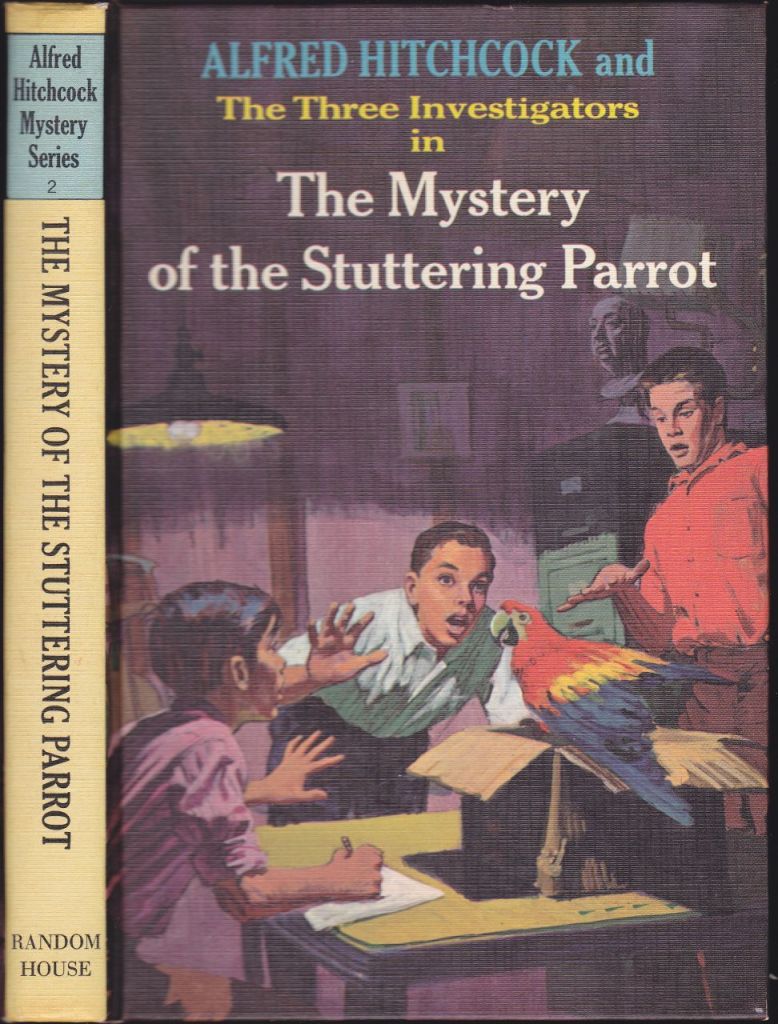
The first two series books I ever read were not from either the Nancy Drew or Hardy Boys series; they were from the Trixie Belden series (The Red Trailer Mystery) and The Three Investigators (The Mystery of the Moaning Cave). Both series wound up being favorites of mine once I eventually got back to them and remembered them; I remember buying five Trixie Belden books at a store at the Ford City mall in Chicago, and I got my first five Three Investigators books from a Toys R Us, I think in the Chicago suburb of Berwin? The two series weren’t as ubiquitous or available as Nancy Drew and the Hardy Boys; which made finding more of them a kind of triumph for me. I’ve already blogged about The Secret of Terror Castle, which was the first Three Investigators book in the series, so I won’t cover that one again. But recently I sat down and reread the second book in the series, The Mystery of the Stuttering Parrot, and remembered again why I love this series so much.

“Help!” The voice that called out was strangely shrill and muffled. “Help! Help!”

Each time a cry from within the mouldering old house pierced the silence, a new chill crawled down Pete Crenshaw’s spine. Then the cries for help ended in a strange, dying gurgle and that was even worse.

The tall, brown-haired boy knelt behind the thick trunk of a barrel palm and peered up the winding gravel path at the house. He and his partner, Jupiter Jones, had been approaching it when the first cry had sent them diving into the shrubbery for cover.

Across the path, Jupiter, stocky and sturdily built, crouched behind a bush, also peering toward the house. They waited for further sounds. But now the old, Spanish-style house, set back in the neglected garden that had grown up like a small tropical jungle, was silent.

“Jupe!” Pete whispered. “Was that a man or a woman?”

Jupiter shook his head. “I don’t know,” he whispered. “Maybe it was neither.

The Three Investigators cases often began this way; with two of them (sometimes all of them) landing smack dab in the middle of something mysterious; whether it was the sight of a weird ghost as they walk past an abandoned house being demolished (The Mystery of the Green Ghost) or biking past an enclosed estate (The Mystery of the Laughing Shadow) or simply riding in the gold=played Rolls Royce limousine and almost getting into an accident (The Mystery of the Silver Spider). Many of their other cases begin with them being hired to find a lost pet, which turns into something more complicated and complex: The Mystery of the Coughing Dragon and The Mystery of the Whispering Mummy fall into this category….while the majority of their cases come by way of referrals from Alfred Hitchcock himself (and why has no one ever done a book about the licensing of the Hitchcoc name, and all the products the great director attached his name to? It’s far overdue.). The Mystery of the Stuttering Parrot combines all three: the boys were referred by Hitchcock to a friend whose recently purchased parrot has either been stolen or gotten free; they are on their way to visit Professor Fentriss to talk to him about the missing parrot–which stuttered–when they hear the cries for help coming from within the house. They are confronted outside by a man with a revolver (he is described here, and throughout the book, as a fat man–even by Jupiter, who hates being called fat), who claims to be Mr. Fentriss and that the bird has returned; he also claims that Hitchcock had called him to say the boys were on their way over. As they are leaving they realize that the house had no telephone wires (which used to actually be a thing, before cell phones), so they go back. Indeed, the man they met was an imposter and Mr. Fentriss is also tied up in his home. They rescue him, discover that he bought the missing parrot from a sickly Hispanic man selling the birds (there were others) out of his donkey cart, and that his friend Irma Waggoner sent the peddler to them. (Note: the man is described, and referred to, over and over as a Mexican; he actually is Mexican, so it’s not necessarily problematic–other than the fact that no one knew he was Mexican at first; referring to all Latinx/Hispanic people as Mexican when they may not actually be Mexican is problematic. In an update they would undoubtedly change it to Hispanic–as he did speak Spanish as a first language and his English isn’t good–which we see when the boys find him later in the book.) Miss Waggoner’s parrot has also disappeared; it also spoke, as did Mr. Fentriss’. (I kept thinking as I read it for the first time but parrots don’t stutter; he would have to be taught to do that. Very early on Jupiter also mentions this; I always feel inordinately proud of myself every time I read Jupiter saying this) Eventually, it turns out that the man who taught the birds special speeches had a masterpiece painting in his possession, and each parrot speaks a clue to the location of where he hid it when he realized he was dying–so the boys not only have to find all the parrots to get all the messages, they also have to decipher the clues and find the painting. Eventually they do–while also trying to avoid a flamboyant international art thief and his thugs–in a spooky, abandoned graveyard in the fog. A little bit of luck, and the boys solve the mystery–but despite that piece of luck, the entire case is actually solved by deductions based on the evidence presented thus far, with Jupiter revising his theories whenever new evidence is presented.

I love this series, and the books still make for compelling reading today. Some of the story is dated of course–no cell phones, no computers for research (Bob does all their research at the library, where he works part time), the casual racism of the time–but many of the books still hold up. Hitchcock’s death obviously impacted the series, but I’ve never understood why The Three Investigators never became as popular as–if not more so–than Nancy Drew and The Hardy Boys. The three boys have distinct personalities–you know Pete will never want to investigate anything complicated, but will inevitably prove how courageous he actually is; Bob is studious and not as easily excitable as Pete, and he’s the one who usually follows Jupiter’s train of thought while Pete always gets confused; and Jupiter himself is a young Sherlock Holmes. Robert Arthur, who wrote the original series up through number 11, The Mystery of the Talking Skull (someone else wrote number 10, The Mystery of the Moaning Cave, which also ironically is the first of the series I actually read). Arthur won two Edgars from Mystery Writers of America for his radio plays; he also ghost edited some of the Alfred Hitchcock Presents anthologies I remember from my childhood. The Three Investigators are no longer in print, because of legal disputes between the Arthur estate and Random House about who owns the characters and so forth; it’s a shame. The books are still in print in many different languages–and are especially popular in Germany–where two of the books were actually filmed.

Most of my series books are in storage, but there are some still in the Lost Apartment–and I think when I am too tired to read something new, I may just get down a series book as an homage to my childhood and revisit some of these kids’ series.